Fact file JOURNAL OF THE IRISH DENTAL ASSOCIATION
6a
6b
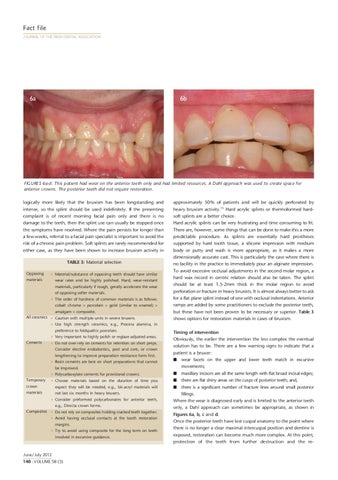
FIGURES 6a-d: This patient had wear on the anterior teeth only and had limited resources. A Dahl approach was used to create sp ace for anterior crowns. The posterior teeth did not require restoration. logically more likely that the bruxism has been longstanding and intense, so the splint should be used indefinitely. If the presenting complaint is of recent morning facial pain only and there is no damage to the teeth, then the splint use can usually be stopped once the symptoms have resolved. Where the pain persists for longer than a few weeks, referral to a facial pain specialist is important to avoid the risk of a chronic pain problem. Soft splints are rarely recommended for either case, as they have been shown to increase bruxism activity in TABLE 3: Material selection Opposing materials
Material/substance of opposing teeth should have similar wear rates and be highly polished. Hard, wear-resistant materials, particularly if rough, greatly accelerate the wear of opposing softer materials. The order of hardness of common materials is as follows: cobalt chrome > porcelain > gold (similar to enamel) >
amalgam > composite. All ceramics Caution with multiple units in severe bruxers.
approximately 50% of patients and will be quickly perforated by heavy bruxism activity.16 Hard acrylic splints or thermoformed hardsoft splints are a better choice. Hard acrylic splints can be very frustrating and time consuming to fit. There are, however, some things that can be done to make this a more predictable procedure. As splints are essentially hard prostheses supported by hard tooth tissue, a silicone impression with medium body or putty and wash is more appropriate, as it makes a more dimensionally accurate cast. This is particularly the case where there is no facility in the practice to immediately pour an alginate impression. To avoid excessive occlusal adjustments in the second molar region, a hard wax record in centric relation should also be taken. The splint should be at least 1.5-2mm thick in the molar region to avoid perforation or fracture in heavy bruxists. It is almost always better to ask for a flat plane splint instead of one with occlusal indentations. Anterior ramps are added by some practitioners to exclude the posterior teeth, but these have not been proven to be necessary or superior. Table 3 shows options for restoration materials in cases of bruxism.
Use high strength ceramics, e.g., Procera alumina, in preference to feldspathic porcelain. Very important to highly polish or reglaze adjusted areas. Cements
Do not over-rely on cements for retention on short preps. Consider elective endodontics, post and core, or crown lengthening to improve preparation resistance form first. Resin cements are best on short preparations that cannot
Timing of intervention Obviously, the earlier the intervention the less complex the eventual solution has to be. There are a few warning signs to indicate that a patient is a bruxer: I
be improved. Polycarboxylate cements for provisional crowns. Temporary crown materials
Choose materials based on the duration of time you expect they will be needed, e.g., bis-acryl materials will not last six months in heavy bruxers. Consider preformed polycarbonates for anterior teeth,
e.g., Directa crown forms. Composites Do not rely on composites holding cracked teeth together. Avoid having occlusal contacts at the tooth restoration margins. Try to avoid using composite for the long term on teeth involved in excursive guidance.
June/July 2012 140 : VOLUME 58 (3)
I I I
wear facets on the upper and lower teeth match in excursive movements;
maxillary incisors are all the same length with flat broad incisal edges; there are flat shiny areas on the cusps of posterior teeth; and, there is a significant number of fracture lines around small posterior fillings. Where the wear is diagnosed early and is limited to the anterior teeth only, a Dahl approach can sometimes be appropriate, as shown in Figures 6a, b, c and d. Once the posterior teeth have lost cuspal anatomy to the point where there is no longer a clear maximal intercuspal position and dentine is exposed, restoration can become much more complex. At this point, protection of the teeth from further destruction and the re-