PEER-REVIEWED
A
B
C
B FIGURE 8B: Steep cuspal angle.
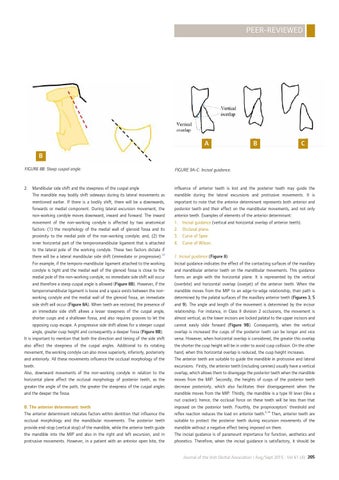
FIGURE 9A-C: Incisal guidance.
2.
influence of anterior teeth is lost and the posterior teeth may guide the mandible during the lateral excursions and protrusive movements. It is important to note that the anterior determinant represents both anterior and posterior teeth and their effect on the mandibular movements, and not only anterior teeth. Examples of elements of the anterior determinant:
Mandibular side shift and the steepness of the cuspal angle The mandible may bodily shift sideways during its lateral movements as mentioned earlier. If there is a bodily shift, there will be a downwards, forwards or medial component. During lateral excursion movement, the non-working condyle moves downward, inward and forward. The inward movement of the non-working condyle is affected by two anatomical factors: (1) the morphology of the medial wall of glenoid fossa and its proximity to the medial pole of the non-working condyle; and, (2) the inner horizontal part of the temporomandibular ligament that is attached to the lateral pole of the working condyle. These two factors dictate if there will be a lateral mandibular side shift (immediate or progressive).12 For example, if the temporo-mandibular ligament attached to the working condyle is tight and the medial wall of the glenoid fossa is close to the medial pole of the non-working condyle, no immediate side shift will occur and therefore a steep cuspal angle is allowed (Figure 8B). However, if the temporomandibular ligament is loose and a space exists between the nonworking condyle and the medial wall of the glenoid fossa, an immediate side shift will occur (Figure 8A). When teeth are restored, the presence of an immediate side shift allows a lesser steepness of the cuspal angle, shorter cusps and a shallower fossa, and also requires grooves to let the opposing cusp escape. A progressive side shift allows for a steeper cuspal angle, greater cusp height and consequently a deeper fossa (Figure 8B). It is important to mention that both the direction and timing of the side shift also affect the steepness of the cuspal angles. Additional to its rotating movement, the working condyle can also move superiorly, inferiorly, posteriorly and anteriorly. All these movements influence the occlusal morphology of the teeth. Also, downward movements of the non-working condyle in relation to the horizontal plane affect the occlusal morphology of posterior teeth, as the greater the angle of the path, the greater the steepness of the cuspal angles and the deeper the fossa. B. The anterior determinant: teeth The anterior determinant indicates factors within dentition that influence the occlusal morphology and the mandibular movements. The posterior teeth provide end-stop (vertical stop) of the mandible, while the anterior teeth guide the mandible into the MIP and also in the right and left excursion, and in protrusive movements. However, in a patient with an anterior open bite, the
1. 2. 3. 4.
Incisal guidance (vertical and horizontal overlap of anterior teeth). Occlusal plane. Curve of Spee. Curve of Wilson.
1. Incisal guidance (Figure 8) Incisal guidance indicates the effect of the contacting surfaces of the maxillary and mandibular anterior teeth on the mandibular movements. This guidance forms an angle with the horizontal plane. It is represented by the vertical (overbite) and horizontal overlap (overjet) of the anterior teeth. When the mandible moves from the MIP to an edge-to-edge relationship, their path is determined by the palatal surfaces of the maxillary anterior teeth (Figures 3, 5 and 9). The angle and length of the movement is determined by the incisor relationship. For instance, in Class II division 2 occlusions, the movement is almost vertical, as the lower incisors are locked palatal to the upper incisors and cannot easily slide forward (Figure 9B). Consequently, when the vertical overlap is increased the cusps of the posterior teeth can be longer and vice versa. However, when horizontal overlap is considered, the greater this overlap the shorter the cusp height will be in order to avoid cusp collision. On the other hand, when this horizontal overlap is reduced, the cusp height increases. The anterior teeth are suitable to guide the mandible in protrusive and lateral excursions. Firstly, the anterior teeth (including canines) usually have a vertical overlap, which allows them to disengage the posterior teeth when the mandible moves from the MIP. Secondly, the heights of cusps of the posterior teeth decrease posteriorly, which also facilitates their disengagement when the mandible moves from the MIP. Thirdly, the mandible is a type III lever (like a nut cracker); hence, the occlusal force on these teeth will be less than that imposed on the posterior teeth. Fourthly, the proprioceptors’ threshold and reflex reaction reduces the load on anterior teeth.6,14 Then, anterior teeth are suitable to protect the posterior teeth during excursion movements of the mandible without a negative effect being imposed on them. The incisal guidance is of paramount importance for function, aesthetics and phonetics. Therefore, when the incisal guidance is satisfactory, it should be
Journal of the Irish Dental Association | Aug/Sept 2015 : Vol 61 (4) 205