CLINICAL FEATURE
Ready to crown Maximising clinical efficiency using the dental laboratory to facilitate the planning and execution of crown preparations.
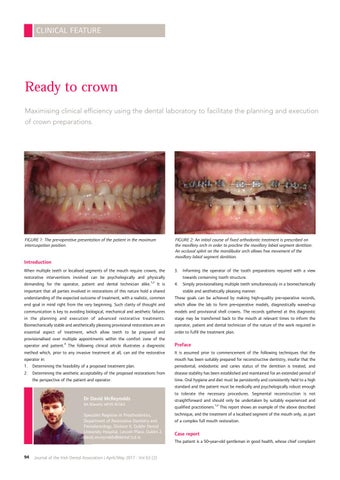
FIGURE 1: The pre-operative presentation of the patient in the maximum intercuspation position.
FIGURE 2: An initial course of fixed orthodontic treatment is prescribed on the maxillary arch in order to procline the maxillary labial segment dentition. An occlusal splint on the mandibular arch allows free movement of the maxillary labial segment dentition.
Introduction When multiple teeth or localised segments of the mouth require crowns, the restorative interventions involved can be psychologically and physically 1,2 demanding for the operator, patient and dental technician alike. It is important that all parties involved in restorations of this nature hold a shared understanding of the expected outcome of treatment, with a realistic, common end goal in mind right from the very beginning. Such clarity of thought and communication is key to avoiding biological, mechanical and aesthetic failures in the planning and execution of advanced restorative treatments. Biomechanically stable and aesthetically pleasing provisional restorations are an essential aspect of treatment, which allow teeth to be prepared and provisionalised over multiple appointments within the comfort zone of the operator and patient.3 The following clinical article illustrates a diagnostic method which, prior to any invasive treatment at all, can aid the restorative operator in: 1. Determining the feasibility of a proposed treatment plan. 2. Determining the aesthetic acceptability of the proposed restorations from the perspective of the patient and operator.
Dr David McReynolds BA BDentSc MFDS RCSEd
Specialist Registrar in Prosthodontics, Department of Restorative Dentistry and Periodontology, Division II, Dublin Dental University Hospital, Lincoln Place, Dublin 2. david.mcreynolds@dental.tcd.ie
3.
Informing the operator of the tooth preparations required with a view towards conserving tooth structure. 4. Simply provisionalising multiple teeth simultaneously in a biomechanically stable and aesthetically pleasing manner. These goals can be achieved by making high-quality pre-operative records, which allow the lab to form pre-operative models, diagnostically waxed-up models and provisional shell crowns. The records gathered at this diagnostic stage may be transferred back to the mouth at relevant times to inform the operator, patient and dental technician of the nature of the work required in order to fulfil the treatment plan.
Preface It is assumed prior to commencement of the following techniques that the mouth has been suitably prepared for reconstructive dentistry, insofar that the periodontal, endodontic and caries status of the dentition is treated, and disease stability has been established and maintained for an extended period of time. Oral hygiene and diet must be persistently and consistently held to a high standard and the patient must be medically and psychologically robust enough to tolerate the necessary procedures. Segmental reconstruction is not straightforward and should only be undertaken by suitably experienced and qualified practitioners.1,2 This report shows an example of the above described technique, and the treatment of a localised segment of the mouth only, as part of a complex full mouth restoration.
Case report The patient is a 50-year-old gentleman in good health, whose chief complaint
94
Journal of the Irish Dental Association | April/May 2017 : Vol 63 (2)