SECTION ONE BEFORE YOU APPLY
You should familiarise yourself with this section before preparing your application. The purpose of this section is to clarify for you the standard required of a Chartered Engineer; in particular it aims to explain the formation and competences expected of a Chartered Engineer and to give guidance on how to demonstrate this formation. 1.1
What is a Chartered Engineer?
1.1.1
The legal basis to the title of Chartered Engineer In 1969, Oireachtas Éireann granted to Engineers Ireland the sole statutory power and responsibility for awarding
1.2
The formation of the Chartered Engineer
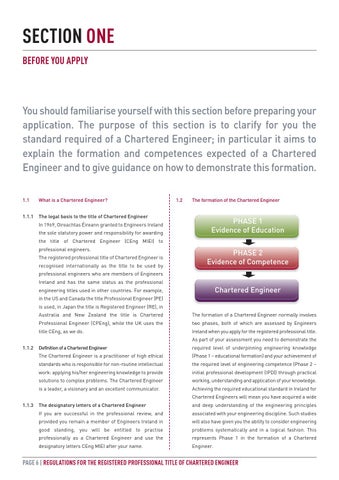
PHASE 1 Evidence of Education
the title of Chartered Engineer (CEng MIEI) to professional engineers. The registered professional title of Chartered Engineer is recognised internationally as the title to be used by
PHASE 2 Evidence of Competence
professional engineers who are members of Engineers Ireland and has the same status as the professional
Chartered Engineer
engineering titles used in other countries. For example, in the US and Canada the title Professional Engineer (PE) is used, in Japan the title is Registered Engineer (RE), in Australia and New Zealand the title is Chartered
The formation of a Chartered Engineer normally involves
Professional Engineer (CPEng), while the UK uses the
two phases, both of which are assessed by Engineers
title CEng, as we do.
Ireland when you apply for the registered professional title. As part of your assessment you need to demonstrate the
1.1.2
Definition of a Chartered Engineer
required level of underpinning engineering knowledge
The Chartered Engineer is a practitioner of high ethical
(Phase 1 – educational formation) and your achievement of
standards who is responsible for non-routine intellectual
the required level of engineering competence (Phase 2 –
work: applying his/her engineering knowledge to provide
initial professional development (IPD)) through practical
solutions to complex problems. The Chartered Engineer
working, understanding and application of your knowledge.
is a leader, a visionary and an excellent communicator.
Achieving the required educational standard in Ireland for Chartered Engineers will mean you have acquired a wide
1.1.3
The designatory letters of a Chartered Engineer
and deep understanding of the engineering principles
If you are successful in the professional review, and
associated with your engineering discipline. Such studies
provided you remain a member of Engineers Ireland in
will also have given you the ability to consider engineering
good standing, you will be entitled to practise
problems systematically and in a logical fashion. This
professionally as a Chartered Engineer and use the
represents Phase 1 in the formation of a Chartered
designatory letters CEng MIEI after your name.
Engineer.
PAGE 6 | REGULATIONS FOR THE REGISTERED PROFESSIONAL TITLE OF CHARTERED ENGINEER