8 MASSACHUSETTS LAWYERS JOURNAL | OCTOBER 2012
BAR NEWS
Holloway convenes first HOD meeting of association year BY TRICIA M. OLIVER
MBA President Robert L. Holloway Jr. called to order the first House of Delegates meeting for the 2012-13 association year at the MBA offices in Boston. As his first report of the year, Holloway shared with the group his priorities — membership, education and media/public relations. He also mentioned that he’d be focusing on outreach to Massachusetts’ affiliated county bars and meeting with various civic groups across the state. Holloway, fresh off of a meeting with SJC Chief Justice Roderick L. Ireland and Trial Court Chief Justice Robert A. Mulligan, expressed commitment to further enhancing benchbar communications. To that end, he mentioned the first in a series of informal receptions for the bench and bar to be held in Essex County in the coming months. “We hope to move that into other counties,” Holloway said. He has also tapped attorney Christa Arcos, along with judges Stephen E. Neel (ret.) and Peter M. Lauriat to begin discussing the issues arising from the lack of law clerks in Superior Court. Holloway encouraged all delegates to follow his lead and serve as “ambassadors for our profession.” He also set the expectation for each delegate to recruit one new member over the next month. Holloway was followed by MBA
President-elect Douglas K. Sheff, who gave an overview of the three key committees formed to focus on the association’s priorities. The Membership Committee is chaired by MBA Vice President Christopher P. Sullivan, the Education Committee is being co-chaired by MBA Treasurer Marsha V. Kazarosian and MBA Past President David W. White Jr., while the Media Committee is being led by Sheff. MBA Vice President Robert W. Harnais followed with brief remarks concentrating on an initiative that ties into MBA’s continued efforts to address the socioeconomic issues plaguing the state’s so-called “Gateway Communities.” Harnais explained that meetings with members of the federal bench and Chief of the U.S. Probation Department for Massachusetts Christopher Maloney have led to the MBA’s involvement in a re-entry program for federal inmates. Harnais handed off the microphone to Kazarosian who spoke more about the recharged MBA Education Committee, sharing that the group will be working with volunteer members and staff to present CLE offerings that are “current, more dynamic and cost-effective.” As treasurer, Kazarosian reported that numbers for FY12 look to be slightly better than budget and membership renewals for this association year (FY13) are on budget. Secretary Martha Rush O’Mara
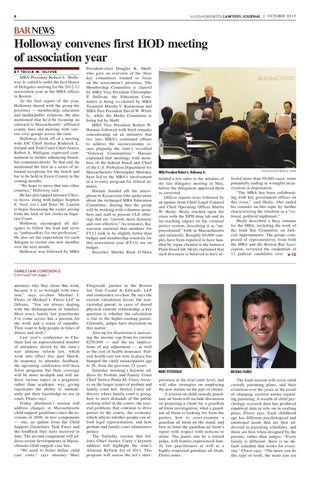
HOD PHOTOS BY TRICIA M. OLIVER
MBA President Robert L. Holloway Jr. fielded a few edits to the minutes of the last delegates meeting in May, before the delegation approved them as corrected. Officer reports were followed by an update from Chief Legal Counsel and Chief Operating Officer Martin W. Healy. Healy touched upon the crisis with the DPH drug lab and its far-reaching impact on the criminal justice system, describing it as “unprecedented” both in Massachusetts and nationally. Roughly 60,000 samples have been reported to have handled by rogue chemist in the Jamaica Plain-based lab. Healy explained that such discourse is believed to have af-
fected more than 30,000 cases, some potentially ending in wrongful incarceration or deportation. “The MBA has been collaborating with key government offices on this issue,” said Healy, who ended his remarks on this topic by further characterizing the situation as a “colossal, political nightmare.” Healy described a busy summer for the MBA, including the work of the Joint Bar Committee on Judicial Appointments. The group, comprised of representatives from both the MBA and the Boston Bar Association, reviewed the credentials of 13 judicial candidates over 10
MARC FITZGERALD
MICHAEL FLORES
pretation at the trial court level, and will offer strategies on employing the new statute on the part of clients. A session on child custody guardians ad litem will include discussion on preparing a client for a guardian ad litem investigation; what a guardian ad litem is looking for from the parties; how to cross-examine a guardian ad litem on the stand, and how to limit the guardian ad litem’s report with respect with motions to strike. The panel, run by a retired judge, will feature experienced family law practitioners as well as a highly-respected guardian ad litem, Flores notes.
The final session will cover child custody parenting plans, and their evolution over the years as the result of changing societal norms regarding parenting. A wealth of child psychology research data has produced empirical data to rely on in crafting plans, Flores says. Each childhood age has different psychological and emotional needs that are best addressed in parenting schedules, and those are best when designed by the parents, rather than judges. “Every family is different; there is no default schedule that works for everyone,” Flores says. “The more you do this type of work, the more you see
FAMILY LAW CONFERENCE Continued from page 1 attorneys why they chose this work, because it is so wrought with emotion,” says co-chair Michael I. Flores of Michael I. Flores LLC in Orleans. “You are always dealing with the disintegration of families. Most every family law practitioner I’ve come across has a passion for the work and a sense of empathy. They want to help people in times of duress and strife.” Last year’s conference in Chatham had an unprecedented number of attendees, driven by the state’s new alimony reform law, which went into effect this past March. In response to attendee feedback, the upcoming conference will have fewer programs but their coverage will be more in-depth and will address various topics in a pragmatic rather than academic way, giving registrants the ability to immediately put their knowledge to use in court, Flores says. Friday afternoon’s session will address changes in Massachusetts child support guidelines since the revisions of 2009, in two components — one, an update from the Child Support Guidelines Task Force and the feedback they have received to date. The second component will address recent developments in Massachusetts child support case law. “We need to better define child care costs,” says attorney Marc
Fitzgerald, partner in the Boston law firm Casner & Edwards, LLP and conference co-chair. He says the current calculation favors the noncustodial parent; in cases of shared physical custody relationship, a key question is whether the calculation is fair to the higher-earning parent. Currently, judges have discretion on this matter. Also up for discussion is increasing the income cap from its current $250,000 — and the tax implications of any adjustment — as well as the cost of health insurance. Federal health care law now in place has bumped the child emancipation age to 26, from the previous 23 years. Saturday morning’s keynote address by Probate and Family Court Chief Justice Paula M. Carey focuses on the larger issues of probate and family court law. Justice Carey addresses where family court is going, how to meet demands of the public seeking relief in the courts; the societal problems that continue to drive parties to the courts; the economy, which affects whether people can afford legal representation; and how probate and family court administers justice. The Saturday session that follows Chief Justice Carey’s keynote address will highlight the state’s Alimony Reform Act of 2011. This program will assess the act’s inter-