1
Suburbs—
to price point it’s different. From block to block it can be different. But, what we definitely see is recovery of the suburbs,” he said. “Remember that the suburbs have been beaten-up terribly in the last few years and the suburbs actually were undervalued for a long time. The suburbs that were undervalued have a new audience. There’s also a new audience for large homes.” Steinberg said empty nesters who might want to move back to New York City and those in the city who want bigger space are now realizing that the time is right, especially with interest rates down. The National Association of Realtors agrees that real estate it hot. It is reporting sales of existing homes at a record pace, up 24.7% in July despite the economic upheaval created by the Covid19 pandemic. “The four-bedroom colonial in Scarsdale today might sell within a matter of hours. It all depends on how it’s priced. If it’s a realistic seller who has priced it where the market is you may even have multiple bids,” Steinberg said. “When you get above $10 million, everyone says they fly off the shelf because those are the headlines the press loves to write about because they’re great stories. In the last decade, the most expensive properties always take a year to two years to sell, at least. Even in the busiest times the vast majority do take that long at that price. It’s not a quick, sim1
Google—
ther offers zero down financing, starting at $150 per month. Geothermal heating systems function by drawing from the Earth’s energy absorption from the sun, which is stored in underground pipes. The energy is mixed with a water solution that carries the energy to the house’s heat pump. Dandelion says that, on average, a typical house will spend about $150 a month for geothermal, versus $300 a month for oil heating. Sachse said that, in addition to the financial incentives, Dandelion felt that expanding into Connecticut — it will expand out from Fairfield County, he said — made geo-
6
SEPTEMBER 7, 2020
The National Association of Realtors said that while yearover-year sales had been down about 27% in May, by July they had turned around and were up about 6% from 2019, with July 2020’s completed transactions of single-family homes, townhomes, condominiums and co-ops jumping 24.7% from what they were in June. According to the organization, that translates into a seasonally adjusted annual rate of 5.86 million transactions. “The housing market is well past the recovery phase and is now booming with higher home sales compared to the pre-pandemic days,” said Lawrence Yun, the association’s chief economist. “With the sizable shift in remote work, current homeowners are looking for larger
homes and this will lead to a secondary level of demand even into 2021.” Steinberg, who left Douglas Elliman in 2014 to join Compass as its president, now holds the title Chief Evangelist and leads the Leonard Steinberg Team at the company. He is credited with being responsible for more than $3 billion in transactions and has a reputation for handling the marketing for some of the city’s top properties such as a $40 million penthouse apartment in Tribeca as well as luxury offerings in Brooklyn, Westchester and Connecticut. Steinberg said that his team has available a wide variety of price points starting at around $700,000. “They vary in style and size and location, amenities, finish condition. I have some in brandnew buildings that have never been lived in and I have some that require a gut renovation,” Steinberg said. “A $40 million property in Manhattan must have outdoor space, must have big views, spectacular finish,
Founded in 2012 as Urban Compass, the firm has developed a platform that allows agents to use proprietary technology to market properties and complete the sale process. The founders were entrepreneurs Ori Allon and Robert Reffkin. Allon previously had founded the search technology company Julpan that was acquired by Twitter. He devised the search algorithm Orion, which was acquired by Google. Reffkin worked at management consulting firm McKinsey & Company and Goldman Sachs. In 2005, he was appointed as a White House Fellow to serve as a special assistant to the Secretary of the Treasury in the George W. Bush administration. The company had several successful fundraising efforts and according to an April report by Barron’s was valued at $6.4 billion. It boasts of having a network of 20,000 agents nationwide, more than 325 offices throughout the U.S. and a 2019 sales volume of $91 billion. It describes itself as the third-largest privately held brokerage in the country. Steinberg said that one thing setting Compass apart from its competitors is that it builds all of its technology rather than just buying off-the-shelf software and trying to adapt it to the company’s needs. “Many of the tools are designed to fuel the efficiency of agents so that the consumer
doesn’t have to rely on the agent’s brain capacity alone. They rely on the technology mixed with the experience and knowledge that agents have to infuse insights into the procedure,” Steinberg said. “The tools that are built for the agent are one aspect but there also are tools that are built for the consumer, whether they’re a buyer, a seller, a renter, a landlord or a developer.” Steinberg said that the real estate business is no longer as simple as running an ad and expecting people to come in and write a check. “Compass combines the best of high technology to infuse technology into the real estate advisory equation. Compass is the ecosystem that provides the technology, infrastructure and help for agents to be the very best they can be so the consumer is best served with a combination of technology and human ingenuity,” Steinberg said. “What we try to do at my team is to bring that ingenuity and experience to the table and creating and curating the marketing or purchasing strategy. No one needs an agent unless they deliver real tangible value. Some people are obsessed exclusively with price. I personally believe the quality of service and quality of product are as important or more important. We also try to simplify the process. We live in an over-messaged, overcomplicated world. Simplification for the consumer has real value to them. Time is a lost luxury and you really cannot replicate time. I think we’ve learned that more now than ever before.”
graphical sense. “We can begin to service (the county) out of our warehouse in Westchester County,” he said. “There are 550,000 homes in Connecticut that use fuel oil for heat and we believe it’s a great opportunity for us.” Sachse said that to date Dandelion has installed its heat pump systems in over 400 homes in New York and that it expects to double that number in both states by the end of 2021. “We’ve already sold a few” in Connecticut, he said. While most people like the idea of being more environmentally responsible, Sachse continued, Dandelion is under no illusion that is the main reason for most consumers’ fossil
fuel-to-geothermal decisions. “It’s a dollar-and-cents issue for most people,” he said, “and we understand and embrace that.” Dandelion has also had to endure some ups and downs during its relatively brief history. Originally a project at X, the research and development lab at Google’s parent company Alphabet, Dandelion launched as an independent company in 2017 to a fair amount of fanfare. In January of this year, co-founder and CEO Kathy Hannun stepped down to become Dandelion’s president and focus on its product development. Sachse’s hiring as CEO was announced at the same time; given what some saw as
his sudden departure from IT firm Stardog last September, he seemed an unusual choice. But, Sachse told the Business Journal, before Stardog he was chief marketing officer at Opower, an Saas customer engagement platform for utilities; he was given credit for guiding Opower through its $532 million acquisition by Oracle in 2016. “I’ve been passionate about the energy space for some time,” Sachse said. Dandelion also had to weather a March Forbes article that detailed various customer complaints, most of them about delayed and inexpert installations, many of them due to the firm’s reliance on subcontractors.
While those beefs arose before Sachse took the helm, he said Dandelion has “learned how to control the quality of our contractors. We now do the installations ourselves, or with several subcontractors who are heavily vetted.” Following what Dandelion is counting on a successful expansion throughout Connecticut, Massachusetts will probably be next. “They have some geothermal incentives in place, but they’re on a smaller scale,” Sachse said. “But we expect that they will be expanding those. “There’s a huge market out there,” he added. “We feel good about where we are and where we believe we’re headed.”
top-quality security and amenities and a ‘wow’ factor that justifies that price.”
TECH-MINDED
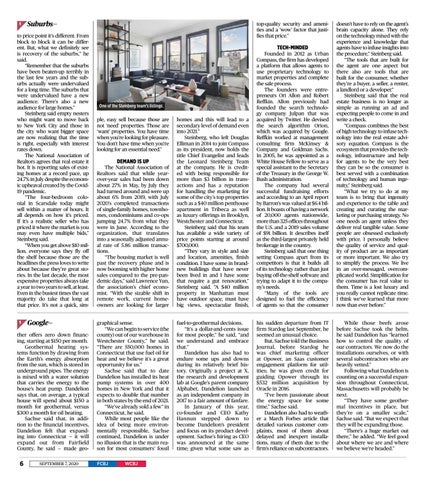
One of the Steinberg team’s listings.
ple, easy sell because those are not ‘need’ properties. Those are ‘want’ properties. You have time when you’re looking for pleasure. You don’t have time when you’re looking for an essential need.”
DEMAND IS UP
FCBJ
WCBJ