HOSPITALS AND GROUP PRACTICES
‘Health home’ could be Medicaid cure BY JOHN GOLDEN jgolden@westfairinc.com
O
fficials at Hudson Health Plan in Tarrytown plan to use their recent award-winning, three-year project with chronically ill and down-and-out Medicaid patients as a model for a “health home” being formed by a coalition of Westchester County health care providers to better serve more Medicaid patients at reduced costs. The federal Patient Protection and Affordable Care Act allows states to form health homes to coordinate physical health care, behavioral care and social services for Medicaid recipients. Hudson Health Plan is working with several health care providers and agencies to launch the Hudson Valley Cares Coalition, one of two health homes
being formed in Westchester County, said Georganne Chapin, Hudson Health Plan president and CEO. In the Medicaid program, “Too often the structural barriers, the eligibility rules, even the confidentiality rules, can get in the way of getting people the services they need,” Chapin said. “This should be all about getting the right services to the people who need them.” The Westchester Cares Action Program (WCAP), which this spring received the 2012 Distinguished Public Health Service Award from Westchester County officials, “was a tremendous first step in that direction.” A nonprofit provider of state-sponsored Medicaid Managed Care, Child Health Plus and Family Health Plus insurance plans to about 115,000 people in
Westchester and the Hudson Valley region, Hudson Health Plan and its behavioral care partner, Beacon Health Strategies, in 2009 developed the Westchester Cares Action Program as a new model for integrated health care coordination. It was one of seven chronic illness demonstration projects around the state selected by the state Health Department. The projects were to manage the care of people who are heavy users of health care services – often starting with emergency room visits and resulting in costly hospitalizations – that are billed directly to the state Medicaid office. Many of the patients’ physical illnesses are compounded by mental illness, drug and alcohol addictions and homelessness. State officials gave the WCAP’s orga-
Jonathan R. Fugo, DO Plastic and Reconstructive Surgeon
nizers a target goal of enrolling 250 sick and poor Medicaid patients. “They sent us lists of people to find,” said Margaret Leonard, senior vice president of critical services at Hudson Health Plan and executive director of WCAP. Finding and enrolling them was expected to take two months, Leonard said. “In reality, it took us almost 18 months to find
“Too often the structural barriers, the eligibility rules, even the confidentiality rules, can get in the way of getting people the services they need.” — Georganne Chapin, president and CEO , Hudson Health Plan
Hudson Valley Plastic Surgery is dedicated to bringing a wide range of cosmetic and reconstructive surgical services to the Hudson Valley. Led by Plastic Surgeon, Dr. Jonathan Fugo, the practice provides many procedures including: • Cosmetic surgical procedures of the face, nose, body and breasts including face lifts, rhinoplasty, breast lift, breast augmentation, body contouring and liposuction. • Reconstructive surgery of the face, body, breasts and hands. • Non-surgical facial rejuvenation including Botox, facial and lip fillers as well as skin peels. Hudson Valley Plastic Surgery is part of the St. Luke’s Cornwall Medical Group and is conveniently located at SLCH’s Cornwall campus.
Hudson Valley Plastic Surgery Offering Premier Cosmetic Surgery Services at NEW Cornwall Office.
For more information, or to make an appointment, call (845) 237-7040 or visit www.DrFugo.com 21 Laurel Avenue, Suite 240, Cornwall NY, 12518
DrFugo.com
16 April 30, 2012 • WCBJ • HV Biz
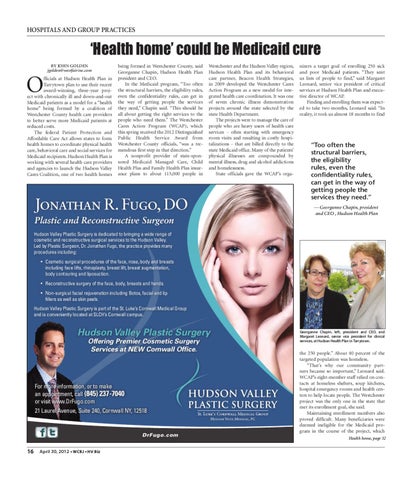
Georganne Chapin, left, president and CEO, and Margaret Leonard, senior vice president for clinical services, at Hudson Health Plan in Tarrytown.
the 250 people.” About 40 percent of the targeted population was homeless. “That’s why our community partners became so important,” Leonard said. WCAP’s eight-member staff relied on contacts at homeless shelters, soup kitchens, hospital emergency rooms and health centers to help locate people. The Westchester project was the only one in the state that met its enrollment goal, she said. Maintaining enrollment numbers also proved difficult. Many beneficiaries were deemed ineligible for the Medicaid program in the course of the project, which Health home, page 32