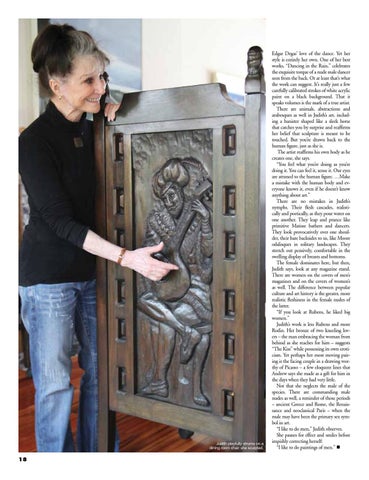
Judith playfully strums on a dining room chair she sculpted.
18
Edgar Degas’ love of the dance. Yet her style is entirely her own. One of her best works, “Dancing in the Rain,” celebrates the exquisite torque of a nude male dancer seen from the back. Or at least that’s what the work can suggest. It’s really just a few carefully calibrated strokes of white acrylic paint on a black background. That it speaks volumes is the mark of a true artist. There are animals, abstractions and arabesques as well in Judith’s art, including a banister shaped like a sleek horse that catches you by surprise and reaffirms her belief that sculpture is meant to be touched. But you’re drawn back to the human figure, just as she is. The artist reaffirms his own body as he creates one, she says. “You feel what you’re doing as you’re doing it. You can feel it, sense it. Our eyes are attuned to the human figure. …Make a mistake with the human body and everyone knows it, even if he doesn’t know anything about art.” There are no mistakes in Judith’s nymphs. Their flesh cascades, realistically and poetically, as they pour water on one another. They leap and prance like primitive Matisse bathers and dancers. They look provocatively over one shoulder, their bare backsides to us, like Moore odalisques in solitary landscapes. They stretch out pensively, comfortable in the swelling display of breasts and bottoms. The female dominates here, but then, Judith says, look at any magazine stand. There are women on the covers of men’s magazines and on the covers of women’s as well. The difference between popular culture and art history is the greater, more realistic fleshiness in the female nudes of the latter. “If you look at Rubens, he liked big women.” Judith’s work is less Rubens and more Rodin. Her bronze of two kneeling lovers – the man embracing the woman from behind as she reaches for him – suggests “The Kiss” while possessing its own eroticism. Yet perhaps her most moving pairing is the facing couple in a drawing worthy of Picasso – a few eloquent lines that Andrew says she made as a gift for him in the days when they had very little. Not that she neglects the male of the species. There are commanding male nudes as well, a reminder of those periods – ancient Greece and Rome, the Renaissance and neoclassical Paris – when the male may have been the primary sex symbol in art. “I like to do men,” Judith observes. She pauses for effect and smiles before impishly correcting herself: “I like to do paintings of men.” n