FAIRFIELD COUNT Y
BUSINESS JOURNAL
YOUR ONLY SOURCE FOR LOCAL BUSINESS NEWS • westfaironline.com Bob Rozycki
FCBJ TODAY
Vol 48, No. 19 • May 7, 2012
After sour 2011, BI finds ’12 sweet
Terms easing on commercial and real estate loans? Yes, but not standards … 2 For ASML, the chips are not down … 3
BY ALEXANDER SOULE
casoule@westfairinc.com
I
A very small fan base for very light jets at UTC … 5 Obamacare rebate checks are in the mail … 7
Drs. John Crowe and John Murphy
Incentivizing medicine Pay-for-performance changing health care
More than 300 approved for Small Business Express … 10 The List: Largest public companies ... 12 Special report: A Fairfield County mogul gets his time in the public eye ... 13 Also … “In 1952 in Bridgeport, there were more registered Republicans than registered Democrats, believe it or not – and back then in Bridgeport, Democrats could only vote once.” … 4
BY PATRICK GALLAGHER
pgallagher@westfairinc.com
P
rompted in part by the Affordable Care Act, health care providers nationwide are beginning to rally behind a novel concept: being rewarded for keeping people out of the hospital. Under a provision of the health care law,
Medicine, page 6
Teeing up internships BY ALEXANDER SOULE
casoule@westfairinc.com
L MEDIA PARTNER
doctors, hospitals and other providers who serve Medicare patients now have the option of forming accountable care organizations (ACOs), which present a framework for ultimately replacing the fee-for-service system with a pay-for-performance arrangement. This shift represents one of the most signifi-
ooking for an internship in real estate investment? Advance to Avant Capital Partners’ website in Greenwich. Hospitality? HEI Hotels & Resorts in Norwalk still has the welcome mat out. Think you might end up spending the summer on the golf links? Put those clubs down. Mill River Country Club is looking for
an accounting intern. This year’s college graduates are hitting a better job market than alumni of the previous three years, but only a slim majority of employers say they plan to hire recent college graduates. The Business Council of Fairfield County is referring prospective interns to a website called InternHere.com, which at press Internships, page 6
n a video spoof online, a marketing guru gives viewers a peek at how Boehringer Ingelheim plans to generate word-ofmouth: parrots trained by buxom scientists to pronounce – correctly – the company’s name. A few more models and macaws may be needed in Ridgefield to generate some noise in Hartford. As Gov. Dannel P. Malloy outlines a biosciences “research triangle” framed by Yale University in New Haven and University of Connecticut facilities in Farmington and Storrs, Boehringer Ingelheim Pharmaceuticals Inc. is promising reinvigorated growth, a year after a bestselling drug opened up to generic competition resulted in hundreds of job cuts. As Connecticut works with Jackson Laboratory Inc. to build a $1 billion genomics research facility in Farmington, Boehringer Ingelheim has flown relatively low on the radar of late – until recently when it revealed big job gains in the past year amid successful new drug trials now under way. With the company’s U.S. headquarters in Ridgefield more than 40 miles outside Malloy’s industry triangle on the far western side of the state, it may be time for the governor to redraw his life sciences map to encompass a “research rhombus.” Boehringer Ingelheim’s presence has hardly been lost on Malloy – last August he was on hand for a ceremonial groundbreaking on a $42.5 million addition to the company’s local campus, where it will undertake varying research and safety studies. Boehringer Ingelheim followed that up last November with a second building that will cost $65 million. The Sweet, page 6
Solar firms open in Stamford • 11
Optimism rising among lenders, borrowers BY ALEXANDER SOULE
casoule@westfairinc.com
A
pair of new surveys suggest renewed confidence by real estate lenders and borrowers, despite a momentary dip on a separate index that tracks the investment performance of commercial real estate properties. It marked the second straight Federal Reserve survey in which more bankers reported stronger demand for commercial loans, with inquiries on credit lines also up to help in covering costs for inventory, equipment, accounts receivable and acquisitions. An ongoing real estate survey by Marcus & Millichap and National Real Estate Investor, meanwhile, showed that confidence hit its highest level in the first quarter since the index started in 2004, following a dip in the fourth quarter last year. Real estate’s investment performance in the first quarter, however, was at its lowest level in two years in the East, according to a separate index maintained by the National Council of Real Estate Investment Fiduciaries. Nearly 60 percent of real estate investors told the Fed that credit is more available today than six months previous, with less than 10 percent of respondents reporting tightening credit. Multifamily apartment
Gold coastal property
Home permits up in Q1 Despite a tepid March, builders in the first quarter filed permits for new homes in Fairfield County at 250 percent the rate of a year ago. The 2012 filings were bolstered by AvalonBay’s permit for more than 260 units in Shelton, where the Arlington, Va.-based company has its local administrative office. Some 75 new permits in March pushed Fairfield County’s year-to-date total to more than 400 units in all.
Parallel 41 readies for opening The RMS Cos. chose Parallel 41 as the name for a new apartment building at 1340 Washington Ave. in Stamford that will total nearly 125 units near the University of Connecticut-Stamford.
buildings remain the most-sought-after investments nationally, with undeveloped land and offices trailing as companies continue to use available space to accommodate new hires. “The incoming data on the U.S. economy has been a bit more upbeat of late, suggesting that the recovery may be getting better established,” said William Dudley, president of the Federal Reserve Bank of New York, speaking in Buffalo last month. “But while these developments are certainly encouraging, it is far too soon to conclude that we are out of the woods in terms of generating a strong, sustainable recovery.” In its quarterly survey of senior loan officers, the Federal Reserve queried more than 80 banks, including some foreign banks that have loan offices here. The Fed does not break the results out by regions. Overall, an increasing number of domestic banks told the Fed they are easing terms on commercial and industrial loans in response to more aggressive competition from banks and other lenders, as well as loans for commercial real estate – mainly decreasing spreads on loan rates over the cost of funds. To a lesser degree, bankers cited an improving economy as a reason for easing loan terms.
The building’s amenities include a roof deck equipped with an outdoor kitchen and flat-screen TVs, a health club, a lounge and game room and a private screening room with a 120-inch rear projection TV as well as a popcorn machine. The 18 penthouses have private roof terraces. An opening is scheduled for later this spring. Monroe-based JL Design Associates was the interior designer and Glastonbury-based TRIO Properties L.L.C. is the building manager.
Hotel OK’d for Harbor Point Stamford’s zoning board approved Building & Land Technology’s application for a 125room waterfront hotel, Stamford’s first since Hotel Zero Degrees opened in 2009. Stamford-based BLT has yet to identify the brand of the planned hotel, which will provide a focal point for its ongoing Harbor Point development that has drawn the headquarters of Starwood Hotels & Resorts Worldwide Inc., among other companies. Separately, Stamford’s zoning board is
NCREIF PROPERTY INDEX, EAST REGION Total rate of return on investment performance Q1
Q2
Q3
Q4
2012
2.1%
2011
3.6%
3.9%
3.0%
2.9%
2010
0.5%
4.4%
4.2%
5.3%
2009
-8.4%
-5.2%
-2.4%
-2.2%
2008
1.6%
0.4%
0%
-9.7%
2007
3.7%
4.3%
4.0%
3.1%
Source: National Council of Real Estate Investment Fiduciaries
Credit standards governing whether a company can get a loan remain largely unchanged, but overall loan demand is also increasing, lenders told the Fed, including for residential mortgages. More banks are soliciting applications for the Home Affordable Refinance Program, or HARP 2.0, authorized late last year to help homeowners refinance mortgages that are severely underwater. A third of banks are actively soliciting HARP 2.0 applications and satisfying most demand as it comes in, though nearly half of the banks indicated that they had very little participation in HARP 2.0.
A majority of participants said they expected to approve at least 60 percent of HARP 2.0 applications. Banks were also asked to indicate what factors were currently impeding their ability to originate more home loans – factors at play included a high level of loan applications and difficulties in completing timely and accurate appraisals. The Fed also quizzed banks on whether they have altered their policies on lending to businesses with a significant presence in Europe, with the financial crisis there impacting U.S. companies to secure financing.
threatening to delay some BLT work at Harbor Point until the company comes up with a permanent replacement for a boat yard that has been shut down for environmental remediation, the Stamford Advocate reported.
Post Road West, according to CoStar, with the Westport office of Goedecke & Co. L.L.C. arranging the financing.
Goodrich renovations roll on
Twenty-two months after a tornado bashed into the Barnum Museum, the Bridgeport attraction has partially reopened with an exhibit chronicling its own rebuilding efforts. The original Barnum Institute building was completed in 1893. It is owned by the city of Bridgeport and is listed in the National Register of Historic Places. Swanke Hayden Connell Architects is restoring the museum’s historic dome and other parts of the building. The multimillion-dollar project is expected to take two more years to complete. An exhibit called “Recovery in Action” is open Thursdays and Fridays from 11 a.m. to 3 p.m. in the People’s United Bank Gallery, showcasing restoration efforts by the museum to the collections and property. The museum also resumes lectures this month.
Goodrich Corp. is spending $2 million on renovations at its 100 Wooster Road facility in Danbury, as United Technologies Corp. finalizes financing to acquire the company. Goodrich has more than 500 employees at an optics and satellite systems plant on Wooster Road.
BNC refinances three buildings Bank of New Canaan reportedly loaned $15.5 million secured by three Westport office buildings totaling 83,000 square feet of space and fully occupied. Affiliates of Paragon Realty Group L.L.C. secured the financing for buildings at 301 Riverside Ave., 191 Post Road West and 276
Barnum exhibit puts focus on reconstruction
2 Week of May 7, 2012 • Fairfield County Business Journal a division of Westfair Business Publications • www.westfaironline.com
– Alexander Soule
RDS_FCBJ_Apr12_50sMCFC_Ad:RDS_FCBJ_Apr12_50sMCFC_Ad
Thinking nano-tiny ASML eyes smaller circuits for bigger sales BY ALEXANDER SOULE
casoule@westfairinc.com
A
fter taking Applied Materials’ crown as the largest maker of semiconductor manufacturing equipment in the world, ASML Holding NV is readying systems to produce far smaller circuitry that it hopes will boost further sales in the near future. The Netherlands-based company makes systems to print circuitry on chips, flat panel displays and other devices. A half-dozen of ASML’s new extreme ultraviolet lithography systems are now being used in factories. ASML’s largest U.S. plant is in Wilton, where the company has the largest hightech workforce in Fairfield County at more than 900 employees. ASML picked up its Wilton plant via its 2000 acquisition of SVG Lithography, with the plant originally built 50 years ago by PerkinElmer.
Worldwide semiconductor revenue totaled $307 billion last year, according to Stamfordbased Gartner Inc., up 1.8 percent from 2010. ASML was launched in 1984 in the Netherlands as a joint venture between Philips and Advanced Semiconductor Materials International, creating a North American headquarters the following year in Tempe, Ariz. In the first quarter, sales were down 14 percent from a year ago to $1.6 billion, with U.S. system sales totaling about $210 million. ASML had a $369 million profit and its sales marked an improvement from a relatively anemic fourth quarter. ASML said it expects revenue to come in slightly lower for the current quarter, but
sees a pick-up after that. Last year, the company caught Applied Materials to become the world’s top maker of chip equipment, according to VLSI Research. At ATMI Inc. in Danbury, whose canisters are used to pipe gases into chip-production chambers, revenue was down 8 percent to below $93 million, with executives similarly citing softness in the semiconductor sector that they expect to dissipate. “Our microelectronics revenues were consistent with the industry bottoming during the quarter, particularly with certain foundry customers,” ATMI CFO Tim Carlson said. Worldwide semiconductor revenue totaled $307 billion last year, according to Stamford-based Gartner Inc., up 1.8 percent from 2010, with Intel Corp. holding a 16.5 percent market share, its highest mark ever. Intel recently included ASML on a list of its top suppliers from a quality perspective. Gartner analyst Peter Middleton said the growth has occurred despite an “inventory correction” that companies are completing that should bolster demand in the current second quarter. He projects a 4 percent growth rate for this year from 2011’s sales levels. Longer term, ASML is working to sell equipment capable of producing circuits measuring less than 20 nanometers in diameter, with a human hair measuring anywhere from 50,000 to 100,000 nanometers, with CEO Eric Meurice saying the smaller systems will be driven in part by emerging mobile technologies. “There are certain numbers of phases when you introduce such a technology,” Meurice said during a mid-April conference call. “The first phase is to have some R&D tools to do some recipes and confirm the technology – that’s what we’ve been doing. And although there have been delays, … by the end of the day, the recipes are being made. “If you talk to foundry customers, you will see a lot of exciting products getting into mobile applications which requires power,” he said.
FAIR ARGUMENT “In today’s world, people are about building things fast and they’re going to forget. We can’t let them forget … because if they do, this will all be for nothing.”
4/24/12
4:57 PM
Page 1
Robert D. Scinto, Inc. is pleased to offer the following spaces for lease. Immediate Occupancy
50 Waterview Drive, Shelton, Connecticut 90,000 sq. ft. – R&D, light manufacturing, warehousing, and office space
Occupancy December 2012
Medical Center of Fairfield County, Trumbull, Connecticut 75,000 sq. ft. – Medical Suites from 1,200 to 55,000 sq. ft.
Development Underway
50 Corporate Drive, Trumbull, Connecticut 86,400 sq. ft. – R&D, light manufacturing, warehousing, and office space
Robert D. Scinto, Inc. OWNER/DEVELOPER/BUILDER/MANAGER
203.929.6300 www.scinto.com
– David Roche, Connecticut State Building & Construction Trades Council, at the 25th anniversary commemoration of the L’Ambiance Plaza collapse in Bridgeport FAIRFIELD COUNTY BUSINESS JOURNAL • Week of May 7, 2012
3
PERSPECTIVES
Taxmagedd-on with it already
“T
axmageddon?” By now you’ve heard the term describing the $500 billion tax increase that is on the books at the end of 2012. As the Heritage Foundation notes, under current law, five of 18 new tax hikes under Obamacare kick in even as the Bush and payroll tax cuts are set to expire along with the Alternative Minimum Tax patch. Under the Affordable Care Act, a 3.8 percent surtax looms on income over $250,000, which Heritage Foundation researcher Curtis Dubay dubs “the most economically damaging tax in the law” and the one that raises the most revenue. “A tax increase the size of Taxmageddon for just one year is simply unprecedented,” Dubay wrote in an issue brief last month. “By comparison, all the tax increases in Obamacare – itself an enormous tax increase – raise $502 billion over 10 years, which is
almost as much as Taxmageddon will increase taxes just in 2013.” Given that thorny little problem of a November election, we doubt Congress and Obama will have much of a problem tabling Taxmageddon to a quick fix next year, along with another loom-
ing debt crisis and assorted other fiscal woes. But a constantly shifting tar pit of tax policy is getting everyone stuck, including CPAs, according to a White Plains, N.Y., tax expert who testified at a U.S. Senate hearing last week on the issue.
“From a practical standpoint, or from the standpoint of a CPA professional who is dealing with taxpayer issues daily, there is a need to address the varied types of taxes and how they impact the taxpayer and the tax collector,” said Sanford Zimman, who is national tax chair of the National Conference of CPA Practitioners. “Individuals are left to battle with each jurisdiction that wants a piece of the action and their tax dollars … Businesses which have nexus in multiple jurisdictions are also potentially subject to double or triple taxation.” At the same hearing, a Tax Foundation researcher tangled with a senator on the issue of tax simplification, recounting the episode in a blog post that day, noting 9,600 different sales taxes alone nationally. “States are moving away from simplicity, away from uniformity,” Joe Henchman said. “We have trouble keeping up with it all and we’re a tax policy think tank … not a small business.”
• Main office telephone. . . . . . . . (914) 694-3600 • Newsroom fax. . . . . . . . . . . . . . (914) 694-3680 • Sales fax. . . . . . . . . . . . . . . . . . . . (914) 694-3699 • Research fax. . . . . . . . . . . . . . . . (914) 694-3682 • Editorial e-mail. . . . . casoule@westfairinc.com Or write to: Fairfield County Business Journal 3 Gannett Drive, Suite G7 White Plains, N.Y. 10604-3407 www.westfaironline.com Publisher • Dee DelBello Managing Editor • Bob Rozycki
News
Fairfield County Bureau Chief • Alexander Soule Editor, Digital Content • Patrick Gallagher Records Reporter • George Cassidy Reporters • Patrick Gallagher • John Golden • Janice Kirkel • Mary Shustack • Zoë Zellers Research Director • Alissa Frey
Advertising Sales
Sales Manager • Anne Jordan Duffy Account Executives • Barbara Stewart Hanlon • Dan Vierno • Kristina Cook Director Digital Sales • Thomas Spanos Programs and Projects Coordinator • Beverly Visosky
Production
Department Director • Alison Kouzmanoff Art Director • Caitlin Nurge Digital Media Designer • Olga Loginova
Circulation
Director of Circulation • Holly Gallicchio Circulation Representative • Marcia Rudy
Administration
Chief Operating Officer • Michael Gallicchio Chief Financial Officer • Marie T. Orser Office Manager • Sylvia Sikoutris
Grace, then grimaces
T
om Foley’s misfortune was not so much in trailing Ann Romney to the podium – after all, nobody could have topped her graceful and downright great address in Stamford on the eve of the Republican primary. The former gubernatorial nominee’s mistake might have been just taking the podium at all that evening. If Foley keeps his new Prescott Bush Award in a prominent place, we have a feeling the DVD of his acceptance speech will be consigned to a dusty drawer – if not the dustbin. From his opening comments appearing to mock Michelle Obama as first lady (imagine the GOP’s reaction to any ridicule of Laura Bush), to a Rod
Stewart joke that elicited a wince and headshake from Chris Shays on the dais just behind – this was not Foley’s finest night. And it came as a surprise. In the 2010 campaign, Foley came across as one might expect given his pedigree as former ambassador to Ireland and President George W. Bush’s handpicked director of private sector development in Iraq – measured, quick-witted, sturdy. If Gov. Dannel P. Malloy’s debate style is the strident equivalent of jabbing a finger at his opponent, Foley proved the master of the arched eyebrow and even-toned rejoinder. Nobody could blame Foley if he
were still feeling a bit bitter about the 2010 election, after the balloting fiasco in Bridgeport whose votes put Malloy over the top. That, by happenstance, provided fodder for Foley’s one amusing line of the night. “In 1952 in Bridgeport, there were more registered Republicans than registered Democrats, believe it or not – and back then in Bridgeport, Democrats could only vote once,” Foley said. “Dead Democrats couldn’t vote at all.” That was as good as it got from Foley on this go around. If his party hopes not to be dead on arrival the next time it gets a crack at the governor’s mansion, it better elevate the rhetoric.
Fairfield County Business Journal (USPS# pending) is published Weekly, 52 times a year by Westfair Communications, Inc., 3 Gannett Drive, White Plains, NY 10604. Application to mail at Periodicals Postage rates is pending at White Plains, NY, USA 10610. POSTMASTER: Send address changes to: Fairfield County Business Journal: Westfair Communications, Inc., 3 Gannett Drive, White Plains, NY 10604. More than 40 percent of the Business Journal is printed on recycled newsprint. © 2012 Westfair Communications Inc. All rights reserved. Reproduction in whole or in part without written permission is prohibited
Have your say
The Business Journal welcomes letters to the editor and opinion columns. Submissions must include the writer’s name, home or business address, email address and telephone number for verification purposes. The Business Journal reserves the right to edit submissions for accuracy, style and space considerations. Email submissions to casoule@westfairinc.com. Submissions may appear in print and online.
4 Week of May 7, 2012 • Fairfield County Business Journal a division of Westfair Business Publications • www.westfaironline.com
Art Graham
Citrin Cooperman Corner If Your New Business Fails, Can You Collect Money?
A UTC executive sunk any suggestion of the company investing further in production of Eclipse jets.
UTC grounds its light-jet investment BY ALEXANDER SOULE
casoule@westfairinc.com
I
n late April, Eclipse Aerospace Inc. received the federal stamp of approval to start producing new jets. Now if only it could get the same stamp from its controlling investor United Technologies Corp. As it nears completion of its gargantuan, $16.5 billion acquisition of Goodrich Corp., UTC has been pawning off assets to raise cash for the deal, including Rocketdyne, a manufacturer of rocket engines, and Clipper Windpower, a maker of wind turbines. Two years after UTC subsidiary Sikorsky Aircraft Corp. acquired a significant stake in Albuquerque, N.M.-based Eclipse – with Sikorsky President Jeff Pino an enamored owner of one of the company’s “very light jets” – UTC has not stated any plans to put Eclipse onto the auction block as it has done with Clipper and Rocketdyne. In an April conference call, however, a senior UTC executive painstakingly blocked any thought of additional funding into new production of Eclipse aircraft, which has been on hiatus since a 2009 bankruptcy. CFO Greg Hayes bristled after being asked by an analyst about UTC’s investment in Eclipse against divestments such as Rocketdyne. “Can I make it very clear? We’re not investing any more money in Eclipse,” Hayes said. “We did make a small investment – less than $25 million – in Eclipse, really to service the aftermarket of the aircraft. I think there is about 300 of those airplanes that have been delivered. But we are not in the light-jet business if you will. We’re in the aftermarket
business supporting the planes that are out there, but we’re not in the manufacturing business for light jets.” Stratford-based Sikorsky was one of two UTC divisions to see a sharp drop in first-quarter sales, along with UTC Climate, Controls and Security. UTC found a buyer in Comvest last month for its U.S. fire and security business. UTC had pieced the business together from the acquisition of Red Hawk Security Systems and other companies over several years. Only in 2010, Pino wanted to restart Eclipse production, seeing opportunities to leverage Sikorsky’s supplier network and sales expertise. “After I flew the Eclipse jet, I said this is (too) amazing a plane to not be in production,” Pino said at the time. “If you think about our strengths, which is putting together a supply chain and building stuff, I thought, ‘What a great possible combination.’ So we invested, we’ve got all of our supply chain and operations professionals evaluating the business case to launch the jet again.” If UTC does not see the business case, the Eclipse remains a singular engineering feat, winning the 2005 Robert J. Collier Trophy bestowed by the National Aeronautic Association as the greatest advance in aviation that year. Last year’s Collier award recognized the Boeing 787 Dreamliner, with Sikorsky winning the 2010 award for its X2 high-speed helicopter. From a production standpoint, for now Eclipse remains stuck on the tarmac. “It is an amazing personal piece of transportation, I can attest to that,” Pino said.
BY ALAN A. SCHACHTER, CPA.ABV, CVA, CFE, CFF CITRIN COOPERMAN Between high unemployment rates and a dissatisfied workforce, there’s been a rash of new business start-ups over the last several years. Some will succeed. Others will fail. And like more established businesses, a portion of new businesses will inevitably wind up in court, suing for economic damages based on allegations of breach of contract, malpractice, intellectual property infringement or business interruption. Given the current economic environment, it is a critical time to look at the obstacles and opportunities facing business owners and investors who may consider a lawsuit if their start-ups go under. As with all businesses, lost profits for new enterprises must be proved. In the past, the “new business rule” restricted a start-up’s ability to sue for damages even if damages had occurred and there was no question that the business was entitled to a cash award. The courts ruled that lost profits could never be calculated with reasonable certainty without an established history of the business’ profits. The good news is that Connecticut, New York and a majority of other states have since rejected the new business rule. Nevertheless, it is still a challenge for new businesses to win a monetary award for damages because the courts often require a high threshold of evidence by the owner to support a lost profits claim. Connecticut and New York require that the enterprise firmly establish that it would have been able to generate future profits, which is a tougher standard than that which is applied to an established business. In addition, start-up businesses have limited options when it comes to ways to prove their case. Economic damages experts often use one
of three methods to estimate lost profits: (1) management’s projections, (2) the “before/after” method, or (3) the “yardstick” method. Since start-up companies usually do not have profitable before periods to assist in estimating future profits, and management’s projections are often over stated and unreliable, the yardstick method often becomes the only alternative. The yardstick method is used to predict a company’s profits by reference to the performance of comparable businesses. The challenge is finding reliable matches in terms of location, size, industry and competition. The courts also look to similar businesses operated by the owner, the extent of the involvement of the enterprise’s investors, and the general state of the economy, when making their decision. To prepare for these challenges, the business owner should work with an economic damages expert to compile as much company and industry data as possible, keeping in mind the high level of scrutiny that will be used to establish that the company would have earned profits. The next Citrin Cooperman Corner column will appear on this page, Monday, June 4th, 2012 dealing with executive compensation. About the Author: Alan A. Schachter, a partner in Citrin Cooperman’s Valuation and Forensic Services Group, is based in the Norwalk office. He is both a certified fraud examiner and a certified valuation analyst, and accredited as a business appraiser by the AICPA. Alan has presented and written extensively on many areas of forensic accounting, litigation support and business valuation, and served as a special consultant to the New York State Department of Taxation and Finance for enforcement matters. Alan can be reached by phone at (203) 254-3000 or at aschachter@ citrincooperman.com. Citrin Cooperman is a full-service accounting and business consulting firm.
A MESSAGE FROM CITRIN COOPERMAN FAIRFIELD COUNTY BUSINESS JOURNAL • Week of May 7, 2012
5
Teeing up internships — From page 1
deadline had posted just over two dozen internship opportunities so far this year. For its part, Fairfield University listed just short of 100 internships on an internal website dedicated to helping students find opportunities, and major employers like General Electric Co. and Boehringer Ingelheim Pharmaceuticals Inc. were still looking to fill some available slots heading into May. “I think the grad market will be marginally better in the area,” said David Lewis, CEO of OperationsInc, a human resources advisory company in Stamford. “Still on the quiet side in terms of any major shift upward in hiring, so grads should not expect to see more offers, or even interviews, unfortunately,” he said. There’s just no industry up here that is hot or taking the lead. Social media (in New York City) is where it is happening right now.” In a Harris Interactive poll commissioned by Chicago-based CareerBuilder L.L.C., 54 percent of employers reported that they plan to hire new college graduates, up from 46 percent in 2011 and the biggest year-over-year gain since the start of the recession. Harris Interactive polled more than 2,000 hiring managers in February and early March. The survey did not break down hiring plans by geography. “Companies across industries are placing a strong emphasis on recruiting fresh talent for technology-related roles and positions designed to drive revenue, and they’re willing to pay more for high-skill, educated labor,” said Brent Rasmussen, president of CareerBuilder’s North American operations, in a written statement. Of those hiring, just 29 percent plan to offer higher starting salaries. While employers were most likely to report that they would pay between $30,000 and $40,000, a significant portion will extend offers exceeding $50,000, CareerBuilder noted. Business majors were most in demand, followed by computer and information sciences and engineering. For its part, Connecticut Innovations is recruiting businesses to apply for grants of up to $25,000 to create high-tech internships that solve real problems. As of mid-April, more than 30 companies had inquired about the program. “Research indicates students with internships attract 24 percent higher salaries in their first job,” stated Christine Gemelli, a Connecticut Innovations staff member focused on the state’s Small Business Innovation Research programs. “That certainly makes a strong case for supporting internships.”
Dr. Simeon Schwartz
Mike Weber
Jon Schandler
Incentivizing medicine —
ance provider. “The financial incentives that were structured in a fee-for-service environment I think just led us down the path of, ‘The more stuff you do, the more money you make,’” said Dr. John Murphy, CEO of Western Connecticut Health Network and one of five panelists. Now, he said, “We have to focus and celebrate empty beds in a hospital as opposed to full beds in a hospital. The incentives have to lead the way ... I think the incentives have to reward keeping people well.” Also speaking at the panel were Dr. John Crowe, president of Orthopedic and Neurosurgery Specialists P.C. in Greenwich; Jon Schandler, president and CEO of White Plains Hospital in Westchester County; Dr. Simeon Schwartz, CEO of WestMed Medical Group in Purchase, N.Y., and Mike Weber, president and CEO of Health Quest in LaGrangeville, N.Y. The formation of ACOs – a topic that was covered on just seven of the 900-plus pages of the Affordable Care Act – is “fundamentally reorganizing the entire health care delivery system,” Schwartz said. One year ago, less than 1 percent of
WestMed’s patients were covered by some form of shared savings model. By July, Schwartz projected between 40 and 50 percent of the practice’s patients will fall under that category, a transition he said he had expected to take “decades.” Similarly, Schandler said every new managed care contract entered into by White Plains Hospital is a pay-for-performance contract, with built-in incentives that are based on the quality of care, patient satisfaction and efficiency. The Affordable Care Act has prompted other changes as well, namely the consolidation of smaller practices into larger medical groups or hospitals as efficiency becomes paramount. “It makes it much more difficult for us to adapt in the same way than the group that has 200-plus doctors or a hospital because we’re under the same pressure to increase our efficiency, to increase computerization,” Crowe said. However, Crowe said the trend might have been inevitable. Asked whether the era of small practices is drawing to a close, he said, “I think the answer is yes, but again, I’m not sure it’s because of Obamacare.”
research spending by 3 percent and now invests nearly a quarter of prescription drug net sales in research and development, above the industry average. Boehringer Ingelheim is the largest privately held employer in Fairfield County with 2,600 employees. Its Germany-based parent says the Americas region is its most important market. Entering May, Boehringer Ingelheim listed just over 80 open jobs in Ridgefield, more than a dozen of them scientists and similar fields requiring high levels of training and experience. Boehringer Ingelheim’s Ridgefield scientists and engineers churned out more than 50 patent applications last year – by comparison, Yale fell just short of that mark. The University of Connecticut, meanwhile,
produced less than half that number of life science patent applications. The company is also changing how it approaches research – in March it announced a $20,000 prize to solve a biological problem using a crowdsourcing platform from Kaggle Inc. to solicit ideas. If Boehringer Ingelheim is finding new ways to get ideas in house, it is not having any problems getting the word out – more than 300,000 people have viewed the viral video on YouTube in which British comedian Ray Cokes leads a tour of a mock Boehringer Ingelheim lab where parrots are bred to enunciate the company name. “So my little mobile marketing manager, what have we learned today?” Cokes croons. “Sauerkraut,” the bird responds.
From page 1
cant changes to affect health care providers since the law was enacted, panelists said at an April 26 roundtable, “Can Hospitals Make the Difference,” hosted by the Fairfield County Business Journal and sister publication the Westchester County Business Journal. Providers or groups of providers who serve at least 5,000 Medicare beneficiaries were able to begin applying for status as ACOs under the Medicare Shared Savings Program in January, with the first ones officially starting in April. The private sector has also joined in the movement, with a number of regional medical care providers forming ACOs for their commercially insured patients. Whereas previously, more procedures would mean more revenue for doctors and hospitals, providers that choose to form or join an ACO are encouraged to avoid any unnecessary duplication of services and to prioritize patient satisfaction, resulting in shared savings for the ACO and the insur-
BI finds ’12 sweet — From page 1
company invested nearly $140 million more to build new facilities in Ohio and Iowa, while acquiring a 300,000-square-foot plant in California. Underwriting it all was a 6 percent boost in Boehringer Ingelheim sales last year to $17.4 billion, with the company adding 1,800 employees without disclosing any additions in Ridgefield and Danbury where it has a large presence in the Matrix Corporate Center. Sales were boosted in part by the launch of Pradaxa, used to prevent the formation of blood clots, which produced worldwide sales of $832 million last year. Boehringer Ingelheim said it increased
6 Week of May 7, 2012 • Fairfield County Business Journal a division of Westfair Business Publications • www.westfaironline.com
Report: Businesses due health insurance rebates BY ALEXANDER SOULE
casoule@westfairinc.com
C
onnecticut small businesses and individuals are in line for rebates triggered after some insurance carriers exceeded allowable administrative spending under federal health reform. As of August, insurance companies will be required to pay rebates to small businesses and individuals if they did not spend at least 80 percent of their premium income on health care claims and quality improvement activities, with carriers allowed to reserve the rest for administration, marketing and profits. The medical loss ratio threshold is higher for large group plans, which must spend at least 85 percent of premium income on claims and quality improvement, leaving 15 percent or less for administrative expenses. Health insurance carriers could provide more than $6.3 million this year in rebates to Connecticut residents on individual health plans, according to a new study from the Kaiser Family Foundation, or more than $135 per member. Small employers are set to receive more than $1.8 million, just short of $50 for each person on their health plans. The Kaiser Family Foundation bases its rebate estimates on insurer filings to the National Association of Insurance Commissioners, drawn from a database maintained by Mark Farrah Associates. Rebates could total $1.3 billion this year nationally, according to the foundation, including $426 million in the individual market, $377 million in the small group market and $541 million for large employers. If not particularly large, the rebates are among the more tangible effects of federal health reform from the vantage point of consumers until the major provisions of the Affordable Care Act go into effect in 2014, depending on the outcome of a U.S. Supreme Court challenge to the law. Insurers started reserving funds last year to pay the rebates, despite uncertainty over how the program would function. UnitedHealth Group Inc., a major Connecticut carrier via its Oxford Health
1700 EAST PUTNAM AVENUE
division, said it recorded a $130 million favorable “true-up” to its original estimates based on a better record on the medical loss ratio front. “There are a host of factors that obviously influenced that,” said Dan Schumacher, CFO of UnitedHealth, in a mid-April conference call. “We’re measuring it across 350 intersections; and so there are changes in estimates. But also importantly, there were changes to state and federal guidelines that it came down in the first quarter that influenced the rebate result for 2011.” Hartford-based Aetna Inc. also has been making course corrections as it absorbs the implications of the new rules. “Our rebates will probably be lower than they were (last year), since in 2011 our
Health insurance carriers could provide more than $6.3 million this year in rebates to Connecticut residents on individual health plans, according to a new study from the Kaiser Family Foundation, or more than $135 per member.
SmArT locATion, SmArTEr PricE Average price per sq ft:
$45
$55
$65
$75
$85
1700 EAST PuTnAm AvEnuE STAmford downTown ArEA GrEEnwich downTown ArEA
A Greenwich landmark with all the amenities: products were priced into the market before the rules were actually known,” said Joseph Zubretsky, CFO of Aetna Inc., in an April conference call. “It’s really the achievement of your MBR (medical benefit ratio). You’re either going to put the money in the price of your product and get it on the street immediately, or you’re going to pay in a rebate. So I would focus people on the quality of our MBR, which at 79.9 percent was an excellent result for the quarter.” That was an improvement from the 77 percent MBR rate Aetna reported a year ago. “Clearly we have better insights now having a year’s worth of experience,” Zubretsky said.
• Pre-built office suites with trading floor available immediately
• complimentary shuttle to and from the train
• Pre-furnished options available
• 2,000 - 75,000 square foot spaces
• Adjacent to the hyatt regency Greenwich
• full-service café and fitness center with personal training
Call us today for a tour: 203-637-3060 or 203-325-5380 www.1700eastputnam.com
1700 East Putnam Avenue • old Greenwich, cT 06870 203.637.3060 or leasing@relatedproperties.com
FAIR ARGUMENT “L’Ambiance is ground zero for worker safety … It was greed. It was putting process over worker safety.
177 Broad Street, Suite 700 • Stamford, cT 06901 william v. cuddy, Jr: 203.325.5380 or william.cuddy@cbre.com
– U.S. Sen. Richard Blumenthal, at the 25th anniversary commemoration of the L’Ambiance Plaza collapse in Bridgeport 19996_Related_Ad_FCBJ.indd 1
3/29/12 11:11 AM
FAIRFIELD COUNTY BUSINESS JOURNAL • Week of May 7, 2012
7
Dr. Abrams is a Psychiatrist who knows that success in business requires optimizing mental and emotional wellness. A Harvard-trained Board Certified psychiatrist specializing in the business community, Dr Abrams has been helping business people and their families for the past 20 years. LINUS S. ABRAMS, M.D., F.A.P.A. DEARFIELD MEDICAL BUILDING, 4 DEARFIELD DRIVE-SUITE 107 GREENWICH, CT. 06831 • TEL (203) 861-2654
Your #1 source for local business news
westfaironline.com
IN THE FIELD
Chilton exec found dead Benjamin Robert Williamson Jr., a senior executive with Chilton Investment Co., died April 22 while on a trip to his native North Carolina. He was 55. Williamson was managing director of hedged U.S. equities at Chilton Investment, whose CEO Richard Chilton Jr. is among Fairfield County’s wealthiest residents with Forbes estimating his net worth at $1.1 billion. At deadline, authorities had yet to report a cause of death, but said they do not suspect foul play. Williamson’s car was found submerged off a boat ramp on Figure Eight Island, N.C., a wealthy enclave where Williamson’s mother lives with husband Zack Bacon Jr. His son Louis Bacon is the
The law firm for successful people.
• Tax • Wealth Planning • Corporate
• Funds and Private Equity • Real Estate • Litigation
founder of Moore Capital Management, a New York City-based hedge fund.
Aetna now selling in Costco Aetna Inc. is now offering individual and family health insurance plans to Costco Wholesale Corp. members in Connecticut. The Aetna plan offers monthly premiums negotiated only for Costco members and lower copayments for prescriptions from Costco pharmacies. On Costco’s website, plans covering families with two schoolage children ranged from $300 to $550 monthly, with deductibles between $4,000 and $7,500 and out-of-pocket maximums between $12,000 and $24,000. Costco has locations in Norwalk and Brookfield.
More cost cuts at Xerox Xerox Corp. said a “weak” business environment impacted sales of printers and other equipment in the first quarter and promised cost cuts to keep up profitability without providing immediate details. First-quarter revenue for Norwalk-based Xerox totaled $5.5 billion, up 1 percent from a year ago, with its Affiliated Computer Services unit leading the way. The company won an $848 million contract during the quarter from the state of Texas, where ACS is based, to create cloud-based infrastructure for various processes. Xerox’s profit fell 4 percent to $269 million. Xerox cut 500 North American jobs in the first quarter, taking a $17 million charge to account for severance and other restructuring moves. The company’s worldwide employment totaled 138,300 at the close of March.
• Philanthropy • Art • Trust Administration
Ursula Burns, left.
www.withersworldwide.com London | New York | BVI | Geneva | Greenwich CT | Hong Kong | Milan | New Haven | Zurich 660 Steamboat Road Greenwich Connecticut 06830 203 302 4100 David M. Lehn, Esq. Office Managing Director
“In North America, we saw a continued trend from the fourth quarter, which was a little bit stronger than throughout the rest of 2011 – which is good,” Xerox CEO Ursula Burns said in a conference call.
Poll: Raise minimum wage Connecticut voters overwhelmingly support raising the state’s $8.25 per hour minimum
8 Week of May 7, 2012 • Fairfield County Business Journal a division of Westfair Business Publications • www.westfaironline.com
wage, according to a Quinnipiac University poll, with Republicans roughly split on the issue. The Connecticut General Assembly has been considering a bill that would raise the state’s minimum wage to $9.25 an hour. Half of those polled by Quinnipiac think a hike would reduce the number of people small businesses hire versus 45 percent who said it would have no impact. Separately, just more than half of those polled think the state’s economy would stay the same over the next 12 months, with 28 percent saying it would improve and 19 percent bracing for further deterioration. About four in 10 residents said they are in worst shape financially than they were a year ago, against three in 10 who say they are doing better.
Jobless benefits threatened Connecticut’s dwindling unemployment rate is threatening jobless benefits for some 75,000 people, and Gov. Dannel P. Malloy gave state agencies two weeks to come up with a plan. Currently, 26 weeks of state benefits and 47 weeks of emergency unemployment compensation (EUC) are available to those eligible to apply for unemployment benefits. As a result of Connecticut’s current 7.7 percent unemployment rate, however, the state will no longer be eligible to provide seven of the 20 weeks of extended benefits. Under federal legislation, all EUC benefits will end in December.
Freepoint expands into metals
Freepoint has 150 employees in Greenwich and a half-dozen other offices.
Greenwich-based Freepoint Commodities L.L.C. is buying a JPMorgan Chase & Co. unit based in Stamford that trades ore that has been crushed and milled to increase the metal concentration. The companies did not disclose terms. New York City-based JPMorgan acquired the business in 2010 from Royal Bank of Scotland plc and Sempra Energy, with Philip Bacon leading the operation. Freepoint itself created last year by Sempra veterans with backing from Greenwich-based Stone Point Capital L.L.C.
Conn. on green power list Connecticut’s state government remains among the 50 organizations ranked on the Environmental Protection Agency’s Green Power Partnership, a quarterly assessment of the renewable power usage. Illinois was the only other state government to make the list. Connecticut ranked 46th on the EPA’s Green Power Partnership national top 50 list, with nearly 108,000 megawatt hours consumed, 17 percent of the state’s total power consumption and suffi-
cient to power some 10,000 homes for a year. Organizations can meet EPA Green Power Partnership requirements using renewable energy certificates, on-site generation, and utility green power products. Norwalk-based Xerox Corp. was the only Connecticut company to make the national 50 list, deriving 17.5 percent of its energy from renewables. Among varying sectors, Newtown-based Curtis Packaging Corp. was 10th among printing and packaging companies for green power use; Hotchkiss School and Greenwich Academy were in the top 10 schools; and Quinnipiac University was among the top 20 colleges. – Alexander Soule
“Financial incentives from the Energy Conscious Blueprint program encouraged us to invest in opportunities that have reduced our energy and maintenance costs.” – Benny Smith, Vice President of Facilities, Price Chopper Supermarkets
“ We have worked with the Energy Efficiency Fund for many
Factory demand strong
years on new construction projects. It is a great partnership
Project: Price Chopper Supermarket, Middletown, CT
Praxair Inc. said first-quarter sales were bolstered by strong energy and manufacturing activity in North America, though demand globally from semiconductor makers remains soft. Praxair is among the world’s largest suppliers of industrial and medical gases. It has 400 people at its Danbury headquarters. In the first quarter, Praxair sales were up 5 percent from a year ago to $2.8 billion, with North America sales up 6 percent to $1.4 billion. Praxair’s profits were up 7 percent to $419 million.
and a very user-friendly process,” said Benny Smith,
Fund incentives: $112,817
Price Chopper Supermarkets. The best time to integrate
Projected energy savings: $112,555 annually
IMS makes buy IMS Health acquired DecisionView, a San Francisco-based company whose software helps life sciences organizations manage patient enrollment for clinical trials. The companies did not reveal financial terms. Danbury-based IMS Health was taken private in a 2010 leveraged buyout by TPG Capital, CPP Investment Board and Leonard Green & Partners. IMS Health provides a range of services to pharmaceutical companies, including data on drug sales used for competitive benchmarking.
money-saving energy efficiency measures into your project is early in development, during the design phase.
Due to the initial capital investment needed to purchase high-efficiency technologies, the Fund offers substantial financial assistance to help you bridge the gap. And the payback — reduced energy costs — is immediate and long-term. According to Smith: “We have reduced our utility consumption, which means we can better control costs at the consumer level. Our customers also enjoy a more pleasurable shopping experience as a result of energy efficient technologies installed, and our teammates are excited to work in a state-of-the-art supermarket.”
For more information on energy efficiency programs for businesses, call 1-877-WISE-USE (1-877-947-3873) or visit www.ctEnergyInfo.com
Connecticut’s Energy Efficiency Programs are funded by a charge on customer energy bills.
NU-27153 C&I testimonial PriceChop_7375x85_FCBJ.indd 1
3:44 PM FAIRFIELD COUNTY BUSINESS JOURNAL • Week of May4/25/12 7, 2012 9
ARE YOU PAYING TOO MUCH FOR YOUR INSURANCE? Are you properly covered?
AUTO • MOTORCYCLE • HOME • LIFE RETIREMENT PLANS • RENTERS • CONDO • CO-OP
Are you with more than one broker? If you answered YES to any of these questions call us.
J. GIARDINA INSURANCE
Joe Giardina, Licensed Agent Protecting your personal as well as business assets.
For a QUICK QUOTE visit our website www.jgiardinains.com
(866) 540-6555 WE SERVICE THE TRISTATE REGION AND PROVIDE TOP LINE INSURANCE
Small Business Express looks to add larger firms BY ALEXANDER SOULE
casoule@westfairinc.com
W
ith more than 300 companies having qualified for Connecticut’s Small Business Express program, the state is close to finalizing an expansion of the program to include those with 100 workers, twice as many as currently allowed. Included in Gov. Dannel P. Malloy’s jobs bill last fall, the Small Business Express program promises loans or grants for companies that agree to add jobs, with the Connecticut Department of Economic and Community Development (DECD) striving to meet a 30-day window for approving aid. The Connecticut General Assembly is scheduled to adjourn its two-year session May 9, the first for Malloy. In completing last year’s session on time along with a special session sandwiched into last fall, Connecticut has enacted an array of new taxes, as well as varying incentives for companies that create jobs, while also mandating companies with at least 50 employees to pay them when out sick. Malloy had made education the focus of this year’s session, with Hartford observers skeptical that meaningful reform would emerge from a charged political process. According to new estimates confirmed by state Comptroller Kevin Lembo, meanwhile, Connecticut has shaved $11.2 billion from its future unfunded liabilities for retiree costs. Connecticut’s projected unfunded actuarial accrued liability is now $20 billion, down from $31.2 billion as of last June, due in part to state unions agreeing last year to cuts in benefits after Malloy threatened thousands of job cuts, as well as a restructuring of a prescription drug program for seniors. In late April, the Connecticut House of Representatives voted in favor of expanding the Small Business Express incentive loan to companies with 50 to 100 workers, with the program limited in the past year to those
with fewer than 50 employees. The bill makes several other changes to the initial Small Business Express program, allowing repayment periods to be doubled to 10 years, increasing maximum loan amounts to $500,000 and allowing businesses outside Connecticut to qualify for the funding if they commit to meeting employment requirements inside the state. In the first few months of the program, more than 325 companies applied for loans or grants employing a total of 1,000 people, according to Catherine Smith, DECD commissioner, who provided lawmakers an
The Connecticut House of Representatives voted in favor of expanding the Small Business Express incentive loan to companies with 50 to 100 workers.
update early in this year’s legislative session. Smith said the state had denied just five applications at that point in time. Malloy’s office said there are 30 recipients to date. “We’ve actually seen quite a pick-up in the amount of business that we’ve seen that comes from over the border from one state or another,” said Catherine Smith, commissioner of the Connecticut Department of Economic and Community Development, testifying in support of the bill earlier this year. “We don’t want to be restricted, if you will, to Connecticut, since there does seems to be interest from companies outside the state.”
FAIR ARGUMENT
Sign up for our newsletter.
“About three o’clock in the morning, if the (rescue workers) thought they heard a noise, everything stopped. And it was just so eerie because you could hear a pin drop.” – Kevin Byxbee, Fairfield County Labor Council, at the 25th anniversary commemoration of the L’Ambiance Plaza collapse in Bridgeport
westfaironline.com 10 Week of May 7, 2012 • Fairfield County Business Journal a division of Westfair Business Publications • www.westfaironline.com
Sunny outlook Solar companies open in Stamford BY ALEXANDER SOULE
casoule@westfairinc.com
A
s Connecticut amps up to invest $1 billion in new renewable energy systems over several years, two solar companies have opened Stamford offices in expectation of demand. REgeneration Finance moved from Harrison, N.Y., to 300 First Stamford Place, owned by New York City-based Malkin Properties. REgeneration is occupying more than 4,000 square feet of space in the building. Scotland’s Renewable Resources Ltd., meanwhile, opened an office at 119 Research Drive in Stamford. Last year, REgeneration completed construction or arranged financing for 12 megawatts of photovoltaic solar projects across 50 sites in four states, power for the equivalent of more than 9,000 homes. The company to date has focused its efforts on
We’ve Been Helping Businesses Grow for Over 75 Years
renewable electricity possible, according to the Connecticut Public Utility Regulatory Authority. Even as financing floods into the Connecticut market, new products are becoming available. Dow Chemical Co. Offering our clients a wide variety of service in: has begun selling a solar shingle that won a Public and Municipal Law • Corporate/Business Law • Commercial Real Estate 2012 Edison Award for innovation in New Land Use • Education • Estate Planning/Probate • Labor and Employment York City last month. Litigation • Affordable Housing • Urban and In Shelton, meanwhile OPEL Economic Development Technologies Inc. nearly quadrupled sales last year to $6 million selling systems that help solar arrays track the sun and so become more efficient. OPEL reported a $15 million loss, driven, it said, by delayed 75 Broad Street 27 Imperial Avenue deployment of next-generation solar techMilford, CT 06460 Westport, CT 06880 (203) 783-1200 (203) 227-9545 nologies as cheaper panels made in China come onto the market. DDI-1062 DM CT 7.375x7.125-BW:DDI-1062 DM CT 7.375x7.125-BW 12/21/11 3:33 Page 1 For more information visitPM www.bmdlaw.com
Opel Technologies’ photovoltaic systems track the sun and concentrate its energy.
public schools, but also markets to businesses and other nonprofits. In all, the company has developed more than 100 megawatts of solar capacity. Until recently, CEO Jaime Smith was general manager of SunEdison’s U.S. commercial business, which had $250 million in revenue last year. Connecticut Light & Power Co. and United Illuminating Co. are administering Connecticut’s new zero-emissions renewable energy credit (ZREC) and lowemissions renewable energy credit (LREC) programs. Under the programs, renewable energy project developers will receive 15-year contracts for the payment of a set price per megawatt hour of output in the form of renewable energy credits. By selecting quality projects that have lower costs, the ZREC and LREC programs will maximize the amount of instate economic activity generated by the program and procure the lowest priced
The art of making people smile. Delta Dental knows what it takes to keep you and your employees happy. At Delta Dental, we can help you create a dental plan that’s sure to paint a smile on your employees’ faces: • Expertise. We’re part of the most experienced dental benefits company in the country. • Flexibility. We can help you design a plan that meets your needs and budget—without compromising on value. • Network of Dentists. We offer access to the largest network of dentists in the U.S.—with 4 out of 5 dentists participating nationwide. • Simplicity. You can count on us for easy plan administration. • Customer Satisfaction. Add it all up: the largest network, unbeatable expertise, flexibility, value and cost savings, and it’s easy to see why Delta Dental is your best choice. Delta Dental. We’re committed to promoting oral health for all your employees. Call 1-860-633-9200 or visit www.deltadentalct.com. In CT, Delta Dental Insurance Company writes dental coverage on an insured basis and Delta Dental of New Jersey administers self-funded dental benefit programs.
FAIRFIELD COUNTY BUSINESS JOURNAL • Week of May 7, 2012 11
THE LIST
Largest Public Companies
Fairfield County Next list: May 14 SBA Lenders
Largest Public Companies
Ranked by 2011 revenue.
Next list: May 14 — SBA Lenders
Rank
Ranked by 2011 revenue.
1 2 3 4 5
Name, address, phone number Area code: 203 (unless otherwise noted) Website
General Electric Co. 3135 Easton Turnpike, Fairfield 06828 373-2211 • ge.com
Verizon Communications* (Headquartered in New York City) 500 Summit Lake Drive, Valhalla, NY 10595 (914) 741-8700 • (800) VERIZON (837-4966) • verizon.com
UBS (Headquartered in Zurich, Switzerland) 677 Washington Blvd., Stamford 06901 719-3000 • ubs.com
Xerox Corp. 45 Glover Ave., Norwalk 06856 968-3000 • xerox.com
Diageo
6 7
Terex Corp.
8
Emcor Group Inc.
9
Pitney Bowes Inc.
2011 revenue ($ millions)
2010 revenue ($ millions)
2009 revenue ($ millions)
Jeffery R. Immelt 1892
147,300.0
149,593.0
154,438.0
Manufactures commercial and consumer products and business and consumer financial services
Ivan G. Seidenberg 1983
110,875.0
106,565.0
107,808.0
Global communications, information and entertainment company
Oswald J. Grübel 2001
30,650.0
47,975.0
40,095.0
Securities broker and dealer and a proprietary investment activity company
Ursula Burns 1906 (as Haloid Co.)
22,626.0
21,633.0
15,179.0
Manufacturer of office printers, copiers, fax machines
15,952.0
14,632.0
15,334.0
The world's largest producer of alcoholic drinks
Stephen F. Angel 1907
11,252.0
10,116.0
8,956.0
Provides atmospheric gases as well as processed and specialty gases
Ronald M. DeFeo 1986
6,504.6
4,418.2
3,858.4
Manufactures heavy-duty machinery and equipment for construction
Anthony J. Guzzi 1994
5,613.5
4,852.0
5,227.7
Electrical and mechanical construction
Murray D. Martin 1920
5,278.0
5,425.3
5,569.2
Mailing and postage meters
Mary A. Wilderotter 1935
5,243.0
3,797.7
2,117.9
Operates telecommunications access lines in 24 states and offers voice and data services over fiberoptics networks
William R. Berkley 1967
5,156.0
4,724.1
4,431.2
Commercial property/casualty insurance
Jeffrey H. Boyd 1997
4,355.6
3,084.9
2,338.2
Online "name your own price" travel accommodations
Anthony J. Allott 1987
3,509.2
3,071.5
3,066.8
Manufactures metal, plastic and cardboard containers for the food industry
Michael Kneeland 1998
2,611.0
2,237.0
2,358.0
Rents commercial and construction equipment
Eric C. Fast 1985
2,545.9
2,217.8
2,196.3
Manufactures variety of engineered industrial products
Robert G. Burton Sr. 1993
1,909.2
1,708.5
1,614.6
Offers both commercial printing services and customized envelopes, labels and forms
Daniel P. Donovan 1995
1,591.3
1,212.8
1,206.8
Distributes home heating oil, propane, natural gas and electricity to retail customers
David E. Berges 1946
1,392.4
1,173.6
1,108.3
Manufactures advanced structural materials for use in aircrafts, law-enforcement items, recreational products and home goods
Robert B. Goergen Sr. 1994
796.6
852.7
1,050.8
Manufactures candles, related items and heating fuels sold through home parties, retailers and industrial customers
(president, Diageo North America)
1997
39 Old Ridgebury Road, Danbury 06810 (800) 772-9247 • praxair.com 200 Nyala Farm Road, Westport 06880 222-7170 • terex.com 301 Merritt 7, Norwalk 06851 849-7800 • emcorgroup.com 1 Elmcroft Road, Stamford 06926 356-5000 • pb.com
10
Frontier Communications Corp.
11
W.R. Berkley Corp.
12
Priceline.com Inc.
13
Silgan Holdings Inc.
14
United Rentals Inc.
15
Crane Co.
16
Cenveo Inc.
17
Star Gas Partners L.P.
18
Hexcel Corp.
19
Blyth Inc.
3 High Ridge Park, Stamford 06905 614-5600 • frontier.com 475 Steamboat Road, Greenwich 06830 629-3000 • wrberkley.com 800 Connecticut Ave., Norwalk 06854 299-8000 • priceline.com 4 Landmark Square, Stamford 06901 975-7110 • silganholdings.com 5 Greenwich Office Park, Greenwich 06831 622-3131 • unitedrentals.com 100 First Stamford Place, Stamford 06902 363-7300 • craneco.com 1 Canterbury Green, 201 Broad St., Stamford 06901 595-3000 • cenveo.com 2187 Atlantic St., Stamford 06902 328-7310 • star-gas.com 281 Tresser Blvd., 2 Stamford Plaza, Stamford 06901 969-0666 • hexcel.com 1 E. Weaver St., Greenwich 06831 661-1926 • blythinc.com
Type of business
Larry Schwartz
(Headquartered in London) 801 Main Ave., Norwalk 06901 229-2100 • diageo.com
Praxair Inc.
Chief executive officer(s) Year company established
Question or comments, call (914) 694-3600, ext. 3005. Source: Information from Yahoo Finance, company websites, annual reports and financial statements. * The Valhalla, N.Y., office is the regional center for Fairfield County.
THE WEEKLY LIST IS NOW AVAILABLE BY DIGITAL SUBSCRIPTION. Go to westfaironline.com/buy/the-lists/ for more information and to view a sample. 12 Week of May 7, 2012 • Fairfield County Business Journal a division of Westfair Business Publications • www.westfaironline.com
SPECIAL REPORT
Powerful Private Companies
Dalio: out of the shadows BY ALEXANDER SOULE
casoule@westfairinc.com
I
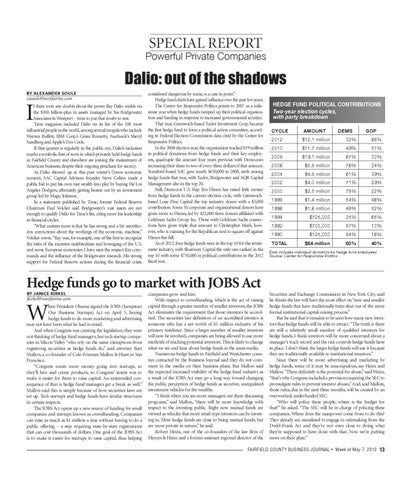
f there were any doubts about the power Ray Dalio wields via the $100 billion-plus in assets managed by his Bridgewater Associates in Westport – time to put that doubt to rest. Time magazine included Dalio on its list of the 100 most influential people in the world, among several moguls who include Warren Buffett, IBM Corp.’s Ginni Rometty, Facebook’s Sheryl Sandberg and Apple’s Tim Cook. If that quartet is regularly in the public eye, Dalio’s inclusion marks a symbolic first of sorts in which privately held hedge funds in Fairfield County and elsewhere are joining the mainstream of American business, despite their ongoing penchant for secrecy. As Dalio showed up at this past winter’s Davos economic summit, SAC Capital Advisors founder Steve Cohen made a public bid to put his own vast wealth into play by buying the Los Angeles Dodgers, ultimately getting beaten out by an investment group led by Magic Johnson. In a statement published by Time, former Federal Reserve Chairman Paul Volcker said Bridgewater’s vast assets are not enough to qualify Dalio for Time’s list, citing more his leadership in financial circles. “What matters more is that he has strong and a bit unorthodox convictions about the workings of the economic machine,” Volcker wrote. “Ray was, for example, one of the first to recognize the risks of the excessive indebtedness and leveraging of the U.S. and some European economies. I have seen the respect Ray commands and the influence of the Bridgewater research. His strong support for Federal Reserve actions during the financial crisis,
considered dangerous by some, is a case in point.” Hedge fund chiefs have gained influence over the past few years. The Center for Responsive Politics points to 2007 as a milestone year when hedge funds ramped up their political organization and funding in response to increased governmental scrutiny. That year, Greenwich-based Tudor Investment Corp. became the first hedge fund to form a political action committee, according to Federal Election Commission data cited by the Center for Responsive Politics. In the 2008 election year, the organization tracked $19 million in political donations from hedge funds and their key employees, quadruple the amount four years previous with Democrats increasing their share to two of every three dollars of that amount. Stamford-based SAC gave nearly $650,000 in 2008, sixth among hedge funds that year, with Tudor, Bridgewater and AQR Capital Management also in the top 20. Still, Democrat U.S. Rep. Jim Himes has raised little money from hedge funds in the current election cycle, with Greenwichbased Lone Pine Capital the top industry donor with a $5,000 contribution. Some 30 corporate and organizational donors have given more to Himes, led by $22,000 from donors affiliated with Goldman Sachs Group Inc. Those with Goldman Sachs connections have given triple that amount to Christopher Meek, however, who is running for the Republican nod to square off against Himes this fall. As of 2012, four hedge funds were in the top 10 for the investment industry, with Shumway Capital the only one ranked in the top 10 with some $750,000 in political contributions in the 2012 fiscal year.
HEDGE FUND POLITICAL CONTRIBUTIONS Two-year election cycles, with party breakdown CYCLE
AMOUNT
DEMS
GOP
2012
$12.1 million
32%
68%
2010
$11.7 million
49%
51%
2008
$19.1 million
67%
33%
2006
$5.8 million
76%
24%
2004
$4.8 million
61%
39%
2002
$4.0 million
71%
29%
2000
$2.5 million
78%
22%
1998
$1.4 million
54%
46%
1996
$1.6 million
48%
52%
1994
$725,000
35%
65%
1992
$700,000
87%
13%
1990
$125,000
84%
16%
$64 million
60%
40%
TOTAL
Data includes individual donations by hedge fund employees Source: Center for Responsive Politics
Hedge funds go to market with JOBS Act BY JANICE KIRKEL
jkirkel@westfairinc.com
W
hen President Obama signed the JOBS (Jumpstart Our Business Startups) Act on April 5, freeing hedge funds to do more marketing and advertising may not have been what he had in mind. And when Congress was creating the legislation, they were not thinking of hedge fund managers, but tech startup companies in Silicon Valley “who rely on the same exemptions from registering securities as hedge funds do,” said attorney Bart Mallon, a co-founder of Cole-Frieman Mallon & Hunt in San Francisco. “Congress wants more money going into startups, so they’ll hire and create products, so Congress’ intent was to make it easier for them to raise capital. An unintended consequence of that is hedge fund managers get a break as well.” Mallon said this is simply because of how securities laws are set up. Tech startups and hedge funds have similar structures in certain respects. The JOBS Act opens up a new source of funding for small companies and startups known as crowdfunding. Companies can raise as much as $1 million a year without having to do a public offering – a step requiring state-by-state registrations that can cost thousands of dollars. One goal of the JOBS Act is to make it easier for startups to raise capital, thus helping
companies grow and hire. With respect to crowdfunding, which is the act of raising capital through a greater number of smaller investors, the JOBS Act eliminates the requirement that those investors be accredited. The securities law definition of an accredited investor is someone who has a net worth of $1 million exclusive of his primary residence. Since a larger number of smaller investors will now be involved, companies are being allowed to use more methods of reaching potential investors. This is likely to change what we see and hear about hedge funds in the mass media. Numerous hedge funds in Fairfield and Westchester counties contacted by the Business Journal said they do not comment in the media on their business plans. But Mallon said the expected increased visibility of the hedge fund industry as a result of the JOBS Act may go a long way toward changing the public perception of hedge funds as secretive, unregulated investment vehicles for the wealthy. “I think when you see more managers out there discussing programs,” said Mallon, “there will be more knowledge with respect to the investing public. Right now mutual funds are viewed as vehicles that more retail-type investors can be investing in. Most hedge funds are close to being mutual funds, but are more private in nature,” he said. Robert Heim, one of the co-founders of the law firm of Meyers & Heim and a former assistant regional director of the
Securities and Exchange Commission in New York City, said he thinks the law will have the most effect on “new and smaller hedge funds that have traditionally been shut out of the more formal institutional capital-raising process.” But he said that it remains to be seen how many new investors that hedge funds will be able to attract. “The truth is there are still a relatively small number of qualified investors for hedge funds. I think investors will be more concerned about a manager’s track record and the risk controls hedge funds have in place. I don’t think the larger hedge funds will use it because they are traditionally available to institutional investors.” Since there will be more advertising and marketing by hedge funds, some of it may be unscrupulous, say Heim and Mallon. “There definitely is the potential for abuse,” said Heim, “that’s why Congress included a provision requiring the SEC to promulgate rules to prevent investor abuses.” And, said Mallon, those rules, due in the next three months, will be created by an overworked, underfunded SEC. “Who will police these people, where is the budget for that?” he asked. “The SEC will be in charge of policing these companies. Where does the manpower come from to do this? They already are mandated to engage in rulemaking from the Dodd-Frank Act and they’re not even close to doing what they’re supposed to have done with that. Now we’re putting more on their plate.”
FAIRFIELD COUNTY BUSINESS JOURNAL • Week of May 7, 2012 13
Powerful Private Companies
Private business a powerful engine for economic growth BY CHRISTOPHER P. BRUHL
B
usinesses start private, fail or succeed, and, if successful, go public or get purchased by a public company. From Ford to Apple, Microsoft to Google, and Pepperidge Farm to Bare Naked, that’s how it works. Except when it doesn’t. The overwhelming majority of businesses in the U.S. don’t, and will never, trade on a stock exchange. They won’t be acquired. Earnings will never be publicly disclosed. The SEC, for the majority of business owners, is a college athletic conference, not a regulatory body. Well, of course, you say. Mom and Pop’s answer to Uncle Sam in simpler ways than Fortune 500s. Private businesses are small. Good neighbors, but not global competitors. Useful, but hardly powerful drivers of our economy and society. This is true, except when it isn’t.
Actually, “private” doesn’t equal “small.” Cargill, Bechtel, Mars (the M&M folks), Toys R Us and Amway are just a few of the private giants in the U.S. Behemoths like these are served by equally large, equally private professional services firms. It is true, however, that private businesses tend to be much smaller in revenue and number of employees than public companies. An accounting firm is hundreds of times more likely to have five or fewer CPAs than to have 5,000. Most retail businesses have a single location. Yet, in aggregate, even these small private companies employ far more people than the public companies. In Connecticut, business is overwhelmingly private, with the large majority of enterprises avoiding the traditional C corporation. Here, the S corporation, the L.L.C., the L.P. and sole proprietorships account for more than 75 percent of all business entities formed over the past 20 years. Our private companies are highly diverse.
Purdue Pharma L.P. is a multibillion-dollar pharmaceutical company whose products are used worldwide. Tauck, a much smaller business, is just as globally far reaching as Purdue Pharma – but instead of delivering products, they provide experiences to travelers in the U.S. and throughout the world. The Mitchell family, which started in retailing in a tiny, second-floor space in Westport, now operates four high-end, high-fashion stores in Westport, Greenwich, Long Island and San Francisco. Subway’s first sandwich was made to order in a small shop in Bridgeport in 1965. Now, more than 36,000 restaurants exist in 100 countries – and Subway is still private. The state of Connecticut, led by a new governor and legislative leaders that see economic growth as essential to the sustainable delivery of public services, has re-energized its efforts to help create jobs. They have created the First Five program of incentives for major employers and the Department of Economic and Community Development’s
Small Business Express and Connecticut Innovations’ Innovation Ecosystem, which will commit hundreds of millions of dollars to entrepreneurship and small business growth. The governor has also appointed a Business Tax Policy Review Task Force to take a fresh look at how our tax code affects the competitiveness of our current mix of enterprises, both publicly traded and privately held. In aggregate, private companies are the dominant economic force in our county. As we seek to recover economically, a most welcome broader awareness is growing among policy makers and the general public that in business, “big” and “small” are not synonyms for “public” and “private.” This awareness, as described above, is leading to constructive action and will, over time, produce powerful results. Christopher Bruhl is president and CEO of The Business Council of Fairfield County in Stamford. He can be reached at cbruhl@ businessfairfield.com.
ask andi by andi gray
What’s in store for the next generation of business? Some 93 percent to 95 percent of all companies in the U.S. are privately held. That’s a huge percentage. And it’s been that way for most of our country’s history. Why is it that now is the time for an explosion of growth, profit and stability for privately held entrepreneurial business? The U.S. enjoys a rich history and culture of entrepreneurship. While many of the first settlers arrived here compliments of large, public trading companies (Dutch East India, Hudson Bay), many of the settlers quickly established themselves as shopkeepers, farmers, fishermen, merchants and anything else that would provide independence and opportunity. Fast forward to the last third of the 20th century. The advent of microcomputing led to another revolution. The Industrial Age was coming to an end, the Information Age was dawning, as computers were about to become the great leveler for small business competition. Microsoft’s BASIC program, cheap readonly and random access memory, and inex-
pensive circuitry that enabled keyboards and other tools, were a few of the world-changing innovations. The computer could finally be operated by everyday people, without computer programming staff to handle input and output. The size was reduced from a room to a desktop. The culture of entrepreneurship joined forces with automation tools. Small businesses could finally access, assemble, analyze and distribute massive amounts of information with limited human capital. From 1980 to 2010, the proliferation of computer-based tools, targeted to the needs of small business owners, was astounding. Today, the pace of innovation and offerings continues to multiply geometrically. In the 1990s, finance and accounting tools came down in price from 100s of thousands, to 10s of thousands, to a few hundred dollars. Between 2000 and 2010, marketing programs that used to rely on five-, six- and seven-figure advertising budgets were replaced by individuals learning to use available free and nearly free Internet-based tools. Communication with the world now happens in seconds on a computer that costs a few hundred dollars. The door has been blown wide open for entrepreneurs to build sophisticated, profit-making businesses, going head to head with their large sister companies, the major corporations of the Industrial Age. The
race is on to see who can build what fastest, who can provide the best innovations, and who can best meet marketplace needs in the most innovative and customer-oriented ways. The grand experiment has only just begun. In the mid 1970s and early 1980s, the Information Age was just getting off the ground. Analysis shows that the most profitable and successful privately held companies are those that have been around at least 20 years. And many companies fall by the wayside as the leaders emerge as only one business out of four makes it through each 10-year cycle. The first generation of computer enabled businesses started around 1980. The early adopters, companies that grew because of technology starting in the 1980s and 1990s, are now only 20 to 30 years old – the point at which they show real traction, stability and profit. Even the industries that entered the Information Age already well established – construction and related trades, manufacturing, medicine and financial services – have only had the benefit of 1.5 cycles of 20-year development with computer enabling tools. Tools that enable computers, such as GoToMeeting (2004 - 2009), LinkedIn (2002), Facebook (2004), Constant Contact (1995), none of them have been around 20 years. Wait until their leverage kicks in with the companies they enable also being around for 20
years, sometime around 2015 to 2029. For the first time, we are seeing small, privately held companies, fully enabled with the tools they need, up and running with those tools for 20-plus years. Many examples of companies thriving, despite the economy, are here in our own backyard. And this is the tip of the iceberg. Sure, some of those companies will be snapped up by large corporations. And the majority will be gone in under 10 years, out of ideas, mismanaged or just plain out of luck as a result out of business conditions. But if ever the time was right to chance it, to seek to become a strong and fierce competitor, to carve out a profit niche and fuel an ever expanding portfolio of products and services, it’s here and now. Looking for a good book? Try “Jacquard’s Web: How a Hand-Loom Led to the Birth of the Information Age” by James Essinger. Andi Gray is president of Strategy Leaders Inc., strategyleaders.com, a business-consulting firm that specializes in helping entrepreneurial firms grow. She can be reached by phone at (877) 238-3535. Do you have a question for Andi? Please send it to her, via email at AskAndi@StrategyLeaders.com or by mail to Andi Gray, Strategy Leaders Inc., 5 Crossways, Chappaqua, NY 10514.
14 Week of May 7, 2012 • Fairfield County Business Journal a division of Westfair Business Publications • www.westfaironline.com
No matter the question, the answer is right down our hall Suppose your mid-market company has a highly specialized need – a complex transaction or new acquisition. One way to approach it might be to start throwing hours and people at it. But that’s not our style. At Deloitte Growth Enterprise Services, our size means we have advisors who specialize in the very service you need. We quickly put the right person with the right experience on it. You save time and money. And get what you seek – answers. To learn more about Deloitte Growth Enterprise Services and its customized offerings for mid-market and privately held companies, contact Harry Hurvitz +1 203 708 4000 or e-mail us at dges@deloitte.com Gain insight with Perspectives, our series of reports, podcasts, and events for mid-market and privately held companies at www.deloitte.com/us/dges
Official Professional Services Sponsor
Professional Services means audit, tax, consulting and financial advisory services.
As used in this document, “Deloitte” means Deloitte & Touche LLP, Deloitte Consulting LLP, Deloitte Financial Advisory Services LLP, and Deloitte Tax LLP, which are separate subsidiaries of Deloitte LLP. Please see www.deloitte.com/us/about for a detailed description of the legal structure of Deloitte LLP and its subsidiaries. Certain services may not be available to attest clients under the rules and regulations of public accounting. Copyright © 2012 Deloitte Development LLC. All rights reserved. Member of Deloitte Touche Tohmatsu Limited 36 USC 220506
FAIRFIELD COUNTY BUSINESS JOURNAL • Week of May 7, 2012 15 1601-62752_Doors_FBJ.indd 1
4/26/12 4:52 PM
Bridgeport Public Library: A gathering place for the entire community The Bridgeport Public Library serves as the principal public library for the city of Bridgeport, the largest municipality in Connecticut. A city of more than 130,000 residents where more than 60 languages are spoken, Bridgeport is one of the most densely populated cities in the U.S. covering 16 square miles. Our flagship Burroughs and Saden Memorial Public Library downtown, along with our four neighborhood branches, is proud to be one of Bridgeport’s premier cultural centers. Our superb historical collections/genealogy department attracts visitors from all over the world. Cultural programs for all ages focusing on art, literature and music are continually offered at of all our locations. Recently, the library was proud to announce that thanks to the overwhelming support of city voters, it is now providing seven days of service a week, including Saturdays at all branches for the first time since 1989. Jim O’Donnell, president of the library board of directors, said, “We are so pleased, in the face of all the administrative challenges presented, to finally be able to open our doors seven days a week. These additional hours will give patrons more opportunities in these difficult economic times to use the essential services provided by our libraries. All of us connected with the library are grateful to the Bridgeport community who recognize the priceless value of our libraries expressed by the overwhelming support of the library referendum, which has provided the BPL with sustainable funding. “Being able to use the library in person, and not just online, any day of the week is just one of the many ways the Bridgeport Public Library is working to be there for you.” Scott Hughes, City Librarian
Bridgeport Public Library Member, Cultural Alliance of Fairfield County
The mission of the Cultural Alliance of Fairfield County is to support cultural organizations, artists and creative businesses by providing promotion, services and advocacy. For more information, visit CulturalAllianceFC.org or email infoCulturalAllianceFC.org or call 256-2329. For events lists, visit FCBuzz.org.
FCBUZZ Chernow, Blue Narcissus.
TIME TO CELEBRATE
Silvermine Arts Center in New Canaan is celebrating 90 years of bringing the arts to Fairfield County. To commemorate this historic milestone, the arts center will present a range of varied events throughout the year, including a special exhibition of works by guild artist members. Artists have been drawn to Silvermine since visionary sculptor Solon Borglum moved here in 1906 and established it as a place for artists and art lovers to gather to appreciate, enjoy and learn about the arts.
Arts & Culture of Fairfield County
Axleroad, Lost Souls Crossing The River Styx.
In honor of the anniversary, there will be a celebration of the Silvermine Guild of Artists with an exhibition featuring current members. The exhibit has been designed as an open call to all the current guild members. The exhibit will be open to the public from May 9 and run through June 9. The exhibition is sponsored by the Rosenthal Family Foundation in honor of Hinda G. Rosenthal and Venü Magazine. “Ninety years as an artist-founded and led organization is truly worth celebrating,” Executive Director Leslee Asch said. “A tribute to this momentous occasion will be a commemorative book, which will highlight the extraordinary history of this magical place and the people who have given tirelessly to make it great.” Other events planned for the celebratory year include the second annual Silvermine Artsfest, which last year inaugurated the new Sculpture Walk, Sept. 15, featuring music by Fishman’s Biting Fish Brass Band. For more information, call 966-9700 ext. 22, or visit silvermineart.org.
Pedvisocar, Getting used to dark.
STEVE GUTTENBERG AT THE AVON The Avon Theatre presents “An Evening with Steve Guttenberg” June 5 at 7 p.m. The event will feature a 30th anniversary screening of “Diner” followed by a Q&A moderated by film critic Joe Meyers and a book signing of the actor’s new work, “The Guttenberg Bible.”
Each ticket purchase includes a signed copy of the book. A limited supply of additional books will be available for purchase. Lucky’s Classic Burger & Malt Shop will provide food tastings for the event. For tickets, call the administrative office during daytime business hours at 661-0321 or call the box office during show times at 967-3660. Ticket pricing is: carte blanche and members $25, nonmembers $35.
For more information contact: Bridget Stokes Director of Communications bstokes@avontheatre.org 203.661.0321 (office) 203.644.6831 (mobile)
Visit FCBuzz.org for more information on events and how to get listed. An Evening with Steve Guttenberg at The Avon Theatre
a division of Westfair Business Publications • www.westfaironline.com 16 Week of May 7, 2012 • Fairfield County Business Journal (STAMFORD, CT) April 27, 2012 The Avon Theatre presents An Evening with Steve Guttenberg on Tuesday, June 5th at 7:00 p.m. We will feature a 30th anniversary screening of Diner, followed by a Q&A moderated by film critic Joe Meyers (CT Post) and a book signing of Mr. Guttenberg’s new work, The Guttenberg Bible. Each ticket purchase includes a signed copy of the book. A limited supply of additional
Presented by: Cultural Alliance of Fairfield County
on the record Attachments Bortot, Lucille and Raffaele Bucci, Stamford. $60,000 in favor of 710 Long Ridge Road Operating Company II L.L.C., Stamford. Property: 74 Elizabeth Ave., Stamford. Filed March 23.
Bankruptcies
Willowbrook Holdings L.L.C., 7 Greenfield Drive, Shelton. Chapter 11, filed April 13, case no. 12-50688. Assets: $500,000 to $1 million. Liabilities: $500,000 to $1 million. Type of business: limited liability company. Debtor’s attorney: Stephen P. Wright, Harlow Adams & Friedman P.C., Milford.
Building Permits
The following petitions were filed in U.S. Bankruptcy Court, Bridgeport. Chapter 11 indicates the filer intends to submit a plan of reorganization to the court. Chapter 7 inA. V. Tuchy, Norwalk, contractor dicates a liquidation of assets. for Pepperidge Farm Inc. Perform renovations at an existing commerElm Knoll Farm, 294 E. Canaan cial building, 595 Westport Ave., Road, East Canaan. Chapter 12, Norwalk. Estimated cost: $5 milfarm bankruptcy, filed April 12, lion. Filed April 12. case no. 12-50679. Assets: $500,000 to $1 million. Liabilities: $1 million to $10 million. Creditors: Law- Carrier Commercial Service, rence D. Coon & Son, $107,024; Middletown, contractor for The Lindell Hardware, $44,610; DECD, Bank of New York Mellon. Refur$45,044; Lindell Fuels, $16,460; bish air conditioning at an existing CHN Capital, $15,582; Monsanto, commercial building, 10 Mason $12,677; Renaissance Nutrition, St., Greenwich. Estimated cost: $12,514; Farm Plan, $12,250; Blue $586,000. Filed March 30. Slope Sawdust, $10,013. Type of business: partnership. Debtor’s at- Encon Heating, Stratford, contorney: Anthony S. Novak, Chorch- tractor for 33 Grove Street L.L.C. es & Novak P.C., Manchester. Construct additions and perform alterations at an existing commercial building, 33 Grove St., New Canaan. Estimated cost: $50,000. Filed April 16.
Commercial
Haja 151 L.L.C. Fit out an existing commercial space for tenant Lori Dodd Dream Spa at 151 Greenwich Ave., Greenwich. Estimated cost: $75,000. Filed March 29.
Items appearing in the Fairfield County Business Journal’s On The Record section are compiled from various sources, including public records made available to the media by federal, state and municipal agencies and the court system. While every effort is made to ensure the accuracy of this information, no liability is assumed for errors or omissions. In the case of legal action, the records cited are open to public scrutiny and should be inspected before any action is taken. Questions and comments regarding this section should be directed to: Bob Rozycki c/o Westfair Communications Inc. 3 Gannett Drive, Suite G7 White Plains, N.Y. 10604-3407 Phone: (914)694-3600 Fax: (914)694-3680
Maggiore Construction, Norwalk, contractor for the city of Norwalk. Fit out an existing office space for tenant SNEW at 30 Monroe St., Norwalk. Estimated cost: $140,000. Filed April 11. Merritt 7 Venture L.L.C. Perform interior alterations at an existing commercial building, 501 Merritt 7, Norwalk. Estimated cost: $298,000. Filed April 11.
Merritt Ridge L.L.C. Fit out an existing commercial space for tenant Versimedia at 129 Glover Ave., Norwalk. Estimated cost: $110,000. Filed April 11. Property CT OBJLW One Corp. Fit out an existing commercial space for tenant Weber at 3 Greenwich Office Park, Greenwich. Estimated cost: $125,000. Filed March 30.
FSA Construction Services, Wilton, contractor for Aimee and Douglas Mueller. Perform alterations at an existing single-family residence, 122 White Oak Shade Road, New Canaan. Estimated cost: $125,000. Filed March 23.
G&T Development L.L.C., Easton, contractor for 1550 Post Road East L.L.C. Perform interior renovations at an existing single-family residence, 30 Merriman Road, Stamford. Estimated cost: $54,000. Filed Turner, Michael, Middletown, April 9. contractor for Winnipauk Village. Perform exterior renovations at multifamily housing, 71 Aiken St., Graber, Deena and Howard Norwalk. Estimated cost: $611,000. Graber. Construct additions and Filed April 11. perform alterations at an existing single-family residence, 55 Cousins Road, Stamford. Estimated cost: $231,455. Filed April 11.
Residential
Anthony Tomas Builders L.L.C., Norwalk, contractor for Janet Reddock, trustee. Construct a new fivebedroom single-family residence at 1129 Oenoke Ridge, New Canaan. Estimated cost: $930,000. Filed April 2.
Haggerty Pools, Stamford, contractor for Maria and Hugh O’Donnell. Install an in-ground pool and enclosure at an existing single-family residence, 96 Thornwood Road, Stamford. Estimated cost: $51,000. Filed March 30.
Clark Construction, Ridgefield, contractor for Shawn and Michael Gardner. Construct an addition at an existing single-family residence, 519 Weed St., New Canaan. Estimated cost: $465,000. Filed March 14.
J&J Woodworking, Wallingford, contractor for Alejandra Holloway and David Nehrends. Construct additions and perform exterior renovations at an existing single-family residence, 65 Wildwood Road, Stamford. Estimated cost: $450,000. Filed April 4.
Duffy Construction Inc., Stamford, contractor for Jennifer Dolan. Perform interior renovations at an existing single-family residence, 363 North St., Greenwich. Estimated cost: $165,000. Filed March 29. Emerson Construction, Manchester, contractor for South End Atlantic L.P. Construct additions and perform exterior renovations at an existing single-family residence, 660 Atlantic St., Stamford. Estimated cost: $140,000. Filed April 4. Fitzpatrick, Jaime and Patrick Fitzpatrick. Construct an addition at an existing single-family residence, 108 Parish Road, New Canaan. Estimated cost: $115,000. Filed April 17.
King’s Painting, Stamford, contractor for Laura Tobin. Perform interior renovations at an existing single-family residence, 35 Revonah Circle, Stamford. Estimated cost: $69,000. Filed April 5. Lanni, Gino, New Canaan, contractor for Sharon and Brian Libman. Construct an addition at an existing single-family residence, 1065 Weed St., New Canaan. Estimated cost: $50,000. Filed March 22. Noble Construction Management, South Salem, N.Y., contractor for Carmen Gelineau and Von Hughes. Perform interior renovations at an existing single-family residence, 1522 Riverbank Road, Stamford. Estimated cost: $70,000. Filed April 11.
Paragon Builders, Norwalk, contractor for Matthew and Joe Gifford. Construct an addition at an existing single-family residence, 3 River St., Norwalk. Estimated cost: $290,000. Filed April 5.
Court Cases
Bridgeport Superior Court
Shore & Country Partners L.L.C., Fairfield, contractor for Jacqueline and Eric Sacks. Perform alterations and renovations at an existing single-family residence, 17 Rocky Point Road, Norwalk. Estimated cost: $85,900. Filed April 4.
Chroma Building Corp., Stamford. Filed by United States Risk Management L.L.C., New Orleans, La. Plaintiff’s attorney: Sugarmann & Sugarmann, New Haven. Action: The plaintiff alleges that prior to the date of this action it delivered goods and/or services to the defendant Shoreline Pools, Stamford, con- and that $3,544 relating to those tractor for Jennifer and Robert deliveries remains outstanding Gallois. Install an in-ground pool and past due from the defendant and enclosure at an existing single- despite repeated requests for payfamily residence, 213 Hawk’s Hill ment by the plaintiff. The plaintiff Road, New Canaan. Estimated cost: seeks repayment of all outstanding amounts plus interest, costs and $150,000. Filed March 15. reasonable attorneys’ fees. Filed March 12. Case no. CV126025905. Tavolacci, Frank, Bedford, N.Y., contractor for Melinda and Jeffrey Fager. Perform alterations at an ex- Fairfield County Granite L.L.C., isting single-family residence, 198 et al., Bridgeport, et al. Filed by Hemlock Hill Road, New Canaan. People’s United Bank, Bridgeport. Estimated cost: $100,000. Filed Plaintiff’s attorney: Benanti & Associates, Stamford. Action: The April 9. plaintiff alleges that the defendant failed to observe payment terms Titus Builders L.L.C., Wilton, of a September 2007 business contractor for Paula and John credit note, for which payment was Addeo. Construct an addition at an guaranteed by a co-defendant, and existing single-family residence, 70 that $9,632 relating to that note Valley Road, New Canaan. Estimat- remains outstanding and past due from the defendants despite reed cost: $150,000. Filed April 17. peated requests for payment by the plaintiff. The plaintiff seeks repayWadia Construction L.L.C., New ment of all outstanding amounts Canaan, contractor for Thomas plus interest, costs and reasonMcCaughey. Construct an addition able attorneys’ fees. Filed March 9. to an accessory building at an ex- Case no. CV126025883. isting single-family residence, 416 Greenley Road, New Canaan. Estimated cost: $65,000. Filed April 17. From Spain Inc., Norwalk. Filed by Tri-Pac Inc., Downington, Pa. Plaintiff’s attorney: Tolisano & West Construction Corp., New Danforth L.L.C., Ellington. Action: Canaan, contractor for Gregory The plaintiff alleges that prior to Latrenta. Construct an addition at the date of this action it delivered an existing single-family residence, goods and/or services to the defen2015 Ponus Ridge, New Canaan. dant and that $25,547 relating to Estimated cost: $225,000. Filed those deliveries remains outstandMarch 22. ing and past due from e defendant despite repeated requests for payment by the plaintiff. The plaintiff seeks repayment of all outstanding amounts plus interest, costs and reasonable attorneys’ fees. Filed March 9. Case no. CV126025890.
THE RECORDS SECTION IS NOW AVAILABLE BY DIGITAL SUBSCRIPTION. Go to westfaironline.com/buy/records-section/ for more information and to view a sample. FAIRFIELD COUNTY BUSINESS JOURNAL • Week of May 7, 2012 17
on the record Ingersoll-Rand Co., et al., Piscataway, N.J., et al. Filed by Robert Choate, Ledyard. Plaintiff’s attorney: Embry & Neusner, Groton. Action: The plaintiff alleges that the defendants negligently exposed him to asbestos in the workplace despite extensive evidence of the dangers of such exposure and that, as a result of this exposure, he suffered serious and painful disorders and has incurred substantial continuing medical expenses. The plaintiff seeks damages in excess of $15,000 plus applicable costs and reasonable attorneys’ fees. Filed March 12. Case no. CV126025908.
Monroe Tile and Stone Design L.L.C., et al., Monroe, et al. Filed by People’s United Bank, Bridgeport. Plaintiff’s attorney: Benanti & Associates, Stamford. Action: The plaintiff alleges that the defendant failed to observe payment terms of a September 2005 business credit note, for which payment was guaranteed by a co-defendant, and that $7,252 relating to that note remains outstanding and past due from the defendants despite repeated requests for payment by the plaintiff. The plaintiff seeks repayment of all outstanding amounts plus interest, costs and reasonable attorneys’ fees. The plaintiff seeks repayment plus interest, costs and reasonLindade Corporation Inc., et al., able attorneys’ fees. Filed March 9. Bridgeport, et al. Filed by Patrick Case no. CV126025885. Crucitti, Monroe. Plaintiff’s attorney: Cotter Cotter & Mullins, Trumbull. Action: The plaintiff al- S. J. Masters Inc., Canaan. Filed by leges that he was struck in the eye Eric H. Zelinski & Company L.L.C., by construction while employed Fairfield. Plaintiff’s attorney: Brian on a construction site owned or S. Cantor, Fairfield. Action: The otherwise under control of the de- plaintiff alleges that prior to the fendants as the result of an unsafe date of this action it delivered goods condition arising from negligence and/or services to the defendant on the part of the defendants, and that $1,259 relating to those their agents and employees, which deliveries remains outstanding and caused him to suffer serious, pain- past due from the defendant despite ful injuries and to incur substan- repeated requests or payment by the tial medical expenses. The plaintiff plaintiff. The plaintiff seeks repayseeks damages in excess of $15,000 ment of all outstanding amounts plus applicable costs and reason- plus interest, costs and reasonable attorneys’ fees. Filed March 12. able attorneys’ fees. Filed March 8. Case no. CV126025907. Case no. CV126025866. MFXA Construction and Management L.L.C., Bridgeport. Filed by Wendy Hrynewski, Bridgeport. Plaintiff’s attorney: Matthew S. Hirsch, Trumbull. Action: The plaintiff alleges that she was injured while attempting to move supplies left on her premises by the defendant as the result of an unsafe condition arising from negligence on the part of the defendant, its agents and employees, which caused her to suffer serious, painful injuries and to incur substantial medical expenses. The plaintiff seeks damages in excess of $15,000 plus applicable costs and reasonable attorneys’ fees. Filed March 9. Case no. CV126025892.
Stonybrook Restaurant L.L.C., et al., Fairfield, et al. Filed by Gary Feather, Stratford. Plaintiff’s attorney: Paoletti & Gusmano, Bridgeport. Action: The plaintiff alleges that he was assaulted by an intoxicated patron while on premises owned or otherwise under control of the defendants as the result of an unsafe condition arising from negligence on the part of the defendants, their agents and employees, which caused him to suffer serious, painful injuries and to incur substantial medical expenses. The plaintiff seeks damages in excess of $15,000 plus applicable costs and reasonable attorneys’ fees. Filed March 9. Case no. CV126025896.
Danbury Superior Court
Danbury Lodge No. 120 of the Benevolent and Protective Order of Elks, Danbury. Filed by the Knights of Columbus Home of Danbury Connecticut Inc., Danbury. Plaintiff’s attorney: William J. Hagan, Danbury. Action: The plaintiff alleges that the defendant failed to observe terms of a lease agreement between the parties in that it failed to vacate the premises after expiration and that extensive damage to the premises was discovered after the defendant’s eviction. The plaintiff seeks damages in exStarbucks Corp., Seattle, Wash. cess of $15,000 plus applicable costs Filed by Antonia Furnari, Stratford. and reasonable attorneys’ fees. Filed Plaintiff’s attorney: Thomas M. April 3. Case no. CV126009101. Yuditsky, Bridgeport. Action: The plaintiff alleges that she fell while a business invitee on the defendant’s Durant’s L.L.C., Danbury. Filed premises as the result of an unsafe by The Amber Room Colonnade, condition arising from negligence Danbury. Plaintiff’s attorney: the on the part of the defendant, its Law Office of Cynthia A. Jaworski, agents and employees, which Rocky Hill. Action: The plaintiff caused her to suffer serious, pain- alleges that negligent tent instalful injuries and to incur substan- lation by the defendant damaged tial medical expenses. The plaintiff the plaintiff’s premises and effects. seeks damages in excess of $15,000 The plaintiff seeks damages in explus applicable costs and reason- cess of $2,500 plus applicable costs able attorneys’ fees. Filed March 13. and reasonable attorneys’ fees. Filed April 5. Case no. CV126009126. Case no. CV126025920.
N. J. Voog Realty L.L.C., et al., Ridgefield. Filed by Fairfield County Bank, Ridgefield. Plaintiff’s attorney: Patrick J. Walsh, Ridgefield. Action: The plaintiff alleges that it is the owner of a July 2007 $210,000 mortgage note issued by N. J. Voog Realty, for which payment was guaranteed by a co-defendant, and that amounts relating to that note remain outstanding and past due from the defendants despite repeated requests for payment by the plaintiff. The plaintiff seeks repayment of all outstanding amounts plus interest, costs and reasonable attorneys’ fees, including without limitation by means of foreclosure on the defendants’ property securing the note subject to interests of senior secured creditors. Filed April 4. Case no. CV126009106. Pateley Associates L.L.C., et al., Hartford, et al. Filed by U.S. Bank N.A., trustee, Dallas, Texas. Plaintiff’s attorney: Zeichner Ellman & Krause, Greenwich. Action: The plaintiff alleges that it is the owner of defaulted August 2001 mortgage notes issued by the defendant Pateley Associates, for which payment was guaranteed by co-defendants and that $3.9 million relating to those notes remains outstanding and past due from the defendants despite repeated requests for payment by the plaintiff. The plaintiff seeks repayment of all outstanding amounts plus interest, costs and reasonable attorneys’ fees, including without limitation by means of foreclosure on the defendants’ property securing the notes subject to interest of senior secured creditors. Filed April 3. Case no. CV126009099.
The Stop & Shop Supermarket L.L.C., Hartford. Filed by Dipti Soni, Danbury. Plaintiff’s attorney: Ventura Ribeiro & Smith, Danbury. Action: The plaintiff alleges that she fell while a business invitee on the defendant’s premises as the result of an unsafe condition arising from negligence on the part of the defendant, its agents and employMiller & Stone Inc., Ridgefield. ees, which caused her to suffer seFiled by New Hope Natural Media rious, painful injuries and to incur Division of Penton Media, Boulder, substantial medical expenses. The Colo. Plaintiff’s attorney: Charles plaintiff seeks damages in excess of Busek, Norwalk. Action: The plain- $15,000 plus applicable costs and tiff alleges that prior to the date of reasonable attorneys’ fees. Filed this action it delivered goods and/ April 4. Case no. CV126009102. or services to the defendant and that $18,800 relating to those deliveries remains outstanding and past due from the defendant despite repeated requests for payment by the plaintiff. The plaintiff seeks repayment of all outstanding amounts plus interest, costs and reasonable attorneys’ fees. Filed April 9. Case no. CV126009137.
Stamford Superior Court Colony Grill Inc., Stamford. Filed by Ismael Balta, Stamford. Plaintiff’s attorney: Richard H. G. Cunningham, Stamford. Action: The plaintiff alleges that he was denied appropriate overtime compensation during the course of his employment with the defendant. The plaintiff therefore seeks damages in excess of $15,000 plus applicable costs and reasonable attorneys’ fees. Filed March 16. Case no. CV126013315. Hartford Gun Club Inc., et al., East Granby, et al. Filed by Patricia Kennedy, Riverside. Plaintiff’s attorney: Tooher Wocl & Leydon L.L.C., Stamford. Action: The plaintiff alleges that she was struck by a ricocheting bullet while visiting premises owned or otherwise under control of the defendants as the result of an unsafe condition arising from negligence on the part of the defendants, their agents and employees, which caused her to suffer serious, painful injuries and to incur substantial medical expenses. The plaintiff seeks damages in excess of $15,000 plus applicable costs and reasonable attorneys’ fees. Filed March 14. Case no. CV126013296. Hem Management Group Inc., Hartford. Filed by U.S. Foodservice Inc., Rosemont, Ill. Plaintiff’s attorney: Joseph A. Maker, Stamford. Action: The plaintiff alleges that prior to the date of this action it delivered goods and/or services to the defendant and that $31,325 relating to those deliveries remains outstanding and past due from the defendant despite repeated requests for payment by the plaintiff. The plaintiff seeks repayment of all outstanding amounts plus interest, costs and reasonable attorneys’ fees. Filed March 14. Case no. CV126013302. Jos. A. Bank Clothiers Inc., Hartford. Filed by Pear Partners L.L.C., Stamford. Plaintiff’s attorney: Robinson & Cole, Stamford. Action: The plaintiff alleges that the defendant failed to observe terms of a December 2009 lease agreement between the parties, specifically in that it made false and misleading statements regarding revenues and associated rental calculations, which caused the plaintiff to incur a substantial financial loss. The plaintiff seeks damages in excess of $15,000 plus applicable costs and reasonable attorneys’ fees. Filed March 20. Case no. CV126013349.
Konko L.L.C., Hartford. Filed by Tri-Stary Building Corp., Pleasantville, N.Y. Plaintiff’s attorney: Ivey Barnum & O’Meara, Greenwich. Action: The plaintiff alleges that prior to the date of this action it delivered goods and/or services to the defendant and that $33,616 relating to those deliveries remains outstanding and past due from the defendant despite repeated requests for payment by the plaintiff. The plaintiff seeks repayment of all outstanding amounts plus interest, costs and reasonable attorneys’ fees. Filed March 19. Case no. CV126013339. Twenty-Three Sixteen Post Road L.L.C., Southport. Filed by Bernardine Alward, Westport. Plaintiff’s attorney: Jeremy G. Vishno, Fairfield. Action: The plaintiff alleges that she fell while visiting the defendant’s premises as the result of an unsafe condition arising from negligence on the part of the defendant, its agents and employees, which caused her to suffer serious, painful injuries and to incur substantial medical expenses. The plaintiff seeks damages in excess of $15,000 plus applicable costs and reasonable attorneys’ fees. Filed March 14. Case no. CV126013294.
U.S. District Court Air & Liquid Systems Corp., et al. Filed by Sharon and James Ziettlow. Plaintiff’s attorney: Christopher Meisenkothen. Action: claim filed in connection with notice of removal of an existing action to an alternative venue. Filed April 13. Case no. 12CV00560. AlloStem Therapeutics L.L.C. Filed by AlloSource. Plaintiff’s attorney: Andy I. Corea. Action: claim filed in connection with trademark infringement. Filed April 13. Case no. 12CV00557. GPT Niantic L.L.C. Filed by David Maker. Plaintiff’s attorney: not available. Action: claim filed in connection with a petition for removal of an existing medical malpractice suit to an alternative venue. Filed April 13. Case no. 12CV00561. Majella Foundation, et al. Filed by Christopher Joliat. Plaintiff’s attorney: Anthony R. Minchella. Action: claim filed in connection with breach of contract. Filed April 12. Case no. 12CV00551.
THE RECORDS SECTION IS NOW AVAILABLE BY DIGITAL SUBSCRIPTION. Go to westfaironline.com/buy/records-section/ for more information and to view a sample. 18 Week of May 7, 2012 • Fairfield County Business Journal a division of Westfair Business Publications • www.westfaironline.com
on the record Credits, Clients and Awards Kerry Anne Ducey of Ridgefield, editor in chief of the HamletHub news website in Ridgefield and sister sites in communities throughout Connecticut, has won a Connecticut Press Club Award for original journalism published to the web. HamletHub is a network of hyper-local sites that provide locally sourced news about a community.
Vicki O’Meara, executive vice president and president of Pitney Bowes Services Solutions, is the recipient of the 2012 Pamela L. Carter Award in InsideCounsel magazine’s Third Annual Transformative Leadership Awards. The awards honor in-house counsel and law firm partners who have demonstrated a commitment to advancing the empowerment of women in corporate law.
Connecticut Hispanic Bar Association has announced the following individuals have been elected to its slate of board members and officers for 2012-2013. Maria Garcia, a law clerk at the United States District Court for the District of Connecticut, has been elected president. Erick I. Díaz, of counsel at Hayber Law Firm L.L.C., is president-elect. Karem Friedman, associate at Wiggin & Dana L.L.P., has been elected vice-president. Walter Menjivar, student at the University of Connecticut School of Law, has been elected secretary. Alex Toribio, associate at McCarter & English L.L.P., has been elected treasurer. Troy Jellerette of Norwalk has joined First Niagara as a senior relationship manager. Most recently, he served as a middlemarket relationship manager for JPMorgan Chase where he focused on the Connecticut marketplace. Jellerette graduated from Babson College with a Bachelor of Science degree in finance, investments and communication.
Newsmakers Sherry Boyd of Trumbull has joined William B. Meyer Inc. in Statford as an account executive. A graduate of the Boston University School of Management, Boyd was previously with ArchivesOne. She comes to William B. Meyer with an industry-specific background in account management and business development.
Stonington Water Street Associates L.L.C., et al. Filed by Valley Forge Insurance Co., et al. Plaintiff’s attorney: William A. Meehan. Action: claim filed in connection with a declaratory judgment. Filed April 13. Case no. 12CV00555. Yale University. Filed by Martin Donovan. Plaintiff’s attorney: William S. Palmieri. Action: claim filed in connection with age-related job discrimination. Filed April 12. Case no. 12CV00549.
Deeds
Commercial 19 Sterling Drive Development L.L.C., Westport. Seller: FYC L.L.C., Ridgefield. Property: 19 Sterling Drive, Westport. Amount: $760,000. Filed March 26. First Garden Development L.P., Stamford. Seller: 1032 Hope Street L.L.C., Southbury. Property: 1032 Hope St., Stamford. Amount: $1.5 million. Filed March 20.
Rob Valentine of New Fairfield has joined the New England Computer Group (NECG), a computer support firm serving Fairfield and Westchester counties, as a senior systems engineer. Valentine has more than 20 years of experience implementing information technology solutions for small to mid-sized business, with a special expertise in systems for law firms. He holds a bachelor’s degree in management information systems from Pace University.
On the Go: Business, Etc. Wednesday, May 9 “Set Yourself Free: A Guide for Small-Business Owners,” 7 p.m., Fairfield Public Library, 1080 Old Post Road, Fairfield. For information, visit fairfieldpubliclibrary.org. Stamford Business Group networking meeting, 7:29 a.m., Cafeteria at 9 W. Broad St., Stamford. For information, call 975-2950 or visit stamfordbusiness.com.
Information for these features has been provided by the subjects or their delegates
Joshua Koskoff has been named a fellow of the International Society of Barristers, an international honor society of outstanding trial lawyers. He is the third attorney selected from the law firm of Koskoff, Koskoff & Bieder –– which has offices in Bridgeport, Danbury, New Haven and Stamford –– and one of only six in Connecticut. Koskoff was selected by a committee of his peers.
HFH L.L.C., Greenwich. Seller: Darnett Daniels, Bridgeport. Property: vicinity of Laurel Avenue, Bridgeport. Amount: $135,000. Filed April 9.
Wright Design Build L.L.C., Redding. Seller: Gregory Wargo, Danbury. Property: 104 Sport Hill Road, Redding. Amount: $135,000. Filed March 26.
Bell, Sherry and Danny Bell, Bethel. Seller: Orismar Carneiro, Redding. Property: 292 Black Rock Turnpike, Redding. Amount: $270,000. Filed March 21.
DiBuono, Sharon and Joseph DiBuono, Bethel. Seller: Toll CT II L.P., Newtown. Property: 6 Briar Ridge Drive, Bethel. Amount: $439,582. Filed March 29.
Farman, Zeeshaan, New York City. Seller: Bushra and Shafiq Ur Rahman, Stamford. Property: 100 Maple Tree Ave., Unit 12, Stamford. Amount: $325,000. Filed March 27.
On Mianus Pond L.L.C., Greenwich. Seller: Walter Pendleton III, Greenwich. Property: 265 Valley Road, Cos Cob. Amount: $291,000. Filed April 3.
Residential
Berlage, Theresa and Ryan Berlage, Bethel. Seller: Diane and Michael Quinn, Bethel. Property: 6 Honey Hollow Drive, Bethel. Amount: $337,500. Filed April 2.
Docimo, Aurora and Lorenzo Docimo, Stamford. Seller: Brian Gentile and Maurice Gentile Jr., trustees, Kearnysville, W.V, and Goshen, respectively. Property: 66 W. Hill Circle, Stamford. Amount: $575,000. Filed March 27.
Fein, David, Stamford. Seller: RMS Long Term Family Investments L.L.C., Stamford. Property: Unit 13B, The Village at River’s Edge, Stamford. Amount: $425,000. Filed March 21.
Dunleavy, John, Bronx, N.Y. Seller: Johnny Rodriguez, Bethel. Property: 33 Hearthstone Drive, Bethel. Amount: $285,000. Filed April 2.
Fields, Mary and Brian Fields, New York City. Seller: Danielle and Peter Getchell, Stamford. Property: 98 Emery Drive East, Stamford. Amount: $810,000. Filed March 27.
PBDB Three L.L.C., Stamford. Seller: the estate of May Conte, Darien. Property: Unit B16, Beachcomber Condominium, Stamford. Amount: $102,500. Filed March 27. Tomas Brothers L.L.C., Wilton. Seller: Sascha Rand, Westport. Property: 66 Hillandale Road, Westport. Amount: $437,500. Filed March 28. Westport Building Company L.L.C., Westport. Seller: Eileen Shea, Westport. Property: 5 Ledgemoor Lane, Westport. Amount: $632,500. Filed March 26.
Allen, Christine and Edward Byrne, Fairfield. Seller: Diana Essig and Greg Jonason, Stratford. Property: 285 Hollywood Ave., Stratford. Amount: $300,000. Filed April 4. Antoine, Pauline and Jean Antoine, Stratford. Seller: Mary Carey, Stratford. Property: 255 Sunnybank Ave., Stratford. Amount: $252,000. Filed March 29. Arif, Halimah, Danbury. Seller: Barbara and Jeffrey Jones, trustees, Orange. Property: 277 Courtland Ave., Stamford. Amount: $390,000. Filed March 23. Auguste, Marie and Darney Auguste, Stamford. Seller: the estate of John Boccuzzi, Norwalk. Property: 72 Noble St., Stamford. Amount: $387,000. Filed March 28.
Bresnan, Elizabeth, Sherman. Seller: Toll CT III L.P., Newtown. Property: 38 Warrington Round, Danbury. Amount: $384,922. Filed April 5. Campolettano, Sara and John Campolettano, Stratford. Seller: Christopher Iannucci, Shelton. Property: 115 Meadowland Road, Stratford. Amount: $389,900. Filed March 30. Cishek, Jessica and Daniel Cishek, Ridgefield. Seller: Campagna Properties L.L.C., Wolcott. Property: 8 Woodland Drive, Redding. Amount: $387,000. Filed April 2.
Elliott, Stephanie and George Kursar, Norwalk. Seller: Gene Rostov, Stamford. Property: 20 Aspen Lane, Stamford. Amount: $800,000. Filed March 26. Eveno, Pilar and Louis Eveno, Stamford. Seller: Thomas Kuslik, Stamford. Property: 38 Puritan Lane, Stamford. Amount: $410,000. Filed March 23.
Fuschetto, Anthony, West Redding. Seller: Rebecca Rice, Hadley, Mass. Property: 45 Chestnut Woods Road, Redding. Amount: $375,000. Filed March 5. Greenspan, Pamela and Charles Harrington, Weston. Seller: Martha Korman and Gail Samuelson, trustees, Redding. Property: 23 Farview Farm Road, Redding. Amount: $585,000. Filed Feb. 29.
GET THE RECORDS EARLY. Go to westfaironline.com/buy/records-section/ for more information and to view a sample. FAIRFIELD COUNTY BUSINESS JOURNAL • Week of May 7, 2012 19
on the record Kent, Lisa, trustee, Westport. Seller: Anne and Gilbert Holmes Jr., Westport. Property: 17 Salem Road, Westport. Amount: $2.4 million. Filed March 27.
Woodward, Maria and Sage Woodward, Norwalk. Seller: Suzanne and William Mathews, Pawtucket, R.I., and Ridgefield, respectively. Property: 127 Simpaug Turnpike, Redding. Amount: $325,000. Filed March 12.
Keyes, Walda, Weston. Seller: Toll CT II L.P., Newtown. Property: 12 Briar Ridge Drive, Bethel. Amount: Yates, June, Milford. Seller: Rebeca and David Monteiro, Strat$432,776. Filed March 29. ford. Property: 285 Raven Terrace, Stratford. Amount: $280,000. Filed Koszkul, Christine and Theodore April 10. Sandler, Stamford. Seller: Natalie DeFeo, Stamford. Property: 28 Highline Trail, Stamford. Amount: Foreclosures $700,000. Filed March 23.
Barr, Mary, et al. Creditor: Wells Letko, Meghan and Matthew Fargo Bank N.A., trustee. Property: Letko, Milford. Seller: Jessica and 55 Cumberland Drive, Bridgeport. John Killian, Stratford. Property: Mortgage default. Filed April 10. 156 Wainwright Place, Stratford. Amount: $272,500. Filed March 28. Bauer, Patricia, et al. Creditor: Candlewood Terrace CondoMancini, Catherine and Roger minium Association Inc. Property: Renzi, Stamford. Seller: Matthew 6 Rose Lane, No. 2-11, Danbury. Alpert, Monroe. Property: 42 Edge- Delinquent common charges. Filed wood Ave., Stamford. Amount: April 5. $536,000. Filed March 27. Mehta, Asha and Mohan Mehta, Danbury. Seller: RGGN Realty L.L.C., Danbury. Property: Unit 4, Colonial Plaza Condominium, Danbury. Amount: $305,000. Filed April 5.
Bonifacio, Gabriel, et al. Creditor: Wells Fargo Bank N.A. Property: 93 W. Wooster St., Unit 2, Danbury. Mortgage default. Filed April 5.
Bruno, Raymonde, et al. Creditor: the Water Pollution Control Authority of the city of Bridgeport. Moore, Alice and Bryan Keller, Property: 69 Dover St., Bridgeport. Stamford. Seller: Katherine Da- Delinquent water and sewer fees. rois, Stamford. Property: 968 Filed April 10. Sunset Road, Stamford. Amount: $515,000. Filed March 22. Foster, Guillermina, et al. Creditor: Nob Hill Condominium AssoPastor, Rebecca and Richard Pas- ciation. Property: 78 Mencel Circle, tor Jr., Canton. Seller: Meredith Unit B, Bridgeport. Delinquent and Michael Miller, Redding. Prop- common charges. Filed April 10. erty: 208 Redding Road, Redding. Amount: $678,300. Filed April 2. Gould, Rosemary, et al. Creditor: Onewest Bank F.S.B. Property: 9 Raucher, Herman, Stamford. Brookwood Drive, Bethel. MortSeller: Palmer Hill Partners L.L.C., gage default. Filed March 29. Stamford. Property: 77 Havemeyer Ave., Unit 31, Stamford. Amount: $889,500. Filed March 22. Hettenbaugh, Kathryn, et al. Creditor: Constance Hamrah and Anthony Campagna III. Property: Tobin, Laura and Seth Tobin, 785 North Trail, Unit A, Stratford. Stamford. Seller: Cheryl and Delinquent judgment lien. Filed Perry Frydman, Stamford. Prop- April 9. erty: 35 Revonah Circle, Stamford. Amount: $650,000. Filed March 22. Lupinacci, Michael, et al. Creditor: PHH Mortgage Corp. PropWiegand, Bruce, Westport. Seller: erty: 235 Henry Ave., Unit 21G, Amy and Jeffrey Staw, Wilton. Stratford. Mortgage default. Filed Property: 57 Crescent Road, West- April 2. port. Amount: $1.3 million. Filed March 30.
MacKenzie III, David, et al. Creditor: Wells Fargo Bank N.A. Property: 25 Ellsworth St., Unit 8, Bridgeport. Mortgage default. Filed April 10.
Yevich, James, et al. Creditor: Flagstar Bank F.S.B. Property: 94 Cutspring Road, Stratford. Mortgage default. Filed April 9.
David, Robert, et al., Bridgeport. $9,476 in favor of Credit Acceptance Corp., Southfield, Mich., by Nair & Levin P.C. Property: 289 Maple St., Bridgeport. Filed April 10.
Ziehl, Joseph, et al. Creditor: HSBC Bank USA N.A., trustee. Property: 98 Virginia Ave., Dee, William, Danbury. $582 in Bridgeport. Mortgage default. favor of the Danbury Office of Filed April 10. Physicians Services P.C., Danbury, by Robert L. Peat. Property: 55 Mill Plain Road, Unit 33-7, Danbury. Moreno, Jaime, et al. Creditor: Filed April 5. Wells Fargo Bank N.A. Property: 33 Judgments Boston Terrace, Unit 5, Bridgeport. Mortgage default. Filed April 10. Brown Jr., Robert, Redding. Efosa, Anthony, Stamford. $2,054 $12,675 in favor of Target National in favor of Aquarion Water Co., Bridgeport, by Ian A. Cole. PropMoreno, Milagros, et al. Credi- Bank, Minneapolis, Minn., by erty: 124 West Ave., Stamford. Filed Stephen A. Wiener. Property: 12 tor: Aurora Loan Services L.L.C. March 26. Property: 480 Ezra St., Bridgeport. Pocahontas Road, Redding. Filed March 26. Mortgage default. Filed April 10. Ely, Stacey, et al., Bridgeport. $14,796 in favor of The United IlluRutty, Lorna, et al. Creditor: U.S. Chilinsky, Magdalena, Bridge- minating Co., New Haven, by Nair Bank N.A., trustee. Property: 649 port. $3,803 in favor of Bridgeport & Levin P.C. Property: 62 Herkimer Noble Ave., Bridgeport. Mortgage Radiological Associates, Bridge- St., Bridgeport. Filed April 10. port, by Melissa L. Simonik. Propdefault. Filed April 10. erty: 111 Corn Tassel Road, Bridgeport. Filed April 10. Ford, Scott, Danbury. $415 in favor Sessa, James, et al. Creditor: Cenof Danbury Hospital, Danbury, by tral Mortgage Co. Property: 119 Robert L. Peat. Property: 1 Beaver Chilinsky, Magdelena, BridgeEagle Drive, Stamford. Mortgage Brook Road, No. 24, Danbury. Filed port. $5,907 in favor of The United default. Filed March 27. Illuminating Co., New Haven, by April 9. Nair & Levin P.C. Property: 111 Shea, Daniel, et al. Creditor: Corn Tassel Road, Bridgeport. Filed Ford, Vinson, Stamford. $3,654 Deutsche Bank National Trust Co., April 10. in favor of Aquarion Water Co., trustee. Property: 468 Woodstock Bridgeport, by Ian A. Cole. PropAve., Stratford. Mortgage default. erty: 57 West Ave., Stamford. Filed Clark, John, Westport. $1,227 Filed April 2. in favor of Santa Energy Corp., March 26. Bridgeport, by Janine M. Becker. Simpson, Wade, et al. Creditor: Property: 167 North Ave., Westport. Georgetown Land Development Newtown Savings Bank. Property: Filed March 29. Company L.L.C., Georgetown. 24 Clearview Ave., Danbury. Mort$92,000 in favor of Frank S. Owen, gage default. Filed April 5. Connolly, John and Mary Ellen Larchmont, N.Y., by Scott M. HarConnolly, Westport. $5,943 in fa- rington. Property: Parcels A and B, Smith, Patrick, et al. Creditor: the vor of Convent Mews Condomin- Redding town maps 3434 and 3435, Water Pollution Control Authority ium, Westport, by Nicholas Thie- Redding. Filed March 14. of the city of Bridgeport. Property: mann. Property: 124 Riverside Ave., 561 N. Summerfield Ave., Bridge- Unit 4, Westport. Filed March 28. Gooden, Dorothy, Stratford. $818 port. Delinquent water and sewer in favor of Midland Funding L.L.C., fees. Filed April 10. Cooper, Michael, Danbury. $830 San Diego, Calif., by Stephen A. in favor of the Danbury Office of Wiener. Property: 265 Dewey St., SNEP Associates L.L.C., et al. Physicians Services P.C., Danbury, Stratford. Filed March 29. Creditor: the town of Stratford. by Robert L. Peat. Property: 6 Valley Property: Dock Unit 90, Breakwa- Road, Danbury. Filed April 5. Green, Clinton, et al., Bridgeport. ter Key Condominium, Stratford. $5,431 in favor of Land Rover CapiDelinquent municipal taxes. Filed Daluz, Sonia and Luiz Daluz, tal Group, Livonia, Mich., by Nair March 27. Bethel. $459 in favor of Ivete Dias & Levin P.C. Property: 182 Truman M.D., Brookfield, by Robert L. Peat. St., Bridgeport. Filed April 10. Tyne, Cloverlin, et al. Creditor: Property: 26 Birch Road, Bethel. Green Tree Servicing L.L.C.. Prop- Filed April 5. Green, Terrence, Stamford. erty: 68 Hanover St., Bridgeport. $11,798 in favor of Pitney Bowes Mortgage default. Filed April 10. Daniele, Frank, Norwalk. Federal Credit Union, Stamford, by $103,159 in favor of JPMorgan John R. Fiore. Property: 36 Hillcrest Valentine, Mary, et al. Creditor: Chase Bank N.A., New Haven, by Ave., Stamford. Filed March 23. Bankunited F.S.B. Property: 1 Elm Keith R. Ainsworth. Property: 81 Tree Place, Stamford. Mortgage de- Ferry Court, Stratford. Filed April 2. fault. Filed March 27. Malcolm, Robert, et al. Creditor: USA Residential Properties L.L.C. Property: 112 Lawn Ave., Stamford. Mortgage default. Filed March 22.
Guerrero, Guillermo, Stratford. $4,789 in favor of CACH L.L.C., Denver, Colo., by Joseph M. Tobin. Property: 381 Sherwood Place, Stratford. Filed April 5. Hardy, Lileth, Danbury. $1,584 in favor of Danbury Hospital, Danbury, by Robert L. Peat. Property: 18 Robinson Ave., Danbury. Filed April 9. Haymes, Geneva, Stratford. $2,987 in favor of Midland Funding L.L.C., San Diego, Calif., by Stephen A. Wiener. Property: 16 Franklin Ave., Stratford. Filed March 28. Healy, Christopher, Westport. $1,974 in favor of Gault Inc., Westport, by Philip H. Monagan. Property: 38 Bulkley Avenue North, Westport. Filed March 23. Hubicki, Joseph, Redding. $1,580 in favor of Danbury Hospital, Danbury, by Robert L. Peat. Property: 138 Limekiln Road, Redding. Filed March 28. Jaswaye, Debra, Bridgeport. $2,488 in favor of Capital One Bank (USA) N.A., Richmond, Va., by Stephen A. Wiener. Property: 213 Lakeside Drive, Bridgeport. Filed April 10. Jay, Jonathan, Stratford. $1,185 in favor of Capital One Bank (USA) N.A., Richmond, Va., by Stephen A. Wiener. Property: 127 Warwick Ave., Stratford. Filed March 29. Kalakay, Cheryl, Stratford. $5,215 in favor of Capital One Bank (USA) N.A., Richmond, Va., by Julie B. Solomon. Property: 3124 Broadbridge Ave., Stratford. Filed March 28. Leary, Lynn, Danbury. $601 in favor of Danbury Hospital, Danbury, by Robert L. Peat. Property: 6 Sunset Drive, Danbury. Filed April 5. Loya, Tricia, Bethel. $480 in favor of Danbury Hospital, Danbury, by Robert L. Peat. Property: 23 Midway Drive, Bethel. Filed April 9. Lutzel, Bruce, Stamford. $4,332 in favor of Citibank (South Dakota) N.A., Sioux Falls, S.D., by Stephen A. Wiener. Property: 80 High Clear Drive, Stamford. Filed March 26.
THE RECORDS SECTION IS NOW AVAILABLE BY DIGITAL SUBSCRIPTION. Go to westfaironline.com/buy/records-section/ for more information and to view a sample. 20 Week of May 7, 2012 • Fairfield County Business Journal a division of Westfair Business Publications • www.westfaironline.com
on the record Malacea, Elena, Bridgeport. $8,597 in favor of Discover Bank, New York City, by Joseph M. Tobin. Property: 216 Cherry Hill Drive, Unit 1A, Bridgeport. Filed April 10. Marnelakis, Peter, Danbury. $1,169 in favor of Danbury Hospital, Danbury, by Robert L. Peat. Property: 35 Jackson Drive, Danbury. Filed April 5. Miller, Todd, Stratford. $4,527 in favor of The United Illuminating CO., New Haven, by Nair & Levin P.C. Property: 419 Huntington Road, Stratford. Filed March 27.
Rybacki, Roman, Stamford. $1,591 in favor of Capital One Bank (USA) N.A., Richmond, Va., by Russell L. London. Property: 95 Liberty St., Apt. C3, Stamford. Filed March 26. Shack, Lauren and Adam Shack, Greenwich. $4,260 in favor of Greenwich Pool Service L.L.C., Stamford, by Karen M. Riggio. Property: 433 Stanwich Road, Greenwich. Filed April 5. Sikiotis, Petula, Stamford. $901 in favor of Capital One Bank (USA) N.A., Richmond, Va., by Russell L. London. Property: 59 High Rock Road, Stamford. Filed March 26.
Mohtares, Philip, Redding. $1,597 in favor of FIA Card Services N.A., Newark, Del., by Julie B. Solomon. Smith, Steven, Bridgeport. $2,344 Property: 7 Sullivan Drive, Red- in favor of Medical Anesthesiology ding. Filed March 26. Associates, Bridgeport, by Joseph M. Tobin. Property: 284 Exeter St., Bridgeport. Filed April 10. Nazir, Arif, Stamford. $4,337 in favor of Aquarion Water Co., Bridgeport, by Ian A. Cole. Property: 119 Srenaski, Lisa, Danbury. $434 in Stillwater Ave., Stamford. Filed favor of Danbury Office of PhysiMarch 26. cians Services P.C., Danbury, by Robert L. Peat. Property: 21 Topstone Drive, Danbury. Filed April 9. Olufowobi, Kayode, Stratford. $4,187 in favor of Midland Funding L.L.C., San Diego, Calif., by Standish, Edith, Stratford. $1,432 Stephen A. Wiener. Property: 145 in favor of Santa Energy Corp., Sheffield Drive, Stratford. Filed Bridgeport, by Janine M. Becker. March 29. Property: 144 Chelsea St., Stratford. Filed April 5.
Watson, Kim, Stratford. $2,208 in favor of Discover Bank, New Albany, Ohio, by Stephen A. Wiener. Property: 220 Thompson St., Stratford. Filed April 9. Wilcox, Danielle, Bridgeport. $2,901 in favor of Medical Anesthesiology Associates, Bridgeport, by Joseph M. Tobin. Property: 2050 North Ave., Bridgeport. Filed April 10.
Liens
Federal Tax Liens – filed Anton, David, 16 Goodhill Road, Apt. 15, Bethel. $73,924, responsible corporate officer. Filed April 2. Brushworks Inc., P.O. Box 878, Bethel. $2,146, corporate income tax. Filed April 2. Java Joe’s L.L.C., 30 Station Place, Stamford. $7,462, Federal unemployment tax, FICA and employee withholding tax. Filed March 26. JNF Inc., 184 Summer St., Stamford. $10,050, FICA and employee withholding tax. Filed March 22.
Ovalle, Edgar, Stamford. $666 in favor of Capital One Bank (USA) N.A., Richmond, Va., by Russell L. London. Property: 1072 E. Main St., Apt. 3, Stamford. Filed March 26.
Theodore, Fritz, Danbury. $453 in favor of Danbury Hospital, Luxus Stone L.L.C., 60 Lupes Danbury, by Robert L. Peat. Prop- Drive, Stratford. $197, Federal unerty: 4 Silcam Drive, Danbury. employment tax. Filed April 2. Filed April 9.
Pacific, Eugene, Bethel. $1,919 in favor of Danbury Office of Physicians Services P.C., Danbury, by Robert L. Peat. Property: 112 Old Hawleyville Road, Bethel. Filed April 5.
Major Tires Company L.L.C., 80 Turnage, Tomiko, Stratford. Century Drive, Stratford. $1,623, $1,631 in favor of World Finan- FICA and employee withholding cial Network Bank, Westerville, tax. Filed April 2. Ohio, by Stephen A. Wiener. Property: 195 Dover St., Stratford. Filed March 28.
RJLM Inc., et al., Stamford. $4,376 in favor of Ford Motor Credit Company L.L.C., Livonia, Mich., by Nair & Levin P.C. Property: 130 Crystal Lake Road, Stamford. Filed March 26.
Turnage, Tomiko, Stratford. $3,795 in favor of Discover Bank, New Albany, Ohio, by Stephen A. Brian Walsh Landscaping Co., 60 Wiener. Property: 195 Dover St., Palmer St., Stamford. $5,673, FICA and employee withholding tax. Stratford. Filed March 28. Filed March 26.
Romano, Craig, Stratford. $1,130 in favor of American Express Centurion Bank F.S.B., Salt Lake City, Utah, by Sara M. Gould. Property: 10 Henry Place, Stratford. Filed April 2.
Federal Tax Liens-released
Turnage, Tomiko, Stratford. $6,790 in favor of Midland Funding L.L.C., San Diego, Calif., by Stephen A. Wiener. Property: 195 Dover St., Stratford. Filed March 28.
Walker, Annette, Stratford. $6,505 in favor of Worldwide Asset PurRybacka, Teresa, Stamford. $1,779 chasing L.L.C., Atlanta, Ga., by in favor of Capital One Bank (USA) Joseph F. Agnelli III. Property: 213 N.A., Richmond, Va., by Russell L. Soundview Drive, Stratford. Filed London. Property: 95 Liberty St., April 5. Stamford. Filed March 26.
Pine Tree Garage Inc., 63 Black Rock Turnpike, Redding. $4,356, FICA and employee withholding tax. Filed March 12. Westport Music Center L.L.C., 1460 Post Road East, Westport. $25,668, FICA and employee withholding tax. Filed March 26.
Mechanic’s Liens-filed
Utting, Barbara and Ken Utting, Westport. Filed by Garon Fence Company Inc., Bedford Hills, N.Y., by Gary Prato. Property: 8 Manitou Court, Westport. Amount: $70,935. Armstrong, Jocelyn and Addison Filed March 22. Armstrong, Westport. Filed by Probuild Company L.L.C., Milford, by Nick Berardis. Property: 17 Ca- Weaver, Karen and Leon Weaver, nal St., Westport. Amount: $19,165. Redding. Filed by Textured Home L.L.C., Montclair, N.J., by Martin Filed March 30. Schwartz. Property: 118 Mountain Road, Redding. Amount: $108,568. HPHV Direct L.L.C., Boston, Filed March 20. Mass. Filed by Mitchell Giurgola Architects L.L.C., New York City, by Steven Goldberg. Property: 208 Lis Pendens and 250 Harbor Drive, Stamford. Amount: $21,260. Filed March 27. The following filings indicate a legal action has been initiated, the outVaccaro, Virginia, Redding. Filed come of which may affect the title to by BHI Snow Management Ser- the property listed. vice L.L.C., Georgetown, by Michael Lento. Property: 741 Redding Road, Redding. Amount: $1,172. Abed, Wendy, et al., Westport, et Filed March 20. al. Filed by Hunt Leibert Jacobson P.C., Hartford, for Deutsche Bank National Trust Co., trustee, Vault Sigma L.L.C., Redding. Los Angeles, Calif. Property: 1A Filed by Bouchard Construction Plunkett Place, Westport. Action: Inc., Bethel, by Steven Dunn. Prop- to foreclose a delinquent mortgage erty: 8 Church Hill Road, Redding. in the original principal amount of Amount: $4,000. Filed March 13. $725,000 dated December 2006. Filed March 30. Voight, Frances, Stratford. Filed by Glenmoor Contractors L.L.C., Anderson, Owen, et al., BridgeNorth Haven, by Nick Piscitelli. port, et al. Filed by Hunt Leibert Property: 480 James Farm Road, Jacobson P.C., Hartford, for CenStratford. Amount: $5,400. Filed tral Mortgage Co., Little Rock, Ark. April 5. Property: 95 Locust St., Bridgeport. Action: to foreclose a delinquent Witkin, Dana and Scott Witkin, mortgage in the original principal Westport. Filed by Nation Electri- amount of $281,250 dated August cal Contracting L.L.C., Stratford, 2006. Filed April 9. by Robert Mills. Property: Plot B, Westport town map 5819, West- Bass, Jillian, et al., Stratford, et port. Amount: $18,294. Filed al. Filed by Bendett & McHugh March 26. P.C., Farmington, for Everbank, Jacksonville, Fla. Property: 138 Johnson Ave., Stratford. Action: to foreclose a delinquent mortgage in the original principal amount of $266,091 dated September 2009. Filed April 3. Colorado Plaza L.L.C. and Hancock Pharmacy II L.L.C., Bridgeport. Filed by Infra-Metals Co., Blackstone, Tiffany, et al., GreenWallingford, by David Whitehead. wich, et al. Filed by Garrett A. DenProperty: 1407 Fairfield Ave., niston, Milford, for Entertainment Bridgeport. Amount: $17,708. Filed Financial L.L.C., Vernon. Property: 481 Old Long Ridge Road, April 10. Stamford. Action: to foreclose a delinquent mortgage in the origiUtting, Barbara and Ken Ut- nal principal amount of $600,000 ting, Westport. Filed by Barbessi dated July 2011. Filed March 22. Tile L.L.C., Monroe, by Brian Barbessi. Property: 8 Manitou Court, Westport. Amount: $17,297. Filed Burns, Estate of Ann, et al., Bethel, et al. Filed by Bendett & McHugh March 22. P.C., Farmington, for GMAC Mortgage L.L.C., Horsham, Pa. Property: 87 Juniper Road, Bethel. Action: to foreclose a delinquent mortgage in the original principal amount of $134,000 dated June 2007. Filed April 4.
Mechanic’s Liens–released
Ceron, Gladys, et al., Stamford, et al. Filed by Patrick J. Rosenberger, Hartford, for TD Bank N.A., Cherry Hill, N.J. Property: 43 Crescent St., Unit 17, Stamford. Action: to foreclose a delinquent mortgage in the original principal amount of $144,000 dated March 2008. Filed March 27. Dawkins, Margaret, et al., Bridgeport, et al. Filed by Hunt Leibert Jacobson P.C., Hartford, for Citimortgage Inc., O’Fallon, Mo. Property: 117 Park Terrace, Bridgeport. Action: to foreclose a delinquent mortgage in the original principal amount of $379,051 dated December 2008. Filed April 10. Delallo, Gary, et al., Westport, et al. Filed by Griffith H. Trow, Stamford, for Sikorsky Financial Credit Union Inc., Stratford. Property: 302 Post Road East, Unit 8, Westport. Action: to foreclose a delinquent mortgage in the original principal amount of $40,000 dated September 2007. Filed March 21. Denninger, Christopher, et al., Bethel, et al. Filed by Hunt Leibert Jacobson P.C., Hartford, for Newtown Savings Bank, Newtown. Property: 99 Putnam Park Road, Bethel. Action: to foreclose a delinquent mortgage in the original principal amount of $181,500 dated July 2002. Filed April 10. Donaldson, Kimberly, et al., Bridgeport, et al. Filed by Marc Krasnow, Bridgeport, for Meadowview Townhouse Condominium Association Inc., Bridgeport. Property: Unit 11, Meadowview, Bridgeport. Action: to foreclose on the unit to recover delinquent common charges due the association. Filed April 10. Facey, Loleth, et al., Bridgeport, et al. Filed by Deborah L. Dorio, Farmington, for Webster Bank N.A., New Britain. Property: 109 Wheeler Ave., Bridgeport. Action: to foreclose a delinquent mortgage in the original principal amount of $125,000 dated March 2008. Filed April 9. Fajardo, Julio, et al., Bethel, et al. Filed by Hunt Leibert Jacobson P.C., Hartford, for U.S. Bank N.A., Minneapolis, Minn. Property: 9 Sharon Court, Bethel. Action: to foreclose a delinquent mortgage in the original principal amount of $319,800 dated November 2006. Filed March 29.
GET THE RECORDS EARLY. Go to westfaironline.com/buy/records-section/ for more information and to view a sample. FAIRFIELD COUNTY BUSINESS JOURNAL • Week of May 7, 2012 21
on the record Gage, David, et al., Stratford, et al. Filed by John P. Fahey, Farmington, for Provident Funding Associates L.P., Santa Rosa, Calif. Property: 271 Fourth Ave., Stratford. Action: to foreclose a delinquent mortgage in the original principal amount of $311,000 dated October 2007. Filed March 28.
LL Mac Developers L.L.C., et al., Stratford, et al. Filed by Robert N. Sensale, New haven, for American Tax Funding L.L.C., Jupiter, Fla. Property: 292 Roosevelt Ave., Stratford. Action: to foreclose on the property to recover delinquent municipal taxes assigned to the plaintiff for collection. Filed April 3.
Ouellette Kristy, et al., Stratford, et al. Filed by Christopher J. Smedick, Milford, for the town of Stratford. Property: 465 Light St., Stratford. Action: to foreclose on the property to recover delinquent municipal water and sewer fees. Filed April 5.
Van Etten, Scott, et al., Stratford, et al. Filed by Christopher J. Smedick, Milford, for the town of Stratford. Property: 280 Arrowhead Place, Stratford. Action: to foreclose on the property to recover delinquent municipal water and sewer fees. Filed April 5.
Garcia, Giovanni, et al., Bethel, et al. Filed by Vincent J. Averaimo, Milford, for Connecticut Housing Finance Authority, Rocky Hill. Property: 8 Whitlock Ave., Bethel. Action: to foreclose a delinquent mortgage in the original principal amount of $251,000 dated June 2008. Filed April 9.
Marino, Vicente, et al., Stamford, et al. Filed by Steven G. Berg, Norwalk, for Essex House Owners Inc., Stamford. Property: 20 North St., Unit B2, Stamford. Action: to foreclose on the unit to recover delinquent common charges due the association. Filed March 20.
Reyes, Raphael, et al., Bridgeport, et al. Filed by O’Connell Flaherty & Attmore L.L.C., Hartford, for MGIC Investor Services Corp., Milwaukee, Wis. Property: 831 Kossuth St., Bridgeport. Action: to foreclose a delinquent mortgage in the original principal amount of $222,000 dated July 2007. Filed April 10.
Williams, Linda, et al., Stamford, et al. Filed by Taryn D. Martin, Plainville, for Retained Realty Inc., New York City. Property: 595 Hope St., Stamford. Action: to foreclose a delinquent mortgage in the original principal amount of $140,000 dated April 2008. Filed March 23.
Richardson, Joy, et al., Stratford, et al. Filed by Christopher J. Smedick, Milford, for the town of Stratford. Property: 21 Wooster Ave., Stratford. Action: to foreclose on the property to recover delinquent municipal water and sewer fees. Filed April 5.
Wollard, Sheri, et al., Stratford, et al. Filed by Rebecca Sacks-Oppenheim, Armonk, N.Y., for Deutsche Bank National Trust Co., trustee, Los Angeles, Calif. Property: 32 Legion Ave., Stratford. Action: to foreclose a delinquent mortgage in the original principal amount of $198,000 dated March 2007. Filed April 4.
Rodrigues, Dennis, et al., Redding, et al. Filed by Rebecca SacksOppenheim, Armonk, N.Y., for Deutsche Bank National Trust Co., trustee, Los Angeles, Calif. Property: 31 Goodsell Hill Road, Redding. Action: to foreclose a delinquent mortgage in the original principal amount of $425,000 dated June 2003. Filed Feb. 29.
Mortgages 1550-1560 Post Road East L.L.C., Stamford, by Michael Gray. Lender: Stamford First Bank, Stamford. Property: 1550 Post Road East, Westport. Amount: $2.1 million. Filed March 29.
Vallejo, Monica, et al., Stratford, et al. Filed by David A. Carlson, Pawtucket, R.I., for HSBC Bank USA N.A., trustee, Buffalo, N.Y. Property: 324 McKinley Ave., Stratford. Action: to foreclose a delinquent mortgage in the original principal amount of $191,920 dated May 2006. Filed March 30.
Leifer, Beryl and Roger Leifer, Westport, by Beryl and Roger Leifer. Lender: People’s United Bank, Bridgeport. Property: 3 Sylvan Road South, Westport. Amount: $4 million. Filed March 29.
Martinez, Geraldo, et al., StratGonzalez, Beatriz, et al., Stam- ford, et al. Filed by Christopher J. ford, et al. Filed by Brynne H. Nich- Smedick, Milford, for the town of ols, Stamford, for Second Fairlawn Stratford. Property: 6 Birch Drive, Condominium Association Inc., Stratford. Action: to foreclose on Stamford. Property: Unit 21D3, the property to recover delinquent Second Fairlawn Condominium, municipal water and sewer fees. Stamford. Action: to foreclose on Filed April 5. the unit to recover delinquent common charges due the association. Masi, Dawn, et al., Stratford, et al. Filed March 22. Filed by Christopher J. Smedick, Milford, for the town of Stratford. Horahan, James, et al., Stratford, Property: 35D Happy Hollow Ciret al. Filed by Steven G. Berg, Nor- cle, Stratford. Action: to foreclose walk, for Breakwater Key Condo- on the property to recover delinminium Association Inc., Stratford. quent municipal water and sewer Property: Unit 111, Breakwater Key fees. Filed April 5. Condominium, Stratford. Action: to foreclose on the unit to recover delinquent common charges due McDonald, Janette, et al., Stamford, et al. Filed by Steven G. Berg, the association. Filed March 30. Norwalk, for Greenway Condominium Association Inc., StamIwanski, Brian, et al., Stratford, et ford. Property: Unit 12, Building al. Filed by Christopher J. Smedick, C, Greenway Condominium, Milford, for the town of Stratford. Stamford. Action: to foreclose on Property: 215 Short Beach Road, the unit to recover delinquent comStratford. Action: to foreclose on mon charges due the association. the property to recover delinquent Filed March 20. municipal water and sewer fees. Filed April 5. Mello, John, et al., Westport, et al. Filed by Steven G. Berg, NorKrokovich, Ronald, et al., Bethel, walk, for Essex House Owners Inc., et al. Filed by Michael R. Kaufman, Stamford. Property: 20 North St., Danbury, for Newtown Savings Unit 11-2, Stamford. Action: to Bank, Newtown. Property: 3 Hoyt foreclose on the unit to recover deRoad, Bethel. Action: to foreclose a linquent common charges due the delinquent mortgage in the original association. Filed March 26. principal amount of $256,000 dated January 2007. Filed April 3. Mierzejewski, Patsy, et al., Stratford, et al. Filed by O’Connell FlaLimbo, Virgenes, et al., Stratford, herty & Attmore L.L.C., Hartford, et al. Filed by Steven G. Berg, Nor- for U.S. Bank N.A., trustee, Minnewalk, for Colony Green Condo- apolis, Minn. Property: 225 Dover minium Association Inc., Stratford. St., Stratford. Action: to foreclose a Property: Unit 122, Colony Green delinquent mortgage in the origiCondominium, Stratford. Action: nal principal amount of $204,000 to foreclose on the unit to recover dated June 2006. Filed April 9. delinquent common charges due the association. Filed March 27.
Bay Ten Holdings L.L.C., Westport, by Roger Leifer. Lender: Spranklin, Noah, et al., Bridge- People’s United Bank, Bridgeport, et al. Filed by Marc Kras- port. Property: 10 Bay St., Westnow, Bridgeport, for Meadowview port. Amount: $4 million. Filed Townhouse Condominium Asso- March 29. ciation Inc., Bridgeport. Property: Unit 2, Meadowview, Bridgeport. Action: to foreclose on the unit Dietter Properties L.L.C., Brookto recover delinquent common field, by Frederick Dietter. Lender: charges due the association. Filed Entertainment Financial L.L.C., April 10. Vernon. Property: Unit 13, Building 119, Eagle Rock Condominium No. 4, Bethel. Amount: $172,000. Filed Temple, William, et al., Stratford, April 2. et al. Filed by Christopher J. Smedick, Milford, for the town of Stratford. Property: 91 Woodland Ave., Evans & Lewis Realty L.L.C., Stratford. Action: to foreclose on Bethel, by Douglas Lewis. Lender: the property to recover delinquent Newtown Savings Bank, Newtown. municipal water and sewer fees. Property: 93 Greenwood Ave., Filed April 5. Bethel. Amount: $346,500. Filed April 5.
Leifer, Roger, trustee, Westport, by Roger Leifer. Lender: People’s United Bank, Bridgeport. Property: 5 Sylvan Road South, Westport. Amount: $4 million. Filed March 29.
Hudson Cleaning Services, 75 Hooker Road, Bridgeport 06610, c/o Derek Hudson Sr. Filed April 10. Imagine Treks, 100 Holmes St., Stratford 06615, c/o Bret Johnson. Filed March 29.
Westport Building Company L.L.C., Westport, by George Frank. Lender: Fairfield County Bank, Ridgefield. Property: 5 Ledgemoor Jack L. Lederer Board Advisors, Lane, Westport. Amount: $1.4 mil- 30 Harbour View Place, Stratford 06615, c/o Jack Lederer. Filed lion. Filed March 26. March 28.
New Businesses
Low Life Auto Club, 210 Washington Ave., Apt. 419, Bridgeport The Business Journal is not respon- 06605, c/o Sirenio Almodovar. Filed sible for typographical errors con- April 9. tained in the original filings. Luxury Goods for Less, 425 Affordable Cleaning of Connect- Beechwood Ave., Bridgeport 06604, icut, 115 Manila St., Bridgeport c/o Jacqueline Ruiz. Filed April 9. 06610, c/o Melva Ruffner. Filed April 10. Lyrik London His and Hers Apparels, 1869 Barnum Ave., BridgeBones Graphiks, 725 Barnum port 06610, c/o Leshawn Stallworth. Ave., Stratford 06614, c/o Jeffrey Filed April 11. Gazerro. Filed March 29. Mexicana Tri-State Limo Service Choices for Minority Women L.L.C., 80 Granfield Ave., BridgeL.L.C., 567 Palmetto Road, Bridge- port 06610, c/o Maximino Perez. port 06606, c/o Nancy Johnson. Filed April 10. Filed April 11. MidNet Media, 11 Woodbine CirComplete Home Services, 118 cle, Bridgeport 06606, c/o Michael Manhattan Ave., Bridgeport 06606, Mezzaratte. Filed April 10. c/o Gabriel Ramo. Filed April 11. MJ Siding Co., 83 High Park Ave., Cortina Pizzeria Napolitana, 960 Stratford 06615, c/o Maruisz YasinMain St., Bridgeport 06604, c/o ski. Filed March 28. Ahmed Gad. Filed April 10. Pat Ron’s Delivery Service, D&M Furniture Restoration, 330 Ezra St., Bridgeport 06606, 748 Post Road East, Westport c/o Everol Hall-Campbell. Filed 06880, c/o Darcio de Carvalho. April 10. Filed March 22. Professional Installation, 432 Diversified Real Estate, 3085 Burritt Ave., Stratford 06615, c/o Main St., Stratford 06614, c/o Dar- Carlos Rodriguez. Filed March 30. ryll Harmon. Filed April 10. Renu Asphalt Maintenance, Fosterco L.L.C., 233 Sheridan St., 4772 Main St., Stratford 06614, c/o Bridgeport 06610, c/o Michael Fos- Christopher Bahr. Filed March 27. ter. Filed April 9. SOB Journal, 11 John Applegate Goshen’s Care Home Health Road, Redding 06896, c/o Patrick Agency, 230 Orange St., Stratford Garrard. Filed March 15. 06615, c/o Wildarly JeanmichelEdmond. Filed April 3. Staples Running, 11 Belaire Drive, Westport 06880, c/o Mary HanraThe Hammerstone Group, 500 han. Filed March 29. Post Road East, Westport 06880, c/o James Lissette. Filed March 21.
THE RECORDS SECTION IS NOW AVAILABLE BY DIGITAL SUBSCRIPTION. Go to westfaironline.com/buy/records-section/ for more information and to view a sample. 22 Week of May 7, 2012 • Fairfield County Business Journal a division of Westfair Business Publications • www.westfaironline.com
on the record Tina’s Pizza and Grill, 1882 E. Apparatus for providing uniaxiMain St., Bridgeport 06610, c/o al load distribution for laminate Violeta Kola. Filed April 9. layers of multilayer ceramic chip carriers. Patent no. 8,156,990 issued to: Jay A. Bunt, Esopus, N.Y.; Tom’s Plumbing, 8 Silent Grove, Donald W. Diangelo, Fishkill, N.Y.; Westport 06880, c/o Thomas Con- Cristian Docu, Montgomery, N.Y.; stantino. Filed March 29. Thomas Foley, Beacon, N.Y.; Melvin R. Gottschalk Jr., Danbury; Vilarino Services L.L.C., 3898 Lisa A. Hamilton, Chelsea, N.Y.; Main St., Bridgeport 06606, c/o Thomas A. Kline, Wappingers Falls, N.Y.; Mark J. LaPlante, MontgomVanuza Oliveira. Filed April 9. ery, N.Y.; Hsichang Liu, Fishkill, N.Y.; Sebastian Loscerbo, NewWorld Star Distributor, 1500B burgh, N.Y.; Govindarajan NataReservoir Ave., Bridgeport 06606, rajan, Poughkeepsie, N.Y.; Olga A. Otieno, Bel Air, Md.; and Renee L. c/o Hanif Vahora. Filed April 5. Weisman, Poughkeepsie, N.Y. Assigned to International Business Patents Machines Corp., Armonk, N.Y.
Check-valve unit for solid-ink reservoir system. Patent no. 8,162,462 issued to: Ivan Andrew McCracken, Portland, Ore.; Chad Johan Slenes, Sherwood, Ore.; Tony Rogers, Milwaukie, Ore.; Shawn Michael Close, Portland, Ore.; William Bruce Weaver, Canby, Ore.; and Chad David Freitag, Portland, Ore. Assigned to Xerox Corp., Norwalk.
Analyzing repetitive sequential events. Patent no. 8,165,349 issued to: Russell Patrick Bobbitt, Pleasantville, N.Y.; Quanfu Fan, Somerville, Mass.; Arun Hampapur, Norwalk; Frederik Kjeldsen, Poughkeepsie, N.Y.; Sharathchandra Umapathirao Pankanti, Darien; Akira Yanagawa, New York City; and Yun Zhai, White Plains, N.Y. Assigned to International Business Machines Corp., Armonk, N.Y.
Detecting objects crossing a virtual boundary line. Patent no. 8,165,348 issued to: Arun Hampapur, Norwalk; Ying-li Tian, Yorktown Heights, N.Y.; and Yun Zhai, White Plains, N.Y. Assigned to International Business Machines Corp., Armonk, N.Y.
Automatic imposition gutter removal. Patent no. 8,164,783 issued to Michael E. Farrell, Webster, N.Y. and Javier A. Morales, Irondequoit, N.Y. Assigned to Xerox Corp., Norwalk.
Azaindazole compounds as CCR1 receptor antagonists. Patent no. 8,163,918 issued to: Daniel Kuzmich, Danbury; John Lord, Poughkeepsie, N.Y.; and Can Mao, New Milford. Assigned to BoehAnode with ceramic additives ringer Ingelheim International for molten carbonate fuel cell. G.m.b.H., Germany. Patent no. 8,163,437 issued to: Abdelkader Hilmi, Bethel; Chao-Yi Bags of visual context-depenYuh, New Milford; and Moham- dent words for generic visual catmad Farooque, Danbury. Assigned egorization. Patent no. 8,165,410 to FuelCell Energy Inc., Danbury. issued to Florent Perronnin, France. Assigned to Xerox Corp., Norwalk. Anti-static and slippery anti-curl back coating. Patent no. 8,163,449 Bio-based amorphous polyester issued to: Robert C. U. Yu, Webster, resins for emulsion aggregation N.Y.; Edward F. Grabowski, Web- toners. Patent no. 8,163,459 issued ster, N.Y.; and Yuhua Tong, Web- to: Valerie M. Farrugia, Canada; ster, N.Y. Assigned to Xerox Corp., Guerino Sacripante, Canada; Ke Norwalk. Zhou, Canada; Edward G. Zwartz, Canada; and Michael S. Hawkins, Apparatus and method for me- Canada. Assigned to Xerox Corp., Norwalk. tering fluid film in an ink-jet printing system. Patent no. 8,162,472 issued to Brendan H. Bottle. Patent no. D658,065 issued Williamson, Rochester, N.Y. and to: Roy Oommen, Bloomfield, N.J.; David P. Van Bortel, Victor, N.Y. As- Sriram Tharmapuram, Stamford; Florian Godet, France; and Fabien signed to Xerox Corp., Norwalk. Druart, France. Assigned to PepsiCo Inc., Purchase, N.Y. Apparatus and method for monitoring communications. Patent no. 8,166,521 issued to Geoffrey Zampiello, Norwalk and Jonathan Martin, Middletown. Assigned to AT&T Intellectual Property I, L.P., Atlanta, Ga.
Cluster-based printer model for tone reproduction curve estimation. Patent no. 8,164,788 issued to: Shen-Ge Wang, Fairport, N.Y.; David C. Craig, Pittsford, N.Y.; and Fan Shi, Penfield, N.Y. Assigned to Xerox Corp., Norwalk.
Document management system with public key infrastructure. Patent no. 8,166,525 issued to Dale Ellen Gaucas, Rochester, N.Y. and Paul Ronald Austin, Webster, N.Y. Assigned to Xerox Corp., Norwalk. Electronic device. Patent no. 8,164,089 issued to: Yiliang Wu, Canada; Nan-Xing Hu, Canada; Ping Liu, Canada; Hadi K. Mahabadi, Canada; Paul Smith, Canada; and Giuseppa Baranyi, Canada. Assigned to Xerox Corp., Norwalk. Electronic format file content sensitive user interface. Patent no. 8,164,766 issued to: Jean-Pierre R M. van de Capelle, Rochester, N.Y.; Katherine Loj, Rochester, N.Y.; and Michael E. Farrell, Ontario, N.Y. Assigned to Xerox Corp., Norwalk. Endoluminal access device. Patent no. 8,162,895 issued to Kevin Sniffin, Danbury. Assigned to Tyco Healthcare Group L.P., North Haven. Faucet handle. Patent no. D658,271 issued to David Schaefer, Danbury. Assigned to Waterworks IP Co. L.L.C., Danbury. Firearm gas piston operating system. Patent no. 8,161,864 issued to Brian Vuksanovich, Poland, Ohio. Assigned to Sturm, Ruger & Company Inc., Southport.
Hair-iron appliance. Patent no. D658,330 issued to; Brenda P. Yue, Hong Kong. Assigned to Conair Corp., Stamford.
Method and apparatus for radical prostatectomy anastomosis, including an anchor for engaging a body vessel and deployable sutures. Patent no. 8,162,960 issued to Scott E. Manzo, Shelton. Assigned to Tyco Healthcare Group L.P., Norwalk.
Infrared heat source tied to image scanner for transitional document erasing. Patent no. 8,164,803 issued to Bryan J. Roof, Newark, N.Y. Assigned to Xerox Method and apparatus for sepaCorp., Norwalk. rating air. Patent no. 8,161,771 issued to Henry Edward Howard, Grand Island, N.Y. and Martin L. Ink stick for a phase change ink- Timm, Getzville, N.Y. Assigned to jet printer. Patent no. D658,229 Praxair Technology Inc., Danissued to: Brent Rodney Jones, bury. Sherwood, Ore.; Jonathan R. Ritter, Cupertino, Calif.; Brian Walter Aznoe, Sherwood, Ore.; and Method and system for camChristopher R. Gold, Tigard, Ore. paign management. Patent no. Assigned to Xerox Corp., Norwalk. 8,166,336 issued to: Paul J. Bailo, Trumbull; Stephen K. Dantu, New Hempstead, N.Y.; and Marat S. Intelligent text-driven docu- Khalfin, Staten Island, N.Y. Asment sizing. Patent no. 8,164,762 signed to American Express Travissued to Ronney John Rizzo, el Related Services Company Penfield, N.Y. Assigned to Xerox Inc., New York City. Corp., Norwalk.
Multistep progress indicator and method for indicating progress in a multistep computer application. Patent no. 8,166,413 issued to: Mary Ellen Arndt, Macedon, N.Y.; Michael Kerrigan Hawes, Pittsford, N.Y.; and Anna Forte, Rochester, N.Y. Assigned to Xerox Corp., Norwalk. Needle guard mechanism with angled strut wall. Patent no. 8,162,881 issued to: Thomas F. Lilley Jr., Simsbury; Sean J. Albert, Barrington, N.H.; Dennis M. Bialecki, Oxford; David J. Goral, Brookfield; and Thomas K. Sutton, West Simsbury. Assigned to Smiths Medical ASD Inc., Rockland, Mass. Neutral pixel detection in an image path. Patent no. 8,165,388 issued to Xing Li, Webster, N.Y. Assigned to Xerox Corp., Norwalk.
Object-oriented-based methodology for modeling busiMethod and system for supply- ness functionality for enabling Metal gate integration struc- ing portable gas cylinders. Pat- implementation in a web-based ture and method, including ent no. 8,162,587 issued to: Bradley environment. Patent no. 8,166,454 metal fuse, anti-fuse and/or Hagstrom, Glen Ellyn, Ill.; Paul W. issued to: Arun K. Gupta, Easton; resistor. Patent no. 8,159,040 is- Garvey, Georgetown, Calif.; and Rajiv K. Uppal, Trumbull; and sued to: Douglas D. Coolbaugh, William J. Bryce, Willowbrook, Ill. Devang I. Patrikh, Bethel. Assigned Highland, N.Y.; Ebenezer E. Es- Assigned to Praxair Technology to International Business Mahun, Newburgh,N.Y.; Ephrem G. Inc., Danbury. chines Corp., Armonk, N.Y. Gebreselasie, South Burlington, Vt.; Zhong-Xiang He, Essex Junction, Vt.; Herbert Lei Ho, New Method for achieving uniform Phase-change inks containing Windsor,N.Y.; Deok-kee Kim, Bed- media temperature and size colorant compounds. Patent no. ford Hills,N.Y.; Chandrasekharan throughout the pre-heat zone. 8,163,074 issued to Jeffrey H. BanKothandaraman, Hopewell Junc- Patent no. 8,162,469 issued to: Jen- ning, Hillsboro, Ore. Assigned to tion, N.Y.; Dan Moy, Bethel; Robert nifer Joyce Rea, Rush, N.Y.; Jason Xerox Corp., Norwalk. Mark Rassel, Colchester, Vt.; John Matthew LeFevre, Penfield, N.Y.; Matthew Safran, Wappingers Falls, Roger G. Leighton, Rochester, N.Y.; N.Y.; Kenneth Jay Stein, Sandy and David A. Mantell, Rochester, Predictive DMass.data transHook; Norman Whitelaw Robson, N.Y. Assigned to Xerox Corp., fer. Patent no. 8,166,212 issued to: Louis Ba La, Webster, N.Y.; Scott C. Hopewell Junction, N.Y.; Ping-Ch- Norwalk. Warner, Ontario, N.Y.; and Ramesh uan Wang, Hopewell Junction,N.Y.; Nagarajan, Pittsford, N.Y. Assigned and Hongwen Yan, Somers, N.Y. Assigned to International Busi- Method for integrating reservoir to Xerox Corp., Norwalk. ness Machines Corp., Armonk, charge modeling and down-hole fluid analysis. Patent no. 8,165,817 N.Y. issued to: Soraya Betancourt, Cam- Scissors. Patent no. D658,022 isbridge, Mass.; Armin Kauerauf, sued to Stuart David Farnworth, Method and apparatus for Germany; and Oliver Mullins, Westport and Michael E. Peterson, modeling print jobs. Patent no. Ridgefield. Assigned to Schlum- Fairfield. Assigned to Acme United 8,164,777 issued to Sudhendu Rai, berger Technology Corp., Sugar Corp., Fairfield. Fairport, N.Y. and Yuri Gartstein, Land, Texas. Webster, N.Y. Assigned to Xerox Semi-automatic punch-hole reCorp., Norwalk. Method, system and article for moval. Patent no. 8,164,796 issued producing a mail-piece enve- to: Michael J. Wilsher, Great Britain; Method and apparatus for out- lope having improved seal in- Azhar Malik, Great Britain; and Peputting outcomes of a gaming tegrity. Patent no. 8,163,115 issued ter Watson, Great Britain. Assigned device. Patent no. 8,162,735 issued to John Kline, Danbury and Jay to Xerox Corp., Norwalk. to: Jay S. Walker, Ridgefield; James Reichelsheimer, Shelton. Assigned A. Jorasch, Stamford; Magdalena to Pitney Bowes Inc., Stamford. Snap-in electrical connector M. Fincham, Norwalk; Russell P. with locking cam and method Sammon, San Francisco, Calif.; of use. Patent no. 8,162,693 isMultiaxial spinal fixation sysand Scott T. Friesen, New York City. sued to Delbert L. Auray, Stratford tem. Patent no. 8,162,990 issued to Assigned to International Game and Kenneth M. Kiely, Stratford. Robert Potash, Seymour and AnTechnology, Reno, Nev. thony James, Shelton. Assigned to Assigned to Bridgeport Fittings Inc., Stratford. Spine Wave Inc., Shelton.
GET THE RECORDS EARLY. Go to westfaironline.com/buy/records-section/ for more information and to view a sample. FAIRFIELD COUNTY BUSINESS JOURNAL • Week of May 7, 2012 23
on the record Solid-ink stick delivery system with static constraints, strategic barriers and breakage control. Patent no. 8,162,463 issued to: Brent Rodney Jones, Sherwood, Ore.; Frederick T. Mattern, Portland, Ore.; and Christopher Ryan Gold, Tigard, Ore. Assigned to Xerox Corp., Norwalk.
Surgical devices incorporating liquid-jet assisted tissue manipulation and methods for their use. Patent no. 8,162,966 issued to: Brian G. Connor, Newfields, N.H.; Joseph P. Sylvester Jr., New Hampton, N.H.; Paul T. Modoono, Chelmsford, Mass.; Kevin P. Staid, Lowell, Mass.; and David M. Reed, New Canaan. Assigned to Hydrocision Inc., North Billerica, Mass.
Substrate with camouflage pattern. Patent no. D657,961 issued to Amber Marie Brookman, West- Surgical stapler. Patent no. port. Assigned to Brookwood 8,162,197 issued to: Dominick L. Companies Inc., New York City. Mastri, Bridgeport; Frank J6 Viola., Sandy Hook; Thomas W. Alesi Jr., New Fairfield; Robert J. Geiste, MilSunless tanning substrate. Pat- ford; and Jon Wilson, Fairfield. Asent no. 8,163,272 issued to: James signed to Tyco Healthcare Group SaNogueira, Suffern, N.Y.; Olga L.P., North Haven. V. Dueva-Koganov, White Plains, N.Y.; and Thomas Russo, Butler, N.J. Assigned to Playtex Products System and method for asInc., Westport. sisted document review. Patent no. 8,165,974 issued to: Caroline Privault, France; Jacki O’Neill, France; Jean-Michel Renders, France; Victor Ciriza, France; and Yves Hoppenot, France. Assigned to Xerox Corp., Norwalk.
System and method for compensating run-out errors in a moving web-printing system. Patent no. 8,162,428 issued to: Yongsoon Eun, Webster, N.Y.; Jeffrey J. Folkins, Rochester, N.Y.; and Jess R. Gentner, Rochester, N.Y. Assigned to Xerox Corp., Norwalk.
System and method for scheduling ink-jet recovery in an ink-jet printer. Patent no. 8,162,433 issued to Bhaskar T. Ramakrishnan, Wilsonville, Ore. and Mary Lynne Morrow, Mulalla, Ore. Assigned to Xerox Corp., Norwalk.
System and method for detecting weak and missing ink jets in an ink-jet printer. Patent no. 8,162,431 issued to: Cary Eric Sjolander, Tigard, Ore.; Keith W. Ragsdale, Tigard, Ore.; Kathleen M. Faraci, Newberg, Ore.; and Heidi P. Noce, Sherwood, Ore. Assigned to Xerox Corp., Norwalk.
System for selecting and purchasing assets and maintaining an investment portfolio. Patent no. 8,165,948 issued to: O’Shaughnessy; James P., New York City; Cowin; Gregory L., Trumbull; Downey; Stephen M., Babylon, N.Y.; McIntire; Gregory L., Stamford; Tyson; Kevin P., White Plains, N.Y. Assigned to The Globe Resources Group Inc., Henderson, Nev.
System and method for registering color ink-jet printing in a mailing machine. Patent no. 8,162,468 issued to Walter J. Kulpa, Trumbull and Jay Reichelsheimer, Shelton. Assigned to Pitney Bowes Inc., Stamford.
BENNETT CANCER CENTER
Celebrating 20 Years of Service to the Community
Systems and methods for applying a selected treatment agent into contact with tissue. Patent no. 8,161,976 issued to: David S. Utley, San Carlos, Calif.; John W. Gaiser, Mountain View, Calif.; and Rachel Croft, San Francisco, Calif. Assigned to Mederi Therapeutics Inc., Greenwich.
Telecommunication and computing platforms with serial packet switched integrated memory access technology. Patent no. 8,165,111 issued to: Viswa Nath Sharma, San Ramon, Calif.; Barton W. Stuck, Westport; ChingTai Hu, Fremont, Calif.; Yi-chang Chou, Fremont, Calif.; and William Chu, Elmsford, N.Y. Assigned to Psimast Inc., San Ramon, Calif.
Transfer port and method for transferring sterile items. Patent no. 8,163,251 issued to Daniel Py, Stamford.
Transforming partially specified processing instructions and PDL data into a product description. Patent no. 8,164,782 issued to: Kirk J. Ocke, Ontario, N.Y.; Michael David Shepherd, Ontario, N.Y.; Dale Ellen Gaucas, Penfield, N.Y.; and Telecommunication connectors Philip C. Rose, Sodus, N.Y. Asand apparatus for mounting the signed to Xerox Corp., Norwalk. same. Patent no. 8,162,692 issued to: John A. Siemon, Woodbury; James Frey, Woodbury; Maxwell K. Waste phase change ink recyYip, Trumbull; Marc Pardee, Wa- cling. Patent no. 8,162,465 issued terbury; Randy J. Below, Cheshire; to: Steven Ross Slotto, Camas, and Anthony Veatch, Watertown. Wash.; Britton T. Pinson, VancouAssigned to The Siemon Co., Wa- ver, Wash.; Clifford Alan Bell, Oregon City, Ore.; Steven Van Cleve tertown. Korol, Dundee, Ore.; and Brian Edward Williams, Woodburn, Ore. Three-petal teether. Patent no. Assigned to Xerox Corp., Norwalk. D658,303 issued to: Jennifer Chin, Bridgeport; Diana Sierra, North Bergen, N.J.; and Marisol Rodriguez, Brooklyn, N.Y. Assigned to Playtex Products L.L.C., Shelton.
T N U O NAL C D OUR L E I F SS J YOUR er R m I o t ENHANCE BRAND FA SINE cus e h gt
oympl une ll come t t n i e u perc ngs w als o nine but thi fession will bee e v , s a o y h e r do h u n t r n g p e r v i c h e n t t “We this cose you ronic s itely. Wlk abou e ho elect defin to ta ase th t in r r m m en n d t t n s, h Refo last back a sing ouith us i ey wan o purc siness i of t e u e w en t h a n t t l l bu r t r assed nd e e y r S a e t m l Wal Act p ctices a re- thble to s mes wh they weir sma a custo nk i n a e co e or h th or -Fra otectio ices prang requ nt f o be c d d tim ortgag COUNTY r o rP i erre hodox w hi e able t v t t r FAIRFIELD D r e e n i o d s d m n a lding JOURNAL The nsume ancial lity rep a n d u n o r t n fe e s , to fi feBUSINESS t il l b e i on , Co ing fin io l e bu i y w i l l s a bi .” r quest ing thransact l o o k d i t i on a and r limits ccount e k h t w n or t o u r b a e m a j o f o l l ow s i n g t f . st f e noeate ad yea eases a a r h a r l w s h nks e ly a co e, and u k n cr s T b o t n i ,” t incr a s a b y ca reim bank inite pens er is r b n te r b u s i n e s o f th t of e cou othectice of to the ost def nge ex own oint s wi A lo here th e l y b a s e d m a t te r p a M m er u p i n .com t t a c s o e r w l t n o p s i p c o the ways is m nterch he AT ut in we’re t he fair i ce - s a om le cu g g r is c a ser v are a ay.” residen , is t “Theres the i ense t aid. “B what e, and w est sadd bankin u c k i n g t @ a s n ’ p s e n e r h w k a e p s x s e is b an “T g is, d. “W other nan, ciatio n rdor ther he e ardt ecau ng he us i he re b s, on of t a n , kin rdt sai g the r y Noo g Asso a whe d us, re is t Reinh imal, bts comi ost to n r s mo ice fee Count y a e c b e ,” n l e a r n n n a i n i r g h i e d n e v t h w h i k u o n a he r s G C se f i e l d , o ein ht pu to - chargi , it’s mre acco sits, th ew ing B an n t roupk of Newimburs by Rcourse, ording cticut the righe larg nk per c t s m o dep o r o bu rs G Fa i r a e f b l a e t c f e d a m s i n o ing Ac Conn al ha hing nity b rre Ba nci is r num e rei d the a te r Fina eld, the Bank, es incu at a l gett the gre wed.” exact l will b rdt sai oup’s he inanci pproac ommu t e h C t h i f g t f t N o F a B f Fair to i n r s h a do h a n a n c i a e i n h a i n g g r . ac F i r s r ch a r . ncia one iGoodbye, R k s risk ram BNComes to from g in s sk, fo F na c way hello ko ord ove Tover hou BNC F closed, the bandeposity is to c i nSquare Ban Stamf olders s’ ATM ere is ahe prog Stamford makes itself e ri e BAsNGECleaves, ng f l i i t d i b k r r a r n i s on t a te g t h k e lt y a d a i c d t n r l , b a l t u a o and unt h petitor said t days t . r k a f f t r o o y e am f h ou n ’s a o ci as n oes rel ually at the st is wit loans n a rdy ba aid. “It er loy e of th a acco g com fficials ts first success Finan e to w s t g r “It’ ially stu onan s custom is on nks.” e in ategy d contin y afte ause i g our resi usin Bank o ut in i great of BNCmessag they o ec ba th a ch s; to cin n ly st r m t te g nc gy, bg to be n, CEO ends a nts tha ancial fina take,” Nong-ter ch, whimunity n for are ability he stra osits, be finan “Not oial loan ur e t a c o T e dep e a r s a i d . str rovin gotso licy s l clie e fin an ost l r rea com reaso bank rdt r “ c e m w r i for o r te is p Jay For ew po otentia a larg to b nd the acles fo id the it to th Reinha ach get mo ts that ere,” he ur command deposi s i do h u t o e d e i n a e n and p nk at xte obst dt sa benef osits. appro her o h e t p e b a g r n d i on , said ositors e to b mai Reinha and its ase dep ncial’s k in oth as that wel loans, a hu y much fash has a wor d r e c a s d a e n i r dep ’t hav i u e t v h c t s s m F n k n in ra re n. s, de rs ve C orie of bancapture do n progple, to gh BN stome 's ATM w Have can we ha s. We a e.” ices sim thou any cue bank or Ne , ‘how nds, service g mod lar serv group eposit providee said ocal, m out th artford to say eir fu are growin a simi ancial ote d s that d imm h n In C Fi a remsinesse an an is l s with City, H n was s to t e they ther sc u d ha BN area York uestio acces ng lik y the o nk t he lemente small b hine to t Columbus Park, Stamford, CT t i q w l b e e e g e c s. e ba kel a e med N “ Th r p k a f h o y t n f m m e t a i u b s th di em with a t check p with to, nic do w i t h o a n d nal he s ys t and us, nickel t said. e natioe branccus- clients deposi re fed usiness d. m e g r a d r t o b r sai 20 y bu e ly fr g to inha e la e mo ttrac diat “Peoplegiving nhardt there e n h e i goin ks,’” Re cally t to hav s, to a n ’r r eld e e i y e a f e R r r e i b Fa ers t th ,” ban Histori s been re ATM ey a g em,” ’ve 100% OF THE DONATIONS RAISED SUPPORT THE BENNET T C ANCER CENTER k of a o stomsaction at th ing th say, ‘I here, bu throu Ban h u m e c y h e y g t n e fT ach, g a tra and whllar dim “Peopl y CDs the wa name to strate herefor nt o e o r d s i t s p WE THANK OUR SPONSORS TO DATE: t AD SPACE PROVIDED BY: e m a p a k i n t u d i e s 0 0 do t h al l my no , pre o u t l ch a s a n d e r s . m ardt me have s our ow or $2 The Ashforth Company einh ATM as mu tom “With off bya lot of 00 and ke it w f the and diming ven kn There’s ed R r y F n d e n a o 1 e The Advocate/Greenwich Time • 95.9 The Fox ma n ru and don’t comrs urn We did e the $ hat m ering oor.’ r h “ ot t e d w y a ch e w i t h t ca Thomson Reuters • UBS • Wells Fargo kingy the in th in e ustom ege n e said. lly see a se are the gat on ees tha i n k t a u n c coll b h rea o s is f it an walk ne ; th n ba ur i n s t id the have you h outs l for u onli u r s e s tow of o ers, avo oment all ommut go – to as r it ica c i a l re i m b h c n a e c e Week of May 7, 2012 • Fairfield County Business Journal a division of Westfair Business Publications •a www.westfaironline.com th Fin l ly it. C “As , we w ey are le on th NC a t i c a i t y e r t h p e op e B a u to m n h u T t m h e t h r ju s e war – w en t s o soft stud
BU
AND , BOOST MORALE. din min sits
po g de
in
Min
Join Us! Sunday, June 3, 2012 R E G I S T E R , D O N AT E , S P O N S O R , V O L U N T E E R !
www.hope-in-motion.org WALK or RUN 5K / RIDE 10, 20 or 50 MILES
BY RYAN DORAN rdoran@westfairinc.com
T
hirty years after being built, Stamford Square is undergoing a $12 million makeover, changing its marketing focus and saying goodbye to its longtime tenant. The building at 3001 Summer St. was built and developed by The Ashforth Co. in partnership with
GE Capital in 1980 and designed by architect Emory Roth and Sons. GE has remained its primary tenant since Day 1, but is leaving for new quarters. “GE had a very tough decision,” H. Darrell Harvey, Ashforth’s co-CEO, said. “They’ve had two-thirds of this building on multiple floors for 30 years. They needed to renovate most of their space and were offered a very aggressive deal at 1600 (Summer St.),
one of the best deals I’ve ever seen. Of course we’d rather have them here, but we understand their need to move and are still very friendly with them.” Stamford-based Benenson Capital offered GE 160,000 square feet over three floors. Harvey said the two-phase renovation at Stamford Square, now going into the second phase, is designed to upgrade and enhance the building’s
FAIRFIELD COUNTY BUSINESS JOURNAL January 10, 2011
When your company is featured in the Business Journals spread the word with our professionally produced reprints and plaques. To order call (914) 694-3600.
24
Invite you to join them for complimentary Drinks and Bites at the
41 South Moger Avenue Mount Kisco, New York www.churchillsmountkisco.com (914) 666-4800
ROAR FOR A CURE COCKTAIL PARTY MAY 10, 2012 | 6:00 P.M. - 9:00 P.M. AN EXCLUSIVE SHOPPING EVENT BENEFITTING THE MAX CURE FOUNDATION FOR PEDIATRIC CANCER CAUSES HOSTED BY DANIELE CHURCHILL AND LORI LAND 41 S MOGER AVENUE - MOUNT KISCO, NY 10549 HONORARY CHAIR CATHERINE ZETA-JONES CO-CHAIRS LISA AND JONATHAN DANIEL | AMY AND JON KASS CORINNE AND DAVID ROSENSTOCK | STACY AND MATT WEINBERG RAFFLE PROVIDED BY MILLER MOTORCARS 15% OFF ALL MERCHANDISE FOR EVERY $1,000 YOU SPEND YOU WILL RECEIVE A $100 GIFT CARD WWW.MAXCUREFOUNDATION.ORG WWW.CHURCHILLSMOUNTKISCO.COM RSVP by May 1, 2012 JENNY ALCEBO | (646)756-2580 | JENNY@MAXCURE.ORG SPONSORS
FAIRFIELD COUNTY BUSINESS JOURNAL • Week of May 7, 2012 25
faces&places To your health Panelists at an April 26 roundtable hosted by the Business Journal addressed the myriad issues today facing hospitals and health groups. On the panel were: Dr. John Murphy, CEO of Western Connecticut Health Network; Dr. John Crowe, president of Orthopedic and Neurosurgery Specialists P.C. in Greenwich; Jon Schandler, president and CEO of White Plains Hospital, White Plains, N.Y.; Dr. Simeon Schwartz, CEO of WestMed Medical Group in Purchase, N.Y., and Mike Weber, president and CEO of Health Quest in LaGrangeville, N.Y.
1
2
Photographs by Bob Rozycki Identifications are from left unless otherwise indicated. Those attending the roundtable included: 1. Jane Barrat and Sally Frank. 2. Sally Herlihy and Andrea Rinn. 3. Kathryn DeSilva and Taryn Branca. 4. Jackie Ruby, Gary Meglino and Sandee Bennett. 5. Jennifer, Lindsey and Sheila Wilner. 6. Una Hopkins and Cindy Ganung. 7. Frank Rao, Michael Rao and Ken Festa. 8. Chris Yandow, Jill Schantz and Rita Verri. 9. Potoula Gjidija and Jennifer Gelick. 10. Daniel Morris and Ethan Sullivan. 11. Amy Allen and Marissa Brett.
3
4
5
6
8
9
7
10
11
26 Week of May 7, 2012 • Fairfield County Business Journal a division of Westfair Business Publications • www.westfaironline.com
Business ConneCtions events
InsIde the CapItol
CBIA’s Annual Health & Safety Conference
Connecticut’s Economic Blues
H
ow do Connecticut voters feel about the state’s economy? Glum, according to the results of the latest Quinnipiac Poll.
Only 19 percent of those surveyed described the state’s economy as good, while 79 percent said it was poor or “not so good.” That’s a sentiment that hasn’t changed much in recent years. And when coupled with the state’s uncertain jobs picture, it’s fair to assume voter confidence in the direction of the state is fragile, at best. Pessimistic forecast When asked whether economic conditions would improve over the next 12 months, less than a third (29%) responded yes, 56 percent said things would stay the same, and 14 percent said they would get worse. That pessimism is shared across all age groups, while those with college degrees and higher incomes
tended to be slightly more optimistic. Sixty percent of voters said they were dissatisified with the direction of the state, while just 39 percent said they were satisfied.
CBIA’s Annual Health & Safety Conference— the largest of its kind in the state—provides business owners and safety and human resource professionals with essential tools for reducing these numbers and creating a healthy and safe workplace.
The legislature
Sessions:
The Q-Poll found that almost half of Connecticut voters (49 percent) disapproved of the state legislature’s performance.
f OSHA Update: Priorities & Enforcement Initiatives
Less than a third (32 percent) approved of the way state lawmakers handled their jobs, while 20 percent had no opinion. More than half (56 percent) disapproved of state government’s handling of the economy, while 64 percent disagreed with current tax policies (last year, the General Assembly passed the largest income tax increase in the state’s history). ➤ Read more at gov.cbia.com
f If You’re Not Alert, You’re Going to Get Hurt f NFPA 70E Electrical Codes & Employee Safety
Scan & register!
f Turning First-Line Supervisors into Safety Champions f Balancing Employee Health & Safety with Company Goals
Issues & polIcIes
Pooling Bill Pits State Against Taxpayers, Businesses
A
s the 2012 legislative session comes to a close and proposals head to their ultimate fates, lawmakers’ action on one proposal in particular—the health insurance pooling bill—could seriously impact the fate of much more than probably was intended.
market will be unfairly divided into winners and losers—likely leaving many small businesses not chosen for the new pool to face sharply higher premium costs from a less-healthy population of participants.
HB 5487 opens the expensive state employee health plan to small businesses and several other groups. Since the state’s health plan is a self-insured system, expanding it will expose Connecticut taxpayers to significant financial risk—in paying the medical claims of all the plan’s participants.
Just as ominous is the damaging effect of HB 5487 on Connecticut’s soon-to-be-created health insurance exchange.
The more people allowed into the state-run pool, the greater taxpayers’ liability—a costly, open-ended risk. HB 5487 also gives the state comptroller significant power to cherry-pick the small business market and welcome only the healthiest groups into the pool. If that happens, Connecticut’s small employer
HB 5487 will weaken Connecticut’s exchange because the state’s healthcare pool will be barred from being offered through the exchange. Only fully licensed health insurance products may be offered in the exchange, and again, the state plan is self-insured. CBIA urges lawmakers to abandon HB 5487 because of the collateral damage it will cause.
f Employee Safety & the Diverse Workforce: Many Cultures, One Goal f Slips, Trips, & Falls: The New ANSI Standards f Driver Safety for Non-fleet Operations f Contractors, Vendors, & Visitors: Managing Accident Risk
Date Wednesday, May 16, 2012 Time 8:30 am–3:20 pm Place The Farmington Club 162 Town Farm Rd., Farmington Cost Members of CBIA, SHRM CT, CT Safety Society, CT Valley and Nutmeg chapters of ASSE, $129; Nonmembers, $179
➤ Read more at gov.cbia.com
➤ Register at cbia.com
FAIRFIELD COUNTY BUSINESS JOURNAL • Week of May 7, 2012 27
SOCIAL MEDIA: LOvE Or hAtE It PANEL:
DAvID MEnkEn
Partner, McCarthy Fingar LLC
krIS ruby
Founder & CEO of Ruby Media Group
ChrIS DESSI
CEO of Silverback Social
JaCk Serpa
Executive Vice President for Engage 121
Jonathan kinSler
Principal at American Interactive Marketing LLC
MODERATOR:
bruCE nEwMAn
Vice President The Productivity Institute
Here are some questions the panel of experts will address. • Is social media causing us to lose the ability to engage with others? • How can you make money from it? • How can your social media site be heard amid all the noise in the sales space? • Where does social media fit in marketing and communications? • How do you develop a social media strategy? • How can your business stay on the legal side of federal and state privacy requirements? • How can your business protect itself against social media mishaps? So many more questions, plus your own – all part of this exciting program.
THURSDAY, MAY 31 11:30 A.M. complimentary served lunch at
VALBELLA
1309 E. Putnam Ave., Riverside, Conn.
NOON PROGRAM
A roundtable conversation sponsored by Register now. Space is limited. Westfair Communications Inc. Email Beverly Visosky Westchester County Business Journal Fairfield County Business Journal • HV Biz • WAG
at bvisosky@westfairinc.com or go to westfaironline.com//social-media/
next roundtable • are CFoS thE rEAL CEOS? • June 26