Photo
February 27, 2023 thevarsity.ca/section/photo photo@thevarsity.ca
On Upcomings: Introspections of a young Kenyan photographer A reflection on being a young creative in Nairobi, Kenya Alexander Osodo Varsity Contributor
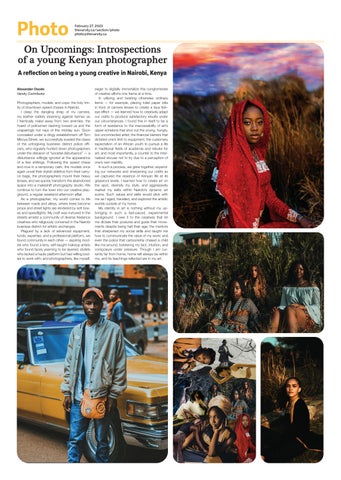
Photographers, models, and cops: the holy trinity of downtown speed chases in Nairobi. I clasp the dangling strap of my camera, my leather loafers steaming against tarmac as I frantically make away from two enemies: the hoard of policemen dashing toward us and the unsparingly hot rays of the midday sun. Soon concealed under a dingy establishment off Tom Mboya Street, we successfully evaded the claws of the unforgiving business district police officers, who regularly hunted down photographers under the delusion of “societal disturbance” — a disturbance willingly ignored at the appearance of a few shillings. Following the speed chase and now in a temporary calm, the models once again unveil their stylish stilettos from their carryon bags, the photographers mount their heavy lenses, and we quickly transform the abandoned space into a makeshift photography studio. We continue to turn the town into our creative playground, a regular weekend-afternoon affair. As a photographer, my world comes to life between roads and alleys, where trees become props and street lights are rendered by soft boxes and speedlights. My craft was nurtured in the streets amidst a community of diverse freelance creatives who religiously convened in the Nairobi business district for artistic exchanges. Plagued by a lack of advanced equipment, funds, expertise, and a professional platform, we found community in each other — aspiring models who found a lens; self-taught makeup artists who found faces yearning to be layered; stylists who lacked a haute platform but had willing bodies to work with; and photographers, like myself,
eager to digitally immortalize this conglomerate of creative efforts one frame at a time. In utilizing and twisting otherwise ordinary items — for example, placing toilet paper rolls in front of camera lenses to create a faux fisheye effect — we learned how to creatively adapt our crafts to produce satisfactory results under our circumstances. I found this in itself to be a form of resistance to the inaccessibility of art’s upper echelons that shut out the young, hungry, but unconnected artist; the financial barriers that dictated one’s limit to equipment; the customary expectation of an African youth to pursue a life in traditional fields of academia and rebuke for art; and most importantly, a counter to the internalized excuse not to try due to a perception of one’s own inability. In such a process, we grew together, expanding our networks and sharpening our crafts as we captured the essence of Kenyan life at its grassroot levels. I learned how to create art on the spot, diversify my style, and aggressively market my skills within Nairobi’s dynamic art scene. Such values and skills would stick with me as I aged, travelled, and explored the artistic worlds outside of my home. My identity in art is nothing without my upbringing in such a fast-paced, experimental background. I owe it to the creatives that let me dictate their postures and guide their movements despite being half their age; the mentors that sharpened my social skills and taught me how to communicate the value of my work; and even the police that cartoonishly chased a child like me around, bolstering my tact, intuition, and composure under pressure. Though I am currently far from home, home will always be within me, and its teachings reflected are in my art.