20
THE VARSITY
SCIENCE
science@thevarsity.ca
Lillian Dyck’s contribution to neuropsychiatry The George Gordon First Nation scientist examined how identity influences research Ashiana Sunderji Varsity Staff
The honourable Lillian Eva Quan Dyck, who is a member of the George Gordon First Nation, was born in 1945 to a Cree mother and a Chinese father. After completing a Bachelor of Arts, a Masters of Science in Biochemistry, and a PhD in Biological Psychiatry — all from the University of Saskatchewan — she went on to become a professor in the university’s Neuropsychiatry Research Unit. Notably, she is one of the first First Nations women in Canada to receive a PhD in the sciences. Dyck’s early life and early career In a 2013 interview, Dyck recalled how in her early life, her older brother Winston was physically and verbally bullied for being Chinese, and the siblings kept their Indigenous identity hidden to prevent further discrimination. Her professional success was similarly met with sexism and racism. She expressed that she received many comments that diminished her importance in her roles as a professor and associate dean at the University of Saskatchewan. Dyck was initially drawn to studying the intersection between biochemistry and alcoholism, prompted by the racist stereotype regarding Indigenous peoples’ susceptibility to alcoholism. She started off with research surrounding alcohol metabolism in Indigenous
peoples before shifting to research drugs later in her career and their mechanisms of action for treating strokes, Alzheimer’s disease, and schizophrenia. Quetiapine research In a paper published in July 2008, Dyck and her team reported on the effects of an antipsychotic drug, quetiapine, on patients with Alzheimer’s disease. As of September 2022, the FDA has approved this drug to treat schizophrenia, mania, and Major Depressive Disorder, and research has indicated its potential uses for anxiety that are not yet approved. One of the main physiological indicators of Alzheimer’s is the aggregation of amyloid beta protein plaques — clumps of proteins that disrupt the proper function of cells — in the brain. Dyck’s 2008 paper explains that quetiapine can reduce the cytotoxic oxidative stress that results from failure to detoxify reactive molecules in cells caused by amyloid beta plaques. Dyck’s research has also shown that quetiapine can reduce memory dysfunction, as well as the amyloid precursor proteins that can lead to Alzheimer’s in certain mice models. Further, they explained how the amyloid beta protein aggregates produce an unstable reactive hydroxide molecule (OH-), which causes a positive feedback loop for the increased formation of amyloid beta protein aggregates. Quetiapine is supposed to capture OH- and thus reduce protein aggregation.
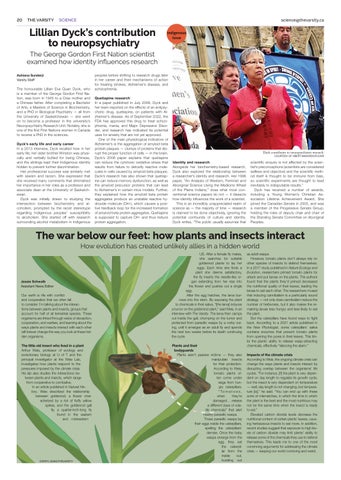
Dyck contributes to neuropsychiatry research. COURTESY OF OBERT MADONDO/FLICKR
Identity and research Alongside her biochemistry-based research, Dyck also explored the relationship between a researcher’s identity and research. Her 1996 paper, “An Analysis of Western, Feminist and Aboriginal Science Using the Medicine Wheel of the Plains Indians,” does what most conventional science papers do not — it dissects how identity influences the work of a scientist. This is an incredibly unappreciated realm of science as — the majority of time — research is claimed to be done objectively, ignoring the potential confounds of culture and identity. Dyck writes, “The public usually assumes that
scientific enquiry is not affected by the scientist’s preconceptions (scientists are considered selfless and objective) and the scientific method itself is thought to be immune from bias, so scientific experiments are thought to lead inevitably to indisputable results.” Dyck has received a number of awards, including a Young Women’s Christian Association Lifetime Achievement Award. She joined the Canadian Senate in 2005, and was a member of the Progressive Senate Group, holding the roles of deputy chair and chair of the Standing Senate Committee on Aboriginal Peoples.
The war below our feet: how plants and insects interact How evolution has created unlikely allies in a hidden world
Jessie Schwalb Assistant News Editor
Our earth is rife with conflict and cooperation that we often fail to consider. I’m talking about the interactions between plants and insects, groups that account for half of all terrestrial species. These organisms are linked through webs of deception, cooperation, and warfare, and learning about the ways plants and insects interact with each other will forever change the way you look at these hidden organisms. The little old insect who lived in a plant Arthur Weis, professor of ecology and evolutionary biology at U of T and the principal investigator at the Weis Lab, investigates how plants respond to the pressures imposed by the climate crisis. His lab also studies the interactions between plants and insects, which range from cooperative to combative. In an article published in Natural History, Weis described the relationship between goldenrod, a flower characterized by a riot of fluffy yellow spikes, and the goldenrod gall fly, a quarter-inch-long fly found in the eastern and midwestern
CHERYL NONG/THEVARSITY
US. After a female fly mates, she searches for suitable goldenrod plants to lay her eggs. Each time she finds a plant she deems satisfactory, the fly inserts the needle-like organ extending from her rear into the flower and pushes out a single egg. After the egg hatches, the larva burrows into the stem. By exposing the plant to chemicals in their saliva, “[the larva] induces a tumor on the goldenrod plant,” said Weis, in an interview with The Varsity. The larva then camps out inside the gall, chomping on the tumor and protected from parasitic wasps by a corky outing, until it emerges as an adult fly and spends the next two weeks before its death continuing the cycle. Plants and their bodyguards Plants aren’t passive victims — they also manipulate insects for their protection. According to Weis, tomato plants often come under siege from hungry caterpillars. “ To m a t o e s , when they’re damaged… release a different class of volatile chemicals” that alert nearby parasitic wasps. These parasitic wasps lay their eggs inside the caterpillars, spelling the caterpillars’ demise. Once the baby wasps emerge from the egg, they eat the caterpillar from the inside out, bursting out
as adult wasps. However, tomato plants don’t always rely on other species of insects to defend themselves. In a 2017 study published in Nature Ecology and Evolution, researchers primed tomato plants for attack and put larvae on the plants. The authors found that the plants they’d primed decreased the nutritional quality of their leaves, leading the larvae to eat each other. The researchers mused that inducing cannibalism is a particularly sound strategy — not only does cannibalism reduce the number of herbivores, but it also makes the remaining larvae less hungry and less likely to eat the plant. But the caterpillars have found ways to fight back. According to a 2021 article published in the New Phytologist, some caterpillars’ saliva contains enzymes that prevent tomato plants from opening the pores in their leaves. This limits the plants’ ability to release wasp-attracting chemicals, effectively “silencing the alarm.” Impacts of the climate crisis According to Weis, the ongoing climate crisis can change the ways plants and insects interact by disrupting overlap between the organisms’ life cycles. “For instance, [if] the plant is very dependent on day length to regulate its growth cycle, but the insect is very dependent on temperature — well, day length is not changing, but temperature [is],” he said. “You can end up with these sorts of mismatches, in which the time in which the plant is the best and the most nutritious may not be the same time when the insect is ready to eat.” Elevated carbon dioxide levels decrease the nutritional content of certain plants’ leaves, causing herbaceous insects to eat more. In addition, recent studies suggest that exposure to high levels of carbon dioxide may limit plants’ ability to release some of the chemicals they use to defend themselves. This leads me to one of the most convincing arguments for addressing the climate crisis — keeping our world conniving and weird.