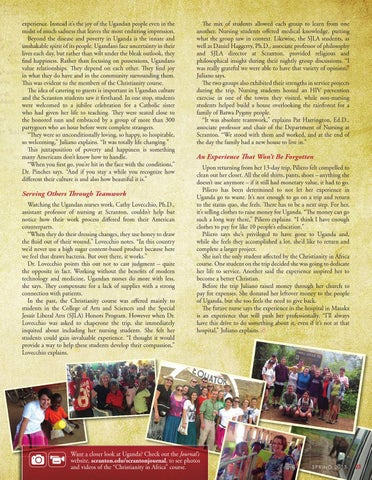
experience. Instead it’s the joy of the Ugandan people even in the midst of much sadness that leaves the most enduring impression. Beyond the disease and poverty in Uganda is the innate and unshakable spirit of its people. Ugandans face uncertainty in their lives each day, but rather than wilt under the bleak outlook, they find happiness. Rather than focusing on possessions, Ugandans value relationships. They depend on each other. They find joy in what they do have and in the community surrounding them. This was evident to the members of the Christianity course. The idea of catering to guests is important in Ugandan culture and the Scranton students saw it firsthand. In one stop, students were welcomed to a jubilee celebration for a Catholic sister who had given her life to teaching. They were seated close to the honored nun and embraced by a group of more than 300 partygoers who an hour before were complete strangers. “They were so unconditionally loving, so happy, so hospitable, so welcoming,” Juliano explains. “It was totally life changing.” This juxtaposition of poverty and happiness is something many Americans don’t know how to handle. “When you first go, you’re hit in the face with the conditions,” Dr. Pinches says. “And if you stay a while you recognize how different their culture is and also how beautiful it is.”
Serving Others Through Teamwork Watching the Ugandan nurses work, Cathy Lovecchio, Ph.D., assistant professor of nursing at Scranton, couldn’t help but notice how their work process differed from their American counterparts. “When they do their dressing changes, they use honey to draw the fluid out of their wound,” Lovecchio notes. “In this country we’d never use a high sugar content-based product because here we feel that draws bacteria. But over there, it works.” Dr. Lovecchio points this out not to cast judgment – quite the opposite in fact. Working without the benefits of modern technology and medicine, Ugandan nurses do more with less, she says. They compensate for a lack of supplies with a strong connection with patients. In the past, the Christianity course was offered mainly to students in the College of Arts and Sciences and the Special Jesuit Liberal Arts (SJLA) Honors Program. However when Dr. Lovecchio was asked to chaperone the trip, she immediately inquired about including her nursing students. She felt her students could gain invaluable experience. “I thought it would provide a way to help these students develop their compassion,” Lovecchio explains.
The mix of students allowed each group to learn from one another. Nursing students offered medical knowledge, putting what the group saw in context. Likewise, the SJLA students, as well as Daniel Haggerty, Ph.D., associate professor of philosophy and SJLA director at Scranton, provided religious and philosophical insight during their nightly group discussions. “I was really grateful we were able to have that variety of opinion,” Juliano says. The two groups also exhibited their strengths in service projects during the trip. Nursing students hosted an HIV prevention exercise in one of the towns they visited, while non-nursing students helped build a house overlooking the rainforest for a family of Batwa Pygmy people. “It was absolute teamwork,” explains Pat Harrington, Ed.D., associate professor and chair of the Department of Nursing at Scranton. “We stood with them and worked, and at the end of the day the family had a new house to live in.”
An Experience That Won’t Be Forgotten Upon returning from her 13-day trip, Piliero felt compelled to clean out her closet. All the old shirts, pants, shoes – anything she doesn’t use anymore – if it still had monetary value, it had to go. Piliero has been determined to not let her experience in Uganda go to waste. It’s not enough to go on a trip and return to the status quo, she feels. There has to be a next step. For her, it’s selling clothes to raise money for Uganda. “The money can go such a long way there,” Piliero explains. “I think I have enough clothes to pay for like 10 people’s education.” Piliero says she’s privileged to have gone to Uganda and, while she feels they accomplished a lot, she’d like to return and complete a larger project. She isn’t the only student affected by the Christianity in Africa course. One student on the trip decided she was going to dedicate her life to service. Another said the experience inspired her to become a better Christian. Before the trip Juliano raised money through her church to pay for expenses. She donated her leftover money to the people of Uganda, but she too feels the need to give back. The future nurse says the experience in the hospital in Masaka is an experience that will push her professionally. “I’ll always have this drive to do something about it, even if it’s not at that hospital,” Juliano explains.
Want a closer look at Uganda? Check out the Journal’s website, scranton.edu/scrantonjournal, to see photos and videos of the “Christianity in Africa” course.
S PRIN G 2013
23