The Tribune | Weekend | 25
Friday, November 4, 2016
Forgotten facts Paul C Aranha of the “Great Game”; and an adventure story involving a mystical and religious voyage of discovery. Kim’s trip with the Lama along the Grand Trunk Road is the first part of the great adventure story. While making this journey Kim is identified by his late father’s regimental chaplain by the Masonic emblem which he wears around his neck. Forcibly separated from the Lama he is sent to a good school financed by the Lama. After three years of schooling Kim is given a government appointment to begin his role in the “Great Game”, but before this happens he makes another long trip to the Himalayas with the Lama where the espionage and religious threads of the story collide. In an intriguing chapter Kim obtains maps and important papers from the Russians, who are working to undermine British control of the region. Kim delivers these to his employer and at story’s end the reader is left to decide on Kim’s future. The artistic triumph of Kipling’s novel is that there is no resolution either to the story or the political conflict. Indeed Kipling considered India to be unhappily subservient to Imperialism, but that it was India’s best destiny to be ruled by England. ‘Kim’ is a master work of Imperialism by an author at the peak of his literary powers. Although controversial today, the story is not a political tract. Kipling’s choice of the novel form to express himself and to engage with an India that he loved but could never properly be part of is its powerful central strand. It is a document of historical moment and a signpost along the turbulent road to August 15, 1947, Partition, and an Independence from which there was no return. ‘Kim’ was completed in Sussex, where Kipling lived until his death in 1936. It won him great fame and a large following. In 1907, he won the Nobel Prize for Literature, the first English language recipient. After the First World War, during which his son John was killed, Kipling’s vision darkened. His bleak visionary stories of England and its future, coupled with his eccentric animal and quasi-theological tales, influenced his reputation. When he died he was accorded the honours reserved by Britain for its greatest writers. Buried in Westminster Abbey, he has remained an institution in English Letters - respected and canonised but also imperceptibly contentious. NEXT WEEK: The troubled Bronte overshadowed by his famous sisters • Sir Christopher Ondaatje is an adventurer and writer resident in the Bahamas. A Sri Lankan-born Canadian-Englishman, he is the author of several books, including “The Last Colonial”. He acknowledges that he has quoted liberally from Edward Said’s 1987 Introduction to Kim.
How Oakes Field landed its name
A
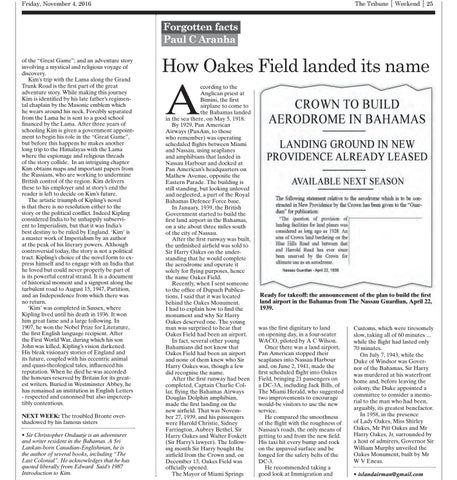
ccording to the Anglican priest at Bimini, the first airplane to come to the Bahamas landed in the sea there, on May 5, 1918. By 1929, Pan American Airways (PanAm, to those who remember) was operating scheduled flights between Miami and Nassau, using seaplanes and amphibians that landed in Nassau Harbour and docked at Pan American’s headquarters on Mathew Avenue, opposite the Eastern Parade. The building is still standing, but looking unloved and neglected, a part of the Royal Bahamas Defence Force base. In January, 1939, the British Government started to build the first land airport in the Bahamas, on a site about three miles south of the city of Nassau. After the first runway was built, the unfinished airfield was sold to Sir Harry Oakes on the understanding that he would complete the aerodrome and operate it solely for flying purposes, hence the name Oakes Field. Recently, when I sent someone to the office of Dupuch Publications, I said that it was located behind the Oakes Monument. I had to explain how to find the monument and why Sir Harry Oakes deserved one. The young man was surprised to hear that Oakes Field had been an airport. In fact, several other young Bahamians did not know that Oakes Field had been an airport and none of them knew who Sir Harry Oakes was, though a few did recognise the name. After the first runway had been completed, Captain Charlie Collar, flying the Bahamas Airways Douglas Dolphin amphibian, made the first landing on the new airfield. That was November 27, 1939, and his passengers were Harold Christie, Sidney Farrington, Aubrey Bethel, Sir Harry Oakes and Walter Foskett (Sir Harry’s lawyer). The following month Sir Harry bought the airfield from the Crown and, on December 13, Oakes Field was officially opened. The Mayor of Miami Springs
Ready for takeoff: the announcement of the plan to build the first land airport in the Bahamas from The Nassau Guardian, April 22, 1939. was the first dignitary to land on opening day, in a four-seater WACO, piloted by A C Wilson. Once there was a land airport, Pan American stopped their seaplanes into Nassau Harbour and, on June 2, 1941, made the first scheduled flight into Oakes Field, bringing 21 passengers on a DC-3A, including Jack Bills, of The Miami Herald, who suggested two improvements to encourage would-be visitors to use the new service. He compared the smoothness of the flight with the roughness of Nassau’s roads, the only means of getting to and from the new field. His taxi hit every bump and rock on the unpaved surface and he longed for the safety belts of the DC-3. He recommended taking a good look at Immigration and
Customs, which were tiresomely slow, taking all of 60 minutes ... while the flight had lasted only 70 minutes. On July 7, 1943, while the Duke of Windsor was Governor of the Bahamas, Sir Harry was murdered at his waterfront home and, before leaving the colony, the Duke appointed a committee to consider a memorial to the man who had been, arguably, its greatest benefactor. In 1958, in the presence of Lady Oakes, Miss Shirley Oakes, Mr Pitt Oakes and Mr Harry Oakes, Jr, surrounded by a host of admirers, Governor Sir William Murphy unveiled the Oakes Monument, built by Mr W V Eneas. • islandairman@gmail.com