24 | The Tribune | Weekend
Friday, May 6, 2016
mailboats ABOUT THE AUTHOR
A family legacy
T
CAPTAIN Eric Wiberg is a marine and naval historian, author and a maritime lawyer who grew up in Nassau in the 1970s and 1980s and is a regular visitor to The Bahamas. In 2009 Capt Wiberg began the first of three books on U-Boats in the Bahamas and Bermuda and in 2012 began a blog focusing on mailboats and their contribution to Bahamian history. He is the author of ‘Tanker Disasters’, ‘Round the World in the Wrong Season’ and ‘U-Boats in the Bahamas and Turks & Caicos’ and is working on a book about mailboats in the Bahamas. He is writing a series in The Tribune on the glorious history of mailboats, their place in island life, the characters that define them, the variety of craft, the dozens of islands they serve, the mailboat ‘dynasties’ and the challenges facing the modern fleet.
here are families in the Bahamas whose names are synonymous with mailboats and etched into the history of the service. Sir George William Kelly Roberts, from Harbour Island, was the head of one such dynasty. In the late 1920s, Sir George transformed and standardised the subsidisation of mailboats as well as financed the construction and operation of at least eight vessels. His contributions to Bahamian life extend beyond Eleuthera: he played a leading role in the political life of the country. Born in 1906, he died aged 57 and is buried on the grounds of the library named after him in his hometown of Dunmore Town. He purchased his first boat - the Alice Mabel - when he was 17 and followed with the Richard Campbell (1937), Gary Roberts (1940), Air Pheasant (1942), Drake (1942), Noel Roberts (1943), Air Swift (1943) and the Captain Roberts (1945). According to Anne and Jim Lawlor in their book “The Harbour Island Story”, they were owned under the holding company Richard Campbell Ltd of Nassau. Sir George was born on Harbour Island, the son of Captain George Campbell and Nellie Maud Roberts, whose ancestors arrived from Bermuda with the Eluetherian Adventurers in 1647. According to the Lawlors, as a young man George “sailed before the mast on the threemasted schooner Bentley under his father before moving to Nassau at the age of 12. As a self-made man he grew to own the City Lumber Yard”. He married Freda Genevieve Sawyer at Trinity Wesleyan Church in Nassau on January 7, 1929, when he was 23. Together they had three sons: Richard Campbell (in 1929), Gary William Kelly (born 1934), and Noel Sawyer Roberts (in 1938). From the late 1950s the family residence was “Lucky Hill” on Eastern Road, near Dick’s Point Road in eastern New Providence. Sir George was active in politics and served in the House of Assembly from 1935 to 1955, and as a member of the Executive Council between
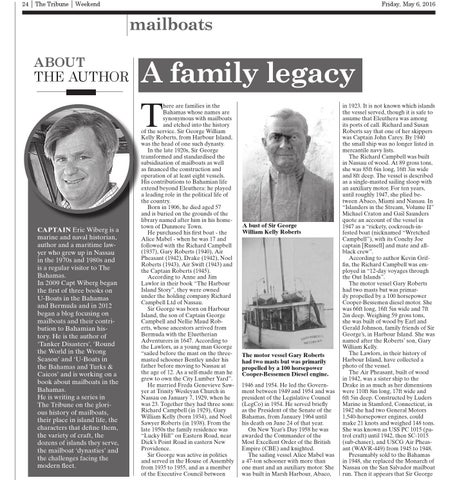
A bust of Sir George William Kelly Roberts
The motor vessel Gary Roberts had two masts but was primarily propelled by a 100 horsepower Cooper-Bessemen Diesel engine. 1946 and 1954. He led the Government between 1949 and 1954 and was president of the Legislative Council (LegCo) in 1954. He served briefly as the President of the Senate of the Bahamas, from January 1964 until his death on June 24 of that year. On New Year’s Day 1958 he was awarded the Commander of the Most Excellent Order of the British Empire (CBE) and knighted. The sailing vessel Alice Mabel was a 47-ton schooner with more than one mast and an auxiliary motor. She was built in Marsh Harbour, Abaco,
in 1923. It is not known which islands the vessel served, though it is safe to assume that Eleuthera was among its ports of call. Richard and Susan Roberts say that one of her skippers was Captain John Carey. By 1940 the small ship was no longer listed in mercantile navy lists. The Richard Campbell was built in Nassau of wood. At 89 gross tons, she was 85ft 6in long, 16ft 3in wide and 8ft deep. The vessel is described as a single-masted sailing sloop with an auxiliary motor. For ten years, until roughly 1947, she plied between Abaco, Miami and Nassau. In “Islanders in the Stream, Volume II” Michael Craton and Gail Saunders quote an account of the vessel in 1947 as a “rickety, cockroach-infested boat (nicknamed “Wretched Campbell”), with its Conchy Joe captain [Russell] and mate and allblack crew”. According to author Kevin Griffin, the Richard Campbell was employed in “12-day voyages through the Out Islands”. The motor vessel Gary Roberts had two masts but was primarily propelled by a 100 horsepower Cooper-Bessemen diesel motor. She was 66ft long, 16ft 5in wide and 7ft 2in deep. Weighing 59 gross tons, she was built of wood by Earl and Gerald Johnson, family friends of Sir George’s, in Harbour Island. She was named after the Roberts’ son, Gary William Kelly. The Lawlors, in their history of Harbour Island, have collected a photo of the vessel. The Air Pheasant, built of wood in 1942, was a sister ship to the Drake in as much as her dimensions were 110ft 8in long, 17ft wide and 6ft 5in deep. Constructed by Luders Marine in Stamford, Connecticut, in 1942 she had two General Motors 1,540-horsepower engines, could make 21 knots and weighed 148 tons. She was known as USS PC 1015 (patrol craft) until 1942, then SC-1015 (sub-chaser), and USCG Air Pheasant (WAVR-449) from 1945 to 1948. Presumably sold to the Bahamas in 1948, she replaced the Monarch of Nassau on the San Salvador mailboat run. Then it appears that Sir George