film & music \\ 14 {filmandmusic@thestrand.ca } THE STRAND | 15 MARCH 2012 “It’s getting harder and harder to find legitimate information on what’s going on out there. Docs, to me, have always been a great way of informing yourself.” The projection booth can play 35mm film as before, as well as HD tapes, digital files, and Blu-Ray. Smith even suggests that 3D might be an option further down the road. The flexible formats allow the Bloor to receive foreign prints from overseas filmmakers that never printed digital, or 16mm edited in someone’s basement, while still carrying industrystandard equipment to accommodate the major distributors. Those companies, while necessary to the success of Bloor 2.0, were also partly to blame for the cinema’s closure in 2011. Brothers Paul and Cam Bordonaro have owned the Bloor since the 70s, a transitional period from the ol’ single-screen neighbourhood theatre to 24-screen Cineplexes. “If [the distributors] had made a
delay of one year between releasing a film at the theatre and releasing on video,” argues Paul, with the all the ingrained frustration of a veteran exhibitor, “they could keep a vibrant movie theatre industry, but they’re willing to see this crash and burn as long as they can sell anywhere else.” He sees an adultery metaphor in how theatres are treated by Hollywood: “It would be like being married to someone for a hundred years, and then another girl comes along and then: ‘See ya!’” Nonetheless, the Bordonaros are optimistic about the new theatre and the architectural updates. The concession stand has been moved to the side of the lobby, which now ends in a glass pane looking out into the auditorium. The screen has been moved higher to allow for more stage events; clearly the Bloor now recognizes its role as host of Hot Docs, and all the galas and Q&A’s that come with that responsibility.
“You see a bad documentary, and you still come out with something. You see a bad fiction film, and you’ve just wasted an hour and a half of your life.”
ALEX GRIFFITH
F
or many months there has been a black hole in the heart of the Toronto cinephile, and that hole used to be the home of the Bloor Cinema in the Annex. The programming was a synthesis of the best: high-brow filmes you would find at TIFF Lightbox; American classics you’d always wanted to see on a 15foot screen; second-run releases that had bowed out of Cineplex weeks ago; and wonderfully awful or awfully wonderful cult hits to tear apart
your pretensions. Now, renovated and refurbished with seats inspired by Michael Moore’s Traverse City Film Festival Theatre, the Bloor Hot Docs Cinema is open again, its schedule docu-fied by programmer Robin Smith. On the steps of the theatre’s balcony, now outfitted with Dolby 7.1 speakers, Smith says the content will be “75 percent docs, 25 percent fictional films,” with improvisation and adjustments after the Hot Docs festival running 26 Apr.–6 May.
Smith studied film at York University (“I realized I was too pretentious to make films”) before working on the distribution side of the industry. “Docs always spoke to me really strongly.” He, like the other characters behind the Bloor’s comeback, speaks of documentaries with a visceral enthusiasm. Neil Tabatznik, head of investor group Blue Ice, remarked at a press conference that “you see a bad documentary, and you still come out with something. You see a bad fiction film, and you’ve just wasted an hour and a half of your life.” Smith adds:
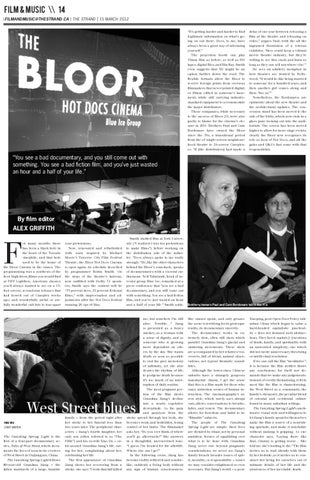
Brothers/owners Paul and Cam Bordonaro tell it like it is
me, but somehow I’m still alive. Terrible…” Jiang is presented as a heavy smoker, as a woman with a sense of dignity, and as someone who is growing more dependent on others by the day. She wants death as soon as possible to end the grey monotony of infirmity, yet she also desires the rhythm of life, to postpone death because it’s too much of an interruption of daily routine. The most poignant portion of the film shows Grandma Jiang’s decline into a nearly vegetative decrepitude. As the pain and paralysis from the stroke spread through her body, she becomes weak and bedridden, losing control of her limbs. The filmmaker asks her, “Do you ever think of where you’ll go afterwards?” She answers in a thoughtful, unconcerned tone: “I guess I’m headed for the afterlife. Where else can I go?” In the following scene, Jiang has become visibly withered and zombielike, suddenly a living body without any sign of human consciousness.
She cannot speak, and only groans: the scene is terrifying for its grotesque reality, its documentary sincerity. The documentary works in extremely slow, often still shots which parallel Grandma Jiang’s glacial and stuttering movements. These shots are accompanied by her relatives’ voiceovers, full of trivial, natural observations, not typical thematic soundbites. Although the lower-class Chinese suburbs have a strangely gorgeous ramshackle charm, I get the sense that this is a film made for those who enjoy unbroken scenes of human interaction. The cinematography’s atrest style, which rarely uses abrupt cuts, allows conversations to breathe, falter, and renew. The documentary allows for boredom and habit to be “filmable” subjects. The people of The Vanishing Spring Light are simple: their lives are dictated by ritual, not by personal ambition. Scenes of squabbling over what is to be done with Grandma Jiang never rise beyond pragmatic considerations; we never see Jiang’s family broach broader issues of spirit, morality, or responsibility — issues we may consider enlightened or even necessary. But Jiang’s world — a post-
West Street blues FAN WU staff writer
The Vanishing Spring Light is the first of a four-part documentary series, Tales of West Street, which documents the lives of soon-to-be evictees of West Street in Dujiangyan, China. The Vanishing Spring Light follows 80-year-old Grandma Jiang — the fallen matriarch of a large, humble
family — from the period right after her stroke to her funeral less than two years later. The peripheral characters — Jiang’s fourth daughter, her only son (often referred to as “The Fifth”) and his ex-wife Xiao Da — orbit around Grandma Jiang’s life, caring for her, complaining about her, celebrating her life. The first appearance of Grandma Jiang shows her recovering from a stroke: she says “I wish that fall killed
LEILA KENT
LEILA KENT
By film editor
Xiaoping, post-Open Door Policy suburban China which began to value a hard-headed capitalistic practicality — does not demand such abstractions. They faced capital-Q Questions of death, family, and spirituality with an unworried simplicity, one which did not invite unnecessary theorizing or intellectual resolution. If we can call the film “meditative”, it is because the film neither draws any conclusions for itself nor demands that we make any judgements. Instead of overtly thematizing, it feels most like the film is characterizing: the West Street as a community, the family’s chemistry, the peculiar blend of oriental and occidental culture found in many suburban settings. The Vanishing Spring Light’s unobtrusive visual style and willingness to let Jiang’s family speak for themselves make the film a source of a nourishing quietude, and make it watchable without making it gripping. As one character says, “Laying there like that, Granny is getting worse… She told me she’s waiting to die.” The film invites us to wait silently with them by her bedside, as it invites us to construct her being for ourselves out of intimate details of her life and the awareness of her inevitable death.