VOL. XXIX NO. 341 3 Sections 32 Pages P18 TUESday : JaNUaRy 19, 2016 www.thestandard.com.ph editorial@thestandard.com.ph
Pump prices cut by P1.10
A5
‘Pnoy did notHing to stoP massacre’ By Macon Ramos-araneta and Sandy araneta
PRESIDENT Benigno Aquino III “did not do anything at all” while the 44 Special Action Force commandos were being slaughtered by Muslim rebels in Mamasapano, and some Cabinet officials lied to the Senate panel investigating the massacre last year, Senator Juan Ponce Enrile said Monday. On the Senate floor, Enrile said he could prove that Aquino “actively and directly” involved
himself in the planning and execution of Operation Exodus, the ill-fated covert police
operation to neutralize two highprofile terrorists in Mamasapano in Maguindanao on Jan. 25, 2015. On that day, the President was monitoring the operation while on board a plane headed to Zamboanga, Enrile said. “I want to put this on record,” the 91-year-old senator said when he took the floor. Enrile’s remarks came in response to an attempt by Senate President Franklin Drilon to block the introduction of new informa-
tion during the reopening of the Senate investigation of the Mamasapano debacle. Drilon had argued that the Senate committee on rules had approved Enrile’s motion to reopen the investigation but never mentioned new matters. In seeking new hearings, Enrile said he was unable to ask questions during last year’s hearings because he was under hospital arrest at the PNP General Hospital in Camp Crame, where SAF members who
survived the Mamasapano debacle were also confined. Enrile would not say if his new information came from the SAF survivors at the PNP hospital, but said the family of the SAF survivors came to him and he talked to them about the incident. Senate Majority Leader Alan Peter Cayetano, chairman of the committee on rules, said the results of the earlier Mamasapano hearings would not be voided because good faith was ascribed to Enrile. Next page
Condemnation. Members of the Kilusang Mayo Uno condemn President Benigno Aquino III’s veto of a bill granting a P2,000 increase to the Social Security System’s pensioners during a protest rally in Mendiola, Manila, on Monday. Danny Pata
Roxas also rejects SSS pension increase By John Paolo Bencito ADMINISTRATION standard bearer Manuel Roxas II said Monday he opposed raising Social Security System pensions for retirees by P2,000 and said President Aquino III was right in vetoing the bill that proposed it. “All of our decisions and actions will have an effect,” Roxas said. “What
is important here is the reason, and I would agree and support that it isn’t correct, unjust, and certainly not a part of Daang Matuwid that for political points, because we have elections, that we will destroy the future of more than 31 million who contribute to the SSS.” “According to experts, the SSS would be in a brink of bankruptcy if we will do this. We’re good for one, two, three
years, but the pension funds of those who contribute will be destroyed. So, what’s right there? Will we do this just for political points only? I will not agree on this,” Roxas said, echoing the President. Aquino vetoed the bill that would have raised pensions for some 2.1-million retirees by P2,000 across the board, saying he was looking out for the 31-million SSS members. Next page
UK, PH discuss defense accord
A4
t u e s D AY : J A N u A R Y 1 9, 2 0 1 6
A2
news
editorial@thestandard.com.ph
Jakarta terrorists used PH guns By Francisco Tuyay and Sandy Araneta
THE guns used by terrorists in last week’s attacks in Jakarta may have been smuggled into Indonesia from Mindanao, where gun running thrives despite tightened security measures, a spokesman of the Moro National Liberation Front said Monday. War is a business,” MNLF spokesman Absalom Cerveza said, noting that weapons can easily be smuggled into Indonesia given its vast shoreline, which is difficult to monitor. Indonesian police said Sunday the guns seized from the Jakarta attackers likely originated from the Philippines, a report the Palace said it was still verifying. Police, meanwhile, said they were investigating who was behind an attempt to smuggle improvised
PNoy... From A1
But Drilon said he still had his reservations on the new matters and insisted that this should be cited by Enrile in his manifestation. At this juncture, Enrile reiterated his manifestation for reopening the hearings before the committee on public order headed by Senator Grace Poe. He then said the President did nothing to rescue the SAF members. The leader of the opposition also said he will show that some Cabinet members who appeared before the Senate hearing did not disclose facts they knew. Among the Cabinet officials who testified last year was then Interior Secretary Manuel Roxas II, who is now running for president under the administration banner. Roxas testified last year that he was kept out of the loop on the covert operation. Enrile also ruled out holding a closed-door session on the Mamasapano massacre. “My question—was there a national security matter in the Mamasapano [case]? None. This is a police operation, the enforcement of criminal law. The basis of the operation was the enforcement of a warrant of arrest. What is the national security [matter] here?” Enrile said on the floor. “What are we talking about national security? I have handled national security for 17 years,” Enrile said in a separate interview before the session. “Why [hold a] closed door [session]? We are supposed to be transparent, Daang Matuwid,” he said. “We are not hiding anything here. We’re saying the truth will set us free.” He said his only objective in seeking for the resumption was to know the truth and to know if there were people lying to the country. “That’s all. If they are not lying, they have nothing to say. If they did not lie, they have no worry. If they performed their job in office, they have no worry,” Enrile said. In her committee report last year, Poe said Aquino was ultimately responsible for the death of the 44 police commandos in Mamasapano.
bombs and bomb-making components into Zamboanga City. The bombs and components were found in an abandoned motor boat Saturday. While Absalom said the guns used in Jakarta might have been sold by gun runners or unscrupulous soldiers, MNLF commander Samer Samsudin said the weapons came from members of the Bangsamoro Islamic Freedom Fighters, a group that broke away from the Moro Islamic Liberation Front.
Samsudin said some BIFF fighters had even participated in the grenade and gun attack at the Thamrin district, an entertainment and shopping area in Jakarta. The spokesman for the Armed Forces, Brig. Gen. Restituto Padilla, said they have not received reports from their counterparts in Indonesia relating to reports that the seized guns came from the Philippines. “We were surprised about it,” he said. In Malacañang, Communications Secretary Herminio Coloma Jr. said they were still trying to verify the report in the Wall Street Journal. The report quoted Indonesian police spokesman Anton Charliyan as saying that nine guns seized in counterterrorism raids around the country since Thursday’s attack were also likely to have come from the Philippines.
The Palace on Monday said they have been open and forthcoming in the Senate investigation. “The Senate is at liberty to determine how it wants to conduct the planned reopening of the inquiry,” said Communications Secretary Herminio Coloma Jr. “Records will show that the Executive branch had always been open and forthcoming in addressing all questions pertaining to the Mamasapano incident,” he added. Enrile vowed to delve into the liability of the President in the deaths of the 44 police commandos when the hearings reopen. “He is the President until the end of his term and he has accountability over the events that transpired during his entire term,” Enrile said. “It is irrelevant whatever the time he has left in his term. He is the President, period. He has the ultimate responsibility and accountability for the incident,” he added. The Senate committee on public order and dangerous drugs has set the hearing on Jan. 27. Enrile said his motion to reopen the Mamasapano inquiry had nothing to do with politics and said he had no ax to grind against Aquino. But he said he wanted Aquino to attend the hearing to explain his actions or inaction which may have led to the deaths of the 44 commandos. Also on Monday, Senator Ferdinand Marcos Jr. said unfulfilled government promises and the cries for justice from the families of the SAF 44 justified the reopening of the Senate investigation. “Almost a year has passed after the Mamasapano massacre and yet we continue to hear complaints from some of the kin of the SAF 44 that they have yet to receive the assistance the government promised to them,” Marcos said. Marcos said the complaint of two widows rab counter to the statement the Philippine National Police last July claiming they have provided about P80 million in cash aid for all the kin of the SAF 44 as well as scholarship benefits for children of the slain policemen. “But what the families of the SAF 44 are asking most from the government is justice for their loved ones. Yet until now no case has been filed in court to prosecute those responsible,” Marcos added.
Charliyan said information about the origin of the weapons came from some of the 12 people arrested in the raids. Four attackers and four civilians died during the Thursday attack in Jakarta, the first major terrorist action in Indonesia’s capital since 2009. Islamic State has claimed responsibility for the attacks, and police said funding for the attacks came from Islamic State in Syria. Police also said they didn’t know whether there was any connection between the attacks in Jakarta and four arrests made over the weekend in Malaysia. Police detained four people between Jan. 11 and 15 in Kuala Lumpur and neighboring Selangor state on suspicions that they were planning an attack and that they had connections to IS. As Congress resumed session Monday, the government’s chief peace negotiator with the Muslim
Roxas...
From A1
In doing so, he argued that the bill would seriously damage the stability of the SSS. “The government would be irresponsible if it allowed the depletion of the funds,” Press Secretary Herminio Coloma Jr. said in a statement, quoting Aquino. Despite the flak the decision has drawn, Roxas said approving the bill would lead them astray from the policy of Daang Matuwid or the straight path because it would harm the sustainability of the fund. “Daang Matuwid is making decisions on things that would do better in the long run and in the broader sense for the betterment of our countrymen and the whole country,” he said. Roxas added, however, that this did not mean that the government should not help SSS pensioners. Like Aquino, he proposed alternatives to the P2,000 increase in pensions, including offering them “one-time relief” and enrolling them in the government’s health insurance program. “What I am saying is that, the assistance that the government can give should be backed by a strong financial foundation for the SSS,” Roxas said. Roxas said that he isn’t afraid for a backlash as a result of the President’s veto. “You know if you have done the right thing, you have nothing to worry about. I’ve done what is right, PNoy [Aquino] did what is right, what should he worry about? In leadership not all decisions would be popular. But there are right and wrong decisions. We will go to the right thing, and that is Daang Matuwid,” he said. House Speaker Feliciano Belmonte Jr. on Monday blasted the leadership of the SSS for not exerting enough effort to push through a companion
bill that would enable them to raise membership premiums to fund the pension benefits. “The SSS was too timid,” Belmonte said. “They should have been more aggressive.” Belmonte said the SSS also failed to send representatives to Congress when lawmakers were debating the measure. “If I were in the SSS, I’d have done my best to be here during congressional deliberations, not just sending a legal officer,” said Belmonte, who used to head the Government Service Insurance System. Former Iloilo Rep. Augusto Syjuco Jr. urged the Office of the Ombudsman to hold SSS officials responsible for allowing the agency to go bankrupt. As a taxpayer for and in behalf of the 2.15-million SSS pensioners, Syjuco asked the Ombudsman to investigate the case. “With the veto by the President, it now comes to our attention that SSS is not capable to implement the pension increase because of its precarious financial condition,” his complaint read Also on Monday, senatorial candidate Leyte Rep. Martin Romualdez urged House leaders to rally behind a proposal that would provide an alternative to the vetoed pension increase. Romualdez said Congress should work for the passage of another bill in the remaining session days of the 16th Congress as a show of malasakit or compassion to senior citizenmembers of state-run pension agency. “Congress should not ignore the strong clamor to increase the pensions of SSS members. We can push for the approval of another bill that would be acceptable to all stakeholders,” said Romualdez, who heads the independent minority bloc in the House. The leftist bloc in the House, meanwhile, condemned Aquino for his refusal to allocate funds to increase SSS pensions and called on lawmakers to override his veto. House leaders have already
rebels, Miriam Coronel Ferrer, made a renewed pitch for the passage of the Bangsamoro Basic Law, saying it would help address terrorism. “The Comprehensive Agreement on the Bangsamoro and the draft Bangsamoro law are social justice measures, but from the global security perspective, these are also a containment measure against jihadist extremism,” Ferrer said. “I reiterate our appeal to our legislators...in view of the recent violence in Indonesia,” she said. Earlier, National Security Adviser Cesar Garcia said the BBL would help curb the spread of extremism in Mindanao. “In particular, the Bangsamoro government would be able to help moderate Islamic leaders to counter the ideology of radicalism being promoted by the Islamic State and steer the Muslim community away from ISIS influence,” Garcia said. PNA
rejected an override, however, saying it was “next to impossible.” “The main reason President Aquino vetoed the bill is now clear—he just does not want to allocate funds for SSS. The SSS fund life argument has been raised many times during the hearings and we have studied their arguments including their report that they will have a deficit of P4 billion if the pension is increased by P2,000,” said Bayan Muna party-list Rep. Neri Colmenares, the principal author of the SSS pension hike bill. “We have maintained in these hearings that the SSS should increase collection and eliminate unnecessary expenses but if these are still insufficient to cover this, then government should allocate funds to cover the deficit,” Colmenares added. 1-BAP party-list Rep. Silvestre Bello III also criticized the President’s veto and said Congress had the power to reverse his decision. “If Congress honestly wants to override the veto of the President, [it can do so by all means]. Time is no problem,” Bello said. SSS president and chief executive Emilio de Quiros Jr. said Monday the SSS would agree to raise monthly pensions if contributions are raised from the present 11 percent to as much as 15.8 percent. In a news briefing, De Quiros said the life of the fund would be depleted in 11 years if the monthly increase in pension were granted without an equivalent adjustment in premiums. De Quiros said in comparison, the GSIS, the pension fund for government employees, imposes a contribution rate of 21 percent. He added that other countries such as Vietnam, Malaysia and Singapore require members to contribute at least 20 percent of their base income to the pension fund. With Maricel V. Cruz, Roderick T. dela Cruz and Rio N. Araja
T U E S D AY : J A N U A R Y 1 9, 2 0 1 6
A3
NEWS
editorial@thestandard.com.ph
Poe camp to answer Tatad’s new charge
Gridlock. The traffic was heavy as usual along Edsa and Quezon City on Monday morning. Jansen RomeRo
State’s health program deteriorating, says Binay VICE President Jejomar Binay on Monday criticized the government’s health program, saying the health services in the country had deteriorated as its health policies had been an additional burden to the poor instead of helping them. “It is very sad that an ordinary worker gets a big tax cut but receives little assistance particularly from government health service,” Binay’s spokesman Joey Salgado said. Citing a report from IBON Foundation, Salgado said PhilHealth members were still shelling out large amounts of money for confinement, medicine and other medical needs, and that was defeating the purpose of PhilHealth membership. “Health services have not improved at all and have even became more costly to the public,” Salgado said. “A Binay administration will improve the PhilHealth system and will develop and implement a comprehensive health program with emphasis on preventive health care that is accessible to Filipinos.”
Meanwhile, Binay expressed surprise on Monday over the reported jeering at him during the Sinulog celebration in Cebu City. Only a handful hecklers made a scene when they booed Binay as he greeted the Cebuanos who were celebrating the Sinulog festival on Sunday, contrary to what was published by a pro-administration daily. “I did not hear it,” Binay said. Salgado said a Binay administration would allot more money to the health program to provide more medicines and equipment to health centers and hospitals. He cited a Philippine National Health Accounts report in 2013 that said patients still had to shell out almost 70 percent of their money for health expenditures. “IBON said this is contrary to the
administration’s claim that through PhilHealth, families belonging to the poorest or 20 percent of the population will not have to shell out a single centavo for public hospital services due to PhilHealth in 2012,” Salgado said. “The research group added that this number had risen to 40 percent in 2014.” The study showed that most of the PhilHealth beneficiaries interviewed said they still had to buy medical equipment prescribed by doctors and nurses and which were not provided by the hospital. Those equipment included breathing tubes, intravenous therapy materials such as needles, syringes, dextrose, surgical materials, birthing materials, urine bags, catheters, blood-transfusion-related materials, oxygen masks, ampoule and vials, gloves and cleaning implements. The beneficiaries also bought medicine outside the hospital as these were not available in the hospital’s pharmacy. These included antibiotics, anti-inflammatory drugs and drugs for pneumonia, tu-
berculosis, cough, allergies, dialysis, pain and fever. While paying patients “had a positive attitude towards PhilHealth,” they complained of poor ventilation, lack of cleanliness, noise in the wards, smelly toilets and lack of beds in the health facilities, IBON said. “The health program we offer to our people supports our broad goal to attain inclusive and sustainable growth through intensive jobs-creation activities and expanded social services,” Salgado said. He said it was sad that IBON also noted that “the objective of socialized subsidy is not being achieved with Lifetime members receiving the highest benefit payment per beneficiary on average (P1,259.52), and Sponsored Program members composed of poorer beneficiaries receiving the lowest benefit payment (P572.71) in 2013.” It was sadder to note, Salgado said, that the study showed “PhilHealth has also not guaranteed reduced or zero out-of-pocket expenditures.” Vito Barcelo and Junex Doronio
THE camp of independent presidential candidate Grace Poe said Monday they will answer former Senator Francisco Tatad’s plea before the Supreme Court asking it to investigate her latest TV ad that delved on her disqualification cases. “We will see to that. We will answer his allegations, said Valenzuela Mayor Rex Gatchalian, Poe’s spokesman. “All ads go through the scrutiny of the respective networks’ ethics committees. A network will not allow any ad to air if it doesn’t meet the legal and ethical standards of the network.” Gatchalian said Poe’s ads merely reflected the sentiments of her supporters. “They simply explain that Senator Poe remains in the running in the coming elections contrary to what some quarters are spreading,” Gatchalian said. Meanwhile, Poe said Monday she wanted the Commission on Higher Education to explain how it could possibly fail to spend P1.23 billion from its 2014 budget, which was meant for financial assistance programs, when millions of poor Filipinos were unable to afford college education. “This is an injustice to the students who should have benefited from the amount that was not spent by CHED. They were deprived of educational aid from the State because of the failure of the commission to do its job,” Poe said. The Philippine Statistics Authority says there are four million outof-school youth in the country, and of those 19 percent cite insufficient family income as the main reason for forfeiting their education. CHED itself said in a 2010 media report that two out of five high school graduates were unable to go to college because of the high cost of tertiary education, Poe said. “It is the government’s responsibility to make education affordable and accessible especially to the poor,” Poe said. She said CHED officials should explain how they failed to monitor and evaluate the financial transactions made by CHED’s central and regional offices. macon Ramos-araneta
Estrada clan divided on who to back THE Ejercito-Estrada political clan of San Juan appeared divided Monday over which candidate to support in this year’s elections after Mayor Guia Gomez of San Juan decided to back Manuel Roxas II instead of Senator Grace Poe for the presidency. Gomez, who made the announcement in San Juan on the same day, said her decision to support Roxas was not binding on the other family members including her son Senator JV Ejercito and Manila Mayor Joseph Estrada. “Well, yes. The family may be split, but I’m already decided—I have already made up my mind,” Gomez told reporters. She said her decision stemmed from the help that the former Interior secretary had extended to her city. “She’s [Poe] too young. I feel that maybe she should run first for vice president,” Gomez said. Ejercito said that while he respected his mother’s decision to support Roxas, he would remain supportive of Poe.
“My mother and I had experienced sleepless nights as most of the presidentiables are all close to us. She has her own reasons, and I do not see anything wrong with this,” he said. But Mayor Estrada has yet to announce whom to support for 2016. On Saturday, Roxas’ wife, former broadcaster Korina Sanchez, posted social media messages hinting that the administration standard bearer might have finally gotten the support of the Estrada patriarch. Sanchez, in her Instagram account, posted a photo of her and Estrada when they were both in Tondo, Manila, for the Feast of the Santo Niño. “Korina, I will always tell everyone that I think Mar Roxas is the most qualified to become president,” Sanchez quoted Estrada as saying. But Gomez said the former President had always been inclined to support the opposition bet. Ejercito said his father was thinking of supporting “the candidacy of either Senator Grace Poe or Vice President Jejomar Binay.” John Paolo Bencito
exercise. Members of the Quezon City police conducted an exercise along Edsa and Ortigas on Monday following a nationwide alert after the terror attack in Jakarta. Jansen RomeRo
T U E S D AY : J A N U A R Y 1 9, 2 0 1 6
A4
NEWS
editorial@thestandard.com.ph
PH, UK eye new defense pact By Vito Barcelo
Turkish firm gets P700-m contract By Florante S. Solmerin
THE Philippines and the United Kingdom have agreed to forge a defense agreement that will expand military, security and disaster response cooperation between the two countries, British Ambassador Asif Ahmad said Monday.
A BIDS and Awards Committee of the Department of National Defense has awarded the Aselsan A.S, an electronics defense firm based in Turkey, the P1.116billion contract to purchase 4,464 night-vision monoculars worth P250,000 each. The BAC, headed by retired general Assistant Secretary Ernesto Boac, said Aselsan tendered a bid of a little more than P700 million, P300 million lower than the bid of Armasight Enterprises last Thursday. Aselsan was represented by Murat Unluturk, owner of the Defense Marketing Consultancy, associate Civan Uzcivanuglu and two others. Aselsan’s local partner is System Nomics Philippines Inc. led by Alan Mendoza, who is also the subject of an arms smuggling case filed before the Ombudsman by Romulo Maningding, a former police general who became a defense contractor upon retirement. Maningding’s lawsuit stemmed from a separate billion-peso contract on the purchase of fuses for heavy artillery that was awarded to another Turkish firm, Mechanical And Chemical Industry Corp., which allegedly used fake export licenses from the United States State Department. In his complaint before the Ombudsman, Maningding claimed to be a former local representative of MKEK and its partner Defense Marketing Consultancy, until he exposed the use of the fake US licenses.
Ahmad said the new pact will be more substantive and will address the dearth in ambition of the old one agreement, but it will “not be as complicated” as the agreements the Philippines has with its treaty allies, the United States and Australia. “It’s not VFA,” Ahmad said, referring to the Visiting Forces Agreement with the US. “I won’t describe it as British troops coming here because that sounds a bit emotive. It’s British expertise coming here.” The ambassador did not reveal details, but said the countries are already exchanging drafts that present “a range of options and capabilities that we actually have and it is then up to the Philippine government to decide.” Ahmad said the UK wanted to “expand its scope a little bit” to cover some of the lessons its military learned when they were bringing aid to the victims of Typhoon ‘‘Yolanda’’ in 2014. “We have too many written protocols to have these done,” he said. “We treat it more like an umbrella under which we can do many, many things, but at least there is permission within that.” Ahmad said the new accord was one of the points agreed by British Foreign Minister Philip Hammond and Foreign Affairs Secretary Albert del Rosario earlier this month. “I don’t want to put a timetable but I think well before October. We are just exchanging drafts,” Ahmad said. Ahmad announced the new agreement as the Civil Aviation Authority of the Philippines said it will install navigational equipment beside the Rancudo Airfield at Pag-asa Island. The CAAP said the agency will lease a 200 sq.m parcel of land beside the airport runway for the installation of Automatic Dependent Surveillance-Broadcast equipment in a 200 sq. m land beside the runway of Rancudo airfield at Pag-asa Island. The technology is a system that an aircraft use to determine their location via satellite navigation and makes flying significantly safer by providing pilots with improved situational awareness.
Prayer protest. An offspring of one of the members of the Justice for Mercy and Truth holds up a placard asking the Supreme Court to stop the Commission on Elections from excluding their presidential bet, engineer Juanita Mendoza-Trocenio, from running in the coming elections. DANNY PATA
Caguioa tops JBC shortlist By Rey E. Requejo A CHILDHOOD classmate of President Benigno Aquino III topped the Judicial and Bar Council shortlist of nominees to replace Associate Justice Martin Villarama Jr. who retired last Friday. During its regular meeting on Monday, the seven-member JBC, chaired by Chief Justice Ma. Lourdes Sereno, approved the shortlist composed of Justice Secretary Alfredo Benjamin Caguioa, Court of Appeals Presiding Justice Andres Reyes Jr., CA Associate Justices Jose Reyes Jr. and Apolinario Bruselas Jr., and former Commission on Audit chairperson Ma. Gracia Pulido-Tan. Caguioa, Presiding Justice Reyes and Justice Reyes garnered the unanimous approval of all seven members of the council tasked to vet nominees to judicial posts. Of the shortlisted nominees, Caguioa, who served as President Aquino’s chief
legal counsel before being appointed Justice Secretary and his classmate from elementary to college, is said to be the top contender for the SC post. Caguioa took up economics and later law at the Ateneo, where he was a classmate and close friend of Executive Secretary Paquito Ochoa Jr., Budget Secretary Florencio Abad, Internal Revenue commissioner Kim Henares, Senator Teofisto Guingona III, among many others. Son of the late Court of Appeals Justice Eduardo Caguioa, he was a senior partner of the Caguioa and Gatmaytan law office. Prior to passing the Bar in 1986, he obtained his law degree from the Ateneo de Manila law school in 1985, along with several members of the current Aquino administration. He joined SyCip Salazar Hernandez & Gatmaitan in 1986 and was a partner there from 1994 until February 2007. Caguioa went on leave for a year in 1987 to join his father in handling appeal cases in the CA and the Supreme Court.
Eucharistic Congress stamps. An employee of the Philippine Postal Corp. shows
a sheet of commemorative stamps that will be issued in conjunction with the 51st International Eucharistic Congress that will be held in Cebu starting Jan. 25. DANNY PATA
T U E S D AY : J A N U A R Y 1 9, 2 0 1 6
A5
NEWS
editorial@thestandard.com.ph
Outages in May dim poll prospects By Maricel V. Cruz
Wage hike. Health workers join government employees in a protest rally outside the Senate office in Pasay City to denounce the salary standardization law, saying this will not uplift the welfare of state workers. LINO SANTOS
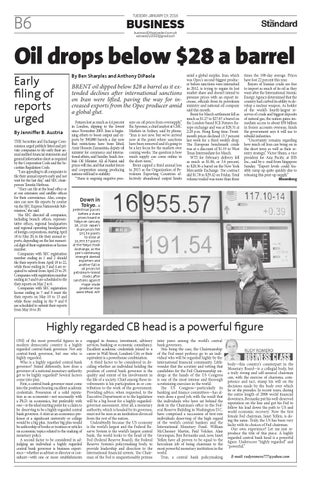
Pump-price rollback: Gas cheaper by P1.10 By Alena Mae S. Flores The country’s oil firms reduced prices by as much as P1.45 per liter to reflect the softening world oil prices. Pump prices of gasoline went down by rates ranging from P1 to P1.10 per liter, kerosene by P1.25 per liter and diesel by P1.45 to P1.50 per liter. eastern Petroleum Corp. cut prices starting 6 a.m. Monday but the other companies slashed prices starting 12:01 a.m. Tuesday. Fernando Martinez, eastern Petroleum chairman and chief
executive attributed the latest price cut to the continuous downtrend in world oil market following the lifting of sanctions on Iran’s export. “Analysts even forecast the lifting of sanctions on Iran would result in a further downward pressure on oil and commodities in the near term,” Martinez said.
Pilipinas shell Petroleum Corp., Petron Corp., PTT Philippines, seaoil Philippines, Phoenix Petroleum Philippines, among others issued their respective price advisories. “Petron will implement the following price rollbacks effective 12:01 a.m. January 19. Blaze 100, XCs, Xtra Advance and super Xtra by P1 per liter, Turbo Diesel and DieselMax by P1.45 per liter and kerosene by P1.25 per liter. These reflect movements in the international oil market,” the country’s biggest oil firm said. World oil prices have been going down this January, pulling
a low of $27 per barrel due to fresh concerns over China’s economy that added to persistent reports of huge storage overhangs, nearrecord production and slowing demand that have already dragged prices lower. Reports of an increase in us petroleum stockpiles also pulled down prices. Diesel prices in Metro Manila now range from P17.78 to P21.60 per liter while gasoline ranges from P32.20 to P39.55 per liter. Last Jan. 12, most oil firms also implemented price rollbacks of P0.10 per liter for gasoline and P0.70 per liter for both diesel and kerosene.
A House leader on Monday expressed concern that brownouts in May elections will likely occur due to the series of bombings on transmission towers in Mindanao Cagayan de oro Rep. Rufus Rodriguez lamented that it has been a year and still the mastermind has not been unmasked. Rodriguez said the situation demands that President Benigno Aquino III should convene a national security meeting to avert any power crisis during the crucial weeks before the May 9 elections. “We are facing the May 9 elections. What will happen if we do not have supply? How can we have elections that will be credible?” Rodriguez said at a congressional hearing Monday. The House energy committee, chaired by oriental Mindoro Rep. Rey umali, led the briefing by the Department of energy and the National Grid Corporation of the Philippines on the “sustainable Power Development Plan and Transmission Development Plan,” with focus on Mindanao, in light of the recent bombing of power transmission towers in Lanao del sur, Mindanao. since January 2015, a total of 18 towers of the NGCP have been bombed by unidentified men. Rodriguez warned that the country might be facing “a failure of elections in Mindanao comprising of 22-million people or 11-million votes.” The region has a total voting population of 12.6 million, the Commission on elections said. During the hearing, Doe undersecretary Mylene Capongcol said the government is looking at the possibility of creating a task force to handle the what Rodriguez described as “approaching crisis proportion” situation.
Govt sets March sale of P65-b lands One new train for MRT the Finance Department-led Privatization Council are the seVeN pieces of prime real estate Benedicto-owned 5,161 sq. m worth P65.8 billion sequestered by land in Legazpi City, Albay and the government allegedly sourced another 5,952 sq. m land in Naga from ill-gotten wealth will be put City, Camarines sur that were up for public bidding in March this surrendered to the PCGG by virtue year following the approval for their of the Compromise Agreement sale by the Privatization Council, between PCGG and former the Presidential Commission on Ambassador Roberto s. Benedicto. Benedicto served as the Good Government said on Monday. Three lots forfeited from former Philippines’ ambassador to Japan National Bureau of Investigation for six years in the early 1970s. Another plot of land will be Director Jolly Bugarin, including a 2,335 sq. m. land located in Tagaytay sold in Caloocan City, ceded to the City and parcels of land in Puerto Republic/PCGG by virtue of a 1994 Galera by virtue of supreme Court Compromise Agreement between PCGG and spouses Alejo and Teresita decision dated 6 August 2012. Bugarin, during his incumbency Ganut. Ganut served as the aide and as a director under the Marcos valet of former President Marcos. Last for sale is the 1,146 sq. m administration from 1967 to 1986, was able to acquire the real estate Wigwam Compound property in Baguio that was ceded to the property. Also approved for sale by government by Jose Y. Campos in
By John Paolo Bencito
March 1986. Campos also voluntarily surrendered the 18-hectare Payanig sa Pasig property whose ownership rights are still being tried at courts. PCGG Chairman Richard T. Amurao said that he “welcomes the approval granted by the Privatization Council on the said properties and he expressed confidence that the PCGG will receive competitive bid offers during the auction sale.” “We will continue to work even harder in carrying out one of our major tasks, which is to privatize surrendered and recovered illgotten assets of the Marcoses and his cronies with proceeds going to its true owners, the Filipino people. PCGG shall remain assiduous in our mandate as long as there are Marcos ill-gotten wealth yet to be recovered,” Amurao said.
By Darwin G. Amojelar THe Transport Department said on Monday a new MRT train would be made operational by the end of the first quarter this year. “Commuters will experience increased passenger convenience and service reliability with the arrival of more new LRVs. If the evaluation of the first set is found to be satisfactory, we are expecting one new train to be operational by the end of this quarter,” Transport secretary Joseph emilio Abaya said. once the necessary check on the electrical components is completed within the week, the vehicle will undergo dynamic testing to ensure the reliability of parts. A 5,000-kilometer test run will
be done on the main line during non-revenue hours. Abaya said the second of 48 light rail vehicles for the Metro Rail Transit Line 3 system was already assembled and set to be tested this month. He added that two more LRVs will be delivered by February, and then four more LRVs will be shipped from March until January 2017. “With mobility a priority to the DoTC, we are hoping to provide more available trains to the riding public through the 48 additional LRVs—an improvement that should have been done by the system’s private owner, Metro Rail Transit Corp., in the mid-2000s— in addition to system upgrades and better maintenance works,” Abaya added.
T U E S D AY : J A N U A R Y 1 9, 2 0 1 6
A6
NEWS
editorial@thestandard.com.ph
Trader sues 13 Martires mayor et al for plunder
Aviation safety. An
PLUNDER and graft charges were filed on Monday against the incumbent mayor of Trece Martires City in Cavite before the Office of the Ombudsman. Businessman Alex Peñalba, who is also running in the city mayoralty race, said he has voluminous documents obtained from the Commission on Audit detailing the alleged abuses and violations of Mayor Melandres De Sagun, Vice Mayor Alexander Lubigan, members of the city council and officials of the city’s budget, treasurer’s and accounting office. Peñalba’s move is expected to heighten the political tension in a three-way fight in the city, already declared an election hotspot by the Comelec and the Philippine National Police. Peñalba said he decided to file the cases against De Sagun and the other city officials amid threats against his life and his family. The Commission on Audit took note in its 2010 up to 2014 findings of numerous violations of government guidelines upon audit of the city’s finances. It cited the first notable violation in the annual report for 2010 which “revealed that some disbursement vouchers for payment of infrastructure projects, procurement and transfer of funds amounting to P66,370,741.20 were paid by the City Government without complying with the pre-audit mandate of CoA-Circular No. 2009-002 dated May 18, 2009.” Other CoA guidelines were similarly violated that year with amounts involving millions of pesos. Also alleged in Peñalba’s complaint were the CoA findings of the city’s “failure to properly document, account and provide specific guidelines for financial assistance grants amounting to P34,818,381.22, thereby understating the Donations account and overstating the Other Maintenance and Operating Expenses and Other Payables.”
equipment called Automatic Dependent SurveillanceBroadcast will be installed beside the runway of Rancudo airfield on Pag-asa Island. ADS-B technology is used to determine an aircraft’s location and makes flying significantly safer by providing pilots with pertinent updates ranging from temporary flight restrictions to runway closings. ERIC APOLONIO
Comelec junks Duterte’s motion versus poll exec By Rey E. Requejo
ELECTIONS Commissioner Rowena Guanzon won’t inhibit from the four disqualification cases against presidential bet, Davao City Mayor Rodrigo Duterte, that are being heard by the Comelec First Division. In a three-page Order, the Comelec First Division dismissed the motion of Duterte seeking Guanzon’s inhibition from the consolidated cases for lack of merit. “In view of the foregoing, the Comelec First Division hereby denies the Motions for Disqualification and/or Inhibition for lack of merit,” the Comelec ruled. The poll body stressed that the motion failed to meet the requirements for a mandatory inhibition for a member of the commission. Under the Comelec Rules of Procedure, “no member shall sit in any case in which her or his spouse or child is related to any party within the sixth civil degree of consanguin-
ity or affinity, or to the counsel of any of the parties within the fourth civil degree of consanguinity or affinity, or in which he has publicly expressed prejudgment as may be shown by convincing proof . . .” The Comelec also cited the memorandum of Guanzon refusing to inhibit from the case based on her own determination on the question of her disqualification. In a memorandum, Guanzon stressed that there is no valid reason for her to inhibit in the disqualification cases of Duterte. “The grounds for disqualification the Respondent cited are not for mandatory inhibition, thus it is my discretion whether to inhibit or not,”
the Comelec official said. “Wherefore, I am not inhibiting from the cases of Respondent Rodrigo Duterte,” she added. Guanzon denied that she has prejudged the case of Duterte when she became the lone dissenter in the earlier decision of the Comelec en banc to accept the Certificate of Candidacy for president of the mayor. She said her dissenting opinion should not be taken as meaning she wants to have Duterte disqualified as petitioned by broadcaster Ruben Castor. “There is no truth to the Respondent’s claim. My dissenting vote on that resolution does not show that I believe, before the hearings began, that the CoC of Duterte must be canceled. It merely means that I wanted the Castor vs Duterte case to be heard before I vote to accept his CoC,” Guanzon said. As to her supposed close relationship with the lawyer of one of the petitioners versus Duterte, Guanzon reiterated that Atty. Maria Sheila Bazar is neither her rela-
tive nor sorority sister. “She is a member of a rival sorority group in UP. She is a member of the now inactive Gender Justice Network, which is open to women lawyers from all colleges of law and law students. She is, like myself, a member of the UP Women Lawyers’ Circle because we graduated from the UP College of Law,” Guanzon said. She added that the social media accounts of the Gender Justice Network have long been dormant and that the pictures presented by Duterte’s camp were taken way back in 2011. To note, Bazar is the lawyer of University of the Philippines Student Council Chairman John Paulo Delas Nieves, who is one of the petitioners versus Duterte, along with Castor, nuisance presidential candidate Rizalito David, and lawyer Ely Pamatong. Guanzon assured the public that despite having met many lawyers during the course of her career, “none of them expect a favorable decision from me by reason of our association.”
Iglesia urges collective action to combat poverty, spur growth WITH half of Filipino families considering themselves poor in 2015, the Iglesia ni Cristo called for the country to work together to combat poverty as it continued its national anti-poverty outreach program aimed at providing “real, doable and concrete assistance” to members of local communities throughout the country. According to INC General Auditor Glicerio B. Santos Jr., the church as part of its Lingap Pamamahayag program on Saturday distributed more than 20,000 goodie packs and 15,000 pieces of clothing to residents of Barangay Zulueta, Nueva Ecija, and on Sunday distributed 1,200 goodie packs in Antipolo City Jail, consistent with the directives of Executive Minister Bro. Eduardo V. Manalo to step up the INC’s efforts to assist the poor. “Ang INC ay tumutulong sa kapwa kahit na ano ang relihi-
yon; umaambag sa pangkalahatang kilos at galaw para sa kaginhawaan ng bawat pamilya. (The INC is a homegrown church that seeks to help all regardless of their faith; that contributes to collective efforts to uplift the lives of every family.) While we recognize that self-rated poverty may have gone down through the efforts of government, when half of families nationwide say they are poor, something must be done,” said Santos. The SWS released earlier this month the results of its fourth quarter 2015 survey on selfrated poverty and self-rated food poverty, indicating that 50 percent of Filipino families consider themselves poor, bringing the yearly average to 50 percent. This is four points below the 2014 average of 54 percent. The survey, which was conducted from Dec. 5 to 8, 2015
among 1,200 adult respondents nationwide, also revealed that 33 percent of families consider themselves food-poor—a twopoint drop compared to last September’s 35 percent. In light of these statistics, Santos said that the INC believes that “this is the challenge of the times: to set aside our differences, our agendas, and to do what has to be done to help our countrymen, instead of just talking about it.” Earlier this year, the INC distributed thousands of similar goodie packs to residents of Barangay Maharlika in Taguig City. The church has also recently set up at 16,000-hectare ecofarming site in Cotabato. Intended to be planted with bananas, corn, rice and coffee, the site was meant to provide livelihood assistance to around 8,400 members of the lumad and b’laan inidigenous communities.
Last respects. Senatorial candidate and Leyte Rep. Martin Romualdez (right) pays his last respects to his grandfather-in-law Democrito Mendoza Sr., 92, at the Philippine Convention Hall of the Trade Union Congress of the Philippines building at Mariner’s Court, Pier 1 Cebu City. Mendoza was a World War ll veteran and served as president of the Associated Labor Union, Trade Union Congress of the Philippines, National Union of Port Workers in the Philippines and chairman of Oriental Port Allied Services Corp. Mendoza was the grandfather of Yedda Romualdez, wife of congressman Romualdez. VER NOVENO
T U E S D AY : J A N U A R Y 1 9, 2 0 1 6
A7
NEWS
editorial@thestandard.com.ph
Encounter with Reds kills two in Caramoan By Florante S. Solmerin AT LEAST two rebels were killed and another one was captured after a 15-minute fierce encounter between government troops and the New People’s Army Monday morning in Caramoan, Camarines Sur, Southern Luzon Command chief Lieutenant General Ricardo Visaya said. “Before the encounter, our troops in the area got intelligence reports about armed men believed to be NPA rebels moving from one place to another in the area. The intel indicates the rebels were distributing papers containing instructions to political wannabes to pay permit-to-campaign fees,” Visaya said. He said the encounter occurred in Barangay Gibgos at around 10:20 a.m. In its report, the 83rd Infantry Battalion said its troops composed of 21 soldiers encountered around 14 rebels. After heavy firefight, the rebels withdrew. “Our troops recovered two dead rebels and cornered another rebel during pursuit operations. Aside from them, our troops also recovered three M16 rifles, an M653 carbine rifle, an M203 Grenade Launcher, 3 backpacks, 3 improvised explosive devices (IEDs), and subversive documents,” Visaya said. He said there was no casualty on the government side. Earlier, Visaya ordered all commanders under his command to be vigilant against the NPA’s PTC as this is extortion and must be stopped. “Our election preparations shall not be made as excuse for us not to hit the NPAs. On the contrary, hitting them is a vital component of our election preparations,” he said.
Army foils BIFF attempt to invade military base DATU SAUDI AMPATUAN, Maguindanao —Bandits failed to invade a major military base in Maguindanao due to advance information, army officials said Monday. About 50 heavily armed Bangsamoro Islamic Freedom Fighters on Sunday night harassed government forces but quickly fled when soldiers, who have obtained intelligence information on the group’s plan, traded shots with the
bandits at 8 p.m. Sunday in the village of Kabpangi, Datu Saudi Ampatuan, Maguindanao. First Lieutenant Emmanuel Ferrer, Mechanized Army team leader, told reporters they received intelligence on the impend-
ing attack. Villagers also reported the presence of BIFF bandits in Barangay Kabpangi. Before they could strike at the base, the soldiers, backed by armored personnel carriers, went to Kabpingi only to receive gunfire from the group. The BIFF also lobbed hand grenades at the military. A 30-minute firefight ensued until the bandits, led
by Commander Kagi Tatang, fled to the marshland. Lt. Colonel Warlito Limet, 2nd Mechanized Infantry Brigade chief, said there were no casualties from the government side during the firefight. He could not confirm whether or not the attackers sustained casualties. Ferrer said his men tried to chase the attackers along the sides of a narrow cemented highway but re-
treated for fear of booby traps that could have been left by the attackers. At past 7 a.m. Monday, government forces found an improvised bomb with a rope tied to a small tree during clearing operations at the encounter site. The IED could have exploded had pursuing soldiers stepped on the rope, Ferrer said. Bomb experts defused the IED Monday morning. PNA
More power. The Davao Baseload Power Plant in Davao City was recently inaugurated by President Aquino.
Monetary Board places Abra rural cooperative under receivership VILLAVICIOSA, Abra—The Monetary Board has ordered a rural bank based in one of the province’s lowland municipalities closed and placed under receivership of the state-run deposit insurer. In a circular released over the weekend, the central bank said the Monetary Board placed the Rural Bank of Villaviciosa Inc. under the receivership of the Philippine Deposit Insurance Corp. The Monetary Board said that with the closure, the rural bank is now prohibited from doing business in the Philippines and its assets
and affairs are now under the control of the PDIC. The Rural Bank of Villaviciosa Inc. is the first rural bank to be placed under PDIC receivership this year. In 2015, the Monetary Board closed down and placed 14 banks under PDIC receivership, a slight improvement from the 15 closed banks in 2014. Earlier, the PDIC said it is optimistic that there will be fewer bank closures this year following implementation of the Consolidation Program for Rural Banks. The CPRB, a two-year program that aims to
strengthen the operations of rural banks in the country by encouraging them to consolidate, is gaining interest from small lenders, the central bank earlier said. Jointly conceptualized by the central bank, the PDIC and the Land Bank of the Philippines, the program seeks to enable rural banks to improve their financial strength, enhance their viability, strengthen management and governance, generate synergies and economies of scale through common infrastructure systems and resources; and expand their market reach.
New take on denim. These models wear denim evening gowns designed by Joey Sadsad in Baguio City. DAVID CHAN
T U E S D AY : J A N U A R Y 1 9, 2 0 1 6
A8
OPINION
ADELLE CHUA EDITOR
lettertotheeditor@thestandard.com.ph
OPINION
EAGLE EYES DEAN TONY LA VIÑA
THE POE ORAL ARGUMENTS
[ EDI TORI A L ]
NOT-SO-OLD WOUNDS SENATE Minority Leader Juan Ponce Enrile may have his own motives for seeking the re-opening of hearings into the Mamasapano massacre, whose first anniversary will be commemorated next week. Whatever they are, they coincide fortuitously with the nation’s—and the SAF 44’s family members’—quest for answers on what really happened on that cornfield one Sunday at around this time last year. At best, we have seen half-hearted attempts on the part of several agents of the government to make sense of what happened, especially given the emotional reaction of the public and the clamor for explanations. Through hearings in both Houses, we became aware of the bizarre behavior and unconventional decisions that were taken as the 44 men were sent on a mission that led to their deaths. Mr. Aquino, for his part, gave us an extended glimpse into his nature when he spewed incoherent statements about his—and his friends’—knowledge of and participation in the botched mission. On more than one occasion, he turned the conversation to himself, saying that he knew how it felt to lose a family member. He had been bereaved, himself. The report released by the Senate committee said the President bore the responsibility for the outcome of the said operation. But that was that. One year on, and the nation seems sadly and dangerously close to forgetting the unresolved issues of Mamasapano. Enrile promises he has new information about what the President knew and when he knew it. The senator also says he can prove that Mr. Aquino actively and directly involved himself in the operation, while some Cabinet officials lied about their own roles in the killings. This could be politics, but more importantly, this could be justice. The deaths of the 44 men who were sent by their superiors on a mission and then were left to fend for themselves have not been sufficiently resolved. Their families continue to mourn their loss as we marvel at the eagerness of the Aquino administration to move on to other things and forget this altogether. To the nagging question “why,” we just might get the answers soon. We will stay tuned.
PEOPLE VERSUS NOYNOY LOWDOWN JOJO A. ROBLES BY NOW, people know how this administration loves to paint pictures in black and white. Or, to be more precise, yellow or non-yellow. Because President Noynoy Aquino can only comprehend dichotomies of “us versus them,” he has decided that not giving a pension increase to 2.15-million pensioners will make him look good to 33-million members of the Social Security System. And
because he insists on this false dichotomy, he fails to realize that he is uniting all Filipinos —SSS pensioners, contributors and everyone else—against him and his administration. I had a chat with Bayan Muna Rep. Neri Colmenares, author of the original House bill that was approved by Congress and vetoed by Aquino last week. Colmenares, who is probably the most sober and deliberate leftist I know, has noted this fake dualism, as well, from another angle. “What the President probably fails to realize is that, in the issue of increasing pensions, the people can no longer be reas-
sured by statements that previous governments were at fault,” Colmenares told me. “To them, it’s one government; and this government doesn’t want to give pensioners an increase that they desperately need, even when others before it did.” There’s a little of that, as well, in current, raging controversy about Aquino’s veto of the P2,000 monthly pension increase. According to Aquino and his well-paid minions in the SSS board and its top management, they cannot afford a pension increase because they are only now bringing the pension fund back on its feet—the
A9
The true dichotomy is about the people against their own government.
insinuation being, of course, that previous administrations caused the fund to become unstable, in an actuarial sense. But even SSS, in its press conference yesterday, was forced to admit that Aquino only increased pensions once (in 2014, by executive order and SSS board action), and then only by five percent (after previous governments increased pensions 22 times, with the increases of as much as 20 percent). The truth is, according to Colmenares, any government and any SSS management can increase pensions on their own, without Congress action. “But this is precisely why we wanted a legislated increase, because there was apparently no initia-
tive on the part of this administration to do so on its own,” he explained. Colmenares filed his House bill increasing the SSS pensions in 2011, perhaps when he was still of the belief that Aquino would actually do well as President. And even until Aquino actually vetoed the Congress-approved increases, Colmenares was hoping that the President would simply sign it—it was too good an opportunity to pass up, for any right-thinking President with a heart for the poor. Of course, Aquino proved to anyone
Published Monday to Sunday by Philippine Manila Standard Publishing Inc. at 6/F Universal Re Building, 106 Paseo de Roxas, corner Perea St., Legaspi Village, Makati City. Telephone numbers 832-5554, 832-5556, 832-5558 (connecting all departments), (Editorial), 832-5546, (Advertising), 832-
with half a brain that he simply doesn’t think the way normal people do. And that he is really all about the true dichotomy of the people against their own government. *** Oh, and by the way, the other thing that Aquino and his SSS officials like to talk about is the supposed endangering of the SSS’ actuarial life that will be the direct result of the grant of a P2,000 monthly increase for pensioners who are now getting the princely sum of P1,200 a month. This is an alarmist
5550. P.O. Box 2933, Manila Central Post Office, Manila. Website: www. manilastandardtoday.com E-mail: contact@thestandard.com.ph
MST ONLINE
can be accessed at: www.manilastandardtoday.com
MEMBER
PPI
Philippine Press Institute The National Association of Philippine Newspapers
and untrue scenario that must be shot down, if we are to get to the bottom of the pension controversy. As Colmenares explained, the SSS was predicted to go bankrupt by 2015 as recently as in 1999. Without making big changes to either pensions and other payouts, this didn’t come to pass—and even now, the top SSS fat cat, fund president and CEO Emilio de Quiros, can claim that despite a sorry 30-plus percent collection rate, his administration was able to lengthen the fund’s actuarial life. Continued on A11
MST Management, Inc. Philip G. Romualdez Arnold C. Liong Former Chief Justice Reynato S. Puno Jocelyn F. Domingo Ron Ryan S. Buguis Anita F. Grefal Treasury Manager
Chairman President & Chief Executive Officer Board Member & Chief Legal Adviser Director of Operations Finance Officer Edgar M. Valmorida Circulation Manager
I WRITE this column as a guide to the oral arguments that will be held today in the Supreme Court on the Comelec decisions disqualifying Grace Poe. I have weighed in on many issues on these cases but for today’s column, out of respect for the Court, I will refrain from putting forward my opinions. Several points should be kept in mind during these arguments. Foremost of this is that the Supreme Court is not a trier of facts. Second is that the case now pending with the Court is a Rule 64 petition from a decision of the Comelec en banc. Both of these considerations mean that the proceedings before the Court will be limited to oral arguments, and that the parties are no longer allowed to present any additional evidence that was not yet formally offered before the Comelec when the cases against Poe were heard by the Comelec’s two divisions, in the first instance, and its En Banc, on motion for reconsideration. It is therefore interesting how the Court will handle this issue, in the event the much-speculated DNA evidence on Poe’s parents or relatives is acquired during the Court proceedings. Will the Court remand the cases back to the Comelec for the reception of evidence? Or will it receive and appreciate the DNA evidence itself, in order to settle Poe’s citizenship once and for all? As to the evidence already presented before the Comelec, the rule is that the findings of fact of the Comelec on this evidence are binding on the Supreme Court, unless such findings were arrived at with grave abuse of discretion. In such a case, the Court may declare a different conclusion from that of the Comelec, based on its own appreciation of the same evidence. But primarily, the Court’s interest will focus on questions of law, rather than questions of fact, the latter having been largely settled and uncontested from the beginning, such as Poe’s origin of birth as a foundling, her acquisition of American citizenship, her oath of allegiance under RA 9225, and her eventual renunciation of American citizenship. These facts are not questioned; it is their effects and consequences in law and jurisprudence that are at the heart of the oral arguments. Because the case brought to the Supreme Court is a Rule 64 petition from unfavorable resolutions of the Comelec, Poe must show that the Comelec acted with grave abuse of discretion amounting to lack or excess of jurisdiction. Poe must show to the Court that Comelec did not merely commit an error of law when it ruled that she is not a naturalborn citizen and that she has not been a Continued on A11 Rolando G. Estabillo Jojo A. Robles Ramonchito L. Tomeldan Chin Wong/Ray S. Eñano Francis Lagniton Joyce Pangco Pañares Adelle Chua Romel J. Mendez Roberto Cabrera
Publisher Editor-in-Chief Managing Editor Associate Editors News Editor City Editor Senior Deskman Art Director Chief Photographer
Emil P. Jurado Chairman Emeritus, Editiorial Board
T U E S D AY : J A N U A R Y 1 9, 2 0 1 6
A8
OPINION
ADELLE CHUA EDITOR
lettertotheeditor@thestandard.com.ph
OPINION
EAGLE EYES DEAN TONY LA VIÑA
THE POE ORAL ARGUMENTS
[ EDI TORI A L ]
NOT-SO-OLD WOUNDS SENATE Minority Leader Juan Ponce Enrile may have his own motives for seeking the re-opening of hearings into the Mamasapano massacre, whose first anniversary will be commemorated next week. Whatever they are, they coincide fortuitously with the nation’s—and the SAF 44’s family members’—quest for answers on what really happened on that cornfield one Sunday at around this time last year. At best, we have seen half-hearted attempts on the part of several agents of the government to make sense of what happened, especially given the emotional reaction of the public and the clamor for explanations. Through hearings in both Houses, we became aware of the bizarre behavior and unconventional decisions that were taken as the 44 men were sent on a mission that led to their deaths. Mr. Aquino, for his part, gave us an extended glimpse into his nature when he spewed incoherent statements about his—and his friends’—knowledge of and participation in the botched mission. On more than one occasion, he turned the conversation to himself, saying that he knew how it felt to lose a family member. He had been bereaved, himself. The report released by the Senate committee said the President bore the responsibility for the outcome of the said operation. But that was that. One year on, and the nation seems sadly and dangerously close to forgetting the unresolved issues of Mamasapano. Enrile promises he has new information about what the President knew and when he knew it. The senator also says he can prove that Mr. Aquino actively and directly involved himself in the operation, while some Cabinet officials lied about their own roles in the killings. This could be politics, but more importantly, this could be justice. The deaths of the 44 men who were sent by their superiors on a mission and then were left to fend for themselves have not been sufficiently resolved. Their families continue to mourn their loss as we marvel at the eagerness of the Aquino administration to move on to other things and forget this altogether. To the nagging question “why,” we just might get the answers soon. We will stay tuned.
PEOPLE VERSUS NOYNOY LOWDOWN JOJO A. ROBLES BY NOW, people know how this administration loves to paint pictures in black and white. Or, to be more precise, yellow or non-yellow. Because President Noynoy Aquino can only comprehend dichotomies of “us versus them,” he has decided that not giving a pension increase to 2.15-million pensioners will make him look good to 33-million members of the Social Security System. And
because he insists on this false dichotomy, he fails to realize that he is uniting all Filipinos —SSS pensioners, contributors and everyone else—against him and his administration. I had a chat with Bayan Muna Rep. Neri Colmenares, author of the original House bill that was approved by Congress and vetoed by Aquino last week. Colmenares, who is probably the most sober and deliberate leftist I know, has noted this fake dualism, as well, from another angle. “What the President probably fails to realize is that, in the issue of increasing pensions, the people can no longer be reas-
sured by statements that previous governments were at fault,” Colmenares told me. “To them, it’s one government; and this government doesn’t want to give pensioners an increase that they desperately need, even when others before it did.” There’s a little of that, as well, in current, raging controversy about Aquino’s veto of the P2,000 monthly pension increase. According to Aquino and his well-paid minions in the SSS board and its top management, they cannot afford a pension increase because they are only now bringing the pension fund back on its feet—the
A9
The true dichotomy is about the people against their own government.
insinuation being, of course, that previous administrations caused the fund to become unstable, in an actuarial sense. But even SSS, in its press conference yesterday, was forced to admit that Aquino only increased pensions once (in 2014, by executive order and SSS board action), and then only by five percent (after previous governments increased pensions 22 times, with the increases of as much as 20 percent). The truth is, according to Colmenares, any government and any SSS management can increase pensions on their own, without Congress action. “But this is precisely why we wanted a legislated increase, because there was apparently no initia-
tive on the part of this administration to do so on its own,” he explained. Colmenares filed his House bill increasing the SSS pensions in 2011, perhaps when he was still of the belief that Aquino would actually do well as President. And even until Aquino actually vetoed the Congress-approved increases, Colmenares was hoping that the President would simply sign it—it was too good an opportunity to pass up, for any right-thinking President with a heart for the poor. Of course, Aquino proved to anyone
Published Monday to Sunday by Philippine Manila Standard Publishing Inc. at 6/F Universal Re Building, 106 Paseo de Roxas, corner Perea St., Legaspi Village, Makati City. Telephone numbers 832-5554, 832-5556, 832-5558 (connecting all departments), (Editorial), 832-5546, (Advertising), 832-
with half a brain that he simply doesn’t think the way normal people do. And that he is really all about the true dichotomy of the people against their own government. *** Oh, and by the way, the other thing that Aquino and his SSS officials like to talk about is the supposed endangering of the SSS’ actuarial life that will be the direct result of the grant of a P2,000 monthly increase for pensioners who are now getting the princely sum of P1,200 a month. This is an alarmist
5550. P.O. Box 2933, Manila Central Post Office, Manila. Website: www. manilastandardtoday.com E-mail: contact@thestandard.com.ph
MST ONLINE
can be accessed at: www.manilastandardtoday.com
MEMBER
PPI
Philippine Press Institute The National Association of Philippine Newspapers
and untrue scenario that must be shot down, if we are to get to the bottom of the pension controversy. As Colmenares explained, the SSS was predicted to go bankrupt by 2015 as recently as in 1999. Without making big changes to either pensions and other payouts, this didn’t come to pass—and even now, the top SSS fat cat, fund president and CEO Emilio de Quiros, can claim that despite a sorry 30-plus percent collection rate, his administration was able to lengthen the fund’s actuarial life. Continued on A11
MST Management, Inc. Philip G. Romualdez Arnold C. Liong Former Chief Justice Reynato S. Puno Jocelyn F. Domingo Ron Ryan S. Buguis Anita F. Grefal Treasury Manager
Chairman President & Chief Executive Officer Board Member & Chief Legal Adviser Director of Operations Finance Officer Edgar M. Valmorida Circulation Manager
I WRITE this column as a guide to the oral arguments that will be held today in the Supreme Court on the Comelec decisions disqualifying Grace Poe. I have weighed in on many issues on these cases but for today’s column, out of respect for the Court, I will refrain from putting forward my opinions. Several points should be kept in mind during these arguments. Foremost of this is that the Supreme Court is not a trier of facts. Second is that the case now pending with the Court is a Rule 64 petition from a decision of the Comelec en banc. Both of these considerations mean that the proceedings before the Court will be limited to oral arguments, and that the parties are no longer allowed to present any additional evidence that was not yet formally offered before the Comelec when the cases against Poe were heard by the Comelec’s two divisions, in the first instance, and its En Banc, on motion for reconsideration. It is therefore interesting how the Court will handle this issue, in the event the much-speculated DNA evidence on Poe’s parents or relatives is acquired during the Court proceedings. Will the Court remand the cases back to the Comelec for the reception of evidence? Or will it receive and appreciate the DNA evidence itself, in order to settle Poe’s citizenship once and for all? As to the evidence already presented before the Comelec, the rule is that the findings of fact of the Comelec on this evidence are binding on the Supreme Court, unless such findings were arrived at with grave abuse of discretion. In such a case, the Court may declare a different conclusion from that of the Comelec, based on its own appreciation of the same evidence. But primarily, the Court’s interest will focus on questions of law, rather than questions of fact, the latter having been largely settled and uncontested from the beginning, such as Poe’s origin of birth as a foundling, her acquisition of American citizenship, her oath of allegiance under RA 9225, and her eventual renunciation of American citizenship. These facts are not questioned; it is their effects and consequences in law and jurisprudence that are at the heart of the oral arguments. Because the case brought to the Supreme Court is a Rule 64 petition from unfavorable resolutions of the Comelec, Poe must show that the Comelec acted with grave abuse of discretion amounting to lack or excess of jurisdiction. Poe must show to the Court that Comelec did not merely commit an error of law when it ruled that she is not a naturalborn citizen and that she has not been a Continued on A11 Rolando G. Estabillo Jojo A. Robles Ramonchito L. Tomeldan Chin Wong/Ray S. Eñano Francis Lagniton Joyce Pangco Pañares Adelle Chua Romel J. Mendez Roberto Cabrera
Publisher Editor-in-Chief Managing Editor Associate Editors News Editor City Editor Senior Deskman Art Director Chief Photographer
Emil P. Jurado Chairman Emeritus, Editiorial Board
T U E S D AY : J A N U A R Y 1 9, 2 0 1 6
A10
OPINION lettertotheeditor@thestandard.com.ph
WHAT REALLY HAPPENED TO THE POINT EMIL P. JURADO
HAVE you noticed invitations to weddings these days? They carry the note that “while we appreciate wedding gifts, it would please us more if you can just send cash gifts in envelopes to begin our journey to life.” Santa Banana, this is like saying, “you are being invited, so better bring cash or check!” There are versions of this kind of extortion. It comes in the form of a money dance where those invited are supposed to pin peso bills on the gown of the bride. I also do not like how they show videos of the groom and the bride, their first meeting, their
What was President Aquino doing in those crucial days?
courtship, engagement and wedding preparations. I don’t mind so much videos showing their wedding ceremonies. What I hate most of all is when you are invited to a one o’clock wedding at a church and the reception is far off. If you factor in the traffic situation in Metro Manila, a five o’clock reception becomes seven o’clock because that’s only when guests start arriving. Santa Banana, that’s almost a whole-day affair. *** I don’t know how BS Aquino III can get out of the hole of his own making. The Senate will reopen the investigation into “Oplan Exodus” which resulted in the slaughter of 44 police commandos in Mamasapano, Maguindanao. Minority leader Juan Ponce Enrile will ask question because he say he has inside information which were not brought to fore when the Senate probe started last year.
President Aquino may have owned “ultimate accountability and responsibility” for the massacre, but there are lingering questions he must answer. After all, he is President, chief executive, top cop of the PNP and Commander-in-Chief of the Armed Forces of the Philippines. Enrile was in detention at Camp Crame when the Senate public order committee under presidential candidate Mrs. Mary Grace Natividad Kelly Poe Llamanzares started the probe. The senator wants to know why there was an ominous silence from the President on the day of the massacre, and even a few days after it. Santa Banana, what really happened during those three days beginning Jan. 25 when the botched police operation, headed by BS Aquino III’s best friend, then suspended PNP Chief Alan Purisima, resulted in the deaths of the SAF 44? As President, BS Aquino III must have monitored “Oplan Exodus,” aimed at neutralizing a Malaysian and a Filipino terrorist. US President Barack Obama did so during the operation against Osama Bin Laden, and the Americans were later privy to it. So what was the President really doing in Zamboanga? But there was complete silence on “Oplan Exodus” for three days. Yes, BS Aquino went to Zamboanga on the day “Oplan Exodus” was launched, but it was not in connection with the police operation. He went there supposedly to find out what happened when a bomb killed one person and to find out why. This was during the birthday of his late mother, former President Cory. That simply didn’t make sense. There were efforts on the part of the butchered police commandos to the army battalion nearby to call for assistance. The help never came. According to information, the peace panel (which was also monitoring the operation) didn’t want the peace process with the Moro Islamic Liberation Front put in jeopardy. Jeopardy, my foot, when the police commandos were already being butchered. Help came only about noon that day.
MAIL MATTERS NO JUSTIFICATION FOR PHILHEALTH PREMIUM HIKE FOR 2016, PhilHealth announced that monthly contributions may increase due to additional benefits they will accord senior citizens and indigent patients. PhilHealth keeps on deceiving the public to justify the impending premium hike. Why would they propose an increase in monthly contribution to provide additional benefits for senior citizens and indigent patients when already, a large chunk of the health budget amounting to Php 43.8 billion is already allocated for PhilHealth in 2016? PhilHealth and its policy makers should get a dose of reality and stop deceiving the public. For the record, PhilHealth is not the answer to the Filipino people’s
health-related woes as is deceptively assured by Aquino and Roxas’ Daang Matuwid—an overhyped slogan but nothing more than an empty rhetoric. It is a vehicle of patronage politics and fails to reach all those who are in dire need of health care. On the other hand, PhilHealth accounts for a mere fraction of a member’s hospital bill while Filipino “households continue to bear the heaviest burden in terms of spending for their health needs as Private Out-of-Pocket accounted for 56.3 percent of the total health expenditure in 2013,” according to the Philippine Statistics Authority’s Philippine National Health Accounts released in Aug. 4, 2015. Increased out of pocket expenses
in a national health insurance system has brought more burden than ease among Filipinos—a result of a collapsing health care sytem that has long been taken over by big foreign and local private/corporate business interests. PhilHealth is not the answer to the public’s burden on health. Health expenditures should be shouldered by the state and given directly to public health facilities and providers so that health care can be free, progressive, and comprehensive. ELEANOR A. JARA, M.D. Executive Director Council for Health and Development chdmancom@gmail.com
NO MIX-UP IN CEBU PACIFIC FLIGHTS WE WRITE in connection with the article written by Mr. Vito Barcelo and published in The Standard on Jan. 12, 2016, entitled “Schedule mix-up delays Cebu flight.” We would like to respectfully clarify that there was no mix-up in the schedules of the assigned pilots and cabin crew of Cebu Pacific flight 5J 558 Cebu-Manila last Jan. 10, 2016. The crew members were also not on day-off As Commander-inChief of the AFP, BS Aquino III should be held accountable and liable. There are other consideration that came with the operation fiasco since the heads of the terrorists came with $5 million and $1 million, respectively. What is difficult to understand is why General Getulio Napeñas, chief of the PNP Special Action Force, was sacked while the generals of the AFP who failed to assist the “Fallen 44” were not even given a slap on the wrist. In Japan, for instance, if this Mamasapano fiasco happened there would have been a lot of Aquino people committing “hara kiri.” But, Santa Banana, not under BS Aquino III. There was clearly an attempt at coverup. To add insult to injury, BS Aquino III never apologized for the fiasco. And he did not even give the grieving relatives the courtesy of his presence when the remains of the butchered 44 commandos arrived at Villamor Air Base. Instead, he chose to attend the inauguration of his Japanese friends at Mitsubishi Motors. That’s BS Aquino III for you—lacking in empathy,
compassion and sensitivity. We have only five months before BS Aquino III steps down. But he still has a lot to answer for. Just a few words for him: What goes around will come around. *** The backlash of BS Aquino III’s action of vetoing the proposed law raising the Social Security System pensioner by P2,000 across the board, and increase the minimum monthly pension from P1,200 to P3,200 on the administration’s candidates, especially Liberal Party candidate Mar Roxas, and even the administration’s senatorial ticket is now being felt nationwide. There are reports that LP splinter groups are now joining the Grace PoeChiz Escudero group of independents. That is, if Mrs. Mary Grace Natividad Kelly Poe Llamanzares will not be disqualified by the Supreme Court soon enough. People just can’t buy BS Aquino III’s copout or excuse that if he allowed the proposed law to be signed, some 31 million members of the SSS will seriously be compromised for the benefit of only 2.1 million of SSS pensioners. Thirteen years from now, he said,
as reported, as they were coming from flight 5J 571 Manila-Cebu. 5J 558 departed Cebu at 10:19 p.m. on Jan. 10, 2016, and arrived in Manila at 11:32 p.m. on the same day. PATERNO S. MANTARING, JR. Vice President, Corporate Affairs CEBU AIR, INC. the funds will be depleted. Santa Banana, BS Aquino III is comparing apples with oranges. The 2.1 million pensioners are the elderlies and the sick who need most the P2,000 added to their pensions monthly not only to buy medicines and get hospitalized but, to many, to keep body and soul together. Now, in the wake of the backlash against the administration’s candidates, Malacañang is talking about compromises, like giving the pensioners an additional P500 a month, which is rubbing salt to an injury. Even an additional P1,000 would be a miserable sum given the cost of living these days. What the people cannot understand is why SSS executives and directors are getting fat bonuses. For efficient work, my foot? The System could have increased the premium of its members. Besides, my gulay, there are so many SSS members that have not totally contributed. I know since I’m also an SSS pensioner with a monthly pension of a little over P3,000. My gulay, this amount when I have been a journalist for over 65 years. My employers must
have failed to contribute their share. The fear of BS Aquino III about the System going bankrupt is not entirely correct. There are many ways to augment the pension increase. He simply is heartless! *** I’ve said that the senatorial race for the newcomers will be very tight. And poll surveys are validating my statement. Name recall is the name of the game in the race. Just look at the poll surveys and see that re-electionists and returning senators are leading the race—xcept boxing icon Manny Pacquiao and former Justice Secretary Leila de Lima who are in the “Magic 12.” Pacquiao is in the Top 12 is also due to name recall. De Lima, when she was still a member of the Cabinet, was visible to the media. What I’d like to be included within the Magic 12 are Leyte Rep. Martin Romualdez who is certainly more qualified than Pacquiao, and former Metro Manila Development Authority Chairman Francis Tolentino, who I believe was one of the most competent members of the Aquino Cabinet.
T U E S D AY : J A N U A R Y 1 9, 2 0 1 6
A11
OPINION lettertotheeditor@thestandard.com.ph
HAIL TO THE CHAIR VICTOR AVECILLA
THE SILENCE OF THE CHARTERS
ORAL arguments in the disqual- discovered within the territorial ification cases lodged against jurisdiction of the Philippines. Senator Grace Poe, a candidate Convention delegate Manuel for president in the May 2016 Roxas is credited with the reelections, will be heard by the mark that such foundling is preSupreme Court today. By now, sumed to be the child of Filipino anyone monitoring the cases parents under the civil law, and must be aware of the arguments. that since foundlings were rare One argument raised in favor in 1934, and for reasons of style, of Poe needs to be discussed. that observation need not be Since the argument relies on the categorically stated in the text 1935 Constitution, or more spe- of the charter they were draftcifically, what is not in the said ing. From this premise, the Poe charter, a brief discussion of the camp sweepingly concludes that background of the 1935 charter the intention of the 1935 Constimay be necessary. tution is to consider a foundling In early 1935, the 1934 Con- in Philippine territory a naturalstitutional Convention com- born citizen of the country. pleted a draft charter for the The argument is fallacious. anticipated Philippine ComIf that was what Delegate Roxmonwealth. The draft was even- as had in mind, why didn’t he intually approved by President sist on its inclusion in the text of Franklin Roosevelt of the Unit- the 1935 Constitution? There was ed States, and later ratified by nothing stopping him and other the Filipino people in a nation- delegates similarly minded from wide plebiscite. Upon its ratifi- doing so. Instead, these delegates cation, the draft charter became chose to remain silent about it. the 1935 Constitution of the The mere fact that foundlings Commonwealth and, in 1946, were rare in the Philippines in the Republic of the Philippines. 1934 does not excuse the delThe 1935 Constitution is si- egates’ silence and inaction.From lent on the citizenship of found- these premises, therefore, it may lings discovered within Philip- be reasonably postulated that pine territory. what the 1934 Constitutional Poe’s lawyers and allies argue Convention did not include in that in the course of the pro- the 1935 Constitution must be ceedings of the 1934 Constitu- deemed excluded from it. tional Convention, a couple of Moreover, it is not clear if the delegates raised a query regard- Roxas remark was subjected to a ing the citizenship of a foundling vote during the proceedings of
The Poe... From A9 Philippine resident for the past 10 years immediately prior to the May 9, 2016 elections. She must show that the Comelec did so with grave abuse of discretion. Indeed, there is no hard and fast rule that clearly draws the distinction between a mere error of law and grave abuse of discretion. Although jurisprudence has laid down what, in theory, would constitute a mere error of law, on the one hand, and one committed in grave abuse of discretion, on the other, that same jurisprudence has taught us lawyers that such a distinction is more a principle of law than an immutable rule. Consequently, the primary question in the oral arguments would be whether or not the Comelec’s ruling that Grace Poe is not natural-born and a 10-year resident are such blatant and palpable errors of law, consequently making them acts that constitute grave abuse of discretion. These are the procedural standards, or what amounts to standards, that the Court will consider in this landmark case on citizenship and presidential qualifications. Substantially, however, the main issues that will interest the Justices are of course the matter of Poe’s citizenship and residency themselves. The citizenship issue invites several questions on how the wording of the 1935 Constitution on citizenship should be treated. We have already been given a preview of the kind of questions most likely to be asked on this subject when
the convention. If no affirmative vote was taken, then the Roxas remark is inconclusive, a mere comment which binds nobody. In the construction of the provisions of the Constitution, the Supreme Court ruled in 2000 that what is controlling is not the intention of the delegates of the convention that framed it, but the interpretation given to it by the Filipino people who ratified it. After all, the 1935 Constitution became the supreme law of the land, not because the delegates to the 1934 Constitutional Convention wrote it, but because it was ratified by the people as such. Thus, a constitutional convention can propose anything, but its proposals are not binding without the approval of the people. Since the so-called Roxas remark never saw print in the text of the 1935 Constitution when it was submitted to the people for their ratification, then it is manifestly unfair and unjust to bind the people to something which was not stated in the charter itself. To insist otherwise is akin to forcing a contracting party to comply with an inexistent stipulation in the contract he entered into. It is also like changing the rules of the game in the middle of the match, or getting a written warranty with the fine print invisible.
the members of the Senate Electoral Tribunal grilled the lawyers of Poe and her opponents. However, the main question will always be whether or not Poe is a natural-born citizen under the Constitution. Does the 1935 and subsequent Philippine Constitutions exclude foundlings—who by layman definition cannot identify their birth origins—from ever being recognized as natural-born citizens? Can a liberal interpretation of the 1935, 1973, and 1987 Constitutions allow preponderance of evidence or substantial evidence, fortified by reasonable presumptions, to establish natural-born status? Or do these Constitutions necessarily require, as others claim, conclusive evidence, or proof that is beyond question and doubt? Is a birth certificate, and the presumption of regularity in its execution, the only acceptable document and presumption in determining one’s status as a natural-born citizen? Or are there other evidence and presumptions that could be considered, especially in circumstances where the standard evidence and presumption are patently inapplicable? On the subject of Poe’s residency, the main question will be whether or not Poe meets the 10-year residency requirement for presidential aspirants. Was Grace Poe already a resident of the Philippines as early as May 9, 2006, even before she has re-acquired her Philippine citizenship under RA 9225? When does establishment of Philippine residency start for aliens, or former Filipinos who are eventually repatriated by taking an oath of allegiance
Like its predecessor, the 1973 Constitution is silent on the citizenship of foundlings. Since several delegates to the 1971 Constitutional Convention which drafted the 1973 charter were experts in Constitutional Law, they must have been aware of the salient points in the proceedings of the 1934 Constitutional Convention, as well as the silence of the 1935 Constitution on the citizenship of foundlings. If the Roxas remark meant anything at all, the delegates would have given it some attention. The fact that the 1973 Constitution does not even mention anything about foundlings suggests that the Roxas remark was deemed immaterial by the delegates who framed it. Whether or not the 1973 Constitution is considered the martial law-era Constitution has nothing to do with the silence of the charter on the citizenship of foundlings. There is likewise no valid basis to brand the 1973 Constitution as a pro-Marcos charter. Ex-president Diosdado Macapagal, an arch rival of President Ferdinand Marcos, was the president of the 1971 Constitutional Convention. When the draft charter was completed in 1972, Macapagal himself went to Malacañang Palace to deliver it to Marcos. Actually, the focus of the legal debate regarding Poe’s citi-
under the Citizenship Re-acquisition Act or RA 9225? Is a Bureau of Immigration certification the exclusive proof of Philippine residency of aliens, or of former Filipinos yet to be repatriated under RA 9225? Does Philippine residency of repatriated Filipinos only start on the day they take their oath of allegiance under RA 9225? One final issue of specific interest is the question of whether or not Poe committed material misrepresentations when she declared in her Certificate of Candidacy that she is a natural-born citizen and a 10-year resident of the Philippines before the 2016 elections. For one’s CoC to be canceled on the ground of material misrepresentation, it must be proven that such misrepresentation was knowingly made, i.e., deliberately, willfully, misleadingly, and maliciously. In short, it must be proven that Poe knew from the very start that she was not a natural-born citizen or a 10-year resident. The question the Court may ask is whether or not there can be material misrepresentation in asserting a fact that, in itself, consists of a difficult question of law that has kept even legal experts divided in their opinions. Hopefully, the Court will finally put an end to all these issues that has divided not only legal experts, but the nation as well. Whatever this decision, we should all accept as, in our legal system, the final word on the interpretation of the Constitution is the Supreme Court. Facebook Page: Dean Tony La Viña Twitter: tonylavs
zenship should not be the 1935 Constitution (even though Poe was born when it was in force), but the 1987 Constitution which states who may and may not be president of the Republic—the high public office Poe seeks in May 2016. Like the 1935 and 1973 charters, the 1987 Constitution is silent on the citizenship of foundlings. The 1987 Constitution was drafted by the 1986 Constitutional Commission, an assembly composed of unelected individuals hand-picked by then-President Corazon Aquino. There is nothing in the records of this commission which indicates if its members were even aware of the Roxas remark. Since there were also several experts in Constitutional Law in the 1986 Constitutional Commission, it appears very likely that the Roxas remark was also considered immaterial by this constituent assembly. In sum, the Roxas remark was conspicuously missing in the 1935 Constitution, and disregarded and ignored by the 1971 Constitutional Convention, and by the 1986 Constitutional Commission. In addition, the Roxas remark was never ratified by the people. Under these circumstances, it is unthinkable how and why the Roxas remark should apply to the disqualification cases against Poe.
People... From A9 The fact of the matter is, nearly all pension funds worldwide are predicted to die early deaths. None of them do because appropriate measures—not just increased contributions—are taken. The assumptions made by fund managers to predict actuarial life of things like pension funds, if they are based on an “all things being equal” scenario, will always be dire. But the truth is, even the SSS does not need to run to Malacañang or Congress to extend the fund’s life— there are other measures that SSS can take and has taken in the past. The amazing thing is, under De Quiros’ well-fed administration, how the fund has grown despite his management’s poor collection efforts and the huge salaries and other emoluments that top officials and board members have been receiving. It is not a question of extending the actuarial life of the SSS if, as Colmenares says, De Quiros himself has admitted before Congress that a P2,000 pension increase will only cause a P10billion annual deficit. Of course, SSS has given Congress, during deliberations on the bill, different numbers from the ones it has given Aquino. The first are real, the second are intended to scare a President who is not known to look beyond superficial figures. The SSS deserves all the flak it’s been getting, I insist, for making Aquino think it cannot afford the increases, which would supposedly kill the fund. De Quiros cannot escape the blame—and possibly the future lawsuits—that are headed his way.
T UE S DAY : JA N UA RY 1 9 , 2 0 1 6
A12
SPORTS sports@thestandard.com.ph
Spurs remain unbeaten at home Ledecky crushes 800m free world record, Phelps wins
Tim Duncan #21 of the San Antonio Spurs against the Dallas Mavericks in San Antonio, Texas. AFP
KATIE Ledecky crushed her own women’s 800m freestyle world record on Sunday, clocking a stunning 8min 6.68sec to win at the Pro Swim meeting in Austin, Texas. The 18-year-old American obliterated the previous record of 8:07.39 that she set at the 2015 World Championships last August 8 in Kazan, Russia. “It was exciting,” said Ledecky, who beat the water in triumph when she saw her time. “It’s always exciting when you can get pushed along by a crowd like this in Austin.” She upstaged superstar Michael Phelps, who blazed to victory in the 200m individual medley to notch his first win over rival Ryan Lochte in the event since the 2012 London Olympics. Phelps, whose 18 Olympic gold medals include three in the 200m individual medley, powered through the final 25 meters of the closing freestyle leg to win in 1:58.00sec. Lochte, the current world record-holder in the event, held a narrow lead at every turn but settled for second in 1:58.43. “Ryan and I have had a lot of great swims with one another,” Phelps said. “Joking around with him beforehand, I kind of knew we were going to try to battle it out. I knew it would come down to the touch.” Phelps finished the three-day meet with two victories—including his 100m butterfly win on Friday—and a fourth place finish in the 200m freestyle. “We have a couple more meets before (Olympic) trials. Hopefully I’ll be better than this,” said Phelps, adding that the lower-key meetings are a chance to assess not only his speed but also technical details such as turns as he continues a comeback aimed at adding to his Olympic legacy in Rio. Ledecky, who was the youngest member of the US Olympic delegation in London four years ago, is on course to build her Games legacy as well.
Gomez edges Snedeker in playoff to win Sony Open ARGENTINA’S Fabian Gomez birdied the second playoff hole on Sunday to beat Brandt Snedeker for the US PGA Tour Sony Open title in Honolulu, Hawaii. Gomez blistered the par-70 Waialea Country Club Course for a final-round 62 for a 20-under total of 260. His round included seven birdies in a row from the sixth through the 12th—six of them from within eight feet. He shook off momentum sapping bogeys at 13 and 14 to birdie the last two holes. Gomez was in at 20-under when Snedeker, who
shared a one-shot overnight lead with Zac Blair, carded his fifth birdie of the day at the par-five 18th to cap a four-under 66 and force the playoff. After both parred the first playoff hole—the 18th—they returned to the 18th tee for the second hole of the decider. Gomez two-putted from the front of the green for birdie, collecting the second US PGA Tour title of his career when Snedeker just missed his birdie chance from 10 feet. “I’m really, really happy,” Gomez said. “It’s my second victory on tour. I felt good all week long and was able to put on a great round today.
“I got on a streak with seven putts in a row and it made me feel good like I could win the tournament.” He kept his cool after back-to-back bogeys, and with his confidence restored by a 10-foot birdie putt at 17 calmly drained a 22-footer from off the green at the last hole of regulation. “I knew I needed to make birdies coming in,” he said. “I sort of let (the bogeys) go away and kept going.” Gomez teared up talking about the recent death of his caddie Adrian Monteros’s father, adding: “this win is in his name.”
Grizzlies forward Barnes fined for Fisher remarks MEMPHIS Grizzlies forward Matt Barnes has been fined $35,000 for remarks about New York Knicks coach Derek Fisher deemed detrimental to the best interests of the NBA, the league said Sunday. Barnes had already served a two-game ban for attacking and threatening Fisher after an altercation between the two at the California home of Barnes’ ex-wife, Gloria Govan. Although Barnes was on his best behavior when the Grizzlies hosted the Knicks on Saturday, he wasn’t shy in the days before the game about voicing his dislike of Fisher. In the comments that prompted action from the league, Barnes defended his decision to resort to physical violence against Fisher. “Violence is never the answer, but sometimes it is,” Barnes said when asked about the October incident. “And unfortunately, it happened. I don’t regret it.” “Matt Barnes’ comments condoning violence do not reflect who we are as a league or the character of our players,” Kiki VanDeWeghe, the NBA’s executive vice president of basketball operations said Sunday in a statement. “His words are unacceptable and entirely inconsistent with the core principles of this game and the NBA.”
Crushing right. T.J. Dillashaw (right) attempts to punch Dominick Cruz in their ban-
tamweight bout during UFC Fight Night 81 at TD Banknorth Garden on January 17, 2016 in Boston, Massachusetts. AFP
THE San Antonio Spurs are streaking into the second half of the NBA season after notching their 11th straight victory on Sunday, 112-83 over the Dallas Mavericks. Forward LaMarcus Aldridge scored 23 points, 13 of them in the pivotal third quarter, as the Spurs thrashed their cross-state rivals to remain unbeaten in 24 home games this season. It was their 33rd straight home victory in a streak dating back to last season and took their record to 366, equaling their best start to a campaign, previously achieved in 2010-11. The Spurs have earned 11 of their 36 victories by a margin of at least 25 points, a new club record. Fresh off a victory over Eastern Conference powerhouse Cleveland, the Spurs fought through their worst first quarter of the season on Sunday. But they turned things around with the aid of suffocating defense, holding the Mavericks to their lowest field-goal percentage of the season at 35.8 percent. Mavericks big man Dirk Nowitzki was limited to just four points. “Both LA (Aldridge) and Boris (Diaw) were great in the pick-and-roll defense getting back to Dirk,” Spurs coach Gregg Popovich said. “Obviously, he’s a tough cover, so both of them deserve a lot of credit.” Dallas coach Rick Carlisle said Nowitzki’s poor shooting night was his fault. “I have to get Dirk better look—we have to run some things to put him into better positions,” Carlisle said. The Spurs trailed by two points after the first quarter, but out-scored the Mavs 6440 in the second and third periods to gain control. Spurs starters Tim Duncan and point guard Tony Parker scored just two points apiece, Parker departing in the third quarter with a sore right hip. But Boris Diaw contributed 16 points for San Antonio and Kawhi Leonard chipped in 15 while sitting out the fourth quarter and reserve guard Jonathon Simmons stepped up with 14 points for the Spurs. A frustrated Carlisle was ejected from the game with 11:17 to play in the fourth quarter after coming far onto the court and gesturing at one of the officials. By that time, the Spurs were leading by 23 points.
T UE S DAY : JA N UA RY 1 9 , 2 0 1 6
A13
SPORTS sports@thestandard.com.ph
Llamas scores tennis repeat TRACY Llamas recovered from a second set meltdown and hacked out a 6-2, 0-6, 10-5 victory over Kiana de Asis to cop the girls’ 16-and-under crown, completing a second straight two-title romp in the Palawan Pawnshop-Palawan Express Pera Padala regional tennis circuit in Dumalag, Capiz yesterday. Llamas came through with big shots in the decider to frustrate De Asis then dominated Avril Suace, 6-1, 6-0, to pocket the 18-U title at the Dumalag Tennis Club as the La Carlota, Negros Occidental ace duplicated her feat in the kickoff leg of the circuit presented by Slazenger in Roxas City last week. Top seed Macie Carlos matched that two-title mark with an equally tough 6-3, 5-7, 10-5 decision over De Asis in the 14-U finals with the National Capital Region bet also bagging the 12-U diadem with a 6-1, 6-0 romp over Alexa Milliam. “Llamas is enjoying top form, a result of hard work and determination while Carlos lived up to her billing,” said Palawan Pawnshop president/CEO Bobby Castro. “While it was doubly frustrating for De Asis, we believe those setbacks will further toughen her up for her next tournament.” San Carlos City’s Ryle Singson, meanwhile, upstaged the fancied bets in the boys’ premier side, repulsing No. 8 Reynan Mahusay, 3-6, 6-1, 10-3, in the semis then thumping Jarul Marquez, 6-1, 6-1, in the finals while local ace and No. 6 Justin Alba also upended No. 4 Mahusay, 3-6, 7-5, 10-4, to snare the 16-U plum in the Group 2 tournament sponsored by Palawan Pawnshop and hosted by Mayor Amado Eriberto Castro Jr.
Garcia at Forum PHILIPPINE Sports Commission Chairman Richie Garcia makes his first appearance in the Philippine Sportswriters Association Forum for the year as he heads Tuesday’s two-part program at Shakey’s Malate. Garcia is expected to talk about the programs for 2016 of the government sports agency, which celebrates its 26th year founding anniversary on Jan. 25. The other part of the public sports program aired live over DZSR Sports Radio 918 and presented by San Miguel Corp., Accel, Shakey’s, and the Philippine Amusement and Gaming Corp will have the UGB 13: Foreign Invasion event. Appearing in behalf of the Philippine leg of the US-based World Series of Fighting are UGB MMA promoter Ferdie Munsayac and fighter Mark Palomar.
Members of Team PLDT Home Ultera, led by coach Roger Gorayeb (extreme left), display their medals and trophy after winning the Shakey’s V-League Reinforced Conference crown over Army last month.
V-League fueled PH volleyball renaissance EXPECT women’s volleyball to spike its way to fame again with the NCAA league now on its homestretch and the UAAP kicking off its season late this month. It has been the fare on the local volley scene the past decade or so with the sport— which has become the next big thing after basketball—continuing to enjoy tremendous popularity with post-collegiate plays keeping the players busy and stars emerging as poster girls and social media icons. Virtually dormant in the mid-1990s, volleyball has made a 360-degree turn and now enjoys unrivalled popularity since Sports Vision and Shakey’s joined hands and revived it through the V-League in 2004. But it didn’t come easy. Sports Vision and Shakey’s
had to go through tough times to keep the sport going and in play, so to speak. They banked on former stars and new faces to generate interest and never stopped in coming up with innovations, including the TV coverage, to give it a mainstream appeal. Now, the sport has not only given way to young players dreaming to be the next superstars but also inspired other camps to put up their own tournaments and leagues, further adding to the development and growth of the sport that has produced talents as the Sorianos, Daquises, Maizos, Balses, Bautistas,
Tabaqueros, Roceses, Bentings, Carolinos and Valdezes, named the top 10 players by the fans during the Shakey’s V-League’s milestone 10th year. The sport has become so popular that in one non-bearing UAAP game between collegiate rivals Ateneo and La Salle, close to 19,000 fans and supporters poured into the 16,000-seater MOA Arena, forcing the guards to shoo some of them away. A repeat of that crowd-drawing feat – credited to V-League’s popularity – looms this season with three-peat seeking Ateneo and La Salle tipped to clash again and the likes of National U, University of the Philippines and a host of others itching to prove their worth. “Frankly, the results were more than we ever hoped for,” said Ricky Palou of Team Sports Vision that includes the late former PBA commissioner
Jun Bernardino, former Asian Basketball Confederation secgen Moying Martelino and Qatar Basketball Federation players affairs supervisor Rhea Navarro, They collaborated wtih Shakey’s, through general manager Vic Gregorio, to put up the V-League, which has stood the test of time and is on track to an unprecedented growth with three conferences of different formats and make-up offered the last few seasons. The last two years even saw the sport reach greater heights with a new pro club tournament, inspired by the V-League success, emerging and a pioneering men’s league coming into fore. “We’d be frank to say that all our efforts helped resurrect volleyball. And the live coverage of the games the last few years has further spurred the interest of the public,” said Palou.
Ali celebrates 74th birthday By Ronnie Nathanielsz
The poster of the Thrilla in Manila featuring Muhammad Ali against Joe Frazier
MUHAMMAD Ali, hailed as “The King of Boxing” by the World Boxing Council and millions of fans around the world, celebrates his 74th birthday today in the US. With a record of 56 wins, including 37 knockouts and 5 defeats, Ali won the heavyweight championship three times with the WBC stating he won “via his more than brilliant, unique skills and great courage and became the icon of the ring.” The premier boxing organization, under its president Mauricio Sulaiman, said: “The sheer charm, and force of his personality, his principled position in opposing US participation in Vietnam and his dignity in every single day combating Parkinson’s have made him more than a
hero and an example for us.” The WBC recalled that Ali was born with the name Cassius Marcellus Clay in 1942. As a kid in Louisville, Kentucky, the theft of his bicycle would change his life forever as the policeman in charge of his case, Joe Martin, was a boxing coach and introduced the young Clay into the boxing world. An Olympic gold medalist in the light heavyweight division, he turned pro and teamed up with one of the greatest trainers and motivators of all time in Angelo Dundee. In his early years, he not only won most of his fights by knockout, but predicted the round in which his opponent would fall and fulfilled his promise. Ali’s battles with Sonny Liston, George Foreman and his trilogy with Joe Frazier have emerged as legends of their time.
T UE S DAY : JA N UA RY 1 9 , 2 0 1 6
A14
SPORTS sports@thestandard.com.ph
Malaysians, Fil-Ams eye PH Open EVEN as the 2016 Philippine Athletics Track and Field Association National Open Invitational still has to be formally announced and launched by PATAFA President Philip Ella Juico, a number of crack overseas athletes from Malaysia and Fil-Americans have served notice of their desire to participate in the three-day event.
The annual Open will be held from April 7 to 9 at the track and field stadium of the Philsports complex in Pasig City. Malaysia, through its president, Karim Ibrahim, and young Fil-Ams have contacted Juico to say that they are competing in the National Open as part of their plan to join the national team.
ANNOUNCEMENT For the period of January 15 to April 15, 2016, newly acquired SKYmobi subscribers of SKYmobi Plans 799 and 1099 in Metro Manila will enjoy P200 off their SKYmobi Monthly Service Fee (MSF) for 12 months. PACKAGES
MONTHLY DATA ALLOCATION*
MONTHLY SERVICE FEE (MSF)
With PROMO: MSF for 12 Months
SKYmobi Plan 799
3 GB
P799.00
P599.00
SKYmobi Plan 1099
5 GB
P1,099.00
P899.00
* In excess of the data volume allocation and without any Internet add-on, subscriber will be charged at P1 per MB. ** Rates are VAT inclusive. *** Per DTI-FTEB SPD Permit No. 0361, Series of 2016. Promo Period: January 15 – April 15, 2016. Promo also applies to all existing SKYmobi subscribers. Apply for SKYmobi through any accredited SKY Agent. Please see flyers for details. ( T S - J A N . 19 , 2 016)
As members of the national team, they will have a shot at competing in the 2016 Rio Olympics and succeeding competitions like the 2017 SEA Games in Malaysia, the 2018 Asian Games in Indonesia, the 2019 SEA Games in the Philippines and the 2020 Olympics in Japan. Heading the cast of hopefuls are brothers Yacine and Said Guermali, sons of distance coach Adam Guermali of Morocco who trained under the legendary Said Aouita of Morocco. Aouita held five world records and captured the gold medal in the 1984 Los Angeles Olympics. For his part, Adam was the Moroccan champion in the 3,000- and 1500-meter runs and has under his wings several world class runners mainly from Africa. The Guermalis are based in Vancouver, Washington State, but have close ties with the track community in Portland, Oregon, which is considered a hotbed of US track and field. At the young age of 16, Yacine, now a high
Republic of the Phillippines Department of Health National Capital Regional Office VALENZUELA MEDICAL CENTER BIDS AND AWARD COMMITTEE Padrigal St., Karuhatan, Valenzuela City Telefax No. 294-4625 Email addressvmc_bac@yahoo.com INVITATION TO APPLY FOR ELIGIBILITY AND TO BID LABORATORY AND MEDICAL EQUIPMENT CY 2016 PUBLIC BIDDING NO. 2016-003 Dated February 10, 2016 1.
FUNDING SOURCE: The Valenzuela Medical Center (VMC) through INCOME/GAA/GOP intends to apply the amount of Fifteen Million Nine Hundred Forty Six Thousand Pesos Only (Php 15,946,000.00), being the Approved Budget for the Contract (ABC) for the provision of public bidding for LABORATORY AND MEDICAL EQUIPMENT CY 2016. Bids received in excess of the ABC shall be automatically rejected at Bid Opening.
2.
The Valenzuela Medical Center now invites sealed Bids from eligible Bidders for laboratory and medical equipment CY 2016. The description of an eligible Bidder is contained in Section II of the Bidding Documents’ ITB.
3.
Bidding will be conducted through open competitive bidding procedures using nondiscretionary pass/fail criteria as specified in the Implementing Rules and Regulations Parts A (IRR-A) of Republic Act No. 9184 (RA 9184), otherwise known as the Government Procurement Reform Act, and is restricted to Filipino citizens/sole proprietorships, organizations with at least sixty percent (60%) interest or outstanding capital stock belonging to citizens of the Philippines, and to citizens or organizations of a country the laws and regulations of which grant similar rights or privileges to Filipino citizens, pursuant to Republic Act 5183 (RA 5183) and subject to Commonwealth Act 138 (CA 138). Only Bids from bidders who pass the eligibility check will be opened. The process for the eligibility check is described in Section II of the Bidding Documents, ITB. The Bidder with the lowest calculated bid (LCB) shall advance to the post-qualification stage in order to finally determine his responsiveness of the bid to the technical and financial requirements of the project. The contract shall then be awarded to the Lowest Calculated and Responsive Bidder (LCRB) who was determined as such during the post-qualification procedure.
school senior, has times of 1:58 in the 800 meters; 4;12 in the mile; 9:18 in the the two mile event and 8:40 in the 3,000 meters which is the second fastest time in the youth division of the US. Yacine, who won the District Finals in Cross Country in October last year, will turn 17 in July and is a senior at the Camas High School in Camas City, Washington. Said, the older of the two Guermali boys, has times of 48 secs in the 400 meters; 1:50 in the 800 meters and 4:08 in the mile. Said was named athlete of the year in 2015 by the Columbian, the school paper of his high school, Columbia River High in Vancouver, Washington. Said, 19, is now a freshman track and field scholar at the University of Portland in Oregon. Adam, who arrived in Manila in the first week of January, assured Juico of Yacine’s and Said’s participation in the National Open during their meetings capped by a session at the PATAFA office with Secretary General
Reynato Unso joining the discussion. Adam is married to the former Juliet Quilban of Nueva Vizcaya. Juliet’s uncle is legendary cyclist Domingo Quilban of the Pangasinan team in the now-defunct Tour of Luzon. Adam has volunteered to coach the country’s middle distance and women’s marathon athletes in Portland. He was recommended by Davian Clarke, coach of Olympic qualifier Eric Cray. A returnee to the Open is Brandon Thomas who has joined Clarke and Cray as the latter’s training partner in Texas. Thomas, who competed in the 2015 National Open in Sta Cruz, Laguna, can, according to Clarke, run a time good enough to qualify for the 7th Asian Indoor Championship in Doha, Qatar, and hopefully, the World indoors (in Eugene, Oregon).” Thomas will compete in the 100 and 200 meter runs. Clarke says that their goal is for Thomas to equal the Olympics qualifying standard of 10.30 seconds in the 100 meters.
Republic of the Philippines MUNICIPALITY OF MULANAY Province of Quezon January 19, 2016
Invitation to Bid for Construction of Municipal Comprehensive Disaster Evacuation Center at Mulanay Elementary School The Local Government Unit of Mulanay, Quezon through the 2015 BUB/DILG Fund& LGU Fund Counterpartintends to apply the sum of Six Million, Two Hundred Twelve Thousand, Three Hundred Ten Pesos and Sixty Eight Centavos (Php6, 212,310.68) only being the Approved Budget for the Contract (ABC) to payments under the contract for Construction of Municipal Comprehensive Disaster Evacuation Center at Mulanay Elementary School/2016-001. Bids received in excess of the ABC shall be automatically rejected at bid opening. The Local Government Unit of Mulanay, Quezonnow invites bids for Construction of Municipal Comprehensive Disaster Evacuation Center at Mulanay Elementary School. Completion of the Works is required by 75 calendar days. Bidders should have completed a contract similar to the Project. The description of an eligible bidder is contained in the Bidding Documents, particularly, in Section II. Instruction to Bidders. Bidding will be conducted through open competitive bidding procedures using nondiscretionary pass/fail criterion as specified in the Implementing Rules and Regulations (IRR) of Republic Act 9184 (RA 9184), otherwise known as the “Government Procurement Reform Act”. Bidding is restricted to Filipino citizens/sole proprietorships, partnerships, or organizations with at least seventy five percent (75%) interest or outstanding capital stock belonging to citizens of the Philippines. Interested bidders may obtain further information from Local Government Unit of Mulanay, Quezon and inspect the Bidding Documents at the General Services Section-Procurement Unit from 8:30 AM to 4:30 PM during working days. A complete set of Bidding Documents may be acquired by interested Bidders on January 19, 2016 to February 8, 2016; 8:30 AM to 4:30 PM from the address below; and upon payment of a nonrefundable fee for the Bidding Documents, pursuant to the latest Guidelines issued by the GPPB, in the amount of Ten Thousand Pesos (Php10, 000.00) to the Cashier of the LGU- Municipal Treasurer Office.
4.
Interested Bidders may obtain further information from Valenzuela Medical Center and inspect the Bidding Documents at the address given below from 9:00AM-4:00PM starting January 19, 2016 to February 10,2016
It may also be downloaded free of charge from the website of the Philippine Government Electronic Procurement System (PhilGEPS), provided that bidders shall pay the fee for the Bidding Documents not later that the submission of their bids.
5.
A complete set of Bidding Documents may be purchased by interested Bidders from the address below and upon payment of a non-refundable fee in the amount of 1 Million up-5 Million/ Five Thousand Pesos Only (P5,000.00); and 5 Million up-10 Million/ Ten Thousand Pesos Only (P10,000.00) and Ten Million up (P15,000.00). The method of payment will be in cash. The Bidding Documents shall be received personally by the prospective bidder or his authorized representative. It may also be downloaded free of charge from the website of the Philippine Government Electronic Procurement System (PhilGEPS) and the website of the Procuring Entity, provided that Bidders shall pay the nonrefundable fee for the Bidding Documents not later than the submission of their bids.
The Local Government Unit of Mulanay will hold a Pre-Bid Conference on January 25, 2016; 10:00 in the morningat the Municipal Function Hall, LGU Bldg. Egualidad Street, Poblacion I, Mulanay, Quezon, which shall be open to all interested parties.
6.
The Valenzuela Medical Center will hold a Pre-Bid Conference open to all interested parties on January 27, 2016, 10:00 AM at 4th Floor, Conference Room of Valenzuela Medical Center, Padrigal St., Karuhatan, Valenzuela City which shall be open only to all interested parties who have purchased the Bidding Documents.
7.
Eligibility Check and Bid Opening will be on February 10, 2016. Bids will be opened in the presence of the Bidders’ representatives who choose to attend at the address below.
8.
Bids and eligibility requirements must be delivered to the address below on or before, February 10, 2016 10:00 AM, 4th Floor, Conference Room of Valenzuela Medical Center, Padrigal St., Karuhatan, Valenzuela City. All bids must be accompanied by a Bid Security in the form of Cash, Manager’s Check or Cashier’s Check Bank Draft or Bank Guarantee of two (2%) percent, 5% Surety Bond and Securing Declaration (notarized) of the total amount to bid. Late Bids shall not be accepted.
9.
The Valenzuela Medical Center reserves the right to accept or reject any Bid, and to annul the bidding process and reject all Bids at any time prior to the contract award, without thereby incurring any liability to the affected Bidder or Bidders.
(TS-JAN. 19, 2016)
(SGD) DONA D. SALMOS, RN, MAN BAC Chairperson
Bids must be delivered to the address below on or before February 9, 2016; 10:00 in the morningat the Municipal Function Hall, LGU Bldg. Egualidad Street, Poblacion I, Mulanay, Quezon. All bids must be accompanied by a bid security in any of the acceptable forms and in the amount stated in ITB Clause. Bids will be opened in the presence of the bidders’ representatives who choose to attend at the address below. Late bids shall not be accepted. The Local Government Unit of Mulanay, Quezon assumes no responsibility whatsoever to compensate or indemnify bidders for any expenses incurred in the preparation of the bid. The Local Government Unit of Mulanay, Quezon reserves the right to accept or reject any bid, to annul the bidding process, and to reject all bids at any time prior to contract award, without thereby incurring any liability to the affected bidder/s. For further information, please refer to: Engr. Delio H. De Leon LGU Bldg., Municipal Engineering Office 4312 Poblacion I, Mulanay, Quezon Cell Nos. 0998-975-5275 Tel. Nos. 042-319-7122/Fax Nos. 042-319-7610 deliohapordeleon@gmail.com Signed: ENGR. DELIO H. DE LEON BAC Chair Municipal Engineer (T S-J A N . 19 , 2016 )
Another prospect is 19-year old Trenten Beram, a freshman athletics scholar at the University of Connecticut (U Conn). Beram, a Mathematics major, joined the weekly relays at Philsports in November last year and ran what PATAFA official Edward Kho noted was a “controlled and tactical race, without much of an intense effort”, clocking a handtimed 48.89 seconds. Beram’s coach, Gregory Roy, U Conn head coach of track and field and cross country. In his email to Juico, Roy stated that when Beram ran in the weekly relays, the U Conn freshman was in the midst of preparations for the NCAA Championships in June and advised the PATAFA that Beram was therefore not prepared to run in the 200 meters where his personal best “as an 18-year old was 21.09 seconds coming off an injury.” The Olympic qualifying standard in the men’s 200 meters is 20.50 seconds. Beram’s mother Nena, is from Cebu while his father is an American of Romanian descent.
Baby Tams sweep 1st round CHESTER Gio Pabualan scored two goals as defending champion Far Eastern University-Diliman overpowered Ateneo, 6-0, to stay perfect in the UAAP juniors football tournament at the Moro Lorenzo Football Field. The Baby Tamaraws dominated the final firstround match to gain a maximum of nine points on top of the table. A Bukidnon native who is the league’s leading scorer with three goals, Pabualan opened the scoring on the 13th minute and struck with another just before fulltime. Other FEU-Diliman goalscorers were Nikko Jay Caytor (46th), Orian Togores (64th), Christian Bacara (74th) and John Villaseñor (84th). De La Salle-Zobel and University of Santo Tomas battled to a scoreless standoff in the other match. The Junior Archers got the precious point to move in second spot with four, while the Blue Eaglets remained at three points. The Tiger Cubs have one point in last place. Second round begins tomorrow at the Moro Lorenzo pitch with La SalleZobel facing Ateneo at 2 p.m., and FEU-Diliman (TS-DEC. 1, 2015) taking on UST at 4 p.m.
T UE S DAY : JA N UA RY 1 9 , 2 0 1 6
A15
SPORTS sports@thestandard.com.ph
LOTTO RESULTS 6/55 00-00-00-00-00-00 6/45 00-00-00-00-00-00 4 DIGITS 0-0-0-0 3 DIGITS 0-0-0 2 EZ2 0-0
P0 M+ P0 M
Man(uel) in the middle IN Game 1 of the Philippine Cup finals ARMAN pitting San D. ARMERO Miguel Beer and Alaska Milk, the Beermen, despite the absence of man mountain June Mar Fajardo, played brilliant basketball for most of the game, but wilted down the stretch against the defensive pressure put up by the Aces. San Miguel’s late meltdown resulted in a 100-91 win and a 1-0 edge in the series for Alaska, which has now won five straight games since losing to GlobalPort in the first game of their semifinal series. Complementing its hard-nosed defense was an offense anchored on an array of scorers from every conceivable spot on the floor. One man, though, stood out for Alaska and keyed the Aces’ drive when the team needed him most. Vic Manuel, Alaska’s mid-sized center outscored, outmuscled and outsmarted San Miguel’s “bigs” in the absence of Fajardo and finished with a game-high 24 points to lead the Aces. At 6’4”, Manuel is several inches smaller than Gabby Espino and Yancy de Ocampo who alternated on the no. 5 spot for SMB. (Incidentally, all three big men graduated from “lesser-known” schools, basketball-wise. Manuel played for the PSBA Jaguars, Espino was a product of the PCU Dolphins and De Ocampo played for St. Francis of Assisi). Espino and De Ocampo, however, failed to contain the muscle-bound Manuel from doing his thing inside the paint. He was at his best in the fourth quarter, where he unloaded 14 points, including a clutch basket in the final minute that keyed the Aces’ strong windup. This, while also helping defend their territory alongside Sonny Thoss and limiting the Beermen to a franchise record-low of 28 rebounds in a game. Manuel’s quiet demeanor, work ethic and consistent scoring at the paint reminds one of Bong Hawkins, also of Alaska, who, during his stint with the Aces, was just as unstoppable and just as smart with the ball in his hands at the paint. The bigger test for Manuel, however, will come in Game 2, when Fajardo hopefully reports back for the Beermen and resume his monster ways. Still, under coach Alex Compton’s “share ball” system, Manuel will still certainly find a way to score, rebound and do whatever it takes to help his team win. ••• Two loved ones are celebrating their birthdays this January. I’m referring to my niece Chacha Estrada-Mones, my sister’s eldest daughter who will be turning a year older on the 21st and of course, my son Aaron Cham, who will turn 15 on the 23rd. Happy birthday Cha-Cha and to my son Aaron Cham, I wish all the best in life for you. I will always be there for you. And because this is a sports column, I’m also sending my birthday greetings to one of my favorite NBA players, Miami Heat’s Dwyane Wade, who turned 34 yesterday. For reactions, e-mail me at armero_23@ yahoo.com
STEP BACK
A better world, one good deed at a time. San Miguel Beermen center June Mar Fajardo (left) and Star Hotshots team manager Alvin Patrimonio surprised train riders recently when they showed up at the Cubao LRT-2 station, giving away stored-value LRT cards for free. The visit, one of several made by SMC volunteers last month, was part of the company’s community service initiatives for its 125th anniversary and aligned with its vision to make the world better. Earlier, SMC launched its “libreng sakay” which saw 16 buses commissioned by SMC providing free rides to commuters along Malanday, Edsa, Ayala, and NAIA Coastal road (and back) during rush hour.
SMB aching to rebound as Alaska seeks 2-0 lead
By Jeric Lopez
ALASKA coach Alex Compton wants no part of any possible deja vu for the Aces. That’s why he wants his team to keep pushing as hard as they can when they shoot for a commanding 2-0 lead against rival San Miguel Beer in their best-ofseven championship showdown in the 2015-16 Philippine Basketball Association Philippine Cup. Momentum is on Alaska’s side as it goes for a second straight win against the Beermen, who are in a must-win situation, in their Game 2 clash today at 7 p.m. at the Smart Araneta Coliseum. Taking a trip down memory lane, Compton remembered that his Aces were in this similar situation last season, also in the finale against San Miguel Beer. They were ahead, 1-0, but ended up losing the series and the championship to the Beermen in an epic
seven-game war. With that, Compton doesn’t want any complacency from him and his boys as they continue to push hard for that elusive title. “We’re ahead, but we need three more games,’’ said Compton. “We were also ahead 1-0 against them (San Miguel) last season in the All-Filipino finals and we still lost. We don’t want to be ahead of things. We want to keep our focus and effort.’’ In Game 1 Sunday night, the Aces trailed most of the way against the June Mar Fajardo-less San Miguel before unleashing a furious rally in the final period to draw first blood, 100-91, and grab the early series lead. Big man Vic Manuel starred for Alaska as he scored 14 of
Centennial... From A16
with the most popular sailing circuits in the world). Every year, since 1962, international yachtsmen and women have pitted themselves against the cold rough seas off Hong Kong at the start of the race, and the languid, sun-drenched slope of the windless days off the coast of the Philippines. Subic Bay hosts 2 out of 12 races from the Asian Yachting Grand Prix Centennial III also bagged the overall title in an international race in the combined Subic to Boracay Race and Boracay Cup Regatta 2015 in Malay, Aklan, after several second-place finishes in the past. TP 52 Davidson-designed Centennial
his game-high 24 points in the killed us. We need to take care of game-turning payoff period to the ball to get a win,’’ said Austria. spearhead his squad to the imFajardo, who is nursing a portant victory. bruised and swollen knee, is Overall, the red-hot Aces have still listed as day-to-day at this won four in a row, dating back to point and it is still uncertain the semifinals and six of their last when he’ll be able to return to seven since the elimhelp the Beermen. ination round. The good news Game Today (Game 2, Finals - Smart Without Fajardo though was that surAraneta Coliseum) manning the paint, gery was ruled out 7 p.m. - San Miguel vs. Alaska Manuel and Co. and the talented beout-muscled the hemoth just needs Beermen and dominated the to rest and rehab his injured knee boards. The Aces out-rebounded to recover. San Miguel Beer, 48-28, and that Even without Fajardo, San proved to be one huge factor why Miguel had little problems inithe result favored Alaska. tially as it led most of the way In addition, San Miguel coach in Game 1 and even held a sizeLeo Austria blamed the team’s able 78-66 lead, the largest of the clumsiness with the ball as their game, with over 11 minutes left. turnovers led to instant offense Unfortunately for the Beerfor Alaska. men, it was the Aces who had “We had a hard time defend- the most significant run and ing against them. We got out- the last say, with Fajardo’s abrebounded by 20. We also had sence evidently affecting San a lot of turnovers. We made 23 Miguel’s inside game in the points of our turnovers and that closing minutes.
III, with its 16 crew, scored the IRC Racing Class with a time 27:37:39, while Frank Pong’s Jelik is a close second with 27:45:06, in March last year, the longest sailing race in the Philippines. Pong, Asia’s top sailor and 2013 Asian Yachting Grand Prix Skipper of the Year, is one of the leading supporters of sailing in the Philippines. His donation of new sails for the training boats of the Saturday Afternoon Gentlemen’s Sailing Club Sailing School, in partnership with the PSA, has helped jumpstart the sailing program in Subic. Centennial III and other winners in the SBBR and the Boracay Cup Regatta have earned precious points in the race for the AY skipper and Yacht of the Year honors. The race to Boracay and the Boracay Cup are two out of the 12 races which are
conducted across Southeast Asia—Malaysia, Singapore, Indonesia, Thailand Hong Kong will host the other events—that award points to the winners. Around 20 elite local and international sailing teams have took part in the sailing race. Last September, the Centennial sailing team skippered by Southeast Asia Match Racing gold medalist Balladares, won the championship of the DBS Marina Bay Club match racing on SB40 yachts and participated in by top international teams at the Singapore Marina Bay. Members of the team were Joel Majarito, Rommel Chavez, Richly Magsanay, Teodorico Asejo and Bernard Floren. Several athletes being backed by Standard Insurance also excelled in different sports divisions last year.
T U E S DAY : J A N U A R Y 1 9, 2 0 16
A16
RIERA U. MALL ARI EDITOR
REUEL VIDAL A S S I S TA N T E D I T O R
sports@thestandard.com.ph
SPORTS
Centennial III reigns in 2015 races
Centennial III and its crew are shown during one of their 2015 races.
Donaire’s title fight with Hungarian is on By Ronnie Nathanielsz
CAMERON Dunkin, the manager of former five-division world champion Nonito Donaire, has confirmed that No. 4-ranked Zsolt Bedak has agreed to the terms set by Top Rank for his title fight against the super bantamweight champion “Filipino Flash” at the Smart Araneta Coliseum on April 9. “I talked to the guy and we’ll get the contracts out, but they have agreed to take the fight. We are gonna go forward,” Dunkin told The Standard. Donaire and his fam-
ily have been on vacation at the beautiful El Nido resort in Palawan and are expected to return to Manila on Monday and start preparations for his training camp.
Bedak was a former member of the Hungarian Olympic team to the 2004 Athens Olympics, where he scored an impressive victory over Abner Mares, who later became a world champion in the pro ranks. He reportedly fights very much like Dunkin’s original choice Evgeny Gradovich, who eventually declined to face Donaire because the former featherweight world champion was having problems coming down to the 122-pound limit. In his tune-up fight in Valencia, Spain, Gradovich tipped the scale at 128 pounds and had a
hard time against Mexican journeyman Jesus Galicia, before winning a majority decision. Rather than face Donaire, Gradovich has decided to take a 10-round featherweight bout against unbeaten Oscar Valdez (18-0, 16 KOs) on the undercard of the welterweight title fight between eightdivision world champion Manny Pacquiao and welterweight champion Timothy “Desert Storm” Bradley at the MGM Grand on April 9. He said he didn’t know anything about Bedak yet, adding he would study
Spurs rip Mavs for 11th win in a row
SMB wants to rebound, Alaska eyes 2-0 series lead
TURN TO A12
TURN TO A15
tapes of his fights with his trainer/father Dodong Donaire when he begins training in Las Vegas after the Philippine Sportswriters Association Annual Awards night on Feb. 13, when he, the longest-reigning Filipino champion Donnie “Ahas” Nietes, the WBO light flyweight king, and young golfer Miguel Tabuena will receive the “Athlete of the Year” awards. “I am very honored and very thankful for the award. I accept the award with pride. They will see more of me in the years ahead,” Donaire said.
THE year 2015 was a banner year for Philippine sailing team and its major sponsor. The Philippine men’s sailing team, helmed by top class sailor Ridgely Balladares and managed by Standard Insurance computer engineer Richly Magsanay and sailor Rommel Chavez took home the country’s first Southeast Asian Games sailing gold in a decade. The trio, who are with the Centennial III sailing team, have helped to earn the Philippines its 29th gold medal overall at the just concluded SEA Games in Singapore. Philippine Sailing Association president Judes Echauz disclosed that the team improved on the 2013 SEA Games silver finish and the gold win was the Philippines’ first at the games since they hosted the biennial event in 2005. With Balladares, Magsanay and Chavez, Standard Insurance Centennial III also swept last year’s Commodore’s Cup Regatta at the Subic Bay Freeport Zone. Commodores’ Cup Regatta is one of the 12 prestigious regattas of the Asian Yachting Grand Prix championship that determines the Asian Yachting Skipper and Yacht of the Year (all of which are of international standards, comparable Turn to to A14 A15 Turn
TUESDAY: JANUARY 19, 2016
RAY S. EÑANO EDITOR
RODERICK T. DELA CRUZ ASSISTANT EDITOR
business@thestandard.com.ph extrastory2000@gmail.com
BUSINESS
B1
Another rating upgrade seen By Gabrielle H. Binaday
FINANCE Secretary Cesar Purisima said Monday an international credit rating agency is set to upgrade the Philippines’ sovereign rating again in the coming weeks, confirming the country’s strong fundamentals. He said the country had received 23 credit rating upgrades from different credit rating institutions such as Standard & Poor’s, Moody’s Investors Service and Fitch Ratings since 2010. “I heard that in the next few
weeks, there will be another upgrade coming up, bringing it to 24,” Purisima said in a speech during the celebration of the 67th anniversary of the Insurance Commission. He did not identify the credit rater. The country’s latest credit up-
grade came in July last year, when Japan Credit Rating Agency raised the Philippines’ score to “BBB+” from “BBB”. Standard & Poor’s maintained the country’s debt rating at “BBB” in April. S&P assigned a “stable” outlook on the rating, or one notch above the minimum investment grade, and which was assigned to the Philippines in May last year. The Finance Department said in terms of credit outlook, the 23rd upgrade the Philippines received was when Fitch Ratings lifted the outlook for the country to “positive” from “stabled” in September 2015.
Analysts said with the new “positive” outlook, the Fitch rating of “BBB-” for the Philippines, which is the minimum investment grade, was likely to be upgraded within the short term. “Economic growth continues to outperform ‘BBB’-rated peers, and favorable demographics support the medium-term growth outlook,” Fitch said in a report. Moody’s also has an investmentgrade credit rating of “Baa2” on the Philippines, with a stable outlook. Purisima said he was hopeful about the upcoming credit upgrade, given the country’s sound economic fundamentals.
“I’m always hoping. I’m just looking at the fundamentals [because] if you look at the fundamentals, the external position is very strong. The overall macro environment is strong. BPO [business process outsourcing] and remittances are strong,” Purisima said. He said the outlook for the economy remained rosy, despite the quick slowdown in China. “The issue right now that makes the market very jittery is China, but if you look at the correlation, of Philippine growth to China growth, we have the lowest correlation. That means we’re the least vulnerable in the region,” Purisima said.
PSe comPoSite index Closing January 18, 2016
8000 8340 7880 7420 6960 6500
6,335.09 114.41
PeSo-dollar rate
Closing JANUARY 18, 2016 48.00 46.00 45.00
P47.650
44.00
CLOSE
43.00
HIGH P47.640 LOW P47.850AVERAGE P47.750 VOLUME 424.300M
P417.00-P627.00 LPG/11-kg tank P33.30-P40.75 Unleaded Gasoline
oPriceS il P today
No pension hike. The Social Security System holds a media briefing at its headquarters in Quezon City to defend the decision of President
P20.40-P23.80 Diesel
Aquino decision to veto House Bill No. 5842, which aims to increase the monthly pensions by P2,000. Shown presiding the briefing are (from right) SSS president and chief executive Emilio de Quiros Jr., commissioner Michael Victor Alimurong representing the general public, and vice president for public affairs and special events Marissu Bugante. RODERICK T. DELA CRUZ
P34.55-P39.15 Kerosene Bangko Sentral ng Pilipinas Monday, January 18, 2016
F oreign e xchange r ate Currency
Unit
US Dollar
Peso
United States
Dollar
1.000000
47.7220
Japan
Yen
0.008544
0.4077
UK
Pound
1.426200
68.0611
Hong Kong
Dollar
0.128266
6.1211
Switzerland
Franc
0.998004
47.6267
Canada
Dollar
0.688326
32.8483
Singapore
Dollar
0.694734
33.1541
Australia
Dollar
0.687711
32.8189
Bahrain
Dinar
2.657101
126.8022
Saudi Arabia
Rial
0.266845
12.7344
Brunei
Dollar
0.692329
33.0393
Indonesia
Rupiah
0.000072
0.0034
Thailand
Baht
0.027502
1.3125
UAE
Dirham
0.272301
12.9947
Euro
Euro
1.091100
52.0695
Korea
Won
0.000822
0.0392
China
Yuan
0.151883
7.2482
India
Rupee
0.014763
0.7045
Malaysia
Ringgit
0.227454
10.8546
New Zealand
Dollar
0.643211
30.6953
Taiwan
Dollar
0.029773
1.4208 Source: PDS Bridge
MNTC spending P1.5b to upgrade Subic toll road By Darwin G. Amojelar MANILA North Tollways Corp. said Monday it will invest P1.5 billion to transform the SubicClark-Tarlac Expressway, or SCTEx, into a world-class expressway. “While the rehabilitation and modernization of SCTEx will take three years to complete, motorists will already experience the improvements by Holy Week this year,” Metro Pacific Tollways Corp. president and chief executive officer Rodrigo Franco said. MPTC is the holding company of MNTC, which operates the North Luzon Expressway.
MNTC was awarded the contract to manage, operate and maintain SCTEx late last year by the Bases Conversion and Development Authority, the government agency that built the toll road. Under the contract, MNTC will be responsible for the management, toll collection, traffic safety and security, toll road and facilities maintenance, including greening and landscaping, public relations and marketing of SCTEx until 2043. Traversing the provinces of Bataan, Pampanga and Tarlac, the 94-kilometer SCTEX is linked to the northern tip of
NLEx at Sta. Ines, Mabalacat, Pampanga. “Aside from integrating the two tollways seamlessly, we have lined up a lot of enhancement works for SCTEx,” Franco said. “These include pavement works, construction of new facilities and the improvement of the toll collection and communications systems,” he added. In anticipation of the usual surge in traffic volume every Holy Week, MNTC is putting priority on beefing up the safety, comfort, and convenience of motorists on SCTEx. Closed-circuit television cameras and emergency call boxes
are being installed along the expressway to ensure the security of motorists. The roadside emergency call boxes will enable distressed motorists to directly and quickly connect to the SCTEx traffic control room. The CCTV cameras, meanwhile, will enable real-time monitoring of the entire stretch of the expressway which, in turn, will allow allow MNTC teams to respond faster to motorists who may need assistance. Additional lights and reflectorized strips are also being mounted to guide motorists during the night.
TUESDAY: JANUARY 19, 2016
B2
BUSINESS business@thestandard.com.ph extrastory2000@gmail.com
The STandard BuSineSS daily STockS review Monday, January 18, 2016
52 Weeks
Previous
High Low 7.88 75.3 124.4 107 56.5 4.2 17 30.45 10.4 2.6 1.01 100 1.46 30.5 75 91.5 361.2 57 180 1700 124 3.26 47 5 2.36 15.3 148 20.6 85 36 65.8 2.97 4.14 21.5 21.6 11.96 9.13 11.8 31.8 109 20.75 15.3 9.4 0.98 241 3.95 74 33.9 90 13.26 293 5.25 12.98 15 7.03 3.4 4.5 6.3 7.34 238 3.28 0.315 2.18 2.65 234 5.28 1.3 2.17 0.59 59.2 30.05 7.39 3.4 823.5 10.2 84 3.35 4.92 0.66 1455 76 9.25 0.85 17.3 0.71 5.53 0.0670 1.61 84.9 3.5 974 1.66 1.39 156 0.710 0.435 10.5 1.99 1.75 41.4 5.6 5.59 1.44 0.201
STOCKS
Close
High
Low
FINANCIAL 2 1.96 45.85 44.5 97.05 94.50 85.10 83.30 36 33.5 1.26 1.11 14.7 14.3 17 16 6.50 6.50 1.6 1.6 0.430 0.430 71 69.45 0.9 0.9 16.24 15.00 22.00 22.00 48.00 45.80 252.2 250 32 31.6 147.2 136.8 1280.00 1280.00 55.00 55.00 1.51 1.5 INDUSTRIAL 35.9 Aboitiz Power Corp. 39.95 40.25 39.2 1.11 Agrinurture Inc. 4.3 4.32 4.1 1.86 Alsons Cons. 1.2 1.24 1.18 7.92 Asiabest Group 10 10 9.2 32 C. Azuc De Tarlac 100.00 105.00 105.00 15.32 Century Food 15.14 15.1 14.96 20.2 Conc. Aggr. ‘A’ 35 36 35 10.08 Cirtek Holdings (Chips) 17.62 18.4 17.4 29.15 Concepcion 42 42.5 41.95 1.5 Crown Asia 2.18 2.07 2.02 1.5 Da Vinci Capital 2.13 2.41 2.01 10.72 Del Monte 11.8 11.2 11 9.55 DNL Industries Inc. 7.250 7.120 6.770 9.04 Emperador 8.19 8.04 7.50 6.02 Energy Devt. Corp. (EDC) 5.60 5.52 5.40 8.86 EEI 5.33 5.33 5.30 20.2 First Gen Corp. 19.38 19.28 19 71.5 First Holdings ‘A’ 56.7 56.6 54.2 13.86 Ginebra San Miguel Inc. 11.80 11.88 11.88 13.24 Holcim Philippines Inc. 14.28 13.54 13.54 5.34 Integ. Micro-Electronics 5.2 5.2 5 0.395 Ionics Inc 2.150 2.140 2.090 173 Jollibee Foods Corp. 202.40 202.00 198.00 LBC Express 8.5 8 7.35 2.3 LMG Chemicals 1.73 1.7 1.7 33 Macay Holdings 38.95 41.25 41.25 23.35 Manila Water Co. Inc. 24.85 24.55 23.7 17.3 Maxs Group 15.1 15.1 14.38 5.88 Megawide 5.8 5.8 5.5 250.2 Mla. Elect. Co `A’ 315.00 311.00 307.00 3.87 Pepsi-Cola Products Phil. 3.15 3.12 2.94 8.45 Petron Corporation 5.73 5.70 5.40 10.04 Phinma Corporation 11.50 11.50 11.00 3.03 Phoenix Petroleum Phils. 3.65 3.70 3.55 1.95 Phoenix Semiconductor 1.37 1.36 1.29 1 Pryce Corp. `A’ 2.19 2.17 2.12 4.02 RFM Corporation 3.82 3.82 3.80 5.9 Roxas Holdings 5.9 5.31 5.31 161 San Miguel’Pure Foods `B’ 120 120 116.2 1.55 Splash Corporation 2.57 2.57 2.51 0.138 Swift Foods, Inc. 0.137 0.137 0.137 1.02 TKC Steel Corp. 1.02 0.89 0.89 2.09 Trans-Asia Oil 2.05 2.08 2.02 152 Universal Robina 187 182.1 180.1 4.28 Victorias Milling 4.55 4.55 4.55 0.640 Vitarich Corp. 0.58 0.59 0.57 1.2 Vulcan Ind’l. 1.00 0.99 0.98 HOLDING FIRMS 0.44 Abacus Cons. `A’ 0.310 0.310 0.300 48.1 Aboitiz Equity 56.5000 55.8000 55.0500 20.85 Alliance Global Inc. 14.62 14.42 13.76 6.62 Anscor `A’ 6.12 6.05 6.05 0.23 ATN Holdings A 0.200 0.200 0.180 634.5 Ayala Corp `A’ 670 665 636 7.390 Cosco Capital 7.42 7.35 7 12.8 DMCI Holdings 12.12 12.00 11.20 2.6 F&J Prince ‘A’ 5.2 5.2 5.2 2.26 Filinvest Dev. Corp. 4.42 4.40 4.38 0.152 Forum Pacific 0.193 0.191 0.180 837 GT Capital 1300 1295 1274 IPM Holdings 9.88 9.75 9.50 49.55 JG Summit Holdings 63.80 63.15 61.00 4.84 Lopez Holdings Corp. 5.58 5.57 5.2 0.59 Lodestar Invt. Holdg.Corp. 0.55 0.55 0.53 12 LT Group 14.1 14.4 13.74 0.580 Mabuhay Holdings `A’ 0.48 0.51 0.49 4.2 Metro Pacific Inv. Corp. 5.1 5.18 5.06 0.030 Pacifica `A’ 0.0290 0.0290 0.0280 0.550 Prime Orion 1.730 1.710 1.680 59.3 San Miguel Corp `A’ 60.00 59.90 58.50 1.5 Seafront `A’ 2.38 2.33 2.08 751 SM Investments Inc. 809.00 808.00 776.00 1.13 Solid Group Inc. 0.99 0.97 0.97 0.93 South China Res. Inc. 0.70 0.69 0.69 80 Top Frontier 65.900 67.000 63.000 0.211 Unioil Res. & Hldgs 0.2450 0.2400 0.2350 0.179 Wellex Industries 0.1690 0.1800 0.1660 PROPERTY 6.74 8990 HLDG 6.800 6.800 6.400 0.65 A. Brown Co., Inc. 0.62 0.64 0.59 1.2 Araneta Prop `A’ 1.070 1.080 1.060 30.05 Ayala Land `B’ 30.750 30.000 29.450 3.36 Belle Corp. `A’ 2.3 2.3 2.15 4.96 Cebu Holdings 5 5 4.6 0.79 Century Property 0.47 0.46 0.44 0.083 Crown Equities Inc. 0.102 0.102 0.099 2.5 66 88.05 88.1 45.45 1.68 12.02 19.6 6.12 1.02 0.225 78 0.9 17.8 58 62 276 41 118.2 1200 59 2.65
AG Finance Asia United Bank Banco de Oro Unibank Inc. Bank of PI China Bank Bright Kindle Resources COL Financial Eastwest Bank Filipino Fund Inc. I-Remit Inc. MEDCO Holdings Metrobank Natl. Reinsurance Corp. PB Bank Phil Bank of Comm Phil. National Bank PSE Inc. RCBC `A’ Security Bank Sun Life Financial Union Bank Vantage Equities
Trading Summary FINANCIAL INDUSTRIAL HOLDING FIRMS PROPERTY SERVICES MINING & OIL GRAND TOTAL
SHARES 10,518,343 76,249,495 103,419,194 154,429,858 185,132,704 459,667,387 991,560,451
2.1 45.1 98.00 85.25 35.1 1.19 14.76 17.04 6.45 1.81 0.430 71.7 0.9 15.50 22.00 48.50 259 32 139.5 1315.00 56.00 1.52
Close
%
Net Foreign
Change Volume
Trade/Buying
2 45.1 95.90 85.05 33.5 1.26 14.3 16.02 6.50 1.6 0.430 69.9 0.9 15.50 22.00 46.65 250 31.8 143.5 1280.00 55.00 1.5
-4.76 0.00 -2.14 -0.23 -4.56 5.88 -3.12 -5.99 0.78 -11.60 0.00 -2.51 0.00 0.00 0.00 -3.81 -3.47 -0.62 2.87 -2.66 -1.79 -1.32
24,000 6,800 1,514,860 1,512,600 200,900 375,000 10,200 166,400 500 6,000 20,000 2,008,140 30,000 12,000 100 169,200 1,640 80,900 3,048,730 35 1,910 25,000
40.25 4.31 1.23 9.99 105.00 14.96 36 18.4 42 2.07 2.41 11.02 7.050 8.04 5.44 5.31 19.06 54.2 11.88 13.54 5.07 2.120 201.00 7.5 1.7 41.25 24 14.4 5.8 310.00 2.94 5.48 11.50 3.56 1.33 2.15 3.82 5.31 116.2 2.57 0.137 0.89 2.08 182 4.55 0.59 0.98
0.75 0.23 2.50 -0.10 5.00 -1.19 2.86 4.43 0.00 -5.05 13.15 -6.61 -2.76 -1.83 -2.86 -0.38 -1.65 -4.41 0.68 -5.18 -2.50 -1.40 -0.69 -11.76 -1.73 5.91 -3.42 -4.64 0.00 -1.59 -6.67 -4.36 0.00 -2.47 -2.92 -1.83 0.00 -10.00 -3.17 0.00 0.00 -12.75 1.46 -2.67 0.00 1.72 -2.00
1,037,800 100,000 266,000 56,100 150 321,600 400 504,700 516,900 254,000 15,768,000 142,300 18,268,900 661,300 9,852,200 73,800 2,496,300 678,970 100 400 157,200 3,376,000 594,890 26,500 16,000 100 3,711,900 115,600 349,300 116,200 811,000 4,187,900 2,100 95,000 377,000 653,000 19,000 100 360 174,000 110,000 2,000 1,514,000 2,915,430 696,000 185,000 50,000
0.300 55.4000 13.92 6.05 0.200 644 7.05 11.70 5.2 4.40 0.180 1286 9.50 62.25 5.21 0.54 14.4 0.49 5.14 0.0290 1.700 59.90 2.08 800.00 0.97 0.69 67.000 0.2350 0.1660
-3.23 -1.95 -4.79 -1.14 0.00 -3.88 -4.99 -3.47 0.00 -0.45 -6.74 -1.08 -3.85 -2.43 -6.63 -1.82 2.13 3.16 0.78 0.00 -1.73 -0.17 -12.61 -1.11 -2.02 -1.43 1.67 -4.08 -1.78
180,000 1,191,180 8,254,500 20,000 260,000 455,670 4,872,500 10,171,100 19,800 92,000 110,000 62,380 1,977,600 1,959,720 17,999,600 102,000 1,355,400 70,000 34,005,400 17,600,000 445,000 535,190 28,000 184,780 20,000 50,000 31,930 980,000 340,000
6.410 0.62 1.060 29.900 2.23 5 0.45 0.102
-5.74 0.00 -0.93 -2.76 -3.04 0.00 -4.30 0.00
354,100 993,000 43,000 13,539,900 1,966,000 2,100 2,660,000 10,910,000
44,770.00 -60,218,272 -47,610,018.50 14,000.00 -37,740.00 -1,118,170.00
-74,452,981.50 2,200.00 -7,450,095.00 -173,026.00 -536,500 211,770,268.00 -448,000.00 -1,650.00 -22,402,600.00
2,809,420.00 977,230.00 3,255,040 -4,040.00 2,749,640.00 -324,032.00 -21,750,021.00 -2,913,978.00 -30,282,263.00 4,229.00 -20,939,916.00 -13,784,141.50 -123,884.00 -422,000.00 -41,846,803.00
-13,615,785.00 -684,046.00 972,800.00 10,963,818.00 390,660.00 -691,653.00 39,200.00 -107,500.00 11,460.00 -5,950.00 -76,900.00 -145,600.00 74,953,845.00 2,689,050.00
-46,624,882.50 -28,403,758.00 -23,891,995.00 -1,128,730.00 -27,194,552.00 359,760.00 -48,691,910.00 -83,687,349.50 67,629,470.00 -5,957,830.00 7,388,922.00 5,600.00 -8,318,686.50 -50,234,935.00 -388,211.00
-796,394.00 30,491,890.00 -2,349,220.00 -705,300.00
52 Weeks
Previous
High Low
STOCKS
Close
0.69 10.96 0.97 2.22 2.1 1.8 5.94 0.180 0.470 0.72 8.54 31.8 2.29 4.9 21.35 1.06 7.56 1.62 8.59
0.415 2.4 0.83 1.15 1.42 1.27 4.13 0.090 0.290 0.39 2.69 22.15 1.6 3.1 15.08 0.69 3.38 0.83 5.73
Cyber Bay Corp. Double Dragon Empire East Land Global-Estate Filinvest Land,Inc. Interport `A’ Megaworld MRC Allied Ind. Phil. Estates Corp. Phil. Realty `A’ Primex Corp. Robinson’s Land `B’ Rockwell Shang Properties Inc. SM Prime Holdings Sta. Lucia Land Inc. Starmalls Suntrust Home Dev. Inc. Vista Land & Lifescapes
10.5 66 1.44 1.09 15.82 0.1430 5.06 99.1 2.6 7.67 2720 8.41 1.97 119.5 0.017 0.8200 2.2800 12.28 3.32 3.2 1 2.46 15.2
1.97 35.2 1 0.63 8.6 0.0770 2.95 56.1 1.6 4.8 1600 5.95 1.23 102.6 0.011 0.041 1.200 6.5 1.91 1.95 0.650 1.8 6
0.62 1.040 22.8 6.41 185 22.9 3486 0.760 2.28 46.05 90.1
0.335 0.37 14.54 3 79 4.39 2748 0.435 1.2 31.45 60.55
11.6 0.85 10 0.490 1.9
7.59 0.63 5 0.315 1.14
2GO Group’ ABS-CBN Acesite Hotel APC Group, Inc. Bloomberry Boulevard Holdings Calata Corp. Cebu Air Inc. (5J) Discovery World DFNN Inc. Globe Telecom GMA Network Inc. Harbor Star I.C.T.S.I. IP E-Game Ventures Inc. Island Info ISM Communications Leisure & Resorts Liberty Telecom Macroasia Corp. Manila Bulletin Manila Jockey Melco Crown Metro Retail MG Holdings NOW Corp. Pacific Online Sys. Corp. PAL Holdings Inc. Phil. Seven Corp. Philweb.Com Inc. PLDT Common PremiereHorizon Premium Leisure Puregold Robinsons RTL SBS Phil. Corp. SSI Group STI Holdings Travellers Waterfront Phils. Yehey
0.0098 5.45 17.24 0.330 12.7 1.19 1.62 9.5 4.2 0.48 0.420 0.440 0.022 0.023 8.2 49.2 4.27 3.06 7.67 12.88 10.42 0.040 420 9
0.0043 1.72 6.47 0.236 6.5 0.85 0.77 5.99 1.17 0.305 0.2130 0.2160 0.013 0.014 3.240 18.96 2.11 1.54 5.4 7.26 2.27 0.015 115.9 3.67
Abra Mining Apex `A’ Atlas Cons. `A’ Basic Energy Corp. Benguet Corp `A’ Century Peak Metals Hldgs Coal Asia Dizon Ferronickel Geograce Res. Phil. Inc. Lepanto `A’ Lepanto `B’ Manila Mining `A’ Manila Mining `B’ Marcventures Hldgs., Inc. Nickelasia Nihao Mineral Resources Oriental Peninsula Res. Petroenergy Res. Corp. Philex `A’ PhilexPetroleum Philodrill Corp. `A’ Semirara Corp. TA Petroleum
70 525 120 515 111 1060 1047
33 500 101.5 480 101 997 1011
78.95 84.8
74.5 75
ABS-CBN Holdings Corp. Ayala Corp. Pref ‘B2’ First Gen G GLOBE PREF P MWIDE PREF PCOR-Preferred A PF Pref 2 PNX PREF 3A PNX PREF 3B SMC Preferred B SMC Preferred C SMC Preferred E SMC Preferred F
6.98
0.8900 LR Warrant
15
3.5
12.88
5.95
130.7
105.6 First Metro ETF
Alterra Capital Makati Fin. Corp. Italpinas Xurpas
High
VALUE 972,280,351.00 1,246,358,578.47 1,327,156,789.19 1,087,038,918.48 869,637,401.34 52,074,836.446 5,579,154,141.93
FINANCIAL 1,459.12 (DOWN) 19.61 INDUSTRIAL 10,229.43 (DOWN) 197.31 HOLDING FIRMS 6,012.58 (DOWN) 120.25 PROPERTY 2,539.34 (DOWN) 63.08 SERVICES 1,364.92 (DOWN) 16.45 MINING & OIL 8,975.11 (DOWN) 68.56 PSEI 6,335.09 (DOWN) 114.41 All Shares Index 3,638.88 (DOWN) 59.12 Gainers: 39; Losers: 133; Unchanged: 37; Total: 209
Close
%
Net Foreign
Change Volume
Trade/Buying
0.390 21.2 0.740 0.94 1.54 1.15 3.65 0.070 0.2000 0.295 8.45 25.00 1.4 2.92 19.90 0.77 4.21 0.780 4.160
0.380 0.370 0.370 22 20.05 21.9 0.740 0.700 0.700 0.93 0.90 0.91 1.52 1.45 1.48 1.23 1.20 1.20 3.56 3.41 3.5 0.070 0.069 0.069 0.1950 0.1950 0.1950 0.29 0.285 0.285 8.43 8.4 8.43 24.60 23.80 24.30 1.4 1.37 1.4 3.09 2.93 3 19.68 19.12 19.50 0.77 0.76 0.77 4.51 4.51 4.51 0.830 0.760 0.820 4.300 3.790 4.300 SERVICES 6.35 6.35 5.9 6 58 58 54 54.1 1.13 1.18 1.12 1.12 0.400 0.400 0.400 0.400 3.08 3.15 2.90 3.08 0.0370 0.0370 0.0360 0.0370 3.05 3.25 3.02 3.2 78.4 78.35 75 75.4 1.48 1.59 1.46 1.57 5.83 5.86 5.75 5.78 1695 1694 1650 1686 6.50 6.48 6.40 6.40 1.13 1.13 1.10 1.10 59 58.15 56 57.55 0.0081 0.0080 0.0075 0.0075 0.123 0.122 0.109 0.120 1.2900 1.2900 1.2700 1.2800 6.80 6.75 6.74 6.75 4.40 4.40 4.27 4.39 2.28 2.24 2.00 2.24 0.480 0.580 0.580 0.580 1.95 1.9 1.9 1.9 1.33 1.43 1.2 1.31 3.52 3.50 3.12 3.50 0.255 0.260 0.255 0.260 0.640 0.630 0.620 0.620 17.5 17.48 17.48 17.48 4.30 4.30 4.30 4.30 100.00 100.00 100.00 100.00 20.35 20.30 19.62 20.15 1904.00 19.03 1886.00 1899.00 0.410 0.420 0.400 0.420 0.465 0.500 0.440 0.495 31.95 33.50 31.00 32.30 64.00 62.10 61.40 61.55 4.75 4.68 4.46 4.50 2.56 2.61 2.38 2.60 0.395 0.390 0.390 0.390 3.65 3.6 3.4 3.51 0.320 0.310 0.310 0.310 3.350 3.230 3.190 3.230 MINING & OIL 0.0043 0.0042 0.0040 0.0041 1.65 1.70 1.70 1.70 4.01 4.15 3.98 4.02 0.193 0.192 0.190 0.190 5.0000 3.79 3.77 3.7900 0.5 0.5 0.45 0.45 0.35 0.34 0.27 0.31 5.78 5.78 5.62 5.78 0.475 0.475 0.455 0.460 0.245 0.245 0.230 0.245 0.140 0.141 0.139 0.140 0.188 0.186 0.186 0.186 0.0099 0.0098 0.0097 0.0098 0.012 0.012 0.011 0.012 1.5 1.5 1.45 1.45 4.15 4.09 3.81 3.94 2.2 2.25 2.2 2.2 0.8900 1.0300 0.8100 1.0300 3.25 3.20 3.18 3.18 4.00 4.00 3.95 3.96 1.19 1.21 1.16 1.19 0.0100 0.0110 0.0099 0.0099 126.50 126.30 124.90 126.30 1.99 1.96 1.88 1.88 PREFERRED 54.1 54.75 50 53.75 530 530 520 530 113.9 113.9 113.9 113.9 536 534 534 534 110 111 111 111 1036 1036 1036 1036 1024 1025 1025 1025 104.3 104.1 104 104 107 106.5 106.5 106.5 80.9 79.5 79.5 79.5 82 82.45 81.9 82 79 79.4 79.2 79.4 79.5 79.5 79.2 79.5 WARRANTS & BONDS 1.410 1.400 1.260 1.390 SME 2.81 3.12 2.81 3.12 2.51 2.51 2.51 2.51 2.6 2.51 2.4 2.4 12.92 12.74 11.98 12 EXCHANGE TRADED FUNDS 105.3 105 103 103.5
T op g ainerS STOCKS
Low
-5.13 3.30 -5.41 -3.19 -3.90 4.35 -4.11 -1.43 -2.50 -3.39 -0.24 -2.80 0.00 2.74 -2.01 0.00 7.13 5.13 3.37
710,000 1,711,400 17,000 395,000 29,572,000 217,000 57,004,000 1,040,000 10,000 730,000 81,100 2,726,500 458,000 15,000 13,799,000 1,004,000 3,000 86,000 14,358,000
7,500.00 -5,649,550.00
-5.51 -6.72 -0.88 0.00 0.00 0.00 4.92 -3.83 6.08 -0.86 -0.53 -1.54 -2.65 -2.46 -7.41 -2.44 -0.78 -0.74 -0.23 -1.75 20.83 -2.56 -1.50 -0.57 1.96 -3.13 -0.11 0.00 0.00 -0.98 -0.26 2.44 6.45 1.10 -3.83 -5.26 1.56 -1.27 -3.84 -3.13 -3.58
28,900 60,430 17,000 320,000 42,042,000 5,300,000 477,000 903,060 158,000 96,900 90,680 101,400 212,000 1,443,470 18,000,000 3,420,000 484,000 31,800 774,000 259,000 10,000 20,000 25,546,000 2,003,000 380,000 972,000 2,000 18,000 150 72,700 62,095 510,000 60,890,000 2,166,300 1,559,090 1,661,000 7,394,000 1,780,000 486,000 10,000 15,000
-4.65 3.03 0.25 -1.55 -24.20 -10.00 -11.59 0.00 -3.16 0.00 0.00 -1.06 -1.01 0.00 -3.33 -5.06 0.00 15.73 -2.15 -1.00 0.00 -1.00 -0.16 -5.53
309,000,000 41,000.00 60,000 24,000 -24,080.00 30,000 500 89,000 7,570,000 9,000.00 24,300 3,020,000 -3,000.00 2,010,000 5,020,000 80,000 42,000,000 42,500,000 -220,000.00 133,000 6,171,000 -15,882,570.00 23,000 2,166,000 19,600.00 38,000 144,000 -155,020.00 136,000 -6,000.00 37,900,000 134,480 -5,127,997.00 72,000
-0.65 0.00 0.00 -0.37 0.91 0.00 0.10 -0.29 -0.47 -1.73 0.00 0.51 0.00
195,200 3,850 1,500 100 2,000 10 10,000 72,500 10,000 6,700 16,910 2,830 14,810
-1.42
102,000
11.03 0.00 -7.69 -7.12
35,000 31,000 119,000 1,954,000
-1.71
4,470
-18,000.00 -24,036,230.00 246,000.00 -67,346,790.00
295,050.00 14,361,035.00 618,180.00 -94,175,338.00
-34,272,790.00
-12,619,370.00 -31,100.00 -12,147,854.00 5,808,755.00 33,200.00 35,407,486.00 -7,200.00 0.00
-20,020,170.00 333,340.00
0.00 -854,097.00 -73,101,990.00 -8,400.00 -5,514,350.00 52,553,590.00 -12,034,765.00 4,740.00 141,560.00 230,100.00 -24,870.00
-2,432,878.00
-7,386,100.00
1,137,682.00
T op L oSerS Close (P)
Change (%)
STOCKS
Close (P)
Change (%)
Manila Bulletin
0.580
20.83
Benguet Corp `A'
3.7900
-24.20
Oriental Peninsula Res.
1.0300
15.73
TKC Steel Corp.
0.89
-12.75
Da Vinci Capital
2.41
13.15
Seafront `A'
2.08
-12.61
Alterra Capital
3.12
11.03
LBC Express
7.5
-11.76
Starmalls
4.51
7.13
I-Remit Inc.
1.6
-11.60
Premium Leisure
0.495
6.45
Coal Asia
0.31
-11.59
Discovery World
1.57
6.08
Roxas Holdings
5.31
-10.00
Macay Holdings
41.25
5.91
Century Peak Metals Hldgs
0.45
-10.00
Bright Kindle Resources
1.26
5.88
Italpinas
2.4
-7.69
Suntrust Home Dev. Inc.
0.820
5.13
IP E-Game Ventures Inc.
0.0075
-7.41
TUESDAY: JANUARY 19, 2016
B3
BUSINESS business@thestandard.com.ph extrastory2000@gmail.com
PSALM reviews buyout of CBK By Alena Mae S. Flores
PNB partner. Philippine National Bank is tapping AsiaPay, a leading payment service provider in the Asia-Pacific region, for its 3D-Secure
Access Control Server solution. The product will give PNB cardholders with a strong, user-friendly, and dynamic authentication system that will mitigate fraud and protect both cardholders and banks from any liability. Signing the agreement are (seated from left) Vincent Jan Santiago, AsiaPay Regional Solution Manager; Mau San Andres, AsiaPay Senior Manager; Joven Hernandez, PNB Savings Bank President; and Annie Umali, PNB Credit Card business head.
LBC Group appeals PDIC’s garnishment By Jenniffer B. Austria
THE LBC Group of the Araneta family appealed the P1.8billion collection case filed by government-owned Philippine Deposit Insurance Corp. after the Makati court garnished more assets and stocks owned by company. LBC Express Holdings Inc. said in a disclosure to the stock exchange LBC Express Inc. and LBC Development Corp. filed an appeal to lift the court’s writ of attachment and hold PDIC liable for any damages suffered by the group following the garnishment order. LBC Development is the parent company of the listed LBC Express Holdings, which in turn owns LBC Express Inc.
LBC Express also reported that the court garnished another six bank accounts it owned with a combined balance of P6.9 million. The Makati court sheriff early this month garnished six bank accounts of LBC Express with a combined balance of P9.976 million. About 1.2 billion LBC Express shares owned and registered in the name of LBC Development, in addition, were tagged in the records or system of Rizal Commercial Banking Corp.’s stock transfer processing section, following a notice of garnishment from the Regional Trial Court, Branch 143 of Makati City. LBC Express said no stock certificates covering the shares of LBC Development were delivered or surrendered to the court sheriff as the stock transfer agent was not in possession of them. “However, as a consequence of such tag, any transfer of said shares by LBC Development Corporation may not be registered in
the records or system of the stock transfer agent, unless and until the writ of attachment is lifted, quashed or discharged,” LBC Express said. The LBC Group, which is engaged in the courier and remittance business, is facing a P1.8-billion claim filed by PDIC in relation to the shuttered LBC Development Bank. PDIC, the appointed receiver and liquidator of LBC Development Bank, wants to claim P1.8 billion worth of “unpaid service fees” from the defendants. LBC Development Bank, a 20-unit thrift bank of the Araneta group, in September 9, 2011, was ordered closed by the Monetary Board of the Bangko Sentral ng Pilipinas and placed under the receivership of PDIC. PDIC in September last year filed syndicated estafa charges against former officials and employees of LBC Development Bank for misappropriating P60 million in the bank’s funds generated from the public in the form of deposits.
POWER Sector Assets and Liabilities Management Corp. is studying the legality of buying out the independent power producer contract of the 728-megawatt Caliraya-Botocan-Kalayaan hydro power plants and the 140MW Casecnan multi-purpose project so it can proceed with their privatization. “It’s only an option by government. Note that this is still under study. Buy out of the IPP contract by the government,” PSALM president Lourdes Alzona told reporters. Alzona said PSALM would conduct a new study on the disposal of the two power plants. The government earlier announced plans to privatize CBK and Casenan hydro power plants by offering the contracted capacities to the IPP administrator. “For the IPPs, CBK and Casecnan, the plan is to have another study aside from the privatization. We have to get opinion if the other options are possible like buy-out. If it is okay on the legal side, we will consider buyout, then it will be sale of asset,” Alzona said. Alzona said cited a buyout provision in the IPP contract and a specific date on the privatization of the assets. “But as per discussion with DoF [Finance Department] and Malacañang, we have to study the legal side if it can be allowed because under EPIRA [Electric Power Industry Reform Act of 2001], we have to privatize,” Alzona said. “If we buy out the IPP plants that are with us, then we can privatize it. But we have to check the legality. That’s why it’s still hanging [as] to what type of privatization we will conduct but it’s scheduled for privatization until 2017 [yet],” she said. The CBK hydro facility consists of the 22.6-megawatt Caliraya in Lumban, 20.8-MW Botocan in Majayjay and the 684.6-MW Kalayaan I and II in Kalayaan, Laguna. J-Power and Sumitomo Corp. of Japan operate the CBK power plants. The 150-MW Casecnan project, meanwhile, was built following the signing of a build-operate-transfer contract between the National Irrigation Administration and California Energy Casecnan Water and Energy Company Inc. in 1994.
Stock market slumps; Megaworld, Alliance Global tumble THE stock market sank Monday in step with the rest of the region as concern grew that global economic growth will falter. The Philippine Stock Exchange Index plunged 114.41 points, or 1.8 percent, to 6,335.09 on a value turnover of P5.6 billion. Losers overwhelmed gainers, 133 to 39, with 37 issues unchanged. Megaworld Corp., the thirdbiggest property developer, dropped 4.1 percent to P3.50, while parent Alliance Global Group Inc. tumbled 4.8 percent to P13.92. Conglomerate Ayala Corp. declined 3.9 percent to P644, while
unit Ayala Land Inc., the secondlargest builder, fell 2.8 percent to P29.90. Universal Robina Corp., the biggest snack food maker, lost 2.7 percent to P182. The rest of the emerging-market stocks fell toward the lowest level since 2009 as a slump in oil prices dragged down energy producers. Russia’s ruble weakened to a 13-month low. The MSCI Emerging Markets Index sank for a third day as a measure of developing-nation energy companies slumped to an 11-year low. Vietnam’s stock gauge was the biggest decliner as
foreign selling accelerated before a leadership reshuffle from later this month. A measure of Chinese shares traded in Hong Kong slumped to a four-year low. The ruble slid for a second day. The yuan advanced in Hong Kong after mainland authorities stepped up efforts to curb speculation against its currency beyond its borders. More than $2 trillion has been sliced from the value of emerging-market equities as a worsening commodities rout and anxiety over China’s management of its slowing economy sap risk appetite. China will on Tuesday report
a slew of economic data including fourth-quarter gross domestic product. Brent oil traded below $28 a barrel after international sanctions on Iran were lifted, paving the way for increased exports from the Opec producer. “China and oil are among the biggest risks for markets this year,” Agus Yanuar, President Director at PT Samuel Aset Manajemen, said in Jakarta. “I would remain defensive for now and watch how much further the market will retreat.” The MSCI Emerging Markets Index lost 0.4 percent to 706.09 at 8:09 a.m. in London, poised
for the lowest level since May 14, 2009. The slide dragged its 14-day relative strength index to 19.5, the lowest since August and below the 30 level that some analysts say signals a rebound is imminent. The gauge has fallen 11 percent this year and been trading below its 50-day moving average since late November. Developing-nation stocks trade, on average, at 10.2 times projected 12-month earnings, a 29 percent discount to advancedcountry shares in the MSCI World Index, according to data compiled by Bloomberg. With Bloomberg
B4
TUP to build Clark campus By Othel V. Campos
State-run Technological University of the Philippines signed a deal with Bases Conversion and Development Authority to build a campus in Clark Green City in Tarlac province.
BCDA president and chief executive Arnel Paciano Casanova and TUP president Adora Pili signed a memorandum agreement for the establishment of the 20-hectare TUP Center for Industrial Development and Productivity. TUP is a state university that provides higher and advanced vocational, technical, industrial, technological, and professional education and training in the industries and technology and practical arts leading to certificates, diplomas and degrees.
“Envisioned to be the knowledge and innovation capital of the country, Clark Green City is the perfect home for this pioneering technological and technical institution,” Casanova said. BCDA, under the agreement, shall allocate 20 hectares within Clark Green City for the establishment of TUP – CINDEP. “This partnership with TUP will pave the way for a new center of excellence in engineering and technology education and
training in the country, that aims to produce globally competitive graduates that would help accelerate economic progress and meaningful social development,” Casanova said. He said the project would complement the development of Clark Green City by training manpower potential in technical, industrial, technological and professional skill development and by providing the necessary human resource support to industries within the city and around the region—developing the Philippines’ vast human capital which is its best asset as a nation. “We look forward to breaking ground for the TUP Center for Industrial Development and Productivity in the Clark Green
City. We see this as a vital asset that will drive the economic and human development of the new city,” Casanova said. The presence of public universities such as TUP at the Innovative and Academic District of the Clark Green City is a part of the agency’s effort in addressing the need for more educational institution, making education accessible and affordable to those living in Central Luzon with the existing population of 12 million, growing at 2.7 percent every year. The University of the Philippines last year signed a memorandum of agreement with BCDA for the construction of the UP global campus on a 70-hectare lot inside the Clark Green City.
DBP loan. The Development Bank of the Philippines signs a loan agreement with Cebu People’s Multi-Purpose Cooperative in Cebu province under the DBP CSF Credit Facility. Shown during the signing ceremony are (seated, from left) CPMPC board chairman Ma. Marlene Ladonga, CPMC chief executive Macario Quevedo, DBP senior assistant vice president Romeo Carandang, DBP assistant manager James Laniwan and DBP account officer Jacel Seno.
PH keeps 115th rank in human development index By Gabrielle H. Binaday THE Philippines retained its 115th rank among 188 countries in terms of quality of living in 2014, the United Nations Development Program said in a report. The UNDP, in its 2015 Human Development Report, gave the Philippines a human development index of 0.668 percent and placed it along 38 other countries under a group with medium human development. It said between 1980 and 2014, the Philippines HDI value rose from 0.557 to 0.668, an increase of 20 percent or an average annual increase of about 0.54 percent. The Philippines 2014 HDI of 0.668 was above the average of 0.630 for countries in the medium human development group. The country’s score, however, was below that world average of 0.711 and regional average of 0.71 for East Asia and Pacific countries. “Transferable and higher skills are needed to secure human development progress in Asia and the Pacific. The region may have been experiencing fast growth and rapid human development, but not necessarily fast job creation,” the UNDP said.
HDI is an average measure of basic human development achievements in a country. The Philippines inequality-adjusted HDI fell to 0.547, a loss of 18.1 percent due to inequality in the distribution of the HDI dimension indices. The gender development index, a measure based on the sex-disaggregated HDI, is calculated for 161 countries. The 2014 female HDI value for the Philippines was 0.649, in contrast with 0.664 for males, resulting in a GDI value of 0.977. Norway ranked first among 188 countries with an HDI of 0.944, while Niger remained at the bottom with an index of 0.348. Other countries with very high human development are Australia, Switzerland, the Netherlands, the United States, Germany, New Zealand, Canada, Singapore and Denmark. Economic Planning Secretary Arsenio Balisacan said the HDR was aligned with the Philippines’ goal of achieving inclusive growth through the massive creation of quality employment and the reduction of poverty in its multiple dimensions. “Over the past five years, we have made major strides on this front. During the course of President Benigno Aquino III’s administra-
tion, our country grew at an annual average of 6.2 percent from 2010 to 2014, making us one of the fastest-growing major economies in Asia,” he said. Balisacan said the robust growth reflected the improvement of the country’s employment wherein the proportion of the unemployed recently reached a new record low of 5.6 percent primarily resulting from the boost in the services and industry sectors. “Moreover, expenditures for social services have significantly increased, wherein the average social services expenditures per person over the past five years, adjusted for inflation, are now 37 percent higher than the same expenditures from 2005 to 2009,” he said. “For the long-term, we have undertaken basic education reforms through the K to 12 program, which adds two more years to basic education, providing Filipino students sufficient time to master the new curriculum that is at par with international standards. Also contributing to the agenda is the conditional cash transfer or CCT Program, which provides cash assistance to families that send their children to school regularly,” Balisacan said.
Under the agreement, UP will develop the property into an academic and research campus of the UP System and operate and manage the said property. The entire Clark Green City is a 9,450-hectare master planned property within the Clark Special Economic Zone in Tarlac.
Desco buys 80% stake in CamSur exploration By Alena Mae S. Flores BASIC Energy Corp. said Monday it signed a farm-in agreement allowing Desco Inc. to acquire an 80-percent participating interest in the Iriga geothermal power project. Basic Energy said in a disclosure to the stock exchange Desco would bear the entire expenditure for the geophysical survey and all other activities required to bring the Iriga geothermal service contract to drilling. “Notwithstanding approval from DoE, Desco shall commence the geophysical activities in February 2016 and shall endeavor to complete the survey in accordance with the work program,” it said. Desco shall also fund the entire drilling cost for the first well, with Basic fully carried in the first well. Desco is a local drilling firm engaged mostly in servicing the geothermal, oil and gas industries. The agreement also stipulates that the cost of drilling the second well and succeeding wells and the cost of production facility shall be divided pro rata between Basic and Desco at 20 percent and 80 percent, respectively. The Iriga geothermal service contract was awarded by the Energy Department to Basic Energy on Feb. 26, 2013. The Iriga, Camarines Sur geothermal area is bounded in the north by the Isarog geothermal block of PNOC Renewables Corp. and to the east by the highly productive Tiwi geothermal service contract, owned by AP Renewables Inc. The areal landscape is dominated by Mount Asog, a stratovolcano immediately southwest of Lake Buhi in Southern Luzon. The area is dominated by the Iriga or Asog volcano located to the southwest of Lake Buhi in southern Luzon. Basic Energy earlier said Desco’s entry following an extensive review underscores its bullishness on the project.
T U E S D AY : J A N U A R Y 1 9, 2 0 1 6
B5
BUSINESS business@thestandard.com.ph extrastory2000@gmail.com
T-bill rates fall in year’s first auction By Gabrielle H. Binaday
THE government sold P20 billion worth of Treasury bills Monday, as investors offered lower interest rates during the first auction of the year. Rewards program. Manulife Philippines announces the launch of ManulifeMOVE, an innovative program that rewards customers with discounted premiums for living a more active lifestyle. The new approach to insurance is designed to appeal to an increasingly tech-savvy customer base,who are conscious about staying active and healthy. Shown are (from left) Manulife Philippines chief marketing officer Melissa Henson, president and chief executive Ryan Charland, Manulife Asia senior vice president and chief marketing officer Jason Dehni and Manulife Philippines vice president for corporate planning Jasper Cheng.
Group detonates bomb near NGCP tower By Alena Mae S. Flores POWER grid operator National Grid Corp. of the Philippines said Monday a bomb exploded near another transmission power in Lanao del Sur province, aggravating the power situation in Mindanao. National Grid said in its latest advisory Tower 50 of Agus 2-Kibawe 138kV line in Barangay Pantar, Dimayon Bubong, Lanao del Sur was damaged by a bomb early Monday morning. “Fortunately, the tower did not topple. Restoration of Tower 50 will commence as soon as the area is secured,” it said. This is the second bombing incident that targeted National Grid’s transmission towers this year, as an unidentified group
also placed a bomb on Tower 63 along the Kabacan-Sultan Kudarat 138-kV line on Jan. 14. Meanwhile, the Agus 2Kibawe line has been cut off since December after Tower 25 was bombed and toppled on Christmas eve. National Grid said the bombings aggravated the power situation in the region. “The incoming 600 megawatts of generation capacity from new power plants will not be sufficient to relieve Mindanao of its energy problems unless the bombing of transmission facilities are stopped. Sufficient supply and strong transmission are both integral to a stable power situation,” it said. Among the power projects that are expected to come on-
line in Mindanao this year are the 200-MW Sarangani Energy Corp. power plant, 405-MW Misamis coal plant of FDC Utilities Inc. and 150-MW plant of San Miguel Corp. National Grid said Tower 25 located in Ramain, Lanao del Norte which was damaged by a bomb on Dec. 24, 2015, still needed to be repaired as the company awaited the resolution of the right-of-way issues between landowner Sambitori family and governmentowned National Transmission Corp. The landowner denied National Grid access to Tower 25 as it demanded payment from TransCo for their decades-old claim. The dispute remains unresolved to this day.
The Bureau of Treasury said it raised P8 billion from the sale of 91-day debt instruments, P6 billion from 182-day papers and P6 billion from 364-day Treasury bills. “The auction committee decided for a full award of the Treasury bills offered during the auction, citing healthy market appetite and rates aligning below secondary market benchmarks,” the Treasury said in a statement after the auction. The first treasury bill auction in 2016 was more than twice oversubscribed, attracting total tenders of P43.5 billion for P20 billion on offer. Interest rates on the P91-day or three-month debt facilities eased 15.2 basis points to 1.684 percent from the previous rate of 1.836 percent. Tenders for the three-month debt papers reached P16.262 billion, or double the original offer of P8 billion. Interest rate on the 182-day or six-month debt papers also went down by 20.1 basis points to 1.642 percent from the previous rate of 1.843 percent. Tenders for the six-month debt fa-
cilities reached P16.755 billion, exceeding the original offer of P6 billion. The 364-day or one-year Treasury bills fetched an average rate of 1.74 percent, or 21.2 basis points lower than the previous rate of 1.952 percent. Tenders for the debt facilities amounted to P10.605 billion, exceeding the offer of P4.605 billion. “Auction results reveal strong preference for the short-dated securities despite thin market activity at the short-end of the curve and downside regional growth and currency risks,” the Treasury said. The Treasury earlier said it would sell P135 worth of debt papers in the first quarter of 2016, including P60 billion worth of short-term instruments with three, six and 12-month tenors. The government set the borrowing mix for 2016 at 85 percent from domestic market and 15 percent from foreign sources. The government taps the domestic debt market to fund most of its financing requirement.
Are your messages secure? WITH more than 573 million users worldwideóat least 8 million of them in the PhilippinesóViber is one of the most popular messaging platforms today. Unfortunately, it is also one of the least secure from prying eyes, along with Skype and Yahoo Messenger, according to the Electronic Frontier Foundation (EFF). The non-profit foundation, which defends civil rights in the digital world, maintains a Secure Messaging Scorecard (https://www.eff.org/secure-messaging-scorecard) that keeps tabs on 38 messaging applications and measures how secure they are from snooping using seven criteria. These criteria ask the following questions: 1) Is the message encrypted in transit? This criterion requires that all user communications are encrypted along all the links in the communication path. 2) Is it encrypted so the provider can’t read it? This criterion requires that all user communications are end-to-end encrypted, which means keys needed to decrypt messages must be generated and stored at the endpoints, by users, not by servers. 3) Can you independently verify the identity of your contacts? 4) Are past communications secure if your keys are stolen? 5) Is the code open to independent review? This criterion requires that sufficient source-code has been published that a compatible implementation can be independently compiled. 6) Is security design properly documented? This criterion requires clear and detailed explanations of the cryptography used by the application. 7) Has there been any recent code audit? This criterion requires an independent security review has been performed within
the 12 months prior to evaluation. This review must cover both the design and the implementation of the app and must be performed by a named auditing party that is independent of the tool’s main development team. The scorecard, begun in 2014, was last updated in November 2015. By far the least secure among all the messaging apps was Mxit, which passed none of the seven criteria. Some of the most popular apps such as Skype, Viber and Yahoo Messenger met only one (Encrypted in transit) of the seven criteria. Others in this group were AIM, BlackBerry Messenger, Ebuddy XMS, Hushmail, and Kik Messenger. Slightly better were FaceBook chat, Google Hangouts, QQ, SnapChat, and WhatsApp, which met only two of the seven criteria.
On the other side of the scoreboard, the most secure messaging apps were Pidgin with Off-the-Record for Windows, Signal / RedPhone, Silent Phone, Silent Text, Telegram (using secret chats), and TextSecure, all of which met all seven criteria. Clearly, if you value communicating securely, any of these six are good bets. The problem is, most of your friends and colleagues are probably not using any of these apps and are on the more popular but less secure platforms instead. On my Android phone, I use both Viber and Telegram, which are quite similar. I prefer Telegram, but most of the people I know are on Viber. It’s the old trade-off between convenience and security. ìMost of the tools that are easy for the general public to use donít rely on security best practices--including end-to-end encryption and open source code,î the EFF says. ìMessaging tools that are really secure often arenít easy to use...î The scorecard, the EFF notes, is only the first phase of its campaign. In later phases, it says, the foundation plans to offer a closer examination of the usability and security of the tools that score highest on its scorecard. The EFF says we shouldn’t read the results as an endorsement of particular messaging tools, but they do give us a better idea which projects are on the right track in terms of security. Column archives and blog at: http://www.chinwong.com
TUESDAY: JANUARY 19, 2016
B6
BUSINESS business@thestandard.com.ph extrastory2000@gmail.com
Oil drops below $28 a barrel Early filing of reports urged By Jenniffer B. Austria THE Securities and Exchange Commission urged publicly listed and private companies to file early their annual audited financial statements and general information sheet as required by the Corporation Code and the Securities Regulation Code. “I am appealing to all companies to file their annual reports early and not wait for the last day,” said SEC chairperson Teresita Herbosa. “They can file at the head office or at our extension and satellite offices for their convenience. Also, companies can now file reports by courier via the SEC Express Nationwide Submission,” she said. The SEC directed all companies, including branch offices, representative offices, regional headquarters and regional operating headquarters of foreign corporations, starting April 18 to May 20, to file their annual reports, depending on the last numerical digit of their registration or license number. Companies with SEC registration number ending in 1 and 2 should file their reports from April 18 to 22, while those ending in 3 and 4 are required to submit from April 25 to 29. Companies with registration number ending in 5 and 6 are scheduled to file their reports on May 2 to 6. Companies with SEC registration license ending in 7 and 8 must file their reports on May 10 to 13 and while those ending in the 9 and 0 are scheduled to submit their reports from May 16 to 20.
By Ben Sharples and Anthony DiPaola
BRENT oil dipped below $28 a barrel as it extended declines after international sanctions on Iran were lifted, paving the way for increased exports from the Opec producer amid a global glut. Futures lost as much as 4.4 percent in London, slipping to the lowest since November 2003. Iran is beginning efforts to boost output and exports by 500,000 barrels a day now that restrictions have been lifted, Amir Hossein Zamaninia, deputy oil minister for commerce and international affairs, said Sunday. Saudi Arabia’s Oil Minister Ali al-Naimi said prices will rise, and that market forces and cooperation among producing nations will lead to stability. “There is ongoing negative pres-
sure on oil prices from oversupply,” Ric Spooner, a chief analyst at CMC Markets in Sydney, said by phone. “Iran is not new, but we’ve arrived now at the point where sanctions have been removed and it’s going to be a key focus for the markets over coming weeks. The question is how much supply can come online in the short-term.” Brent capped a third annual loss in 2015 as the Organization of Petroleum Exporting Countries effectively abandoned output limits
amid a global surplus. Iran, which was Opec’s second-biggest producer before sanctions were intensified in 2012, is trying to regain its lost market share and doesn’t intend to pressure prices with an export increase, officials from its petroleum ministry and national oil company said this month. Brent for March settlement fell as much as $1.27 to $27.67 a barrel on the London-based ICE Futures Europe exchange and was at $28.31 at 2:28 p.m. Hong Kong time. Frontmonth prices declined 13.7 percent last week for a third weekly drop. The European benchmark crude was at a discount of $1.55 to West Texas Intermediate for March. WTI for February delivery fell as much as $1.06, or 3.6 percent, to $28.36 a barrel on the New York Mercantile Exchange. The contract slid $1.78 to $29.42 on Friday. Total volume traded was more than three
times the 100-day average. Prices have lost 22 percent this year. Buyers of Iranian crude are free to import as much of its oil as they want after the International Atomic Energy Agency determined that the country had curbed its ability to develop a nuclear weapon. As holder of the world’s fourth-largest reserves of crude and biggest deposits of natural gas, the nation gains immediate access to about $50 billion in frozen accounts overseas, funds the government says it will use to rebuild industries. “Uncertainty remains regarding how much oil Iran can bring on in the short term as well as their reentry strategy,” Victor Shum, a vice president for Asia Pacific at IHS Inc., said by e- mail from Singapore Sunday. “Export levels could feasibly ramp up quite quickly due to releasing this pent-up supply.” Bloomberg
Down in Tokyo. A
pedestrian passes before a share prices board in Tokyo on January 18, 2016. Japan’s share prices fell 191.54 points to close at 16,955.57 points at the Tokyo Stock Exchange, as the yen’s continuing strength dented exporters and another fall in oil prices hit petroleum-linked stocks after sanctions against major crude producer Iran were lifted. AFP
Highly regarded CB head is a powerful figure ONE of the most powerful figures in a modern democratic country is a highly regarded central-bank governor. Not any central-bank governor, but one who is highly regarded. Who is a highly regarded central-bank governor? Stated differently, how does a governor of a national monetary authority get to be highly regarded? Several factors come into play. First, a central-bank governor must come into the position bearing excellent academic credentials. Possession of a solid reputation as an economist—not necessarily with a Ph.D. in economics, but preferably with one—is the ideal starting point for a claim to be deserving to be a highly regarded central bank governor. A stint as an economics professor at a significant university or college would be a big plus. Another big plus would be authorship of books or treatises or articles on economic topics related to the making of monetary policy. A second factor to be considered in adjudging an individual a highly regarded central bank governor is business experience—whether as adviser or director or consultant—with one or more establishments
engaged in finance, investment, advisory services, banking or economic consultancy. Excellent academic credentials joined to a career in Wall Street, London’s City or their equivalent is a powerhouse combination. A third factor to be considered in deciding whether an individual holding the position of central bank governor is the quality and extent of his involvement in the life of a society. Chief among these involvements is his participation in or contribution to the work of the government. Providing advice, when requested, to the Executive Department or to the legislature will be a big boost for a highly-regardedgovernor assessment. After all, a monetary authority, which is headed by its governor, must not be seen as an institution divorced from the rest of the nation. Undoubtedly because the US economy is the world’s largest and the Federal Reserve System is the world’s largest central bank, the world looks to the head of the Fed (Federal Reserve Board), the Federal Reserve System’s policymaking body, to provide leadership and direction to the international financial system. The Chairman of the Fed is unquestionably primus
inter pares among the world’s central bank governors. This being the case, the Chairmanship of the Fed must perforce go to an individual who will be regarded highly by the international financial community. Little wonder that the scrutiny and vetting that candidates for the Fed Chairmanship undergo at the hands of the US Congress is one of the most intense and thorough scrutinizing exercises in the world. The US Congress—particularly its banking and finance committees—has always done a good job, with the result that the individuals who have sat behind the desk in the Chairman’s office in the Federal Reserve Building in Washington D.C. have comprised a succession of first-rate individuals deserving of the high regard of the world’s central bankers and the International Monetary Fund. William McChesney Martin, Paul Volcker, Alan Greenspan, Ben Bernanke and, now, Janet Yellen have all proven to be equal to the herculean job of being chairman to the most powerful monetary institution in the world. True, a central bank policymaking
body—this country’s counterpart in the Monetary Board—is a collegial body, but a truly strong and self-assured chairman can, with the exercise of charisma, competence and tact, stamp his will on the decisions made by the body over which he or she presides. In recent years, during the entire length of 2008 world financial downturn, Bernanke put his well-deserved reputation on the line and got his Fed to follow his lead down the path to US and world economic recovery. Now the first female Fed chairman, Janet Yellen, is doing the same. Truly, the US has been very lucky with its choices of Fed chairman. Our own experience? Let me just reproduce the title of this piece. A highly regarded central bank head is a powerful figure. Underscore “highly regarded” and “powerful.” E-mail: rudyromero777@yahoo.com
T U E S D AY : J A N U A R Y 1 9, 2 0 1 6
WORLD
CESAR BARRIOQUINTO EDITOR
editorial@thestandard.com.ph
IAEA chief in Iran for talks after nuke deal TEHRAN—International Atomic Energy Agency chief Yukiya Amano was due to hold talks in Tehran Monday on ensuring Iran’s continued compliance with a nuclear deal the US and Iranian presidents hailed as a historic breakthrough. The UN’s atomic watchdog said Amano would meet with President Hassan Rouhani and Ali Akbar Salehi, the head of Iran’s Atomic Energy Organization, to discuss monitoring and verifying Iran’s commitments under the agreement. “A lot of work has gone into getting us here, and implementation of this agreement will require a similar effort,” Amano said in a statement after the deal. The IAEA confirmed late Saturday that Tehran had complied with its obligations under last summer’s accord, leading the United States and the European Union to lift the sanctions imposed over Iran’s disputed nuclear program that crippled its economy for a decade. Rouhani, a moderate whose 2013 election victory helped launch a huge diplomatic effort toward the deal struck on July 14 in Vienna, said the implementation was a crucial moment for his country. “We Iranians have reached out to the world... have opened a new chapter in the relations of Iran with the world,” the official IRNA news agency quoted him as saying. In Washington, President Barack Obama said the breakthrough was vindication of his contentious policy of engagement. “We achieved this through diplomacy without resorting to another war in the Middle East,” he said in an address to the nation. But Obama also noted that “profound differences” with Tehran remained over its “destabilizing activities”. In a sign of those differences, Washington announced it had decided to target the Islamic republic’s ballistic missile program with new measures. Five Iranian nationals and a network of companies based in the United Arab Emirates and China were added to an American blacklist, the US Treasury announced. AFP
B7
2015 called a tipping point for climate change problem PARIS—When future generations write the history of humanity’s faltering quest to repair Earth’s climate system, 2015 will have its own chapter. Nature, along with the usually fractious family of nations, conspired to make it a landmark year: almost certainly the hottest on record for the planet as a whole, and a rare moment of unity when 195 states pledged to curb the carbon pollution that drives global warming. Whether the December 12 Paris Agreement is the key to our salvation or too-little-too-late depends on what
happens starting now, experts and activists told AFP. “The most compelling thing you can say about Paris is not that it saved the planet, but that it saved the chance of saving the planet,” said Bill McKibben, founder of the grassroots organization 350.org and an architect of the worldwide movement to divest from fossil fuel companies. Robert Stavins, director of the Harvard Environmental Economics Program at the Harvard Kennedy School, was also chary: “We will only be able to judge whether it is truly a success year, perhaps decades, from now.” But whatever lies ahead, they all agree that the last year has been a “tipping point” on climate change.
“Paris represented a real sea change in seriousness in coming to grips with the issue,” said Alden Meyer, a veteran climate analyst from the Washingtonbased Union of Concerned Scientists who has followed the UN process for nearly three decades. Much of that seriousness was driven by a crescendo of deadly extreme weather and the growing confidence of science in connecting the dots with long-term shifts in climate. The US National Oceanic and Atmospheric Administration will likely report Wednesday on recordbreaking heat in 2015. They could point to the most powerful hurricane ever registered; freakish, above-freezing temperatures—if only for a day—at the North Pole
R E P U B L I C O F T H E P H I L I P PI N ES
R E P U B L I C O F T H E P H I L I P PI N ES
PH I L I PPI N E STAT I ST I C S AUT H O R I T Y
PH I L I PPI N E STAT I ST I C S AUT H O R I T Y
R EG I O N A L S TAT I S T I C A L S E R V I C ES O F FI C E V I I I TAC LO B A N C I T Y
R EG I O N A L S TAT I S T I C A L S E R V I C ES O F FI C E V I I I TAC LO B A N C I T Y
I N V ITATIO N TO B ID LE AS E O F O FFIC E S PAC E
I N V ITATIO N TO B ID PRO CU R E M E N T O F S E C U R I T Y S E R V I C E S
1.
T h e P h i l i p p i n e S t a t i s t i c s A u t h o r i t y, R e g i o n a l S t a t i s t i c a l S e r v i c e s O f f i c e ( R S S O ) V I I I , Ta c l o b a n C i t y, t h r o u g h t h e F Y 2 0 1 6 G e n e r a l A p p r o p r i a t i o n s A c t i n t e n d s t o a p p l y t h e s u m o f F o u r M i l l i o n Tw e n t y T h o u s a n d P e s o s ( P h P 4 , 0 2 0 , 0 0 0 . 0 0 ) b e i n g t h e A p p r o v e d B u d g e t f o r t h e C o n t r a c t ( A B C) to payments under the contract for Lease of Of f ice Space/PSA Contract N o . 2 0 1 6 - 0 1. B i d s r e c e i v e d i n e x c e s s o f t h e A B C s h a l l b e a u t o m a t i c a l l y rejected at bid opening.
2.
T he Philippine S t at ist ic s Aut h o r it y, RS SO V III, Tac l o ban Cit y now invite s bi ds fo r t he Lease of O f f ic e S pac e l o c ate d in Tac l o ban Cit y fo r PSA Re gi o nal St at ist ic al S er v ic e s O f f ic e and Ley te Pr ovinc ial St at ist ic al O f f ic e. D e liver y of t he G o o ds is require d M arc h 1, 2 016 to M arc h 31 , 2 017. B i dder s sh oul d have c o mp lete d, w it hin f ive (5) year s, f r o m t he date of submis si o n and re c eipt of bi ds, a c o nt r ac t similar to t he Pr ojec t . T he de sc r ipt i o n of an e li gible bi dder is c o nt aine d in t he B i dding D o c ument s, par t ic ular ly, in S e c t i o n II. Inst r uc t i o ns to B i dder s.
3.
6.
T h e P h i l i p p i n e S t a t i s t i c s A u t h o r i t y, R S S O V I I I , Ta c l o b a n C i t y, t h r o u g h t h e G e n e r a l Fu n d f o r 2 016 i n t e n d s t o a p p l y t h e s u m o f Tw o M i l l i o n E i g h t H u n d r e d F i f t y -Tw o T h o u s a n d S i x H u n d r e d E i g h t P e s o s a n d 3 2 /10 0 ( P h P 2 , 8 5 2 , 6 0 8 . 3 2) b e i n g t h e A p p r o v e d B u d g e t f o r t h e C o n t r a c t ( A B C) t o p a y m e n t s u n d e r t h e c o n t r a c t f o r P r o c u r e m e n t o f S e c u r i t y S e r v i c e s f o r 2 016 / P S A C o n t r a c t N o . 2 016 - 0 2 . B i d s rec eived in exc ess of the A BC shall be automatic ally rejected at bid opening.
2.
T h e P h i l i p p i n e S t a t i s t i c s A u t h o r i t y, R S S O V I I I , Ta c l o b a n C i t y n o w i n v i t e s b i d s f o r P r o c u r e m e n t o f S e c u r i t y S e r v i c e s f o r 2 016 . D e l i v e r y o f t h e G o o d s i s r e q u i r e d A p r i l 1, 2 016 t o M a r c h 31, 2 017. B i d d e r s s h o u l d h a v e c o m p l e t e d , w i t h i n F i v e (5 ) y e a r s from the date of submission and receipt of bids, a contract similar to the Project. The description of an eligible bidder is contained in the Bidding Documents, p a r t i c u l a r l y, i n S e c t i o n I I . I n s t r u c t i o n s t o B i d d e r s .
3.
Bidding will be conducted through open competitive bidding procedures using a nondiscretionar y "pass/fail" criterion as specified in the Implementing Rules and R e g u l a t i o n s ( I R R) o f R e p u b l i c A c t ( R A) 9 18 4 , o t h e r w i s e k n o w n a s t h e " G o v e r n m e n t P r o c u r e m e n t R e f o r m A c t ". (i)
4.
Interested bidders may obtain fur ther infor mation from Philippine Statistic s A u t h o r i t y, R S S O V I l l , Ta c l o b a n C i t y a n d i n s p e c t t h e B i d d i n g D o c u m e n t s a t t h e address given below dur ing weekdays from 8:0 0 a.m. to 5:0 0 p.m. A c omplete set of Bidding Documents may be purchased by interested Bidders on J a n u a r y 19 , 2 016 t o F e b r u a r y 1, 2 016 f r o m t h e a d d r e s s b e l o w a n d u p o n p a y m e n t of a nonrefundable fee for the Bidding Documents in the amount of Five Thousand P e s o s ( P h p 5 , 0 0 0 . 0 0) .
A c omplete set of Bidding Documents may be purchased by interested Bidders o n J a n u a r y 19 , 2 016 t o J a n u a r y 2 5 , 2 016 f r o m t h e a d d r e s s b e l o w a n d u p o n payment of a nonrefundable fee for the Bidding Documents in the amount of F i v e T h o u s a n d P e s o s ( P h P 5 , 0 0 0 . 0 0) .
It may also be downloaded free of charge from the website of the Philippine G o v e r n m e n t E l e c t r o n i c P r o c u r e m e n t S y s t e m ( P h i I G E P S) a n d t h e w e b s i t e o f t h e P r o c u r i n g E n t i t y, p r o v i d e d t h a t B i d d e r s s h a l l p a y t h e n o n r e f u n d a b l e f e e f o r t h e Bidding Documents not later than the submission of their bids.
T h e P h i l i p p i n e S t a t i s t i c s A u t h o r i t y, R S S O V I I I , Ta c I o b a n C i t y w i l l h o l d a P r e B i d C o n f e r e n c e o n J a n u a r y 2 5 , 2 016 f r o m 9 : 0 0 a . m . t o 12 : 0 0 n o o n ( P S A B u n d y C l o c k) a t P S A R e g i o n a l S t a t i s t i c a l S e r v i c e s O f f i c e V I I I , L e y t e S R B l d g ., A r t e m i o M a t e Av e ., A b u c a y, Ta c l o b a n C i t y, w h i c h s h a l l b e o p e n t o a l l interested par ties who have purchased the Bidding Documents. Bids must be delivered to the address below on or before 9:0 0 a.m. (PSA B u n d y C l o c k) o n Fe b r u a r y 9 , 2 016 . A l l B i d s m u s t b e a c c o m p a n i e d b y a b i d s e c u r i t y i n a ny o f t h e a c c e p t a b l e f o r m s t h a t b i d d e r s m a y o p t t o u s e a n d i t shall be in the following amount: a.
T h e a m o u n t o f E i g h t y T h o u s a n d F o u r H u n d r e d P e s o s ( P h P 8 0 , 4 0 0 . 0 0) , i f b i d s e c u r i t y i s i n c a s h , c a s h i e r ' s / m a n a g e r ' s c h e c k , b a n k d r a f t /g u a r a n t e e or irrevoc able let ter of credit;
b.
T h e a m o u n t o f Tw o H u n d r e d O n e T h o u s a n d P e s o s ( P h P 2 01, 0 0 0 . 0 0) i f b i d s e c u r i t y i s i n S u r e t y B o n d; o r
c.
A ny c o m b i n a t i o n o f t h e f o r e g o i n g p r o p o r t i o n a t e t o t h e s h a r e o f f o r m w i t h r e s p e c t t o t o t a l a m o u n t o f s e c u r i t y.
5.
T h e P h i l i p p i n e S t a t i s t i c s A u t h o r i t y, R S S O V I l l , Ta c l o b a n C i t y w i l l h o l d a P r e - B i d C o n f e r e n c e a t 9 : 0 0 a . m . ( P S A B u n d y C l o c k) F e b r u a r y 5 , 2 016 a t P S A , R S S O V I I I L e y t e S R B l d g . , A r t e m i o M a t e Av e . , A b u c a y, Ta c l o b a n C i t y w h i c h s h a l l b e o p e n o n l y to all interested par ties who have purchased the Bidding Documents.
6.
Bids must be delivered to the address below on or before 9:0 0 a.m. (PSA Bundy C l o c k) F e b r u a r y 17, 2 016 . A l l B i d s m u s t b e a c c o m p a n i e d b y a b i d s e c u r i t y i n a n y o f t h e a c c e p t a b l e f o r m s a n d i n t h e a m o u n t s t a t e d i n I T B C l a u s e 18 . B i d o p e n i n g s h a l l s t a r t a t e x a c t l y 9 : 0 0 a . m . ( P S A B u n d y C l o c k) F e b r u a r y 17, 2 016 a t P S A , R S S O V l l I , L e y t e S R B l d g . , A r t e m i o M a t e Av e . , A b u c a y, Ta c l o b a n C i t y. Bids will be opened in the presence of the Bidders' representatives who choose to a t t e n d a t t h e a d d r e s s b e l o w. L a t e b i d s s h a l l n o t b e a c c e p t e d .
7.
B i d o p ening shall b e o n Febr uar y 9, 2 016 f r o m 9:0 0 a.m. to 12:0 0 no o n at PSA Re gi o nal S t at ist ic al S er v ic e s O f f ic e V III, Ley te S R B l dg., A r temi o M ate Ave., A buc ay, Tac I o ban Cit y. B i ds w ill b e o p ene d in t he p re senc e of t he B i dder s' repre sent at ive s w h o c h o o se to at tend at t he addre s s b e l ow. L ate bi ds shall not be ac c epte d. 7.
D e l i v e r y o f g o o d s s h a l l b e o n e m o n t h b e f o r e A p r i l 1, 2 016 .
8.
T h e P h i l i p p i n e S t a t i s t i c s A u t h o r i t y, R S S O V I I I , Ta c l o b a n C i t y r e s e r v e s t h e r i g h t t o a c c e p t o r r e j e c t a ny b i d , t o a n n u l t h e b i d d i n g p r o c e s s , a n d t o r e j e c t a l l b i d s a t a ny t i m e p r i o r t o c o n t r a c t a w a r d , w i t h o u t t h e r e b y i n c u r r i n g a ny l i a b i l i t y to the af fected bidder or bidders.
9.
B i d din g i s re st r i c te d to Fi lip in o c it ize ns /s o l e p r o p r i eto r ships, par t ne r ships, o r o r g aniz at i o ns w it h at l e ast s i x t y p e rc e nt (6 0%) inte re st o r o ut st an din g c ap it al sto c k b e l o n gin g to c it ize ns of t h e Phi lip p in e s, an d to c it ize ns o r o r g aniz at i o ns of a c o unt r y t h e law s o r re g ulat i o ns of w hi c h g r ant s imi lar r i ght s o r p r i v i l e g e s to Fi lip in o c it ize ns, p ur suant to R A 518 3 an d subj e c t to C o mm o nwe alt h Ac t 13 8 .
Interested bidders may obtain technic al specif ic ations of the of f ic e spac e and f u r t h e r i n f o r m a t i o n f r o m P h i l i p p i n e S t a t i s t i c s A u t h o r i t y, R S S O V I I I , Ta c l o b a n Cit y and inspect the Bidding Documents at the address given below during w e e kd a y s , f r o m 8 : 0 0 a . m . t o 5: 0 0 p . m .
It may also be downloaded free of charge from the website of the Philippine G o v e r n m e n t E l e c t r o n i c P r o c u r e m e n t S y s t e m ( P h i I G E P S) a n d t h e w e b s i t e o f t h e P r o c u r i n g E n t i t y, p r o v i d e d t h a t B i d d e r s s h a l l p a y t h e n o n r e f u n d a b l e f e e for the Bidding Documents not later than the submission of their bids. 5.
1.
Bidding will be conducted through open competitive bidding procedures using a nondiscretionar y "pass/fail" criterion as specified in the Implementing R u l e s a n d R e g u l a t i o n s ( I R R) o f R e p u b l i c A c t ( R A) 918 4 , o t h e r w i s e k n o w n a s t h e " G o v e r n m e n t P r o c u r e m e n t A c t ". Bidding is restricted to Filipino citizens/sole proprietorships, par tnerships or o r g a n i z a t i o n s w i t h a t l e a s t s i x t y p e r c e n t ( 6 0 %) o r o u t s t a n d i n g c a p i t a l s t o c k belonging to citizens of the Philippines, and to citizens or organizations of a countr y the laws or regulations of which grant similar rights or privileges to F i l i p i n o c i t i z e n s , p u r s u a n t t o R A 518 3 a n d s u b j e c t t o C o m m o n w e a l t h A c t 13 8 .
4.
in December; or life-threatening droughts in eastern and southern Africa. Some of that will be chalked up to El Niño, a natural weather pattern that creates havoc along the tropical and southern Pacific Rim every five or six years. But the very fact that this El Niño is the most intense ever measured may itself be a by-product of global warming. Scientists reported last week that climate change has probably pushed back the next Ice Age by 50,000 years. That may sound like good news, but more than anything it is a stunning testament to the extent to which human activity—mainly burning fossil fuels—has played havoc with the planet’s thermostat. AFP
F o r f u r t h e r i n f o r m a t i o n , p l e a s e r e f e r t o: J A N E G . B A LO N D O RBAC Secretar y Philippine Statistics Authority Regional Statistical Ser vices Of fice VIII L e y t e S R B l d g ., A r t e m i o M a t e Av e ., A b u c a y, Ta c l o b a n C i t y Te l e p h o n e N o . ( 0 5 3) 3 21 - 8 3 9 2 , ( 0 5 3) 3 21 - 8 3 8 9 Fa x N o . ( 0 5 3) 3 21 - 8 3 9 2 E m a i l: p s a J e g 8 @ y a h o o . c o m
( T S - J A N . 19 , 2 016)
(SGD.) EUTEMIO A. LLEVADO, JR. RBAC Chairperson
D e l i v e r y o f t h e g o o d s s h a l l b e o n A p r i l 1, 2 016 t o t h e f o l l o w i n g P S A O f f i c e s : PSA Regional Stat'l. Ser vices Of fice VII WILMA A. PER ANTE O I C Re g i o n a l D i r e c t o r G r o u n d F l o o r L ey t e S R B l d g ., A r t e m i o M a t e Ave., A b u c ay, Ta c l o b a n C i t y
P S A E a s t e r n S a m a r P r ov i n c i a l Stat `l. Of fice RONNIE A . BAJADO O I C P r ov i n c i a l S t a t i s t i c s O f f i c e r 3 r d F l o o r, W h e e l e r ' s B l d g . B r g y. S o n g c o, B ay b ay 5 B o r o n g a n C i t y, E a s t e r n S a m a r
P S A B i l i r a n P r ov i n c i a l S t a t ' l . O f f i c e F R A N C I S C O D. R O S TATA O I C P r ov i n c i a l S t a t i s t i c s O f f i c e r 2 nd F l o o r E M K B l d g . Vicentillo Extension N ava l , B i l i r a n
P S A S a m a r P r ov i n c i a l S t a t ' l . O f f i c e R l Z A N . M O R A L E TA O l C P r ov i n c i a l S t a t i s t i c s O f f i c e r F l a m i n g H AT B l d g . R i z a l Ave n u e C a t b a l o g a n C i t y, S a m a r
P S A S o u t h e r n L ey t e P r ov i n c i a l S t a t ' l . O f f i c e EU T E M I 0 A . L L E V A D O, J R . O I C P r ov i n c i a l S t a t i s t i c s O f f i c e r 2 n d F l o o r Po r t A r e a B l d g ., Demeterio Street, Abgao M a a s i n C i t y, S o u t h e r n L ey t e
P S A N o r t h e r n S a m a r P r ov i n c i a l Stat'l. Office JULIAN E. GALL ANO O I C P r ov i n c i a l S t a t i s t i c s O f f i c e r 2 nd F l o o r N S D W C C B l d g . R ox a s S t r e e t , B r g y. A c a c i a Catarman, Nor thern Samar
8.
T h e P h i l i p p i n e S t a t i s t i c s A u t h o r i t y, Ta c l o b a n C i t y r e s e r v e s t h e r i g h t t o a c c e p t or reject any bid, to annul the bidding proc ess, and to reject all bids at any time pr ior to c ontract award, without thereby incur r ing any liabilit y to the af fected bidder or bidders.
9.
F o r f u r t h e r i n f o r m a t i o n , p l e a s e r e f e r t o: J A N E G . B A LO N D O RBAC Secretar y Philippine Statistics Authority Regional Statistical Ser vices Of fice VIII L e y t e S R B u i l d i n g , A r t e m i o M a t e Av e . , A b u c a y, Ta c l o b a n C i t y Te l . N o . ( 0 5 3) 3 21 - 8 3 9 2 , ( 0 5 3) 3 21 - 8 3 8 9 Fa x N o . ( 0 5 3) 3 21 - 8 3 9 2 Email: psa _ reg8@yahoo.c om
( T S - J A N . 19 , 2 016)
(SGD.) EUTEMIO A. LLEVADO, Jr. RBAC Chairperson
T U E S D AY : J A N U A R Y 1 9, 2 0 1 6
B8
CESAR BARRIOQUINTO EDITOR
editorial@thestandard.com.ph
WORLD
Neighbors worry over Belgium’s nuke plants NIEUW-NAMEN, Netherlands— As the two cooling towers at Belgium’s Doel nuclear power belch thick white steam into a wintry sky, people over the border in the Dutch town of Nieuw-Namen are on edge. They are part of a groundswell of concern in the Netherlands, Germany and Luxembourg over the safety of Belgium’s seven aging reactors at Doel and at Tihange, further to the south and east. “I’m happy Holland, Germany and Luxembourg are reacting because they [officials] don’t listen to you and me,” butcher Filip van Vlierberge told AFP at his shop in Nieuw-Namen, where people can see the Doel plant. Benedicte, one of his customers, nodded in agreement. Van Vlierberge said he was particularly uneasy with the Belgian government’s decision in December to extend the lives of 40-year-old reactors Doel 1 and Doel 2 until 2025 under a deal to preserve jobs and invest in the transition to cleaner energy. “I’m concerned they are too old,” he said. Belgium’s creaking nuclear plants have been causing safety concerns with its neighbors for some time now after a series of problems ranging from leaks to cracks and an unsolved sabotage incident. Luxembourg’s sustainable development minister Camille Gira is due in Belgium on Monday to raise his concerns. Then Dutch Environment and Infrastructure Minister Melanie Schultz will visit Doel with Belgian Interior Minister Jan Jambon for a joint inspection on Wednesday. Doel 1, the country’s oldest reactor, was originally shuttered in February 2015 under a law calling for the country’s gradual phaseout of nuclear power, but the government then restarted it under the extension deal. But the plant, about 15 kilometers as the crow flies from the major port city of Antwerp, had to be closed three days later due to a generator problem. It has now restarted a second time. AFP
Relief. A Syrian woman reacts as refugees and migrants aboard an inflatable dinghy are about to be rescued by MOAS (Migrant Offshore Aid Station) while attempting to reach the Greek island of Agathonisi in Dodecanese, southeastern Agean Sea, overnight on January 16, 2016. Maltesebased NGO MOAS rescued 48 migrants and refugees near Agathonisi island. AFP
Rights activists dismiss bookseller’s ‘confession’ HONG KONG—Rights campaigners dismissed an apparent confession by a missing Hong Kong bookseller paraded on Chinese state television as “worthless” and a “smokescreen” Monday as the city’s leader distanced himself from the case. Gui Minhai, a Swedish national, is one of five missing booksellers from a Hong Kong-based publisher known for salacious titles critical of the Chinese government. Their disappearance has sparked alarm in the southern Chinese city, which is guaranteed a range of freedoms not seen on the mainland. In his confession on state broadcaster CCTV Sunday, Gui said he had returned to China to “take legal responsibilities” for killing a college student in a car accident 11
years ago. A weeping Gui said he had fled the mainland after he was convicted of the crime, despite only receiving a two-year suspended sentence. Amnesty International’s East Asia director Nicholas Bequelin said Gui’s confession raised more questions than answers. “From the legal standpoint the video is worthless,” he told AFP. “Where is he? Under what authority is he detained? What are
the circumstances under which he gave this interview? We cannot exclude the possibility that he made the statement under duress,” he said. The disappearances have fueled growing unease in Hong Kong over the erosion of freedoms in the semi-autonomous city, which was handed back to China from Britain in 1997. But despite deep public concern, Hong Kong leader Leung Chunying refused to discuss Gui’s case. “The Gui Minhai case has not been reported to the Hong Kong police or the Hong Kong government,” he told reporters at a financial forum in Hong Kong. Swedish deputy minister for finance Per Bolund—also speaking at the financial forum—said
Stockholm “is quite concerned about the development” and asked for more “openness” from the mainland authorities, according to the South China Morning Post. The Swedish consulate in Hong Kong said it had no comment. Gui is thought to have gone missing from Thailand, where he has a holiday home. Leung said he attached “great importance” to any new information on another bookseller, Lee Bo, the only one of the five men to have disappeared in Hong Kong. The other three men went missing from southern mainland cities. Lee’s disappearance raised fears that Chinese security authorities were working in Hong Kong’s territory, and against the city’s laws. AFP
US promises to free ex-FBI agent in Iran
Vigil. French gendarmes stand guard in front of the traveler
community camp on January 18, 2016, in Moirans after a police operation to arrest people involved in the violent protests in this city in October 2015. AFP
WASHINGTON—While five American citizens were freed from detention in Iran this weekend, the US government vowed Sunday to work tirelessly for the release of another American who has been missing for nine years. Ex-FBI agent Robert Levinson disappeared in mysterious circumstances in March 2007 during a visit to the Iranian island of Kish. He was reportedly investigating cigarette counterfeiting in the region. Levinson, 67, is considered to be the longest-held hostage in US history, if still alive. “Even as we rejoice in the safe
return of others, we will never forget about Bob,” President Barack Obama said in a White House speech. “Each and every day, but especially today, our hearts are with the Levinson family, and we will not rest until their family is whole again.” Of the US citizens who have been freed by Iran, four were part of a prisoner swap with America, while a fifth was released in a separate process, according to US officials. Taking to Twitter, Secretary of State John Kerry said “For over a
year, we have raised the cases of American citizens unjustly detained in Iran at every opportunity.” He added: “Iran also agreed to deepen our coordination as we work to locate Robert Levinson. We won’t rest until the Levinson family is whole again.” The Federal Bureau of Investigation has announced a $5-million reward for information leading to his return. “The FBI expects our Iranian counterparts to fulfill their commitment to locate Bob and help bring him home safely,” the agency said in a statement. AFP
TUESDAY : JANUARY 19, 2016
C1
TATUM ANCHETA EDITOR
BING PAREL
A S S O C I AT E E D I T O R
BERNADETTE LUNAS
life @ thestandard.com .ph
WRITER
@LIFEatStandard
A RTS, CU LT U RE & T ECH
LIFE
Berlin Wall filled with graffiti
Berlin street art
THE ART THAT IS BERLIN TEXT AND PHOTOS BY ISABELLE ROMUALDEZ
W
hen I first heard that I was going to Berlin, it wasn’t exactly the history of the city that I was most excited about. For sure, Berlin has gone through a lot; it has a turbulent political history, with conflicts dividing the city and the people in the past. I’ve read about the stories in the books. I’ve seen the city by going to the usual tours. However, something more unconventional and interesting was in store for me when I visited the rugged yet colorful city of Berlin late last year. One of the best things you can do in Berlin is go through the alternative tour, which is not your usual tour as they allow visitors to go beyond typical destinations and get to experience the heart and soul of the city. The rendezvous is posted on tour websites, and it is there where you get to meet your eccentric tour guide and a couple of other interested tourists. Along with my fellow tourists, we walked around the city of Berlin, looking at graffiti and getting to know the stories behind each artwork. The tour guide started off with a disclaimer: “This tour is absolutely free; if you like it, you can give me a tip. If you don’t like it, then don’t give me a tip.” Several years ago, art critic Emilie Trice dubbed Berlin as “the graffiti Mecca of the urban art world,” and in fact, it has been officially named the “City of Design” by UNESCO owing to the graffiti that literally cover the walls. I, along with a group of other people from all over the world, was taken to various places where I got to see daring artists (many of them going by pseudonyms) telling stories on walls. Here are the notable artworks, artists, and stories I took note of:
LITTLE LUCY BY EL BOCHO
“Little Lucy” is a cartoon character from a television show that aired back in the day. It was dull and ordinary; communism was depicted through the stories of sweet Little Lucy and her cat. However, El Bocho goes around the city tagging twisted versions of Little Lucy, whom you can see morbidly killing her cat in different ways as you walk around Berlin. It can easily be interpreted that El Bocho is defying the communist movement in Berlin back in the day. The works of El Bocho are usually painted on paper, which he then sticks on the wall. Jake, our tour guide, explained that plenty of artists do this because it would be quicker to vandalize this way. If they paint on the walls directly, the chances of getting caught would be higher.
Little Lucy by El Bocho
IT’S TIME TO DANCE BY SOBRE
Like Little Lucy, you can see “It’s Time to Dance” graffiti everywhere in Berlin as you walk around. They are usually girls caught in the middle of dancing. There may not be any hidden meaning to it, but this is one of my favorites by Sobre because it is light and fun. It could somewhat be an epitome of how fun and carefree the city of Berlin is today.
Just Poet street art on building
SOON
Soon paints people in gasmasks around the city’s walls. Personally, this is my favorite because you know there could be so many meanings behind it. It is aesthetically beautiful, too. Soon is one of the artists that use cheap paper to tag his work on before posting it on walls. According to Jake, these tattered, worn out paper graffiti reflect how Berlin is as a city: very rugged and somewhat worn-out, yet artistic.
It's Time to Dance by Sobre
ROLAND BRÜCKNER/“LINDA’S EX”
Also around Berlin, you can see Roland Brückner’s tag with messages for his ex-lover named Linda. He would plead with her to meet him at this bar at a certain time. As each day goes by, Linda doesn’t show up but Roland would continue to tag messages everywhere until a lot of other street artists chimed in to help Roland convince Linda. Some messages would even say something along the lines of: “For God’s sake Linda, meet him already!” Albeit this was later on revealed as an experiment, this was very amusing to me since it shows how Berlin’s artists are united.
1UP CREW
As I went on with the tour, I started to understand what street artists were like. They not only tag walls to express themselves but to be seen and noticed. Some artists, such as Poet/Just, would use fire extinguishers to paint big artworks on high buildings. You can see this from afar. However, a group of artists wanted to be seen everywhere in Berlin and not just from a certain vicinity. A group of kids called the “1UP CREW” hastily tags subway trains as they stop in a certain station. Since trains go everywhere in Berlin, everyone would be able to see their work.
Girl in gas mask by Soon
Much like the other street art I came across with, Soon’s work could be interpreted in so many ways. The gas mask could simply mean something about war, or it could mean that street artists have the need to hide their faces. “There’s a story behind everything. There are no wrong answers; the interpretation is up to you. It depends on how you see it, and that’s the beauty of Berlin and its art,” says Jake at the end of the tour. “When you get home, days, months, or years from now, you will wake up and you will think about this beautiful city.” And he was right. I find myself waking up, thinking about the beautiful art that is Berlin. The city in itself is art; it is filled with colors, shapes, pain, expression and stories. And yes, I did give Jake a very generous tip.
T U E S D AY : J A N U A R Y 1 9, 2 0 1 6
C2
LIFE life @ thestandard.com .ph
@LIFEatStandard
ARTS AND CULTURE ROUNDUP What’s on in theaters and galleries this week
EXHIBITS Being Big Room, ArtInformal, Mandaluyong City Ongoing until February 6
In his first solo exhibit this 2016, Jacob Lindo showcases his current series of sculptures that, according to him, serves as a reflection of us as individuals and how we navigate our way into society. Lindo’s artworks show how we have evolved into social beings – interacting, agreeing, and rejecting the views of each other – in order to survive the grand scheme of life. Each piece resembles human parts such as the armless overweight body and a hand
blueprints Silverlens Gallery, Makati City Ongoing until February 6
on a head. Lindo says the overweight body is a metaphor for the self-gratifying nature of man for survival or for the pursuit of pleasure. The figures are arranged in such a way that they are interacting with each other, and their gestures imply the most fundamental “yes” and “no” signs to represent people’s varying views and biases. To know more about this ongoing exhibit, visit www.artinformal.com
Hagiography The Inner Room, ArtInformal, Mandaluyong City Ongoing until February 6 Visual artist Jun-Jun Sta. Ana presents not a biography of saints but portraitures usually seen on the dating app for gay men called Grndr. The profile photos of these men showcase their most attractive features and angles – the smoldering gaze or the raging musculature – to make them appear, in one quick glance or scroll, sexually attractive and viable. However, Sta. Ana attempts to present not just attractive faces and bodies but stories of their lives and arbitrary meanings as he put a layer of inscriptions on the images. The artist aims to put a depth on these photos, which may have objectified the people who posted them, and subjectifies them by offering different representations. Visit www.artinformal.com for more details about this ongoing exhibit. The Untamed Wall Silverlens Gallery, Makati City Ongoing until February 6 Conceptual artist and curator Gary-Ross Pastrana welcomes the year with his latest series of collages, which serves as his medium in shifting and entering into the more deliberate and confined nature of wall-bound, framed works. Each of his work is void of popular brands and icons, a contradiction of sorts considering his materials (magazines, books and posters) are teeming with these kinds of images. Results of his cutting and pasting of papers include structures and edifices rising in empty yet vital spaces, the same way that growth arises from where it is needed. For more information, visit www.silverlensgalleries.com
After seven months of immersing herself in the daily routine of the people on the street of Escolta, Manila, Issay Rodriguez presents her latest artworks made using cyanotype printing and graphite drawing. The combination of styles, which she calls “cyanophite,” is a synthesis in itself where various planes, layers and vantage points blend into one. The exhibit showcases views from the McArthur Bridge, Avenida, and Carriedo, among others. The varying shades of cyan induce nostalgia, while the combination of analog and digital technology, manual and mechanical labor and historical and contemporary elements shed light on the possibilities and value of our heritage. Visit www.silverlensgalleries.com for more details on this exhibit. Unlimitext Galleria Quattrocento, Bonifacio Global City, Taguig January 20 to February 2 Through jumbles of letters and numbers, visual and performance artist Sam Penaso exhibits how communication and technology can create art. These symbols, often underestimated in their powers to connect people, are given a new definition by connecting the abstract to the logical. An art resident at the Art Hub in Abu Dhabi, United Arab Emirates, Penaso’s works aim to portray his vision to create perfection in the absolute abstraction of symbols towards a logical pattern – the unification of language, science and mathematics through art. The show opens tomorrow at 6:00 p.m.
CONCERTS PPO 2016: Tetsuji Honna Tanghalang Nicanor Abelardo, Cultural Center of the Philippines, Manila January 22; 8:00 p.m. The country’s leading symphony orchestra, Philippine Philharmonic Orchestra, opens 2016 with its January concert led by Japanese conductor Tetsuji Honna. Performing under the baton of Honna, the PPO, together with guest solo pianist April Dawnena Merced-Misa, will play Ludwig van Beethoven’s Piano Concerto No. 1 and his monumental and memorable Symphony No. 3 “Eroica.” Honna is currently the Music Director and Principal Conductor of the Vietnam National Symphony Orchestra. He has conducted numerous orchestras including La Scala Phil, Filharmonia London, Hungary State Symphony, Arturo Toscanini Orchestra, and Salzburg Mozarteum Orchestra. He has also worked with a number of soloists such as Martha Argerich, Elizabeth Leonskaja, Cecile Licad, Antonio Meneses, Christian Tetzlaff and Cyprien Katsaris.
For inquires and subscription, call the CCP Marketing Department at (02) 832-1125 local 1806, or the CCP Box Office at (02) 832-3704, or Ticketworld at (02) 891-9999.
T U E S D AY : J A N U A R Y 1 9, 2 0 1 6
C3
LIFE life @ thestandard.com .ph
@LIFEatStandard
Power Mac Center marketing director Joey Alvarez talks about the benefits Apple users will get from Office 365, as brand ambassadors Alex Diaz, Chienna Filomeno Microsoft Philippines director for consumer business division Jerry Bongco and Sophia Andres listen
Power Mac Center and Microsoft Philippines team up. (2nd from left) Microsoft Philippines’ Jerry Bongco, Microsoft Philippines country managing director Karrie Ilagan, (5th from left) Power Mac Center chief executive officer Lawrence Sison and Power Mac Center’s Joey Alvarez. Joining them at the launch are the brand ambassadors
Microsoft Office 2016 is now available on Apple devices
A
pple users can now get the same productivity services and applications Microsoft device owners get with the latest Office 365 made available for installation on OS and iOS gadgets. Power Mac Center, the premier Apple partner in the Philippines, and Microsoft Philippines teamed up to make this happen. “Power Mac is truly committed to provide Filipino consumers the complete Apple experience,” Power Mac Center marketing director Joey Alvarez said during the launch. He also acknowledged that they are always looking for ways to support the needs of their loyal patrons, which makes the launch a highly anticipated event among the latter. Office 365 comes with a group of productivity softwares which is now accessible on multiple devices with a single subscription. Furthermore, Microsoft’s Office 2016 comes with every subscription of Office 365 Personal, Office 365 Home, or Office 365 University. The latest version of Word, Excel, PowerPoint, OneNote, OneDrive, Skype and Outlook provides Mac users the best of both worlds with familiar Office experience paired with Apple’s very own office suite iWork.
BY NOIME DAGOHOY
Apart from being synched across multiple devices, Office 365 also provides 1TB OneDrive online storage that can be accessed anytime, anywhere. For constant connection, this latest version allows users to stay connected with 60 minutes of free Skype calls per month to landline and mobile phones in more than 60 countries. Subscription to Office 365 assures that one’s version of Office is always up to date as
users need not worry about upgrading again as Office 365 comes with the latest Office applications, features and services. “This partnership is a key milestone for Microsoft Philippines as we make Office 365 available across all platforms in the mobile-first, cloud-first world. Microsoft’s mission is to empower every individual and organization to achieve more. And
we’ve taken this to heart by breaking down ‘competitive barriers’ and partnering with Power Mac Center,” enthused Microsoft Philippines director for consumer business division Jerry Bongco. “We want to make Office accessible across all platforms, most especially in a wide range of Apple devices,” he declared. Present during the launch, together with Alvarez and Bongco, were Power Mac Center chief executive officer Lawrence Sison, Microsoft Philippines country general manager Karrie Ilagan, Microsoft Philippines retail sales and marketing channels lead Richard Javier, and brand ambassadors Alex Diaz, Sophia Andres and Chienna Filomeno. Office 365 with Office 2016 is now available at all Power Mac Center branches nationwide. Customers who will purchase any Mac device on cash or installment will get a special offer on the Office 365 Personal. Promo period runs until February 29. To know more about Office 2016, visit any of Power Mac Center’s 26 branches or call (02) 8558888 or log on to www.powermaccentercom.
CELLPRIME GIVES FILIPINOS MORE BRANDS IN 2016
A
ccording to a 2014 study by WeAreSocial, a Singapore-based social media consultancy and research firm, the Philippines scored the highest percentage of social web usage in the region, earning the tag as the “most social” nation. Filipinos’ use of social media has expanded from Facebook, Instagram, Twitter, to Snapchat, Tinder and many other social apps available, including gaming online. With this usage comes a greater clamor for better smartphones that are also not painful to the wallet. Cellprime Distribution Corporation, makers of homegrown mobile technology brand Cloudfone, announced game-changing collaborations and partnerships that are set
Azer Villola, CloudFone product development head
to revolutionize the Philippine smartphone market this 2016. Tie-ups with NBA, PBA, Windows 10|Xbox, Spotify, Disney, Marvel and Star Wars will produce exclusive content as well as premium accessories and merchandise for Cloudfone mobile devices. According to Eric Yu, CEO of Cellprime, “In the future, we see that our consumers will continue to demand more for their digital lifestyle. I think that consumers will continue to consume more content on their own, engaging more devices, and continue to live their life through their devices.” Their partnership with Spotify that started at the latter part of 2015 enables the use of the Spotify app for free and it also included earphones, headphones and casing in one upbeat bundle for the users who love to listen to music. For the NBA and PBA, a special app will be included in the CloudFone menu to deliver massive content for users who consume a lot of sports content on their devices. Disney, Marvel and Star Wars collaborations gave rise to CloudFone Special Edition smartphones and tablets that at the same time will carry an exclusive line of mobile accessories. The partnership with Microsoft creates a special edition CloudFone Epic 8.0 tablet with Windows 10|Xbox that enables a preloaded Windows 10 OS and an award winning Xbox game
Eric Yu, Cellprime president
Cellprime, the maker of CloudFone, has rolled out a broad spectrum of mobile devices through collaborations and partnerships with global and local brands. Cellprime Chief Operating Officer Jaime Alcantara (left) showcases devices in partnership with Hyundai, and Gionee while Cellprime president Eric Yu introduces devices with Disney accessories Jaime Alcantara, Cellprime chief operating officer
HALO. The tablet also comes with a free casing and keyboard. Cellprime also entered into a partnership with Korean automotive titan Hyundai to develop a line of mobile devices for midto-high-end smartphone users. Another partnership that requires attention is a strategic alliance with Gionee, one of China’s largest mobile phone manufacturers. Cellprime will engage in sales and marketing activities for Gionee’s high-end smartphone products in the first quarter of the year.
With all the new upgrades and exciting partnerships, the brand is confident of strengthening its hold in the smartphones category. “This marks the beginning of more opportunities for Cellprime, as our partners enrich our capabilities and knowledge of the mobile market,” says Yu. “These partnerships will build on Cellprime’s strengths, and bring us to the forefront of design, marketing, manufacturing and global distribution.” – Chyrelle Gueco
T U E S D AY : J A N U A R Y 1 9, 2 0 1 6
C4
LIFE life @ thestandard.com .ph
@LIFEatStandard
HUNGARIAN FIL-AM PIANIST PERFORMS AT CCP
O
n January 30, catch recitalist, chamber musician and pianist Zsolt Bognar as he takes center stage at the Cultural Center of the Philippines’ Little Theater, 7:30 p.m. A protégé of the distinguished teacher and performer Sergei Babayan, Zsolt Bognár is a Filipino-American pianist whose parents are of Hungarian and Filipino descent. Well known in Europe and across the globe, his performances have been described as powerful and luminous, transporting the audience to an ethereal place while listening to his music. European press praise his music as “overwhelmingly visceral.” His rising presence in the United States, Europe, and in Asia is well received and garnering much praise among critics and audiences. His most recent debut performances took place in Berlin, Vienna, Munich, Amsterdam, Tokyo, Chicago, and Los Angeles, and which included appearances at Lincoln Center in New York, the Kennedy Center in Washington, and the 92nd Street Y. He has frequently
performed chamber music with members of the Cleveland Orchestra and the former Cleveland Quartet, and has been involved in premieres of new music, including pieces by award-winning young composers Louis Chiappetta and Dan Visconti. The Fil-Am musician works with Elyria Pictures in NYC as a host for the film series “Living the Classical Life,” and has been speaking in international engagements for his exploration in music and life as a composer. He guested for two 2014 TEDMED Talks in San Francisco and reached an audience of 164 countries and 172,000 people. Catch him this January as he takes centerstage with his performances that include Franz Schubert’s Impromptu in A-flat major, D935 and Three Piano Pieces D946, Selections from Edvard Grieg’s Lyric Pieces, Schubert-Liszt’s Der Doppelganger, and Franz Liszt’s Fantasie quasi sonata: Après une lecture du Dante. For ticket inquiries, please call the CCP Box Office at 832-3704. Chamber musician and pianist Zsolt Bognar
T EC H TA L K
Lenovo launches a portfolio of next gen devices ideapad Y900 screen and keyboard from side
Lenovo ThinkPad X1 Yoga
T
echnology continues to open up new frontiers in personal computers, with a lot of brands already geared up to release upgrades one after the other. In a recent launch in Las Vegas, Lenovo introduced its latest devices for the personal computer consumers. Lenovo launched eight new laptops, desktops and monitors, ideapad and ideacentre brands that will excite consumers who consume data for work, gaming, and entertaining. Leading the next generation devices is the YOGA 900S, touted as the world’s thinnest ultraportable convertible laptop and offers a distinct option for performance, aesthetic and mobility. Sleek and slim and noticeably lighter than previous models, YOGA 900S measures 12.8 mm and weighs 999 g with a new carbon fiber construction. Yoga, as the name suggests, is a laptop that can twist and flip, making mobility more flexible for a busy person who travels a lot or is often mobile. You may use it in laptop mode and take advantage of the fast Intel® Core™ m7 processor or scan your social media feeds in tablet mode. The laptop also supports an active stylus pen for doodling, annotating on pages or browsing on the touch screen. ideacentre 610S with Optional Wireless Projector detached
Lenovo Y27g RE curved gaming monitor
Lenovo also released two other options for laptop: ideapad 710S, another portable choice that weighs 1.16 kg and features a 6th Gen Intel Core processor for a good quality performance, while the other option is a 15-inch and 17-inch ideapad 700. Both are equipped with Windows 10, have up to the latest 6th Gen Intel Core i7 Standard Voltage processors that deliver incredible performance and power efficiency, up to NVIDIA GTX 950M graphics for better screen imagery, 1TB of spacious storage and optional JBL® stereo speakers for serious performance. To serve the market’s growing appetite for the gaming and entertainment, Lenovo releases four new Y series. Play your favorite RPG anywhere the new ideapad Y900 running Windows® 10, more boost in power and more memory and enhanced GFX with a tap of the one key turbo button. For an even more immersive gaming experience, Lenovo partnered with leading gaming lifestyle brand Razer to collaborate on each other’s expertise in hardware and gaming technology. Together they’ve created the company’s first 27-inch FHD VA curved gaming panel, Y27g Curved Gaming Monitor that comes in a special Razer Edition and the brand’s distinct Chroma lighting effects, and ideacentre Y900 RE in a Razer Edition styling, bundled Razer Chroma keyboard and mouse.
Lenovo ideapad 710S silver and gold models
On the family entertainment category, ideacentre 610S can turn any wall into an instant 100-inch home theatre. Project and play your favorite videos or holiday slideshows from a computer and give your family an instant seamless cinematic experience. What’s even more interesting is this plug and play powerhouse blends in with nearly any home décor. “Innovation is the heart beat of Lenovo and we strive to imagine and create new computing experiences that exceed expectations not just today, but into tomorrow,” says Johnson Jia, senior vice president, PC Business Group, Lenovo. “To achieve this, real people with real computing needs stand at the center of our design and performance decisions. We recognize the pain points and constantly refine and innovate to create ever lighter, faster and more powerful devices that combine technical prowess and striking design to re-imagine computing experiences.” For more information and upates on the products, follow Lenovo on Facebook or Twitter (@Lenovo) or visit at www.lenovo.com.
T UES DAY : JA NUA RY 19, 2016
SHOWBITZ
ISAH V. RED EDITOR
isahred @ gmail.com
C5
The Fabulous Sounds of Platters
The Love PLayLisT of CarPenTers and PLaTTers February is the month of love as we celebrate Valentine’s Day. What better way to celebrate it than to listen to good old music and watch a concert with your loved ones. And a perfect show to catch is The Love Playlist of Carpenters and Platters at the Midas Tent (Midas Hotel & Casino) 8 p.m. on Feb. 14, also at KIA Theatre, Araneta Center on Feb. 15. The Love Playlist of Carpenters and Platters features Laurie Briggs as Karen Carpenter with the worldrenowned The Fabulous Sounds of The Platters, headed by Donne Ray Radford, a fourth generation member of The Platters. The Carpenters were an American vocal and instrumental duo consisting of siblings Karen and Richard Carpenter. Producing a distinctively soft musical style, they became among the best-selling music artists of all time, with over 100 million records sold. Laurie has been touring the world for over a decade now as Karen Carpenter and as part of the tribute act called The Karpenters. Her fascination with Karen’s voice and music started when she was eight years old. “It [Karen’s music]
Donne Ray Radford, a fourth generation member of The Platters (second from right), is joined by the other members of the tribute band
moved me and I started to emulate the sound I heard,” she says. Laurie’s show incorporates all the wonderful hits of the Carpenters as it takes you on a nostalgic journey through the life and times of the Carpenters, performing all the hits including “Close to You”, “Masquerade”, “Top of the World”, “Sing”, “Rainy Days and Mondays”, “Superstar” and “Please Mr. Postman” to name but a few. The unmistakable sound and costumes, which include authentic Californian dresses in the 70’s, make this the most authentic and accurate Carpenter’s experience the world has ever seen.
Before the Carpenters, there was The Platters in the 50s and 60s. They were one of the most successful vocal groups of the early rock and roll era. Their distinctive sound was a bridge between the pre-rock Tin Pan Alley tradition and the burgeoning new genre. The Platters were one of the first African American groups to be accepted as a major chart group and were one of the most successful vocal groups in the world. The Fabulous Sounds of The Platters with Donne Ray Radford continues the legacy of the first and succeeding generations of The Platters. Over the years
and countless shows across the world, The Fabulous Sounds of The Platters has wowed their audience by staying faithful to the distinctiveness of the music and style of the iconic vocal group. When you watch The Fabulous Sounds of The Platters, get ready to be enthralled all over again by classics such as “Only You”, “The Great Pretender”, “Twilight Time”, “Smoke Gets In Your Eyes”, “Harbor Lights”, and more hits of The Platters. This is the second time that the group will be in Manila. Their Valentine show last year was a success and they’ve been receiving numerous requests to do more shows here in the Philippines. Some even said that their front man, Donne Ray, is even better than the other vocalists of The Platters. Expect a double treat when you watch The Love Playlist of Carpenters and Platters featuring Laurie Briggs and The Fabulous Sounds of The Platters. It’s definitely a different kind of concert experience having two world-class acts on one stage. For the so-called ‘millenials’, give this a shot. You’ll probably understand how music
played a big role in the love story of your mom, dad and grandparents. Tickets for the Feb. 15 show is only available at Ticketnet (9115555). For the show at Midas Tent on Feb.y 14, tickets are available at SM Tickets (472-2222), Ticketworld (891-9999 and Ticketnet (911-5555). You can use your BDO (Banco De Oro) debit/credit card to purchase tickets and get a 20 percent discount. For more info and sponsorships, call Royale Chimes Concerts and Events Inc. at (0918) 4972121 or (0906) 4180786.
Laurie Briggs
EnhanCEd sErviCE providEr opErations For sEniors, pWds, and prEgnant WomEn
P
ower Mac Center, the leading Apple Authorized Service Provider in the Philippines, with its commitment to deliver utmost customer satisfaction, enhances its repair and inquiry process at the beginning of 2016. The improvements implemented are set to bring convenience and accessibility to valued customers through significant changes on service levels. Patrons can expect an enhanced Service Menu and a quicker and easier resolution
of queries from a well-trained customer service team. Serviced iPhone and iPad devices will also be given the Power Mac Center personal touch upon release through specially designed packaging. More importantly, Power Mac Center has allotted special lanes for the exclusive use of the elderly, pregnant, and persons with disabilities (PWDs). “Power Mac Center welcomes 2016 with additional ways to keep our relationship with our customers. At the forefront of that
is our service operations,” said Joey Alvarez, Marketing Director of Power Mac Center. “Along with the new year, we renew our commitment to provide our patrons with the complete Apple experience.” The Service team assures of their full commitment to maintain current customer service support as they transition into the new model, particularly providing their clientele the highest standard of Apple expertise, care, and service. Experience easier transaction and faster
Power Mac Center's enhanced service provider operations
turnaround time by visiting Power Mac Center’s Apple Authorized Service Provider locations in Metro Manila, Cebu, and Davao. For more information, call the Power Mac Center Hotline at 725-4762 (4PMC) or email serviceupdate@powermaccenter.com.
T UES DAY : JA NUA RY 19, 2016
C6
SHOWBITZ isahred @ gmail.com
RiChaRD YaP SUPPORtS ManULifEMOVE
M
anulife Philippines announced the launch of ManulifeMOVE, an innovative program that rewards customers with discounted premiums for living a more active lifestyle. This new approach to insurance is designed to appeal to an increasingly techsavvy customer base conscious about staying active and healthy. ManulifeMOVE members are able to measure various activity indicators with the use of fitness trackers synched with the ManulifeMOVE app on iOS or Android devices. Progress can be tracked over time through the number of steps or movements they make when they walk, run or engage in other physical activities. A ManulifeMOVE member can earn premium discounts simply by staying active. With an average of 5,000 steps each day, a member can receive a 5 per cent premium discount for the next year of their eligible policy. By moving more, members can get higher discounts on their premiums: 7 per cent and 10 per cent savings can be earned by achieving an average of 7,000 and 10,000-steps-per-day, respectively*, subject to applicable terms and conditions of the program. “ManulifeMOVE represents a paradigm shift in how people think about insurance,” said Ryan Charland, Manulife Philippines’ president and chief executive officer. “Our customers have told us they want to be healthier by being more active, and want to use technology to help them achieve their fitness goals. We want to show them that they are the heart of our business, and that we innovate in response to their needs. With ManulifeMOVE, we’re pleased to provide them with a program that will reward them for being and
staying active.” “Across Asia, Manulife is focused on helping its customers live a more active lifestyle in an accessible, simple and engaging way,” added Jason Dehni, chief marketing and distribution officer of Manulife Asia. “We are excited to launch ManulifeMOVE in the Philippines on the heels of its successful launch in Hong Kong and Macau.” ManulifeMOVE members can access tips on how to stay active and healthy through the ManulifeMOVE app, which is available on iOS and Android. “The insurance industry has traditionally been transaction and product focused,” said Charland. “However at Manulife, we’re focused on building long lasting customer relationships and providing solutions beyond just financial protection. We want to continuously engage with them to ensure they lead a healthier lifestyle.” Customers may become members of ManulifeMOVE by buying any of the eligible products, which include Manulife Health Choice, Adam, Eve, and any Manulife product with critical illness or hospital income benefit riders. Subject to applicable promo mechanics, from now until Mar. 31, customers who buy these products, make an initial premium payment of Php5,000 and join ManulifeMOVE can claim a Misfit Shine fitness tracking device. Those who are unable to meet the initial payment requirement can still avail of a 25 percent discount on their purchase of either Misfit Shine or Fitbit Flex. The program is also open to customers of the Manulife China Bank Life Assurance Corporation (MCBL) who buy Health Choice, as well as MCBL Enrich and MCBL Invest with critical illness
CROSSWORD PUZZLE 45 46 47 48 51 53 56 58 60 61 62 63 64 65
ANSWER FOR PREVIOUS PUZZLE ACROSS 1 Hump possessor 6 Tempo 10 Volume 14 Coffee emanation 15 Borodin prince 16 Ms. McClurg 17 Job openings 18 Granite mining 20 Sister of Helios 21 Hunker down 23 Warns a jaywalker 24 Observe
25 26 29 34 35 36 37 38 39 40 41 42 43
Many millennia Polite address Loots Shaman’s quest Limerick starter Peace gesture Vanished Corn-chip name Queen’s quarters Here, to Henri Claws badly Glutted Emulates Mozart
Chronicles Mich. neighbor Parroted Granny Smith Dainty ornament — kwon do It has tentacles Engine noise Nautical position — fixe Hair-raising Leaf through Watched Exploits
DOWN 1 Inspect the joint 2 Singer — Guthrie 3 Pasture plaints 4 911 responder 5 Rodeo gear 6 Annoyance 7 Water, in Baja 8 Anagram for taco 9 Blow it 10 Over and above 11 Norse Zeus 12 Word from Babe 13 Beer barrels 19 Geneva’s river 22 Oil amts. 24 “— drummers drumming . . .”
My Cat From Hell Kapamilya actor Richard Yap (second from left) joined Manulife officers during the launch of the new rewards campaign
Richard Yap, Manulife endorser, and Ryan Charland, President & CEO of Manulife Philippines
and hospital income benefit riders. ManulifeMOVE’s launch is supported by an integrated marketing campaign featuring Filipino actors and Manulife Philippines brand ambassadors Sarah Geronimo and Richard Yap. To encourage consumers to move more, the Company will also launch a series of dance tutorial videos with the G-Force, the hottest local dance group, dancing to the ManulifeMOVE Anthem composed by awardwinning composer Thyro Alfaro and performed by recording artist James Reid, also one of the most popular young actors in the Philippines today. “The launch of ManulifeMOVE is the perfect way to kickstart 2016,” said Yap. “Many of us have included
TUESDAY, JANUARY 19, 2016
25 26 27 28 29 30 31 32 33 35 38 39 41 42 44 45 47 48 49 50 51 52 53 54 55 57 59
Dr. Dee
Greek currency Vulcan virtue It merged with BP Tough fabric Donahue and Collins Allows Title role for Madonna Party hearty Nursery buy Proven In a jiffy Round of applause Greenbacks Crept Did some surveying Aries mo. Sighed with delight Nearly shut Volcano goddess Entreaty In order Shrink’s reply (2 wds.) Came apart It turns litmus red Really skimps Old curse word Once named
being healthier and more active in our resolutions for the new year. Manulife enables us to start our own health stories for the year and follow through on these resolutions in an easy and exciting way.” “It’s great that Manulife is encouraging people to embrace an active lifestyle,” said Geronimo. “Through ManulifeMOVE, they’re putting customers like myself on the road to improving our overall well-being. I’m excited to be a part of the ManulifeMOVE movement.” For more information about ManulifeMOVE, visit any Manulife branch, call Manulife Customer Care at (02) 884-7000, Monday to Friday, 8:00 AM – 5:00 PM or send an email to phcustomercare@manulife.com.
New liNeup of shows Animal Planet starts the year with shows that can help pet owners and animal lovers in their goal to make 2016 an even better year for their wonderful creatures. Follow veterinarian Dee Thornell as she treats everything from sled dogs to alpacas to reindeer. She pilots planes, operates four-wheelers and sometimes drives a horse and buggy to reach her patients. Dr. Dee and her staff handle extreme cases and even more extreme clients unique to the Alaskan frontier. And whether it is a family with a pet bear or a gold miner with a pet rat, no client is off limits at Dr. Dee’s Animal House! The new episodes of Dr. Dee: Alaska Vet air 9 p.m. Mondays. Cat behaviorist Jackson Galaxy is back, training cats and their owners. Jackson has seen it all, from spastic cats that break up relationships, to violent felines that put their owners in the hospital. Follow Jackson as he brings his unique understanding of cats to families on the verge of giving up on them in My Cat from Hell, premieres 10 p.m. Jan. 27, and airs Wednesdays thereafter.
T UES DAY : JA NUA RY 19, 2016
SHOWBITZ isahred @ gmail.com
C7
Rocco NaciNo is PeRsoN of the YeaR from c8
On Jan. 4, Kapuso leading man Rocco Nacino received the Person of the Year award given by the Kabataang Sama-samang Maglilingkod Inc. at the Tanghalang Pasigueño, Pasig City. Rocco was recognized for being successful in his chosen field and for being an outstanding member of the youth who serves as an inspiration to many. The Kapuso actor feels very honored and humbled to be given a special award from a youth organization. “Maraming salamat, Philippine Youth, sa karangalang ito. I’m deeply honored to receive this special recognition. I am excited to take on the responsibility to inspire and empower our youth in order to broaden their opportunities for success in the future.” he added. HHHHH DeRRick aND bea iN New soaP Derrick Monasterio reunites with Bea Binene in a new soap that will soon premiere on the Kapuso network. GMA’s upcoming drama series with Bea Binene
flight iDP stuDY abRoaD exPo: 3 stoRies of a DReam fulfilleD Flight IDP: Study Abroad Expo, organized by IDP Philippines, aims to help students find the right path in pursuing a global education. The event was held in Manila, Cebu and Davao, for students aspiring to study abroad. Three participants shared their stories and experience from the expo. Malou Blancaflor was searching universities offering Nursing courses when Murdoch University, in Australia, invited her to meet with them at the expo. Curiosity pushed Arthur Necesito to attend the expo as he wanted to pursue a Master’s Degree abroad. Convinced by an ad he saw in the IDP Manila office, EJ Marchadesch decided to attend the expo to explore his options and cleared their concerns. EJ, before attending the event in Manila, was confused whether to study in Australia or New Zealand, but the expo paved the way for finally deciding on his study destination, “I finally made a decision to study at Cornell Institute of Business and Technology in New Zealand. I chose New Zealand because it’s considered
AndreA BoCelli BACk in town for A show
Actor Rocco Nacino shows off his trophy that recognizes his being a role model to the youth
Monasterio and Binene is now called Hanggang Makita Kang Muli. Laurice Guillen direct the series that will also star, apart from Monasterio and Binene, Raymart Santiago, Angelika dela Cruz, Ina Feleo, Rita Avila, Kim Rodriguez, Shyr Valdez, Luz Valdez, Derrick Monasterio
as one of the safest country to live in. Second, because of the expo, I was able to talk to schools from New Zealand and they were able to convince me and most especially my mom that New Zealand is a very nice country.” Arthur, on the other hand, was influenced by his wife to attend the expo in Davao. He had very little expectation about the event, but was surprised to find out how well-organized and helpful the counselors and the institution representatives were that he already decided his chosen destination and finalized his timeline,” My target intake is First Semester of 2016. I preferred Australia as the best place for my study abroad plan considering it as open and friendly city. Also, I find Australia a nice place for all especially for a beginner and a learner like me.” Malou, who also attended IDP Philippines’ expo in April, was invited by the representative of Murdoch University to attend the event in Cebu. She counts her experience as the turning point in her study abroad plans, because after speaking with several institution representatives, she found the institution that’s the perfect fit for her. My experience at the event provided me with the details of available. Nursing course programs, prerequisite requirements, IELTS Score required, tuition fees, accommodation, cost of living, visa assistance and the whole application process. I’ve
Ramon Christopher, Jak Roberto, and Marco Alcaraz. There is no definite time slot for the series, but the guys over at the Kapuso network hope it would be on prime time. HHHHH teeNage cRime geNius RetuRNs Detective Conan, the anime series that broke international records is returning to its home in the Philippines. Yesterday, Sinichi Kudo—a teenage detective who can solve any case in a flash is back. In the episode, he was drugged by a syndicate and nearly killed. This failed attempt shrunk him instead to the size of a six-year old. Now turning it into an advantage and using it as a disguise, Sinichi continues to catch serial killers and different hooligans, while trying to find out who his perpetrators are. Catch his mind-boggling techniques and follow his journey as a little agent in Detective Conan, Monday to Friday after Ring ni Kakero on GMA.
already lodged an application under the Master of Nursing Practice course from University of New England. My target intake date is February 2016 but the course I’ve chosen does not have a February intake so I chose the next available intake in June 2016.” Through the expo, these participants were able to meet IDP Counselors and representatives from various participating universities who provided necessary information and cleared concerns. Learning about the extensive process and preparations it takes to study abroad, Arthur was assured that with IDP by his side, they could help make it possible. Malou learned the benefits of studying abroad which would pave the way for her personal growth, in intercultural development and educational and career attainment. EJ was able to discover that besides studying, he could do so much more abroad. Because of the expo, Malou, Arthur and EJ highly recommend IDP for people like them, who are after a once in a lifetime opportunity. IDP truly makes studying abroad possible. Learn more about IDP Philippines and the services it offers through its website, https://www.idp.com/ philippines, or call the IDP offices at +63 2 8160755 (Makati) or +63 32 2362758 (Cebu). You may also follow IDP on Facebook, Twitter, and Instagram for updates and important announcements.
On April 26, experience an impressive musical gift from one of the most celebrated tenors in the world, Andrea Bocelli in a concert called Cinema World Tour at Mall of Asia Arena. This is presented by Music Management International (#MMILive). In support of the international tenor superstar’s new album Cinema, the concert will feature stunning pieces from the classic cinema soundtracks along with arias and duets from the most legendary operas and other classical pieces from the Maestro’s repertoire. In 2004, the Italian classical tenor dazzled the Filipino audience and was accompanied by a 90-piece all-Filipino orchestra. To delight fans that weren’t able to see Bocelli in person, expect a magical night to remember as the concert’s first half is dedicated on featuring arias and duets operatic repertoire while the second half is dedicated to the Maestro Bocelli’s popular repertoire and selected songs from the Cinema album, with a special guest artist to sing and perform with him. Cinema celebrates the greatest movie songs of all time and reunites a team of musical legends including David Foster, Humberto Gatica and Tony Renis who collaborated on the trailblazing success of Bocelli’s Amore. “With the album, ‘Cinema’, I’m fulfilling a wish that I’ve harboured for decades. I’ve never made a secret of my dream of bringing to life a recording project associated with soundtracks, as I truly believe that it’s an exceptional artistic treasure trove,” Bocelli said. Cinema marks Bocelli’s first new studio recording in two years, which features a collection of movie songs etched in the culture and hearts of several generations including epic theme songs featured in films such as Doctor Zhivago, Love Story, The Godfather, Life is Beautiful, Il Postino, Breakfast at Tiffany’s, and many more, as well as popular songs from stage musicals, immortalized by their film versions, such as West Side Story and Evita. As a special bonus, there’s a brand new song fashioned from the popular Gladiator score. Bocelli’s legendary voice and with fantastic new arrangements and state-of-the-art recording technologies brings new life to some of the greatest musical masterpieces for film by composers who made both film and music history during the 20th century, from Leonard Bernstein to the legendary Ennio Morricone. True to his status as an international artist, Andrea Bocelli has recorded songs in five different languages (Italian, French, Spanish, English and Sicilian) and has partnered with global superstar Ariana Grande on the heart wrenching duet “E Piu’ Ti Penso” from Once Upon A Time in America and Malena and Nicole Scherzinger in the epic musical anthem “Don’t Cry For Me Argentina” from Evita. With over 80 million albums sold worldwide, this international star who has been honored with star on the Hollywood Walk of Fame, whose Central Park concert in 2011 entered the history of music as one of the greatest live performances of all time, and who has had the honor of performing live in front of three Presidents of the United States, three popes, and royal families all over the world, is back with an exciting new project, intended as an amazing tribute to the “Seventh Art.” Visit #MMILivefor more details. For ticket information, log on to smtickets.com/andreabocelli. com/tickets or call (02) 470-2222.
C8
T UES DAY : JA NUA RY 19, 2016
ISAH V. RED EDITOR isahred @ gmail.com
SHOWBITZ Gloria Romero (1st row, seated second from left)
Kuya Germs' grandchildren Francheska, Gab, Jorell, and Raffy
John Nite, Jackie Lou Blanco, Nino Muhlach, Gina Alajar, and Geleen Eugenio
Kuya Germs, home at last GMA Network President and CEO Felipe L. Gozon and his wife Mrs. Teresa M. Gozon, former Congressman Gilberto M. Duavit Sr., GMA President and COO Gilberto R. Duavit Jr. and EVP and CFO Felipe S. Yalong
Senator Bongbong Marcos and Federico
Dr. Vivian Nite dela Cruz
Federico Moreno
Marichu Maceda
GMA Board Director Joel G. Jimenez
A galaxy of the brightest and biggest stars, TV personalities and media executives gathered on Jan. 13 at GMA Network to pay their last respects to the Master Showman German “Kuya Germs” Moreno and honor his life of love, loyalty, and passion. Hosted by Dingdong Dantes and Jean Garcia, the necrological service for Kuya Germs was overwhelming with memories and fondness for the beloved showbiz icon. From his humble beginnings as a janitor at Clover Theatre, to his thriving career in Sampaguita Pictures, up to his ground-breaking variety shows at GMA including Germside, Germspesyal, GMA Supershow, That’s Entertainment and Walang Tulugan with the Master Showman, Kuya Germs became the industry’s star builder extraordinaire because of his hard work, integrity, perseverance, and most of all, love for his craft. He was a wellloved pillar of the Philippine entertainment industry and throughout his highly celebrated career, he was truly the epitome of a loyal Kapuso as he spent almost five decades of his showbiz life in his second home, GMA Network. The service saw GMA Network’s top level officers – Chairman and Chief Executive Officer Felipe L. Gozon and his wife Teresa M. Gozon, former Congressman Gilberto M. Duavit Sr., GMA President and Chief Operating Officer Gilberto R. Duavit Jr., GMA Board Directors Joel G. Jimenez and Laura J. Westfall, GMA Films President Annette Gozon-Abrogar and Executive Vice President and Chief Financial Officer Felipe S. Yalong together with Kuya Germs’ family, friends, former colleagues in the media and the Kapuso community and other Network officers. Expressing his admiration and testifying Kuya Germs’ loyalty, Atty. Gozon said, “Speaking for myself, I cannot imagine a broadcast network without Kuya Germs.…but I think Kuya Germs will appreciate more if we keep his legacy alive by loving and nurturing show business with all our hearts and all our minds and with utmost sincerity. “Mahigit na 45 years si Kuya Germs dito sa Kapuso Network. And in most of my dealings with him, in my capacity as CEO, we were often guided only by gentleman’s agreement. Kuya Germs is not a man who needed written contracts. I could not help but admire by how he was driven by trust; trust that people will always be good-hearted and live up to their commitments. Kuya Germs was also all about loyalty. May mga unos man kaming pinagdaanan noon, hinangaan ko ang kanyang pagiging mapagpakumbaba at ang kanyang likas na pagmamahal sa GMA. His humility truly made him a person larger than life.” Proving as well how Kuya Germs was man of humility and generosity were eulogies from his close friends including Gilberto M. Duavit Sr., Joel G. Jimenez, Marichu “Manay Ichu” Maceda of Sampaguita Pictures, Manila Vice Mayor Isko Moreno, and Cecilio Pedro of
Lamoiyan Corporation. Though in deep sadness, Kuya Germs’ family led by his son Federico, grandchildren Jorell, ISAH V. RED Francheska, Raffy and Gabby, niece and family matriarch Dr. Vivian Nite dela Cruz, and nephew John Nite also expressed their gratitude to the people who paid tribute to Kuya Germs and shared their fondest memories of their ‘Papa.’ “I think everybody knows that he is a hardworking person. Monday to Sunday he works and that’s how dedicated my father was, and that’s how he loved his professions because he prayed for it, he asked for it. Every single opportunity that he got, he took care of it, he loved it, he gave his all. He is a generous man. Wala na siyang ibang inisip kung hindi kami: pamilya, kaibigan, and his contemporaries. My father is known as a star-builder and I can probably say that most of the stars in the industry came or started from him. But now I will share to you why he is successful in doing that because every child has a dream. My father would be the one to spark that light. He believes that for every child that dreams, they deserve to be given that opportunity to achieve their dreams. That is the secret of my father,” said Federico. For his valuable contributions and loyalty to the network, GMA management presented a posthumous plaque of appreciation and recognition to Kuya Germs. Among the notable names in the industry who came to pay their respects to the Master Showman were Jessica Soho, Marian Rivera, Dennis Trillo, Manilyn Reynes, Alessandra de Rossi, Keempee de Leon, Derrick Monasterio, Thea Tolentino, Jake Vargas, Mikoy Morales, Carmi Martin, Alessandra de Rossi, Eddie Ilarde, Diva Montelaba, Bibeth Orteza, Rafa SiguionReyna, Louise delos Reyes, Celia Rodriguez, Vina Morales, Senator Bongbong Marcos, KC Concepcion, Erik Santos, Bela Padilla, Betong Sumaya, Denice Barbacena, Angeli Pangilinan, Joey Generoso, Ramon Christopher, Maricel Morales, Michael Angelo, Shaina Magdayao, Prince Villanueva, Rochelle Barrameda, Maritoni Fernandez, Lance Raymundo, Shirley Fuentes, and among many others. Celebrating the colourful life that Kuya Germs led, performances by Gary Valenciano, Christian Bautista, The Company, Gerphil Flores, and Dulce. A funeral mass was held on Jan. 14 at GMA 7 before he was laid to rest at the Loyola Memorial Park in Marikina. Asia’s Songbird Regine Velasquez-Alcasid rendered a heartfelt song for the Master showman during the mass. Federico once again thanked all the people who paid tribute and supported his Papa throughout his career. All the words that were said and the tears that were shed would not seem enough to gratify the profound love that they have for Kuya Germs. Goodbye and good night, Kuya Germs! ➜ Continued on C7
Jean Garcia and Dingdong Dantes
Marian Rivera
Manila Vice Mayor Isko Moreno
Regine Velasquez Alcasid
Former Congressman Gilberto M. Duavit Sr.