IN BRIEF 8990 sees sales of P4b from 13 Tondo towers MASS housing developer 8990 Holdings Inc. expects to generate P4 billion in sales this year from 13 building residential complexes within an 8.4-hectare project in Tondo, Manila. 8990 Holdings said the demand for Urban Deca Homes Manila project had been strong after the whole development neared completion. The Tondo project, the company’s largest to date, will deliver 13,000 units with a total estimated value of P20 billion. Sales reservations to date are nearing 2,000 units with a total of 3,200 units expected to be delivered before the end of the year. Revenues from Tondo project in the first quarter of 2018 reached P1 billion. “Once our buyers saw that buildings are already nearing completion, we noticed a significant jump in our sales. We are certain we will see this trend continue as we roll out more units to meet the strong demand for housing in the Tondo area,” said 8990 Holdings president and chief executive Willie Uy. Jenniffer B. Austria
Okada wins 2 cases against Tiger Resort JAPANESE gaming tycoon Kazuo Okada recently scored twin legal victories against his former gaming firm, Tiger Resort Leisure and Entertainment Inc., the company behind Okada Manila, one of three integrated casino resorts in Entertainment City, Parañaque. In separate resolutions, the City Prosecutor’s office of Paranaque dismissed “for lack of probable cause” two estafa complaints against Okada. The first complaint alleged that Okada released $3.15 million in company funds to himself and several associates as salaries and consultancy fees, while the second case involved the payment of $7.09 million to Aruze Philippines Manufacturing Inc., an Okada company that allegedly supplied defective LED strip lights to the casino. In dismissing both complaints, government lawyers said the legal controversy took the nature of intra-corporate disputes between the company and its officers which are civil in nature. Julito G. Rada
Business Metro Pacific borrowing P18b to fund Calax road
By Darwin G Amojelar
M
PCala Holdings Inc., a unit of Metro Pacific Tollways Corp., said it expects to raise P18 billion through loans from banks to party finance the construction of the Cavite Laguna Expressway Project. “We’re hoping June or July to close P18 billion loans from local banks,” MPTC president and chief executive Rodrigo Franco said over the weekend. MPCala earlier tapped Leighton Holdings of Australia to build the Cavite side and local contractor DMCI Consunji Inc. to construct the Laguna side. Calax, one of the largest public-private partnership projects, involves the financing, design, construction, operation and maintenance of a four-lane, 47-kilometer closed-system toll expressway connecting Cavitex (Manila–Cavite Expressway) and South Luzon Expressway.
The P34.5-billion expressway will start from Cavitex in Kawit, Cavite and end at the SLEx-Mamplasan Interchange in Biñan, Laguna. Construction is expected to be completed by 2020, while operations and maintenance are set from 2020 to 2050. MPCala also submitted an unsolicited proposal to the Department of Public Works and Highways to build the P22.43billion Cavite-Batangas Expressway. MPCala said in May it expected to obtain the original proponent status for the Cavite-Batangas Expressway this month. “As far as we are concerned, we already completed the required documents that they needed. It’s really up to the DPWH [Department of Public Works and Highways] to review and issue the original proponent status. Our expectation is by this month,’ MPCala Holdings president and chief executive Luigi Bautista told reporters earlier. “After OPS, we have to submit it to Neda [National Economic and Development Authority] for review. If Neda approves it, there will be negotiations.
After negotiations, only time they will offer to Swiss Challenge,” he said. CTBex is a 49-kilometer expressway that will connect Cavite and Batangas, with a spur road to Tagaytay City and ultimately terminating in Nasugbu, with another spur road to Tuy, Batangas. The CTBex project is expected to start construction by the first quarter of 2019 and targeted to be completed by the first half of 2022. Once completed, the project would cut travel time from Sta. Rosa, Laguna to Nasugbu, Batangas from 2.5 hours to just an hour. The project will start at Silang East Interchange of Cavite-Laguna Expressway. The alignment will traverse the towns of Silang, Amadeo, Mendez and Alfonso in Cavite, Tagaytay City and Nasugbu in Batangas. MPTC is constructing the P27.9billion Cebu-Cordova Link Expressway project. The 8.25-km bridge project, set to be completed by 2020, will connect Cebu City to Mactan Island via Cordova.
Leviste’s solar firm invests in Indonesia SOLAR Philippines is investing in a 1.5-megawatt solar power project in an off-grid area in Indonesia, an official said over the weekend. “Indonesia actually has no viable RE (renewable energy) subsidy right now but we’re actually constructing our first overseas project in Indonesia this quarter,” Solar Philippines president Leandro Leviste told reporters. “It’s going to be 1.5 MW in an offgrid area which will be one of the biggest projects in Indonesia because the market there is very early compared to the Philippines,” he said. Solar Philippines is putting up the solar project in the island of Borneo with a local partner. Leviste said the Philippines had the best solar power market in Southeast Asia due to its “relatively open and free market environment.” “Whereas in other countries, it’s pretty much government-controlled,” he said. Leviste said overseas expansion was part of a long term growth plan of Solar Philippines. Alena Mae S. Flores
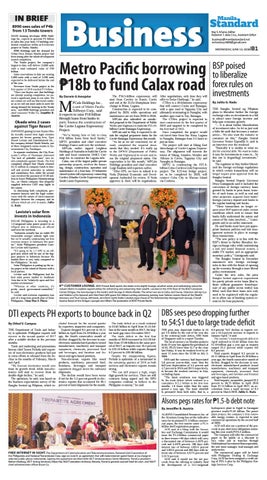
8TH CUSTOMER LOUNGE. BDO Private Bank opens the doors to its eighth lounge, another warm and welcoming venue for
valued clients to explore opportunities for enhancing and preserving their wealth. Located at the 47th floor of the BDO Corporate Center Ortigas, the new lounge is the bank’s sixth lounge in Metro Manila. The other two are in Cebu and Davao. Directors Johnip Cua and Violeta LuYm (second and third from left) grace the ribbon-cutting ceremony, joining Juan Sabino Lizares (head of the Wealth Advisory and Trust Group, leftmost), and (from right) Stella Cabalatungan (head of the Relationship Management Group), Cheryll Gavino (head of the Ortigas Lounge) and Albert Yeo (president of BDO Private Bank).
Ray S. Eñano, Editor Roderick T. dela Cruz, Assistant Editor business@manilastandard.net extrastory2000@gmail.com WEDNESDAY, JUNE 13, 2018
B1
BSP poised to liberalize forex rules on investments By Julito G. Rada THE Bangko Sentral ng Pilipinas plans to liberalize further the foreign exchange rules on investments in a bid to attract more foreign investor and help spur economic growth. “... It is about further liberalization of investment rules. So let us just wait a little bit until that becomes a mature policy... We also want the industry to comment on this,” Bangko Sentral Governor Nestor Espenilla Jr. said in an interview over the weekend. “Basically it is similar to what we did for external debt. We want to make it easy for investments to come in... So this one is [regarding] investments,” he said. The regulator in May further liberalized the foreign exchange regulations in which certain transactions will no longer require prior approval from the Bangko Sentral. Bangko Sentral Deputy Governor Diwa Guinigundo said it included the conversion of foreign currency loans granted by banks to peso loans, transfer of such loans, as well as real and other properties acquired from banks’ foreign currency deposit unit books to the regular banking unit books. “These transactions no longer require prior BSP approval under certain conditions which seek to ensure that banks fully understand the nature and extent of the risks involved...,” Guinigundo said in an earlier statement. He said banks must have put appropriate business policies and risk management systems in place to manage these transactions. “The new policy is in line with the BSP’s thrust to further liberalize foreign exchange rules while maintaining a safe and sound financial system, a stable FX market, and an appropriate monetary policy,” Guinigundo said. The Bangko Sentral in December announced new foreign exchange rules in line with the thrust of opening up the economy through a more liberal policy environment. Under the new rules, the prior Bangko Sentral approval requirement for purely private sector loans [that is, those without guarantee from/exposure of any public sector entity] was lifted, such that these loans now only need to be registered with the regulator to allow use of banking system resources for loan payments.
DTI expects PH exports to bounce back in Q2 DBS sees peso dropping further By Othel V. Campos THE Department of Trade and Industry is optimistic Philippine exports will recover in the second quarter of 2017 after a notable decline in the previous months. Trade and marketing and promotions bureau chief Senen Perlada said exporters of non-electronics products had put in extra efforts to rebound from the decline in the months of February, March and April. “We forecast electronics would continue its growth trend, while non-electronics will start to recover from its double-digit decline,” he said. The optimism, he said, was based on the business expectations survey of the Bangko Sentral ng Pilipinas, which in-
cluded forecast for the second quarter by exporters, importers and companies. Exports dropped 8.5 percent to $5.11 billion in April from $5.59 billion a year ago, the fourth consecutive month of decline, dragged by the decrease in nonelectronic manufactured products (wood manufactures, machinery and transport equipment, chemicals, processed food and beverages, and furniture and fixtures) and agro-based products. Non-electronic exports like wood products, machinery, processed food, furnitures, beverages and transport equipment dragged down the outbound shipments. The decline would have been worse if not for the 5.5-percent growth in electronics exports that accounted for 69.1 percent of total shipments for the month.
The trade deficit as a result widened to $3.62 billion in April from $1.55 billion in the same month in 2017, the largest trade gap since December 2017. The trade deficit in the first four months of 2018 increased to $12.20 billion from $7.66 billion in the same period of 2017, as imports rose 10.5 percent to $33.16 billion while exports dropped 6.2 percent to $20.96 billion. Despite the disappointing figures, Perlada is optimistic of a turnaround in the remaining quarters of 2018 as both services and electronics exports remain strong. “We can still project a high, single digit growth for services. There are still contracts being signed and the BPO companies continue to believe in the Philippine economy,” he said.
to 54:$1 due to large trade deficit THE peso may depreciate further to 54 per US dollar by the end of the year due to the widening trade deficit, DBS Bank of Singapore said in a report Tuesday. The local currency on Monday posted a fresh 12-year low against the greenback at 52.95, P0.25 lower than 52.7 at the close last Friday. It was its weakest level in almost 12 years since the 52.98 on July 3, 2006. DBS said the currency had depreciated 5.8 percent year-to-date, more than the full-year depreciation of 5.4 percent and 4.7 percent in 2016 and 2015 respectively, to become the weakest currency in Asia, excluding Japan. “The latest weakness was triggered by the trade deficit which widened to a cumulative $12.2 billion in the first four months, 1.6 times wider than the same period a year ago. The trade shortfall is pressured from both sides, that is, a
6.2-percent YoY decline in exports versus a 10.5-percent increase in imports in January-April,” it said. The country’s trade-in-goods deficit in April widened to $3.62 billion from the $1.55-billion gap a year ago as imports surged 22.2 percent while exports fell 8.5 percent. Total exports dropped 8.5 percent to $5.11 billion in April from $5.59 billion a year ago, the fourth consecutive month of decline, dragged by the decrease in nonelectronic manufactured products (wood manufactures, machinery and transport equipment, chemicals, processed food and beverages, and furniture and fixtures) and agro-based products. Total imports, meanwhile, jumped 22.2 percent to $8.73 billion in April 2018 from $7.14 billion in April 2017, an acceleration from a tepid increase of 0.3 percent in March 2018. Julito G. Rada
Alsons pegs rates for P1.5-b debt note By Jenniffer B. Austria
FREE INTERNET IN SIGHT. The Department of Communication and Telecommunications, National Grid Corporation of the Philippines and National Transmission Corp. sign on June 8 an agreement that will make internet speed faster at no charge in selected public places nationwide. Signing the agreement are (from left) DICT Undersecretary Denis Villorente, TransCo president Melvin Matibag, DICT Acting Secretary Eliseo Rio, NGCP president Anthony Almeda, TransCo general counsel Noel de Leon and NGCP chief administration officer Bryan Co.
ALSONS Consolidated Resources Inc. of the Alcantara Group has set the indicative rates for its planned P1.5-billion commercial paper, the first tranche under a P2.5billion shelf registration program. ACR said in a filing with the Securities and Exchange Commission it would issue the P1.5-billion commercial paper in three tenors—90 days which will carry a discounted rate of between 4.4979 percent and 5.4979 percent, 180 days with interest rate of between 4.8314 percent and 5.8314 percent and 360 days with interest rate of between 4.9174 percent and 5.9174 percent. ACR said it would use the net proceeds from the offering to initially fund the development of a 15.1-megawatt
hydropower plant in Siguil in Sarangani province worth P1.01 billion. The power plant project, the company’s first renewable energy venture, is expected to start commercial operations by the second half of 2020. ACR will also use a portion of the proceeds to pay short term obligations maturing this year worth P374.3 million. The company will offer the commercial paper to the public at a discount to face value and in tranches through Multinational Investment Bancorporation, the sole issue manager, lead manager and underwriter. The commercial paper will be listed with Philippine Dealing & Exchange Corp. ACR has been assigned a credit rating of PRS A plus by the Philippine Ratings Services Corp.