extrastory2000@gmail.com
World
THURSDAY, JANUARY 11, 2018
B3
CESAR BARRIOQUINTO, Editor mst.daydesk@gmail.com
‘Deal will do little to disarm N. Korea’
SEOUL―An agreement for North Korea to send athletes to the Winter Olympics in the South signals a step change in relations, analysts say, but will do little to curb Pyongyang’s nuclear capabilities. The North and South on Tuesday held their first official dialogue in more than two years, agreeing that Pyongyang would send a large delegation to next month’s Winter Olympics and promising further highlevel talks. The meeting came after months of confrontation over North Korea’s nuclear and missile tests, with both parties seeking to dial down tensions. “Both sides wanted to win and they got it,” said John Delury, a professor at Seoul’s Yonsei University. Seoul and Olympic organizers have been keen for Pyongyang -- which boycotted the 1988 Summer Games in South Korea’s capital -- to take part in what they repeatedly proclaimed as a “peace Olympics” in Pyeongchang.
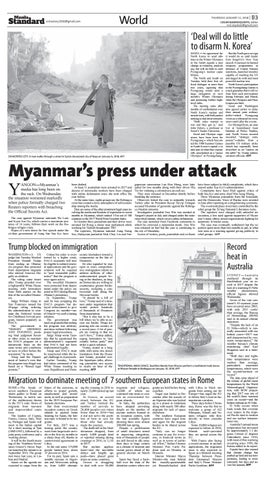
DEVASTATED CITY. A man walks through a street in Syria’s devastated city of Raqa on January 9, 2018. AFP
But the North gave no sign it would do so until leader Kim Jong-Un’s New Year speech. It pursued its banned weapons programmes in defiance of United Nations sanctions, launched missiles capable of reaching the US and staged its sixth and most powerful nuclear test. North Korea’s participation in the Pyeongchang Games is a tacit guarantee that it will refrain from such provocations during February and March, when the Olympics and Paralympics are held. Seoul and Washington also agreed earlier to delay their annual joint military drills―which Pyongyang views as a rehearsal for invasion―until after the events. Go Myong-Hyun, an analyst at Seoul-based Asan Institute of Policy Studies, said North Korea secured so-called “strategic composure”―shelter from a possible US military strike which has repeatedly been described as an “option on the table” by Trump administration officials. AFP
Myanmar’s press under attack Y ANGON―Myanmar’s media has long been on the rack. On Wednesday the situation worsened markedly when police formally charged two Reuters reporters with breaching the Official Secrets Act.
The case against Myanmar nationals Wa Lone and Kyaw Soe Oo, which carries a maximum sentence of 14 years, follows their work on the Rohingya refugee crisis. Hopes of a new dawn for free speech under the civilian government of Aung San Suu Kyi have
been dashed. At least 11 journalists were arrested in 2017 and dozens of non-media workers have been charged with online defamation since she took office the year before. At the same time, rights groups say the Rohingya crisis has created a toxic atmosphere of self-censorship among the media. Here are some of the other prominent legal cases involving the media and freedom of expression in recent months in Myanmar, which ranked 131st out of 180 countries in the 2017 World Press Freedom Index. In October three journalists and their driver were arrested for flying a drone near parliament while working for Turkish broadcaster TRT. The reporters, Myanmar national Aung Naing Soe, Malaysian journalist Mok Choy Lin and Sin-
gaporean cameraman Lau Hon Meng, were later jailed for two months along with their driver Hla Tin for violating a colonial-era aircraft act. They were released in December shortly before finishing the sentence. Observers linked the case to antipathy towards Turkey after its President Recep Tayyip Erdogan accused Myanmar of genocide against the Rohingya Muslim minority. Investigative journalist Swe Win was arrested at Yangon’s airport in July and charged under the notorious 66(d) statute, which covers online defamation. His case stemmed from Facebook comments in which he criticized a nationalist monk. Swe Win was released on bail but the case is continuing in the city of Mandalay. Scores of writers, poets, journalists and civilians
have been subject to 66(d) complaints, which have soared under Suu Kyi’s administration. Complaints have been filed against critics of both Suu Kyi and army chief Min Aung Hlaing. Three Myanmar journalists from the Irrawaddy and the Democratic Voice of Burma were arrested in June after reporting on a drug-burning ceremony. The event took place in territory controlled by the rebel group the Ta’ang National Liberation Army. The reporters were charged with unlawful association, a law used against supporters of Myanmar’s many ethnic armed organizations fighting for autonomy in border areas. The case was eventually withdrawn but the reporters spent more than two months in jail, in what was seen as a warning against giving publicity to rebel groups. AFP
Record heat in Australia
Trump blocked on immigration WASHINGTON―A US judge late Tuesday blocked President Donald Trump from ending an Obamaera program that protected from deportation migrants who entered America illegally as children. The ruling came hours after Trump presided over a high-profile White House meeting with lawmakers from both parties on the fate of the so-called Dreamers. Judge William Alsup in San Francisco issued his 49-page ruling ordering the administration to reinstate the Deferred Action for Childhood Arrivals program, known popularly as DACA. The government is “HEREBY ORDERED AND ENJOINED, pending final judgment herein or other order, to maintain the DACA program on a nationwide basis on the same terms and conditions as were in effect before the rescission,” he wrote. Alsup said the Department of Justice’s view that the program was illegal was based on a “flawed legal premise.”
Unless his order is overturned by a higher court, DACA recipients will now be eligible to submit renewal applications and the government will be required to “post reasonable public notice” that the program is once again active. The so-called Dreamers were protected from deportation under the policy enacted in 2012 during Barack Obama’s presidency. In September, Trump said he was scrapping the DACA program but delayed enforcement to give Congress six months―until March―to craft a lasting solution. The government was sued on grounds that ending the program was arbitrary and done without following proper legal procedures. Judge Alsup wrote Tuesday that he questioned the administration’s argument that DACA had not been implemented legally. Alsup said DACA must be resurrected while the legal challenge to it proceeds. Earlier Tuesday, Trump had taken command of the White House meeting to coax Republican and Dem-
ocratic lawmakers toward a compromise on the fate of Dreamers. He also signaled he was open to more comprehensive immigration reform to address millions of other undocumented people living in the shadows, as long as Democrats are willing to countenance greater border security, including a controversial wall along the Mexican border. “It should be a bill of love,” Trump said of a measure under negotiation that would protect hundreds of thousands of Dreamers from deportation. “But it also has to be a bill where we’re able to secure our border. Drugs are pouring into our country at a record pace. A lot of people are coming in that we can’t have,” Trump added, urging lawmakers to “put country before party” and strike a quick solution. Trump, seated at a long table with some two dozen lawmakers from the House and Senate, presided over the bipartisan talks, allowing journalists rare access to nearly an hour of the meeting. AFP
TRADITIONAL MASK DANCE. Buddhist Monks from Bhutan perform a traditional mask dance at Bhutan Temple in Bodhgaya on January 10, 2018. AFP
Migration to dominate meeting of 7 southern European states in Rome ROME―The heads of seven southern European states gather in Rome on Wednesday to tackle one of the stubbornest thorns in the EU’s side: flows of migrants from war-torn and impoverished countries. The leaders of Cyprus, France, Greece, Italy, Malta, Portugal and Spain will meet in the Italian capital for a short meeting at 7pm (1800 GMT), followed by a joint press conference and a working dinner. It will be the fourth meeting of the ‘Southern Seven’ since Greece’s Alexis Tsipras launched the initiative in September 2016. The group met twice last year, in Lisbon and Madrid. Issues on the agenda are expected to range from the
future of the eurozone, to efforts to propel growth, employment and investment, as well as preparation for the 2019 European Parliament elections. But from overcrowded reception centers on Greek islands to packed boats heading for Spain, the hottest topic is bound to be migrants. For Italy, 2017 was a turning point: the country went from large-scale arrivals in the first six months to a sharp drop off, thanks to controversial agreements in Libya. In the end some 119,000 people landed here, down 35 percent on 2016. For its part, Spain saw a notable increase in Algerians and Moroccans sailing in, from 6,000 attempt-
ing the crossing in 2016 to nearly 23,000 picked up last year. In Greece, an accord struck between the EU and Turkey limited the number of arrivals to 28,800 people―six times fewer than in 2016―but it did not solve the problem of how to care for those who had already made the journey. The death toll in the Mediterranean dropped, from nearly 5,000 people dead or reported missing during crossings in 2016, to 3,116 in 2017. But asylum applications―and the inevitable delays and lengthy appeals―have placed great strain on some countries. Greece is struggling to deal with over 50,000
migrants and refugees, 14,000 of whom are crammed into tents or centers on overcrowded Aegean islands. In Italy, the authorities have stopped providing details on the number of asylum seekers housed in its reception centers, with the last available figures showing there were almost 200,000 last spring. Despite a proliferation of small structures aimed at improving integration, tens of thousands of people are still forced to idle away their days in large centers as a climate of mistrust and racism grows ahead of the general election on March 4. Spain has faced a backlash over the state of the detention centers where mi-
grants are held before being expelled. Anger was fueled in December after the suicide of an Algerian who was locked up in a prison in Andalusia along with nearly 500 other migrants for lack of space elsewhere. The southern European countries have urged time and again for the migrant burden to be shared across the EU. “Italy can no longer continue to pay for everyone, in financial terms as well as in terms of political effort,” Italian Finance Minister Pier Carlo Padoan said on Monday in Brussels. Interior Minister Marco Minniti―the man behind the morally-questionable yet Brussels-backed deal
with Libya to block migrants from setting out for Europe―has urged the EU to follow Italy’s lead on humanitarian corridors. Three days before Christmas, Rome was the first to welcome a group of 162 Ethiopian, Somali and Yemeni refugees who flew directly in from crisis-hit Libya. Some 10,000 refugees are expected to follow in 2018, Minniti said―provided they are spread across the EU. With France also facing a record increase in asylum applications, the migration issue is also expected to figure at a bilateral meeting Thursday between President Emmanuel Macron and Italy’s Prime Minister Paolo Gentiloni. AFP
SYDNEY―Australia sweltered through its third-hottest year on record in 2017 despite the lack of a warming El Niño weather phenomenon, official figures showed Wednesday. Seven of the vast continent’s 10 warmest years have occurred since 2005, with only 2011 cooler than average, the Bureau of Meteorology (BOM) said in its annual climate statement. “Despite the lack of an El Niño―which is normally associated with our hottest years―2017 was still characterized by very warm temperatures,” the weather bureau’s climate monitoring chief Karl Braganza said in a statement. “Both day- and nighttime temperatures were warmer than average, particularly maximum temperatures, which were the second-warmest on record.” The data came ahead of the release of global mean temperatures by the World Meteorological Organization, with BOM projecting that 2017 was one of the world’s three warmest years on record―and the hottest without an El Niño. El Niño occurs when trade winds that circulate over waters in the tropical Pacific start to weaken and sea surface temperatures rise. Australia’s annual mean temperature has increased by approximately 1.1 degrees Celsius (2 degrees Fahrenheit) since 1910, with most of this warming occurring since 1950, the bureau added in its report. Experts have also warned that climate change has pushed up land and sea temperatures, leading to more extremely hot days and severe fire seasons. AFP