•••
Page 10
THE STANDARD | December 2014
Opinions
•••
THE STANDARD | December 2014
Six word stories Coding profiles
Racial unrest in the United States
Page 11
Features
Is college really worth it? Lorenzo Maglione |
JAMES MALIN A St. Louis grand jury recently came to the unanimous decision to not indict Darren Wilson, the police officer who killed Michael Brown, an 18-year-old AfricanAmerican resident of Ferguson, MO. The murder took place during an attempt to detain Brown for questioning regarding a shoplifting he was suspected to have committed. Following the verdict, unrest ensued. Riots broke out in Ferguson, protests took place all around the United States and London; the verdict gained so much media coverage that President Barack Obama even made an address regarding the case. In his address, Obama reiterated a point made by Brown’s parents following the grand jury’s decision to not indict Wilson, requesting that all protests be carried out peacefully in order to catalyse positive change, rather than destruction. This plea was not adhered to in Ferguson. Ferguson quickly became the epicentre of mass riots; stores were looted, cars were tipped over and burned – this ruckus induced the police’s retaliation, which included gunfire in an attempt to subdue the rioters. The reaction to the non-indictment caused was rooted in frustration; this case was viewed as the latest episode of the continuing trend of African Americans falling victim to police brutality and receiving unfair treatment from the justice system. As a white teenager who has never lived in America, I am not qualified to discuss the details of the case, nor have I ever experienced the perceived atrocities African Americans suffer at the hand of the police. Because of my inability to truly empathize with the cause, my initial reaction was not about the non-indictment. When I woke up and saw the events unfold on the news, I was angry; I was not angry at the grand jury, nor was I angry at the police – I was angry at the media. With the new, communal nature of the manner in which news is reported, there is no guarantee of objectivity. More tradi-
tional news sources, such as the New York Times, abide by ethical codes which forbid subjective, biased reporting; this steadfast, moral approach helped ensure that such reactions were more sparse. Now, with the primary platform for the proliferation of news being social media, these more trusted news sources are becoming obsolete, for better or worse. These ethical codes allowed for well-informed opinions, which are harder to come by these days as there is no such code in guerilla journalism. Not only does this undermine the journalistic industry, it also devalues the justice system. As soon as Brown’s story gained traction in the media, Wilson was effectively guilty, regardless of the verdict the grand jury would come to. It was almost ir-
relevant that he avoided indictment: If he went to trial and was acquitted, his name’s cache would always be the man who killed an unarmed black teenager; if he was sentenced to serve jail time, that would not be too different to the life he will live anyway. Due to the nature that news is disseminated in nowadays, there is little room for nuance – after all, how much can you fit in 140 characters? This reduces cases such as Brown’s to being oversimplified and sensationalized. Again, I am not qualified enough to try to dissect the case itself; but, I would guess, and hope, that there is a lot more to the story than is portrayed by the media. When it is reduced to the barebones of the case as it was, the likelihood of such a visceral reaction increases greatly. This is clearly a contentious issue and to cover it in such a heavy-handed, clumsy manner is irresponsible. It is incumbent upon the media to treat such sensitive matters responsibly and with objective reason. That has not been the case recently, and we have seen the damage that can cause.
AMNAH AHMAD On July 17, 2014 Eric Garner, a 43-year -old black man, was put in a chokehold, and later died as a result, in New York by white policeman, Daniel Pantaleo, as he resisted arrest for selling loose cigarettes and evading tax. On August 9, 2014 Michael Brown, an unarmed 18-year-old black man, was shot dead in Ferguson,
MO, by white policeman Darren Wilson, for aggressive behavior. On 22 November, 2014, Tamir Rice, a 12-year-old black boy, was shot dead in a public park in Ohio by white policeman Timothy Loehmann, as he brandished a toy gun. All three black deaths were unjustified and smacked of racial profiling amongst police officers across different cities. In response to these events, protests have erupted across the United States, ranging from peaceful to violent. People are out on the streets rallying against the discrimination of black males by the police force. I have been following these three cases, as well as the reactions to them, for the past few months, both in the press and at ASL. When I read about the protests in the U.S., I could see that the core issue is about discrimination and injustice. Closer to home, at ASL, where the majority of the students are American, the reaction to the cases are quite shocking. Instead of discussing the prejudice that exists in the police force and extends to
the legal system, some of my peers try to justify the officers’ actions. I know these ASL students are not racist but, to me it seems they do not want to accept the ugly reality of the issue that is present in their country. Their response is not driven by prejudice but by a prevalent chauvinistic attitude. Another aspect that comes into play is “white privilege,” which is one of the most difficult topics to talk about. Our community needs to acknowledge its existence and learn how to use it positively. If Eric Garner had been white, I believe the attitude of Pantaleo to the situation would have been different. I don’t think Pantaleo would have used the chokehold against a white man resisting arrest for a petty crime. If the police used undue force on a white man, who then died from the incident, I don’t doubt that justice would have been served. I think the police would have been indicted, and a jury would not have found it difficult to produce a just verdict. In my opinion, the crime is the same but the reaction differs based on the colour of the victim. Protests following the man’s death had he been white would have had a wider acceptability, as well. The defensive attitude that I hear, even at ASL, about the police would have instead gone in favor of the white victim. These reactions frustrates me. Now, let’s look at Cleveland, Ohio. This time it was a black boy who was shot and once again the police officer got away without indictment. Now let’s imagine Tamir Rice as a white boy playing with a BB gun with no orange safety sticker on it. First off, I don’t think anyone would even have bothered to call the police. If the police had been called, I think they would have handled the situation differently. The police officer would not have shot this 12-year-old white boy. He would perhaps have talked him out of waving a gun around, realized it was a toy gun and left the situation uneventfully. So now, with these two examples where I have replaced the black men and boys for white people, don’t the cases seem to be issues of racism and discrimination? Three different cities in three different states, located 500 to 1,000 miles apart. I can’t pass this as a mere coincidence. We must stand up and speak out. Accept that we have a problem. This is the first big step towards a solution.
F
or roughly $200,000, you could buy an average house in America. Or, you could put a student through four years of college education. As the cost of college continues to rise in both the U.S. and abroad, many students are having to ask the
Cost in 1978
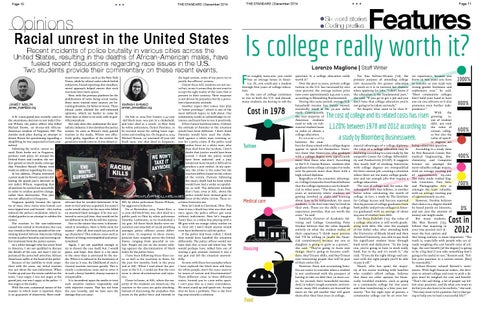
question: Is a college education really worth it? Over the past 25 years, private college tuition in the U.S. has increased by over 1000 percent; the average tuition price now costs approximately $45,000 a year, according to Bloomberg Businessweek. During this same period, average U.S. household income has barely moved, essentially stuck at the 50,000 dollar mark. Consequently, the vast majority of American students need to take on substantial student loans in order to obtain a college education. Economically however, the numbers for those armed with a college degree appear to speak for themselves. Statistics show that Americans who graduate with a college degree earn significantly more than those who don’t: According to the U.S. Census Bureau, students who graduate from college can expect to make over 60 percent more than those with a high school diploma. Regardless of the economic advantages, College Counselor Ivan Hauck believes that the college experience can be beneficial in other ways. “The three, four, five years at university where students are getting involved in clubs and learning about how to be independent, for most students, is the first time they’ve lived on their own. Those are the skills a college experience provides, that are worth the costs,” he said. Similarly, Director of Academic Advising and College Counseling Patty Strohm believes that the value depends entirely on what the student makes of their experience.“I think most parents feel ‘I’ll be willing to [make the financial commitment] because my son or daughter is going to grow as a person,” she said. “They’re going to learn new things, they’re going to become confident, they’ll learn skills, and they’ll meet new interesting people that will be part of their entire life.” However, these non-accounting benefits are easier to consider when a student is not confronted with the prospect of having to take on debt that, in most cases, far exceeds their household income. And, in today’s tough economic environment, many ASL students are focused far more on the job market that will greet them after their four years in college.
For Ana Salitan-Alvarez (’16), the primary purpose of attending college isn’t necessarily for greater education as much as it is to increase her chances when applying for jobs. “I don’t know if the education is the fundamental part,” she said. “If you go to get a job and you don’t have that college education you’re not going to be taken seriously.” Yet despite what seem to be clear fi-
ter experience, because you know in two years you have to transfer so you need very strong grades freshman and sophomore year,” he said. “Most community colleges don’t hold your hand or have one-on-one advisors so it also promotes even further independence.” With the growing issue of student debt, not only the value of certain colleges but also the value of specific degrees are being called into question. According to a study done by Pew Research Center, Biomedical Engineering, Biochemistry, and Computer Science are amongst the most valuable college majors, with an average starting pay of approximately $51,000. The same study ranked English Literature, Fine Arts, and Photographic Arts as amongst the least valuable, with an average starting pay of approximately 30,000. However, Strohm believes that choice in a degree should be based purely on interests, and not just the amount of money one might make. But many students, like Max Barnett (’15), believe that majoring in your true passion isn’t always the best option and that being realistic is more important. “The truth is, especially with people who are already weighing the cost benefit ratio of college, the cost benefit [of the degree] is going to be a big deal if you take something that’s going to be useful or not,” Barnett said. “Follow your passions to a certain extent. [But] be reasonable.” Salitan-Alvarez echoed Barnett’s sentiments. With high financial stakes, the decision to attend college and even to pick a degree must be weighed for cost and benefit. “That’s the sad thing, a lot of people say follow your passions, and do what you want to do but you also have to be realistic,” she said. “You may want to be a painter, but is that going to help you to lead a successful life?”
Medical care
Housing
Food
800%
The cost of college and its related costs has risen 1,120% between 1978 and 2012 according to a study by Bloomberg Businessweek.
Tuition
1000%
nancial advantages of a college diploma, the value of a college education may be declining according to a new study by the nonprofit Center for College Affordability and Productivity (CCAP). It suggests that nearly half of working Americans with college degrees are overqualified for their current job, creating a situation where there are too many college graduates and not enough jobs that require a college education. The cost of college and, for some, the subsequent debt that follows, is another factor when calculating the worth of college. In fact, a study by The Institute for College Access and Success reported that 69 percent of college graduates from both public and private colleges in America graduated with an average of about $29,000 of student loan debt. For Katja Kukelski (’15), the value of a college education is still worth graduating with debt. She cites the example of her father who, after attending both the University of Rhode Island and then Stanford University, was able to pay back his significant student loans through hard work and dedication. “In the long run, you’re going to have to work really hard, but in the end it’s worth it,” she said. “If you do the right things and connect with the right people you’ll be able to pay it off.” Hauck, who has spent the majority of his career working with families who couldn’t afford college, believes that there are other options for financially troubled students, such as going to a community college for two years and then transferring to a four year university. “For the right type of person, a community college can be an even bet-
600%
400%
200%
0%
Cost in 2012