6
THESPECTRUM / SPECIAL REPORT
JULY 2016
West Philippine Sea Dispute By Lex Diwa P. Aloro and Katherine E. Co
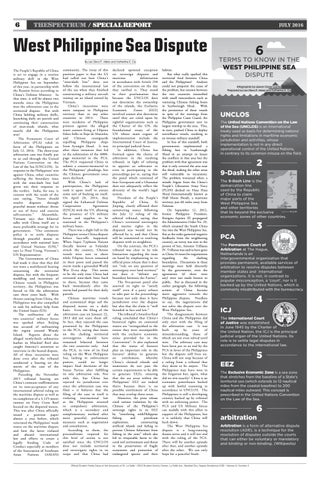
The People’s Republic of China is set to engage in a routine military drill in the West Philippine Sea on September of this year, in partnership with the Russian forces according to China’s Defense Ministry. In that time, it will be almost two months since the Philippines won the arbitration case in the territorial dispute. But with China holding military drills, launching daily air patrols and continuing their construction of man-made islands, what exactly did the Philippines win? The Permanent Court of Arbitration (PCA) ruled in favor of the Philippines on July 12, 2016. The three-year arbitration case was finally put to an end through the United Nations Convention on the Law of the Sea (UNCLOS). In response to the Philippines’ win against China, other countries suffering the boundary issue with the nine-dash line had given out their response to the verdict. India, for one, is content with the result of the case saying, “States should resolve disputes through peaceful means without threat or use of force and exercise self-restraint.” Meanwhile, Vietnam says that bilateral talks with China itself are a more preferable strategy for its government. “Our consistent policy is to settle disputes through peaceful means in accordance with national laws and United Nations (UN),” says Le Hoai Trung, Vietnam’s UN Representative. The Government of China had made it clear that they did not want a multilateral hearing concerning the territorial dispute, but with the frequent meddling and incursions of Chinese vessels in Philippine territory, the Philippines was forced to file the arbitration case three years back. With threats coming from China, the Philippines was also compelled to seek for military help from the United States (US). The unification of the two countries’ military forces was sparked when Beijing was accused of militarizing the region around Woody Island. Reports about the alleged newly-built submarine harbor in Mischief Reef also caught America’s attention to intervene in the heated dispute. All of these incursions were done even after the tribunal conducted a hearing on the merits of the case of the Philippines. Preceding the November 2015 tribunal hearing are China’s constant reaffirmations on its non-acceptance of any international arbitral ruling on the maritime dispute as well as its completion of a 3,125-meter runway on Fiery Cross Reef located on the disputed waters. This was after China officially issued a position paper almost a year before, which reiterated the Philippines’ weak stance on the maritime dispute and how the latter violated and abused international law and efforts to create a legally binding Code of Conduct especially as members of the Association of Southeast Asian Nations (ASEAN)
community. The irony of this position paper is that the US had called out how China’s “nine-dash line” does not follow the international law of the sea when they finished constructing a military aircraft runway on an island owned by Vietnam. China’s incursions were more rampant in Philippine territory than in any other countries in 2014. There were incidents of Philippine protests against the alleged water cannon firing at Filipino fisher folks in Bajo de Masinloc and Chinese coastguards expelling Philippine ships from Ayungin Shoal. It was after these instances that led to the submission of the 4000page memorial to the PCA. The PCA requested China to submit a counter-memorial to the Philippines’ pleadings, but the Chinese government once more declined. With China’s lack of participation, the Philippines took it upon itself to ensure some sort of backing on itself. On April 28, 2014, they signed the Enhanced Defense Cooperation Agreement (EDCA) with the US, allowing the presence of US military forces and supplies to be stationed in the Philippine’s military bases. There was a slight lull in the Philippine versus China dispute before face-offs happened. When Super Typhoon Haiyan (locally known as Yolanda) struck the country, Chinese vessels were sent to shore while Filipino forces remained in their posts and passed the storm inside a grounded World War II-era ship. This seems to be the only time China had retreated nine-dash lines back to shore, because they came back immediately after the storm had passed for their daily patrols. Chinese maritime vessels and economical ships sail the disputed waters on a daily basis. Even the filing of the arbitration case on January 22, 2013 did not scare them off. In fact, they rejected the case presented by the Philippines to the PCA, saying that issues on the clashing territorial sovereignties should have remained bilateral between the two countries only. And the PCA, in view of its final ruling on the West Philippine Sea, lacking in enforcement powers, could no longer impact final decisions of the States Parties after fulfilling its sole arbitration role. Not only this, but China has rejected its jurisdiction ever since the arbitration case was filed – it believes that the filing of the case in itself is violating international law as the Philippines resorted to compulsory arbitration, which is a secondary and complementary method after more peaceful, preliminary measures such as negotiation and consultation. According to them, the preconditions required for this level of action is not satisfied since the UNCLOS does not include territorial and sovereignty rights in its scope and that China had
declared optional exception on sovereign disputes and maritime delimitation in accordance with Article 298 of the convention on the day they ratified it. They stood in their proclamation that because the UNCLOS does not determine the ownership of the islands, the Exclusive Economic Zones (EEZ) involved cannot also determine until they are ruled upon by rightful organizations such as the Charter of the UN, the foundational treaty of the UN whose main organs of implementation include the International Court of Justice, its principal judicial force. In addition, China has frowned upon the choice of arbitrators in the resulting tribunal, in light of refusing to appoint an arbitrator or even in participating in the proceedings per se, saying that the panel which consisted of four Europeans and a Ghanaian does not adequately reflect the diversity of the world’s legal system. President of the People’s Republic of China, Xi Jinping, clearly affirmed their unwavering stance following the July 12 ruling of the arbitral tribunal, saying that China’s territorial sovereignty and marine rights in the disputed seas would not be affected by it, and that China will be committed to resolving disputes with its neighbors. On the contrary, the PCA’s tribunal was clear in its role limitations regarding the issue on hand by emphasizing in its official press release that it does not “rule on any question of sovereignty over land territory” nor does it “delimit any boundary between the Parties”. The five-person panel also asserted its right to “satisfy itself” even if a party refuses to take part in the proceedings because not only does it have jurisdiction over the dispute but also that the claim is “well founded in fact and law.” The tribunal’s Award or final ruling concluded that China’s historical rights on contested waters are “extinguished to the extent they were incompatible with the exclusive economic zones provided for in the Convention”. It also explained that the status of features play an important role in the features’ ability to generate an entitlement, whereby China’s claimed islands and seamounts do not pass the certain requirements to be able to generate EEZs, ensuring that the sea areas within the Philippines’ EEZ are indeed theirs because there is no possible entitlement of China that may overlap these areas. Moreover, the press release cited various violations by the Chinese of the Philippine’s sovereign rights in its EEZ by “interfering withPhilippine fishing and petroleum exploration, constructing artificial islands and failing to prevent Chinese fishermen from fishing in the zone” which also led to irreparable harm to the coral reef environment and threat to the preservation of fragile ecosystems and protection of endangered species and their
habitat. But what really sparked this territorial feud between China and the Philippines? Analysts could not pinpoint the cause of the problem, but tension between the two countries intensified with small misconducts such as venturing Chinese fishing boats in Scarborough Shoal. With the persistence of these vessels in spite of the warnings from the Philippine Coast Guard, the Philippine government sent its largest warship to the area. This, in turn, pushed China to deploy surveillance vessels, resulting to an intense military standoff. In lieu of this standoff, both governments implemented a fishing ban in Scarborough Shoal in an attempt to lessen the conflicts in that area but the problem with that agreement was that it only covered the area near the shoal, making the other areas still vulnerable to incursions. The problem worsened when a missile frigate from the China’s People’s Liberation Army Navy (PLAN) docked on Hasa Hasa Shoal (internationally known as Half Moon Shoal), a maritime territory just 60 miles away from Palawan. On September 12, 2012, former Philippine President, Benigno Aquino III propagated the Administrative Order No. 29, which renamed the South China Sea into the West Philippine Sea. But as the order garnered negative feedbacks from the neighboring country, an envoy was sent in the person of Sen. Antonio Trillanes IV. Trillanes was said to have gone to China 16 times for negotiations regarding the clashing boundaries. Discussions in these meetings were held discreetly by the government, even the agreements (if there were any) were not made known to public. But as discussed in the earlier paragraph, the following actions of China became more aggressive towards the Philippine dispute. Needless to say, the negotiations did not solve the dispute over the West Philippine Sea. The disagreement between China and the Philippines did only start with the filing of the arbitration case. It was built up by years of misunderstanding, those of which are not even solved until now. The arbitrary case may have been put to an end by the PCA in favor of the Philippines but the dispute still lives on. China will not stop because of a ruling from a tribunal that they deem to be unjust. The Philippines may have won in the litigation but, again, what did we win exactly? China is an economic powerhouse backed up with lawful reasoning in accordance to UNCLOS. The Philippines is still a developing country backed up by tribunal with no enforcing power. The PCA and US Military forces can meddle with this affair in support of the Philippines, but it is unlikely that China will back down. The West Philippine Sea dispute is a long-running drama series and it will not end with the ruling of the PCA. There will be another episode after that, and another episode after the other. We can only hope for a peaceful finale.
Infographic by Jowan Dave Guides Prepared by Lex Diwa P. Aloro and Katherine E. Co
Official Student Media Corps of the University of St. La Salle - USLS Student Activity Center, La Salle Ave., Bacolod City, Negros Occidental 6100 - Volume 61 Number 3