HOUSING CRISIS transitional housing. I interviewed for housing five times and was going to have to go back a sixth time to get in. If Pfeifer had been around, then I would have gotten in immediately.” Past resident Danielle Patton echoes this sentiment. “You can’t move into a house, with evictions on your record and tell the landlord, ‘Hi, I don’t have a job but I’ll promise I’ll get one!’ Because you don’t know how you’re going to pay rent. But Gene (Gammond) said,’It’s fine, we’ll figure it out.’ He let me move in. So now I’m building rental history, and paying my rent on time. It gave me an opportunity to reinvent my life.” Patton is a 27-year-old mother of two who faced a slew of possession charges and a stint in rehab before she was clean for six months. She relapsed. “I took meth to be a super-mom, but pretty quickly it consumed me. She says she tried to stay clean but, “Moved in with a friend I went to treatment with who was having a hard time staying clean. We figured if we were together it would be easier. That was not the case.” Ariana, a housing manager and graduate of the program, has been in recovery for four and a half years. She just gave up her two-bedroom apartment to move back into a Pfeifer women’s home. As a housing manager, the free rent and monthly stipend will allow her to save for a down payment on a home. “I was lucky to make it to jail and not have died,” she says. “So to think I could actually buy a home in two to three years, well, never did I think that could be a possibility.”
A Reality: Relapse “I tell the guys we’re equal,” says Roniger, the male house manager. “I try my best to keep it a communal accountability, keep everybody working towards the same goals...because we’re all working towards the goal of recovery and so they kind of help each other.” Still, honor system aside, relapses do happen. “If I hear something or if somebody is acting strange and I think there’s something going on with them, I check, I do
UAs, (urine analyses)... and if someone fails, they’re basically given a 24-hour notice to move out. They’re out for five days and then they have to pee clean to get back in," Roniger says. “If it happens a second time, then they’re out for 30 (days) or indefinitely, depending on what they do,” he adds. Gammond says the model works, “because of the rules and the structure and having that accountability piece.” Transitioning from out-patient treatment to regular life can be an in-depth and painful process, so a safe and supportive space is crucial. The National Institute on Drug Abuse says transitional housing “exponentially reduces the risk of relapse,” and they recommend at least 90 days of transitional sober living. There is no real time limit on a transitional home, though Gammond says most in their program stay from six to eight months before moving on. “Not saying that everyone who walks through our doors is cured...but they don’t do it while they’re here. “When we have people dying in our community who don’t have
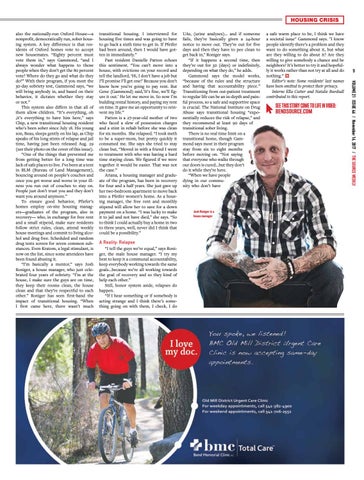
Josh Roniger is a house manager.
a safe warm place to be, I think we have a societal issue" Gammond says. "I know people identify there’s a problem and they want to do something about it, but what are they willing to do about it? Are they willing to give somebody a chance and be neighbors? It’s better to try it and hopefully it works rather than not try at all and do nothing.” SW Editor’s note: Some residents' last names have been omitted to protect their privacy. Interns Ella Cutter and Natalie Burdsall contributed to this report.
SEE THIS STORY COME TO LIFE IN VIDEO: BENDSOURCE.COM
9 VOLUME 21 ISSUE 46 / November 16, 2017 / THE SOURCE WEEKLY
also the nationally-run Oxford House—a nonprofit, democratically run, sober housing system. A key difference is that residents of Oxford homes vote to accept new housemates. “Eighty percent must vote them in,” says Gammond, “and I always wonder what happens to those people when they don’t get the 80 percent vote? Where do they go and what do they do?” With their program, if you meet the 30-day sobriety test, Gammond says, “we will bring anybody in, and based on their behavior, it dictates whether they stay or not.” This system also differs in that all of them allow children. “It’s everything, oh ,it’s everything to have him here,” says Chip, a new transitional housing resident who’s been sober since July 18. His young son, Beau, sleeps gently on his lap, as Chip speaks of his long stints of relapse and jail time, having just been released Aug. 29 (see their photo on the cover of this issue). “One of the things that prevented me from getting better for a long time was lack of safe places to live. I’ve been at a tent in BLM (Bureau of Land Management), bouncing around on people’s couches and once you get worse and worse in your illness you run out of couches to stay on. People just don’t trust you and they don’t want you around anymore.” To ensure good behavior, Pfiefer’s homes employ on-site housing managers—graduates of the program, also in recovery— who, in exchange for free rent and a small stipend, make sure residents follow strict rules, clean, attend weekly house meetings and commit to living alcohol and drug free. Scheduled and random drug tests screen for seven common substances. Even Kratom, a legal stimulant, is now on the list, since some attendees have been found abusing it. “I’m basically a mentor,” says Josh Roniger, a house manager, who just celebrated four years of sobriety. “I’m at the house, I make sure the guys are on time, they keep their rooms clean, the house clean and that they’re respectful to each other.” Roniger has seen first-hand the impact of transitional housing. “When I first came here, there wasn’t much