ALSO IN THIS ISSUE: VOLATILITY OF COMMODITIES AND LOAN OPTIONS FOR SMALL BUSINESSES NOVEMBER 2023 WWW.SFNET.COM
Barry SFNET’S NEW PRESIDENT
Bobrow HE DISCUSSES HIS GOALS FOR 2024 AS WELL AS HIS CAREER TRAJECTORY AND VIEWS ON THE COMING YEAR.
Because things aren’t always as they seem One must comprehend the whole picture before arriving at conclusions. Tiger’s ABL appraisers are never satisfied taking just one look at a problem. They take a second, third, and fourth until they see the true picture. Boots-on-the-ground due diligence. Proprietary TigerInsightstm Analytics. $5b/year liquidation expertise. Take a closer look.
ASSET INTELLIGENT New York I Los Angeles I Boston I San Francisco I Chicago I Houston I Toronto I 888-55-TIGER I TIGERGROUP.COM
TOUCHING BASE BUILT FOR THE MOMENT
Reflecting on SFNet’s Accomplishments As we approach the end of another remarkable year, I am reflecting on the accomplishments and milestones we have achieved in the past 12 months. We’ve not only weathered the challenges that came our way, both as an association and an industry, but emerged stronger and more vibrant. We also retained our unwavering commitment to our mission and goals and we have set the stage for an exciting 2024. I am truly grateful for the dedication, hard work, and support of the SFNet community, volunteers and the SFNet team. As illustrated by the theme of our Annual Convention, “Built for the Moment: Agility. Patience. Opportunity” our industry is an adaptable one, adept at anticipating and responding to current trends and demands, and turning challenges into opportunities. Here are just a few of the highlights. Many thanks to the legions of volunteers who helped make this possible. Be sure to read our quarterly membership updates, which we launched early this year, and our Annual Report to Members for continued updates. The refresh of the Market Sizing and Impact Study was completed in June with over 1500 downloads by SFNet members to date. The Advocacy Committee worked diligently on several issues this year including achieving favorable treatment for ABLs and Factors in CFPB’s Final Rule on Dodd Frank 1071 and securing a safe harbor provision to California’s commercial finance disclosure law, which went into effect last year. SFNet also created compliance guides for both the California and the New York disclosure regulations and is currently working with our bank members, legislators, regulators, and aligned trade groups to address shortcomings in the new interagency Basel-related capital proposal. A Mid-Year Factoring Survey was added to our data offerings in addition to our Annual Factoring Survey and quarterly ABL surveys. SFNet refreshed 10 core professional development programs, with new content and case studies, and added two new classes as well as a new leadership development program with NYU. Hundreds of you availed yourselves of these valuable resources. Our Guest Lecture series and Great Places to Work college outreach programs continued to attract new talent to our industry. Another highlight of the year for SFNet was the second iteration of our Mentoring Program. On page 44 of this issue, you can read about its success and how it has become an invaluable program for SFNet members. A major development in 2019, was the creation of the SFNet
Hall of Fame. In this issue of TSL, we honor the SFNet 2023 Hall of Fame inductees on page 65. During the Annual Convention, we will celebrate these industry icons to whom we are forever indebted. Through their vision, determination and dedication, they’ve had a profound effect on generations of professionals, shaping our industry and association.
RICHARD D. GUMBRECHT SFNet’s new president, SFNet Chief Executive Officer Barry Bobrow, managing director and head of credit markets for Regions Business Capital is a widely respected industry leader. On page 16, Barry discusses his career trajectory, his outlook for the industry and his goals for SFNet in 2024. Commodity producers face volatile market swings due to factors such as macroeconomics and supply chain stability, creating risks for secured lenders. Understanding each commodity’s nuances, risk-management strategies, and regulatory considerations is crucial. Turn to page 22 for Dealing with the Volatility of Commodities by Myra Thomas. On page 26, in Lender Considerations in a Meme-Stock Environment: Safeguarding Against Retail Investor Lotto Ticket Holders and Indecisive Management, Hilco executives explore the events that culminated in the liquidation of Bed Bath & Beyond, and the disruption caused by meme stock market dynamics on conventional valuation metrics. Companies in distress are turning to the out-of-court restructuring of their debt in ways that leave lenders who made loans on the basis of a senior secured position either with certain assets no longer available as collateral pursuant to a “drop down financing” or subordinate to new tranches of debt pursuant to an “uptiering transaction.” On page 36, in The Saga of Serta, David Morse of Otterbourg takes a look at the arguments being made in some of the litigation that has often followed on such uptiering transactions and, in particular, the June 2023 decision of the Bankruptcy Court in the Serta case. Earlier this year, Charlie Perer of SG Credit Partners kicked off a new series featuring key entrepreneurs and executives who have built leading commercial finance companies. This iteration, on page 52, is about LaSalle Business Credit, told by some of the key executives who played seminal roles in the 1990s. I look forward to seeing many of you in Orlando! Watch your inbox for details on what SFNet has in store for 2024.
1
THE SECURED LENDER NOV 2023
TABLE OF CONTENTS. NOVEMBER 2023 VOL. 79 ISSUE 8
COVER STORY INTERVIEW WITH SFNET’S NEW PRESIDENT BARRY BOBROW P18
Interview with SFNet’s New President Barry Bobrow Barry Bobrow is a managing director and head of credit markets for Regions Business Capital. He is a widely respected leader in middle-market leveraged finance and asset-based lending. Here, Bobrow discusses his career trajectory, his outlook for the industry and his goals for SFNet in 2024. 18 BY MICHELE OCEJO FEATURE STORIES
Dealing with the Volatility of Commodities Commodity producers face volatile market swings due to factors such as macroeconomics and supply chain stability, creating risks for secured lenders. Understanding each commodity’s nuances, risk-management strategies, and regulatory considerations is crucial. To navigate these challenges, secured lenders must maintain strong industry knowledge, adapt lending structures, collaborate with third parties, and balance risk and return for their clients. 22 BY MYRA THOMAS
Lender Considerations in a Meme-Stock Environment: Safeguarding Against Retail Investor Lotto Ticket Holders and Indecisive Management 2
THE SECURED LENDER NOV 2023
FEATURED STORY DEALING WITH THE VOLATILITY OF COMMODITIES P.22
Recently, a new phenomenon in the public equity markets has emerged, commonly referred to as “meme stocks.” This article explores the events that culminated in the liquidation of Bed Bath & Beyond (BBBY), and the disruption caused by meme stock market dynamics on conventional valuation metrics. 26 BY DAVID PERESS & JORDON PARKER
The Saga of Serta: The Next Chapter— Subordination of “Non-Participating” Lenders Upheld by Bankruptcy Court “Liability Management Transactions” continue to grab headlines. Companies in distress are turning to the out-of-court restructuring of their debt in ways that leave lenders who made loans on the basis of a senior secured position either with certain assets no longer available as collateral pursuant to a “drop down financing” or subordinate to new tranches of debt pursuant to an “uptiering transaction.” This article takes a look at the arguments being made in some of the litigation that has often followed on such uptiering transactions and in particular the June 2023 decision of the Bankruptcy Court in the Serta case. 36 BY DAVID W. MORSE, ESQ.
SFNet’s Mentoring Program: Continuing to Guide Growth
The Story of LaSalle Business Credit In this feature series, Charlie Perer sits with the key entrepreneurs and executives who have built leading commercial finance companies. This feature is about LaSalle Business Credit, told by some of the key executives who played seminal roles in the 1990s. Here to tell the story are Mike Sharkey, Marty Battaglia, Bob Corsentino and Bruce Sprenger. 52 BY CHARLIE PERER SFNET AWARDS
SFNet Hall of Fame Inductees Profiles of SFNet’s 2023 Hall of Fame inductees, including their career highlights and contributions to the industry. 65
SFNet’s 79th Annual Convention Exhibit Guide Showcases the exhibitors at SFNet’s Annual Convention. 75
Articles CANNABIS FINANCE TRENDS
Lights, Camera, Regulatory Action? Practical Considerations for Cannabis Lenders Partners at the law firm Armstrong Teasdale LLP provide readers with an update on the transformation of the cannabis industry and what it means for lenders. 82 BY JEFFREY A. WURST, PAUL J. CAMBRIDGE AND JEFFREY F. BARR
FEATURED STORY THE SAGA OF SERTA: THE NEXT CHAPTER P.36
SFNet’s second iteration of the program nearly doubled in size with participants and is proving to be an invaluable resource for members. 44 BY EILEEN WUBBE SPONSORED CONTENT CREDIT TRENDS
Seeking Growth, Small-Business Owners Can Tap a Variety of Loan Options What are the credit needs and opportunities for today’s small-business owners? This article explores results from Pathward’s new survey. 48 BY JAMES FARRELL
3
THE SECURED LENDER NOV 2023
TABLE OF DEPARTMENT CONTENTS INDUSTRY MOVES
The Secured Finance Network is the trade group for the asset-based lending arms of domestic and foreign commercial banks, small and large independent finance companies, floor plan financing organizations, factoring organizations and financing subsidiaries of major industrial corporations.
CROSS-BORDER FINANCE ESSAY
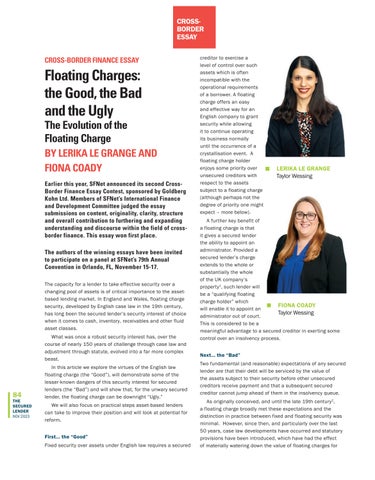
Floating Charges: The Good, the Bad and the Ugly The Evolution of the Floating Charge Earlier this year, SFNet announced its second Cross-Border Finance Essay Contest, sponsored by Goldberg Kohn Ltd. This essay won first place. The authors of the winning essays have been invited to participate on a panel at SFNet’s 79th Annual Convention. 84 BY LERIKA LE GRANGE AND FIONA COADY SECURITY INTEREST TRENDS
A License to Foreclose: Obtaining a Security Interest in a Government-Issued License Recent rulings provide a useful backdrop for reviewing the law relating to whether a lender’s security interest can attach to a government-issued license, and ultimately, whether the lender can realize upon the value of the license itself. 90 BY STEVE SEPINUCK, STACY HOPKINS, JENNIFER HILDEBRANDT AND KATHERINE BELL SFNET COMMITTEE SPOTLIGHT
Entrepreneurial Committee This column highlights the hard work and dedication of SFNet committee volunteers. Here we speak with Will Bence, managing director, Wingspire Capital, and chair of SFNet’s Entrepreneurial Committee. 94 BY EILEEN WUBBE
4
THE SECURED LENDER NOV 2023
Departments TOUCHING BASE 1 NETWORK NOTES 6 INDUSTRY DEALS 10
The objectives of the Association are to provide, through discussion and publication, a forum for the consideration of inter- and intra-industry ideas and opportunities; to make available current information on legislation and court decisions relating to asset-based financial services; to improve legal and operational procedures employed by the industry; to furnish to the general public information on the function and significance of the industry in the credit structure of the country; to encourage the Association’s members, and their personnel, in the performance of their social and community responsibilities; and to promote, through education, the sound development of asset-based financial services. The opinions and views expressed by The Secured Lender’s contributing editors and authors are their own and do not necessarily express the magazine’s viewpoint or position. Reprinting of any material is prohibited without the express written permission of The Secured Lender. The Secured Lender, magazine of the asset-based financial services industry (ISSN 0888-255X), is published 8 times per year (Jan/Feb, March, April, May, June, September, October and November) $65 per year non-member rate, and $105 for two years non-member rate. SFNet members are complimentary. Secured Finance Network 370 Seventh Avenue, Suite 1801, New York, NY 10001. (212) 792 -9390 Email: tsl@sfnet.com
www.SFNet.com Periodicals postage paid at New York, NY, and at additional mailing offices. Postmaster, send address changes to The Secured Lender, c/o Secured Finance Network, 370 Seventh Avenue, Suite 1801, New York, NY 10001 Editorial Staff Michele Ocejo Editor-in-Chief and SFNet Communications Director mocejo@sfnet.com Eileen Wubbe Senior Editor ewubbe@sfnet.com Aydan Savaser Art Director asavaser@sfnet.com Advertising Contact: James Kravitz Business Development Director T: 646-839-6080 jkravitz@sfnet.com
WE GET DEALS DONE Offering Fast, Reliable, and Customized Financial Solutions Businesses today need financial solutions that are quick, dependable, and tailored to their unique needs, and they need those solutions now. At eCapital, we offer rapid approvals to solve cash flow challenges and maximize financial flexibility all backed by industry-leading technology. Our funding model is ready to empower small and medium-sized businesses to achieve their goals, today. We are experts in: • Asset-based Lending • Freight Factoring • Invoice Factoring • Payroll Funding • Lines of Credit • Equipment Refinancing Let's talk - visit eCapital.com today!
DEPARTMENT DEPARTMENT NETWORK INDUSTRY NOTES MOVES Access Capital, Inc. Announces William Palmer’s Promotion to Collateral Analyst, Team Leader William (Bill) Palmer’s remarkable career with Access Capital began in 1998 as a collector. Thanks to his exceptional work ethic and adeptness, he swiftly undertook the responsibility of managing past-due accounts. Before long, he ascended to the role of collateral analyst. His consistent and impressive performance led to successive promotions, first to senior collateral analyst and now to team leader of the collateral analyst team. He can be reached at wpalmer@accesscapital.com. BNP Paribas Appoints Matt O’Connor Head and Annabella Espina COO of its Miami Office BNP Paribas Securities Corp., a unit of Europe’s leading bank BNP Paribas, announced the appointment of Matt O’Connor as head of its new Miami office as well as Annabella Espina as chief operating officer (COO). O’Connor joined the bank in 2014 and has over 20 years of experience in financial markets. Prior to BNP Paribas, he was head of Commodity Investor Sales at Deutsche Bank and held various positions with Lehman Brothers. Espina is currently the CFO of CIB Mexico and has been with BNP Paribas for over 17 years. She has held several senior positions within the Bank in Paris, New York, and Mexico City, including chief of staff for Finance and Tax and head of Financial Management and Corporate Development for CIB Americas. Breakout Capital and 12Five Capital Join Forces to Create a Powerhouse in Small Business Lending
6
THE SECURED LENDER NOV 2023
Breakout Capital is delighted to announce the successful merger of 12Five Capital, a Chicago-based commercial finance company with a focus on factoring, purchase order financing and asset-based lending. The merger, facilitated by Altriarch Commercial Finance, Inc., the new parent company of both Breakout and 12Five, establishes a strategic alliance with a dayone portfolio exceeding $80 million.
McLean Wilson, CEO, and president of Breakout Capital will serve the combined firm as co-chief executive officer alongside Danielle Brown who joins the firm also as co-CEO. Ryan Jaskiewicz, CEO, 12Five Capital, will serve as the firm’s chief strategy officer. Forensic, Litigation and Valuation Services Partner Joins EisnerAmper Global business advisory firm EisnerAmper announced that Tami Clemenza has joined the firm as a partner in its Forensic, Litigation and Valuation Services (“FLVS”) Group. Clemenza has more than three decades of experience providing forensic accounting services, focusing on matrimonial litigation support and dispute resolution. Ronnie Bloom to Expand FGI Finance Footprint in Western United States FGI Worldwide LLC announced that Ronnie Bloom, managing director, will expand his business development efforts to the Western U.S. Bloom will remain involved in Canadian transactions as he develops and nurtures partnerships in California, the Pacific Northwest, and Texas. Eclipse Business Capital Adds Brandon Hodges to its Business Development Team Eclipse Business Capital, LLC (“EBC”) announced that Brandon Hodges has joined the organization as a managing director. Hodges, who will be in Los Angeles, is an ABL veteran with extensive experience originating and structuring credit transactions. Hodges can be reached at bhodges@eclipsebuscap.com. Luke Joyner Joins First Business Bank’s Asset-Based Lending Team First Business Bank welcomed Luke Joyner to its Asset-Based Lending team as vice president – Asset-Based Lending. Joyner brings more than 10 years of experience in finance and asset-based lending to First Business Bank.
First Citizens Bank Extends Its Brand to Legacy CIT Business Verticals First Citizens Bank announced that it is extending its brand to cover numerous commercial business verticals that previously fell under First Citizens’ CIT division. This effort represents another major step towards First Citizens fully integrating CIT since its 2022 merger. The First Citizens name and logo will be adopted by nearly all businesses within CIT’s Commercial Finance group, including Energy; Healthcare Finance; Maritime Finance; Technology, Media and Telecommunications; Aerospace, Defense and Government; Capital Equipment Finance; Asset-Based and Sponsor Finance Lending; and Commercial Real Estate, among others. The transition is expected to be completed by year-end. The CIT abbreviation, which stood for Commercial Investment Trust, will remain in use in some corners of First Citizens, such as the CIT Rail division, CIT Commercial Services and the CIT Bank online bank. Gordon Brothers Welcomes Chris Menard as Chief Financial Officer Based in Boston, Chris Menard is an integral part of the firm’s leadership and is responsible for the overall management of global financial reporting, planning and analysis, treasury, and tax strategy and compliance. He has over 25 years’ experience in finance and accounting, growing organizations and leading dispersed teams globally, 15 of which were as a CFO. Gordon Brothers Acquires Durkin Group Enhancing Services to Include Field Examinations Gordon Brothers acquired Durkin Group, a professional services firm that provides field examinations and diligence services to lenders, investors, and operators in North America. The investment enhances Gordon Brothers’ suite of service offerings to assist companies throughout their lifecycle, complements the firm’s valuation, disposition and capital services, and expands its expertise to better serve clients. Founded in 2001 by Kevin Durkin, Durkin Group has built a national reputation as a
leader in credit risk support and diligence services for the secured finance industry.
Bobbi Acord Noland Named as Top 10 Influential Banking & Finance Lawyer in Georgia for 2023 by Business Today
Legacy Corporate Lending Adds Terrance McKinney as Executive Vice President of Portfolio Management
Parker, Hudson, Rainer & Dobbs LLP Commercial Finance Practice Group Leader, and Partner Bobbi Acord Noland has been recognized among the “Top 10 Influential Banking & Finance Lawyers in Georgia for 2023” by Business Today. Noland also serves as SFNet co-general counsel.
Terrance McKinney will be based in Plano, TX and will be responsible for ensuring all new and existing transactions are maintained in compliance with the firm’s Portfolio Management Guidelines and Credit Policies. McKinney brings more than 30 years of asset-based lending and commercial finance experience. Kristyn Scott Joins Mitsubishi HC Capital America as Director of Capital Markets Kristyn Scott will be responsible for all small ticket capital markets activity across the organization involving transportation, construction, industrial, technology, medical, and fitness equipment. Utilizing her strong expertise in relationship management, she will oversee more than 50 existing capital markets program partners. Scott will also seek opportunities to expand the business to encompass new partners and asset classes. Carl Bretzman Joins Mitsubishi HC Capital America to Further Expand Industrial Relationships Mitsubishi HC Capital America announced that industry veteran Carl Bretzman has joined the company to manage and grow business development initiatives in its Industrial Finance division. New York Restructuring and Finance Team Led by Five Partners to Join Morgan Lewis Morgan Lewis will bolster its finance team by bringing in five partners in New York—a transactional restructuring and bankruptcy litigation team led by Richard Stern and including Michael Luskin, Stephan Hornung, Matthew O’Donnell, and Alex Talesnick. This team will further strengthen the firm’s services to financial institutions across corporate, finance, bankruptcy, litigation, and restructuring needs.
Boudewijn Smit Joins NautaDutilh’s New York Office Boudewijn Smit has joined NautaDutilh’s New York office. Smit works in NautaDutilh’s Finance department and was previously based in the firm’s London office. He has been actively involved with SFNet’s European Chapter. Peapack Private Hires Ling Li, Senior Managing Director, Commercial Private Banker Peapack-Gladstone Financial Corporation and Peapack Private, a division of PeapackGladstone Bank, are proud to announce that Ling Li has joined its commercial banking team as a senior managing director, Commercial Private Banker. Li is responsible for providing customized bank solutions to small and medium-sized enterprises to achieve their long-term financial goals. Regions Bank Announces Newly Appointed Risk Management Executives Regions Bank announced Anna Brackin has been appointed to serve as chief compliance officer overseeing the company’s compliance risk management program. In addition, Gary Walton recently joined the bank as Business Unit chief risk officer for Regions’ Consumer Banking and Wealth Management divisions. Rosenthal Names Feride Bennett VP Business Development Officer of International Factoring Division Rosenthal & Rosenthal, Inc. announced that Feride Bennett has joined Rosenthal as VP business development officer of its
International Factoring Division. Bennett brings over 25 years of domestic and international factoring experience in senior executive roles. SG Credit Partners Announces Hiring of Irena Snider as CFO Irena Snider was hired as chief financial officer with responsibilities including strategy, capital raising, reporting and building financial infrastructure. Snider brings to SG Credit more than 20 years of experience in financial services, investment banking and public accounting with leading firms such as KBW, Raymond James and EY. SLR Capital Partners Appoints Ingrid Kiefer as Partner and Chief Business Development Officer SLR Capital Partners, LLC announced that Ingrid Kiefer joined the firm in September as a partner and chief business development officer. Kiefer will lead SLR’s business development and investor relations, leveraging over 25 years of experience in the credit and alternatives investment industry. SLR Capital Partners Welcomes Chris York as a Partner SLR Capital Partners, LLC announced that Chris York has joined the firm as a partner. York will focus on product and business development, leveraging his 17 years of experience in the credit and alternatives investment industry. Texas Capital Strengthens Energy Industry Coverage Texas Capital Bancshares, Inc. announced key leadership appointments and enhanced capabilities as part of its Corporate & Investment Bank offerings for the energy sector. Texas Capital has brought on energy finance veteran Marc Graham as head of Energy as well as a team of seasoned energy investment banking veterans, all of whom are equipped with deep industry and technical knowledge and experience in providing innovative solutions to support clients
7
THE SECURED LENDER NOV 2023
DEPARTMENT DEPARTMENT NETWORK INDUSTRY NOTES MOVES across the energy sector. In addition to Graham’s appointment, Texas Capital announced that managing directors Michael Bodino, Christian Gibson and Randall Byrne have joined the energy investment banking team, together with an experienced team of financial and technical professionals, to drive business growth and client acquisition in the energy vertical. Texas Capital Bancshares, Inc. Appoints Amos McDonald as Head of Business Banking
Wells Fargo Hires Credit Suisse Veteran as Head of Financial Sponsors Malcolm Price has joined Wells Fargo’s corporate and investment bank (CIB) as the head of financial sponsors, after 35 years at Credit Suisse. At Wells Fargo, Price will jointly report to Tim O’Hara, head of banking, and Scott Warrender, head of coverage within the banking unit.
Tiger Group Announces New Field Examination Team
Wells Fargo announced that William M. Daley, the company’s vice chairman of Public Affairs, will retire at the end of this year. Daley joined Wells Fargo in 2019 from BNY Mellon to lead Public Affairs, a newly created corporate function spanning Government Relations, Corporate Communications, Corporate Branding, Community Relations, the Wells Fargo Foundation, and other areas.
U.S. Bank Names Kai Sakstrup Chief Product Officer for WCIB Division
THE SECURED LENDER NOV 2023
Webster Financial Corporation announced that Kristy Berner has been appointed executive vice president, general counsel and corporate secretary of Webster Financial Corporation and Webster Bank. She will lead all of Webster’s corporate legal services.
Amos McDonald is based in The Woodlands, TX, and is responsible for setting and driving production goals within the firm’s Business Banking division and leading a seasoned team of bankers. He reports to Texas Capital managing director and head of Commercial Banking Jay Clingman, who is responsible for the firm’s commercial strategy and expanding its commercial client base.
Tiger Group has expanded its offering for asset-based lenders by hiring two industry veterans with decades of combined experience in field examinations and related services. Joining Tiger as senior managing directors are veteran field examiners Katherine Houser-Rodriguez and Stephen Savage, both of whom previously worked for Wells Fargo.
8
Webster Appoints Kristy Berner as Executive Vice President, General Counsel and Corporate Secretary
U.S. Bank announced that strategy and marketing executive Kai Sakstrup has been named chief product officer for its Wealth, Corporate, Commercial and Institutional Banking (WCIB) division. Beginning Oct. 1, Sakstrup will lead a cross-functional team in developing and creating new products across the WCIB organization to better serve wealth and institutional clients, commercial businesses and corporations.
Wells Fargo Announces Retirement of William M. Daley, Vice Chairman of Public Affairs, at the End of 2023
FOR FOCUSED CLARITY. Value Added Field Exams
Delivering exceptional results for 25 years. Recurring Exams
Survey Exams
Physical Inventory Observations
(562) 429-5700
Forensics Exams
Due Diligence Exams
Internal Control Testing
Collateral Review
www.insightexams.com
DEPARTMENT INDUSTRY DEALS
10
THE SECURED LENDER NOV 2023
Lender/Participant
Lender Type
Amount
Borrower
Industry
Structure
Accord Financial, Lender
Non-bank
$5.0M
Valeo Pharma, a dynamic Canadian pharmaceutical company with a dedicated focus on the commercialization of innovative prescription products in Canada
Pharmaceutical
Credit Facility
Aequum Capital, Lender
Non-bank
$9.0M
Industry-leading, technology-focused independent online pharmacy, Midwest
Pharmaceutical
Revolving Credit Facility
Amerisource Business Capital, Lender
Non-bank
$14.0M
Provider of wireline solutions to the U.S. energy industry, TX
Energy
Working Capital Facility
Amerisource Business Capital, Lender
Non-bank
$1.0M
Technology platform for moving and transportation services, Texas
Technology
Working Capital Facility and Equity Co-Investment
Amerisource Business Capital, Lender
Non-bank
$2.0M
Manufacturer and distributor of designer bathroom vanity units, sinks, toilets, and bidets, California
Other
Working Capital Facility
Amerisource Business Capital, Lender
Non-bank
$1.0M
Technology platform for moving and transportation services, Texas
Technology
Working Capital Facility and Equity Co-Investment
ATLAS Securitized Products Holdings, L.P., Lender
Non-bank
$600.0M
Maritime Partners, LLC, a leading provider of maritime financing solutions, specializing in vessels that are used in the domestic Jones Act trade
Advertising
Warehouse Facility
ATLAS SP Partners, i80, the Victorian Government, and iPartners, Lender
Non-bank
$130.0M
Lighter Capital
FinTech
Credit Facility
Austin Financial Services, Inc. (AFS), Lender
Non-bank
$4.0M
Private equity-owned contract beverage manufacturer based in the Pacific Northwest
Manufacturing
ABL facility, consisting of an AR & inventory revolver, with an equipment term loan
Austin Financial Services, Lender
Non-bank
$2.5M
Distributor of foam, resin and other products sold to major retailers
Distribution
Credit Facility
Baker Garrington Capital Corp., Lender
Non-bank
$1.0M
Company in the energy sector, Texas
Energy
Factoring Facility
Baker Garrington Capital Corp., Lender
Non-bank
$3.0M
Company in the construction and energy industries, Texas
Construction
Factoring Facility
Banco Latinoamericano de Comercio Exterior (Bladex), Joint Lead Arranger; Deutsche Bank AG, Global Coordinator, Joint Lead Arranger
Bank
$1.0B
Ecopetrol S.A., the largest company in Colombia and one of the main integrated energy companies in the American continent
Energy
Term Loan Facility
Bank of America, N.A., Administrative Agent; Apterra Infrastructure Capital LLC, Syndication Agent, Sole Bookrunner
Bank, Nonbank
$500.0M
OPAL Fuels Inc., a vertically integrated producer and distributor of renewable natural gas (RNG) and renewable electricity
Energy
Senior Secured Credit Facility
Lender/Participant
Lender Type
Amount
Borrower
Industry
Structure
Bank of America, N.A., Lender
Bank
$100.0M
Enfusion, Inc., a leading provider of cloud-native software-as-a-service (SaaS) solutions for investment managers
Advertising
Revolving Credit Facility
Bank of America, N.A., Lender; Truist Bank, Administrative Agent
Bank
$350.0M
Capteris LLC, a provider of mid and large ticket equipment finance solutions targeting the midmarket, large corporate, and financial sponsor segments
Finance
Credit Facility
Bank of Montreal, Administrative Agent
Bank
$300.0M
Tucows Inc., an American-Canadian publicly traded Internet services and telecommunications company, Toronto, Ontario, Canada
Telecommunications
Consisting of a Revolving Credit Facility of up to $240 Million, With an Accordion for $60 Million
Bank of Montreal, Lender
Bank
$328.0M
Hammerhead Energy, Inc., a Calgary, Canada-based energy company, with assets and operations in Alberta targeting the Montney formation
Energy
Increase in Credit Facility From to C$450 Million ($328M) From C$350 Million ($255M)
Barclays Bank, Administrative Agent, Waterfall Asset Management, Lender
Bank, Nonbank
$177.0M
Purchasing Power, LLC, a voluntary benefit company
Other
Revolving Credit Facility
Celtic Capital Corporation, Lender
Non-bank
$3.6M
Printer for the newspaper advertising industry, New York
Printing
Accounts Receivable and Inventory Lines of Credit and an Equipment Loan
CIBC Innovation Banking, Lender
Bank
$3.5M
Nanoprecise Sci Corp., an automated AIbased maintenance solution provider that helps companies read and interpret data to effectively predict the remaining useful life of any machine or asset
Other
Debt Financing Facility
CIBC Innovation Banking, Lender
Bank
$13.0M
Performio, an incentive compensationsoftware company
Other
Growth Capital Financing
CIT Northbridge Credit, Lender
Bank
$55.0M
National CineMedia LLC, an American cinema advertising company
Media & Entertainment
Revolving Credit Facility
City National Bank, Lender; UMB Bank, Lender; Key Bank, Lender; Texas Capital Bank, Lender; Siemens Financial Services, Lender; Barclays, Lender; MUFG, Lender; Royal Bank of Canada, Administrative Agent, Bookrunner, Lead Arranger
Bank
$425.0M
Prime Healthcare Services, Inc., one of the nation’s premier health systems recognized for quality and patient safety initiatives and performance
Healthcare
Senior Secured Revolving Credit Facility
Commercial Finance Partners (CFP), Lender
Non-bank
11
$20.0M
Specialty dentures and implants DSO
Healthcare
Consisting of a $15 Million Enterprise Value-Based Cash Flow Term Loan with a $5 Million Multi Delayed Draw term loan
THE SECURED LENDER NOV 2023
DEPARTMENT INDUSTRY DEALS
12
THE SECURED LENDER NOV 2023
Lender/Participant
Lender Type
Amount
Borrower
Industry
Structure
Encina Lender Finance, LLC (ELF) Lender
Non-bank
$25.0M
Sparrow Financial, a fintech startup lending to consumers nationwide, Las Vegas, NV
FinTech
Senior Credit Facility
Encina Lender Finance, LLC (ELF), Lender
Non-bank
$50.0M
Bright Money, a fintech platform that helps consumers manage their debt
FinTech
Senior Secured Credit Facility
Export Import Bank of India (EXIM Bank), Lender
Bank
$100.0M
REC Limited
Other
Foreign Currency Term Loan Agreement
Export Import Bank of India (EXIM Bank), Lender
Bank
$100.0M
REC Limited
Other
Foreign Currency Term Loan Agreement
First Business Bank, Lender
Bank
$2.5M
Client operating as a smart bus platform
Transportation
Factoring Facility
First Business Bank, Lender
Bank
$12.0M
Oilfield service company
Oil & Gas
Revolving Line of Credit, Equipment Term Loan, and Equipment CapEx Line
FrontWell Capital Partners Inc., Lender
Non-bank
$25.0M
Borealis Foods Inc., a fast-growing food tech company with a mission to serve growing consumer needs and global food challenges through its development of nutritious, healthy, and affordable readyto-eat meals
Technology
Secured Credit Facility
Gateway Trade Funding, Lender
Non-bank
$150.0K
US brewing company
Food & Beverage
Stretch Finance Transaction
Gateway Trade Funding, Lender
Non-bank
$250.0K
US apparel related company
Apparel
Stretch Finance Transaction
Gateway Trade Funding, Lender
Non-bank
$100.0K
US gaming related company
Other
Stretch Finance Transaction
Gateway Trade Funding, Lender
Non-bank
$350.0K
US packaging company
Packaging
Stretch Finance Transaction
Gateway Trade Funding, Lender
Non-bank
$150.0K
US automated power control company
Other
Stretch Finance Transaction
Gateway Trade Funding, Lender
Non-bank
$90.0K
Canadian railroad supply company
Other
Stretch Finance Transaction
Gateway Trade Funding, Lender
Non-bank
$75.0K
US consumer electronics company
Electronics
Stretch Finance Transaction
Gateway Trade Funding, Lender
Non-bank
$500.0K
US apparel related company
Apparel
Stretch Finance Transaction
Gibraltar Business Capital, Lender
Non-bank
$13.0M
USAopoly, a producer of Monopoly games with a twist via a licensing agreement with Hasbro
Media & Entertainment
Asset-Based Financing Facility
Golub Capital, Administrative Agent, Joint Bookrunner, Left Lead Arranger
Non-bank
$3.4B
Hyland Software, which provides industryleading technology foundations that empower its customers to create better human connections
Technology
Unitranche Facility
Graywolfe Capital SEZC, Lender
Non-bank
$6.0M
Eco Oro Minerals Corp., a precious metals exploration and development company
Mining, Minerals & Metals
Credit Facility
Lender/Participant
Lender Type
Amount
Borrower
Industry
Structure
Hercules Capital, Inc., Lender
Non-bank
$50.0M
Senseonics Holdings, Inc., a medical technology company focused on the development and manufacturing of longterm, implantable continuous glucose monitoring (CGM) systems for people with diabetes
Technology
Term Loan Facility
Hercules Capital, Inc., Lender
Non-bank
$50.0M
Senseonics Holdings, Inc., a medical technology company focused on the development and manufacturing of longterm, implantable continuous glucose monitoring (CGM) systems for people with diabetes
Technology
Term Loan Facility
Horizon Technology Finance Corporation, Lender
Non-bank
$40.0M
Elligo Health Research®, Inc.
Technology
Venture Loan Facility
HSBC Bank plc, Sole Lead Arranger; Chimera Abu Dhabi, Lender; Orchard Global Asset Management, Lender
Bank, Nonbank
$300.0M
The Prax Group, a British multinational, independent global energy conglomerate dealing in crude oil, petroleum products and biofuels
Energy
Term Loan Facility
Huntington Business Credit, Lender
Bank
$20.0M
Stratus Surfaces, LLC, a wholesale distributor of high-grade natural stone, quartz, and porcelain slabs, primarily to fabricators, Austin, TX,
Wholesale
Credit Facility
InterNex Capital, Lender
Non-bank
$1.5M
Staffing company, hat provides consultants to Fortune 500 companies, Pennsylvania
Staffing
Revolving Line of Credit
J D Factors, Factor
Non-bank
$2.0M
Staffing company, Georgia
Staffing
Factoring Facility
J D Factors, Factor
Non-bank
$500.0K
Transportation company, California
Transportation
Factoring Facility
J D Factors, Factor
Non-bank
$200.0K
Fiberoptic installation company, Quebec, Canada
Other
Factoring Facility
J D Factors, Factor
Non-bank
$500.0K
Transportation company, Illinois
Transportation
Factoring Facility
J D Factors, Factor
Non-bank
$400.0K
Transportation company, Missouri
Transportation
Factoring Facility
J D Factors, Factor
Non-bank
$400.0K
Jewelry distribution company, Quebec, Canada
Distribution
Factoring Facility
J D Factors, Factor
Non-bank
$250.0K
Directional boring company, Arizona
Other
Factoring Facility
J D Factors, Factor
Non-bank
$2.0M
Staffing company, Georgia
Staffing
Factoring Facility
J D Factors, Factor
Non-bank
$500.0K
Transportation company, California
Transportation
Factoring Facility
J D Factors, Factor
Non-bank
$200.0K
Fiberoptic installation company, Quebec, Canada
Other
Factoring Facility
J D Factors, Factor
Non-bank
$500.0K
Transportation company, Illinois
Transportation
Factoring Facility
J D Factors, Factor
Non-bank
$400.0K
Transportation company, Missouri
Transportation
Factoring Facility
J D Factors, Factor
Non-bank
$400.0K
Jewelry distribution company, Quebec, Canada
Distribution
Factoring Facility
King Trade Capital, Lender
Non-bank
$1.5M
Existing client in the retail industry
Retail
Purchase Order Finance Facility Increase
KKR, Lender
Non-bank
$93.7K
TalkTalk, a leading value for money connectivity provider in the UK
Other
Non-Recourse Financing Facility
13
THE SECURED LENDER NOV 2023
DEPARTMENT INDUSTRY DEALS
14
THE SECURED LENDER NOV 2023
Lender/Participant
Lender Type
Amount
Borrower
Industry
Structure
KKR, Lender
Non-bank
$93.7K
TalkTalk, a leading value for money connectivity provider in the UK
Other
Non-Recourse Financing Facility
LSQ, Lender
Non-bank
$5.0M
Automotive parts producer
Automotive
Credit Facility
MidCap Business Credit LLC, Lender
Non-bank
$8.0M
Manufacturing company, Pittsburgh, PA
Manufacturing
Asset-Based Credit Facility
Modeso LLC d/b/a RapidFunds, Lender
Non-bank
$35.0M
A leading alternative credit fund
Finance
Senior Secured Credit Facility
National Bank of Canada, Lender
Bank
$6.4M
FLO, a leading North American electric Other vehicle (EV) charging network operator and a smart charging solutions provider
Revolving Credit Facility
nFusion Capital, Lender
Non-bank
$2.0M
Sullivan Commercial Painting, Inc. offering a full range of commercial painting services, from a small renovation to a warehouse or an entire roll-out, Florida.
Other
Factoring Line of Credit
Ocean Bank, Lender
Bank
$10.0M
Major flower importer
Advertising
Working Capital Facility
OP Corporate Bank, Lender
Bank
$32.0M
WithSecure Corporation, formerly F-Secure Corp is a cyber security products and services company
Other
Revolving Credit Facility
Oxford Commercial Finance, Lender
Non-bank
$750.0K
Wholesaler of computer accessories, Utah
Wholesale
Accounts Receivable Purchase Facility
Oxford Commercial Finance, Lender
Non-bank
$750.0K
Wholesaler of computer accessories, Utah
Wholesale
Accounts Receivable Purchase Facility
Pathlight Capital LP, Lender
Non-bank
$635.0M
Beyond Finance, LLC, a provider of success fee-based debt resolution services
Finance
Senior Secured Delayed-Draw Term Loan Facility
Pathlight Capital LP, Lender
Non-bank
$635.0M
Beyond Finance, LLC, a provider of success fee-based debt resolution services
Finance
Senior Secured Delayed-Draw Term Loan Facility
Post Road Group, Lender
Non-bank
$100.0M
Healthcare Funding Partners (HFP), a leading player in the Health Insurance Marketplace financing sector
Insurance
Credit Facility
Renaissance Asset Finance, Lender
Bank
$5.3M
One Stop Business Finance, a specialist SME lender
Finance
Revolving Credit Facility
Republic Business Credit, Lender
Non-bank
$3.5M
Oregon-based private equity-owned metal injection molding company
Mining, Minerals & Metals
Asset-Based Loan Revolver with an Additional $500,000 Equipment Term Loan
Republic Business Credit, Lender
Non-bank
$1.0M
Independent children’s book publisher
Publishing
Recourse Factoring Facility
ReStore Capital LLC, Administrative Agent, Collateral Agent, Lender
Non-bank
$65.0M
Express, Express, LLC, an indirect, whollyowned subsidiary of the Company
Other
Asset-Based Term Loan Agreement
Rosenthal & Rosenthal Inc., Lender
Non-bank
$1.0M
A women’s accessories and textiles company based in New York
Textiles
Purchase Order Financing
Rosenthal & Rosenthal Inc., Lender
Non-bank
$35.0M
A New York-based digital canvas and software technology company
Technology
Purchase Order Financing Facility
Lender/Participant
Lender Type
Amount
Borrower
Industry
Structure
Rosenthal & Rosenthal, Factor
Non-bank
$10.0M
Arizona-based home goods and bedding company operating through wholesale channels, both domestically and internationally
Home Goods
Factoring Facility
Rosenthal & Rosenthal, Inc., Factor
Non-bank
$25.0M
Private equity-owned pharmaceutical and healthcare products company
Healthcare
Recourse Factoring Deal
Rosenthal & Rosenthal, Inc., Lender
Non-bank
$6.0M
A Georgia-based family-run wholesale distributor of unique, design-focused decorative pots, containers and vases serving the event planning and décor sectors
Wholesale
Revolving Line of Credit
Rosenthal & Rosenthal, Inc., Lender
Non-bank
$10.0M
A well-known national sleepwear and novelty giftware manufacturer and distributor of branded proprietary specialty gifts based in the Northeast
Manufacturing
Asset-Based Loan
Rosenthal & Rosenthal, Inc., Lender
Non-bank
$4.0M
A New Jersey-based family-owned company operating in the foil and hot stamping manufacturing industry
Manufacturing
Asset-Based Revolver
Rosenthal & Rosenthal, Inc., Lender
Non-bank
$1.5M
A rapidly growing Latin American-based Mexican food company
Food & Beverage
Working Capital
Rosenthal & Rosenthal, Inc., Lender
Non-bank
$3.5M
A popular and fast-growing ready-todrink beverage company based in Massachusetts
Food & Beverage
Incremental Working Capital Facility
Rosenthal & Rosenthal, Inc., Lender
Non-bank
$9.0M
A well-known bakery business based in New York
Food & Beverage
Credit Facility, Consisting of a Revolving Line of Credit and a Term Loan
Rosenthal & Rosenthal, Inc., Lender
Non-bank
$1.0M
Colorado-based e-commerce coffee company
Food & Beverage
Recourse Factoring
Rosenthal & Rosenthal, Inc., Lender
Non-bank
$10.0M
Manufacturer and distributor of military, law enforcement, public safety and outdoor apparel and equipment, Georgia
Manufacturing
Revolving Line of Credit
Sallyport Commercial Finance, Lender
Non-bank
$1.0M
Lighting manufacturer, Tennessee
Manufacturing
Accounts Receivable Facility
Sallyport Commercial Finance, Lender
Bank
$1.5M
Oil and gas services provider
Oil & Gas
Accounts Receivable Facility
Santander Bank, N.A., Administrative Agent, Joint Bookrunner, Joint Lead Arranger
Bank
$250.0M
Wind Turbine & Energy Cables Corp., a leading, diversified manufacturer of electrical cables, wires and steel for use in the renewable energy industry
Energy
Asset-Based Revolving Credit Facility
Second Avenue Capital Partners (SACP), Lender
Non-bank
$12.0M
ThirdLove, a female-founded, women's lifestyle brand that offers elevated essentials including bras, underwear, activewear and more
Apparel
Revolving Credit Facility
Second Avenue Capital Partners, Lender
Non-bank
$50.0M
Allstar Marketing Group, a dynamic consumer product development and marketing company
Media & Entertainment
Revolving Credit Facility
15
THE SECURED LENDER NOV 2023
DEPARTMENT INDUSTRY DEALS
16
THE SECURED LENDER NOV 2023
Lender/Participant
Lender Type
Amount
Borrower
Industry
Structure
SG Credit Partners, Lender
Non-bank
$6.0M
Folloze, the world’s first and only no-code B2B Buyer Experience Platform (BX 3.0)
Technology
Credit Facility
SHF Holdings, Inc., d/b/a/ Safe Harbor Financial, Lender
Non-bank
$3.0M
Washington-based organic, THC-infused beverage company
Cannabis
First Lien Secured Loan
Siena Lending Group LLC, Lender
Non-bank
$20.0M
Privately-held aerospace manufacturer (“AM”), Ontario, Canada
Aerospace
Asset-Based Revolving Line of Credit
Siena Lending Group LLC, Lender
Non-bank
$37.0M
Sharper Image
Retail
Revolving Credit Facility
SLR Credit Solutions, Lender
Non-bank
$40.0M
Essex Technology Group, LLC, (dba Bargain Hunt) one of the leading providers of reverse logistics and excess inventory solutions to manufacturers in the e-commerce/retail sector
Manufacturing
Senior Credit Facility Comprising a Revolver and Term Loan
SLR Digital Finance, LLC, Lender
Non-bank
$3.0M
Video and tech company
Technology
Asset-Based Revolving Credit Facility
Texas Capital Bank, Administrative Bank, NonAgent; Chambers Energy bank Management, LP, Collateral Agent
$1.2B
HighPeak Energy, Inc.
Energy
Senior Secured Term Loan Credit Agreement
Texas Capital Bank, Lender
Bank
$100.0M
Unlock Technologies Inc., a leading home equity investment technology company, and Saluda Grade, a private alternative real estate investment firm
Technology
Revolving Credit Facility
TradeCap Partners, LLC, Lender
Non-bank
$9.0M
Industrial equipment manufacturer
Manufacturing
Production Finance Facility
Transocean, ATW Partners, Material Impact, and RCB Equities, Lender
Non-bank
$20.0M
Nauticus Robotics, Inc., a developer of ocean robots and artificial intelligence for autonomous services to the offshore industries
Other
Secured Loans
Truist, Lender
Non-bank
$130.0M
Fora Financial, a leading provider of flexible financing to small- and mediumsized businesses nationwide
Finance
Revolving Credit Facility
US Capital Global, Lender
Non-bank
$330.0M
A limited liability company developing an entertainment mega-complex in the Southeastern United States
Media & Entertainment
Debt and Equity Financing
Victory Park Capital (“VPC”), Lender
Non-bank
$200.0M
Leonid Capital Partners (“LCP”), a Huntington Beach-based specialty credit fund
Finance
Credit Facility
Victory Park Capital Advisors, LLC, Lender
Non-bank
$150.0M
Dave Inc., one of the nation’s leading neobanks
Other
Amended Delayed Draw Senior Secured Loan Facility
Wingspire Capital, Lender
Non-bank
$50.0M
Conserv Capital, LLC, a provider of equipment financing for small to mid-sized businesses in the construction industry and for independent owner-operators in the long-haul trucking industry
Advertising
Senior Secured Credit Facility
Lender/Participant
Lender Type
Amount
Borrower
Industry
Structure
Wintrust Business Credit (WBC), Lender
Bank
$7.0M
To support the acquisition of a Minnesotabased distributor of fresh and frozen seafood
Distribution
Asset-Based Line of Credit
Wintrust Receivables Finance (WRF), Lender
Non-bank
$15.0M
Southeast-based, third-party logistics firm
Logistics
Account Receivable Line of Credit
Wintrust Receivables Finance (WRF), Lender
Bank
$20.0M
Great Lakes-based temporary staffing firm
Staffing
Account Receivable Line of Credit
Zions Bancorporation, Lender
Bank
$4.0M
A client in design, manufacture, and logistics
Manufacturing
Credit Facility
STATEMENT OF OWNERSHIP, MANAGEMENT AND CIRCULATION Required by 39 U.S.C. 3685. 1. Title of publication: The Secured Lender. 2. Publication No. 0888-255x. 3. Date of filing: September 29, 2023. 4. Frequency of issue: 8x a year. 5. No. of issues published annually: 8. 6. Annual subscription price: $65 for nonmembers. 7. Complete mailing address of known office of publication: 370 7th Ave. Ste. 1801, New York, NY 10001. Contact Person: Michele Ocejo, Telephone: (212) 792-9396. Complete mailing address of the headquarters of general business offices of the publisher: 370 7th Ave. Ste. 1801, New York, NY 10001. 9. Full names and complete mailing address of publisher, editor, and managing editor: Publisher: Secured Finance Network, Inc. 370 7th Ave. Ste. 1801, New York, NY 10001; Editor-in-Chief: Michele Ocejo, 370 7th Ave. Ste. 1801, New York, NY 10001; Managing Editor: Eileen Wubbe. 10. Owner: (If the publica-tion is owned by a corporation, give the name and address of the corporation immediately followed by the names and addresses of all stockholders owning or holding 1 percent or more of the total amount of stock. If not owned by a Corporation, give the names and ad-dresses of the individual owners. If owned by a partnership or other unincorporated firm, give its name and address, as well as those of each individual owner. If the publication is published by a nonprofit organization, give its name and address.): Secured Finance Net-work, Inc., A Delaware Non-Stock, Non-Profit Corporation, 370 7th Ave. Ste. 1801, New York, NY 10001. 11. Known bondholders, mortgagees, and other security holders owning or holding 1 percent or more of total amount of bonds, mortgages or other securities: None. 12. The purpose, function, and nonprofit status of this organization and the exempt status for federal income tax purposes: has not changed during preceding 12 months. 13. Publica-tion Title: The Secured Lender. 14. Issue date for circulation data below: September, 2023. 15. Extent and nature of circulation: a. Total number of copies (net press run): Average no. copies of each issue during preceding 12 months: 6,205; No. copies of single issue pub-lished nearest to filing date: 6,400. b. Paid circulation (by mail and outside the mail): (1) Mailed outside-county paid subscriptions stated on PS Form 3541 (Include paid distribution above nominal rate, advertiser’s proof copies, and exchange copies): Average No. cop-ies each issue during preceding 12 months: 5,455; No. copies of single issue published nearest to filing date: 5,518 (2) Mailed in-county paid subscriptions stated on PS Form 3541 (Include paid distribution above nominal rate, advertiser’s proof copies,
and exchange copies): Average no. copies each issue during preceding 12 months: 0; No. copies of single issue published nearing to filing date: 0; (3) Paid distribution outside the mails including sales through dealers and carriers, street venders, counter sales and other paid distribution outside USPS: Average no. copies each issue during preceding 12 months: 0; No. copies of single issue published nearing to filing date: 0; (4) Paid distribution by other classes of mail through the USPS (e.g., First-Class Mail): Average no. copies each issue during pre-ceding 12 months: 54; No. copies of single issue published nearing to filing date: 500. c. Total paid distribution (Sum of 15b(1), (2), (3) and (4)): Average no. copies of each issue during preceding 12 months: 5,509; No. copies of single issue published nearest to filing date: 5,918. d. Free or nominal rate distribution (by mail and outside the mail): (1): Free or nominal rate outside-county copies included on PS Form 3541: Average no. copies of each issue during preceding 12 months: 0; No. copies of single issue published nearest to filing date: 0. (2) Free or nominal rate in-county copies included on PS Form 3541: Average no. copies of each issue during preceding 12 months: 0. No. Copies of Single Issue Published Nearest to Filing Date: 0. (3) Free or nominal rate copies mailed at other classes through the USPS (e.g., First-Class Mail): Average no. copies of each issue during preceding 12 months: 0; No. copies of single issue published nearest to filing date: 0. (4) Free or nominal rate distribution outside the mail (carriers or other means): Average no. copies of each issue during preceding 12 months: 188; No. copies of single issue published nearest to filing date: 400. e. Total free or nominal rate distribution (sum of 15d (1), (2), (3) and (4): Aver-age no. copies of each issue during preceding 12 months: 188; No. copies of single issue published nearest to filing date: 400. f. Total distribution (Sum of 15c and 15e): Average no. copies of each issue during preceding 12 months: 5,697; No. copies of single issue published nearest to filing date: 6,318. g. Copies not distributed: Average no. copies of each issue during preceding 12 months: 508; No. copies of single issue published nearest to filing date: 82. h. Total (Sum of 15f, 15g): Average no. copies of each issue during pre-ceding 12 months: 6,205; No. copies of single issue published nearest to filing date: 6,400. i. Percent paid (15c/f x 100): Average no. copies of each issue during preceding 12 months: 96.7%; No. copies of single issue published nearest to filing date: 93.6%. I certify that all information furnished on this form is true and complete.
17
THE SECURED LENDER NOV 2023
TSL INTERVIEW
18
THE SECURED LENDER NOV 2023
Interview with SFNet’s New President
BARRY BOBROW
Barry Bobrow is a managing director and head of credit markets for Regions Business Capital. He is a widely respected leader in middle-market leveraged finance and asset-based lending. He has spent the past 38 years working in banking, most of it as a debt capital markets professional, primarily in leveraged lending and supply chain finance. Bobrow has managed highly successful loan syndication teams at several large banks, including Wells Fargo and Bank of America. He has been deeply involved in the asset-based lending market for many years. He is also a past board member of the Loan Syndications and Trading Association (LSTA).
Bobrow is the creator and chairman of the Asset Based Capital Conference (ABCC), an SFNet sponsored conference focusing on the middle-market leveraged and asset-based markets, now in its 16th year. He is also the creator and host of the “SFNet Presents In the Know” podcast. In 2021 Bobrow was inducted into the SFNet Hall of Fame.
BY MICHELE OCEJO
19
THE SECURED LENDER NOV 2023
TSL INTERVIEW In 2017 he was honored as Humanitarian of the Year by National Jewish Health’s annual Financial Industries Dinner, an event annually sponsored by major players in the asset-based industry. Here, Bobrow discusses his career trajectory, his outlook for the industry and his goals for SFNet in 2024. Please provide our readers with some background about your career. After graduating in 1985 with an MBA from the University of Michigan, I started my banking career with Continental Illinois in Chicago - a long time ago but seems like yesterday. I started out in commercial banking, but quickly moved to assetbased lending following the advice an early mentor gave me, “The people I want working on my most important transactions are those that are smart enough to figure out where the deals are getting done and clever enough to get there.” There are many different types of banking careers, but for me asset-based lending was, and still is, a place where I believe I can work on transactions that are challenging and important. My involvement in loan syndication started in the late 1980s when my manager asked me to find a way to better manage our balance sheet. Our borrowers’ needs were growing through industry consolidation and the emergence of the private equity market, and we needed to come up with credit facilities larger than what we could hold by ourselves. There was very little syndication of asset-based loans at that time, so this provided me the opportunity to build a unique skill set. What makes asset-based loan syndication different from other types of loan syndication is the need to thoroughly understand how asset-based lending works and to have a strong understanding of how the loans can fit into the broader capital markets. That small decision I made long ago to develop a unique expertise wound up having a great impact on my career. I’ve had a number of roles in asset-based lending and debt capital markets, but for the past 25 years I have headed up syndication teams that were responsible for all the asset-based syndication at Bank of America and, beginning in 2006, at Wells Fargo. Through these roles I’ve built an amazing network of friends across the debt markets and developed a unique perspective on the growth and development of the asset-based lending industry, capabilities I bring to my current role. I joined Regions Business Capital in 2022 as its head of Credit Markets, where I am helping Regions grow its asset-based business and integrate it more closely with other parts of Regions Bank. This allows us to provide more value to customers while raising the profile and enhancing the profitability of the business.
20
THE SECURED LENDER NOV 2023
You’ve had a successful career in an industry that requires collaboration, whether it be with other lenders, your clients, team members, service partners, etc. Any secrets to fostering strong partnerships and working together successfully? There is no secret to the fact that forming connections and growing relationships are essential to success in any career. Important relationships must start with trust and a sense of mutual appreciation
for the skills and abilities of colleagues. For me, the keys to building strong relationships are honesty and integrity. It’s also crucial to show empathy for others and try to understand their perspective. People can always disagree with your view, but it’s critically important that they trust you. Deals come and go, as do specific jobs, but strong relationships last a lifetime and can help you at all stages of your career. Each time I meet someone I like and respect, I try to establish a relationship that is more than just transactional, and to maintain contact with them over time. That applies to people at every level of experience and in every function. I believe you can never have too many positive relationships, and you never know when those connections will come in handy. What motivated you to get involved in SFNet and how has it affected you both professionally and personally? Early in my career, I began attending SFNet events to meet more people in the industry. As I took on more senior role professionally, and particularly because of the roles I played in loan syndication, it became even more important to be present at the big national events, both to learn important industry information and to build upon my personal network. I began participating in panel discussions and helping plan industry events to get to know people better and learn. Ultimately, that led me to create the SFNet Asset-Based Capital Conference in 2008, which has grown to become one of the signature events on the SFNet calendar. The personal network I’ve built over time was key to the success of the SFNet podcast I began hosting in 2022 entitled, “SFNet Presents In the Know”. In the Know is a series of interviews with people who have important perspectives on topics that impact our industry. SFNet was extremely supportive of the podcast and has helped broaden the viewership through its marketing efforts. Something I’ve really come to appreciate from my SFNet engagement is that there’s something very special about the people our industry. It’s more than their obsession with the Xs and Os of secured lending. The people I’ve worked with in the industry are among the finest people and the best credit minds I have ever encountered. The loans we make can support companies through challenging times, and the institutions we work for appreciate our ability to manage risk well. Across the entire industry there is a shared desire to be a part of something larger than yourself, and an appreciation for the good work we can accomplish together. I am proud of the contributions I’ve been able to make to our industry through the various leadership roles I’ve had with SFNet. Taking on the presidency is the culmination of many things I’ve been working on for years, and it is a way for me to give back to an organization that has meant so much to me. What role has mentoring played in your career, both as a mentor or mentee and what advice would you give to those just starting out in the industry? I wouldn’t be where I am today without the help I’ve received along the way. While some mentors have been more senior, I’ve learned a great
deal from people of all experiences and backgrounds. Often the people I’m supposed to be mentoring wind up guiding me more than I think I helped them. As in any trade, lending can’t be learned quickly. We learn over time from our experiences and from all the people around us. I feel a strong sense of obligation to pass on to others whatever wisdom and perspective I have so that I can help others can build their own journey through their careers. I gain great personal satisfaction from seeing the career success being enjoyed by those who have worked for me over the years. I often urge people who are joining this industry to seek support – you can’t wait for others to come to you. Especially when you’re new, it’s important to identify people whose experiences are different from yours and engage them in a conversation. No two career paths are going to be the same, but if you ask the right questions, you can always learn from others. What are your main priorities and goals as SFNet president? SFNet chief executive officer Rich Gumbrecht and his staff are doing an excellent job providing value for our members. Our conferences and online offerings have never been more popular. The advocacy work led by SFNet has helped our members stay well informed on emerging legal and regulatory issues and has had a positive impact on secured finance businesses in numerous jurisdictions. During her time as president, Jenn Palmer sought to find common ground with other related trade associations. As a result, SFNet has established a successful collaboration with the International Housewares Association and the Small Business Administration. In the past year, our datarelated initiatives have accelerated with the newly updated Market Sizing Study and the second annual Data Issue of The Secured Lender. One of the most important things SFNet is currently focusing on is developing the next generation of industry leadership. SFNet hosts events throughout the year on this initiative, including the Women in Secured Finance events, the Emerging Leaders Summit and the annual 40 Under 40 Awards gala. The current SFNet Executive Committee, which includes numerous people who have come through these processes, is a testament to how well these leadership development initiatives are working. In addition to maintaining all the excellent initiatives already underway, my main goal as president is to ensure that our Executive Committee functions as a strategic board that provides leadership in the industry. I want to use their strength and diversity of perspectives to keep us looking around the corner for emerging trends and issues across our entire secured finance ecosystem of asset based lenders, factors, supply chain financiers, service providers and other key partners, ensuring SFNet will continue to play a strategic role in the overall secured finance industry for many years to come. What challenges and opportunities do you see for the association and the industry as a whole in 2024? The unprecedented nature of today’s markets presents both challenges and opportunities for asset-based lending. The combination of elevated inflation and tight labor markets has most economists struggling for any precedent from which to make predictions. It is
presenting unique challenges to the business plans of both bank and non-bank lenders and the service providers who work with them. Despite the uncertainty, I believe that the current environment provides a unique opportunity for the secured finance industry to differentiate itself through strong performance. We can accomplish this by doing what we do best: lending money to companies that need it and minimizing credit losses by evaluating and proactively managing the risk of those loans based on our many years of experience. Supporting our clients throughout the business cycle is one of our core strengths. Our stakeholders rely on us to excel during challenging times. If we succeed, we will all benefit in the future. As for SFNet, we strengthened our position at the center of information and connectivity for the secured finance industry over the past several years by continuing to provide important content to our members in both online and virtual environments. We are now better positioned than ever to play a leadership role in our industry. We have done an outstanding job of convening forums that frame the right questions, advocating for our ability to play a vital role in the economy throughout the business cycle, and developing the next generation of leaders. The path for SFNet is to continue to play the leadership role it has earned in the secured finance markets during its 79 years of existence, helping our membership adapt and thrive through periods of change. When you aren’t working or volunteering for SFNet, how do you spend your time? Outside of family and work, my passions are current news, tennis, and travel. My wife, Karen, lovingly teases me for my interest in arcane subjects. I am obsessed with learning all I can about current events, financial markets and geopolitics. I consume way too much news, listen to a lot of great podcasts, and have a network of like-minded people who indulge me frequently. As for tennis, I’m a world-class fan. I follow the results of tournaments around the world and feel like I am on a first-name basis with the Tennis Channel crew (although they don’t seem to know me). I hold court in Flushing Meadows for days at the U.S. Open. I love to play tennis too, and particularly enjoy confusing my opponents with my left-handed twist serve. Karen and I have a lifelong passion for travel, beginning with our honeymoon trek through Nepal. We love exploring new places and always learn something important from the people we meet along the way. The pandemic slowed us down a bit, but we are ramping up again. Earlier this year, we traveled to Israel and Jordan. When I look back over my career, I’m struck by how my work in banking has allowed me to make a good life as well as a good living. I get great satisfaction from the things I’ve learned, the friends I’ve made and what we’ve been able to accomplish together. Michele Ocejo is SFNet director of communications and editor-in-chief of The Secured Lender.
21
THE SECURED LENDER NOV 2023
FEATURE STORY
Dealing with the Volatility of Commodities BY MYRA THOMAS Commodity producers face volatile market swings due to factors such as macroeconomics and supply chain stability, creating risks for secured lenders. Understanding each commodity’s nuances, risk-management strategies, and regulatory considerations is crucial. To navigate these challenges, secured lenders must maintain strong industry knowledge, adapt lending structures, collaborate with third parties, and balance risk and return for their clients.
S
teel, copper, aluminum, gold, and silver producers are subject to wide swings in value. Oil, lumber, paper pulp, or even fertilizer face the same sort of pricing pressures. There are implications not only for the producer of the commodity, but also the businesses servicing them, as well as the processors and the related traders. But secured lenders handling commodities are keenly aware of the volatility in this sector, creating bespoke structures and pricing to deal with the associated risks. And those risks can be many and sometimes out of the control of the client. Macroeconomic forces and supply and demand can have an outsized impact on commodities. The stability of the supply chain and how the product is secured are major considerations for lenders too, notes Andrew Pappas, managing director, head of ABL Special Industries Group at BMO Commercial Bank. That’s why it’s essential for secured lenders to keep a watchful eye on the market and why many have former traders and other commodities experts on staff to help understand the risk. Pappas notes that underwriting commodities requires a more controlled approach, since the market can easily and quickly shift. “You always manage the risk by making sure you’re lending to the point where you’re comfortable,” he says. The right appraisers, appropriate counsel, and even trusted advisors and partners abroad can help prevent and mitigate the risks inherent in commodities. Plus, it’s a constant process to learn and evolve to handle an assortment of commodities clients, including everything from metals to frozen orange juice concentrate, says Pappas. Protein commodities, such as meat and dairy, may be subject to spoilage and the related costs. “We continually educate our team, letting them know what the trends are so we can manage our risk and add value to our customers,” he notes. But no matter the commodity, the volatility is something that the ABL structure has to take into account. Understanding the Nuances Of course, the ABL structure is designed around predictability, so that there’s a predictable recovery on the value of the collateral. “With commodities, it becomes more difficult to create an ABL structure that will work when there’s market volatility,” says Alex Sutton, managing director, head of research for Gordon Brothers’ valuation practice. The volatility of commodities’ pricing is something that the ABL structure has to take into account. “That’s where there is a challenge,” he adds. For commodities, the ABL structure also needs to be adjusted to be a percentage of market value for the commodity as opposed to the cost of the inventory. It’s also essential to understand the strategies that commodities clients employ to reduce the pricing risk of their business. Sutton notes, “It could be something as simple as
MEREDITH CARTER Edge Capital Lending
DOUGLAS J. MEYER Valley National Bank
ANDREW PAPPAS BMO Commercial Bank
ALEX SUTTON Gordon Brothers
locking in a price for the product that they sell to that order, so no matter what happens with the market price of the commodity, from that day forward, they lock in their margin.” Others will hedge that risk, and secured lenders need to be aware of the client’s own risk-management strategies. Each commodity has different underwriting standards too. That’s why it’s essential to take a deep dive into how invoicing works for clients, says Douglas J. Meyer, first senior vice president, national head of specialty finance, and head of NYC Corporate Banking at Valley National Bank. “For instance, with a commodity like coffee, where there is an exchange price, there are still differentials because the quality can actually be a little bit better on a particular type of coffee bean than what the market trading it typically says,” he notes. That’s when field examiners and the internal underwriting team need to understand those nuances. Even within the metals space, there are exchange-traded metals, non-exchange traded metals, and even scrap metal,
23
THE SECURED LENDER NOV 2023
FEATURE STORY and the need to create different lending structures for each, notes Meyer. It’s essential to understand the flow of the commodity, and that flow will be different depending on the type of commodity, he adds. Some commodities are federally regulated in some way, which can impact the secured lender and should be accounted for in the lending structure. For example, the Perishable Agricultural Commodities Act (PACA) dictates that suppliers and sellers of agricultural products are first in line in a bankruptcy. The Packers and Stockyard Act (P&S Act) serves the same purpose, but applies to ranchers and their livestock, as well as meat and poultry products. Food safety laws and environmental concerns can also impact some commodities clients. National security and foreign policy might come into play. Plus, commodities trading is heavily regulated and can have an impact on the industry. Preparing for the Unexpected Often, the risks are unknown, and secured lenders must be ready to respond. The recent COVID-19 pandemic and related shutdown created havoc for many sectors, including commodities. With manufacturers and factories shut, the impact on the commodities sector was immediate. Supply chain issues added to swings in pricing. Sutton notes that secured lenders were patient with their clients. The shutdown meant on-site appraisals needed to be postponed. “There was a feeling that it was temporary and there was going to be government support,” he adds.
24
THE SECURED LENDER NOV 2023
to another unexpected risk—the war in Ukraine. According to Meredith Carter, president and CEO of Edge Capital Lending, secured lenders must be ready to respond to global conflict and other geopolitical forces at a moment’s notice. Trade routes might be impacted, thus the availability and access to commodities can impact manufacturing. There are trickledown risks that can reverberate throughout a lender’s portfolio. And, Carter notes, “With the war in Ukraine, having a strong risk-analytics team can help to foresee and mitigate any problems that might arise.” But she adds that “with commodities, the impact of war is not always what one might expect. There are often unintended consequences, such as the increased demand and pricing for metals as countries ramp up military production.” Finding the Right Partners A “one-size-fits-all approach” simply isn’t on the table when it comes to commodities. Carter notes, “Lenders must also tie credit availability to the spot price and availability of the commodity.” She adds that it also depends on the ubiquitousness or esoteric nature of the commodity. If secured lenders need to liquidate the collateral, they need to understand what the market would look like. That’s where outside resources are essential. “We’ll try to figure out the resources needed, whether it be an appraisal firm or talking to liquidators even during the diligence phase,” says Carter. It’s also useful for the secured lender to have boots on the ground, so to speak, especially when it comes to a volatile commodity that sits outside of a processor’s jurisdiction. Well-vetted outside counsel and accounting firms are always a part of the mix when it comes to commodities, she says. That’s how secured lenders can set themselves apart, as well as provide the borrower with crucial information on their own business and sector.
Each commodity has different underwriting standards too. That’s why it’s essential to take a deep dive into how invoicing works for clients, says Douglas J. Meyer, first senior vice president, national head of specialty finance, and head of NYC Corporate Banking at Valley National Bank.
The federal government’s Paycheck Protection Program (PPP) loans saved many middle-market companies, including the weaker commodities firms. “But many of the companies were generally good performers, and they were likely going to come out of it fine,” he adds. “There really weren’t a lot of liquidations, even with the challenges in the economy.” By and large, commodities clients weathered the proverbial storm. Given their need, demand for commodities quickly returned and prices rebounded. Much like COVID-19, secured lenders are now responding
Meyer agrees that finding the right third parties to do some of the diligence, test third-party reports, and deal with
the customs houses are essential in the process. “When it comes to commodities, you trust, but you verify,” he adds. International relationships, particularly a good corresponding banking network, are a necessity for secured lenders handling commodities clients. When it comes to due diligence, Meyer admits it’s an arduous process for commodities clients. Lenders need to understand the flows, deal with spot pricing, dissect trade routes, and so much more. Original bills of lading are key. It’s painstaking and highly manual work, he says. And, every commodity is unique.
Myra Thomas is an award-winning editor and journalist with 20 years’ experience covering the banking and finance sector.
Getting Back to Basics The wide array of commodities and the varying risks for each does remain a challenge for asset-based lenders. Pappas notes, “We make sure our team has access to critical industry resources to make sure they better understand commodity trends and underlying market conditions impacting liquidity, which in turn allows us to serve in an advisory capacity to many of our customers.” And while commodities are, by their very nature, fungible and can be sold readily, a volatile asset does bring increased risk. Collateral underpins the financing exposure, and with commodities, the collateral is always going to be a moving target. Pappas notes that secured lenders can tweak advance rates, apply different flex covenants, and figure out how much debt to allow for one company or for one industry versus another.
Much like COVID-19, secured lenders are now responding to another unexpected risk—the war in Ukraine. According to Meredith Carter, president and CEO of Edge Capital Lending, secured lenders must be ready to respond to global conflict and other geopolitical forces at a moment’s notice.
But there are some things that are universal, no matter the sector, whether it be retail or metals. As with any client, secured lenders must balance the risk with the return they are seeking to generate. Lenders need to know how quickly the inventory turns. A strong management team is critical for any client, as well as appraisals and a financing structure that makes sense. The challenge for secured lenders, as always, is continually balancing their credit risk with the needs of the borrower.
25
THE SECURED LENDER NOV 2023
FEATURE STORY
Lender Considerations in a Meme-Stock Environment: Safeguarding Against Retail Investor Lotto Ticket Holders and Indecisive Management BY DAVID PERESS & JORDON PARKER
26
THE SECURED LENDER NOV 2023
Recently, a new phenomenon in the public equity markets has emerged, commonly referred to as “meme stocks.” This article explores the events that culminated in the liquidation of Bed Bath & Beyond (BBBY), and the disruption caused by meme stock market dynamics on conventional valuation metrics. As discussed below, these market dynamics effected a shift in the leverage typically exerted by a company’s secured lenders and other creditors, resulting in a diminution of collateral values. In this article, we examine the key events leading up to and through BBBY’s liquidation, the public market dynamics throughout that time, and the broader lessons for secured lenders to publicly traded borrowers.
What Is a Meme Stock Public equity markets have existed for centuries, but it is only recently that the mass availability of information technology has provided retail investors the power to influence those markets in any significant way. Meme stocks—the hallmarks of which generally include popularization of underperforming or volatile stocks driven by online communities on social media platforms such as Reddit and Twitter (now “X”)—began to emerge in force in 2020 via the Reddit forum r/wallstreetbets. Stoked by calls to disrupt institutional market participants, retail participation in meme stock pumps reflects an intentional challenge to entrenched institutional financial supremacy and perceived inequities in the equity markets. While focused on these equity market participants, the meme stock phenomenon has challenged conventional valuation models and reshaped the dynamics between equity holders and lenders. An early meme stock was video game retailer GameStop (GME). GME saw its stock price surge more than 1,600% between December 31, 2020 and January 29, 2021, at a time when it had generated YoY revenue that was $1.28 billion less than the prior year (-21.3% YoY) and net losses for fiscal 2020 of $215.3 million.1 The GME meme trade provided a rocky road to say the least. After rallying from $4.42/share on January 8, 2021 to more than $81/share on January 29, 2021, GME plummeted to $10.15/share by February 19, 2021. Hedge funds such as Melvin Capital, Light Street, and White Square, which had taken significant short positions against GME, felt the “squeeze,” as did many retail investors who entered the trade at higher valuations. More recently, GME has traded in a narrower band, trading between $16/share and $21/share for the month of August 2023. During this period, GME reported net losses of $381.3 million and $313.1 million for fiscal 2021 and 2022, respectively.2 The BBBY Meme Stock BBBY’s fiscal 2020 Q1 performance sank nearly 50% compared to the same period in fiscal 2019.3 While COVID-19 impacts were obvious culprits, the company actually reported higher net losses in 2019.4 Coming on the heels of fiscal 2020 Q1 results (three months ended May 30, 2020), by April 3, 2020, BBBY’s opening stock price came in at $3.94/share, its lowest point throughout the 2000s as a publicly traded company. BBBY posted fiscal 2019 net losses in excess of $613 million.15 Notwithstanding these poor results, the stock caught
the meme stock fever with its stock price eventually rising to $35.33 on January 29, 2021, a nearly 800% jump from its April 3, 2020 low. Its market capitalization, which saw a high in 2012 of approximately $16.99 billion, had plunged to a low of $487.6 million on April 3, 2020. When the meme trade took off, BBBY’s market cap rocketed to $4.42 billion on January 26, 2021. Other critical meme pumps affected BBBY in March and August of 2022, as we will discuss below.
DAVID PERESS Hilco Retail Services
BBBY’s Trajectory Leading Up To & Through Its Chapter 1116
How Much Was Lost? In fiscal 2022 (year ended February 25, 2023) BBBY became a cash-burning cauldron, posting net losses JORDON PARKER of nearly $3.5 billion, coming Hilco Streambank on the heels of net losses exceeding $559 million in fiscal 2021.17 As described below, much of these losses were comprised of new money. Eventually, $1.8 billion to $2.4 billion of creditor claims and new equity will be wiped out through its Chapter 11.18 A slew of factors contributed to this outcome, including stock repurchasing programs starting in 2004,19 which ultimately totaled approximately $11.73 billion of buybacks at an average cost of more than $44/share.20 Leadership Shakeup; Owned Brands Strategy In early 2019, BBBY reported its seventh consecutive quarter of declining same-store sales and reported its first annual loss in nearly three decades.21 Dissatisfied activist investors saw to the ouster of 16-year CEO Steven Temares, effective May 13, 2019.22 On November 4, 2019, the BBBY board tapped a new CEO, Mark Tritton,23 who had
(in $USD thousands) 2019 Net Sales
2020 Net Sales
Net Sales Change YoY
2019 Net Earnings (loss)
2020 Net Earnings (loss)
Q1
$2,572,9895
$1,307,4476
-49.19%
$(371,085)
$(302,291)
Q2
$2,719,4477
$2,687,9688
-1.16%
$(138,765)
$217,900
Q3
$2,759,322
9
$2,618,472
-5.10%
$(38,552)
$(75,441)
Q4
$3,106,822
11
$2,619,141
FY
$11,158,58013
10
12
-15.70%
$(65,414)
$9,059
$9,233,02814
-17.26%
$(613,816)
$(150,773)
27
THE SECURED LENDER NOV 2023
FEATURE STORY been widely credited with turning around Target’s lagging performance with the introduction of new private brands and collaborations that were well-received by Target’s customers.
billion in cash and investments and access to an additional $250 million revolver,37 which it decided to fully draw in April.38
Mr. Tritton and his team announced that they would spearhead similar new initiatives at BBBY, replacing wellrecognized licensed and third-party brands with brands created by BBBY’s merchant team (fully launched in fiscal 2021 Q124). Looking back, a portion of declining sales and “slower than expected traffic trends . . . across stores and digital”25 can likely be directly attributed to this change in merchandise strategy. Fiscal 2021 Q4 further saw a 22% decline in net sales26 as BBBY’s customers rejected the company’s newly created owned brands.
The Prepetition ABL Facility & Share Repurchases
To fund operations and working capital investments during this period, among other strategies, the company announced it “divested of five non-core banners . . . generating approximately $534 million in net proceeds, which [were] expected to be used to reinvest in our core business operations to drive growth, fund share repurchases, reduce our outstanding debt, or some combination of these . . . .”27 These transactions are summarized below:
August 10, 2020 saw BBBY lift its suspension of planned debt reductions with the commencement of cash tender offers to purchase up to $300 million of its senior notes due 2034 and 2044.41 The company followed this with an October 28, 2020 accelerated share repurchase agreement of $225 million (the “ASR”) as a part of its $675 million share repurchase authorization, leaving $450 million in remaining available repurchases42 (trading around $12/share at the time), a further expansion of the nearly $12 billion in repurchases effectuated between December 2004 and September 2015.43 BBBY aggressively expanded the ASR buyback target to $825
Announcement Date
Asset Divested / Transaction
Buyer
Net Sales Change YoY
January 8, 2020 (sold December 2019)28
2.1 Million sqft of Owned Real Estate (including Union, NJ Headquarters) Sale-Leaseback
Oak Street Real Estate Capital
($33 million) net loss.
February 18, 2020 (closed August 3, 2020)29
PersonalizationMall.com Business
1-800-FLOWERS.COM, Inc.
$252 million purchase price.
April 13, 202030
One Kings Lange Design Marketplace CSC Generation
Proceeds reportedly "not material" and partially contributed to fiscal 2020 Q2 net sales decline.
October 13, 202031
Christmas Tree Shops Retail Banner (including all 80 brick-and-mortar locations and a distribution center)
Handil Holdings, LLC
$250 million in the aggregate from these three separate transactions.
October 13, 202032
Linen Holdings Business
The Linen Group, LLC (Lion Equity Partners)
Florence, NJ Distribution Center
Institutional Buyer
Selling Assets & Business Units for Cash Now
October 13, 202033 December 14, 2020
28
THE SECURED LENDER NOV 2023
Seeking to shore up liquidity during the height of COVID-19-induced disruptions, BBBY entered into a three-year ABL facility on June 19, 2020 (the “Prepetition ABL”) with aggregate revolving commitments of $850 million and a then uncommitted expansion feature in an aggregate amount up to $375 million.39 Nearly concurrently, BBBY announced plans to close approximately 200 mostly Bed Bath & Beyond® banner stores.40
34
Cost Plus World Market Retail Banner Kingswood Capital Management
Less than two weeks after the PersonalizationMall.com sale, BBBY announced on February 27, 2020 a restructuring program that would reduce its workforce by 500 positions, reducing annual SG&A by approximately $85 million.35 Though these asset sales produced some short-term liquidity and cost savings, they ultimately contributed to a net sales decrease in fiscal 2020 Q3 of 5%, (compared to a gross margin increase of only 340 bps), an overall net decline in sales across the business,36 and served to shrink the balance sheet. At the time of BBBY’s second COVID-19 store closure announcement on March 22, 2020, the company had $1.4
$110 million purchase price.
million on December 14, 2020 (trading around $18/share), concurrently with the announcement of the sale of its Cost Plus World Market® banner.44 BBBY announced another $150 million ASR on January 7, 202145 (trading around $19/share) and again increased the original ASR from $825 million to $1 billion on April 14, 202146 (trading around $25/share). The company negotiated an amendment to the Prepetition ABL to expand its capacity from $850 million to $1 billion (inclusive of a $375 million FILO facility) and to expand its 2023 maturity to 2026, effective August 9, 2021.47 The ASR buyback program ($1 billion in the aggregate) was completed
at the end of fiscal 2021—ahead of schedule,48 which vendors viewed unfavorably, concerned with the program’s continued impact to BBBY’s liquidity position and a perceived inability to pay vendors. As matters played out, it proved that vendors were right to be worried. The Meme Pump & Dump, Management Disruption, Heightened Borrowing, & Delayed Final Freefall Enter activist RC Ventures LLC’s Ryan Cohen, who took a 9.8% stake in BBBY and entered into a cooperation agreement on March 24, 2022, attempting (successfully) to elevate BBBY to meme stock status (stock was hovering around $16/share at the beginning of March and north of $22/share by the time of the cooperation agreement), and through various ploys gaining three independent director seats.49 The meme pump was short lived, and a combination of factors, including COVID-19-induced blows, overall financial headwinds, mounting supply chain issues, and a tight liquidity position continued to significantly exacerbate BBBY’s situation.50 Supply chain and fulfillment issues continued to cripple BBBY, which reported net losses of more than $559 million by the end of 2021.51 Mr. Tritton departed from his role as president and CEO on June 29, 2022, and board member Sue Gove was named interim CEO52 (subsequently appointed as permanent CEO53), who would embark on an uphill battle to right-size the company. Comparable sales were down 23% at the time of Ms. Gove’s appointment,54 and Berkeley Research Group (BRG) was simultaneously retained to advise on cash, inventory, and balance sheet optimization.55 Between August 16-17, 2022, five months after taking its stake in BBBY, “meme lord” Ryan Cohen’s RC Ventures capitalized on another market rally and sold all of its shares (approximately 11.8% of then-outstanding shares) and call options,56 which he originally purchased at an average of roughly $15.34/share and sold for between $18.68/share and $29.22/share, making an estimated $59 million.57 Share value decreased 20% after the announcement, plummeting an additional 35% in after-hours trading. With BBBY in freefall and in need of liquidity, the company announced on August 31, 2022, among other things, (i) an amendment to upsize the Prepetition ABL revolving commitments from $1 billion to $1.13 billion, (ii) a new $375 million FILO facility as a part of the Prepetition ABL amendment, to be fully drawn on or prior to September 2, 2022 (the “Prepetition FILO”), (iii) an at-the-market offering program (“ATM Program”) for up to 12 million shares of common stock, (iv) an exit from a third of its owned brands, substantial reduction in the remaining six owned brands, and a move back to consumer-resonating national brands, and (v) an additional closure of 150 Bed Bath & Beyond® banner stores.58 In this time of turmoil, on September 2, 2022, BBBY also tragically lost its CFO, Gustavo Arnal.59 At this point, it seemed likely that BBBY would need to commence a Chapter 11 to address its ongoing operational and liquidity issues.
However, the meme stock trade still had life, and the ATM Program ultimately generated aggregate gross proceeds of approximately $115 million.60 The company continued to throw long and seemingly increasingly desperate passes, announcing an exchange offer (ultimately extended five times) of any and all of its outstanding (i) 3.749% senior notes due 2024 for new 3.693% senior second lien secured non-convertible notes due 2027 and/or 8.821% senior second lien secured convertible notes due 2027, (ii) 4.915% senior notes due 2034 for new 12.000% senior third lien secured convertible notes due 2029, and (iii) 5.165% senior notes due 2044 for new third lien convertible notes.61 While some existing holders did bite, after five extensions, the exchange offer was terminated on January 4, 2023.62 After delayed fiscal 2022 Q3 results, BBBY posted net losses of nearly $393 million for the quarter.63 By January 19, 2023, BBBY had triggered multiple events of default under the Prepetition ABL and the Prepetition FILO.64 On January 25, 2023, the ABL agent delivered an acceleration notice.65 BBBY’s stock price fell below $3/ share. In a concurrent announcement, on February 6, 2023, BBBY announced its board had appointed Alix Partners’ Holly Etlin as interim CFO on February 2, 2023 and was initiating on February 6, 2023 an underwritten public offering of (i) Series A convertible preferred stock, (ii) warrants to purchase shares of Series A convertible preferred at $1.50/share, and (iii) warrants to purchase common stock, with an expectation of generating approximately $225 million in gross proceeds through the public offering and $800 million through the issuance of securities to exercise warrants to purchase shares of Series A preferred.66 With meme stock blood in the water, on February 7, 2023, Hudson Bay Capital Management, LP took a gamble on the depressed share price and closed an underwritten public offering, and between February 7, 2023 and March 27, 2023, the company received, in total, approximately $360 million.67 Stock prices fell from less than $3/share to less than $1/share during this time. These maneuvers did position BBBY to obtain various waivers and amendments from the prepetition secured lenders, which also resulted in a paydown of the Prepetition ABL facility from $1.13 billion to $565 million.68 The paydown depleted much if not all of the proceeds from the February Hudson Bay offering. By March 30, 2023, the company was again in default and again entered into a waiver and amendment with the Prepetition ABL and Prepetition FILO lenders, with the reduced $565 million Prepetition ABL commitment further reducing down to $300 million.69 At the same time, BBBY terminated the previous public offering and announced another ATM offering to attempt to identify new sources of liquidity.70 BBBY stock was trading around $0.59/ share. After a fifth Prepetition ABL and Prepetition FILO amendment, BBBY finally filed Chapter 11 in the District of New Jersey on April 23, 2023, armed with a debtorin-possession (“DIP”) facility agented by the Prepetition
FEATURE STORY FILO agent in the form of (i) a new money single draw term loan facility consisting of $40 million, and (ii) a roll-up of Prepetition FILO secured obligations in the amount of $200 million.71 Ms. Etlin was also appointed to serve as Chief Restructuring Officer.72 The Friday before the filing, stock was trading at $0.29/share. As of the petition date, BBBY reported approximately $1.8 billion in total funded debt obligations.73 Seemingly undeterred by all of this bad news, retail meme stock investors remained in the game. Between the April 23, 2023 filing date and the May 3, 2023 stock delisting, daily share trading volume ranged from 82 million to 540 million. Investors have traded an average volume of 24 million shares per day on the over-the-counter (OTC) market since the delisting. Winners & Losers There are few winners here. The debtors’ disclosure statement filed on August 1, 2023, reveals that the only unimpaired classes of claims are “Other Priority Claims”74 projected to be $8 million and “Other Secured Claims”75 projected to be $7 million.76 At the petition date, the Prepetition ABL had been paid down to approximately $80.3 million in aggregate principal plus $102.6 million of outstanding letters of credit, which was narrowly repaid in the normal administration of the Chapter 11.77 As of the petition date, $547.1 million remained outstanding under the Prepetition FILO, $200 million of which was rolled up and converted to DIP obligations.78 The $200 million rollup plus the $40 million of new money under the DIP, totaling $240 million, are potentially impaired, with recovery estimated at 8% - 100%.79 The remaining $349.6 million Prepetition FILO claims are projected to recover 42.2% - 100%.80 An estimated $1.8 billion to $2.4 billion of junior unsecured and general unsecured claims and equity will be completely wiped out.81 The retail meme stock investors also lost (except for RC Ventures LLC, which, along with Ryan Cohen, are now defendants to a billion-dollar securities fraud class action82). The amended Chapter 11 Plan—inclusive of full releases of claims against, among others, the Prepetition FILO and DIP lenders, explicitly preserving claims against RC Ventures and Ryan Cohen— was confirmed on a final basis on September 14, 2023.83
30
THE SECURED LENDER NOV 2023
The impact of these machinations was to defer the BBBY Chapter 11 filing, during which time the highly recognizable Bed Bath & Beyond® and buybuy BABY® banners lost significant value. Overstock.com (OSTK) acquired the Bed Bath & Beyond® intellectual property for $21.5 million.84 The transaction closed June 28, 2023,85 and immediately upon the news, OSTK stock price rose more than 27%, equating to a $190 million market cap increase between June 27, 2023 ($1.09 billion market cap) and June 29, 2023 ($1.28 billion market cap). Two months after the news, as of August 31, 2023, OSTK still enjoyed a stock price of $26.11/share and a market cap of $1.18 billion. Infant furniture vendor Dream On Me acquired buybuy BABY® for $15.5 million.86
The Creditor-Shareholder Dichotomy, Management’s Master, & The Perverse Incentives Induced by Irrational Public Markets With the benefit of hindsight, it seems appropriate to ask whose interests were served by the equity offerings that delayed the commencement of the BBBY Chapter 11 case. Should the company have availed itself of bankruptcy protection sooner, or did the willingness of the public equity market to absorb additional issuances lead to an inversion of the typical ordering of leverage in the capital structure of a cash-hemorrhaging enterprise? This is perhaps simply a familiar story playing out with new characters. Prior to 1939, the year in which the Chandler Act was implemented, amending the 1898 Bankruptcy Act,87 management in reorganization proceedings played a central role to bankruptcy proceedings. Suspicions were confirmed through the Douglas Report, a multi-volume SEC study88 concluding that management exerted a tremendous deal of control over these proceedings and frequently operated in a self-serving fashion or in a fashion aligned with various stakeholders to the detriment of others. Post-1939, Chapter X of the Bankruptcy Act required appointment of a trustee89 in corporate bankruptcy cases. The Bankruptcy Reform Act of 1979 repealed Chapter X of the Bankruptcy Act.90 The modern-day Bankruptcy Code was implemented, and the trustee system was replaced by a general rule that left a Chapter 11 debtor’s management in place post-filing, the debtor-in-possession.91 For decades, scholars and practitioners have grappled with the conflict between senior interests and juniors and their respectively bipolar risk appetites. Professors LoPucki and Whitford discussed the dilemma 30 years ago: To illustrate, assume that the value of a debtor’s assets are equal to the amount of its liabilities, all of which are unsecured. If the assets are preserved and invested conservatively during the reorganization case and distributions are then made in accord with the absolute priority rule, creditors will recover approximately the full amounts of their claims and shareholders will recover little or nothing. If the assets are invested aggressively, they might increase or decline in value. If they decline, the shareholders will recover nothing and the creditors will receive less than they would have if the assets had been invested conservatively. If the assets increase in value, the creditors will still recover only the full amounts of their claims while the benefit of the increase accrues to shareholders. It can thus be seen that when a marginally solvent company engages in high risk investment, the risks are borne primarily by creditors while the benefits accrue primarily to shareholders.92 Examined in this light, it seems that the decisions made by BBBY in the leadup to and immediately after its Chapter
11 filing reflected a trade of collateral recovery value for a speculative equity bet to the detriment of BBBY’s creditors.
amending those forms to allow for more frequent and/or dynamic rights, perhaps upon certain public market movements, even.
Between August 16-17, 2022, RC Ventures unloaded its stake, dropping share value precipitously.93 As of February 25, 2023, BBBY operated several e-commerce businesses and 696 Bed Bath & Beyond® retail locations in all 50 states, the District of Columbia, Puerto Rico, and Canada—as well as 5 Bed Bath & Beyond® stores through a joint venture in Mexico—131 buybuy Baby® stores in 37 states and Canada, and 45 Harmon stores in 2 states.94 At the end of August 2022, the company completed the Jefferies-agented ATM issuance95 and shortly thereafter triggered the Prepetition ABL and Prepetition FILO defaults.96 Despite these defaults and its worsening financial performance, sufficient meme stock interest remained such that on February 7, 2023, the company was once again able to access the public equity markets through the Hudson Bay-led public offering.97
It would be difficult, if not impossible, to develop a single formula to determine that a stock is being traded as a meme stock rather than according to rational and fundamental valuation methodologies (e.g., the company’s P/E ratio as compared to similar companies, trading volume and volatility, news and social media sentiment, short interest, lack of fundamental price change catalysts, and other market behavior trends), though a simplified, high-level framework could function as follows.
Where, in other circumstances objective minds and fiduciaries could have pointed to a number of crossroads beginning at, perhaps as early as the height of COVID-19induced shutdowns in mid-2020, management was empowered by the public market’s appetite for its equity, a trade seemingly detached from grounded valuation principles. At a point in time where creditor stakeholders likely would have tried to carve out true Bed Bath & Beyond® and buybuy BABY® going concerns to preserve value and reduce losses, the company was able to gain a handful of precious seconds each time the meme trade was extended. During this period, the company burned through the working capital that would have been needed to support going concern outcomes, and assets were bundled up and sold off at substantial discounts to their going concern values. The Meme-Stock Trade Inverts Stakeholder Leverage: Lessons from Bed Bath & Beyond Leading up to the Chapter 11, BBBY was divesting assets and taking on new debt to fund negative operations, pay dividends,98 and repurchase stock. While the balance sheet was shrinking, the market capitalization—detached from reality—was increasing, enabling the company to continue on its path. From the date that the BBBY meme trade started (January 27, 2021), until the liquidation and sale of the company’s flagship banner, the company burned more than $4.05 billion in cash.99 Could this outcome have been avoided, or at least ameliorated to reduce the erosion of value? What levers could have been pulled to induce decisions that would have preserved asset recovery values? Valuation Test Trigger Covenants Introducing valuation-based triggers could prompt timely assessment of a company’s financial health and operational systems, requiring actions when stock prices deviate significantly from fundamental valuations. The temporal and trigger pieces of valuation covenants are key. Where a lender’s loan documents may currently only allow for valuation rights annually, semiannually, or so on, they should consider
MemeScore = (PECurrent — PEHistorical ) + VolatilityCurrent + SocialMediaMentions PEHistorical
VolatilityHistorical
TotalMentions
Where: 1. PECurrent is the current price-to-earnings ratio of the stock. 2. PEHistorial is the historical average price-to-earnings ratio of the stock. 3. VolatilityCurrent is the current volatility of the stock’s price. 4. VolatilityHistorial is the historical average volatility of the stock’s price. 5. SocialMediaMentions is the number of mentions related to the stock on social media platforms. 6. TotalMentions is the total number of mentions across all sources (news, financial reports, etc.). The equation would then function as follows: 1. The first term (PECurrent — PEHistorical / PEHistorical ) measures the relative increase in the current P/E ratio compared to historical levels. A significant positive value suggests the P/E ratio is elevated compared to its historical average, which might be due to speculative behavior. 2. The second term ( VolatilityCurrent / VolatilityHistorical ) compares the current volatility to historical volatility. A higher value indicates increased current volatility, which could be indicative of speculative trading. 3. The third term ( SocialMediaMentions / TotalMentions ) represents the proportion of social media mentions related to the stock. A higher proportion suggests that social media is playing a larger role in driving attention to the stock, potentially indicating meme stock behavior. So then, take a handful of recent meme stocks, including GameStop (GME), Bed Bath & Beyond (BBBY), Blackberry (BB), AMC Entertainment (AMC), Clover Health Investments (CLOV), and Zomedica (ZOM). We calculate MemeScore beginning January 1, 2018 (except in the case of CLOV, which went public in 2020) through September 1, 2021,100 paying particular attention to price spikes in 2021. As highlighted in the below table100 for emphasis, the snapshots in time in which stock prices surged—seemingly
31
THE SECURED LENDER NOV 2023
FEATURE STORY GameStop (GME)
Bed Bath & Beyond (BBBY) MemeScore
% Change
Date
Blackberry (BB) MemeScore
Date
1/1/2018
1.625
1/1/2019
1.45
1/1/2020
1.233
-10.77%
1/1/2019
1.175
1.357
-6.41%
1/1/2020
1/9/2021
3.2
135.81%
1/30/2021
10
212.50%
9/1/2021
1.65
-83.50%
1.291
-4.70%
1/1/2019
1.2
-7.05%
0.992
-15.57%
1/1/2020
1.224
2.00%
1/1/2021
0.959
-3.33%
1/29/2021
1.783
45.67%
1/9/2021
1.299
35.45%
9/1/2021
1.879
5.38%
1/30/2021
2.012
54.89%
2/20/2021
2.487
23.61%
9/1/2021
2.229
-10.37%
MemeScore
% Change
% Change
Date
Zomedica (ZOM) MemeScore
2.017
1/1/2019
1.825
1/1/2020
Date
6/12/2020
1.358
1/1/2018
1.4
-9.52%
12/31/2020
1.708
25.77%
1/1/2019
1.25
-10.71%
2.167
18.74%
1/8/2021
1.943
13.76%
1/1/2020
1.291
3.28%
1/1/2021
2.083
-3.88%
6/18/2021
2.083
7.21%
1/1/2021
1.175
-8.99%
6/19/2021
4.58
119.88%
9/1/2021
3.208
-29.96%
9/1/2021
1.967
-5.57%
2/20/2021
1.825
55.32%
8/1/2021
1.875
2.74%
9/1/2021
1.833
-2.24%
without a rational market basis—are all associated with significantly higher MemeScores than produced historically. What we have dubbed a MemeScore may also be aptly thought of as the option value ascribed by retail investors—and sometimes larger institutional short-sellers—to flailing stocks; retail investor lotto tickets. Lenders may wish to adopt and refine this framework and customize assumptions based on their unique risk preferences and requirements, and then set a MemeScore percentage change threshold relative to the historic baseline of a specific borrower, at which point a valuation test or other action may be triggered. Covenants & Director Seats THE SECURED LENDER NOV 2023
% Change
Date
1/1/2018
% Change
1/1/2018
Clover Health Investments (CLOV) MemeScore
MemeScore Date
1/1/2018
AMC Entertainment (AMC)
32
% Change
When underwriting a deal and preparing loan documentation, the lender should consider what appropriate remedies for breaches of covenants related to valuation or MemeScore triggers should be. One obvious remedy could, and likely should, be a debt paydown, the effect of which would be to lessen the lender’s exposure in a BBBY-like scenario. As we saw in BBBY, the Prepetition ABL lenders narrowly escaped impairment, which likely would not have been the outcome had they not negotiated significant paydowns following the early 2023
defaults. Another, albeit drastic and less palatable, mechanism in the eyes of the borrower and shareholders would have to do with independent director seats. It appears likely that the management of a stressed or distressed borrower that is enjoying a meme stock pump not founded in traditional valuation principles may feel emboldened to take the Hail Mary passes the retail investor desires to get their lottery payout, to the potential severe detriment of the secured lender. In this case, for instance, RC Ventures quickly and forcefully leveraged its position to obtain three independent director seats and unceremoniously ousted BBBY’s then CEO.102 While not appropriate in all (or maybe many) cases, when extending a potential lifeline on the order of magnitude of hundreds of millions and often exceeding a billion dollars, it seems appropriate that corporate governance safeguards should be triggered to protect a lender’s position. Heightened Proxy Penalties Naturally, if the secured lender wishes to safeguard against potentially incalcitrant management by ensuring its own voice is louder in the board room, the lender may worry about proxy battles led by
unexpectedly powerful Reddit-led retail investors with the same strategy as the lender. To hedge against potential unexpected future proxy battles, lenders may want to consider including heightened proxy penalties that are substantial enough to virtually forbid memeshareholder-friendly management changes at critical junctures in a borrower’s lifecycle.
6
See SEC, Bed Bath & Beyond Inc., Form 10-Q for quarterly period ended May 30, 2020.
7
See SEC, Bed Bath & Beyond Inc., Form 10-Q for quarterly period ended August 31, 2019.
8
See SEC, Bed Bath & Beyond Inc., Form 10-Q for quarterly period ended August 29, 2020.
9
See SEC, Bed Bath & Beyond Inc., Form 10-Q for quarterly period ended November 30, 2019.
10
See SEC, Bed Bath & Beyond Inc., Form 10-Q for quarterly period ended November 28, 2020.
11
See SEC, Bed Bath & Beyond Inc., Form 10-K for fiscal year ended February 29, 2020.
12
See SEC, Bed Bath & Beyond Inc., Form 10-K for fiscal period ended February 27, 2021.
13
See SEC, Bed Bath & Beyond Inc., Form 10-Q for quarterly period ended November 30, 2019.
14
See SEC, Bed Bath & Beyond Inc., Form 10-Q for quarterly period ended November 28, 2020.
15
See SEC, Bed Bath & Beyond Inc., Form 10-Q for quarterly period ended November 30, 2019.
16
See In re: Bed Bath & Beyond Inc., et al., (Bankr. D. NJ 2023, Case No. 23-13359 (VFP)). Amended Disclosure Statement Relating to the Amended Joint Chapter 11 Plan of Bed Bath & Beyond Inc. and its Debtor Affiliates. Docket No. 1713. Hereinafter, “BBBY Ch 11 Disclosure Statement.”
17
See SEC, Bed Bath & Beyond Inc., Form 10-K for fiscal year ended February 25, 2023.
18
See supra n.17, BBBY Ch 11 Disclosure Statement.
Concluding the BBBY Saga The case of BBBY as a meme stock presents unique challenges posed to institutional secured lenders in a market driven by social media frenzy. The disconnection between stock prices and fundamental value, coupled with the allure of quick equity gains, can hinder rational decision-making and distort creditor control dynamics. As the financial landscape continues to evolve, creditors should consider how similar events have unfolded historically and adapt their structures to make the unpredictable waters churned by meme stock-driven markets a bit more navigable. David Peress is executive vice president of Hilco Retail Services and a principal of Hilco Streambank. Prior, to his roles at Hilco, Peress held positions as bankruptcy law partner at Young Conaway Stargatt & Taylor LLP, managing director and general counsel of The Ozer Group, and a principal of private investment fund Crystal Capital. Peress earned his J.D. from the University of Pittsburgh School of Law and his B.A. from the University of Michigan. Jordon Parker is vice president of Hilco Streambank. Prior to joining, Parker served as corporate counsel to a leading NYC-based FinTech company. He earned is J.D. from the Benjamin N. Cardozo School of law and his B.A. from the University of Denver. The views expressed in this article are the personal views of the authors and are not necessarily the views of Hilco Global or any of its affiliates or members, nor are these views intended to be construed as legal, financial, or investment advice. Special thanks to Stella Silverstein and Joshua Cohen for their valuable research on this article.
21
See SEC, Bed Bath & Beyond Inc., Form 8-K, April 10, 2019.
22
See SEC, Bed Bath & Beyond Inc., Form 8-K, May 12, 2019.
23
See SEC, Bed Bath & Beyond Inc., Form 8-K, October 6, 2019. See SEC, Bed Bath & Beyond Inc., Form 8-K, June 30, 2021. See SEC, Bed Bath & Beyond Inc., Form 8-K, September 30, 2021.
26
See SEC, Bed Bath & Beyond Inc., Form 8-K, April 13, 2022. Much, but by no means all, of this decline must also be attributed to global COVID-19-related supply chain disruptions.
27
See SEC, Bed Bath & Beyond Inc., Form 10-K for the fiscal year ended February 27, 2021 (emphasis added).
28
See SEC, Bed Bath & Beyond Inc., Form 10-Q for the quarterly period ended November 30, 2019.
29
See SEC, Bed Bath & Beyond Inc., Form 10-Q for quarterly period ended May 30, 2020.
See SEC, Bed Bath & Beyond Inc., Form 8-K, February 18, 2020.
30
See SEC, Bed Bath & Beyond Inc., Form 10-Q for quarterly period ended May 30, 2020.
See SEC, Bed Bath & Beyond Inc., Form 10-Q for the quarterly period ended May 30, 2020.
31
See SEC, Bed Bath & Beyond Inc., Form 8-K, October 13, 2020.
32
See SEC, Bed Bath & Beyond Inc., Form 8-K, October 13, 2020.
33
See SEC, Bed Bath & Beyond Inc., Form 8-K, October 13, 2020.
2
See SEC, GameStop Corp., Form 10-K for fiscal year ended January 28, 2023.
5
See Allan Sloan, Yahoo! Finance, “Bed Bath & Beyond: How stock buybacks undermined the company,” (Jan. 11, 2023).
25
See SEC, GameStop Corp., Form 10-K for fiscal year ended January 29, 2022.
4
See SEC, Bed Bath & Beyond Inc., Form 8-K, December 15, 2004.
20
24
1
3
19
See SEC, Bed Bath & Beyond Inc., Form 10-Q for quarterly period ended June 1, 2019.
33
THE SECURED LENDER NOV 2023
FEATURE STORY 34
See SEC, Bed Bath & Beyond Inc., Form 8-K, December 14, 2020.
35
See SEC, Bed Bath & Beyond Inc., Form 8-K, February 27, 2020.
36
See SEC, Bed Bath & Beyond Inc., Form 8-K, January 7, 2021.
37
See SEC, Bed Bath & Beyond Inc., Form 8-K, March 22, 2020.
38
See SEC, Bed Bath & Beyond Inc., Form 8-K, April 2, 2020.
39
See SEC, Bed Bath & Beyond Inc., Form 8-K, June 19, 2020.
40
See SEC, Bed Bath & Beyond Inc., Form 8-K, July 8, 2020.
41
See SEC, Bed Bath & Beyond Inc., Form 8-K, August 10, 2020.
42
See SEC, Bed Bath & Beyond Inc., Form 8-K, October 28, 2020.
43
See SEC, Bed Bath & Beyond Inc., Form 10-Q, for the quarterly period ended August 29, 2020.
44
See SEC, Bed Bath & Beyond Inc., Form 8-K, December 14, 2020.
45 46 47
See SEC, Bed Bath & Beyond Inc., Form 8-K, August 9, 2021.
48
See SEC, Bed Bath & Beyond Inc., Form 8-K, April 13, 2022.
49
See SEC, Bed Bath & Beyond Inc., Form 8-K, March 24, 2022.
50
See SEC, Bed Bath & Beyond Inc., Form 8-K, April 13, 2022.
51
See SEC, Bed Bath & Beyond Inc., Form 10-k for the fiscal year ended February 26, 2022.
52
See SEC, Bed Bath & Beyond Inc., Form 8-K, June 29, 2022.
53
See SEC, Bed Bath & Beyond Inc., Form 8-K, October 24, 2022.
54
See SEC, Bed Bath & Beyond Inc., Form 8-K, June 29, 2022.
55
See SEC, Bed Bath & Beyond Inc., Form 8-K, June 29, 2022.
56
See SEC, RC Ventures LLC, Schedule 13D Amendment No. 3, August 18, 2022.
57
See Jesse Pound, CNBC, “Activist investor Ryan Cohen completes planned sale of Bed Bath & Beyond stake, stock falls 40%,” (Aug. 18, 2022).
58
59
34
THE SECURED LENDER NOV 2023
2023. 67
See SEC, Bed Bath & Beyond Inc., Form 8-K, March 8, 2023.
68
See SEC, Bed Bath & Beyond Inc., Form 8-K, February 7, 2023.
69
See SEC, Bed Bath & Beyond Inc., Form 8-K, March 30, 2023.
70
See SEC, Bed Bath & Beyond Inc., Form 8-K, March 30, 2023.
71
See SEC, Bed Bath & Beyond Inc., Form 8-K, April 23, 2023.
72
See SEC, Bed Bath & Beyond Inc., Form 8-K, January 8, 2021.
See SEC, Bed Bath & Beyond Inc., Form 8-K, April 23, 2023.
73
See SEC, Bed Bath & Beyond Inc., Form 8-K, April 14, 2021.
See supra n.17, BBBY Ch 11 Disclosure Statement.
74
See In re: Bed Bath & Beyond Inc., et al., (Bankr. D. NJ 2023, Case No. 23-13359 (VFP)). Amended Joint Chapter 11 Plan of Bed Bath & Beyond Inc. and its Debtor Affiliates. Docket No. 1712. “Other Priority Claims” defined as “any Claim entitled to priority in right of payment under section 507(a) of the Bankruptcy Code, other than: (a) an Administrative Claim; or (b) a Priority Tax Claim, to the extent such Claim has not already been paid during the Chapter 11 Cases.”
75
Id. “Other Secured Claims” defined as “any Secured Claim, other than claims arising under the Prepetition Credit Facilities or the DIP Documents, that is secured by a Lien senior to the Lien securing the DIP Claims, the ABL Claims, and the FILO Claims. For the avoidance of doubt, any Allowed Claim of the Texas Taxing Authorities (as defined in the Final DIP Order) that is a Secured Claim under applicable law shall be an Other Secured Claim.”
76
Id.
77
See supra n.17, BBBY Ch 11 Disclosure Statement.
78
Id.
79
See SEC, Bed Bath & Beyond Inc., Form 8-K, August 31, 2022.
Id.
80
Id.
81
See SEC, Bed Bath & Beyond Inc., Form 8-K, September 2, 2022.
Id.
82
See Alison Frankel, Reuters, “Bed Bath & Beyond investor Ryan Cohen must face emoji-inspired shareholder suit,” (July 28, 2023).
83
See In re: Bed Bath & Beyond Inc., et al., (Bankr. D. NJ 2023, Case No. 23-13359 (VFP)). Findings of Fact, Conclusions of Law, and Order (I) Approving the Disclosure Statement on a Final Basis and (II) Confirming the Second Amended Joint Chapter 11 Plan of Bed Bath & Beyond Inc. and Its Debtor Affiliates. Docket No. 2172.
84
See SEC, Bed Bath & Beyond Inc., Form 8-K, June 13, 2023.
85
See SEC, Bed Bath & Beyond Inc., Form 8-K, June 27, 2023.
86
See SEC, Bed Bath & Beyond Inc., Form 8-K, July 11, 2023.
60
See supra n.17, BBBY Ch 11 Disclosure Statement.
61
See SEC, Bed Bath & Beyond Inc., Form 8-K, October 18, 2022.
62
See SEC, Bed Bath & Beyond Inc., Form 8-K, January 4, 2023.
63
See SEC, Bed Bath & Beyond Inc., Form 8-K, January 10, 2023.
64
See SEC, Bed Bath & Beyond Inc., Form 10-Q for quarterly period ended November 26, 2022.
65
See SEC, Bed Bath & Beyond Inc., Form 8-K, January 10, 2023.
66
See SEC, Bed Bath & Beyond Inc., Form 8-K, February 2,
87
See Chandler Act, ch. 575, 52 Stat. 840 (1938).
88
See U.S. Sec. & Exch. Comm’n, Report on the Study & Investigation of the Work, Activities, Personnel and Functions of Protective and Reorganization Committees (1937-40).
89
See supra n.88, at 885.
90
See Act of Nov. 6, 1978, Pub. L. No. 95-598, § 401, 92 Stat. 2549, 2682 (codified as amended at 11 U.S.C. §§ 101-1501(1988)) (as amended at 11 U.S.C. §§ 101-1532 (2019)).
91
See Lynn M. LoPucki & William C. Whitford, Corporate Governance in the Bankruptcy Reorganization of Large, Publicly Held Companies, 141 U. PA. L. REV. 669, 690-691 (1993).
92
Id. at 683-684.
93
See SEC, RC Ventures LLC, Schedule 13D Amendment No. 3, August 18, 2022.
94
See SEC, Bed Bath & Beyond Inc., Form 10-K for fiscal year ended February 25, 2023.
95
See SEC, Bed Bath & Beyond Inc., Form 8-K, August 31, 2022.
96
See SEC, Bed Bath & Beyond Inc., Form 10-Q for quarterly period ended November 26, 2022.
97
See SEC, Bed Bath & Beyond Inc., Form 8-K, March 8, 2023.
98
See SEC, Bed Bath & Beyond Inc., Form 10-K, for fiscal year ended February 25, 2023. During fiscal 2021 and 2020, BBBY paid total cash dividends of $0.7 million and $23.1 million, respectively.
99
See SEC, Bed Bath & Beyond Inc., Form 10-K, for fiscal year ended February 25, 2023.
100
Calculations rely on the use of Open.ai’s ChatGPT, necessitating the temporal cap of September 1, 2021.
101
Source: Yahoo Finance and Open.ai.
102
See SEC, Bed Bath & Beyond Inc., Form 8-K, March 24, 2022.
35
THE SECURED LENDER NOV 2023
FEATURE STORY
The Saga of Serta: The Next Chapter—Subordination of “Non-Participating” Lenders Upheld by Bankruptcy Court BY DAVID W. MORSE, ESQ.
36
THE SECURED LENDER NOV 2023
“Liability Management Transactions” continue to grab headlines. Companies in distress are turning to the out-of-court restructuring of their debt in ways that leave lenders who made loans on the basis of a senior secured position either with certain assets no longer available as collateral pursuant to a “drop down financing” or subordinate to new tranches of debt pursuant to an “uptiering transaction.” This article takes a look at the arguments being made in some of the litigation that has often followed on such uptiering transactions and in particular the June 2023 decision of the Bankruptcy Court in the Serta case.
A
lthough there were some earlier cases, “liability management exercises” surfaced in a conspicuously notorious way with the headlines of 2017 on the “drop down financings” in J. Crew, Chewy and Neiman Marcus. In 2020, the earlier wave of “drop down financings” were joined by Travelport, Revlon and Cirque de Soleil along with another category of liability management exercises now known as “uptiering” in the cases of Serta, Trimark and Boardriders. With each year since, more cases have surfaced continuing to confound the expectations of lenders who thought the loans owing to them held a first priority position in the borrower’s capital structure.
one of the three major rating agencies and of the remaining thirteen that did not constitute a default on the basis of being a distressed debt exchange at the time of the announcement, seven companies subsequently filed for Chapter 11 or engaged in distressed debt exchanges deemed a default by the rating agencies or both.
Just as J. Crew has become the watchword for “drop down financings,” so the Serta case has become the catch phrase for “uptiering.” Given its prominence, the decision by the Bankruptcy Court in the Southern District of Texas in connection with the exit of Serta from Chapter 11 in June of 2023 takes on even greater significance.
The LSTA Issues (and Re-Issues) its Market Advisory on Liability Management Exercises
The consistent theme in all of these cases is the use by distressed borrowers of interpretations of credit agreement terms to engage in out-of-court restructurings of their debt that results in lenders who made loans with the understanding that they had a senior position on the borrower’s assets either ending up without critical assets as collateral that were the basis for the financing in the case of the “drop down” exercise, or only with recourse to such assets on a subordinate basis in the case of the “uptiering” exercise. In each of these cases, the fundamental expectation of senior secured lenders is defeated by specific interpretations of credit agreement terms that the borrowers, and certain of the original lenders, assert permit the debt restructuring without the consent of the lenders adversely affected and all outside of a bankruptcy case. The Fitch Ratings Study of the Effect of Liability Management Exercises: Do They Really Work for the Distressed Borrower or Just Make the Lenders Worse Off? There is significant irony in the use of these “exercises” by companies in financial distress as captured by a 2023 study by Fitch Ratings. As reported by Fitch, most liability management transactions only delayed default, rather than avoided it and at the same time resulted in significantly less recovery for those lenders that did not have the opportunity to participate in the new financings that are part of the drop down financing or uptiering. Fitch examined 29 companies that had engaged in 30 liability management transactions that were publicly disclosed (Revlon engaged in two) between 2014 and February of 2023 and found that seventeen of the transactions were deemed distressed debt exchanges and treated as a default by at least
DAVID W. MORSE, ESQ. Otterbourg P.C.
A lot has happened in this area since 2020 as cases have progressed, including the issuance by the Loan Syndications and Trading Association (LSTA) of a market advisory on “Liability Management Transactions: Drafting Fixes” on March 29, 2021, which the LSTA then reissued and updated on July 24, 2023, as such transactions continue to defeat the expectations of lenders as to their senior secured position on the assets of a borrower. Implicit in the LSTA’s market advisories, and the need for them, is the recognition that the leveraged loan market, in general, is to be a “senior” secured debt product. If the holder of debt can be subordinated or lose critical collateral, then the foundation on which the lender’s expectations of recovery that is the basis for the making of the loan or the purchase of the debt is adversely affected and the additional risks of the loss of priority pursuant to such transactions needs to be considered in the making or purchase of a loan. While the asset-based lending market may be generally immune from some actions, with the approach of borrowers in the interpretation of credit agreement terms, nothing can be taken for granted.
The Lead-Up to the Serta Bankruptcy Court Decision The Other Cases to Note Before we get to the Bankruptcy Court decision in the Serta Chapter 11 case in June, there are four other cases that bear mentioning. In each of them the courts addressed some of the same issues. The cases are: the “Trimark case” in New York State Supreme Court--Audax Credit Opportunities Offshore Ltd. v TMK Hawk Parent, Corp., No. 565123/2020 (JMC), 150 N.Y.S.3d 894 (Sup. Ct. N.Y. Cty. Aug. 19, 2021), the “Serta Southern District case” in the U.S. District Court for the Southern District of New York --LCM XXII Ltd. v. Serta
37
THE SECURED LENDER NOV 2023
FEATURE STORY Simmons Bedding, LLC, No. 21-CV-3987, 2022 WL 953109 (S.D.N.Y. Mar. 29, 2022), the “TPC case” in the United States Bankruptcy Court for the District of Delaware --Bayside Capital Inc. v. TPC Group Inc, No. 22-5072 (CTG) (Bankr. D. Del. July 6, 2022, and the “Boardriders case” also in New York State Supreme Court--ICG Global Loan Fund 1 DAC v. Boardriders Inc., Index No. 655175/202, 2022 WL 10085886 (Sup. Ct. N.Y. Cnty. October 17, 2022). While a detailed analysis of these cases is for another time, as in the Serta bankruptcy case, each of the cases involves an “uptiering” transaction. In each case, the group of lenders that were excluded from participating in the newly created classes of priming senior debt (the “non-participating lenders”) started an action against the borrower and those lenders that acquired the priming senior debt (the “participating lenders”). When the participating lenders made motions to dismiss the cases brought against them by the non-participating lenders in the New York State courts in Trimark and Boardriders, both New York State courts did not grant the motions to dismiss. Similarly, the Federal court in the Southern District of New York did not dismiss the non-participating lenders’ case in the Serta action in response to the motion to dismiss by the participating lenders in that case. In doing so, the courts found that contrary to the arguments of the participating lenders, the relevant provisions of the credit documents could be interpreted in a way that required the company to get the consent of the non-participating lenders to being primed. So, the decisions were not on the merits, but still helpful to the non-participating lenders. The Trimark litigation was ultimately settled and the Boardriders decision is stayed on appeal in New York State court, so we may not get further insights on the issues from these cases. Meanwhile, the Serta case in the Southern District of New York was taken over by the Bankruptcy Court with the results described below.
Delaware. Unlike either the Trimark case or the Boardriders case (as well as the Serta decision by the Southern District of New York), the Bankruptcy Court in granting a motion for summary judgment in favor of the company and participating lenders found, among other things, that the consent of the non-participating lenders to being subordinated was not required under the applicable agreement. In so finding, the Bankruptcy Court relied on the absence of an express “anti-subordination” provision in the credit document which would have said that the consent of a lender to being subordinated was required, together with some other conclusions based on unique features of the indenture that governed the notes at issue in the case. The similar results in the two State court cases (and the Federal court case in Serta) and the similar results in the two Bankruptcy Court cases may be somewhat attributable to the different places procedurally in which the decisions occurred (a motion to dismiss versus a judgment on the merits), as well as the predisposition of Bankruptcy Courts to support and facilitate the reorganization of the Chapter 11 debtor. Pro Rata Sharing Most credit agreements include a provision that payments to the lenders under a credit agreement are to be shared “pro rata” among the lenders, with each lender’s pro rata share determined based on the amount of its commitment relative to the commitments of all lenders in the facility. There are some variations and twists in this basic concept, when there may be other tranches of debt included in the same credit agreement—like a first-in-last-out tranche or “FILO”, which as the name suggests means payments are only applied to debt in that tranche after payments on the other tranches.
Similarly, the Federal court in the Southern District of New York did not dismiss the non-participating lenders’ case in the Serta action in response to the motion to dismiss by the participating lenders in that case.
38
THE SECURED LENDER NOV 2023
The TPC case was decided in the Bankruptcy Court in
The general rule in most credit agreements is that an amendment requires the approval of the holders of commitments equal to more than 50% of the total commitments. However, there are usually a series of exceptions to the general rule. Some terms of the credit facility are so significant that to amend those terms requires the approval of all lenders or at least each lender adversely affected by an amendment to such provision. When an
amendment to a provision requires the approval of all lenders or all lenders adversely affected by the amendment, it is now commonly referred to as a “sacred right.” Needless to say, the right to be paid at a certain level of priority among the debt that may be subject to a credit agreement is critical to a lender. The lender determines to make a loan on the basis of the priority of its place in the company’s capital structure. That place determines the risk of repayment. Consequently, most credit agreements provide that any amendment to the credit agreement that would change the right of a lender to receive payments pro rata with other debt subject to the same credit agreement requires the approval of each lender that would be adversely affected by such an amendment. Any amendment that reduces the amount of a payment that such lender receives relative to other lenders requires its approval--whether payments made by the borrower or payments from the proceeds of collateral. The requirement that a lender approve a change to its right to a pro rata share of a payment therefore is one of the “sacred rights” of a lender. So, for example, if a lender has provided a commitment of $25 million as part of a $100 million credit facility, for every dollar of payments, the lender would expect to receive 25%. If the credit agreement is amended to create a new “class” of loans, and those loans are to be repaid before the lender’s original $25 million, then if a payment comes in, instead of receiving 25% of such payment, the lender will receive nothing (0%), at least until the new class of loans are repaid. The lender will not receive its pro rata share of such payment as it had expected. Consequently, it is adversely affected and its risk increased from its original bargain. One of the key issues that is litigated in the “uptiering” cases is whether an amendment that creates a new “class” of debt that is entitled to be paid before the existing debt is a change to the provision that requires the pro rata sharing of payments and therefore requires the approval of each lender adversely affected by such change. Each of these cases starts out with a group of lenders, all with the same level of priority in right of payment, each entitled to its pro rata share of payments based on the amount of its commitment. Then, a borrower confronted with financial struggles looks for ways to avoid bankruptcy and perhaps even liquidation, by generating more liquidity. Putting aside the question as to whether a company in such distress should in fact use the bankruptcy court for its intended purpose to restructure its debt or liquidate as may be most appropriate given its circumstances, the company seeks out additional loans to address its needs for more cash to continue to operate. In seeking additional funds, the distressed borrowers find that lenders are more likely to provide additional loans if given a right to payment ahead of the existing debt owing by the company—which leads to the creation of the new class of priming debt.
To achieve this goal, the company looks at the existing credit agreement to see what additional debt it is permitted to incur and with what priority. Since such amounts are usually insufficient or do not address the issue of priority, the company seeks out lenders willing to approve amending the credit agreement to allow new debt with a higher priority than the existing debt. The participating lenders in the super-priority debt argue that such amendments only require 50.1% because the amendments do not affect the requirement that payments be shared pro rata among the lenders. The argument is that such requirement only applies to payments among the same class of debt and by creating a new class of super senior debt, the amendment does not impact the sharing among the same class. The participating lenders also argue that the section of the credit agreement that provides for pro rata sharing is not changed, so there is, in fact, no amendment that requires any approval. And when the subordination of the non-participating lenders occurs as a result of a new tranche of “super-priority” debt subject to a new separate credit agreement, there in fact is no change to the pro rata sharing provision in the original credit agreement. In such circumstances, there may be an amendment to authorize the new intercreditor agreement between the lenders under the existing credit facility and the lenders under the new super-priority debt—but not necessarily any amendment to any provisions of the credit agreement relating to the priority of application of payments. The non-participating lenders say that before the amendments they would have received a pro rata share of the payment. After the amendments, they don’t. Therefore, it is an amendment to the pro rata sharing of payments. The New York Supreme Court in Boardriders expressly concluded that a sacred right requiring approval by a lender to being subordinated could be implicit in the pro rata sharing provisions. While the New York State courts in both Trimark and Boardriders accepted the possibility of the non-participating lenders’ interpretation and so would not dismiss the litigation, the Bankruptcy Court in TPC granted summary judgment in favor of the company and participating lenders on the basis, among other things, that the pro rata sharing provision would more naturally apply to distributions within a class and not prohibit subordination of an entire class to another. The absence of an express reference to subordination requiring each lender’s consent was significant in the TPC decision. Open Market Purchases In some of these cases the credit agreement includes an exception to the requirement that an amendment to the pro rata sharing provision requires the approval of each lender affected by the amendment. The credit agreements say that a lender may assign all of its rights and obligations in respect
39
THE SECURED LENDER NOV 2023
FEATURE STORY of its loans “on a non-pro rata basis” through “open market purchases.” And the amendment provisions say that each lender’s consent to a change to the pro rata sharing provision is required, except in the case of an assignment transaction in an “open market purchase.” So, the issue becomes whether this “open market purchase” exception to the general rule requiring all lender approval for an amendment to the pro rata sharing provision is applicable to the uptiering transaction. Is the “uptiering” an open market purchase? Since the term “open market purchases” is not defined, not surprisingly, the participating lenders and the non-participating lenders offer different interpretations. In uptiering transactions, besides making new money loans that prime the existing loans of the non-participating lenders, there is also usually an “exchange” of the existing debt held by the participating lenders for a new class of higher priority debt (although interestingly this was not one of the features of the uptiering in the TPC case). In this exchange, the participating lender assigns its original debt back to the borrower and in exchange gets debt with a higher priority in right of payment.
purchaser to pay a set market price. In the Boardriders case, the New York Supreme Court was unwilling to accept the position of the company and the participating lenders. The court particularly pointed to the nonparticipating lenders’ arguments that the transactions were not open market purchases because: it was not available to all buyers and sellers in the marketplace; free competition did not determine the market price; no third-party advisor or broker was hired to canvass the market; and the company did not purchase the loans at market value but exchanged the loans at par value despite trading value at 40-50% discount to par.
The position of the participating lenders in the cases is that this exchange is an “open market purchase.” The participating lenders assert that the term refers to a situation where the borrower or its affiliates and the lenders are the buyer and seller and leads to a price that a willing buyer and a willing seller may obtain in a privately negotiated arm’s-length negotiation.
40
THE SECURED LENDER NOV 2023
The position of the participating lenders in the cases is that this exchange is an “open market purchase.” The participating lenders assert that the term refers to a situation where the borrower or its affiliates and the lenders are the buyer and seller and leads to a price that a willing buyer and a willing seller may obtain in a privately negotiated arm’s-length negotiation. The non-participating lenders say that an “open market purchase” requires an “open” market in which any buyer or seller may trade (including all of the lenders, not just a few selected by the borrower to be the participating lenders) and in which prices and product availability are determined by free competition and that a typical open-market purchase is one accomplished through a broker or agent and requiring the
In the Serta Southern District case, the court also said that it could not agree that the participating lender’s interpretation of the term “open market purchases” was the only interpretation, noting that the transaction did not take place in what is conventionally understood as an “open market.” Breach of Implied Covenant of Good Faith and Fair Dealing
All contracts, at least under New York law, include an implied covenant of good faith and fair dealing in the course of contract performance. It does not have to be written in the contract, including, in this, case a credit agreement, but is imputed into the terms of the contract by operation of law. Given the impact of the amendments in each of these cases on the position of the non-participating lenders, the causes of action brought by the non-participating lenders against the company and the participating lender usually include a claim for the breach of this implied covenant. One of the ways that a claim for a breach of this implied covenant works is that it cannot be duplicative of a breach of contract claim. In the Trimark case, the Court concluded that was, in fact, the case, and so granted the motion of the participating lenders to dismiss that claim against the company and participating lenders. By contrast, the Boardriders decision found that the
allegations that the participating lenders worked in concert and in secret to deprive the non-participating lenders of the benefit of their bargain, i.e. pro rata distribution of loan repayments, could constitute bad faith and therefore the court did not grant the motion of the participating lenders to dismiss this cause of action finding that the claim based on the breach of the implied covenant of good faith and fair dealing was not exactly duplicative of the breach of contract claim. In the Serta Southern District case, the Court allowed the participating lenders’ claim for breach of the implied covenant of good faith to proceed as an alternative theory of recovery to their breach of contract claim. The Court said that the pursuit of the claim of breach of the implied covenant of good faith was contingent on the Court’s determination the uptiering transaction and amendments to the credit agreements did not violate the express terms of the agreements. And more substantively noted that the participating lenders bargained for first lien priority, pro rata rights, which rights were subverted by the participating lenders creation of a new tranche of debt with priority rights senior to those of the non-participating lenders. Other Arguments The participating lenders make other arguments some to support their claims and others to respond to arguments from the company and the participating lenders. For example, there are claims by the non-participating lenders for tortious interference with contracts against Oaktree, the sponsor in Boardriders, or against Centerbridge and Blackstone, the sponsors in Trimark, for orchestrating the uptiering transactions. There is also the claim that the effect of the subordination of the debt of the non-participating lenders violates the “waterfall” provision in the credit agreement and effectively is an amendment to release all or substantially all of the collateral, which constitutes another category of “sacred right” requiring the approval of each lender. The reasoning is that since there will be no collateral left over for the nonparticipating lenders after it is applied to pay the new superpriority debt, the amendments to allow the new super-priority debt should be treated as a release of all of the collateral. The decisions do not seem particularly receptive to either of these arguments. In the case of the argument that the subordination is a release of collateral, there in fact is no release of collateral, so the non-participating lenders are straying very far from the terms of the agreement. On the other side, the participating lenders argue that the non-participating lenders are not entitled to bring the claims in the first place because as part of the uptiering transactions the credit agreement is amended to expand the typical “no action” provision. Most credit agreements limit the ability of an individual lender to exercise remedies against the borrower or the collateral independently of the agent or the approval of a majority of the lenders. But such provisions do not limit claims
against other lenders. In anticipation of the litigation that will likely ensue, in an uptiering transaction the credit agreement is amended to expand the limitations on the ability of a lender to take action against the borrower or collateral so as to also prohibit a lender from bringing claims against the agent or another lender or at least adds other requirements to any action by an individual lender against the agent or any other lender so as to make those more difficult to bring. Serta Case Recap On November 8, 2016, Serta entered into three credit facilities: a $1.95 billion first lien term loan credit agreement, a $450 million second lien term loan credit agreement, and a $225 million asset-based revolving credit facility. In 2020, Serta’s business, which had already been struggling as a result of online and foreign competitors, was further impacted by mandated closures of over half of its manufacturing facilities as a result of the government’s response to COVID-19, leading it to look at refinancing alternatives. The company engaged Evercore who contacted eleven different lending groups regarding financing opportunities. One group of lenders, led by Apollo, Angelo Gordon and Gamut Capital, offered the sponsor, Advent, new debt secured by the intellectual property, in a “drop down financing” not unlike J. Crew and Travelport. However, after some negotiations with different groups, on June 8, 2020, Serta announced in a press release that it had entered into a transaction support agreement with the holders of the majority of its first lien and second lien term loans (the “participating lenders”) to recapitalize the company—not Apollo and the others who had proposed the loan based on the intellectual property (the “non-participating lenders”). According to the press release, the transaction was expected to reduce net debt by approximately $400 million, and provide for $200 million in new capital. The company opted for an “uptiering” transaction rather than a “drop down financing”. To do so, the term loan documents were amended to permit the following: $200 million of newly funded super-priority “first out” debt ranking ahead of the existing first lien term loans (the “priority term loan”). $875 million of super-priority “second out” debt ranking ahead of the existing first lien term loans in exchange for certain existing first lien term loans and existing second lien term loans. This left approximately $862 million of the existing first lien and second lien debt from the term loans of the nonparticipating lenders. Three days after the uptiering transaction was announced,
41
THE SECURED LENDER NOV 2023
FEATURE STORY on June 11, 2020, Apollo, Angelo Gordon and Gamut, as the nonparticipating lenders, initiated an action in the Supreme Court of New York for a preliminary injunction and temporary restraining order to prevent the recapitalization. See N. Star Debt Holdings L.P. v. Serta Simmons Bedding LLC, No. 652243/2020, 2020 WL3411267 (N.Y. Sup. Ct. June 19, 2020). These term lenders held approximately 30% of the existing first lien term loans which would be subordinated under the refinancing, while the lenders that had entered into the transaction support agreement for the recapitalization held more than 50.1%. In addition, the collateral agent for the first lien term loan lenders sought to intervene in the North Star action on behalf of the non-participating lenders and separately filed its own action in New York state court challenging the transaction.
THE SECURED LENDER NOV 2023
With that long wind-up, we come to the commencement by Serta of a Chapter 11 case in the Southern District of Texas. On January 23, 2023, Serta filed for Chapter 11 in the Southern District of Texas referring not only to its financial difficulties but the impact of the pending litigation concerning the 2020 uptiering transaction on its strategic position as the basis for the filing. The Bankruptcy Court determined that the disputes subject to the litigation in New York (which were still ongoing since the participating lenders’ motion to dismiss the litigation was not granted as noted above) were better determined in Serta’s bankruptcy case and therefore the litigation in the Southern District of New York were stayed.
On July 2, 2020, the non-participating lenders brought suit in Federal court in the Southern District of New York asserting claims against the company and a number of the participating lenders. See LCM XXII Ltd. v. Serta Simmons Bedding, LLC, No. 20 Civ. 5090 (GBD), 2021 WL 918705 (S.D.N.Y. Mar. 10, 2021). This action was dismissed by an order dated March 10, 2021, due to a lack of subject matter jurisdiction, because the parties were not completely diverse.
On January 24, 2023, Serta commenced an action in the Bankruptcy Court seeking a determination that the 2020 uptiering transaction was permitted under the 2016 credit agreements and the participating lenders did not violate the implied covenant of good faith and fair dealing under the 2016 credit agreements by entering into the uptiering transaction (referred to in the Chapter 11 case as the “Adversary Proceeding”). The non-participating lenders responded on February 23, 2023 and on February 24, 2023, the company filed a motion for summary judgment and on February 24, 2023, the non-participating lenders filed their own motion for summary judgment.
Then, on May 4, 2021, the non-participating lenders (or “plaintiff “lenders) commenced an action in the Federal court in the Southern District of New York against Serta. In response, the participating lenders (or “defendant” lenders) filed a motion to dismiss the action.
On March 28, 2023, the Bankruptcy Court conducted a hearing on the summary judgment motions. At the conclusion of the hearing, the Bankruptcy Court granted partial summary judgment in favor of the participating lenders.
In a decision on March 29, 2022, the court in the case in the Southern District of New York declined to dismiss the action—in the same way that the courts in Trimark and Boardriders did not grant the motions to dismiss the actions by the non-participating lenders against the borrower and participating lenders in the face of similar arguments. LCM XXII Ltd. v. Serta Simmons Bedding, LLC, No. 21 CIV. 3987 (KPF), 2022 WL 953109 (S.D.N.Y. Mar. 29, 2022).
The Bankruptcy Court found that the change to the priority of the original term loans from 2016 to subordinate them to the new tranches did not require the consent of the nonparticipating lenders. The 2016 Serta credit agreement required the consent of each lender in the case of any change to the pro rata sharing provision, except in the case of an “open market purchase” which was permitted under Section 9.05(g) of the credit agreement. In the view of the
In a decision on June 19, 2020, the judge presiding over the North Star action denied the non-participating lenders’ request for a preliminary injunction and allowed the transaction to close.
42
The Main Event—Serta in Chapter 11
In addition, the collateral agent for the first lien term loan lenders sought to intervene in the North Star action on behalf of the non-participating lenders and separately filed its own action in New York state court challenging the transaction.
Serta Bankruptcy Court, the term “open market purchase” in Section 9.05(g) of the 2016 credit agreement was “clear and unambiguous” and the 2020 transactions constituted an “open market purchase.” Therefore, the exception to the rule requiring each lender to approve a change to the pro rata sharing provision of the 2016 credit agreement did not apply, since an “open market purchase” was excluded from such requirement. The summary judgment order is currently on appeal with the Fifth Circuit. On May 15, 2023, the Bankruptcy Court started a trial to consider confirmation of the company’s plan of reorganization and to resolve the remaining claims in the “Adversary Proceeding”. After addressing the objections to the plan of reorganization and confirming the plan subject to a stay of seven days to allow parties to appeal the decision, the Bankruptcy Court turned to the matters in the Adversary Proceeding. The principal remaining claim of the non-participating lenders was that the subordination of their liens constituted a breach of the implied covenant of good faith and fair dealing. The Bankruptcy Court concluded based on the evidence at trial that the parties “were keenly aware that the 2016 Credit Agreement was a “loose document” and understood the implications of that looseness.” The Bankruptcy Court found that the non-participating lenders who had offered a drop down financing that the company did not accept, were trying to do to the other lenders what was done to them. The Bankruptcy Court found that rather than a defensive measure to avoid being subordinated, this was evidence that the nonparticipating lenders knew that the documents were intended to allow priming debt and therefore could not argue that they were unfairly deprived of the benefit of their bargain. The Court in fact turned the reasoning around, saying that it was the non-participating lenders, rather than the participating lenders, who did not act in good faith. In its decision the Bankruptcy Court said: “The parties could have easily avoided this entire situation with the addition of a sentence or two to the 2016 Credit Agreement. They did not. And this litigation ends with each party receiving the bargain they struck—not the one they hoped to get.” And with that, pending any decisions from the Fifth Circuit based on the appeals, is where matters stand in the Serta case. Conclusion In considering all of the above, a few key conclusions seem to surface: No matter how obvious it may be to a lender making loans based on an understanding that it will be in a “senior” secured position as to the assets of the borrower, lenders cannot count on the courts to interpret credit agreement terms in a way that appreciates how significant this expectation is for such lender. These cases raise the question of why companies are
not turning to the Bankruptcy Court for its intended purpose, which is to provide a forum and a set of rules for the negotiation of the rights of borrowers and lenders designed to maximize fairness and balance the interests of the parties in the restructuring of debt, but instead are engaged in the same exercise but outside the haven of such forum. These transactions and the cases that they spawn are a symptom of a larger issue in the terms of credit documents. It may be characterized as a function of “unintended consequences,” but certainly the repeated references in the Serta decision by the Bankruptcy Judge to the “looseness” of the documents dramatically underscores the need for lenders to very carefully and thoughtfully consider the nature of the flexibility that the documents provide to the borrowers. Borrowers need the ability to run their businesses and make important business decisions, but the basis on which the lenders are making their loans and taking risk needs to be specifically addressed in allowing transactions and amendments to the documents. David W. Morse is a member of the finance practice of the law firm of Otterbourg P.C. in New York City and chair of its international finance practice. He represents banks, private debt funds, commercial finance companies and other institutional lenders in structuring and documenting domestic and crossborder loan and other finance transactions, as well as loan workouts and restructurings. He has worked on numerous financing transactions confronting a wide range of legal issues raised by Federal, State and international law. Morse has been recognized in Super Lawyers, Best Lawyers and selected by Global Law Experts for the banking and finance law expert position in New York. Morse has been a representative from the Secured Finance Network (formerly Commercial Finance Association) to the United Nations Commission on International Trade Law (UNCITRAL) on matters concerning secured transactions law. He has given presentations as part of programs sponsored by Practicing Law Institute, the American Bar Association, the Loan Syndication and Trading Association, the Secured Finance Network and other organizations and is the winner of the 2008 Harry H. Chen Memorial Award of Excellence presented by the Secured Finance Network. Morse joined Otterbourg P.C. after graduation from New York University School of Law and received his undergraduate degree from Amherst College.
43
THE SECURED LENDER NOV 2023
FEATURE STORY
SFNet’s Mentoring Program: Continuing to Guide Growth SFNet’s second iteration of the program nearly doubled its participants and is proving to be an invaluable resource for members.
44
THE SECURED LENDER NOV 2023
T
he Secured Finance Foundation, in conjunction with SFNet’s Diversity, Equity and Inclusion Committee helped support the SFNet’s second iteration of its Mentorship Program, which ran from mid-June to August 2023. This year’s program encompassed a diverse cohort, hailing from 14 U.S. states and two countries. The program was designed to encourage diversity and foster inclusivity by enabling established veterans in the secured finance industry and those new to their careers to build relationships and learn from one another through a virtual mentoring initiative. Within this vibrant community, 40 one-on-one mentor-mentee pairs were established to foster individual growth and development. An impressive 55 companies enthusiastically contributed their expertise and resources to the program’s success. This year, there were 80 participants, compared to 44 in 2022. Women consisted of 36% of the program’s participants, emphasizing SFNet’s commitment to inclusivity and gender diversity. The initiative represented a convergence of talent and opportunity, showcasing the program’s wide-reaching impact and potential for growth. SFNet thanks this year’s mentors for their guidance, support, and insights, and mentees, for their enthusiasm, receptiveness to learning, and proactive engagement. SFNet would also like to extend its deepest appreciation to the program chair, Bianca Barredo, managing director, ABL underwriting and originations, MidCap Financial Services, and program champions: Betty Hernandez, EVP & chief credit officer, SLR Business Credit; Terry Keating, CEO, Access Capital; Mignon Winston, vice president – underwriting, Great Rock Capital; Victor Pena, Gaurang Vyas, founder and CEO, Rise Line Business Credit; Candice Hubert, director, business development; Mike Jackson, U.S. director, equity & inclusion, BMO Commercial Bank ABL and Mark Cuccinello, managing director, JPMorgan Chase Bank, who provided unwavering support, guidance, and leadership throughout the program. SFNet’s virtual Mentorship Program offers a series of 1:1 meetings, structured group events and online discussions, facilitated through a private LinkedIn page and Zoom meetings. The program’s focus is on professional development, providing Mentees with the chance to engage in a variety of activities designed to enhance their skills and knowledge. SFNet recognizes the value of a workforce that represents all members of its community and the importance of providing equal opportunities, but growth and development of those in the industry is just as important for DEI initiatives as is hiring and retaining. The program will provide a supportive environment for mentees to enhance their skills, gain valuable insights and network with professionals who share similar interests and experiences. Additionally, mentors have the opportunity to give back to their industry by sharing their expertise, experience and insights by contributing to the development of the next generation of industry leaders. The Mentee and Mentor Experience As a first-time mentee participant, Greg Frattaroli, senior manager, Commercial & Industrial, Gordon Brothers, found the program
informative and beneficial and said it allowed access to successful mentors and like-minded and motivated mentees. “I wasn’t sure what to expect as this was my first time participating in a program like this as a mentee, but my mentor, Kevin Maitland of PNC Business Credit, did an excellent job of helping guide me through the process,” Frattaroli said. “While we shared different industry experiences—him as a technology-focused ABL underwriter at a large bank and me, a commercial and industrial liquidator at a mid-size investment firm—he was able to find similarities between what we do and taught me a lot about career growth that superseded our day-today activities. I consider him a friend and look forward to maintaining our relationship beyond the program.” “The mentorship program is worth its weight in gold,” said mentee Emily Neuherz, senior associate, Portfolio Management, Capital Foundry, who was paired with mentor Terry Keating. “This program has given me the time and space to connect with so many incredible mentors who ‘walk the walk and talk the talk’. Doors are opening for me that I didn’t know were possible. I’m now connected with thoughtful and insightful mentors who care about the growth and development of ABL’s next generation of leaders. I am blown away by the generosity of our mentors and what we’ve accomplished in our sessions.” Mentors also cited their experience as rewarding, with each group bringing different experiences to the table. “It becomes more evident every time I speak with young professionals, that it is essential to take into account the intrinsic power drawn from diversity in the market,” said mentor Oscar Rombola, managing director, eCapital. “Seasoned professionals bring experience, younger ones bring innovation and a combination of both, bring success!” “Mentoring the next generation in finance isn’t a task, it’s a joy,” added Raphael Torres, head of business development, Access Capital. “Sharing my experiences in hopes of imparting wisdom, seeing potential ignite, and helping shape success is a reward in itself.” Interactive Teambuilding Bianca Barredo, head of 2023’s mentorship initiative, and mentor, especially enjoyed organizing bi-weekly, all-hands virtual structured events this year. “We had panels, interactive sessions, and group activities,” she explained. “We had some rough themes for events from the preplanning sessions with the Committee, but to put some meat on the bone for the events, I had to really think about the various skill sets I’ve amassed during my career. I gave a lot of thought to what I wish I knew when I was in my mid-20s and starting my career. Nearly a third of our mentees were under four years in the industry, so I had to put myself back to that mindset. We had an amazing group of mentors with wealth of knowledge and experience, so leveraging that group was a big part of the agenda. I loved how after the events I would get feedback from the mentors on how useful they found the event and how they learned something! Learning never stops.” One of Barredo’s favorite events was group improv exercises to teach mentors and mentees to think on their feet. A universal critical skill of successful people in secured finance, regardless of profession,
45
THE SECURED LENDER NOV 2023
FEATURE STORY is someone’s ability to think critically on the spot.
comfort zone and take control of their own career.”
For help with this exercise, the group relied on Frattaroli, who happens to do stand-up comedy. Two exercises were conducted in breakout sessions: “Yes, and” and “PowerPoint Karaoke” where members collaborated in smaller groups.
Barredo said some mentees would put together agendas and goals for their mentor to maximize their time together and ask questions.
“With the help of Bianca, Betty Lam and Denise Castagna at SFNet, we decided to play these two different games,” Frattaroli explained. “The first game, ‘Yes, and’, is perhaps the entire foundation of the improv skillset. The objective is simple: One person starts with a sentence and the next person in the group adds onto it by saying “Yes, and...” This continues until everyone has shared something or the story is sufficiently ridiculous. It promotes active listening, effective communication, confidence in public speaking and boosts creativity and quick thinking.” Following “Yes, and,” the group played PowerPoint Karaoke, where members were given slides and had to improvise talking points. For example, one slide had a pie chart with varying percentages and the title was “How a dolphin spends its day.” “It was quite ridiculous and a bit silly, but it forces people to come up with something creative,” Frattaroli said. “It’s okay if it’s awkward; that is sort of the point. It’s about learning to deal with unique situations and roll with them to the best of your ability. “Heading into the improv event, I was worried what the result was going to look like,” Frattaroli said. “It can be hard to gain buy-in while in-person with people who signed up for improv class, let alone in a virtual meeting of people who had the idea sprung on them five minutes prior, but the effort and results from the groups I watched were very strong! Everyone was ready to roll up their sleeves and give this weird game a try – many did exceptionally well, and all put in solid effort. I think that strikes at the heart of the commercial and middlemarket secured finance world; we need to be a bit more creative and think outside of the box more than our larger deal counterparts, but that is just my cheeky conjecture.” “Of course, both exercises resulted in awkward moments, dead air, discomfort and random hilarity, but it also encouraged other things like active listening, reading between the lines, open mindedness, teamwork, empathy and, of course, thinking on your feet,” Barredo added. “I loved that event.” Key Takeaways Although the 11-week program has come to a close, mentors and mentees who participated reported seeing the value of setting aside the time and energy to participate.
46
THE SECURED LENDER NOV 2023
“People are busy and the reluctance to commit to an 11-week mentorship program is understandable, but I got such great feedback from the mentors,” Barredo said. “Not only did they enjoy the structured events, which were definitely meant to cater to the mentees, but they all were so impressed by the caliber and engagement of the mentees. They saw how valuable it is to help the next generation of industry leaders and they do have great knowledge to impart. For the mentees, it is always challenging to put yourself out there for something that isn’t part of your current day-to-day job. This program really forced mentees to ask questions, push themselves outside their
“In just 11 weeks I saw so many people grow and garner confidence, which was apparent in the final capstone event where they had to give a three-minute presentation,” Barredo said. “It was a testament, though, to the quality of the group that they really maximized the program. For the next class, I recommend that everyone who signs up to really make the time in the short program window. Feel free to reach out to those who participated this year to get a sense of the program.” Barredo hopes that as the younger generation continues in their carer, they realize the importance of keeping in touch with their mentors along the way. “I really hope people see this as an opportunity to form a longerterm relationship with someone that can be a part of their career development.” For Frattaroli, he advised focusing on strengths while mitigating weaknesses and continuing to network and be curious. “Everyone gets imposter syndrome – even CEOs,” he added. SFNet is excited to announce that the next iteration of its mentoring program is scheduled for winter 2024 and promises to be even more engaging, insightful, and impactful. For further information regarding the program, please don’t hesitate to reach out to SFNet program manager-education and chapters, Denise Castagna, at dcastagna@sfnet.com. Eileen Wubbe is senior editor of The Secured Lender.
Thank you to our SFNet 79th Annual Convention Sponsors & Exhibitors DIAMOND PLUS LEVEL
DIAMOND LEVEL
PLATINUM PLUS LEVEL
PLATINUM LEVEL
GOLD LEVEL
TITANIUM LEVEL
SILVER LEVEL
BRONZE LEVEL
EXECUTIVE LEVEL
EXHIBITOR LEVEL
SMALL BUSNESS LENDING CREDIT TRENDS
Seeking Growth, Small-Business Owners Can Tap a Variety of Loan Options BY JAMES FARRELL What are the credit needs and opportunities for today’s small-business owners? This article explores results from Pathward’s new survey. There’s no doubt that the past few years have been tough on owners of small businesses. Between lockdowns, worker shortages, rising interest rates, supply chain disruptions and natural disasters, the task of predicting demand for products and services is more difficult than ever. And while much of that uncertainty remains, small-business owners are eager to pursue growth. Indeed, that is one of the key findings from Pathward®, N.A.’s new “Small Business Credit Needs and Habits” survey that includes responses from owners and senior executives of 1,000 companies with between 10 and 200 employees across multiple industries. The online survey, which was fielded in March and had a 95% confidence level, sought to identify the credit needs and credit habits of small-business owners. One of the big takeaways from the research is that small businesses looking to grow often aren’t aware of the array of available financing options. Furthermore, many business owners have misperceptions about those options. A Desire to Grow Despite Tight Cash Flow
48
THE SECURED LENDER NOV 2023
The results aren’t really surprising to us. Our deep relationships with clients give us a window into their growth aspirations and their credit needs. Indeed, 70% of respondents said that their company is in growth mode. Another 28% said their company is holding a steady course, with just 2% reporting that their company is struggling. While those findings reflect optimism, the day-to-day financial realities are less so. Slightly more than one-third of companies said that they had just enough cash on hand to remain operational during a period of six to 12 months in the last year. Those cash constraints have real-world implications. (See Figure 1.) More than 80% of the companies reported tangible
impact from cash-flow challenges, including delayed expansion or an inability to capitalize on an opportunity. More than a quarter of business leaders took a pay cut and roughly the same amount delayed planned wage increases. The impact was even more stark in manufacturing, where 37% of companies reported missed or delayed payments and/or delayed an inventory purchase.
SPONSORED CONTENT BY:
JAMES FARRELL SVP, National Originations Pathward®, N.A.
The desire for expansion and the ongoing cashContact Jim at flow challenges mean jfarrell@pathward.com or that a growing number of 517.526.5209 companies will need to borrow funds. More than half of the small businesses that responded to our survey said they believe they will need financing in the next six to 12 months, with another 20% expecting to need it within the next two years. Expansion of operations is the main reason to tap financing, although companies also want to use the funding to buy equipment and machinery, increase staffing and invest in sales and marketing efforts. Misperceptions Lead to Missed Opportunities But many small businesses still aren’t aware of the many financing types that are available to them, leading to the need for more education from service providers who can guide the companies, according to the survey results. It is certainly understandable that a deep analysis of financing options can take a back seat to day-to-day business operations – making sure workers are taken care of, suppliers are paid, and customers are happy. As a result, businesses may be choosing financing options that aren’t the best fit for their need or business. Traditional business lines of credit and SBA loans are the most popular types of financing among small-business owners, according to the survey. Personal loans represent 30% of the financing tapped by business owners and 20% have turned to friends or family for funding. These businesses are missing a viable option – asset-based loans. In general, just 19% of companies have accessed this funding option, although the numbers are significantly higher for insurance and manufacturing. When asked what type of loan they would consider, equity financing and business lines of credit rank high. Those options may be perfectly fine in some situations, but the options are far more varied for these
Figure 1
Figure 2
up equipment. Intellectual property, including patents, also ranked high with some respondents. Still, it is clear that there are many misperceptions about asset-based loans that are likely inhibiting their use. (See Figure 3.) For example, 29% of small businesses incorrectly believe that this type of loan ties up their assets, with just 39% understanding these loans can actually maximize the use of assets. Borrowers also often need to understand that asset-based lending doesn’t mean they are selling their assets (one of the most common misperceptions), but they are borrowing against them. Other misperceptions include the belief that these loans are more expensive than conventional bank loans and that they are only available to established companies.
borrowers. Indeed, the survey showed that owners aren’t fully aware of loan benefits and constraints. The good news is that small businesses are enthusiastic about asset-based loans when presented with them as an option. Nearly two-thirds of survey respondents said they would definitely or be very willing to consider an asset-based loan. (See Figure 2.) As for the collateral that they would provide, more than half of respondents said they would put
The survey results underscore the opportunity that lenders have to serve the small-business sector as they pursue growth. Asset-based loans, in particular, can alleviate some of the concerns that business owners might have about financing deals that could put their equity at risk. Ultimately, lenders must cast a wide net to provide education about the financing options that are available for small businesses. That means not only reaching out to the clients or prospects directly, but to the people who are
49
THE SECURED LENDER NOV 2023
SMALL BUSNESS LENDING
SPONSORED CONTENT BY:
Figure 3
influential with them, such as their lawyers and accountants. When asked in our survey what sources they would consider if they’re looking for an asset-based loan, small businesses also favored online searches and word of mouth. There’s little doubt that small business owners will need financing in the coming year. The challenge for them is to consider all types of borrowing that may be available, including alternatives that they may not initially be at the top of their list. After all, those alternatives may be just what they need to reach their growth potential. Pathward® is proud of its “human touch” with clients and looks forward to partnering with them as they weigh these important decisions. Here are the key takeaways for borrowers and lenders: Small businesses are eager to grow. Many small businesses have daily cash-flow pressures that impede their growth goals. Owners of small businesses are open to borrowing. Many borrowers aren’t fully aware of the financing opportunities that are available to them. Lenders can deepen their relationships with borrowers by providing education and guidance about the benefits and limits of loan types.
50
THE SECURED LENDER NOV 2023
Pathward®, N.A., a national bank and subsidiary of Pathward Financial, Inc. (Nasdaq: CASH), is a U.S.based financial empowerment company driven by its purpose to power financial inclusion. Pathward strives to increase financial availability, choice, and opportunity across our BaaS and Commercial Finance business lines. For +25 years, we’ve provided customercentric, end-to-end support through creative and flexible B2B middle-market financial solutions. We’re Great Place to Work® Certified™. Visit Pathward.com. Jim Farrell, SVP, National Originations Manager, joined Pathward®, N.A.’s Commercial Finance Division (formerly Crestmark) in August 2013 with an established asset-based lending background at such institutions as LaSalle Bank, Bank of America Business Capital, and Huntington Bank. He has over 25 years of experience in the areas of capital formation and financing, turnaround management, and business development, and oversees the Working Capital Finance and Equipment Finance sales teams while focusing on strategic initiatives to expand marketplace presence. Jim holds a bachelor’s degree in finance from Michigan State University and a master’s degree from Trine University. He can be reached at jfarrell@pathward. com or 517.526.5209.
FEATURE STORY
The Story of LaSalle Business Credit BY CHARLIE PERER
In this feature series, Charlie Perer sits with the key entrepreneurs and executives who have built leading commercial finance companies. The purpose of this series is to tell the story behind many of the most famous and dynamic firms of past, present and future. These stories will and should be told by the people who were there in order to ensure accuracy. This feature is about LaSalle Business Credit, told by some of the key executives who played seminal roles in the 1990s. The core team at LaSalle went on to be leaders throughout the entire commercial finance industry. Here to tell the story are Mike Sharkey, Marty Battaglia, Bob Corsentino and Bruce Sprenger. 52
THE SECURED LENDER NOV 2023
C
harlie Perer: Gentlemen, please briefly introduce yourselves.
Mike Sharkey: I have been involved in numerous ABL groups over the years. In 1980 I went to Manufacturers Hanover Commercial Corp. (MHCC) with some senior folks from GE Capital to help them start up an office in Chicago. With Manny Hanny’s reputation and resources, we quickly established a strong presence in the market. From there I went to Standard Chartered where Martin Battaglia helped me to start up Stanchart Business Credit, which we ended up running for 10 years before we sold it to LaSalle. At LaSalle we grew the company into a national powerhouse until it was sold to Bank of America. Cole Taylor was the easiest startup of them all. We already knew the national market inside and out and we knew who to hire. We had built a national reputation for fairness and reliability, and we had an approval process with former LaSalle bankers that gave us a strong story to tell. We started up in 2009 when there was no liquidity in the market and we had fresh capital. It was a great time to start up an ABL. Virtually the entire market looked like one big ABL opportunity. Marty Battaglia: Currently, I am CEO of Eclipse Business Capital. My ABL career spans over 40 years. I have successfully started, nurtured and grown several ABL platforms in the past, both bank, non-bank and foreign. The opportunity presented itself again several years ago to create a non-bank national asset-based lending platform. This very successful business, Encina Business Credit, was recapitalized in 2021 by Barings, Mass Mutual and participation by all senior management. Now known, as Eclipse Business Capital or EBC, the team continues to grow and expand capitalizing on the non-bank ABL market which continues to realize double-digit annual growth. Bob Corsentino: I am co-head of CIBC’s U.S. Asset Based Lending Team and have 40 years of industry experience. In this role, I’m responsible for developing and co-managing the national business efforts for the team. In 2009, I initiated the startup of the team with Bruce Denby. Previously, I served as the chief credit officer for the president and CEO of LaSalle Business Credit. I was also group senior vice president at LaSalle Bank managing a team with offices in Chicago, Texas and the Pacific Northwest. Prior to that, I created a new restructuring Lending Group at LaSalle Bank which focused on new lending opportunities, including DIPs, exits and B/S restructurings.
MARTY BATTAGLIA Eclipse Business Credit
BOB CORSENTINO
MIKE SHARKEY
BRUCE SPRENGER
which was not in ABL, but was interested in the business. ( Note: Aetna Business Credit was formed.) Staff departed shortly after the Civic sale/Aetna purchase and FWF was founded. Another staff of Civic, John Nickoll of Foothill fame started Foothill, also from the roots of Civic Finance West.) After 20 years at FWF, my joining role at LaSalle was to open a new region office in Milwaukee. That office rapidly grew, adding additional locations and evolved to a full service (sales, audit, account management) covering 19 states. My responsibilities also included the start-up of LaSalle Cross Border lending team in cities of Western Europe and Canada. How would you tell the story of LaSalle Business Credit?
Bruce Sprenger: My experience in ABL spans 40 years. I joined LaSalle after departing as president of First Wisconsin Financial (FWF). I met Mike Sharkey via the CFA, now SFNet, FWF was an ABL startup following the sale of a small ABL in Milwaukee, called Civic Finance. Civic sold to Aetna Insurance,
Sharkey: LaSalle was a dominant ABL lender in the U.S. managed by individuals with deep roots and experience in the fundamentals of ABL. Virtually every officer and manager had an impeccable background in ABL, including field exam which allowed us to aggressively serve the market while
53
THE SECURED LENDER NOV 2023
FEATURE STORY walking a fine line between service to our borrowers and the safety of our portfolio. Our backgrounds allowed us to work with our borrowers through both good times and bad without overreacting or taking unnecessary aggressive action. This led to a reputation of fairness and cooperation. That reputation led to a loyal referral and customer base throughout the U.S and Canada. By the way, we embedded our key objectives into an acronym, which we referred to in all of internal communications: GOALS. Grow profit per customer
for several years and were ultimately merged by around 2000. A couple other add-on entities became part of this franchise along the way although were not as significant as the original LaSalle ABL unit or StanChart. Sprenger: LaSalle consisted of great dedicated professionals who grew the scope and size of our business of 18 domestic offices through outstanding focused staff and several tuck-in acquisitions of other ABLs. We segregated the business around teams of traditional ABL, Cross-Border finance, Corporate Restructuring and Retail Finance.
Operational efficiency Asset Quality
Can you describe the culture?
Loan Growth
Sharkey: My previous answer touches on culture, but the grasp of fundamentals cannot be overstated. Our employees from top to bottom had a thorough grasp of the ABL techniques and levers that could be employed and pulled to deal with most any situation. This allowed us to play safely in the rough and tumble world of small ABL where we tended to make our home. At the end, with over 14 billion in commitments and 650 customers in 43 states, we had 450 customers that borrowed under $15 million. We had to go up market to continue our rapid growth, but we never abandoned the lower end of the middle market.
Syndicated transactions We had a highperformance-based culture which rewarded success and did not tolerate lackluster results. While that may seem harsh, it was recognized and respected by our employees and resulted in minimal, if any, undesired turnover over many years. Corsentino: LaSalle Bank was led by Norm Bobins from 1990 to 2007. As a great president and CEO, he truly understood the ABL business, and supported its growth patiently while working with borrowers in troubled times. We had a great reputation for not overreacting. It allowed us to tell a good story and grow tremendously from the early 90s until we were purchased in 2007.
These units operated separately under the LaSalle banner for several years and were ultimately merged by around 2000. A couple other add-on entities became part of this franchise along the way although were not as significant as the original LaSalle ABL unit or StanChart.
54
THE SECURED LENDER NOV 2023
Battaglia: LaSalle was the culmination of several different groups with different cultures. The two main groups were the original LaSalle Bank asset-based lending unit formed by Walter Macur and StanChart Business Credit, which became part of LaSalle in 1993. Mike and I were part of the StanChart organization. These units operated separately under the LaSalle banner
Sprenger: Our brand of “We Close What We Propose” enjoyed great success. The mantra of “No Surprises” (from proposal to closing) was well known in the marketplace. Our culture was built around trust amongst our team and our clients. We took great care to serve and understand our clients and prospects. There was also a “No cookie cutter approach” to problem solving and that creativity was key to how we met the market. Battaglia: Work hard and play hard. The ABL groups of LaSalle, not unlike the bank itself, were very much relationship focused. We were disciplined in our product offering,
basically focusing on a core ABL product focused on the North American market. While we competed with just about every middle-market bank in the country, in many markets our own commercial bank was our most fierce competitor. Unlike banks today, the business credit groups operated autonomously and while we negotiated deal sharing terms with our bank, it was infrequent when this would occur.
adverse and reactionary. LaSalle’s senior management came out of American National Bank, which, at the time, was owned by Heller. Because of that, Norman Bobins, the president of Lasalle, had a solid fundamental understanding of ABL and a true appreciation for the value of the product and the success it could bring. He ran interference for us, which allowed us to work with our borrowers in a safe, but aggressive, fashion.
Corsentino: We had several team leaders that had the entrepreneurial spirit to grow and compete. Many of those early leaders are running ABL groups today. Because of our reputation in ABL, it attracted good people and it did a good job promoting from within.
Sprenger: Talent, creativity and flawless teamwork. We created opportunity for teammates to personally grow and have understanding of the power in working and winning together. We understood what “lane” was the road to success. Egos were left at the door.
What made LaSalle different from many of the other leading firms of the 1990s?
Should LaSalle be viewed as a leading regional or national firm?
Battaglia: I believe we had a culture of not overpromising, delivering what we proposed and we were relationship focused. Sounds simple, right? Trust me when I say it is not. On so many occasions we would outline deal terms that delivered what a prospect needed and that we knew we could deliver only to be beaten by a competitor offering overzealous terms. Most of the time those competitors would re-trade terms during diligence and end up exactly where we were at the onset.
Sharkey: LaSalle was an international player with several offices in Canada and the UK. In fact, we were one of the first lenders to bring broad based ABL to the UK, which, at the time, was pretty much only serviced by factoring companies.
Our brand of “We Close What We Propose” enjoyed great success. The mantra of “No Surprises” (from proposal to closing) was well known in the marketplace. Our culture was built around trust amongst our team and our clients.
Corsentino: I would describe LaSalle Business Credit as a national group as we were in over 40 states. We were very strong in the middle, south and southeast sections of the country. ABL type deals were stronger in those regions and a lot of our
energy was focused there. Corsentino: At LaSalle, we had the ability to compete on transactions across the entire spectrum, from early- stage turnarounds to strong performing companies that needed an airball component. As a relationship-based institution, we worked through cycles with clients and retained those relationships for decades. Sharkey: I think what made us different from most other ABL lenders in the 1990s comes down to the senior management of our bank itself. At the time, most ABL lenders were bank owned. Bank ownership came with senior credit officers, examiners, regulators and boards that tended to be fairly risk
Battaglia: In the core middle-market segment we played in, I would say yes. These were bilateral deals in the $20 to $50 million range. I would venture to say most competitors at the time operating in that segment would have viewed LaSalle as a very formidable competitor. We were developing a larger syndicated market group, but, as you can probably imagine, that is a very time-consuming and difficult process. While this group did well and realized several very meaningful wins, it just didn’t have the time necessary to fully mature before LaSalle was sold to Bank of America.
FEATURE STORY Sprenger: We were international in scope, but regional in delivery. Staying close to the client was key. How you describe the brand of ABL in the Midwest compared to the East Coast? Battaglia: I think this one is more directed to Mike. My experience is that each geographical area has its own characteristics. If you are referencing the Northeast, New York is the financial hub for the U.S. so by definition deal flow there, particularly in the larger deal sector, is much stronger than other parts of the country. Referral sources, industry knowledge and expertise and deal size vary by sector and geography. Sharkey: I don’t see much difference between the brand of ABL in different parts of the U.S. It is useful in all regional areas, and we are no longer viewed as a lender of last resort as we were in the late 70s and early 80s. Corsentino: We were focused on middle markets for manufacturing and distribution and many of the deals on the East Coast were focused on large corporate and/ or publicly traded companies.
56
THE SECURED LENDER NOV 2023
Sprenger: It depends. We served the relationship first and product second. We focused on relationships as key to our growth, especially when it came to serving sponsor clients. If we could bring other skills and products to the client, we did. Cross sales of banking product gave clients a reason to value our approach and service beyond lending. Yet, lending remained our bread and butter. Sharkey: I am not as involved in the market as I once was, but relationship lending took a big hit when the banks dominated the market. Banks do tend to be conservative and reactionary. I suspect that now with the resurgence of independent finance companies, relationship banking may be more prevalent. How difficult were the ownership changes and what were the effects on culture?
Sprenger: Not sure there was a difference. Has the nature of relationship banking changed from the days of LaSalle?
multi-generational privately owned borrowers, which tell me they appreciated that relationship-based approach. It also seems the regulatory environment changed over time. We were able to work with borrowers longer in troubled situations.
Battaglia: My experience is an ownership change where one competitor buys another always results in disruption and culture shock, usually having a more significant impact on the acquiree. I think LaSalle’s acquisition of StanChart was handled very differently and was probably one of the better transitions I have seen or experienced. Cultures were, for the most part, similar and for the most part, the markets we served did not have a tremendous amount of overlap.
LaSalle was an international player with several offices in Canada and the UK. In fact, we were one of the first lenders to bring broad based ABL to the UK, which, at the time, was pretty much only serviced by factoring companies.
Battaglia: Relationship banking? Does it exist today? I would say yes, it has. My view is that today, in many of the larger banks, ABL has become a product. Also, the regulatory environment along with reputational concerns play a more significant role in bank behavior. I also believe most nonbank lenders are more transactional focused and less about relationships today. Corsentino: More companies in our market are now owned by funds that have numerous lending partners, which tend to place less value on relationship lending. LaSalle had a lot of
When B of A acquired LaSalle, cultures were very different and there was complete overlap. Sharkey: When we sold Stanchart to LaSalle, the effect on culture was nil. Given the fundamental knowledge of ABL that these ex-Heller veterans had, we didn’t miss a beat. In fact, our capabilities increased in many ways dramatically. When LaSalle was sold, we found new homes at essentially two banks where LaSalle senior management landed and
took control, so once again we had an easy transition. The same goes for our sales to MB and then Fifth Third. All in all, I would say we were very fortunate that our careers and ability to do business were not impacted too dramatically by the acquisitions. Sprenger: Loaded question. Each change was unique; LaSalle to BofA, then our startup at Cole Taylor, CT sale to MB Financial and then MB sale to Fifth Third. Each created new challenges, market overlaps, issues with credit policy, market segments (large vs small), etc. but we stayed with our brand promises that served us well in transition. As expected, there were bumps in the road, but our performance kept us in the game; the transitions worked well when we could establish trust; only two of these control events, trust was challenged, and that often kept us up at night Corsentino: For me there was very little difference. I started at Exchange Bank (acquired by LaSalle Bank in 1990), and for 40 years I have worked with most of the same senior management teams throughout different institutions. Aside from technology, how would you describe the lending atmosphere in the 1990s with the first wave of true nonbank ABLs being created? Corsentino: Non-banks were willing to finance a higher level of risk on a more aggressive structure. They did deals with aggressive covenants and more availability than we were comfortable with. They also provided a great conduit to allow borrowers who were struggling to find more time to restructure and repair their businesses. Sharkey: Technology change has been incredible since I entered the market in 1978, truly incredible, so it is hard to discount that and its effect on efficiency. Having said that, I don’t think that the fundamentals of the business have changed at all. Right up until the end, we loaned money based upon tried-and-true ABL techniques. The landscape is littered with ABL lenders who tried to jump on the band wagon of different fads over the years. We never gave in to that temptation and did well because of that. Battaglia: I think the only non-bank lenders that created a shift in the market were the rise of second lien lenders. The ABL market embraced their entry as a means of enhancing their competitive offering while keeping their risk exposure in check. By the early 2000s that market had fully matured. Sprenger: Entrance of non-bank ABLs was long overdue and a throwback to the early evolution of ABL. The CITs, Fremonts, Aetnas, etc. came and went primarily due to higher cost of capital and investor return hurdles for lending as the only
product for the non-banks. Is the market any more or less competitive today than it was in the 1990s? Battaglia: The market today is very competitive. Deal structures are much looser with more aggressive loan structures. These are structures where the senior lenders are assuming much more risk in structuring deals. The nonbank market has also continued to price down loan spreads. Excluding out of favor sectors, pricing continues to be a constant battle as we continue down the economic race to the bottom. To an extent, in today’s environment, the involvement of investment bankers and intermediaries attempting to control loan terms, pricing and now major aspects of our due diligence sure feels like an attempt to turn the ABL offering into a commodity. Corsentino: There has always been fierce competition. The difference is in the structures and players. Today there are more options to finance risk. Non-bank structures provide borrowers with options for debt structures that they did not have in the past. These structures cut into traditional ABL and allow commercial lenders to compete in our space by doing the revolver only. Can you talk about innovation at the time and how it’s different from today? Battaglia: Innovation really didn’t start to materialize to any real extent until the late 90s. Today I believe most banks have moved away from strict collateral monitoring and, in most cases, borrowers report monthly. Dominion of cash is not as dominant, so daily and weekly interaction with borrowers has reduced drastically. Great strides have been made to automate collateral as well as financial monitoring as a result of automation. This is also the case with marketing. Marketing efforts today rely more on data and less on a blanket coverage by employees. As I mentioned above, the involvement of an investment banker has become commonplace today where we are being pushed to commoditize and race to the bottom on economics and terms. Today, entertainment is much less a part of the development and ongoing relationship with borrowers and intermediaries. Corsentino: We started with green bar sheets to track collateral so automating tracking of borrowing bases was a big innovation in the late 80s. There was also a lot of conversation around whether we should take faxed borrowing bases or not. No one would touch a retail deal given the lack of control over the inventory, and we all know how that has changed. On the customer side, smaller middle-market businesses now have more detailed analysis and we get that info much quicker and in much greater detail. Also, our 3rd party vendors,
57
THE SECURED LENDER NOV 2023
FEATURE STORY including appraisers, consultants and field auditors, provide a wealth of relevant information. There is also a great deal of realtime info on all markets, which helps us when analyzing changes to customer results. Sharkey: The biggest innovations for us were in taking full advantage of technology. If you innovate on the way you lend money and get away from the fundamentals, you can innovate your way right out of business! Sprenger: I’ll say we did some fairly unique things for the time. We used and developed new tools to source deals to increase the size of the sales funnel. We automated many functions in our back room to free up time for client contact and analysis (i.e. trend cards for one). Why is it so hard to build a successful lending organization like LaSalle? Sharkey: It takes discipline to build an organization like ours and a full and complete understanding of the fundamentals and techniques for taking and controlling risk. I will give you one example: LaSalle Bank had a very strong training program for college graduates. They rotated throughout the bank, spending 6-month rotations in various areas after which they decided where they wanted to be placed. Our rule was that if one of them wanted to be permanently placed into ABL, they had to agree to spend two years in field exam. While this dissuaded many of them who preferred to keep pace with their peers in the program, it ensured that those who joined us had a true interest in the field and a strong desire to learn the business and its fundamentals. It also led to solid individual performance for the long term.
58
THE SECURED LENDER NOV 2023
Battaglia: Most parties looking to enter the ABL market are attracted by financial returns the product can offer. What most don’t fully understand or appreciate at the onset is the fact that to be successful you need a full platform at the start with good disciplines and professionals to make that happen. I can’t tell you how many times I have seen new entrants without the right credit discipline or staff to properly run an ABL shop, start up and fail. Quite often shops start with only a couple professionals, usually marketers and fail. That or the capital providers don’t fully understand the nature of this business or the profile of borrowers it attracts. Almost by definition, many of our borrowers are challenged financially or operationally and are struggling. A fair number will fail, leading to bankruptcies, liquidations and negative publicity. If those backers are not prepared for these outcomes, when they occur, they may elect to head for the hills. Corsentino: A bank may face numerous challenges when it comes to building a successful lending organization, such as:
Effectively managing growth Coping with compressed returns Adapting to an aging talent pool Navigating a complex regulatory environment Sprenger: We had clear trust and support of our parent and board/directors; no “second guessing” from above. We set challenging goals and were trusted to achieve them and we did. What’s your most memorable deal story? Corsentino: A longtime customer that manufactured PVC pipes and fittings for the housing and construction market was hit hard by a downturn in the 80s caused by the energy markets and the cost of resin. The company needed to reorganize itself and completed a plan of reorganization with an outside investor who worked with the middle-management operators. As the lender, we did the DIP and exit financing. As a result, the company thrived for 20 years and expanded to five times its original size. Unfortunately, they waited too long to sell and got crushed in the 2007 market as construction and housing cratered. Because of our strong relationship, we worked to restructure again, but that too failed, so we elected to sell the assets. Management and ownership completely cooperated as we had their guarantees. We attempted a State Court process and used an investment banker. Our first attempted auction seemed flawed, as bidders appeared to be colluding and affecting the auction value. I rejected the highest combined offer and they filed a complaint. The judge rejected their claim and reset the auction. We got a better stalking horse bidder and helped an industry player, who was a late addition to the first auction, complete a thorough due diligence process. The industry player was a successful bidder. He kept the operation in place, saved jobs in a small community and paid a higher cash value, which paid us in full. This was the start of a long career for me in handling restructurings in a similar manner. What do you miss the most about your experience at LaSalle? Battaglia: LaSalle was a great organization with a great culture. It rewarded hard work and success and exposed individuals to all aspects of the business and provided a fair amount of independence. That is hard to replicate today. Corsentino: There was always a friendly competitive environment at LaSalle, and we all worked well together for the overall good of the group and the bank. I always felt like we had great support from upper management, too. They were always there to help you succeed. Even if you had a tough year, they supported you and shifted the focus to your upcoming goals.
Sprenger: The people. What’s the best piece of advice you would give to young professionals starting out in ABL? Battaglia: It takes years to fully understand all the fundamental aspects of ABL. Be patient and absorb all the training and experience you can. The bankruptcy and or liquidation processes will be here for a while and navigating through the process can be a challenge, but is also rewarding. You cannot automate away a problem or have a computer handle a relationship. For those who find this industry attractive, I do believe it will provide a fruitful lifetime career.
Partners, LLC, an investment and advisory firm focused on providing capital to small-to-medium sized businesses. At Intermix, Perer spent significant time sourcing and executing transactions and building relationships within the branded consumer, specialty finance and business services industries. Perer began his career at Oppenheimer & Co. (acquired by CIBC World Markets) where he was a member of the Media Investment Banking Group. He graduated Cum Laude from Tulane University. He can be reached at charlie@ sgcreditpartners.com.
Corsentino: Work hard and take every opportunity to learn something new. Get to know your customers’ businesses on a deep level and always read what they send you. Don’t be afraid to seek and understand industry facts and general economics outside of the your current institution to better manage credits. Sprenger: Each professional has a unique brand (or should develop one). Promote it as part of the team you work with and at all costs guard it with your actions and words. This brand is portable and will follow your success and lead your career.
There was always a friendly competitive environment at LaSalle, and we all worked well together for the overall good of the group and the bank. I always felt like we had great support from upper management, too. They were always there to help you succeed. Even if you had a tough year, they supported you and shifted the focus to your upcoming goals.
Charlie Perer is the co-founder and head of originations of SG Credit Partners, Inc. (SGCP). In 2018, Perer and Marc Cole led the spin out of Super G Capital’s cash flow, technology, and special situations division to form SGCP.
Perer joined Super G Capital, LLC (Super G) in 2014 to start the cash flow lending division. While there, he established Super G as a market leader in lower middlemarket second lien, built a deal team from ground up with national reach and generated approximately $150 million in originations. Prior to Super G, he Co-Founded Intermix Capital
59
THE SECURED LENDER NOV 2023
®
Creating the Future of Secured Finance Today www.SFFound.org
Thank You 2023 Contributors Since its inception, the Secured Finance Foundation has achieved unprecedented success and has now raised over $10 million. These funds are critical to SFNet’s extensive education, research and development mission. SFNet recognizes the tireless efforts of the Foundation’s Board of Directors and countless fundraising volunteers who have exceeded their goals year after year through significant contribution of time and energy to the annual campaigns. Particular thanks go to the following organizations which have continuously supported the Foundation since its formation and whose combined contributions to the Foundation total $2,254,000.
As you grow your business and prepare your team for whatever comes next...
the Secured Finance Foundation is here to help Thanks to 2023 Development Chairperson, Bethani R. Oppenheimer, and her entire fundraising team for their extraordinary efforts raising $437,000 in contributions.
60
THE SECURED LENDER NOV 2023
Bethani R. Oppenheimer, Greenberg Traurig, LLP Bobbi Acord Noland, Parker, Hudson, Rainer & Dobbs LLP Charles Johnson, Foundation Board Frank Grimaldi, Gordon Brothers Janet Jarret, Truist Securities Leonard Lee Podair, Thompson Coburn LLP Marshall C. Stoddard, Jr., Morgan Lewis Bockius, LLP Richard Gumbrecht, SFNet Robert Meyers, Republic Business Credit Stewart W. Hayes, Wells Fargo Capital Finance Amy Barrentine, Regions Business Capital Wade M. Kennedy, Holland & Knight LLP William D. Brewer, Winston & Strawn LLP
We unite our industry for crucial conversations, provide essential data to inform smart business decisions, attract and recognize emerging leaders, and deliver relevant, industry-specific education programs in a variety of formats. But none of this is possible without your support.
2023 Corporate Contributors Platinum Members: $20,000-$34,999 Goldberg Kohn Ltd., Richard M. Kohn Greenberg Traurig, LLP, David B. Kurzweil & Bethani R. Oppenheimer Holland & Knight LLP, James C. Chadwick & Wade M. Kennedy Otterbourg P.C., Jon Helfat & David W. Morse Gold Members: $12,500-$19,999 Blank Rome LLP, Lawrence F. Flick, II McGuireWoods LLP, Penny Zacharias Morgan, Lewis & Bockius LLP, Marshall C. Stoddard, Jr. Parker, Hudson, Rainer & Dobbs LLP, C. Edward Dobbs & Bobbi Acord Noland Skadden, Arps, Slate, Meagher & Flom LLP, Seth E. Jacobson Thompson Coburn, LLP Leonard Lee Podair Winston & Strawn LLP, William D. Brewer Silver Members: $7,500-$12,499 BMO Commercial Bank ABL, Michael W. Scolaro Buchalter, Robert S. Gillison JPMorgan Chase Bank, Jim Wells Wells Fargo Capital Finance, Stewart W. Hayes White Oak Commercial Finance, LLC, Thomas K. Otte Bronze Members: $5,000-$7,499 Choate Hall & Stewart LLP, John Ventola CIT, Marc Heller eCapital Corp., Marius Silvasan & Steve McDonald Hilco Global, Gary C. Epstein MidCap Business Credit, LLC, Steven Samson & William J. Black PKF Clear Thinking, Stuart Kessler SLR Business Credit, Jeffrey K. Goldrich Webster Business Credit, Abby Parsonnet Benefactors: $2,500-$4,999 Apple Bank, Burt M. Feinberg AtlanticRMS, Richard Hawkins BDO USA, P.A, Baker A. Smith Cahill Gordon & Reindel LLP Chapman and Cutler LLP, Daniel Baker CIBC, Bruce Denby Duane Morris, James J. Holman J D Factors LLC, Matthew Johnson KPMG LLP, Andrea Pipitone Beirne Phoenix Management Services, Michael Jacoby Regions Business Capital, Courtney Jeans & Amy Barrentine Siena Lending Group, David Grende SG Credit Partners, Mack McNair Southeastern Commercial Finance, a Renasant Bank Company, Patrick B. Trammell The Financemen’s Club, Jerry Hertzman Truist Securities, Janet Z. Jarrett & Ricardo Simon Valley National Business Capital, John DePledge
61
THE SECURED LENDER NOV 2023
Secured Finance Foundation
Patrons: $1,000-$2,499 AeroFund Financial, Inc., Stephen K. Troy Alter Domus, Ellen T. Cook Amerisource Business Capital, Michael Monk Buchanan Ingersoll & Rooney PC, Sean M. Girdwood Capital Foundry Funding, LLC, John Fox Celtic Capital Corporation, Mark A. Hafner Cost Reduction Solutions, Denise Albanese Dare Capital, Cole Harmonson Dwight Funding, Ben Brachot Edge Capital, Meredith Leigh Carter Entrepreneur Growth Capital, LLC, Dean I. Landis Focus Management Group, J. Tim Pruban Hovde Group, LLC, Tim Stute Knight & Associates, LLC, Tim Knight M&T Bank, Joseph Accardi & Albert Spada McMillan LLP, Jeff Rogers Moritt Hock & Hamroff LLP, Marc Hamroff SFNet Atlanta Chapter, Joe Massaroni TD Bank, Joseph F. Nemia The Keystone Group, Danielle Miller Vion Investments, Stacey Schacter Members: Up To $999 Asset Based Lending Consultants, Inc., Donald Clarke Bank of America, N.A., Laura Kemper Glass King Trade Capital, Edward P. King RSS Robert S. Sandler, LLC, Robert S. Sandler
2023 Individual Contributors
62
THE SECURED LENDER NOV 2023
Foundation Benefactor: $5,000 - $9,999 William D. Brewer, Winston & Strawn LLP Lawrence F. Flick, II, Blank Rome LLP Ian Fredericks, Hilco Global Jonathan N. Helfat, Otterbourg P.C. Stewart W. Hayes, Wells Fargo Capital Finance Jeffrey K. Goldrich, SLR Business Credit Richard Gumbrecht, Secured Finance Network Richard M. Kohn, Goldberg Kohn Ltd. Robert Meyers, Republic Business Credit Bobbi Acord Noland, Parker, Hudson, Rainer & Dobbs LLP Bethani R. Oppenheimer, Greenberg Traurig, LLP Jennifer Palmer, JPalmer Collective Andrea L. Petro, Ready Capital Corporation Foundation Patron $2,500-$4,999 Joe Accardi, M&T Bank Michael Coiley, CIT Healthcare Tina Capobianco, J D Factors LLC John M. DePledge, Valley National Business Capital Janet Z. Jarrett, Truist Securities Charles & Jane Johnson, Secured Finance Foundation
Doug Jung, Hilco Global Robert D. Katz, CTP, CPA, MBA, EisnerAmper In Honor & Memory of Martin I. Katz Lawrence A. Marsiello Michael Monk, Amerisource Business Capital Michael W. Scolaro, BMO Commercial Bank ABL Michael D. Sharkey Friend of the Foundation: $1,500-$2,499 William R. Bence, Wingspire Capital Jennifer B. Ezring, Latham & Watkins LLP Beatriz (Betty) Hernandez, SLR Business Credit David W. Morse, Otterbourg P.C. Peter York, Ohio State University Member of the Foundation $500-$1,499 Amy Barrentine, Regions Business Capital Barry Bobrow, Regions Business Capital Robert W. Bowles, Bluewater Transaction Advisors Miin Chen, Siena Lending Group Lawrence Chua, Ares Management LLC Supremna Cole, Wells Fargo Capital Finance Daniel Ennis, Parker, Hudson, Rainer & Dobbs LLP Laura Kemper Glass, Bank of America, N.A. Steven C. Gold, Allied Financial Corporation Robert P. Grbic, White Oak Commercial Finance, LLC Janalee Johnson, J D Factors LLC Matthew Johnson, J D Factors LLC Stuart Kessler, PKF Clear Thinking Kathleen Parker, HYPERAMS, LLC Greg Slowik, Secured Finance Network Baker A. Smith, BDO USA, P.A. Foundation Donor Up to $499 Clark Dexter Griffith, Legacy Corporate Lending LLC Jennifer Kempton, CIBC Anthony Masci, CIT Bank John N. McDevitt, MUFG Bank, LTD Hamid R. Namazie, Holland & Knight LLP Hai Nguyen, JPMorgan Chase Bank Michael Parisi, Alston & Bird LLP Micah Spellman, Capital One, N.A. Special Acknowledgement Thank you to the Katz Family who support the SFFound Guest Lecture Program through the Martin I. Katz Guest Lecture Scholarship. This scholarship helps to lessen financial stressors, mitigate monetary disenfranchisement, and bring diverse talent to the secured finance industry.
63
THE SECURED LENDER NOV 2023
Bringing you more power.
TODAY. TOMORROW. FOREVER FIRST.
®
FIRST CITIZENS AND CIT. NOW ONE BANK.
Effective asset-based lending gives you more control of your business. Together, CIT and First Citizens offer the strength and flexibility you need to take charge of your cash flow. Moving forward as First Citizens, we’ll keep working hard to bring more power to your bottom line.
F I R S TC I T I Z E N S .CO M / A B L PERSONAL | BUSINESS | COMMERCIAL | WEALTH Member FDIC
2023
On the following pages, we honor the industry icons who have been inducted into the 2023 SFNet Hall of Fame. We all owe a debt of gratitude to these leaders. Although they represent the industry during various periods of time, they have all made criticalcontributions to secured finance and deserve our appreciation for making the industry and our association what it is today. As you read their profiles, you will be struck by the immense talent, hard work and creativity the inductees have expended not only for the good of their respective businesses, but in order to better the industry as a whole. The following profiles are a testament to the ingenuity and vision not only of the pioneers who are long gone, but also those who are leading our industry today.
65
THE SECURED LENDER NOV 2023
Pat Burns began her finance career in 1974 at Riviera Finance. As a single mother, Pat worked hard, learning, and growing in the factoring business. In 1995, she formed Primary Funding Corporation. Attempting to grow a business with little capital provided a large challenge in the first few years; however, her commitment to ethics, personalized service, and strategic partnerships helped the firm stand out in the industry. Pat retired in 2015 and remains active in many community and company endeavors. She has two daughters and enjoys traveling, photography, and a good glass of wine.
PATRICIA BURNS Primary Funding
66
THE SECURED LENDER NOV 2023
How did you get your start in the industry?
What professional achievement are you most proud of?
I was 20 years old and the mother of a beautiful baby daughter in 1973 when a friend introduced me to a company called Riviera Finance. There were about 10 people at Riviera at the time, which was headquartered in the Los Angeles area. I was hired as an admin employee to work 20 hours per week as one of three people in the San Diego office. I knew nothing about the industry and had no idea how that job would shape my life and career. I learned the business by doing a bit of everything…from being an account executive to performing collections. The company was growing and it didn’t take long before my hours were increased to full time. There were no computers and software systems for us at the time, so we did everything by hand. It was tedious work, but that’s the way it was in the early days.
During the early years of Primary Funding, I focused on building strong relationships with bankers in San Diego and throughout California. I am proud to say my efforts led to an Alliance Partnership with Union Bank of California. Union was a statewide bank that entrusted me with this exclusive relationship where their bankers referred all factoring opportunities to Primary Funding. This was a win-win for both companies. It provided Union with an avenue for helping small businesses that could eventually transition to a traditional loan, and it provided Primary Funding with a steady flow of new business. That relationship lasted for over 20 years until Union was bought out.
While at Riviera, I put myself through school at National University. I worked at Riviera during the day, and then had classes from 6 – 10 p.m. a few nights a week. Those were busy times, but I earned a degree in accounting in 2 ½ years. I was with Riviera for about nine years before joining Tony Kinninger at Orange Commercial Credit. Tony was based in the L.A. area and I was in San Diego. Tony was a wonderful mentor for me and, together, we built the company throughout the ‘80s and into the early ‘90s. I was driven and wanted to build my own company, which led me to start Primary Funding Corporation in late 1994. Tony was very supportive and allowed me to take many clients that I had brought in over the years. Funding a new company was not easy, but I was diligent about saving money over the years and I had built up a small amount of capital to get things going. I had just enough capital, which gave me the ability to secure a line of credit with Wells Fargo. As they say, the rest is history.
From a general perspective, I would advise someone to find a good mentor. I learned so much from people who were willing to spend time educating me and were happy to support my goals. Our industry requires experience and understanding of risk, not just to thrive, but even to stay in business. Finding someone to take you under their wing can accelerate the learning and, hopefully, avoid pitfalls. From a sales perspective, I would tell someone to meet with prospective clients face-to-face whenever possible. And stay in front of them. Personal relationships matter.
What advice would you offer to someone just starting out in the industry?
JOHN DALY CIT Trade Services
John started his career in 1973 in the credit department of Manufacturers Hanover Commercial Corporation, which ultimately became CIT (so 39+ years at “one” employer). He was named president of CIT Trade Finance (“CMS”) in 1999, where he grew to become a complete leader, balancing growth/profit initiatives while carefully rendering credit decisions. Prior to that, he was its chief credit officer from 1996-1999 and before that held a variety of roles with increasing levels responsibility such as managing all regional offices outside of NYC and leading/managing the merger of Barclay’s Factoring business in 1995. Prior to becoming president, John reported to Larry Marsiello and the economic events of the late 1980s/early 90s helped shape John’s future strategies. Among other things, the 1990s had tremendous upheaval in the retail industry (bankruptcies, consolidations, etc.) which created dislocation in the vendor base and CMS needed to gain size and scale to remain relevant as a credit provider to both larger retailers as well as a source of loans to vendors transitioning into a new business model. John helmed CIT Trade Services as its president for 13 years until his retirement in 2012. Those 13 years were consequential from a factoring industry perspective, including in 1999 when CIT acquired both Heller’s Factoring business ($7bn of annual factoring volume per Women’s Wear Daily) and Congress Talcott’s factoring business. In the next round of major consolidation in 2003-2005, John again led the acquisition and consolidation of the factoring businesses of GE (2003), HSBC (2004) and SunTrust (2005). While acquisitions played a growth role, he was driving massive organic growth as well. This growth allowed for the investment in technology and John pushed its use before it was fashionable.
What advice would you give to someone just starting out in the business.
would expect: A) Underwriting a $250M deal; B) Syndicating the loan to participants; C) Deal with several environmental issues; D) Close and fund.
Many companies have reduced or eliminated training programs putting the responsibility of learning and development on today’s young professionals. They need to do several things:
This deal saved thousands of jobs and helped a community to prosper. It was also a great learning experience for me. As a point of interest, on the day of funding a $25M wire got lost in the banking system. It almost stopped the closing. Remember, things can and will go wrong at the most inopportune time. Be prepared for the unexpected.
1) Get the best education they can. Attend formal schools that offer courses in their desired area, and pursue post-graduate training. Organizations such as SFNet, industry affiliated organizations, and colleges/universities will offer this type of education. 2) Find and develop a relationship with a mentor. This is not an easy task. How does one select a mentor? What qualities do you look for? I would suggest finding someone with integrity and expertise. Definitely in that order. There is no substitute for integrity. One needs to be constantly diligent on the consequences of their actions. They affect you personally, along with your family and organization. A mentor must be willing to commit time and energy to your development. He/she must be experienced in developing young executives, have knowledge of your chosen field, and challenge you to develop into a capable executive and eventually a leader. Read everything you can about your area of interest and on leadership. Follow the actions of the successful leaders in history and the present. My personal favorites are Churchill and Gandhi. What personal achievement are you most proud? In reflection on my career I would like to share three: 1) My first large deal was the acquisition of a textile firm by a financial buyer. The funding was approximately $250M. It had all the issues you
2) I was involved in seven acquisitions, leading most of them. They all worked out well for CIT. We were able to retain 90% of the clients and continue to service their needs. The key to success was relationships management and service. Personal contact and attention to their needs was paramount. We focused on retaining key personnel and providing superior service. Integrating the acquired clients onto our system quickly and modifying the system to meet their needs was powerful. 3) As an organization, we focused on operational performance and process improvement. Since all of our competitors were either private companies, or part of a large organization, it was not possible to obtain industry performance metrics. So, we decided to work toward continuous process improvement. For our bookkeeping, collection, and cash application business we focused on speed, accuracy, and ease of use. For the credit underwriting we maintained credit quality with our very capable staff. We had direct and open communication with our clients and customers. The lending business had high underwriting standards and was vigilant in maintaining credit quality. I would like to thank all of my colleagues at CIT for their help in making the company a success. It was a team effort. I am most appreciative to my partners and the company for the opportunity.
67
THE SECURED LENDER NOV 2023
C. EDWARD DOBBS Parker, Hudson, Rainer & Dobbs
Ed is the founder and architect of Parker Hudson’s commercial finance, debt restructuring, and ADR practice areas. Over the course of his 49-year career, Ed has represented some of the nation’s largest financial institutions in structuring and documenting financing transactions, including asset-based loans, equipment finance/leasing transactions, and receivable purchase arrangements. As a debt restructuring attorney, Ed has participated in some of the largest bankruptcy cases throughout the country, both as counsel for bank groups and for Chapter 11 debtors. For 25 years, Ed has served on the AAA’s neutrals panel in complex arbitrations and mediations. He is frequently appointed by courts or privately retained by parties as mediator in a variety of business disputes. His mediator service has included assisting parties in resolving sizeable litigation matters in courts throughout the country, including litigation involving Ponzi schemes, dividend recaps, leveraged buyouts, D&O litigation, professional malpractice, and Chapter 11 plan controversies. Ed is a Fellow in the American Colleges of Bankruptcy, Commercial Finance Lawyers (and past President), and Civil Trial Mediators; the Lawyers Foundation of Georgia; and the American Bar Foundation.
What advice would you offer to someone just starting out in the industry? Starting a career in the secured finance industry can be both challenging and rewarding. What follows are some pieces of advice that I would offer to young lawyers at the beginning of their careers: Build a Strong Foundation: Begin by mastering the fundamentals of finance, contract law, commercial law generally, and bankruptcy practice and procedures. A deep understanding of the core principles in these subject matters will serve as the bedrock of your career. Continuing Education: This practice area is constantly evolving, so develop and commit to a habit of continuing education. That means that you should stay abreast of changes in the applicable laws, rules, and regulations as well as industry trends. You can accomplish much of that by attending quality seminars and conferences to expand your knowledge base. Networking: Establishing a robust professional network is essential to your advancement in the profession. Make it a point to attend industry events (such as both regional and national SFNet meetings), join and attend meetings of relevant trade associations (such as the TMA), and cultivate relationships with colleagues, mentors, and clients.
68
THE SECURED LENDER NOV 2023
Attention to Detail: In commercial finance and bankruptcy practices, precision matters. Pay close attention to details in drafting or reviewing contracts and related documents to avoid costly errors and needless disputes. Ethical Integrity and Courtesy: Always adhere to the highest ethical standards. Trust is essential in most practice areas and your reputation for honesty and integrity will be one of your most valuable assets. Treat all counterparts and their attorneys with courtesy and respect.
Mentorship: Seek out experienced mentors who can provide valuable guidance and share their practical wisdom. Learning from those who have navigated the complexities of a sophisticated commercial practice, without stubbing their toe, can be invaluable. Thought Leadership: Enhance your reputation for knowledge and expertise by taking advantage of opportunities to lecture at CLE events and authoring articles on relevant legal topics in the field of your practice. Clients are impressed, and can be reassured, when their lawyer is recognized by peers as a “player” in the field of practice. Develop Judgment: Clients expect their attorneys to have the requisite knowledge of the law, but are willing to pay a premium for good judgment. Good judgment is sometimes developed through the mistakes that we make. As an example, the CEO of a local bank, who had led the bank to extraordinary growth and profitability, announced his retirement. The local newspaper interviewed him and asked what was the secret to his success. He responded, “Simple. Two words: right decisions.” The interviewer then asked, “How does one make right decisions?” The banker replied “Easy. One word: experience,” to which the interviewer followed up with “And how does one get that experience?” The banker then smiled and said, “Two words: wrong decisions.” Attempt to avoid all mistakes, particularly the big ones, but learn from each mistake and you will develop judgment. In summary, success in the commercial finance industry is attributable to a lawyer’s combination of technical expertise, professionalism, and reputation among peers and the client community.
Congratulations
Ed Dobbs
on being inducted into the SFNet’s Hall of Fame. Ed Dobbs is the founder and architect of Parker Hudson’s commercial finance and debt restructuring practice areas. With more than 49 years of experience, he brings a wealth of knowledge, experience and creativity to the table and has been a leader in developing cutting-edge products for the commercial finance industry during his career. We celebrate Ed and all the inductees recognized for their contributions to the secured finance industry. We are proud to call Ed our colleague and friend.
Atlanta I Chicago | Tallahassee
T: 404 523 5300
phrd.com
DAVID GRENDE Siena Lending Group
David Grende has more than 40 years of experience building and running successful asset-based lending businesses and managing corporate turnaround and restructurings. In 2006, David started Burdale Capital Finance (“BCF”) a subsidiary of the Bank of Ireland, which provided financing solutions to a $1.7 billion portfolio of U.S clients. A sale of BCF was mandated as part of the deleveraging required by the IMF bailout of Ireland in 2010. This led to the relaunch of the core team at BCF as Siena Lending Group, a private equity backed independent finco. Since 2013, David has led the successful relaunch and growth of Siena as president & CEO. In 2018 the business was sold to Business Development Corporation of America an affiliate of Benefit Street Partners, LLC (“BSP”). Prior to BCF, David was managing director in the Corporate Advisory Services practice at Huron Consulting Group. At Huron he was involved in three airline cases with Delta the largest and led the winddown of Comdisco Ventures. From 2009 David served on the Executive Committee of SFNet and finished his tenure as president in 2019.
What is your advice to someone just starting out in the industry? If someone starting out in the industry wants to make a career in ABL, they should think about going the extra mile. They will generally start out in a collateral analyst or assistant portfolio management position. From there, they should seek to be involved with the portfolio manager in administering the loan in all respects. They should read the field exam reports, the loan and security agreement, intercreditor agreements, the appraisals, and they should ask their portfolio manager a million questions around these items. Ask to be part of all important conversations with clients, field examiners, and consultants. The opportunity to be involved in a workout, liquidation or bankruptcy will provide invaluable experience, so seek out those opportunities, if they are available. Join the Young Professionals committees of SFNet chapters as well as the national committee and start networking with your peers at other institutions. Peruse the educational offerings of SFNet that will help you continue to learn and ask to be enrolled in them. Never stop finding ways to learn - after 40-plus years in the industry, I continue to learn new things all the time. What are the most memorable moments of your career?
70
THE SECURED LENDER NOV 2023
The first memorable moment was being transferred from NY to LA. After three years in the industry, I was transferred to LA to help build out a very small office with about $10 million in outstandings. I eventually wound up running the office and building it to $100 million before being transferred back to NY to take on an even larger role. My first large scale bankruptcy was in the 1980s, where we led a syndicate of lenders, in a national LTL trucking business during the early days of trucking deregulation. The business shut down after a massive deterioration of the collateral position as a result of cash collateral orders. The shutdown was extremely expensive and involved marshalling 10,000 pieces of equipment (tractors and trailers) into
four locations across the U.S. After the shutdown, we were in a loss position of $25 million in a $50 million loan. It took two years, but not only did we collect on our loan in full, we also created a windfall for the estate. This was accomplished by re-rating the freight bills and increasing the accounts receivable as well as using the Chapter 7 Trustee to collect the receivables in a massive litigation effort in the Bankruptcy Court. The case had so much notoriety that a segment of “60 Minutes” was aired about it. The final memorable moment was in early 2013 when we began Siena Lending Group after finalizing the equity raise and closing on our leverage facility with Wells Fargo. The business was a restart, with my trusted colleagues from Burdale Capital Finance. My dream of starting an independent finance company had come to fruition. What role has SFnet played in your career? Early on in my career, my boss and mentor encouraged me to go to industry events, be a part of what was then CFA (now SFNet), and get involved. This allowed me to start networking with my peers, see the ABL world from many different lenses, and continue learning through the educational offerings. All of this helped me grow and continue propelling my career. After starting Burdale Capital, I focused on becoming part of the Executive Committee of SFNet. I started by joining the Finance Committee and eventually chairing the Committee and making a difference by improving reporting and transparency to the membership. This was recognized and I was thrilled to be asked to be on the Executive Committee and later became president. I found this whole experience invaluable as I had many touchpoints across the industry, created lasting friendships, and walked away with a great sense of accomplishment. I now encourage all my colleagues to continue the path of involvement with SFNet.
40+ Years. One Extraordinary Career. Congratulations to David Grende—our Founder, President & CEO—on your induction into the Secured Finance Network Hall of Fame!
David Grende has spent more than four decades building and running successful asset-based lending businesses and managing corporate turnarounds and restructurings. Thus far, David’s companies have closed more than $5 billion in facilities. David is a true ABL trailblazer whose impact extends far beyond the secured finance industry.
We could not imagine a more deserving member of the SFNet Hall of Fame.
DAVID W. MORSE Otterbourg P.C.
David W. Morse is a member of the finance practice of the law firm of Otterbourg P.C. in New York City and chair of its international finance practice. He represents banks, private debt funds, commercial finance companies and other institutional lenders in structuring and documenting domestic and cross-border loan and other finance transactions, as well as loan workouts and restructurings. He has worked on numerous financing transactions confronting a wide range of legal issues raised by Federal, State and international law. Morse has been recognized in Super Lawyers, Best Lawyers and selected by Global Law Experts for the banking and finance law expert position in New York. Morse has been a representative from the Secured Finance Network (formerly Commercial Finance Association) to the United Nations Commission on International Trade Law (UNCITRAL) on matters concerning secured transactions law. He has given presentations as part of programs sponsored by Practicing Law Institute, the American Bar Association, the Loan Syndication and Trading Association, the Secured Finance Network and other organizations and is the winner of the 2008 Harry H. Chen Memorial Award of Excellence presented by the Secured Finance Network. Morse joined Otterbourg P.C. after graduation from New York University School of Law and received his undergraduate degree from Amherst College.
How did you get your start in the industry?
in experiences in different countries.
At the time that I joined Otterbourg out of law school, with the leadership of Alan Weiskopf on the transactional side and Dan Wallen on litigation, the firm was building a finance practice with a particular focus on asset-based lending. I was fortunate to be in the right place at the right time to participate in the growth of the firm’s practice in that area, along with the evolution of the industry itself to what it has become today, as well as to get real support for my professional development from them and the firm generally. I was also able to gain invaluable experience representing banks in working with Bill Silverman and others on restructurings and workouts that provided real insights as to what the terms of the agreements meant and strategies for dealing with troubled companies.
What professional achievement are you most proud of?
What advice would you offer to someone just starting out in the industry?
72
THE SECURED LENDER NOV 2023
Be enthusiastic and interested, ask questions, be available—more specifically, what I have noticed over the years is the business folks who are genuinely thoughtful and curious about legal issues and those legal folks who are thoughtful and curious about the business issues are the most successful. Counsel and business teams working together inevitably leads to the best results and the most fun. What are some of the most memorable moments of your career? Going to the UN headquarters in Vienna for my first UNCITRAL meeting, which was a colloquium on secured transactions issues like having a filing system for liens and hearing all of the different perspectives on the merits of such a system—and just the variation
Just one is when Richard Kohn and I first put together what was then the “International Lending Workshop” (and now the SFNet International Lending Conference) and created, effectively, two days’ worth of curriculum and programming, and then actually pulled it off—with a great deal of help from a number of fantastic participants like Richard Hawkins and Alister Bazaz, among others, who helped make the event a success. What role did SFNet, its events, connections, etc. play in your career development? SFNet has given me some fantastic opportunities to participate in such projects as the UNCITRA Legislative Guide for Secured Transactions Laws and the model secured transactions law, and to meet with government officials, academicians and practitioners from all over the world, as well as to participate in programs and panels with some great and thoughtful people. I always found the Advanced Legal Workshop, where I was one of the instructors for years, extremely rewarding, even more so when you see the success that some who attended over the years have had in their careers.
William Drake served as the first executive director of The National Commercial Finance Conference, Inc. (SFNet’s original name) until his death in 1964.
WILLIAM DRAKE National Commercial Finance Conference (SFNet)
Mr. Drake held a State Regents scholarship at Columbia College, from which he was graduated with honors in history with an A.B. degree. He was graduated from the Columbia University Law School in 1932, and was admitted to the State bar in 1933. Before beginning with the National Commercial Finance Conference in 1945, Mr. Drake was counsel to the Shipbuilders Council of America, with headquarters in New York. During Mr. Drake’s first convention address he boldly declared the group’s intentions for serving the industry. The organization was new, but the industry had unofficially existed for decades. Drake’s first keynote address referred to things that have been part of the industry’s strategic approach well into the modern era. His vision included being a clearing house for judicial and legislative matters. Another important role was to advance “devices and tools” used by industry members – we’d call that “technology” today. Publicity and image were mentioned as important responsibilities also. Mr. Drake also spoke of newsletters and bulletins discussing trends, current literature, analytical studies, state and federal legislation and judicial decisions. He even mentioned Conference representatives who had already appeared before Congress. This goal of “harmonizing” rules for commercial transactions was referred to in Mr. Drake’s address, clearly pointing to the need for such a development. This was ahead of The Uniform Commercial Code being gradually adopted by the states beginning in 1953. Mr. Drake passed away in 1964 at the age of 59. His vision and leadership have left an indelible mark on our industry.
74
THE SECURED LENDER NOV 2023
Built for the Moment Agility. Patience. Opportunity.
SFNet’s 79th Annual Convention November 15-17, 2023 | Orlando, FL
Exhibitor Guide 2023 75
THE SECURED LENDER NOV 2023
WWW.SFNET.COM
SFNet’s 79th Annual Convention November 15-17, 2023 |Orlando, FL.
ABLSoft, Inc. #18 Nancy Lee, CEO 1350 Old Bayshore Hwy., Suite 520 Burlingame, CA 94010 Phone: 866-632-7146 Email: nlee@ablsoft.com www.ablsoft.com ABLSoft is a leading provider of an all-in-one Cloud lending platform for asset-based lending and factoring. From pre-screening to data trending, the RadarONE platform manages and monitors your entire portfolio with the utmost flexibility. ABLSoft, Inc. is a pioneer in the development of enterprise scalable Web-based solutions and was the first to bring asset-based lending software to the Cloud. For over 20 years, its software development team has provided innovative, yet flexible, browser-based solutions for companies ranging from venture startups to Fortune 500 companies in the financial, healthcare and telecommunications industries.
Accounts Receivable Inc. (ARI Global), #24 Parker Freedman, President 1311 N Westshore Blvd. Tampa, FL 33607 Phone: 813-288-8680 Email: parker@ariglobal.com www.ariglobal.com ARI Global is an independent brokerage firm specializing in accounts receivable insurance. In business since 1996, ARI has over 150 years combined experience with offices throughout the United States. ARI accesses all accounts receivable insurance carriers–domestic and foreign–ensuring clients their best insurance value. Prompt, responsive service and customer satisfaction have earned ARI recognition as an “Elite Broker,” a distinction held only by the best agencies.
Allianz Trade, #10 Jaclyn Hershfeld, Event Coordinator 800 Red Brook Blvd. Owings Mills, MD 21117 Phone: 667-273-7714 Email: jaclyn.hershfeld@allianz-trade.com Allianz Trade is the global leader in trade credit insurance and a recognized specialist in the areas of surety, debt collection, fraud insurance, structured trade credit and political risk. Our proprietary intelligence network analyses daily changes in corporate solvency representing 98% of global GDP. We give companies the confidence to trade and be paid. We compensate your company in the event of a bad debt, but more importantly, we help you avoid bad debt in the first place. Whenever we provide trade credit insurance, surety bonds or other finance solutions, our priority is predictive protection. And when the unexpected arrives, our AA credit rating (Standard and Poor’s) means we have the resources, backed by Allianz, to provide compensation to maintain your business.
Asset Based Lending Consultants, Inc. #21 Don Clarke, President 1641 N 71st Terrace Hollywood, FL 33024 Phone: 954-962-0099 Email: d.clarke@ablc.net www.ablc.net For over 30 years Asset Based Lending Consultants, Inc. has been providing lenders across the United States, Canada, Europe, Australia and the Far East with a strong foundation to enhance their credit decision process. ABLC has been called upon by the leading lenders in the industry to provide the highest quality Field Examination Services available by an independent firm. Led by Donald Clarke (over 35 years in the industry, 1993 SFNet Instructor of the Year, author and international lecturer on ABL disciplines), along with some 20 plus professionals worldwide. Asset Based Learning Consultants, Inc. is a business built on a foundation driven by making a difference for its lender clients. With this same commitment, we offer a franchise program that is designed to be a great opportunity for a variety of candidate profiles, who have a mind for finance, an entrepreneurial mindset, and a desire to provide professional solutions to a growing client base. Whether
Built for the Moment you are an accountant, financial professional or someone who simply just wants to help build business in the local community, ABLC could be the fresh start you have been seeking.
Nove
Change Capital, #20 Raffi Azadian, CEO 600 Madison Ave., 18th Floor New York, NY 10022 Phone: 646-434-0900 Email: raffi@change.capital www.change.capital Change Capital lends, invests, and gives to businesses and initiatives with a preference to align itself with those that provide socially impactful, responsible, sustainable, and highly innovative and disruptive products and services.
CODIX, #5&6 Billy Quinn, Managing Director 1230 Peachtree St. NE, Suite 1900 PMB 208 Atlanta, GA 30309 Phone: 404-790-0998 Email: bquinn@codix.us www.codix.us CODIX is a software solution provider with branches in the U.S., Canada, Mexico, UK, Germany, Romania, Czech Republic, France, Spain, Bulgaria, Tunisia and Vietnam. The product offering (called iMX) is a global, powerful and flexible event-based IT solution that provides an all-in-one package for any kind of commercial finance activity: factoring (traditional/ reverse/international/etc.), invoice discounting, ABL, supply chain finance, leasing and credit insurance. With full multilingual and multicurrency abilities, and based on the latest available technologies, iMX includes all the most advanced business functionalities to cover the needs of a commercial finance company. It also includes native integration of all the tools needed to improve global productivity like an Extranet, telephony, imaging and a decisional environment. CODIX also ensures all the implementation services provided by both business and technical experts, delivering turn-key systems that are totally customized to cover 100% of its client needs, with assurances around a fixed price/fixed time offer.
1 Commercial Finance Partners, #9 Darren Palestine, Managing Partner 1200 N. Federal Highway, Suite 201 Boca Raton, FL 33432 Phone: 561-948-2329 Email: dpalestine@commercialfinancepartners.com https://commercialfinancepartners.com Commercial Finance Partners is a direct commercial lender and debt advisory firm providing creative and flexible financing solutions for small to middlemarket companies. Through direct lending and partner programs, Commercial Finance Partners is the one-stopshop for any non-bank financing need. Our product offering includes accounts receivable financing, SBA 7a and SBA 504, asset-based loans, estate loans, and other non-traditional loan products to fit almost any small to medium-size business financing request. Founded in 2014 by two industry veterans, Commercial Finance Partners take a unique holistic approach to funding. Our solutions are creative, our team is high energy, and our focus is to help our clients and partners succeed in the tricky world of commercial finance. We formed our company in 2014 with the mission to help businesses navigate the business funding landscape. Our company is headquartered in Boca Raton, Florida, with satellite offices in New York, Chicago, Philadelphia, and Boise, and can cover the United States and Canada.
CSC, #3 Paul Schultz 251 Little Falls Dr. Wilmington, DE 19808 Phone: 800-927-9801 x62670 Email: paul.schultz@cscglobal.com www.cscglobal.com CSC® provides knowledge-based solutions for every phase of the business life cycle, helping businesses
SFNet’s 79th Annual Convention November 15-17, 2023 |Orlando, FL. form entities, maintain compliance, execute transaction work, and support real estate, M&A, and other corporate transactions in hundreds of U.S. and international jurisdictions. We work with some of the world’s largest banks and commercial lenders to reduce risk in their lien portfolios, improve their transaction speeds, and create a secure environment for their financial processing needs. We also provide solutions for secure real estate document preparation and recording. We are the trusted partner for 90% of the Fortune 500®, nearly 10,000 law firms, and more than 3,000 financial organizations. Headquartered in Wilmington, Delaware since 1899, we are a global company capable of doing business wherever our clients are—and we accomplish that by employing experts in every business we serve.
Cync Software, #15 Lydia Taylor, Director of Sales 3505 E Frontage Rd., Suite #160 Tampa, FL 34695 Phone: 727-538-2250 x311 Email: ltaylor@cyncsoftware.com www.cyncsoftware.com
78
THE SECURED LENDER NOV 2023
Cync Software, a brand of NDS Systems, is a cloudbased loan monitoring application for asset-based lenders and factors that focuses on automation, cost reduction and mitigating risk. The Cync Software suite provides a collection of software financing solutions that covers a range of accounts receivable and inventory financing, factoring, working capital loans, term loans, covenant monitoring, financial spreading and related credit services. Cync provides a complete solution for commercial finance companies, banks, and factors to track and monitor all aspects of their commercial portfolios from underwriting to reporting. Our dedicated team of professionals are committed to delivering the best quality solutions, customer service, support and efficient processes to the commercial lending community. We value our clients and will continue to enhance our product and reputation by providing sophisticated, cutting-edge monitoring tools for our users.
FGI, #17 T . R . Melendez, U . S . T . ™ Associate Director Augusta 410 Park Ave., Suite 920 New York, NY 10022 Phone: 212-248-3400 Email: amelendez@fgiww.com www.fgiww.com FGI is a global leader in the commercial finance industry, equipping companies with the tools they need to expand and grow. FGI has two principal business units, FGI Finance and FGI Risk, providing clients with flexible and customized lending and risk mitigation solutions designed to support international and domestic growth. FGI provides services to clients in over sixty countries on six continents. With a global and domestic presence, we offer an in-depth understanding of international trade and its complexities, arming you with expertise and the resources to safely expand into new markets. Our lending and financial capabilities, combined with our risk mitigation services and market knowledge, make us the ideal partner to help take your business to the next level. Headquartered in New York City, and with regional offices in London, Los Angeles, Chicago, and Boca Raton, FGI offers a multitude of tools to support companies that may be unable to partner with conventional lenders and other financial institutions.
First Corporate Solutions, #16 Pat Fitzgibbon, Vice President of Sales 914 S Street Sacramento, CA 95811 Phone: 781-392-7089 Email: pat.fitzgibbon@ficoso.com https://ficoso.com/ Founded in 1987, First Corporate Solutions (FCS) is a service, data and web application company providing global UCC & corporate due diligence and risk management solutions. Our services and online searching, filing and portfolio management system are designed to help Fortune 500 lending and legal institutions mitigate risk and perfect secured transactions. From industry standard services such as UCC searches and filings, to specialized products such as Account Monitoring, Real Property Title Searches and Registered Agent Services,
Built for the Moment with First Corporate Solutions, you can consider it done. Additionally, our comprehensive UCC online search, filing & portfolio management provide innovative and comprehensive real time solutions. With our strong network of correspondents all over the country, FCS covers over 4,300 county jurisdictions – every state, every county, every courthouse jurisdiction in the United States. FCS assuring your requests are fulfilled in a timely manner by having customer service centers on both the west and east coast. Serving the legal and financial communities since 1987, First Corporate Solutions has grown substantially over the years. Throughout this growth, we remain driven to deliver the same personal service and care that helped carry us to where we are today.
Flatbay Capital, #2 Elliot Smith, Managing Partner 3 Sugar Creek Center Blvd, Ste. 625 Sugar Land, TX 77478 Phone: 832-248-6176 Email: es@flatbaycapital.com www.flatbaycapital.com Flatbay Capital LLC is a Texas-based non-bank lender focused on owner-occupied commercial real estate loans priced between “bank money” and “hard money.” When operating companies need an alternative to traditional bank financing that calls for creative deal structuring, no covenants, and competitive rates, Flatbay Capital could be the answer. Our typical client is a good company that’s going through a rough patch, but they have a plan and just need a little help. Our bridge loans can refi bank debt (to buy more time), provide cash-out (with sufficient equity), or finance an acquisition of commercial real estate. Visit www. flatbaycapital.com for more information.
Platinum Filings LLC #1 Steven Friedman, President 99 West Hawthorne Ave., Suite 408 Valley Stream, NY 11580 Phone: 718-705-9886 Email: stevenfriedman@platinumfilings.com www.platinumfilings.com
Platinum Filings helps your deals close quicker and smoother. We are a global service provider of due diligence, compliance and business forensics services. We serve leading law firms, lenders, private equity and financial institutions with high-quality work product, client-tailored services, innovation and unmatched turnaround times. We are experts in UCC/Lien research and delivering our results with industry disrupting speed. We harness leading technology and artificial intelligence to deliver a unique experience that combines speed and accuracy. The Platinum Advantage A few items to keep in mind that differentiate Platinum Filings from other service companies: Our unmatched level of personalized customer service We are lightning quick with unmatched speed and turnaround abilities. Thoroughness. We are experts in searching and filing nationwide–and we know each jurisdictions nuance and make sure everything is covered and clear. Competitive pricing Easy billing. What we quote is what you pay–so everything is always organized and efficient on your end for closing. We send an invoice together with the results on every order and can also send monthly spreadsheets of all invoices.
Ready Capital, #25 Christopher Kyrillidis, Vice President – Strategic Alliances 200 Connell Dr., Suite 4000 Berkeley Heights, NJ 07922 Phone: 516-857-1531 Email: christopher.kyrillidis@readycapital.com www.readycapital.com Ready Capital Corporation (NYSE: RC) is a multi-strategy real estate finance company that originates, acquires, finances and services small- to medium-balance commercial loans. Ready Capital specializes in loans backed by commercial real estate, including agency multifamily, investor and bridge as well as affordable housing finance and government guaranteed business loans. Headquartered in New York, New York, Ready Capital employs over 600 lending professionals nationwide. The company is externally managed and advised by Waterfall Asset Management, LLC. With a deep commitment to clients, Ready Capital’s values are at the center of our business. We embrace the importance of prompt communication in every aspect of our business. Our flat organizational structure enables quick, qualified answers for our clients. We think outside the box. We approach every transaction on its own merits to craft customized lending solutions that meet the unique needs of our clients. Our business value is built on the strength of our
79
THE SECURED LENDER NOV 2023
SFNet’s 79th Annual Convention November 15-17, 2023 |Orlando, FL. client and team member relationships. Every handshake is a new opportunity to deepen the connections that make our business thrive. We produce results with confidence when others can’t, and readily stake our reputation on our ability to perform. We say what we mean, mean what we say and place a high premium on transparent communication.
Registered Agents Solutions, Inc. A Lexitas Company (RASi), #11 Katherine Orton, Marketing Manager 5301 Southwest Pkwy., Suite 400 Austin, TX 78735 Phone: 888-705-7274 Email: korton@rasi.com www.rasi.com Registered Agent Solutions, Inc. (RASi) is an innovative leader in the Registered Agent and transactional service industry. Since 2002, RASi has provided quality corporate services to organizations small and large throughout the United States and internationally. With over 100 years collectively, RASi’s staff is comprised of hardworking individuals with extensive corporate knowledge and experience. RASi’s renowned customer service, constant development of useful client applications, and commitment to competitive pricing makes it apparent why RASi has become one of the fastest growing Registered Agent providers in the industry. Even through rapid growth over the years, our core founding values have remained intact. At RASi, we strive to provide consistent and personalized service through the delivery of quality solutions which most often exceed our clients’ expectations. Unlike other companies, RASi does not increase our rates year after year. That’s another reason our clients can trust that they will receive the best value for Registered Agent services.
80
THE SECURED LENDER NOV 2023
RelPro, #4 Lance Rosenthal, Chief Customer Officer 51 JFK Pkwy., 1st Fl. West Short Hills, NJ 07078 Phone: 908-770-2063 Email: lrosenthal@relpro.com www.relpro.com RelPro’s Business Development solution is used by 50% of the Top 50 U.S. Banks (and leading Regional & Non-
Bank firms) to grow their business and increase sales efficiency. RelPro delivers unparalleled quality coverage of private companies & their decision-makers, with accurate contact details and an ease-of-use that enables Business Development professionals to quickly identify new prospects, qualify leads, prepare for calls and close deals faster. RelPro’s UCC, Buyer Intent and other loan filing data provide valuable intelligence for Asset-Based lenders and marketers seeking to identify companies and ABL opportunities. RelPro integrates 20+ data sources including UCC & CRE filings, SBA loans, MBE/DBE Certifications, Medical Practices, Government Contracts, Executive Wealth Insights, and Buyer Intent data - and connects seamlessly with leading CRM and Industry Research platforms. Contact us for a demo.
RB Global, Inc., #23 Patrick Pearson, Vice President, Strategic Accounts 9500 Glenlyon Parkway Burnaby, BC V5J 0C6 Phone: 647-625-8760 Email: ppearson@ritchiebros.com www.rbauction.com RB Global, Inc. (NYSE: RBA) (TSX: RBA) is a leading, omnichannel marketplace that provides value-added insights, services and transaction solutions for buyers and sellers of commercial assets and vehicles worldwide. Through its auction sites in 14 countries and digital platform, RB Global serves customers in more than 170 countries across a variety of asset classes, including automotive, commercial transportation, construction, government surplus, lifting and material handling, energy, mining and agriculture. The company’s marketplace brands include Ritchie Bros., the world’s largest auctioneer of commercial assets and vehicles offering online bidding, and IAA, a leading global digital marketplace connecting vehicle buyers and sellers. RB Global’s portfolio of brands also includes Rouse Services, which provides a complete end-toend asset management, data-driven intelligence and performance benchmarking system; SmartEquip, an innovative technology platform that supports customers’ management of the equipment lifecycle and integrates parts procurement with both OEMs and dealers; Xcira, a leader in live simulcast auction technologies; and VeriTread, an online marketplace for heavy haul transport.
Built for the Moment
Rouse Services, #22 Jake McCarthy, Director 8383 Wilshire Boulevard Beverly Hills, CA 90211 Email: jacob.mccarthy@rouseservices.com Phone: 424-258-5237 www.rouseservices.com
Wolters Kluwer, #8 Dave Prost, Director of Sales 100 South Fifth Street Minneapolis, MN 55402 Phone: 630-466-0992 Email: dave.prost@wolterskluwer.com www.wolterskluwer.com
In decades of service exclusively to the construction equipment industry, Rouse Services has built a legacy of deep expertise, unrivaled data precision, and unparalleled customer service. Today, that heritage drives all of Rouse’s information services, focused on delivering timely equipment metrics with accuracy and reliability unmatched by anyone else. Rouse Appraisals is the industry standard for assetbased lenders seeking asset valuations that meet their demanding criteria. We evaluate more than 40,000 models of equipment every month.
Wolters Kluwer Compliance Solutions is a trusted provider of risk management and regulatory compliance solutions and services to U.S. insurers, banks and credit unions, and securities firms. We help organizations navigate the ever-changing regulatory compliance obligations, compliant document preparation, and mitigate risk with expert lien and title perfection across a wide range of asset types.
Solifi #7 Rosanne Doyle, Global Head of ABL and Factoring, Product Management TractorWorks Building 800 Washington Ave. N, Suite 901 Minneapolis, MN 55401 Phone: 201-965-6513 Email: rdoyle@solifi.com www.solifi.com Solifi is a leading global organization delivering a solid financial technology foundation for equipment, working capital, wholesale, and automotive finance firms. At Solifi, we believe that commerce is only as strong as the system it runs on. Our mission is to reshape finance technology by bringing together proven solutions into a singular powerful technology platform designed to help you protect and scale your business. We guard your company by being precise and reliable, we guide you to success by combining powerful technology with proven expertise, and we help you grow by unleashing the potential of your business. For more information, please visit www.solifi.com.
XEN, #19 Andrew Bertolina, CEO 1559 Sloat Blvd., #137 San Francisco, CA 94132 Phone: 310-951-0596 Email: andrew@xenplatforms.com www.xenplatforms.com XEN is a state-of-the-art, cloud-based loan management platform, providing a modular, fully configurable, end-to-end solution that streamlines, originations, underwriting, decisioning, contracting, onboarding, and servicing for commercial lenders and factors. XEN effortlessly integrates with legacy systems and securely connects to dozens of 3rd party data sources to automate processes, reduce costs and enable rapid implementation. Leveraging cutting edge technologies, XEN empowers lenders to make more accurate credit decisions, attract and retain customers and investors, and gain competitive advantage.
81
THE SECURED LENDER NOV 2023
LEGAL INSIGHTS CANNABIS FINANCE TRENDS
Lights, Camera, Regulatory Action? Practical Considerations for Cannabis Lenders
BY JEFFREY A. WURST, PAUL J. CAMBRIDGE AND JEFFREY F. BARR Partners at the law firm Armstrong Teasdale LLP provide readers with an update on the transformation of the cannabis industry and what it means for lenders. In March of 2021, we published an article in The Secured Lender, sharing insight and expectations for the future of cannabis lending. At that time, the cacophony of state and federal laws at odds with each other presented unique challenges for lenders wishing to service marijuana-related businesses (MRBs). By the close of that year, U.S. cannabis sales reached prime time – $25 billion, according to research from Bank of America Securities. In just over 2.5 years, the industry has transformed, and lenders are increasingly pressured to overcome the challenges associated with accommodating the growing demands of the cannabis industry. In March 2023, Reuters noted that “only about 10% of all U.S. banks and about 5% of all credit unions provide cannabis banking, as per analysts’ estimates.” According to cannabis researcher Brightfield Group, the market is estimated to reach over $31.8 billion in annual sales by the end of 2023, and amass roughly $50.7 billion in annual sales by 2028. Traditional and non-traditional lenders have begun to dip their proverbial toes into cannabis lending. A quick Google search turns up dozens of results for such lenders. Apart from the federal illegality and compliance with banking regulations, all lenders face practical problems with security for loans to cannabis borrowers. As a preliminary matter, securing loans with a cannabis borrowers’ assets may be problematic. Many states do not permit security interests in cannabis licenses or cannabis products. Some states permit these types of security interests, but only after the lender has submitted to a background check or some other approval process.
82
THE SECURED LENDER NOV 2023
Second, regardless of whether the lender takes a security interest, some states require lenders to submit to a “lender suitability” or “financial interest holder” background check and investigation, merely by virtue of loaning funds to a cannabis company. These types of background checks may be comprehensive or protracted, and the failure to undergo a lender suitability check may subject the lender to regulatory action. Third, remedies on defaulting loans to cannabis establishments can be precarious. Foreclosing lenders will undoubtedly need to involve
regulators. This practical fact all but prohibits any self-help remedies under the Uniform Commercial Code (UCC) because taking possession of collateral may not be feasible for a lender if it is not licensed as an MRB by the state. Even seizing noncannabis assets may require regulatory action to access the licensed premises where the non-cannabis assets may be located. These practical problems are not insurmountable, however. Assuming that taking a security interest in licenses or cannabis products is prohibited under applicable state law, some lenders are employing alternative strategies to secure their loans. The following list is not exhaustive, but rather representative of some possible transactions. Secured Real Estate Where a borrower owns the real property on which the cannabis establishment sits, the real property may be a source of collateral. This is especially true if the owner of the property is a real estate holding company that is separate from the cannabis operating company. The lender is thus lending to a real estate holding company instead of a cannabis establishment. The need to involve regulators, as mentioned above, though, complicates evictions and foreclosure actions.
JEFFREY A. WURST Armstrong Teasdale LLP
PAUL J. CAMBRIDGE Armstrong Teasdale LLP
A twist on securing real estate is a sale/leaseback JEFFREY F. BARR arrangement. In this case, Armstrong Teasdale LLP a lender purchases the real property and then leases the property back to the cannabis operating company.
Equipment. While taking a security interest in cannabis and cannabis licenses can be problematic, taking a security interest in non-cannabis assets may be feasible. Trade fixtures, grow beds, lights, security systems, climate control systems, etc. may all be subject to a security interest without typically running afoul of any regulations. Again, seizing non-cannabis assets may still require regulatory assistance, and the non-cannabis assets may not be as valuable of an asset as the licenses or the inventory. Careful drafting of the description of the collateral is essential in this case.
Jeffrey A. Wurst is a partner in the New York office of
Brand/Intellectual Property. Like equipment, a cannabis establishment may have a brand or some intellectual property that may licitly be subject to a security interest. Similarly, the establishment may be receiving royalties from the sale or lease of its brand. These royalties may also be subject to a security interest that does not require regulatory approval.
Jeffrey F. Barr is a partner in the Las Vegas office of Armstrong Teasdale. Jeff focuses his practice on counseling clients in the cannabis and hemp industries with respect to business transactions, commercial litigation, real estate, crisis management and government relations. He is a member of the State Bar of Nevada’s Cannabis Law Section and the National Cannabis Bar Association. He can be reached at jbarr@atllp.com.
Deposit Account Control Agreements. Cannabis companies’ access to conventional banking is still a hurdle, but it is becoming less of a problem. Presuming the borrower has access to a bank account (and presuming the deposit-holding bank cooperates), a lender could take a security interest in the cannabis establishment’s bank account. In some jurisdictions, this will not violate regulations, but it may in others. Like all cannabis regulatory matters, a jurisdiction-specific analysis is necessary. In addition to competent commercial lawyers, prospective lenders are encouraged to seek out qualified cannabis lawyers in the jurisdictions in which they operate.
Armstrong Teasdale, an Am Law 200 firm with offices throughout the United States. He is a Regent of the American College of Commercial Finance Lawyers and a nationally recognized speaker and author on topics of interest to secured lenders. He can be reached at jwurst@atllp.com.
Convertible Loans (Working Capital Loans). Non-traditional lenders may consider loans that convert to equity upon an event of default. The loan agreement, per se, might not be subject to state regulatory approval. Upon conversion, however, the transfer of the equity interests will likely be subject to approval by the applicable state’s cannabis regulators. Personal Guaranties of Principals. The tried-and-true personal guaranty is also a way of securing a loan to a cannabis establishment. Key Takeaways While more and more lenders are exploring loans to cannabis establishments, securing these loans may be problematic because many states prohibit security interests in cannabis licenses or cannabis products. However, the practical problems with security are not insurmountable. There are a number of strategies that lenders can employ to secure their loans. In addition to engaging competent commercial lawyers, it is important that lenders also engage qualified cannabis lawyers in the jurisdictions in which they are making loans to avoid any missteps. Paul J. Cambridge is a partner in the St. Louis office of Armstrong Teasdale. He is a frequent author and speaker on legal and regulatory topics that impact the financial services industry, including mergers and acquisitions, securities law, federal banking regulations, strategic planning and marijuana banking. He can be reached at pcambridge@atllp.com.
83
THE SECURED LENDER NOV 2023
CROSSBORDER ESSAY CROSS-BORDER FINANCE ESSAY
Floating Charges: the Good, the Bad and the Ugly The Evolution of the Floating Charge
BY LERIKA LE GRANGE AND FIONA COADY Earlier this year, SFNet announced its second CrossBorder Finance Essay Contest, sponsored by Goldberg Kohn Ltd. Members of SFNet’s International Finance and Development Committee judged the essay submissions on content, originality, clarity, structure and overall contribution to furthering and expanding understanding and discourse within the field of crossborder finance. This essay won first place. The authors of the winning essays have been invited to participate on a panel at SFNet’s 79th Annual Convention in Orlando, FL, November 15-17. The capacity for a lender to take effective security over a changing pool of assets is of critical importance to the assetbased lending market. In England and Wales, floating charge security, developed by English case law in the 19th century, has long been the secured lender’s security interest of choice when it comes to cash, inventory, receivables and other fluid asset classes. What was once a robust security interest has, over the course of nearly 150 years of challenge through case law and adjustment through statute, evolved into a far more complex beast.
84
THE SECURED LENDER NOV 2023
In this article we explore the virtues of the English law floating charge (the “Good”), will demonstrate some of the lesser-known dangers of this security interest for secured lenders (the “Bad”) and will show that, for the unwary secured lender, the floating charge can be downright “Ugly.” We will also focus on practical steps asset-based lenders can take to improve their position and will look at potential for reform. First… the “Good” Fixed security over assets under English law requires a secured
creditor to exercise a level of control over such assets which is often incompatible with the operational requirements of a borrower. A floating charge offers an easy and effective way for an English company to grant security while allowing it to continue operating its business normally until the occurrence of a crystallisation event. A floating charge holder enjoys some priority over unsecured creditors with respect to the assets subject to a floating charge (although perhaps not the degree of priority one might expect – more below).
LERIKA LE GRANGE Taylor Wessing
A further key benefit of a floating charge is that it gives a secured lender the ability to appoint an administrator. Provided a secured lender’s charge extends to the whole or substantially the whole of the UK company’s property1, such lender will be a “qualifying floating charge holder” which FIONA COADY will enable it to appoint an Taylor Wessing administrator out of court. This is considered to be a meaningful advantage to a secured creditor in exerting some control over an insolvency process. Next… the “Bad” Two fundamental (and reasonable) expectations of any secured lender are that their debt will be serviced by the value of the assets subject to their security before other unsecured creditors receive payment and that a subsequent secured creditor cannot jump ahead of them in the insolvency queue. As originally conceived, and until the late 19th century2, a floating charge broadly met these expectations and the distinction in practice between fixed and floating security was minimal. However, since then, and particularly over the last 50 years, case law developments have occurred and statutory provisions have been introduced, which have had the effect of materially watering down the value of floating charges for
secured lenders. Before a secured lender is entitled to receive any floating charge realisations, considerable sums may have to be paid to prior ranking creditors and/or the insolvency practitioner, namely: Fixed Charge Holders – a subsequently taken fixed charge will generally take priority over an existing floating charge, provided both are registered at the UK Companies House (although this risk can largely be addressed by the inclusion of a negative pledge in the floating charge documentation). Insolvency Officeholder Costs - these will reduce the pot available to floating charge holders; for the insolvency of a complex corporate group these costs can easily run to millions and represent significant value leakage. Ordinary Preferential Creditors – these will include certain specified items such as contributions to pension schemes and certain salary payments, subject to specified limits. Second Preferential Creditors - the recent re-introduction of the crown preference on 1 December 20203 has added to those that rank ahead, elevating HMRC to “second preferential creditor status” for certain priority taxes4 which have been collected by the company on behalf of its employees and customers but not yet accounted for. Prescribed Part - floating charge holder recoveries have further been diminished by the increase to the amount which must be set aside from floating charge realisations for the benefit of unsecured creditors, from £600,000 to £800,000 on 6 April 20201.
creditors. These are principally enshrined in the Insolvency Act 1986 (the “Act”) and include powers to challenge transactions at an undervalue and transactions preferring certain creditors above others. These provisions do not generally unduly trouble an arm’s length commercial lender acting in good faith. However, sitting alongside its less-offensive siblings is section 245 of the Act (“S.245”) which creates the possibility that a floating charge may be determined to be wholly or partly invalid, potentially leaving a secured lender unexpectedly unsecured. This risk merits closer inspection. Assuming the relevant parties are unconnected6, S.245 is relevant if the floating charge is granted within 12 months prior to the onset of insolvency7 and the company was unable to pay its debts at the time of creation of the floating charge or became unable to pay its debts as a result of it. The solvency status of the grantor of a floating charge is of critical importance and, as outlined below, should be aggressively interrogated by a prospective lender in order to determine the extent to which that lender should be engaging with the possibility of a S.245 invalidity. If the insolvency requirements are met, the floating charge will be invalid save to the extent of the aggregate value directly provided to the grantor of the floating charge in consideration for the creation of the floating charge, which consideration must be provided at the time of or after creation of the floating charge. Just last year, Simon Gleeson in Manning v Neste AB (Re Bitumina Industries Ltd)8 (“Manning v Neste”) summed up these requirements stating that “we need to know the date of the Charge’s creation, the date of the provision of any consideration to the Company, whether that consideration falls within the limited range of consideration which can be recognised as such by the section, and what the value of that consideration should be taken to have been.” This exposition provides helpful clarity as to the three key questions a secured lender should consider in order to assess its S. 245 risk: i) Is consideration of the right “type” being advanced to the grantor of the floating charge? ii) Is that consideration being advanced at the right time?
The result of these factors is that the holder of a validly created and fully perfected floating charge may find that the value it receives on realisation of the floating charge assets is vastly less than expected. And… the “Ugly” Whilst eroded recoveries are certainly not good news for a secured creditor, the “ugliest” scenario for a floating charge holder is for that creditor to find that it is actually unsecured. This can be a very real risk, if not well managed. Like many jurisdictions, English law provides various routes for an insolvency practitioner to “look back” and challenge transactions entered into pre-insolvency and, in doing so, increase the pot of assets available to the general body of
iii) What is the value of the consideration? Is consideration of the right “type” being advanced to the grantor of the floating charge? S.245 and subsequent case law make it clear that not all consideration is good consideration in this regard. The Act contemplates the inclusion of money paid, goods or services supplied, and the discharge or reduction of debt as being consideration of the right “type”. Critically, in each case the value must move to the grantor of the floating charge and not to a third party, and it must be given specifically in respect of the grant of the charge9. In the context of a secured loan advanced to a corporate group where the UK subsidiary may be one of many security providers and not the principal borrower, there is a clear risk
85
THE SECURED LENDER NOV 2023
CROSSBORDER ESSAY that, as a factual matter, the UK subsidiary has not (itself) received value of the requisite type as consideration for the grant of the floating charge. Whilst it may be tempting to address this risk by simply funnelling loan proceeds through the UK subsidiary (en route to their final destination elsewhere in the group), it is clear from existing case law that the courts will concern themselves with the substance of the transaction and not just the form. Therefore, simply adding the UK subsidiary as a borrower is unlikely to be a panacea. In Manning v Neste the court considered previous authorities on this point, concluding that it is critical that genuinely “new resources” became available to the company itself. Is the consideration being advanced at the right time? The consideration must be provided at the time of or after creation of the floating charge. This requirement was analysed in Re Shoe Lace Ltd, which concluded that the language of the statute should be construed in accordance with its ordinary meaning. Consideration must be advanced “at the same time as, or after, the creation of the charge” and consideration advanced before the creation of the floating charge will be ignored for the purposes of S.245 - irrespective of the commercial rationale for such consideration preceding the creation of the floating charge.
86
THE SECURED LENDER NOV 2023
its scope will be invalid save to extent of the aggregate value of the requisite consideration. In the context of a secured loan advanced to a corporate group where a portion of the loan proceeds can be rightly considered to be consideration advanced to the UK floating charge grantor, this amount can effectively operate as a cap on the value of the floating charge to the secured lender. Practical Tips for Lenders – grappling with the “Bad” and the “Ugly” Although the floating charge is not without its pitfalls, there are many practical steps that a well-advised lender can take to mitigate these risks. i) Establish jurisdictionally specific reserves in the borrowing base
Although market practice has evolved to mitigate many of the “Bad” and “Ugly” aspects of the English law floating charge, it is unsurprising that a legal construct which is founded on 19th century case law is not optimised for modern day cross border financing deals. It is interesting therefore to look to other (and dare we say younger?) jurisdictions for points of comparison.
The timing of consideration is a factor which requires particularly careful analysis when security is re-taken as part of an amendment process or granted as a condition subsequent to funding. What is the value of the consideration?
Leaving aside commercial issues which may arise in valuing consideration other than where it takes the form of cash, the issue of value of consideration is relevant to a secured lender in that S.245 does not operate on a binary basis (i.e. a floating charge does not pass/fail these requirements). Instead, S.245 operates such that a floating charge which falls within
It is unwise to apply a one-size-fits-all approach to the calculation of reserves in a crossborder transaction. Although the legislation concerning preferred creditors in floating charge recoveries is now a complex area of English law, these items are capable of being mapped out on a lineitem basis.
In the case of some preferred creditors, the Act provides for a cap on leakage from floating charge recoveries but in many instances the quantum of leakage will vary significantly from business to business and may vary over the lifetime of a loan agreement as a group evolves. Therefore, it is critical that the lender is afforded a degree of discretion in calculating these amounts. A wellnegotiated reserves provision will, in the case of an English incorporated security provider, leave significant room for a lender to prudently calculate the borrowing base. ii) Establish the solvency of the floating charge grantor Demonstrating solvency is key, as a S.245 challenge will only succeed if the company was unable to pay its debts at the time of creation of the floating charge or became unable to pay its
debts because of it. Some key items to consider requiring are: Solvency statement and certificate: As an absolute minimum, a secured lender should incorporate solvency representations into the credit agreement, and a secured lender may also require a separate certificate of solvency signed by two directors. However, the operation of S.245 turns on the factual question of solvency and although representations and certificates are helpful (and drive a constructive level of dialogue between lenders and borrowers) they are far from curative in this regard. An action for misrepresentation will be of cold comfort to a lender which finds their floating charge on the wrong side of S.245. Solvency searches: Whilst basic solvency searches are common in the context of provision of legal opinions, lenders may wish to carry out more enhanced solvency searches in the context of S.245 concerns. å By far the most meaningful tool a secured lender has to de-risk its exposure to S.245 is the undertaking of robust commercial and financial due diligence of a borrower.
the requisite control throughout the life of the security, or the security may be re-characterised as floating. It should be noted that strict control mechanisms are often incompatible with the way such assets are dealt with day to day by the security provider, therefore this is not always a useful option. The Case for Reform, a US Comparison Although market practice has evolved to mitigate many of the “Bad” and “Ugly” aspects of the English law floating charge, it is unsurprising that a legal construct which is founded on 19th century case law is not optimised for modern day cross border financing deals. It is interesting therefore to look to other (and dare we say younger?) jurisdictions for points of comparison. The position taken in relation to security interests in the US under Article 9 of the US Uniform Commercial Code is particularly interesting by comparison. Security in the US is not mired in the historic fixed versus floating charge debate from which English law suffers and therefore there is significantly less focus on the degree to which a secured lender controls assets subject to security. Additionally, Article 9 expressly recognises that a collateral provider may have rights to freely dispose of collateral assets without adversely impacting the establishment of security (which as a matter of English law would almost certainly render security purporting to be a fixed charge reduced to a floating charge). With less focus on the nature of the security interest created, in the US priority is principally determined on a “first to file” basis, providing significantly greater certainty to lenders.
In the context of a secured loan advanced to a corporate group where the UK subsidiary may Particularly in the context be one of many security providers and not the of lending to any group principal borrower, there is a clear risk that, suffering some level as a factual matter, the UK subsidiary has not of financial distress, a secured lender should (itself) received value of the requisite type give thought to the as consideration for the grant of the floating ultimate beneficiaries charge. within the borrower iii) Carefully consider the use of proceeds
group of the funds the lender is advancing. In circumstances where the grantor of a floating charge is receiving (whether directly or indirectly) the economic benefit of loan proceeds, there is a wisdom in clearly documenting the same. Where the grantor of a floating charge is not receiving any economic benefit from the lending arrangements, a lender should carefully consider the possible ugly consequences of this feature. iv) Fixed charge security Given the issues we have identified in relation to security taken by way of floating charge, the possibility of taking fixed security could be explored. The lender would need to exercise
There is certainly a case to argue that aspects of the Act and the case law surrounding the floating charge could be adjusted to materially unlock opportunities for increased assetbased lending activity within the UK market. There is some precedent under English law for exempting certain types of transactions from some aspects of insolvency legislation in the
87
THE SECURED LENDER NOV 2023
CROSSBORDER ESSAY interests of facilitating liquidity in the financial markets. The Financial Collateral Arrangements (No. 2) Regulations 2003 effectively ousts the strictures of the Act in certain specified respects (including the disapplication of S. 245) in order to smooth the way for financial collateral transactions, and one wonders whether an analogous argument should be made for asset-based lending transactions. That said, there are no live proposals for reform and so for now, lenders favouring the floating charge will need to ensure that their floating charges are supported by a robust reserves mechanic, confirmation of solvency and clarity as to the distribution of loan proceeds to security providers to mitigate the shortcomings of English law in this regard.
and debt capital markets. Lerika’s experience also covers distressed debt and restructuring, and she regularly acts on cross-border deals. Fiona Coady is a partner in the UK Banking & Finance group within Taylor Wessing and has extensive experience advising both lenders and borrowers in a range of transactions including leveraged and acquisition finance, structured receivables and assetbased lending, private placements, margin loans and structured finance. Fiona principally acts on crossborder transactions and has extensive restructuring experience. 1
The requirements for the creation of a qualifying floating charge are laid down by paragraph 14 of Schedule B1 of the Insolvency Act 1986 (the “Act”). A floating charge qualifies if created by an instrument that (1) states that paragraph 14 of Schedule B1 of the Act applies to it; (2) purports to empower the holder of the floating charge to appoint an administrator under the charge or (3) purports to empower the holder of the floating charge to make an appointment which would be the appointment of an administrative receiver within the meaning of section 29(2) of the Act. A person will be a qualifying floating charge holder if he holds one or more debentures of the company secured (1) by a qualifying floating charge which relates to the whole or substantially the whole of the company’s property or (2) by a number of qualifying floating charges which together relate to the whole or substantially the whole of the company’s property or (3) by charges and other forms of security which together relate to the whole or substantially the whole of the company’s property, where at least one of them is a qualifying floating charge. This must be coupled with the inclusion of the required wording in the security document i.e. (1) that paragraph 14 of Schedule B1 of the Act applies to it; (2) that it purports to empower the holder of the floating charge to appoint an administrator under the charge or (3) that it purports to empower the holder of the floating charge to make an appointment which would be the appointment of an administrative receiver within the meaning of section 29(2) of the Act.
2
With the introduction of the Preferential Payments in Bankruptcy (Amendment) Act 1897.
3
The Finance Act 2020 (which became law on 1 December 2020) restored HMRC as a preferential creditor in respect of certain taxes.
4
For example, VAT, PAYE Income Tax, employee National Insurance contributions, Construction Industry Scheme deductions and student loan payroll deductions.
5
Under the Insolvency Act 1986 (Prescribed Part) (Amendment) Order 2020 (SA 2020/211).
6
There is a separate stricter regime concerning transactions
Conclusion If the only option for an asset-based lender in the UK were floating charge security, lenders may have pause before engaging with certain borrowers. However, the complexity of English law is both its virtue and its vice. English law recognises a wide variety of security interests including fixed and floating charges, pledges, security assignments and mortgages; and this multiplicity facilitates creativity in the secured lending market. In practice, a well-put-together asset-based lending security package will be a tailored combination of almost all of the security interests listed above, such that each asset class can be best secured, balancing the lender’s requirement for reliable security with the operational needs of an underlying business. The possibility for constructing bespoke solutions is virtually limitless. Howsoever constructed, a floating charge will feature in almost every English law governed security package. Although certain aspects of the floating charge may appear unpalatable, in reality it saves its ugliest face for lenders who are unwary or unprepared. For cross-border lenders with more limited experience of the English market or lenders with a particular appetite for supporting distressed businesses, time spent understanding the peculiarities of the floating charge will likely prove to be time very well spent. Notwithstanding its quirks, the floating charge is a phenomenally useful tool for a secured lender and has served the market well for nearly two centuries and provided its risks are properly managed, in the view of these authors at least, the “Good” still outweighs the “Bad” and the “Ugly”.
88
THE SECURED LENDER NOV 2023
Lerika Le Grange is a partner in the UK Banking & Finance group within Taylor Wessing who brings a breadth of experience to finance transactions. She advises financial institutions, corporates, and sponsors on a wide variety of banking and financing work, including general corporate finance, leveraged and acquisition finance, derivatives, structured receivables, asset-based lending, venture debt, litigation funding,
between “connected parties”. A connected party of a company would be a director or a shadow director of that company or an associate of a director or shadow director of that company (associate of a director may include another company of which that director is a director) or an associate of the company. A company is an associate of another company if the same person has control of each company/ a person has control of the company and associates of that person have control of the other company or a group of two or more persons has control of each company and the groups either consist of the same persons or could be regarded as consisting of the same persons by treating (in one or more cases) a member of the group as replaced by a person of whom he is an associate. A company is an associate of another person if that person has control of it or if that person and persons who are his associates together have control of it (sections 249 and 435 of the Act). 7
“Onset of insolvency” is determined by the type of insolvency proceedings that are instituted in relation to the company and the precise timing will depend on how the liquidator or administration is appointed Section 240(3)(e) of the Act – In a liquidation this is the date on which (1) the winding up petition is presented to the court (in a compulsory liquidation); or (2) the date on which the company passes a resolution for its winding up (in a voluntary liquidation). Section 240(3)(a)-(c) – in an administration this will be the date on which (1) an application to court for an administration is issued; (b) a notice of intention to appoint an administrator is filed at court or (3) the date on which the appointment of an administrator takes effect.
8
[2022] EWHC 2578 (Ch).
9
Re Shoe Lace Ltd [1993] BCC 609.
89
THE SECURED LENDER NOV 2023
UCC INSIGHTS SECURITY INTEREST TRENDS
A License to Foreclose
Obtaining a Security Interest in a Government-Issued License BY STEVE SEPINUCK, STACY HOPKINS, JENNIFER HILDEBRANDT AND KATHERINE BELL
STEVE SEPINUCK Paul Hastings
STACY HOPKINS Paul Hastings
JENNIFER HILDEBRANDT Paul Hastings
KATHERINE BELL Paul Hastings
In July of this year, a state court in California ruled that a court-appointed receiver for a business with a cannabis license could sell the assets of the business – including the license – and remit the proceeds to a creditor that has a security interest in the license. Two weeks later, a federal court in Michigan ruled that a licensed cannabis testing facility had no property rights in its license to trigger Due Process protections. These rulings provide a useful backdrop for reviewing the law relating to whether a lender’s security interest can attach to a government-issued license, and ultimately, whether the lender can realize upon the value of the license itself. The issue arises not merely with respect to cannabis licenses, but also with respect to liquor licenses, gaming licenses, broadcast licenses, and many other government-issued licenses and permits. Because the results vary, secured lenders relying on a license as collateral need to do careful diligence. The UCC Effect Article 9 of the Uniform Commercial Code applies to security interests in personal property and fixtures. Consequently, for an asset to be collateral subject to an Article 9 security interest, the asset must be personal property, and the debtor must have rights in the property or the power to transfer rights in the property. Nothing in Article 9 determines whether the debtor has a property interest; that issue is left to other law.
90
THE SECURED LENDER NOV 2023
Article 9 does, however, contain several provisions that override a restriction on the transfer of property. One of these, § 9-408(c), provides that a rule of law, statute, or regulation that prohibits, restricts, or requires the consent of a government or governmental body or official to the creation of a security interest in a general intangible, including a license, is ineffective to the extent it would impair the creation of a security interest. Of course, as a provision of state law, § 9-408 cannot override federal laws restricting the assignment of property rights. So, to the extent that federal law prevents the creation of a security interest in a government license, § 9-408 is irrelevant. Even with respect to state-issued licenses, there are two reasons why § 9-408(c) might not override a statute that would otherwise prevent a security interest from encumbering such a license.
First, while § 9-408(c) undoubtedly prevails over a common-law rule, whether it prevails over another state statute is uncertain. This is illustrated by two cases analyzing whether a similar anti-assignment provision, § 9-406(f), overrides a statutory restriction on the assignment of lottery winnings. In 2010, the Texas Court of Appeals ruled that § 9-406(f) takes precedence over a Texas statute prohibiting assignment of state lottery winnings, even though the lottery statute was more recent and more specific, because § 9-406(f) makes clear that it controls over other law. A few weeks later, the California Court of Appeals ruled that a California statute that restricts the assignment of lottery winnings trumped § 9-406(f), because the specific rules in the Lottery Act controlled over the more general rules in Article 9, even though Article 9 was enacted more recently. Thus, when § 9-406(f) or § 9-408(c) conflicts with another state statute, it is often impossible to know for sure which will control. The official text of § 9-408(e) does provide a potential mechanism to determine whether § 9-408 prevails over another statute. It states that, “[t]his section prevails over any inconsistent provisions of the following statutes, rules, and regulations”, and then, invites states to list the statutes over which § 9-408 is to control. Only one state – Kentucky
– has listed a licensing statute in its version of § 9-408. Almost half the states went further, enacting a non-uniform version of § 9-408(e), stating either that the section prevails over any inconsistent statute (possibly with some exceptions noted), or that the section prevails over any inconsistent statute, unless that other statute expressly refers to the state’s enacted version of § 9 408, and states that the other statute prevails. Presumably, any such state’s § 9-408 would indeed override a licensing statute of that state that purports to prohibit or require the issuer’s consent to the creation of security interest in a license. Second, § 9-408(c) does not purport to convert non-property into property, a point the official comments confirm. Instead, Section 9-408(c) applies to a rule of law, statute, or regulation relating to a general intangible. The term “general intangible” is defined to be a type of “personal property.” Consequently, for § 9-408(c) to apply to an asset, that asset must, in the first instance, be personal property. Traditionally, many government-issued licenses were declared by statute to be privileges, not property, of the licensee. This was likely intended to facilitate the ability of the issuer to suspend or terminate a license, possibly without triggering Due Process protections. The United States Supreme Court long ago frustrated that objective when it ruled that the Due Process clause applies to the suspension of a driver’s license, regardless of whether the license was characterized as a property right or a privilege. Nevertheless, it remains unclear whether a statute declaring a particular type of governmental license not to be property was intended to prevent a security interest from attaching to the license, and similarly unclear whether § 9 408(c) is relevant to the issue. What is clear is that if a government-issued license truly is not property of the licensee, no security interest can ever attach to the
licensee’s interest in the license. Given this background, it is not surprising that the law regarding security interests in government-issued licenses is not uniform. Below, this article explores the treatment of specific types of licenses. Liquor Licenses Most states do not limit the number of liquor licenses that the state or its subdivisions may issue in a geographic area. In such states, a liquor license has little or no value because another license can readily be obtained for a nominal fee. However, seventeen states limit the number of liquor licenses that may be issued for a geographic area, thereby creating value and a secondary market for such liquor licenses. In such a state, a lender extending credit to an operator of a restaurant, bar, night club, or similar establishment might want to have a security interest in all of the debtor’s property, including the liquor license, so as to be able to sell the business as a going concern in the event of a default. The following chart categorizes how those 17 states treat a security interest in a liquor license. If a statute purports to prohibit the transfer or encumbrance of a license or require issuer approval for any such transfer or encumbrance, it is possible that § 9-408(c) would override that statute. If a statute declared the license not to be property, it is less likely that § 9-408(c) would be relevant, but a court might conclude that the declaration was not intended to prevent a security interest from attaching. In any state that allows a security interest to be created in a liquor license, it is likely that the approval of the issuer would be needed for any transfer of the license pursuant to an Article 9 disposition.
States Limiting the Number of Liquor Licenses Security Interest Permitted Alaska
√
Arizona
√
California Florida
Security Interest Not Permitted
License Declared Not to be Property
√ √
Idaho
√
Kentucky
√
Massachusetts
√ (with issuer’s approval)
Michigan
√
Minnesota Montana
√ apparently
New Jersey New Mexico
√
91
√
Ohio
THE SECURED LENDER NOV 2023
√
Pennsylvania
√
South Dakota
√
Utah
possibly
Washington
Statute Purports to Prohibit or Restrict Transfer of a Security Interest
√
UCC INSIGHTS Even among the states that do not limit the number of liquor licenses that may be issued, whether a security interest may attach to such a license varies. The following chart illustrates this variation with respect to the states for which information is available.
to be property, that result seems likely. For example, Nevada requires approval of the State Gaming Control Board to enforce a security interest in the equity of a licensee. Although Nevada has no statute expressly addressing a security interest in a gaming license, that silence is telling.
States Limiting the Number of Liquor Licenses Security Interest Permitted
Security Interest Not Permitted
Alabama
License Declared Not to be Property √
Colorado
√
Connecticut
√
Georgia
√
Illinois
√
Indiana
√
Iowa
√
Kansas
√
Mississippi
apparently
Missouri
√
Nebraska
√
New York
apparently
North Carolina
√
Oklahoma Rhode Island
√ √
South Carolina
√
Tennessee
√
Texas
√
Virginia
√
West Virginia
√
Wisconsin
apparently
Wyoming
√
Gaming Licenses
92
THE SECURED LENDER NOV 2023
Statute Purports to Prohibit or Restrict
A few courts have dealt with issues relating to a security interest in gaming equipment or gaming revenue, but very few cases have addressed whether it is possible to obtain a security interest in a gaming license. This is not surprising. The states that have legalized gaming tend to exercise significant control over who can obtain a gaming license, so as to help ensure that organized crime does not infiltrate the gaming industry. The states are, therefore, highly unlikely to permit anyone other than the licensee to acquire any rights associated with a license. This certainly appears to be the rule in New Jersey and Pennsylvania, which have a statute declaring a gaming license not to be property. Statutes in Colorado, Delaware, Louisiana, New Mexico, and West Virginia provide similarly. Massachusetts, in contrast, appears to treat a gaming license as property and requires the issuer’s consent to a transfer of the license (unless § 9-408 overrides that rule). But even without a statute expressly declaring a gaming license not
It would make no sense to extensively regulate the equity of a licensee while permitting the license itself to be transferrable. Presumably, therefore, a Nevada gaming license is not property and cannot be collateral. Cannabis Licenses Twenty-three states, along with the District of Columbia and three U.S. territories have legalized the recreational use of cannabis. Sixteen additional states and territories have legalized cannabis for medical purposes. Almost all of these jurisdictions have legalized commercial distribution of cannabis, but require a license to cultivate or distribute it. There is little case law on whether a creditor can obtain a security interest in a cannabis license. Other than the cases mentioned at the beginning of this article, the only other known case is a 2021 decision, in which the court ruled that the seller of a membership interest in a limited liability company, who
represented and warranted that the buyers were acquiring the membership interest free of all liens, violated that provision because the LLC had a license to sell cannabis. State law provides that the members of such an LLC are the true parties in interest in such a license, and the state had a lien on the license to secure unpaid taxes. Even if it is possible to acquire a security interest in a cannabis license, lenders need to be cautious. Courts almost uniformly agree that an entity that derives a substantial portion of its income from cultivating or selling cannabis pursuant to a state license, cannot be a debtor in a bankruptcy proceeding because the income-producing assets could not be administered without involving the court, the trustee, and the debtors in an ongoing violation of federal criminal law. Courts have even barred from bankruptcy relief debtors that acquire a substantial portion of their income from cannabis indirectly, such as by contracting with a licensee. It therefore seems likely that even if a security interest could attach to a cannabis license under state law, no federal court would enforce that security interest. Accordingly, a lender to a cannabis licensee should include in the loan or security agreement a clause either selecting state-courts as the exclusive forum for all litigation or providing for arbitration (with a back-up selection of state courts as the exclusive forum, just in case the parties waive arbitration, or it is necessary to get a judicial order compelling arbitration). FCC Broadcast Licenses Federal law prohibits license holders from assigning their license without the FCC’s prior consent, and the FCC has long interpreted this rule as prohibiting the creation of a security interest in an FCC license. Courts have upheld this interpretation. However, the FCC has indicated that a creditor may take a security interest in the proceeds of a broadcast license. Relying on this ruling, some lenders have taken a security interest in the future proceeds of the borrower’s FCC licenses, rather than in the licenses themselves. One potential problem with this approach is that § 552 of the Bankruptcy Code prevents a security interest from attaching to collateral acquired post-petition, unless the post-petition property is proceeds of pre-petition collateral. Consequently, because the license itself is not and cannot be collateral, any receivable generated by a post-petition contract to sell cannot be proceeds of pre-petition collateral. It is, at best, after-acquired property, to which no pre-petition security interest can attach. Nevertheless, a few courts have ruled that a security interest can, if properly drafted, attach pre-petition to the “economic value” of a license, and that any post-petition sale of the license will then generate proceeds of that economic value, which the security interest will encumber. This might seem a bit like judicial slight-of-hand, but it seems analogous to how some states treat a member’s interest in a limited liability company: distinguishing among a member’s economic rights, control rights, and membership status, and presumptively permitting members
to assign their economic rights, but not their control rights or membership status. Concluding Thoughts Secured lenders relying on the value generated by governmentissued licenses should carefully review the law relating to the type of license involved, and consider whether there are drafting strategies or structural devices (such as a pledge of the equity of the entity that owns the license or otherwise insulating the license from other creditors), to help ensure that the lender obtains a security interest in the license or its economic value. Be aware, however, that even if a security interest does attach to a license or the equity interests of the licensee, government approval may be needed to enforce the security interest. Katherine Bell, a partner in the Global Finance practice at Paul Hastings, focuses her practice on commercial and corporate finance transactions. Ms. Bell regularly represents banks, investment banks, finance companies, private debt lenders, other lenders, and borrowers in working capital facilities, acquisition financings, structured financings, and restructurings and recapitalizations. Jennifer B. Hildebrandt, a partner in the Global Finance practice at Paul Hastings and head of the Los Angeles Corporate Department, represents banks and other lenders in commercial finance matters (including asset-based loans and cash flow loans), restructurings, workouts, and special situation lending. Ms. Hildebrandt has extensive experience in multi-tranche and multi-lien transactions. Stephen Sepinuck, Special UCC Advisor at Paul Hastings, began his career practicing law and after a few years became a full-time academic in 1989. Professor Sepinuck specializes in courses on Secured Transactions, Bankruptcy, Sales, Contracts, and Transactional Skills and has authored numerous articles, written twenty books, and won awards for both his teaching and his scholarship. Stacy Hopkins, of counsel in the Global Finance practice at Paul Hastings, focuses her practice on commercial finance and creditors’ rights. Ms. Hopkins advises clients on structuring, negotiating, and documenting cash flow and asset-based transactions across all lifecycles of a loan.
93
THE SECURED LENDER NOV 2023
SFNet Committee Spotlight:
Entrepreneurial Committee
This column highlights the hard work and dedication of SFNet committee volunteers. Here we speak with Will Bence, managing director, Wingspire Capital, and chair of SFNet’s Entrepreneurial Committee. The Entrepreneurial Committee helps plan the annual SFNet Independent Finance & Factoring Roundtable. Please provide us with some background on your career and SFNet involvement. I’ve been in the industry for over 15 years, and I started my career in LaSalle Bank’s commercial credit training program. Following completion of the credit training program, I joined LaSalle Bank’s national ABL group, led by Michael Sharkey. Over the years, I’ve spent time in various ABL roles including as an analyst, field examiner, underwriter, and portfolio manager, prior to ultimately moving into a business development role. Following LaSalle Bank, I worked at Bank of America (via its LaSalle Bank acquisition) and Fifth Third Bank (via its acquisition of MB Financial/Cole Taylor). In 2020, I joined Wingspire Capital and serve as a managing director, leading the team’s business development efforts in the Midwest. I began my SFNet involvement simply by attending local chapter events and meeting other industry professionals. This involvement developed into a committee position on the SFNet’s Education Committee, where I led the creation of the online glossary of terms for the SFNet website, which includes 400+ ABL terms and definitions. In 2016, I was honored to be a part of the SFNet 40 Under 40 Awards inaugural class. Following my work on the Education Committee, I spent three years as chair of the Emerging Leaders (formerly YoPro) Committee, helping drive increased participation within the Emerging Leaders community, and planning the annual Emerging Leaders Summit. My current role is chair of SFNet’s Entrepreneurial Committee.
94
THE SECURED LENDER NOV 2023
For someone who’s reading this and may want to join SFNet’s Entrepeneurial Committee, how would you describe it to them? The SFNet’s Entrepreneurial Committee brings together the leaders of the independent financing firms that are part of the SFNet community. It is a place where ideas are shared, and we work to provide the best platform and community to the leaders of the independent financing firms. The connections made within the Committee are invaluable. I’ve been able to expand my network within the SFNet community to now
include several leaders in the industry that run the firms that make up the fabric of our industry. I’ve used these connections to stay up on the latest industry news, key areas of concern and optimism, and as go-to referral sources on potential lending opportunities. It is truly a fantastic group of motivated, curious, and talented individuals. I highly recommend it to any executives interested in broadening their network of leaders within the industry.
WILL BENCE Wingspire Capital
What does the Committee do? Is the main purpose helping to plan the Independent Finance & Factoring Roundtable event? How early on does planning begin? Yes, the number one focus of the Committee is to help plan the Independent Finance & Roundtable (IFR) event. This is an annual event that has historically been hosted in various cities throughout the US. The 2023 event was in Chicago and 2024 will be in Houston. Planning begins in the weeks directly following the previous year’s event. The Committee begins by debriefing on the previous event as we discuss what worked, what could have been better, and where to focus our efforts for the next year. How much time is involved if you’re an Entrepeneurial Committee member? The Entrepreneurial Committee is not overly taxing as the Committee typically meets monthly following the prior year’s event. These meetings will last 30-60 minutes and will increase in frequency as we approach the IFR event. We typically meet weekly in the final 1-2 months heading into the IFR event as we work to finalize the agenda, panels and networking opportunities. What were some of your biggest achievements in planning this year’s IFR? How is the planning coming along for 2024? Simply being able to build on the momentum from previous IFR events, which had prior been led by Robert Meyers. We had an incredible turnout in my hometown of Chicago. I would like to see attendance and participation like the 2023 event in Chicago with topics and panels reflecting what is top of mind for our industry leaders. It will be great to hear how the changes in the banking landscape over the last 12+ months have impacted these independent firms and how they plan to approach the market in 2024 and beyond. I am also looking
When you contribute to the Secured Finance Foundation, you help fund important initiatives benefitting secured lenders worldwide. Professional Development through online and on-demand education and leadership programs Industry Resources such as annual data studies, market sizing reports and the Compendium of Secured Finance Law NextGen support via mentoring, guest lectures and our 40 Under 40 Awards
Support our Corporate Fundraising Campaign today.
www.SFFound.org
SFNet Entrepreneurial Committee Members forward to discussions around further breakthroughs in technology and its ongoing impact on our industry.
Chairperson William R. Bence, Wingspire Capital Staff Liaison
When you’re not busy at Wingspire and SFNet what do you enjoy doing? My four-year-old son, Warren, and two-year-old-daughter, Naomi, keep me and my wife very busy. We spend nearly all of our free time chasing them around. Any additional free time I use to try to stay active playing basketball, softball, or out on the golf course (Chicago weather permitting). Eileen Wubbe is senior editor of The Secured Lender.
Jeffrey Walsh, Secured Finance Network Robyn Barrett, Oxford Commercial Finance Bryan Ballowe, TradeCap Partners Neil Brodsky, Vion Investments Terry M. Keating, Access Capital, Inc. Kevin Laborde, Cash Flow Resources, LLC Steven Samson, MidCap Business Credit, LLC Stacey J. Schacter, Vion Investments
Kevin Laborde, Cash Flow Resources, LLC What do you enjoy or get out of being on the Entrepreneurial Committee? How is being a member of the Committee beneficial for your career? The Entrepreneurial Committee has been the driver of my SFNet membership. Having like-minded businessmen and women gather to exchange meaningful ideas and get to know one another has been invaluable. This is simply the most relevant part of SFNet for my business. What do you find unique about the IFR event? The free exchange of ideas and opinions has given me policies and tactics that I can take back to my office. As a smaller player in the factoring space, I like to learn from larger companies that tend to have more resources to pour into topics and problems everyone has to deal with. The IFR provides that opportunity and its small size makes it easier to network and build relationships.
96
THE SECURED LENDER NOV 2023
Know-how that says no challenge is too big.
Our commercial bankers are game changers with credit facilities
Commercial & Specialty Lending
to meet top-tier capital needs. But, we also bring market-specific
Treasury Management
know-how and local decisioning. So, your project gets a hometown – and home team – advantage.
©2023 First Horizon Bank. Member FDIC.
Commercial Real Estate
Let’s find a way.
firsthorizon.com/capital
OUR DILIGENCE LOOKS DEEP INTO THE SPACE YOU’RE EXPLORING Like the universe itself, the records within a company’s systems and archives contain hidden clues about the past that can help guide future actions. Knowing where to look, what to look for and how to interpret the findings, requires unique expertise and precision analytics & tools. Whether vetting the financials and accounting practices of an acquisition target, validating the financial condition and collateral of a potential borrower, or assessing operational, accounting or compliance practices within a target, portfolio company or borrower, Hilco Diligence Services is the recognized stellar performer in the diligence and ABL field exam space, delivering integrated 360-degree clarity and confidence to lenders, investors and companies worldwide for over a decade. For more information on how our experienced team can assist you, please contact Doug Jung at 646.321.6616 or djung@hilcoglobal.com. SMARTER SOLUTIONS DRIVING SMARTER DECISIONS VALUATION + MONETIZATION + ADVISORY + CAPITAL
Diligence Services