MIDDLE EAST ISSUE 18 AUGUST 2013
Fishing! Plates full of plenty
Dishing
Meals full of memories
Wishing
Travels full of tastes
Contents
08
24
28
44
UP FRONT
FEATURES
CHEFS
LEISURE
02
EDITORIAL As we learn more about the science of food and eating, boundaries of the culinary experience are being pushed back. Latest evidence concerns the colours of tableware.
08
ROUND TABLE Fish stocks in the UAE are under major threat. A handful of leading chefs discuss the issues.
31
TOQUE TO ME One of only two chefs to have achieved 21 Michelin stars across his restaurants, Alain Ducasse is an industry legend.
44
18
COUNTRY FOCUS We look at the food of Spain.
TRAVEL We head north from the wilds of Patagonia to investigate Chile’s central area - new tastes, new chefs, new excitement.
32
48
THE HOTEL SHOW As exhibitors sign up for the September show, we look at some of the products of interest to F&B.
22
MARKET FOCUS What’s the state of the organic coffee market.
PIMP MY PLATE MLA chef Tarek Ibrahim takes up the challenge and reinvents Lamb rogan josh.
THE LAST WORD The kitchen’s most absurb and unnecessary gadgets.
24
MEAT SKILLS Chef for hire Andy Campbell experiments with New Zealand venison.
28
PRODUCT FOCUS Seafood recipe ideas from Italian supplier Borelli.
04
06
THE EGGS FACTOR Alessandro Zulian is now Head Chef at Carluccio’s in Dubai. What’s in his fridge?
www.cpimediagroup.com
36
FACE TO FACE Lorraine Sinclair is busy reinventing the F&B offerings at the Fairmont Dubai whilst Christian Gradnitzer is relishing his new role refreshing Jumeirah restaurants worldwide.
August 2013 / The Pro Chef Middle East
1
UP FRONT / editors letter
The taste of cutlery We may smile knowingly when we hear Heston Blumenthal is off on another of his futuristic explorations - handing out iPads, perhaps, so that diners of seafood can get the atmosphere of the ocean in another of their senses - but recent research from Oxford University suggests that our relationship with food and how we taste it is much more complex that we could have imagined.
PUBLISHER: DOMINIC DE SOUSA
A paper in the journal Flavour by Charles Spence, professor of experimental psychology, and colleague Vanessa Harrar builds on recent evidence that shows how tableware can affect the perceived taste and flavour of food. What next next? Step forward what they are pleased to call the “visual and proprioceptive influences of cutlery on the response of consumers to the food sampled from it”.
ASSOCIATE PUBLISHERS ALEX BENDIOUIS DAVE REEDER
In other words, eating yoghurt from a white spoon makes it taste sweeter, unless it’s pink yoghurt. A black spoon, on the other hand, will make it taste cheaper. And it’s not just about colour - the shape of the cutlery has an effect too with, for example, food was rated as being saltiest when sampled from a knife rather than from a spoon, fork, or toothpick. Take all this together and it’s clear that properties of cutlery can affect people’s taste perception of everyday foods, most likely when expectations regarding the cutlery or the food have been disconfirmed. According to Spence: “Colour of food is normally a predictor of taste. We know that red is more likely to be sweet. It’s a trick of the mind, but psychologically it feels read. We don’t see colours in isolation, though, they are always seen in contrast. So when you change the colour of a plate or spoon, you can make the food colour look different.” In fact, consumption behaviours can change with the shape of the glass, the size of the plateware and the size of the cutlery with which a person eats. Consumption behaviours are also affected by what a person hears as well as by ambient lighting and music. So, for instance, iI a glass has a ‘cold’ colour, a beverage served from it may well be rated as more thirst-quenching. Certainly, the issue is a complex one but Spence and Harrar seem certain that, not only do the properties of tableware affect people’s perception of food samples, the expected weight of the tableware, a relative attribute that depends on the cutlery’s appearance, the physical materials, the type of food being consumed and potentially individual differences in tactile preferences - that might most appropriately explain the effects on taste. And the future? One area for future research would be to look at how the effects of taste perception can be used to predict how much people eat (or how much salt people add to their meal, say, if they are eating with a ‘salty’ blue knife from a ‘salty’ blue bowl? Or can red, or other specific colours, promote consumption or else perhaps discourage it? Spence is also working with Blumenthal on a new spoon to be used at The Fat Duck. This has a ridge splitting it in two, either laterally or longitudinally, which may be able to deliver taste sequentially.
GROUP COO: NADEEM HOOD
EDITORIAL DIRECTOR: DAVE REEDER dave.reeder@cpimediagroup.com M: +971 55 105 3773 CONTRIBUTORS: MELANIE MINGAS KAREN YOUNG ART EDITOR: CHRIS HOWLETT PHOTOGRAPHY: ANAS CHERUR ADVERTISING SALES SALES DIRECTOR: ANKIT SHUKLA ankit.shukla@cpimediagroup.com M: +971 55 257 2807 SENIOR PRODUCT MANAGER: AJAY SHARMA ajay.sharma@cpimediagroup.com M: +971 50 419 5067 PRODUCTION MANAGER: DEVAPRAKASH devaprakash@cpimediagroup.com M: +971 50 464 9197 DISTRIBUTION ROCHELLE ALMEIDA rochelle.almeida@cpimediagroup.com SUBSCRIPTIONS www.cpievents.net/mag/magazine.php PRINTED BY Printwell Printing Press LLC, Dubai, UAE PUBLISHED BY
Head Office, PO Box 13700, Dubai, UAE Tel: +971 4 440 9100 Fax: +971 4 447 2409 Group Office, Dubai Media City Building 4, Office G08, Dubai, UAE A publication licensed by IMPZ © Copyright 2013 CPI. All rights reserved. While the publishers have made every effort to ensure the accuracy of all information in this magazine, they will not be held responsible for any errors therein.
2
The Pro Chef Middle East / August 2013
www.cpimediagroup.com
Excitement grows As September’s date for this year’s Hotel Show in DWTC approaches, more and more companies are signing up for exhibition space. We look at some of the companies of interest to F&B professionals.
A
ccording to Christine Davidson, Event Director of the Hotel Show, the event and related conference are of critical interest to F&B professionals. “We obviously have one main F&B related session, however I am sure that all F&B managers need to be aware of the forthcoming opportunities that will be brought about by Vision 2020 and Expo 2020. Notably, they should be aware of how increased visitor traffic to Dubai for these events will drive new developments in their hotels and outlets so they do need to understand how to plan. For that reason, many of the conference sessions that we have organised will cover how best to engage with customers - remember too, that isn't just guests to the hotel but also guests to restaurants. In other words, just because a major part of any guest or tourist’s experience will be dictated by F&B, so understanding how and when to piggy back an event, by creating new offers and sending the correct messages to visitors during their trip to the city, will be essential to draw business. F&B is not in isolation but a key part of the wider hotel picture and F&B professionals need to understand the whole hotel business perspective. That said, a number of companies of particular interest to F&B have already announced their participation at the Hotel Show. These include: Procurio The company's main focus is to provide quality products to the hospitality sector, serving a number of high profile clients in the region. These include prestigious projects like the Burj Al Arab, Emirates Towers, Marriott Hotels and Resorts, RitzCarlton and others. It has exclusive distribution rights for several leading global manufacturers of tabletop products, glassware, crockery, cutlery, buffetware, lines and room amenities. It is planning a new launch at the Hotel Show.
Renarte Its core business lies in hospitality supplies, with wide product ranges from complete kitchen equipment to crockery and cutlery, plus a unique selection of tabletop items, tableware, porcelain, glassware and flatware. In addition it offers catering equipment, bar and stewarding equipment. Its clients include St Regis, Westin, Sheraton, Le Meridien and Jumeirah Group. It will be showcasing over 12 brands at the Hotel Show, including Indel B, Dudson, Revol, Forbes, etc. Sambonet Paderno A leading manufacturer of tableware, hollowware, banqueting items, professional cookware and kitchen utensils for restaurant and the foodservice industry. Ciarla Group Currently active in a number of hotel related sectors including hotel supplies and amenities as well as food and beverage items. Perfetto Local partner for Nespresso coffee. Coffema A market leader in the field of installation and service of espresso machines in Germany. Also the UAE sole distributor for Chambrair Wine Care Cabinets, the German market leader for gastronomic wine storage.
Rikan A leading manufacturer and supplier of luxury amenities to the hospitality industry for over three decades. Regional clients include Marriott International, Atlantis The Palm, Shangri-La, Hilton, Jumeirah Group, Le Meridien, Grosvenor House, One&Only Resorts, Armani Hotels & Resorts, Emaar Hotels & Resorts, Kempinski and Ritz-Carlton. It is planning a new launch at the Hotel Show.
Boncafe A leading manufacturer and supplier of fresh roast and ground gourmet coffee as well as a distributor of domestic and commercial coffee machines and producer of a variety of beverage mixes. The company’s strength is the ability to offer a complete package of the finest coffee and equipments, technical service and after-sales support, as well as barista training courses. Franke Kitchen Systems A world-leading provider of kitchen systems consisting of sinks, taps, waste systems, cooker hoods and cooking appliances as well as kitchen systems and services for quick service restaurants. The company also provides superautomatic, professional and semi-professional coffee machines.
“A proactive senior F&B manager should visit the show to understand where the new business and clients will come from and to understand how best to take advantage of engaging them.” - Christine Davidson, Event Director 4
The Pro Chef Middle East / August 2013
www.cpimediagroup.com
UP FRONT / the eggs factor
Taking work home
In Dubai for just six months as Head Chef at Carluccio’s, Alessandro Zulian sources ingredients from Italy to recreate the tastes of home. In only his second job outside Italy, he reveals the contents of his fridge and, not surprisingly perhaps, there’s a selection of products from Carluccio’s!
6
The Pro Chef Middle East / August 2013
www.cpimediagroup.com
the eggs factor / UP FRONT
A
lessandro Zulian is now Head Chef at Carluccio's in Dubai but he grew up in a small village, Fortano, on the outskirts of Rome. His love for the delicious, rustic dishes of Italy was nurtured and his fascination with cooking began when he watched his mother cook for the family. As he grew, he became captivated with the tastes that could be created by mixing different ingredients from the region. He studied in Umbria and then, after graduation
he took his first job in a kitchen in Rome's Gambero Rosso Citta del Gusto, followed by six months on the Greek island of Halkidiki, working in the Italian restaurant Maccaroni at the Sani Village 5 star resort. December 2008 saw him move to Senigallia to take on the role of commis at two Michelin star restaurant Madonnina del Pescatore. Four months later, he returned to Rome as Sous Chef at the Piero & Francesco restaurant. A year later, Alessandro moved to Saturnia in Tuscany to take up the position of Commis
then Chef de Partie in the gourmet restaurant Acquacotta at Terme di Saturnia Spa & Golf Resort. During his time there, the restaurant gained its first Michelin star. He then spent most of last year, before joining Carluccio's, as sous chef at the Golf Club Bogogno in Bogogno, a small village near Milan. Now he’s in Dubai to experience a new culture, bring his authentic Italian talent to the region and share his passion for ingredients and cooking. But what’s in his fridge?
g in my I have the Followin fridge: from Spinneys. - Eggs - Free range home made. ato polpa - This is - Homemade tom or four times ee thr s make thi My mother would reminds me tomato season, It a year, due to the ipe for a well rec ret sec mother’s of home and my seasoned polpa. ovies in Oil. - Carluccio’s Anch s. - Carluccio’s Caper eat these ca Olives - I love to sti Ru o’s - Carlucci cooking. in e tub or to combin straight from the . ary em ros d an sil, parsley - Fresh herbs - Ba r. tte bu d - Lurpak unsalte - Full fat milk. from ggiano - Bought - Parmiggano Re purchase this n't ca I d fresh an Carluccio’s, as it’s Dubai. anywhere else in and like to I like the flavour oil e ffl - White tru sta. This d tatoes, eggs an pa combine it with po . ly Ita in me my ho was brought from la. tel Nu - Chicken breasts. vine tomatoes hini, peppers and - Vegetables - Zuc from Spinneys. ain from chee and apples, ag - Fruit - Grapes, ly Spinneys.
www.cpime www.cpimediagroup.com me ediagro group. up.com o
Augustt 2013 / The Pro Chef Middle East
7
FEATURES / round table
Gavin Gleeson, Executive Chef, Wheeler’s Dubai
Luke Wonnacott, Chef de Cuisine, Ossiano, Atlantis The Palm
Uwe Micheel, Director of Kitchens, Radisson Blu Hotel, Dubai Deira Creek
Casting the net wider Despite increased publicity about the issue, there is a growing realisation that discussion and gentle persuasion about seafood sustainabiity may not be enough to halt or even slow the drastic and fast decline in native ďŹ sh stocks. We gathered together a selection of leading chefs to talk about what can be done, what should be done and how to educate customers into making more sustainable choices.
8
The Pro Chef Middle East / August 2013
Sponsored by
www.cpimediagroup.com
round table / FEATURES
T
wo-thirds of UAE residents eat fish at least once a week. That should be good news, given that fish is a healthy choice, however trends in fish consumption and preferences mean that such heavy consumption is having a disastrous effect on local fish stocks. Despite the fact that certain species have been an important component of the traditional Emirati diet, consumer demand needs to shift drastically in order to make this food resource sustainable and popular fish available for future generations. Of course, the poster child for this transformation of the local eating tradition is the hamour - the UAE’s most popular fish that represents about half of all fish sales in restaurants. This grouper has been so central to the local fishing industry for so long that there is widespread perception that it will continue to be widely available in the Gulf. The reality is different: hamour stocks declined by about 90% between 1978 and 2003 in local waters and now it is estimated that hamour is being fished at over seven times the sustainable level. Some decline in stocks can be laid at the foot of intense coastal development , but unsustainable fishing practices and consumer demand have played - and continue to play - a major role in creating this problem, which is not confined to hamour. In this eco-tragedy, what role can chefs take to help change perceptions and demonstrate that other, sustainable fish also taste great and can be used in a wide variety of recipes? We gathered both executive and seafood focused chefs to discuss the issues.
Sebastian Nohse, Resort Executive Chef, Madinat Jumeirah
Thomas Rebler, Director of Culinary, JW Marriott Marquis Hotel Dubai
How has the situation changed in the time you’ve been here? Uwe Micheel: When I first came more than 20 years ago, there was a lot more good, fresh fish available. Nothing was small in the market and the prices were cheap. I can remember buying hamour for Dhs 6.50 a klilo and often it was still alive. Live Omani lobster was Dhs 25 a kilo. At the fish market, it seemed everything was moving; now, if you go there, you’re lucky to find fresh fish. Everything is defrosted - that I think is the major change as well as the size of fish available. Back then, nothing was small and most fish were alive. Over time I realised that things had changed drastically and, a couple of years back, I spoke to EWS and learned about what was happening. Today, a lot of people are promoting their policies about fish but few are doing anything serious about it, We made a decision to take endangered fish off our menus and only supply sustainable fish. With our flagship fish restaurant, Fish Market, our staff got some abuse from customers for a couple of weeks but came to understand the change. But you got past that? Micheel: Yes, now all our restaurants serve neither hamour or kingfish. The hardest was Shabestan, the Iranian outlet, as there’s really nothing like hamour for quality and suitability for grilling. Our banquets used to serve hamour, now it’s just
www.cpimediagroup.com
Sponsored by
August 2013 / The Pro Chef Middle East
9
FEATURES / round table
labelled as ‘fish’. The good thing, however, as well as the changes being good for fish stocks, we’re actually saving money through using cheaper fish. Thomas Rebler: I think you’re right that with banquets it’s easy to be far less specific about what we’re offering. Micheel: We’re now using Dory for deep frying, but the initiative has meant we’ve had to look at a number of different suppliers. Sebastian Nohse: We took a similar aproach in the Madinat and, to be honest, guest impact has been very small. We’ve always had different options on menus simply because it was hard to get enough quality fish in the quantities we required. Now, looking at local fish, there just isn’t enough supply and we’re finding we have to import more and more. We used also to have live fish in our Chinese outlet but we stopped because we couldn’t guarantee the quality - nobody noticed.
“The good thing, however, as well as the changes being good for fish stocks, we’re actually saving money through using cheaper fish.” - Chef Uwe Micheel fishing methods kill fish. Disease spreads from fish farms. Nothing has worked. So what is the solution? Have we saved the hamour? I don’t know - I go diving and see so many fish caught in discarded nets, just dying. Micheel: Thisn’t about just not eating hamour. There are rules but they’re not enforced. Gleeson: As I said, nothing has worked. Rebler: Remember that there is more than one country fishing the Gulf. I think the attitude is that if we’re not taking the fish, then someone else will. Face it, we’re all in business. I think it’s easier to mandate the choice of fish in a restaurant but if somebody demands hamour for a special function, would we refuse? We’re in a predicament here. Nohse: I disagree. If people demand something, you can always offer alternatives. We have to push against this. Wonnacott: Don’t forget that fishermen face the same ethical dilemmas. End of the day, they have to support their families.
Luke, running a fish restaurant, what impact have you seen? Luke Wonnacott: I think the real lesson of sustainability is that everyone has to be a part of the solution. People need to be invested with the issues and, sadly, too many people do it just to look good rather than for the right reasons. Micheel: They think they can make good PR of it. Gavin Gleeson: We need to face up to reality - basically there is no longer such a thing as sustainable fish. Fisheries kill other fish. Differing
10
The Pro Chef Middle East / August 2013
Sponsored by
www.cpimediagroup.com
eastern canadian offshore lobster
coldwater shrimp
argentine patagonian scallops
snow crab
we’re certified!
arctic surf clams
00/ & 00/ &
Now offering the widest selection of MSC-certified species of any seafood harvester worldwide. Contact us today and learn more about expanding your sustainableseafood offerings.
www.clearwater.ca European Sales Office: +44-1753-858-188 I eusales@clearwater.ca
canadian sea scallop
FEATURES / round table
Micheel: Agreed, but I repeat that we have to start somewhere and hope that more and more people will change their attitudes. Two decades back, 70% of fish in the local market was hamour, which is now at levels of about 6% of what it was. Yes, not everybody will stop demanding it, but the more we take it off our menus, the more suppliers will change. Rebler: As an industry we can have an effect, but it will take more than just hotels doing something about it. Look, Chilean sea bass used to be the chef’s fish , now it’s gone and that’s had an impact on our productivity because other fish take longer to prep. Micheel: We won’t find out what’s possible until and unless we try. How do we educate fishemen? Wonnacott: I’m afraid they’ll always catch fish that aren’t the target.
Rebler: Face it, there will always be by-product. Micheel: Cheap fish are just thrown back into the sea, dead. It’s a crime when you think how many thousands of people you could feed. Gleeson: Many people don’t see a solution. However, when we opened as a new seafood restaurant, there really was no alternative but to be sustainable. I believe publicity will help to drive change. Nohse: You know we can still have a major impact on the community. Look at the Madinat: we order 400 kilos of fish a day. If we change out policies, that can have a big impact on the local fish market. I think it’s one thing to have chefs like yourselves who understand the issues, but how we address a market where a small Arabic restaurant or a fish and chip shop sells hamour as standard on its menu? Micheel: In many cases, of course, that just isn’t
“People do want a dialogue with a chef and we can turn people around because we’re seen as experts. However, the amount of dialogue does depend on why they’ve come to the restaurant - is it a romantic dinner or a business meeting and so on?” - Chef Thomas Rebler 12
The Pro Chef Middle East / August 2013
Sponsored by
www.cpimediagroup.com
FEATURES / round table
THE REALITY Since 1978, the UAE has seen an overall decline of 80% in the average stock size for all commercial species. Recent studies show that fish of many species are caught beyond sustainable levels in the UAE. In the case of the hamour, for example, the current fishing rate is over seven times higher than the level that would maintain a healthy population. There are clear signs that fishing is affecting several species. Consequences that have been observed: Low maximum age. The fish that are caught keep getting younger. We no longer find the same number of older fish that would normally be found in a healthy stock. Hamour can live up to 30 years, but today, the oldest fish that can be found is only 11 years old. High juvenile retention. Most fish we find on the market today are small juveniles. These fish have not had a chance to mature and produce eggs. In the case of kanaad or kingfish, 95% of landed fish are immature. Similarly, for zuraidi fish, 71% of the catch comprises of fish smaller than the size at which they reach maturity. Lower numbers of males.For some species, more females than males are naturally present in the population (eg hamour). However large individuals are heavily targeted by fishing. Since these are usually male, the sex ratio becomes even more imbalanced. This interferes with the species’ ability to reproduce. All these effects are a result of overfishing, which stems from high demand for a small number of popular species. We have unsustainable consumption and exploitation.
hamour but is merely labelled as such. For example, I saw ‘Hamour and chips’ the other day for Dh22. There’s no way that can be hamour at that price. Gleeson: Yes, the fast food industry is a problem. Rebler: here’s the thing. Sustainability and food resonsibility are largely western concepts. Look at the Chinese markets, there it’s about prestige. Take shark fin - it doesn’t taste good, but there’s a perception that providing it to your guests is important. I believe we need the government to help the struggle for sustainable stocks. Maybe none of us have the answer so how do we change? Micheel: Firstly, by getting more chefs on board. As we say, many drops create an ocean. Things can heppen to fish stocks that are out of our control like a natural catastrophe but a group of people
14
The Pro Chef Middle East / August 2013
need to try and make changes. we have to be part of the solution - once demand is not there, then real change can happen. Is part of the issue that eating hamour is seen as, in some sense, part of the national identity? Nohse: I see a growing understanding os the issues in the local community. Emiratis are rapidly expanding their horizons. Micheel: I believe that the very fact that Emiratis feel this affinity to hamour is a strong argument for sustainability. It’s critical to keep the species alive for future generations and, if customers ask why there is no hamour on the menu, I simply tell them that I want their grandchildren to be able to
Sponsored by
EWS-WWF is a national leading environmental NGO. EWS-WWF works at the federal level to conserve biodiversity and promote sustainable living through education and conservation initiatives.
eat it and stocks have to recover. People should see what else is available on the market. I haven’t seen a real, fully grown hamour in the market for over five years - all sorts of fish are labelled that way because of the demand. Nohse: Yes, local culture needs to be observed but equally people need to take greater responsibility. When we made changes in our restaurants, largely it wasn’t such a major culture shock. I think if you approach things the right way, then you should not be afraid to touch it.
www.cpimediagroup.com
FEATURES / round table
time, the value of chefs has changed. Gleeson: It’s just such a massive issue and you can’t explain it simply like you can battery hens or local sourcing. For instance, there are seven different tunas - which are sustainable? There are 100 types of sea bass - which ones can you eat. It’s not simple. Micheel: Chefs have a responsibility for sustainability and for feeding people. The issue is that if we always follow what we should do, then there just won’t be enough food to feed everyone in the world. Gleeson: Price is a massive factor out of our control. There has to be a balance between sustainabiity versus cost. Kebler: How many people buy just to be green. Gleeson: Every food is price driven. Nohse: There is a change though as people are increasingly looking at where their food comes from. If I can demonstrate traceability then I can demand higher prices. That’s a shift. Micheel: But that’s just a market segment. Not everyone does that. Wonnacutt: the reality is that it’s more expensive to eat healthily. Kebler: And traceability is really such a Western concept. Gleeson: I still say we’re severely price driven here in this market. If you want to make money in a restaurant, then you’ll need to reassess your business. Nohse: I don’t think value perception is universal. I’m seeing higher demand for sourcing information and better quality produce. Wonnacutt: At the same time, there’s a huge amount of people waiting choicew at a lower price. At present, we’re sourcing the best we can from Europe but in the Summer we suffer with numbers, wlthough Winter is great. People just want more for less.
Gavin, you’ve been quite pessimistic. Is this the right time to be running a fish restaurant? Gleeson: Maybe not! In some sense, everything is creeeping away from us. Personally, I find it difficult to get local fish of the right quality and quantity. We experiment with it but, to be honest, I do struggle with it. The trouble is that many people don’t care about the issues or sourcing - the want cheap food and are price driven. So they just don’t get the point. Wonnacutt: I suspect they don’t worry until things hurt them personally. Gleeson: Of course, we’ve all had to go out and learn ourselves.. Are we generally optimistic or pessimistic? Micheel: The right time is now. People now listen to chefs and what what we do. We have a responsibility and we should be talking about these issues. 20 years ago, nobody listened to us but, over
“We need to face up to reality - basically there is no longer such a thing as sustainable fish. Fisheries kill other fish. Differing fishing methods kill fish. Disease spreads from fish farms. Nothing has worked. So what is the solution?” - Chef Gavin Gleeson 16
The Pro Chef Middle East / August 2013
Sponsored by
How much should chefs be interacting with customers about issues of sustainability? Rebler: People do want a dialogue with a chef and we can turn people around because we’re seen as experts. However, the amount of dialogue does depend on why they’ve come to the restaurant - is it a romantic dinner or a business meeting and so on? Micheel: Exactly, you have to judge which guests want to talk. Unfortunately, a lot of staff are unwilling or unable to talk with customers. Wonnacutt: I ceertainly found it very difficult in the beginning. I do understand the importance of it but there’s a comfort zone when you’re in the kitchen. Gleeson: I think if customers love food then they’re willing and keen to talk about it.
Our thanks to the staff at JW Marriott Marquis Hotel Dubai for their hospitality in hosting this round table. If you’d like to join a future discussion, plese drop me an e-mail: dave.reeder@cpimediagroup.com
www.cpimediagroup.com
Colour coded VINYL gloves
In the kitchen the smallest things can be the most important... Colour coded vinyl gloves ensure: Easy puncture identification No more latex allergies Good hygiene practice We also specialise in tissue paper and dispensers
DHOFAR GLOBAL TR.CO.L.L.C P.O.Box: 70580, Sharjah, United Arab Emirates Mobile: 050 631 6593, Tel: +971 6 5302525 / 5368690, Fax: +971 6 5302626 / 5368552 Email: chandan@dhofartr.com - dhofart@eim.ae www.dhofartr.com BRANCH: Dubai Investment Park - 1,W-16/598-289-Dubai,U.A.E. Tel: +971 4 8856556, Fax: +971 4 8856566
TRADING COMPANY W.L.L, Po Box No 8028, Doha, Qatar, Tel: +974 44110511, Fax: +974 44110611, Mob: +974 70403935 SHOW ROOM: Office No 12, Building No 8, Barwa Village, Wakra, Doha, Qatar.
Dhofar Global Tr. Co.L.L.C.
FEATURES / country focus
Vamos a comer Spain is a delight for food lovers. With an emphasis on great ingredients, you can dine on traditional classics or experience some of the most experimental cooking in Europe. Although not as instantly recognisable as French or Italian cuisine, it may be that many food writers are correct when they claim that Spanish cuisine is the food of the future, as well as being the food of the past.
18
The Pro Chef Middle East / August 2013
www.cpimediagroup.com
country focus / FEATURES
T
he last few years years have seen a renaissance in Spanish cuisine, led in large part by chefs like Ferran Adrià and the late Santi Santamaria, although the former's elBulli has now closed and the latter's Can Fabes will close this month. Spanish chefs are currently in the vanguard of contemporary European cooking, with a small handful of groundbreaking Spanish restaurants now regularly entering the top ten of the various 'best' restaurant guides. However, although there are more gourmet places in the Basque Country worth making a special tour for than in Paris, not everything is fancy and modern in Spain. Classics like tapas, gazpacho, tortilla and paella are simply made, although with the correct ingredients in their natural surroundings they taste far better than outside the country. Then, of course, there is the third tranche of Spanish cuisine - the dread 'international' cuisines of the Costas where tourists shun Spanish food for a diet of pizza, chips and sangria. Yet, even here, the locals will eat at good restaurants, though they may be off the main drag. One of Spain’s culinary triumphs is the phenomenon of tapas – the little portions that traditionally used to be served up free with a drink in a bar but are now charged. They can be anything – a handful of olives, a slice or two of cured ham, spicy fried potatoes or pig's ear. Many
www.cpimediagroup.com
FOOD FACTS The Spanish agricultural and food industry is fifth in the EU, a fifth of which is exported. There are 83 products under Protected Designations of Origin (PDO), 68 under Protected Geographic Indications (PGI) and three under Traditional Spaciality Guaranteed (TSG).
bars will have a speciality and it's normal to move from bar to bar trying a variety. Tapas also vary from region to region - note, in the Basque region, they're called pintxos - with the best cities being Madrid, León, Logroño, San Sebastián, Granada, Seville and Cádiz. The simplest kind of restaurant is the comedor (dining room), which may be a room at the back of a bar or the dining room of a pensión. These are normally family-run places for workers' lunches with a simple set meal at a budget price. Equivalent establishments on main roads are known as ventas or mesones (inns). Proper restaurants (restaurantes), on the other hand, may be anything
Worldwide, Spain is: The number one producer and exporter of olive oil and extra virgin olive oil. The number one producer and exporter of table olives. The number one producer of pine nuts. The number one exporter of citrus fruits. Second in production and exportation of preserved fish and seafood. Second in production and exportation of almonds. Second in production of mussels. Second in production of artichokes. Fourth in production of pomegranates. Fourth in production and exportation of hazelnuts Fourth in production of pork.
August 2013 / The Pro Chef Middle East
19
FEATURES / country focus
THE CHANGING CULINARY LANDSCAPE Every region of Spain has a different focus on produce and specialities:
from a rustic village establishment to a Michelin star restaurant. Note: asadores specialise in grilled meats, marisquerías in fish and seafood. The weekday, fixed-price lunch (menú del día) is standard on most places, offering three courses and wine. Classier places will have a menu del dia based on the a la carte menu and maybe even a tasting menu (menú de degustación (tasting menu). On the other hand, bars and cafeterias are more likely to offer a combined dish (plato combinado) such as steak, egg and chips. Spaniards generally eat very late, with lunch served from 1-4pm and dinner from 8.30pm to midnight. One thing that distinguishes Spanish food from most of the rest of Europe is the heavy use of rice, a legacy of the long period when the Moors ruled most of the country. In turn, the Moors were heavily influenced by Muslim Arabs from the Middle East, for whom rice was a staple. The Spanish word for rice, arroz, is the giveaway - it comes directly from the Arabic word for rice, alruzz. Today, the term Spanish rice is often used for a specific side dish made from white rice, tomatoes, garlic, onions, parsley, cilantro as well as a few other ingredients. One common cooking method is to sauté the rice until golden brown and cook it in chicken broth. Vegetables including carrots and peas or corn may also be used. Curiously, perhaps, Spain is not a major producer of rice, merely a major consumer. Much of Spain’s produce and many of its recipes are tied to the country’s geographic location on the Mediterranean. Seafood plays a large part in the coastal cuisines, whilst inland the landscape supports olive groves, grain, livestock and more. Currently the world’s largest producer of olive oil, much Spanish produce is amongst the best in
20
The Pro Chef Middle East / August 2013
Andalusia: Fried fish, salmorejo and gazpacho. Seafood, especially shrimp, squid, mackerel and flatfish. Jabugo ham and Sherry. Olives and olive oil. Aragón: Wine. Cured ham. Sweets. Peaches. Asturias: Fabada Asturiana (stew made with large white beans (fabes). Cider. Cheese. Balearic Islands: Seafood. Vegetable-based dishes. Ensaimada pastry. Basque Country: Spider crab, hake and clams. Chese. Wine. Piquillo peppers. Cantabria: Cocido Montañés (stew made with beans, cabbage and pork). Seafood. Veal and game. Pastries. Cream cheese. Brandy, cider and wine. Castilla y León: Black pudding. Roast pig. Garlic soup. Cured ham and sausages. Cheese. Wine. Catalonia: Rice dishes. Seafood. Cured sausages. Catalan cream. La Rioja: Wine. Vegetable soups. Pepper and potato dishes. Extremadura: Cocido extremeño (a stew of bacon, fowl, ham, meats, and vegetables). Pork products. Cheeses. Wine. Galicia: Caldo gallego (selection of seafood, especially octopus, cod and goose barnacles). Tarta de Santiago (tart made of almonds and lemon). Empanadas. Wine. Octopus. Madrid: Cocido madrileño (chickpea stew). Callos a la madrileña (tripe). Strawberries and melons. Wine and aniseed liqueur. Baked sea bream. Murcia: Vegetables. Fish and lamb stews. Wines. Navarre: Vegetable stews. Lettuce hearts with anchovies or salmon. Piquillo peppers. Trout à la Navarra, Cheese. Wine. Valencia: Paella and other rice-based dishes such as Arròs amb crosta.
the world; fruit, vegetables, cheese, lamb, grains, legumes and more. During the Roman Empire, the Spanish were responsible for the spread of wheat as a popular ingredient throughout many neighbouring countries. Ham from Pamplona was
exported around Europe at the same time in a significant boost to the economy. In return, the Romans introduced a variety of ingredients to Spanish cuisine that are still considered essential today; lentils, fava beans, chickpeas and more.
www.cpimediagroup.com
Sascha Triemer Executive Chef Atlantis, The Palm
Olivier Biles Reflets Par Pierre Gagnaire Intercontinental, Dubai Festival City
The Pro Chef Middle East - the magazine for professionals If you work as a chef, restaurant manager, sommelier, banqueting manager or catering manager for a four or five star restaurant in the UAE, then apply for your free monthly copy of The Pro Chef Middle East, the magazine for fine dining professionals.
FOR ALL ADVERTISMENT RELATED ENQUIRES PLEASE CONTACT THE FOLLOWING: Sales Director: Ankit Shukla ankit.shukla@cpimediagroup.com +971 55 257 2807
Senior Product Manager: Ajay Sharma ajay.sharma@cpimediagroup.com +971 50 419 5067
Managing Editor: Dave Reeder dave.reeder@cpimediagroup.com +971 55 105 3773 Read every monthly issue free of charge via: www.cpimediagroup.com
MIDDLE EAST
FEATURES / market focus
The region's appetite for coffee shows no signs of abating, but what's the future for organic coffee. Ryan Godinho, Event Director of the region's only dedicated tea and coffee event, the International Coffee & Tea Festival, offers a snapshot of the market.
22
The Pro Chef Middle East / August 2013
www.cpimediagroup.com
market focus / FEATURES
S
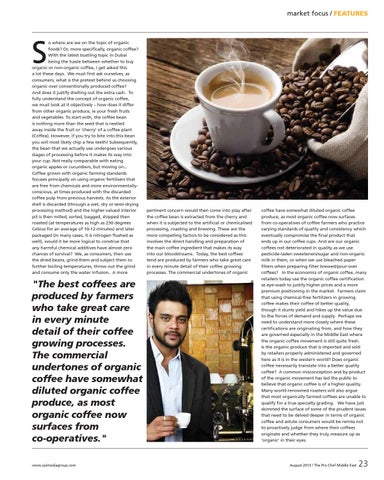
o where are we on the topic of organic foods? Or, more specifically, organic coffee? With the latest bustling topic in Dubai being the tussle between whether to buy organic or non-organic coffee, I get asked this a lot these days. We must first ask ourselves, as consumers, what is the pretext behind us choosing organic over conventionally produced coffee? And does it justify shelling out the extra cash. To fully understand the concept of organic coffee, we must look at it objectively – how does it differ from other organic produce, ie your fresh fruits and vegetables. To start with, the coffee bean is nothing more than the seed that is nestled away inside the fruit or ‘cherry’ of a coffee plant (Coffea). However, if you try to bite into this bean you will most likely chip a few teeth! Subsequently, the bean that we actually use undergoes various stages of processing before it makes its way into your cup. Not really comparable with eating organic apples or cucumbers, but moving on... Coffee grown with organic farming standards focuses principally on using organic fertilisers that are free from chemicals and more environmentallyconscious, at times produced with the discarded coffee pulp from previous harvests. As the exterior shell is discarded (through a wet, dry or semi-drying processing method) and the higher-valued interior pit is then milled, sorted, bagged, shipped then roasted (at temperatures as high as 230 degrees Celsius for an average of 10-12 minutes) and later packaged (in many cases, it is nitrogen flushed as well), would it be more logical to construe that any harmful chemical additives have almost zero chances of survival? We, as consumers, then use the dried beans, grind them and subject them to further boiling temperatures, throw out the grind and consume only the water infusion.. A more
"The best coffees are produced by farmers who take great care in every minute detail of their coffee growing processes. The commercial undertones of organic coffee have somewhat diluted organic coffee produce, as most organic coffee now surfaces from co-operatives." www.cpimediagroup.com
pertinent concern would then come into play after the coffee bean is extracted from the cherry and when it is subjected to the artificial or chemicalised processing, roasting and brewing. These are the more compelling factors to be considered as this involves the direct handling and preparation of the main coffee ingredient that makes its way into our bloodstreams. Today, the best coffees tend are produced by farmers who take great care in every minute detail of their coffee growing processes. The commercial undertones of organic
coffee have somewhat diluted organic coffee produce, as most organic coffee now surfaces from co-operatives of coffee farmers who practice varying standards of quality and consistency which eventually compromise the final product that ends up in our coffee cups. And are our organic coffees not deteriorated in quality as we use pesticide-laden sweeteners/sugar and non-organic milk in them, or when we use bleached paper filters when preparing filter brewed/pour-over coffees? In the economics of organic coffee, many retailers today use the organic coffee certification as eye-wash to justify higher prices and a more premium positioning in the market. Farmers claim that using chemical-free fertilizers in growing coffee makes their coffee of better quality, though it stunts yield and hikes up the value due to the forces of demand and supply. Perhaps we need to understand more closely where these certifications are originating from, and how they are governed especially in the Middle East where the organic coffee movement is still quite fresh. Is the organic produce that is imported and sold by retailers properly administered and governed here as it is in the western world? Does organic coffee necessarily translate into a better quality coffee? A common misconception and by-product of the organic movement has led the public to believe that organic coffee is of a higher quality. Many world-renowned roasters will also argue that most organically farmed coffees are unable to qualify for a true specialty grading. We have just skimmed the surface of some of the prudent issues that need to be delved deeper in terms of organic coffee and astute consumers would be remiss not to proactively judge from where their coffees originate and whether they truly measure up as ‘organic’ in their eyes.
August 2013 / The Pro Chef Middle East
23
FEATURES / skills
Hunting for flavour Surprisingly, perhaps, wild populations of deer can be found throughout most of New Zealand. They’re descendants of deer that were imported from the UK and liberated in the country back in 1851. As well as living wild in herds, they’re also farmed for venison. A group of farmers sharing the same vision about animal welfare and the environment formed Firstlight Foods. Chef for hire Andy Campbell was given a selection of the meat to try out and asked to be inventive.
F
irstlight Foods is a New Zealand-based privately owned farming, processing and exporting business comprised of a small select number of farmer shareholders and a specialist supply chain management team. It is the only Halal approved facility and exporter of venison in New Zealand. All farmers sign up to the same basic principles of integrity, provenance, quality, animal welfare and sustainability. New Zealand has a robust meat supply chain operating under the National Animal Identification
24
The Pro Chef Middle East / August 2013
and Tracing (NAIT) scheme. NAIT uses unique radio frequency identification tags to provide lifestock owners, processors and Government with information on location, movement history and other attributes associated with lifestock. Red deer were introduced from Scotland to New Zealand in the early 1800s, where they thrived and today are widely spread in the wild. In the 1970s a new business of farming red deer commenced and today there are approximately 1.2 million red deer farmed throughout the country. Firstlight Foods specialises in producing tender,
mild flavoured meat. Animals are processed under two years of age and exported as chilled vacuum packed cuts by sea and by air throughout the world. Firstlight venison are raised on a 100% grass diet. Deer are farmed as small herds in large pastures in order to replicate their natural wild conditions as far as possible.. Firstlight Foods is now established in the UAE and will soon be airfreighting red and fallow venison all year round. Premium, grass-fed wagyu beef is expected to follow shortly afterwards.
www.cpimediagroup.com
skills / FEATURES
Red deer Goulash cut or known as diced haunch.
Venison rendang which greatly improved once cooked and left for a day in the fridge as did all the slow cooked dishes.
Fallow deer Shoulder marinated for stir fry.
With saffron broad beans and potatoes.
Rack of red deer cutlet Good for two or sharing platters.
www.cpimediagroup.com
With spiced date and walnut compote.
August 2013 / The Pro Chef Middle East
25
FEATURES / skills
Stir fried fallow deer shoulder Fallow deer shoulder
With Sadaka gluten free and low calorie noodles, dietary friendly.
Seared loin of red deer Coriander and pepper smoked red deer loin. Rear – Thai style Carpaccio ready to be seared.
Thai style carpaccio.
Fallow deer Off cuts for grilled satay.
Satay with spring onions.
“I tried various ways of cooking this lean meat away from the traditional methods. The shoulder was used in stir fries and satay; the loin and fillet smoked and prepared Thai style as carpaccio.” 26
The Pro Chef Middle East / August 2013
www.cpimediagroup.com
Under the Patronage of H. H. Sheikh Mansour Bin Zayed Al-Nahyan Deputy Prime Minister of the UAE, Minister of Presidential Affairs and Chairman of Abu Dhabi Food Control Authority
24-26 November 2013, ADNEC
COMPANIES REPRESENTED BY HOSTED BUYERS WERE RESPONSIBLE FOR US$127 BILLION OF TURNOVER at SIAL Middle East 2012 “We have been impressed how much the show has grown year-on-year, while still maintaining its quality. Our objective was to promote new products and identify potential partners. We have certainly achieved that.” Alaa Kamal, Midamar
Strategic partner:
“We wanted to establish a reliable platform to promote our products to Middle Eastern markets. We discussed a variety of business opportunities with visitors from the GCC and signed deals. We will certainly be signing up next year.” Bozena Czaja, Invest in Poland “We do not have a showroom within the UAE, so we use SIAL Middle East as a platform to showcase our appliances. Each year we meet prospective buyers and conduct quality business.” Imane Louizi, Helix International
Reserve your stand space today!
www.sialme.com Headline sponsor:
SIAL, a subsidiary of Comexposium Group
Platinum sponsor:
Culinary partners:
Official publications:
Alongside:
Organised by:
FEATURES / product focus
Summery salads Borelli was established in the 1970s by Giuseppe Borelli in Manfredonia, Italy. With extensive experience in the industry, he built his company into a leader in the production and marketing of anchovies ďŹ llets in oil, in 1976. The success that followed helped Borelli grow domestically and internationally and the company is run today by his children Rino, Massimo and Laura. Borelli’s expertise is in processing canned ďŹ sh on an industrial scale, using a balance of established techniques and innovative technology to stay competitive in the market. Dedicated to preserving the art of traditional Italian cooking, Borelli uses traditional recipes and processes to prepare their products. Products are then packaged according to the needs of the ingredient, use and storage requirements. Here is a range of recipes created by Borelli chefs perfect for meals or snacks.
Product note: Borrelli Grilled Octopus In Oil
Grilled octopus, kohlrabi, apple and beetroot salad Serves 1 Ingredients 80g grilled octopus 15g kohlrabi 10g apple 10g beetroot 3g fresh coriander (rough chopped)
28
The Pro Chef Middle East / August 2013
2g garlic 5ml white vinegar 10ml olive oil salt and pepper to taste Method 1 Peel the kohlrabi, cut in half and slice thinly. 2 Peel the apple and slice thinly. 3 Core the beetroot and grate it
4 5 6
coarsely on a cheese grater. Mix together all the vegetables and octopus in a large bowl, then add the rest of the ingredients. Stir well, taste and season. To serve, pile the salad on a serving plate and garnish with a little chopped coriander.
www.cpimediagroup.com
product focus / FEATURES
Mussel and salmon stew Serves 1 Ingredients 40g mussels 3g saffron 5g curry powder 100ml ďŹ sh stock salt and pepper to taste 50ml cream 75g salmon 18g carrots 18g potatoes 15g leeks 5g parsley Method 1 Bring the stock to the boil and gently simmer to reduce. 2 Add the saffron, curry powder and cream and bring back to a simmer. Add the salmon cubes, diced carrots, potatoes and leeks, simmer for two to three minutes until tender. Add the chopped parsley and mussels and stir through into the sauce. 3 Season with salt and pepper and serve in a suitable dish.
Product note: Borrelli Mussels In Oil
Prawn surimi, split wheat and beetroot salad Serves 1 Ingredients 90g prawn surimi 37g dried split wheat 25g carrot (peeled) 5ml balsamic vinegar 5g fresh basil (picked) 20g beetroot (cooked) 3g oregano (picked) 2g garlic 10g hard goat's cheese salt and pepper to taste Method 1 Soak the wheat in lots of cold water for 24 hours. Drain, cover with fresh water and simmer for an hour, adding boiling water as necessary. They're done when they are tender but still have some ďŹ rmness. Drain, add some olive oil and salt and then set aside to cool. 2 Preheat the oven to 190C. Cut the carrots on an angle, 1cm thick. Toss with a little olive oil, vinegar, salt and pepper. Spread one layer on an oven tray and roast for 30 minutes - they should still be crunchy. Remove from the oven and while hot, mix with the basil and beetroot. Leave to cool. 3 Mix the wheat with the prawns, carrot and beetroot, add oregano, season and dot chunks of cheese around plate.
www.cpimediagroup.com
Product note: Borrelli Prawn Mussels In Oil In Oil Surimi
August 2013 / The Pro Chef Middle East
29
FEATURES / product focus
Crab, celeriac and lentils with hazelnut and mint Serves 1 Ingredients 70g crab surimi 8g whole hazelnuts 25g Puy lentils water 3 bay leaves 3 thyme sprigs 25g celeriac (small) 8ml olive oil 6ml hazelnut oil 5ml red vinegar 5g fresh mint (chopped) salt and pepper to taste Method 1 Preheat the oven to 140C. Scatter the hazelnuts on a small baking tray and roast in the oven for 15 minutes. Let them cool down, then chop roughly. 2 Meanwhile, in a separate saucepan, cook the celeriac in plenty of boiling salted water for eight to 12 minutes, or until just tender. Drain. 3 In a large bowl, mix the hot cooked lentils with the olive oil, a little of the hazelnut oil, vinegar and season. Add the celeriac and crab, mix well. Taste and adjust the seasoning. 4 To serve, stir in half of the mint and half the hazelnuts. Pile on top. Garnish with the rest of the mint and hazelnuts.
Product note: Borrelli Crab Mussels In Oil In Oil Surimi
Seafood and green herb salad Serves 1 Ingredients 90g seafood salad 5g fresh coriander (picked) 3g fresh basil (torn) 3g fresh parsley (chopped) 3g fresh dill (picked) 3g fresh mint (chopped) 10g rocket leaves (torn) 15g mangetout (finely sliced) 8g flaked almonds (toasted) 5g pumpkin seeds (toasted) 5g sesame seeds (toasted) 2g chilli flakes
Method 1 Place all the herbs, leaves and mangetout in a large bowl. Scatter over the seed mix by hand. 2 Just before serving, gently add the seafood and lightly toss with the salad.. 3 Serve immediately.
Product note: Borrelli Seafood Salad In Oil
BORELLI PRODUCTS ARE EXCLUSIVELY DISTRIBUTED BY EMIRATES SNACK FOODS (ESF). FOR FURTHER RECIPES AND INFORMATION PLEASE CONTACT: Chefs Chef Stefano Callaioli: stefano@esf-uae.com Chef Mikael O’Brien: mikael@esf-uae.com
30
The Pro Chef Middle East / August 2013
Food Service Managers Olga Noskova: olga@esf-uae.com Rodica Olaru: rodica@esf-uae.com
www.cpimediagroup.com
toque to me / CHEFS
King of the stars Alain Ducasse became the first chef to own restaurants carrying three Michelin Stars in three cities and he is one of only two chefs to have achieved 21 Michelin stars across the restaurants in his global empire. All a long way from his humble beginnings on a farm in southwestern France.
A
t the age of 16, in 1972, Alain Ducasse began an apprenticeship at the Pavillon Landais restaurant in Soustons and at the Bordeaux hotel school, before combing work at Michel Guérard’s restaurant in Eug√©nie-les-Bains whilst also working for Gaston Len√¥tre. Five years later, he became an assistant at Moulin de Mougins under chef Roger Vergé, responsible for creating Cuisine du Soleil, and learned the Provençal cooking methods for which
he was later known. His first chef position came in 1980 at L’Amandier in Mougins and, a year later, he was head chef at La Terrasse in the Hôtel Juana in Juanles-Pins, which gained two Michelin stars in 1984. Another two years later, Ducasse was offered the position as Chef at the Hôtel de Paris in Monte Carlo, with management including the hotel’s Le Louis XV. And, in 1988, he opened La Bastide de Moustiers, a 12-bedroom country inn in Provence
and invested in other hotels. Then, in 1996, his empire really started to grow, with the opening of the Alain Ducasse restaurant in Le Parc - Sofitel Demeure Hôtels in Paris. After just eight months of operation, it gained three stars. Next on his list was America with the 2000 opening of the Alain Ducasse restaurant in New York City, which also gained three stars in 2005. However, he closed it two years later in order to open Mix in Las Vegas, followed by Adour in Washington and the more casual Bistro Benoit New York. In 2005, Ducasse opened his first Asian restaurant in Tokyo.
Alain Ducasse au Plaza Athénée - Paris
EAT HERE! 59 Poincaré - Paris Adour - Washington DD Alain Ducasse au Plaza Athénée - Paris Alain Ducasse at the Dorchester - London Aux Lyonnais - Paris Bar & Boeuf - Monaco Beige - Tokyo Benoit - Paris, Tokyo, New York City Le Cour Jardin - Paris Mix - Las Vegas Le Rech - Paris Le Louis XV - Monaco Le Relais du Parc - Paris Le Relais Palza - Paris La Bastide de Moustier - Moustier Ste Marie Spoon - Paris, Saint-Tropez, Beirut, Carthago, Gstaadt, Mauritius, Hong Kong Tamaris - Beirut Trattoria Toscana L’Andana - Grosseto
www.cpimediagroup.com
August 2013 / The Pro Chef Middle East
31
CHEFS / pimp my plate
From India to Egypt A popular ďŹ gure on Gulf-wide TV and as the regional corporate chef demonstrating for Meat & Livestock Australia (MLA), Tarek Ibrahim balances cooking and teaching. He enjoys both equally, but he surprises us by revealing that for several years he was also lead singer of the Electric Arab Orchestra in America. His reinvention of a classic Indian dish was delivered complete with soundtrack!
32
The Pro Chef Middle East / August 2013
www.cpimediagroup.com
pimp my plate / CHEFS
A
popular chef appearing on Fatafeat and as the regional culinary face for MLA, Tarek Ibrahim is a busy man. But he's used to that, frequently multitasking and travelling extensively in his MLA role, which he loves. "I truly believe that Australian meat is the safest in the world, delicious and, of course, halal. Working with MLA is helping my career soar and ot's great to be in a kitchen doing all the things I enjoy and working with the highest calibre chefs." He grew up in a household of women in Alexandria. Apart from his father, he was the only male in a house where his mother, his two sisters, two female cousins and an aunt seemed to spend all day preoccupied with food. "It was a very traditional family. At 6am every day, my mother was in the market getting fresh produce and then the women spent all day cooking and canning." His father, a master cabinet maker, although strict was concerned that his daughters got a proper education and, despite being Muslim, went to a French Catholic school as he believed that offered the best educational choice for them. "He had a different route for me. I was sent to the cheapest public school - he believed I would learn in college and life. School for me was seen by him as a way of learning the value of being a man." His choice of career was uncertain. His father refused to even let him visit his store and, when Tarek asked to join the business, took him to a timber store and got him to carry large bundles of wood for the afternoon. "That put me off wood
for life - I never asked him again!" His next choice was a pilot, but his father was not keen because of the dangers. Then a singer - "A singer? Do you want to be a clown? He almost slapped me…" Finally he settled on tourism as an industry with a future. "I decided to be a chef, inspired by the time I'd watched my mother in the kitchen. My father despaired of me but I went to the University of Alexandria to study photography and surveying before joining other family in Minneapolis in the States. There I started cooking and it felt so good! I worked at the Hyatt Regency for three years, doing so well that I was promoted soon after I began, even though I had very minimal experience." In 1988, he left the hotel and opened his own place, The Upper Crust, where he did a lot of baking and helped kickstart the American adoption of espressos and croissants. The cafe was successful but he split with his business partner and soon had a string of outlets including one that specialised in Middle Eastern food. "It was a busy time - at one stage I had three places open at the same time. Then I began entering competitions and won the Premier Chef of America from the US Dairy Association three years in a row." However, the desire to learn meant that he sold up and moved back to Egypt in order to learn how to make desserts, spending six months training with a female chef who gave him his first formal training. Then back to the US. "It was 1998 and I was doing a lots of demos for the American Culinary Federation and I discovered that I was a
Meat & Livestock Australia (MLA) is a producerowned company whose mission is to deliver world-class services and solutions in partnership with industry and government. Promoting the quality, safety and nutritional value of Australian red meat both domestically and internationally, on behalf of the meat and livestock industry, MLA manages and operates a portfolio of marketing activities aimed at maintaining and increasing demand for Australian meat and livestock. MLA in the Middle East North African region works with retailers, foodservice operators, importers, manufacturers and Australian exporters to maintain and increase the demand for halal red meat and livestock to the region.
natural trainer. I'd do things like make couscous or filo pastry from scratch! And, in the hours when I wasn't training, I took other classes - I wanted to learn things and I like to know what's in my food so I'd learn about Latin food or take extra pastry classes and so on." He entered more competitions and then, in 2004, decided he wanted to know what he had achieved as a chef so he took exams at the American Culinary Federation and became both a certified executive chef and a certified educator.
Lamb rogan josh (Red lamb) Serves: 4 Ingredients: 90ml oil 90kg boneless lamb shoulder, cut into 1-inch pieces salt 2 onions, thinly sliced 2 tbsps minced fresh ginger 2 garlic cloves, minced 1 tbsp plus 1 tsp Madras curry powder 1 tsp turmeric 1/2 tsp cayenne pepper 2 bay leaves can tomato puree 240ml plain whole-milk yogurt 500ml water 1 tsp garam masala coriander leaves, for garnish Basmati rice and warm naan, for serving Method: 1 Heat oil in large casserole, season the lamb and thencook over high heat for about 12 minutes, stirring occasionally. Transfer to a plate. 2 Add onions to the casserole and cook over moderate heat until lightly browned. Add the spices and cook for
www.cpimediagroup.com
3
two minutes. Add the tomato, yogurt and water, bringing to a boil, then season. Return lamb and juices to the casserole. Part cover and simmer over low heat until the lamb
4
is very tender, round one hour. Stir in the garam masala and cook for five minutes. Discard bay leaves and garnish with coriander. Serve with rice and naan.
August 2013 / The Pro Chef Middle East
33
CHEFS / pimp my plate
"That was great for me, since I'd been such a bad student at school." He returned to the Middle East and began training the Egyptian team for the culinary Olympics. "We won five golds in Germany, five in Luxembourg and then swept the board in Turkey with a total of 36 medals. Then, joining MLA, I really dicovered meat for the first time. It's a really wide field and most chefs use it, of course, but don't really get deep into the subject. So I educated myself." Self improvement is something that Chef Tarek feels is vital. "I still want to know more, to explore and to learn. In fact, I'm going to Jordan shortly to learn about molecular gastronomy at La Roche
and, although I'm not big on science fiction food, I'm sure I'll be able to use it in some way. Four times a year, I go to La Roche and teach chefs." He takes great pride in having been the first Arab chef to be nominated for and receive the status of Master Chef from the World Association of Chef Societies (WACS), which is given to professional chefs who create innovative dishes of exceptional quality, push boundaries with creative concepts and hold a reputation for culinary excellence. "Very few chefs gain Master Chef status and it’s such an honour to receive this accreditation as an Arab chef and gain international recognition for my cuisine," he says. "I hope to inspire the new
generation of Arab and Egyptian chefs to greater achievements. We've got outstanding talent and should spread the word about our cuisine." How did he tackle our pimp challenge? "I knew the original dish, of course, but I felt it was very starchy with the potatoes. I considered pumpkin but i think the sweet potato adds a lot of flavour, doesn't disintegrate and is a good substitute. The labneh gives a denser, thicker flavour than yoghurt and helps smooth the spices. Finally, butter has less fat than ghee. I'd also serve it with bread." Could he develop the dish further? "I also cooked the meat for a long time and then stuffed a sambousek and deep fried it. Tremendous!"
STEP BY STEP COOKING GUIDE:
Step 1: Brown the beef.
Step 2: Add tomatoes.
Step 3: Cover with stock.
Step 4: Finish with the yoghurt.
MLA beef rogan josh Serves: 4 Ingredients: 1kg Australian beef blade, topside or round 2 tbsp butter 1 large onion, cut into thin wedges 1 tsp orange smoked pepper powder 1/4 cup Rogan josh curry paste 2 tbsp tamarind paste 400g can of diced tomatoes 2 cups beef stock 400ml can of coconut milk 300g baby sweet potatoes, cubed 2 tbsp labnah salt and pepper to taste 1 cup fresh coriander leaves 2 Indian naan bread (optional} Method: 1 Preheat oven to 180C. Cut beef into 2.53cm cubes. Season with salt and pepper, add about 2 tbs of butter to the beef and mix well. Heat a large frying pan over a medium-high heat. Brown the beef in two or three batches. Remove each batch and place in a casserole dish. 2 Reduce heat in the pan, add a little butter, add the orange pepper powder, add the tamarind
34
The Pro Chef Middle East / August 2013
3
paste, add onion and Rogan josh curry paste, cook for one to two minutes and stir occasionally. Add the tomatoes, stock and coconut milk, stirring until the mixture boils. Add to the casserole dish and stir to combine. Cover the dish, place
in oven. Stir every 40 minutes or so, add stock to keep ingredients just covered. Cook until the beef is very tender. Add the sweet potatoes in the last 30 minutes of cooking time. Sprinkle with coriander and serve.
www.cpimediagroup.com
www.mla.com.au
Halal to the bone. Safe, healthy and halal. That’s Australian Meat for you.
Just a few reasons why our halal assurance is recognised by Islamic
The slaughter is carried out
countries around the world,
by Muslims, in accordance with
including yours.
Shari’a law. And all premises
What’s more, it comes
are registered and regularly
with an authentic halal
monitored. Australian government supervised Islamic slaughter programmes are also in place to ensure
government approved Islamic organisations. If you are looking for halal, just ask for Australian Meat. CommUnion
stringent procedures.
certificate issued by
+971 433 +971 4 4433 13551355 Facebook.com/lambandbeef www.lambandbeef.com
CHEFS / face to face
Consistency is the key Raised on a family farm in a tiny village in the Austria mountains, Christian Gradnitzer discovered the value of real produce at an early age. Now, in his latest role as Group Culinary Director for Jumeirah, he’s determined to make the group known worldwide for outstanding restaurants.
C
onstantly travelling or in endless planning meetings, it’s been quite a challenge to fit into Christian Gradnitzer’s schedule. However, once sitting in the calm of Al Qasr, he has the enviable knack of making you feel as if an interview is the only thing on his mind and he devotes as much time to it as we wish. Just as well, as he has a fascinating story. He grew up in Ferndorf, a hamlet of around 800 people in Carinthia, 20 miles from Italy in the south of Austria. Growing up on a farm that had been in his family for nearly four centuries, he describes his childhood as “paradise” helping his father on the farm and his mother in the small ‘gasthof’ (guest house) she ran using produce from the farm. Even now, he says, a return to this corner of Austria recharges him for the year and allows a short break from “the big burdens of life”. Were you interested in food as a child? My family ran a farm so food was always there. My father kerpt cows, chickens and so on and the nearby forests were full of produce. It was full-on farming and we were very selfsufficient, making our own bread and cheese and everything in between. My mother was a good cook
36
The Pro Chef Middle East / August 2013
- she’d had proper training - and she ran a small guest house on the farm. By the time I was five or six, I was driving the tractor or cleaning out the stables - that was just the way things were for us, it was part of your duty. I used to help her in the kitchen, because I guess it was easier than the stable work! Apart from her food, did you eat out at all? As I said, we lived in a tiny village and were lucky to go to the nearby city even once or twice a year - a real adventure. Eating out wasn’t really our style, though we might occasionally have a pizza. Even today, my parents have never been on a plane and they only got passports when they needed to meet me in Venice some years ago. I was the eldest brother and I had this interest in food; my younger brother liked food and farming - he’s now an engineer. That farm for me was a paradise, both then and now. I’ve been away for 23 years but it’s still the only place where I can switch off. Every year, my wife and I take our children back and we spend a few days in a small cottage in the mountains - no TV, no phones, no WiFi. That gives me energy for the whole years and I think it’s important to connect my kids to that life and spend quality time with them. My son was born in New York and my daughter here in Dubai, so Ferndorf is a very different world for them. But it’s vital to show them how food is prepared and where it comes from. My mother has a massive kitchen garden and it still amazes me that I can’t source food that good. I’m inspired by the place. It’s hard to leave but each time it increases my determination to raise the quality of produce here. We all read about the carbon footprint but I believe we have to do something about it. On a small scale in my villa’s garden I grow herbs - yes, right through the Summer. This year we’ve had chillies for the first time and last night we had the first tomatoes. It’s small scale but it helps me look back at my mother’s garden.
www.cpimediagroup.com
face to face / CHEFS
dishes a modern twist at the highest level. There was no buffet dining and we got new supplies as we travelled, so there was always a different regional feel to the dishes. I’m a strong believer in special authentic cuisines - that’s one thing I truly represent.
When did you decide you wanted to be a chef? I was working in the restaurant and I felt a real connection, though my inclination was towards interacting with customers. The idea of being a chef wasn’t clear to me at the start and I thought I’d be a waiter. I left school at 15 and started a three-year apprenticeship, two years of which I spent cooking at Kurhotels Warmbaderhof, whose restaurant held two Michelin stars. Austria has a great apprentice system and I spent ten months of the year working and then two months studying at the Vocational School for the Catering Trade for my diploma. I had the option of doing a four year apprenticeship which was a combo chef/waiter programme, but I wanted clarity. I discovered I liked to explore produce - you know, a simple salad made with great ingredients is one of the most important things. The restaurant gave me a great basis - it was rooted in Austrian culture, simple and rustic. Again, we did everything especially baking, which I’m still passionate about. After the apprenticeship, what then? I did my one year of military service. In fact, I did it a year early because I didn’t want to interrupt my career once it started. Then I did a series of seasonal jobs - Commis at Hotel Schloss Seefels in Portschach am Worther See and Commis rising to Demi Chef de Partie at the Grand Hotel Quellenhof Resort in Bad Ragaz. That meant a shift to Switzerland - the first time I’d been abroad. After that, I decided to learn English - not a strong subject at school - and decided on a big adventure to America! I got a student visa to learn the language and set off. I can remember thinking on the flight ‘I’m just a little boy from the farm on a big plane!’ Anyway I arrived in San Francisco and it was really, really hard without English. To be honest, I wanted to go home. Were you aware at the time of the new wave of Californian cuisine and the importance of ingredients? I’d read a lot about San Francisco and places like The French Laundry before going there through trade magazines like Rolling Pin - remember, no Internet then for research! The problem was I just couldn’t communicate so instead I tasted and tasted and discovered food - however funky it was, that was no problem. After I finished the course, I started to travel across the US - you can imagine the shock of a place like Las Vegas! By then, I understood the language but not US food trends. I remember most of all being amazed at the seafood - not big in Carinthia. I then went back to Switzerland and the world of fine dining. It was all about learning the basics and doing them over and over again. Every day, we’d have to make a perfect consomme - who does that any more? As a chef, you have to learn the correct way and then you can do your own thing. Were you bitten by the travel bug by this stage?
www.cpimediagroup.com
Oh yes - after America, I had an amazing two weeks in Thailand. I really felt I was connecting with different cultures so, with my new language skills, I got a job at The Dorchester in London under Anton Mossiman, firstly as Demi Chef and then as Chef de Partie. Trouble was, I couldn’t make myself understood in London and I couldn’t understand a word people said! It was very tough. As an aside, why do you think Mossiman never got such wide recognition as other chefs ? Was it because he slipped out of the limelight when he opened his private club? I think he was one of the real innovators who helped push British cuisine forward and he remains a great model for other chefs. There is only one Anton just like there’s only one Michel Roux Sr. I think his personality meant he was never going to create an empire, but he really is an old school gentleman. I learned a lot from him. What next? I joined Cunard Cruise Lines as Chef de Partie which allowed me to travel around the world and, of course, wherever we docked I ate like crazy, especially street food. In Hong Kong, for example, we’d sometimes eat at four or five restaurants in an afternoon. Travelling like that really made me think about myself and the future. Cunard had a very classic style and our job was to give classic
After that you came to Dubai, right? Yes, as Sous Chef at the Burj Al Arab, progressing up the raks to Executive Sous Chef. At that time, from 2000 to 2005, I entered a lot of competitions and together with the team, we had a lot of success. Again, travel was great and I really relished the chance to share other chef’s originality and creativity. Then, at the start of 2006, I took the job of Executive Chef at Jumeirah Essex House in New York City. It was an amazing opportunity and I was super excited but, after living the dream in Dubai, it was very hard to leave that bubble but working in New York was an eye opener, a push into extreme reality. It was an awesome time for me, also because it was a chance to start our family. I learned a lot from the city such as 50 street carts selling shawarmas but only one having really long lines. There were two big things I brought back: one was the authenticity of concepts in the city and the simplicity of innovation. I was inspired strongly by Danny Meyer who started Union Square Cafe. He showed me the importance of great food, atmosphere and service all creating the perfect restaurant's operator vision. Was it hard adapting to New York? Sure. Things we take for granted here like no tax and a nice car are gone. We were travelling on the subway. But the hardest thing to deal with was union power in hospitality. In what way? Say you want a table moved ten feet. You need three people to do it and they won’t unless they get extra money for doing it! I guess Dubai gave me a bubble of comfort and when I came back, it seemed a different place. Not so much that the bubble had burst but that we were having to adapt to different conditions. You came back as Executive Chef at Jumeirah Emirates Towers, right? Yes, in 2008. I was 100% a different person from when I’d left Dubai which was good because Dubai needed a different approach. We were used to seeing full restaurants and now we had to use smart marketing to get customers back.
“ I was inspired strongly by Danny Meyer who started Union Square Cafe. He showed me the importance of great food, atmosphere and service all creating the perfect restaurant's operator vision.” August 2013 / The Pro Chef Middle East
37
CHEFS / face to face
We also had to stop seeing the dip in business in the Summer as a problem and take the American approach of looking at the business as a whole year and realising how well you were doing. Before, I think we were reactive and there was a lot of learning to do. Anyway, after a couple of years I became Resort Executive Chef at Madinat Jumeirah - 850 people under me including 350 chefs and other back of house staff, 29 restaurants and so on. Hard work! Then, last December, I moved into my current role as part of a global team headed by Gert F Kopera to oversee all the F&B operations of the Jumeirah Group and Jumeirah Restaurants. Do you miss not being in the kitchen? Instead I look forward to seeing new things but, yes, I do miss the operations side but not every day. Before, what I did had an immediate impact but now I’m enjoying seeing how people react to our new concepts. You faced a mammoth task coming into the
new role. How did you set priorities? Firstly, we needed to ensure we have the right team in place. This job isn’t just about me, it’s about Jumeirah. The way the company has grown was fairly organic and it was time for us to step back a bit and make changes for the future. We have a great base here in the UAE and a strong pipeline in other territories, but we need to know more than how to play in our own playground. Our mission is simple: to create outstanding restaurants based on a freestanding approach. We need to bring the right offers to market based on concepts. Does that mean we’ll see closures? Certainly we have to streamline to be best in class but looking across all our outlets I don’t see any that are failing badly. As you know, we closed both Pisces - great food, difficult location - and Magnolia but I’m not anticipating other closures. Instead, we intend to renovate and add new concepts with a strong focus on originality and consistent delivery. At present, we’re working on a five year global plan that focuses on the great talent we
have and also delivers clear, design-led concepts. Often, in the past, we’ve relied on chefs to design restaurants, now we’ll use industry experts. A good experience for a diner has three parts, I believe: the food, the beverages and the atmosphere. So we need to look not at what will be popular next year but what will still be in in five years time. What kind of changes can we expect in the short term? Some have been announced, others I’ll not mention yet. A good example of the new approach is Jamie Oliver doing his own thing at Jumeirah Beach Hotel. We want to be open to ideas; equally, we want to move our talent forward although we’re still mapping this thing. You’ll see a lot more authenticity in the future. With a completely free hand, who would you like to see in Dubai? Jean-Georges Vongerichten! What non-Jumeirah restaurants do you like? I don’t really want to give a list but I’m very impressed with La Petite Maison - it’s a simple concept but they really deliver on consistency, which is a challenge for all of us. That’s really why I admire the freestanding model and why we’re moving away from the traditional hotel outlet. I’d also say don’t automatically dismiss outlets in malls - some are very good. I appreciate well delivered restaurant concepts which achieve great consistency. There are many outlets in Dubai which I truly like for their amazing character. What’s wrong with the food scene in Dubai? If I compare Dubai to New York, there people are very loyal to their neighbourhoods. Here we seem a lot more undecided. Finally, what’s happening with Jumeirah Restaurants? The Noodle House is booming and, as you know, we’re ready to export the concept to other countries. Look for the new menu at the start of August, by the way! We’ll look for other home developed brands that we think have similar potential given the right focus. And the Caprice brands? Will we see, for example, an Ivy in the Marina? You know, having a great brand is not enough - you need to do your homework and we’re not rushing into anything when so many of our restaurants need a refresh, a click if you like. Are we talking to Caprice? Of course. Are we considering bringing in other brands? Of course. Are we actively seeking celebrity chefs or brands to open in our hotels? We’re open to discussions but this is not a priority at present..
38
The Pro Chef Middle East / August 2013
www.cpimediagroup.com
17 - 19 SELL YOUR PRODUCTS
TO THE WORLD’S FASTEST GROWING GOURMET & FINE FOOD MARKET
s -EET OVER HIGH PROlLE BUYERS FROM CATERING COMPANIES hotels, restaurants, retailers, specialist distributors and wholesalers s OF EXHIBITORS SECURED ORDERS VALUE BETWEEN 53 AND 53 s # OUNTRY PAVILIONS ALREADY INCLUDE !RGENTINA #HINA &RANCE 'REECE India, Italy, Iran, Germany, Spain, and United Kingdom, and many more!
e a y.
isite ~ ww u q x e e w h t .sp e r ec o l p ial x E it
NOVEMBER 2013 DUBAI WORLD T R A DE C E N T R E
Secure your stand at The Speciality Food Festival!
For the finest gourmet food suppliers only. THE SPECIALITY FOOD FESTIVAL TEAM Tel: +971 4 308 6462 E-mail: speciality@dwtc.com
ORGANISED BY
POWERED BY
OFFICIAL PUBLISHER
OFFICIAL TRAVEL PARTNER
www.speciality.ae
CO-LOCATED WITH
To read what our Exhibitors had to say, scan the QR code!
CHEFS / face to face
Facing the future As the new Executive Chef of Fairmont Dubai, Lorraine Sinclair faced a number of serious issues: 25 kitchen positions to fill and menus across ten outlets, banqueting and in-room dining that hadn’t been refreshed, in some cases, for as long as a decade. A hard-working Glaswegian with years of international experience, she did what she always does: rolled up her sleeves and got straight to work!
F
rom a traditional working class family in Glasgow where food was just something that gave you the energy to get on with things, Lorraine Sinclair has enjoyed a successful career across the globe in Europe, Asia and the Middle East. “At school, I’d never even heard of some of the cities I’ve worked!” she laughs. She’s now responsible for the Fairmont Dubai’s entire culinary operation, including ten dining and entertainment venues, as well as banqueting and in-room dining. In spite of the workload, she’s also looking forward to getting involved with forthcoming Fairmont properties in Ajman and Fujairah, although opening dates of both
40
The Pro Chef Middle East / August 2013
hotels have been pushed back to 2014 and 2015 respectively. What did food mean to you as a child? Not much, to be honest. It came from the supermarket and gave us the energy to get through the day. We’d go picking blackberries and the like which my grandmother would instantly make unhealthy by turning it into over-sugared jam. One treat I remember was going into the back garden with a jar of sugar and dipping fresh sticks of rhubarb straight from the plant into the sugar. Food otherwise came from the supermarket - I never saw even a live chicken till one year we went away on holiday to Wales on a farm.
So, a traditional healthy Scottish diet for you as a kid, then? Absolutely! Everything that could be deep fried was. We’d eat meat pies and try to brush any vegetables off the plate. Nobody in the family had any interest in food, but my mother made excellent desserts - classic stuff like crumbles or Pavlova. We didn’t really eat out - it was a major treat to go to a Chinese restaurant or eat pizza. Our normal restaurant was the local chippie. In those years, Glasgow particularly but also most of Scotland just wasn’t interested in food. It wasn’t until chefs like Nick Nairn came along that things changed and we began to take an interest in the great produce in Scotland - salmon, beef, soft fruits, lobsters,
www.cpimediagroup.com
face to face / CHEFS
smoked haddock and so on. In fact, I think I’ve learned more about Scottish food since leaving the country than I did there. When did your interest in food develop? I remember being intrigued at how food appeared on the table. You’d look in the fridge and there would be virtually nothing and just some standard things in the storecupboard but every day my mother would put a substantial meal on the table. I wanted to know how that was done. I didn’t do well at school - it didn’t do anything for me. I remember a careers officer asking me what interested me and I replied ‘Nothing, especially in this school!’ He suggested I join an apprentice scheme which would mean one day a week at college and five days working. It sounded great and, as I also wanted to travel, I chose cooking. My first job was with a catering company, Canapes, that was also a deli. We’d do functions for 200 people on a Baby Belling! And you loved it? I absolutely loved it! My first job on day one was making coleslaw and I had no idea of quantities so I was pointed to a sack of cabbage, a sack of carrots and one of onions and told to get on with it. Hard work but I was just mesmerised - every day was different. And I even loved college, I think because they treated you like a normal person. Every time I went, I learned something. So in time I got my qualifications from the Glasgow College of Food Technology. And at work, I also learned - the owner was a woman who could do anything. I left after three years because the ownership changed and it wasn’t the same. From there I went to work at The Italian Centre in Glasgow first in the cold kitchen, then pizza making and finally the hot kitchen. It was the biggest shock of my life being in a kitchen. The chefs were pretty chauvinistic and after about 18 months I thought ‘I’m not taking this’ and realised it was time to move away from Scotland. I ended up in a hotel in the tiny village of Upton St Leonard, just outside Gloucester. A little different from Glasgow... Absolutely, but it was a great chance to learn new things - banqueting, bar snacks and an a la carte menu. For the first time I was working with people from other countries - France and South Africa - and the whole place was just a huge culture shock to me and, of course, the cuisine was totally different for me, old-fashioned hotel food. I’d never even had roast beef with Yorkshire puddings - what’s that about? I got put in charge of breakfast which wasn’t good for me - I’m really not a morning person and need a couple of pints of tea to get going. A couple of years of that and I felt it was time to move on. I spotted a job on the trades and became Sous Chef at a beach resort in Sardinia. More culture shock! My skin fried, I didn’t speak any Italian but every Italian I’d met in Glasgow had been friendly and I figured an island was a better overseas start than a bustling major city. Luckily there were lots of British staff there
www.cpimediagroup.com
August 2013 / The Pro Chef Middle East
41
CHEFS / face to face
training of all culinary staff.
but, fairly soon, the Chef had a nervous breakdown and I took over. For the first time, I was creating menus and my own dishes. Then a spell in Corsica before heading back to the UK.
And so finally to Dubai? I got a call from Dubai from the Fairmont GM Michael Moecking who I’d heard of when he was in Turkey. He basically laid out a possible future, a vision of where I could go with the company. I joined and there a lot to do - some of the menus hadn’t changed for years! I had the chance to work with a clean board. I started with banqueting where the menu was so old and boring, the chefs were creating new ones every day! Next, we tackled in-room dining, which was unchanged for a decade. I created a new menu based on comfort food but with a 5-star twist.
You’d had enough of overseas? No, not at all. I was applying hard for jobs in Asia and sending my CV off to places like Malaysia. I got a number of phone responses wanting to speak to Mr Lorraine and when I explained that was me I was told again and again that in Malaysia the chef must be a man! Then I heard about a job in Bahrain and I had no idea where that as. I met the owner, a Kuwaiti - the first Arab I’d ever come across. Anyway, I moved to Bahrain late 1990s to run a restaurant, which led to five restaurants, including the New York style Zoë and the Italian themed Mezzaluna. Again, major culture shock! I arrived during Ramadan and had no idea you couldn’t drink water in the streets. So I was there a couple of years and then back to the UK to help some friends who were opening restaurants. And then - South Korea! That’s quite a leap! Just back to Bahrain for a second, how did you find the staff? Well, I had my education certificates but most guys in the kitchen just had passion. They’d left home to support their families and really had no knowledge about food or cooking. After the Middle East I made it out to Asia, this time Sri Lanka which again was another world. Between their accents and mine, understanding was an issue! I also couldn’t see why people pretended they knew how to do something instead of asking questions and learning. Then I moved on to Seoul via a spell in Hong Kong. Lot of new produce to learn about - I didn’t know that names of the local fish and the other chefs were like ‘You don’t know? How long have you been a chef?’ Of course, the day as a chef the day you think you know everything is the day you should put your knives down. Every day is a new experience - always new things to think about. I was working as Chef de Cuisine and then Executive Sous Chef in the Lotte Hotel, which was the biggest in Seoul with 1,400 rooms and 127 outlets. The food was amazing and I had the chance of opening a wine restaurant - people there really had no knowledge of wine or pairing and would often order the most expensive bottle and the cheapest food. A great experience being there and I learned a lot about different cultures - it was the time of the World Cup and one day there were three million people on the street! The palate of Koreans is very different to that of Europeans and I was hired to make food my way. Food should be authentic. I can cook Thai foor, for example, but I’m not Thai and so flavours will be different.
So everything needed refreshing? Yes. The hotel used to have a great reputation for food but with all the competition these days, you really need to be on your toes and deliver new things. We had 25 empty positions when I arived but now we have a waiting list of people wangting to join us.
How long did you stay in Seoul? Two years and then, in 2004, I took a job as Executive Chef in the Moevenpick Hotel in Istanbul, as again they were looking for a female chef. It was a hysterical kitchen - nobody spoke English and the culture was very different but I loved the fresh food and I was in my element. A couple of years in I got a call from Hong Kong - again they were looking for a female chef so I joined the Langham Place Hotel Mongkok, opening a Japanese and then a Chinese outlet which gained 2 Michelin stars. Diners there were were uncultured about food however - they’d mix lots of items from a buffet on the same plate. A lot of moving around! Oh, it gets worse! Langham then asked me to move to Thailand - I love Thai food - then Shanghai and then three more hotels all in opening phase. I just got tired to travelling, of living in hotels. I was working harder than ever before but I didn’t see any success path so I moved back to Hong Kong as Executive Chef at the head office of HSBC. I was great to be able to do something different and have some normality in my life and a chance to focus on new ideas and recharge, Of course, I knew it was just a stopgap measure but it was a good 18 months. Then it was back to hotels as Executive Chef as The Grand Tarabya Hotel Istanbul, as part of the preopening team responsible for menu engineering, budgeting and recruitment and
What other changes can you talk about? We’re refocusing Spectrum On One - the basic idea is the same but there’s more structure and the food will be more authentic. The private dining area will become Dining in the Dark - 25 seats, two sittings, four nights a week, based on a fixed menu of meat, fish or veg. You’ll eat in complete darkness - without the sense of sight, the other senses have to take over and food tastes different. That will open in September as will our special pork menu that focuses on American style ribs with spicy rubs. It’s taken some time to get the authorisation - as you know you need a totally seperate kitchen - but these are the kinds of things that will make us different. Exchange Grill is, I think rather too meaty and off-putting to many women, so we’re bringing in smaller cuts and fish plus some great desserts like poached egg on toast which is an ‘egg’ made of mango yoghurt on brioche. What’s your general view of the Dubai food scene? I think there’s lots of room for innovation. In many ways Asia is far ahead and I think some kind of hat scheme or even Michelin woud make a difference. And don’t people here love their brunch! They really frighten me as it like a competition to see who can put out the most food. I went to one recently and I doubt I even saw a tenth of what was on offer. I also find the celebrity thing quite sad - people paying and extra Dhs 200 for a steak just because a chef has his name over the door. There’s a lot of places to eat here but, honestly, I’m not seeing the wow factor.
“Don’t people here love their brunch! They really frighten me as it like a competition to see who can put out the most food. I went to one recently and I doubt I even saw a tenth of what was on offer.” 42
The Pro Chef Middle East / August 2013
www.cpimediagroup.com
INTRODUCING
@thehotelshow facebook.com/thehotelshow
Save the Date From the 28th – 30th September
2EGISTER NOW FOR YOUR free fast-track badge to ATTEND 4HE (OTEL 3HOW THEHOTELSHOW COM REGISTER
Join us for the ultimate 360° hospitality experience at The Hotel Show What’s in it for you?
&OR THE FULL EVENT SCHEDULE PLEASE VISIT thehotelshow.com/visionconference
s Attend a 3-day Vision Conference featuring more than 50 hours of hospitality sessions s 6ISIT THE #AREER :ONE TO MEET WITH (2 -ANAGERS FROM 15 leading Dubai hotels looking for their next talent s *OIN THE ULTIMATE SPEED NETWORKING EVENT AND NETWORK ONE ON ONE s !RCHITECTS INVESTORS AND DEVELOPERS CAN enjoy a luxury lounge to meet clients and SIGN NEW BUSINESS CONTRACTS s #ELEBRATE THE LAUNCH OF 4HE ,EISURE 3HOW
Strategic Partner
Gold Sponsor
OfďŹ cial Media Partners
www.cpidubai.com
News and analysis for the Middle East’s hospitality professionals
OfďŹ cial Knowledge partners
OfďŹ cial Recruitment Partner
LEISURE / travel
onward to the centre After last issue’s exploration of the Patagonia region of Chile and its amazing scenery and unusual ingredients, it’s time this issue for editor Dave Reeder to head north to the central region and Santiago, with time for a side trip to Valparaiso.
44
The Pro Chef Middle East / August 2013
www.cpimediagroup.com
travel / LEISURE
P
uerto Montt is a business and commercial hub surrounded by lakes and volcanoes. After the pristine air of the south, it is a shock to the system, especially when torrential rain precludes any real view of the scenery of this area. Thankfully, we are booked into the Cumbres Patagonicas hotel whose Swiss chalet decor and stunning views over the nearby water promise more than the weather can deliver. However, the hotel’s restaurant has just won an award as one of the leading restaurants in the region - yet another sign of the fast-growing renaissance of Chile’s culinary outlook. So, at the Cumeres del Lago, under Executuve Chef Claudio Useda, we’re treated to a platter of local shellfish (king crab, squid and abalone), truffled cream of potato soup, baked salmon with lobster cream and apple and myrtle crumble. The meal, like many we enjoy, is European in style but playing off local ingredients. Service and presentation are excellent and a contrast to our quick tour of the small town the next morning when, sheltering from the rain, we check out the much poorer quality produce on sale in the local small supermarket. The change is dramatic and we see this again and again throughout the country: despite incredible produce, the majority of people appear to have no real interest in sourcing quality foods. That means more for the tourists, of course!
www.cpimedigroup.com
What is it? Last issue, we showed you the curious local bbarnacle, sold everywhere as picorocus. Cooking them is simplicity itself, but still rather a cukture shock. They’re steamed in a moderate oven for five minutes and then the barnacles pulled from their shells. The shells are then used as little cups and, in a single swallow, the hot juices released by cooking are swallowed in a single gulp as ‘Chilean viagra’, before the barnacles are chopped up, covered with a squeeze of lemon and eaten.
Mid-morning, we make our way to the Gastronomy School at the University of Santo Tomas where Chief Instructor Frederic Enery took us through a variety of local produce, from shellfish to seaweed before another excellent lunch. The school outputs about 120 culinary students a year, feeding the growing hospitality sector in Chile. Then on to Multiexports Food, a major processor and exporter of Pacific salmon (coho), trout and Atlantic salmon. 1,000 staff work two shifts a day to cope with demand as fish are filleted, deboned,
August 2013 / The Pro Chef Middle East
45
LEISURE / travel
packaged and readied for dispatch in an endless production line. Demand is now so high around the world that live harvest from 30m x 30m cages, which hold up to 50,000 fish at a time, now
Food glossary Araucaria - Like large pine nuts, these are the seeds of the monkey puzzle tree. Cebiche - Mrinated raw seafood. Charqui - Dried salted meat like jerky. Chocio - Meat and chicken pie with a maize topping. Curanto - Sausage and shellfish stew. Empanadas - Filled savoury pastries. Locos - Abalone. Manjar - Reduced milk dessert. Mero - Patagonia toothfish. Merken - Seasoning made from red chillies, toasted coriander seeds, cumin and salt. Mote - Soaked cereal grains. Mote con huesillo - Drink of dried apricot or peach cordial with mote. Pebre - Salsa. Pisco - Grape brandy. Porotos con riendas - Beans and spaghetti. Sopaipillas - Fried cornmeal pastry.
46
The Pro Chef Middle East / August 2013
represents some $250m pa or 48,000 tons. A late arrival at Hotel Casa Higueras in Valparaiso meant we had no time to explore the city before turning up at the local culinary school in Vina del Mar. Here Chef Corporativo, Juan Pablo Mellado, explained some of the basics of Chile’s culinary heritage, in particular how waves of immigrants from Spain, Germany, Italy, France, Yugoslavia and Croatia had created a very unusual blend of European techniques with the local tradition of a maximum of five or six ingredients in
any dish. He is optimistic for the future but believes Chile has not yet established itself as a country with a true culinary identity. “That will come,” he said, “when we take dishes and rename them so they become part of our heritage.” A quick tour of the major port of Valparaiso concluded with a visit to one of the houses of famed Chilean poet Pablo Neruda, an amazing compendium of antiques and objets trouvées. We dine at the Allegre restaurant in the Palacio Astoreca Hotel - an exceptional meal of delicacy and respect for ingredients like quinoa and squid ink in an elegant setting that, in Europe, would be nudging for a Michelin star. By now, however, after several days of constant travel we are starting to slow down and the next morning sees a late start on our way to a tasting of the Viña Ventisquero range, before moving en masse to the Casablanca Valley and a visit of the Ventisquero vineyards. The setting is idyllic, the wines a revelation. Finally, we reach journey’s end at the Hotel W in Santiago, with one last gastronomic treat - dinner at Osadio, where chef/owner Carlo von Muhlenbrock is dedicated to reclaiming the rich food heritage of southern Chile. Claiming to be the first fine dining chef to give merken serious attention, he delivered a meal that combined great produce and the works of Neruda. A fitting end.
www.cpimediagroup.com
travel / LEISURE
We dine at the Allegre restaurant in the Palacio Astoreca Hotel - an exceptional meal of delicacy and respect for ingredients like quinoa and squid ink in an elegant setting that, in Europe, would be nudging for a Michelin star.
www.cpimedigroup.com
August 2013 / The Pro Chef Middle East
47
LEISURE / the last word
Objects of lunacy As any chef knows, you can do just about anything you need in a kitchen with a decent knife and a whisk, however marketeers of gadgets continue to deliver useless objects to home cooks, all with the latest promise that just one more piece of a kit will miraculously turn you in a great chef. Not only is that promise hollow, what is more amazing is that anybody thought these things up in the first place. We present a round-up of useless objects 1.The banana slicer In what universe is slicing a banana such a tough job? And, last time I looked, not all bananas come straight enought to fit into this complete waste of kitchen space. 2. The pasta measuring tool Not hard is it to judge the amount of pasta you want to eat? Apparently the manufacturers of this gadget think so, otherwise what possible reason could they have for trying to inflict this on us? 3. The spaghetti twirling fork You’re too lazy and lardy to twist your own fork? Maybe you’ve been eating too much pasta. We are speechless. We are without speech. 4. The strawberry slicer Got a spare $7 to spare? If so, you’ll save yourself the effort of having to use a knife to slice up
strawberries. Trouble is, this device doesn’t deal with the stem, so you’ll have to shell out the same amount again for a strawberry stem remover. We’re staying with a knife, thank you very much. 5. The egg cracker If you’re too lazy to crack open an egg, then you’ll probably be too lazy ever to wash it so it’ll quickly get yucky and unpleasant. Just do what the rest of the world does and crack it against the rim of a bowl, okay? 6. The avocado slicer Then again, you could just use a spoon, right? Where’s the device that takes the stone out? 7. The pizza scissors As a circular pizza cutter is one of those kitchen devices that it’s actually worth making room for, this one is just a joke. Isn’t it?
5
4
7
6 1
2 48
The Pro Chef Middle East / August 2013
3
www.cpimediagroup.com
“
76%
What do of consumers find
more attractive than a normal tea bag?
”
...Lipton Pyramid. Your customers will love the unique taste in our Pyramid tea bag and you’ll love what it does for your business. High quality tea at a mainstream price Operator-approved merchandising Strong Rainforest Alliance Certified ™range
To order, call +971 4 881 5552 www.unileverfoodsolutionsarabia.com