ARTS
10
November 10, 2010
Hemingway’s Garden of Eden fails to impress bEtHANY O’grADY staFF Writer
impawards.com
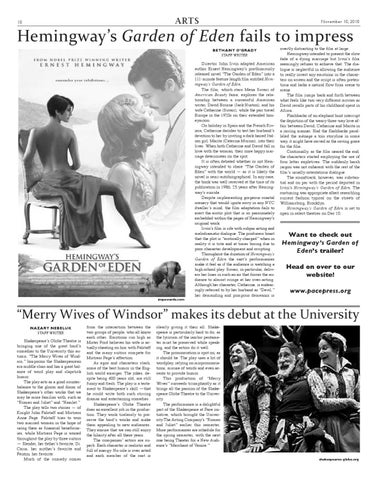
director John irvin adapted american author ernest Hemingway’s posthumously released novel “the Garden of eden” into a 111-minute feature length film entitled Hemingway’s Garden of Eden. the film, which stars Mena suvari of American Beauty fame, explores the relationship between a successful american writer, david Bourne (Jack Huston), and his wife Catherine (suvari), while the pair travel europe in the 1920s on their extended honeymoon. on holiday in spain and the French riviera, Catherine decides to test her husband’s devotion to her by inviting a dark haired italian girl, Marita (Caterina Murino), into their lives. When both Catherine and david fall in love with the woman, their once happy marriage deteriorates on the spot. it is often debated whether or not Hemingway intended to share “the Garden of eden” with the world — as it is likely the novel is semi-autobiographical. in any case, the book was well received at the time of its publication in 1986, 25 years after Hemingway’s suicide. despite implementing gorgeous coastal scenery that would ignite envy in any NYC dweller’s mind, the film adaptation fails to erect the erotic plot that is so passionately embedded within the pages of Hemingway’s original work. irvin’s film is rife with subpar acting and melodramatic dialogue. the producers boast that the plot is “erotically charged” when in reality it is trite and at times boring due to poor character development and scripting. throughout the duration of Hemingway’s Garden of Eden the cast’s performances make it feel as if the audience is watching a high school play. suvari, in particular, delivers her lines in such an air that forces the audience to almost cringe at her over-acting. although her character, Catherine, is endearingly referred to by her husband as “devil,” her demanding and pompous demeanor is
overtly distracting to the film at large. Hemingway intended to present the slow fade of a dying marriage but irvin’s film seemingly refuses to achieve that. the dialogue is neglectful in allowing the audience to really invest any emotions in the characters on screen and the script is often pretentious and lacks a natural flow from scene to scene. the film jumps back and forth between what feels like two very different movies as david recalls parts of his childhood spent in africa. Flashbacks of an elephant hunt interrupt the depiction of the weary three-way love affair between david, Catherine and Marita in a jarring manner. Had the flashbacks paralleled the ménage a tois storyline in some way, it might have served as the saving grace for the film. Continually, as the film neared the end, the characters started employing the use of four letter expletives. the suddenly harsh jargon was not coherent with the rest of the film’s usually ostentatious dialogue. the soundtrack, however, was substantial and on par with the period depicted in irvin’s Hemingway’s Garden of Eden. the costuming was appropriate albeit resembling current fashion typical on the streets of Williamsburg, Brooklyn. Hemingway’s Garden of Eden is set to open in select theatres on dec 10.
Want to check out Hemingway’s Garden of Eden’s trailer? Head on over to our website! www.pacepress.org
“Merry Wives of Windsor” makes its debut at the University NAzArY NEbELuK staFF Writer
shakespeare’s Globe theatre is bringing one of the great bard’s comedies to the University this autumn. “the Merry Wives of Windsor,” lampoons the shakespearean era middle class and has a great balance of word play and slapstick humor. the play acts as a good counterbalance to the gloom and doom of shakespeare’s other works that we may be more familiar with, such as “romeo and Juliet” and “Hamlet.” the play tells two stories — of Knight John Falstaff and Mistress anne Page. Falstaff tries to woo two married women in the hope of using them as financial beneficiaries, while Mistress Page is wooed throughout the play by three suitors — slender, her father’s favorite, dr. Caius, her mother’s favorite and Fenton, her favorite. Much of the comedy comes
from the interaction between the two groups of people, who all know each other. emotions run high as Mister Ford believes his wife is actually cheating on him with Falstaff and the many suitors compete for Mistress Page’s affection. as egos and characters clash, some of the best humor in the english world emerges. the jokes, despite being 400 years old, are still funny and fresh. the play is a testament to shakespeare’s skill —that he could write both such stirring dramas and entertaining comedies. shakespeare’s Globe theatre does an excellent job in the production. they work tirelessly to preserve the bard’s works and make them appealing to new audiences. they ensure that we can still enjoy the hilarity after all these years. the companies’ actors are superb. each character is realistic and full of energy. No role is over acted and each member of the cast is
clearly giving it their all. shakespeare is particularly hard to do, as the lyricism of the iambic pentameter must be preserved while speaking, and the actors do it well. the pronunciation is spot on, as it should be. the play uses a lot of wordplay, relying on mispronunciations, misuse of words and even accents to provide humor. this production of “Merry Wives” succeeds triumphantly as it brings all the passion of the shakespeare Globe theatre to the University. the performance is a delightful part of the shakespeare at Pace initiative, which brought the University the acting Company’s “romeo and Juliet” earlier this semester. More performances are schedule for the spring semester, with the next one being theater for a New audience’s “Merchant of Venice.” shakespeares-globe.org