quiet
T H E O ’ C O L LY
focus
o c o l ly. c o m
april 22, 2016
Oklahoma State ace Thomas Hatch is quiet, but after missing 15 months, his return to the mound has not been.
KURT STEISS/O’COLLY
Earn GEN ED credit ONLINE this Fall! Check out these excellent courses: (N) Geology of National Parks GEOL 3043, CRN# 67587 For more information about online courses, call 405-744-5647 or visit: asoutreach.okstate.edu
(N) Brewing Microbiology* MICR 4990, CRN# 67600
(A) Math Functions & Their Uses MATH 1483, CRN 67687 *Gen Ed Designation Pending Approval Not Guaranteed Until Officially Approved
(A) Business Calculus
MATH 2103, CRN# 68416
(N,L) Evolution of the Earth**
A&S 2000/GEOL 1224, CRN# TBA
**Gen Ed Designation & Course Pending Approval - Not Guaranteed Until Officially Approved
cowb oy baseball
c ove r s t o ry
Hatch returns from injury with newfound perspective cowboy baseball Oklahoma State vs. TCU When: 6 p.m. Friday, 4 p.m. Saturday, 1 p.m. Sunday Where: Allie P. Reynolds Stadium Follow: @NathanSRuiz, @Marshall_Once, @HK_Barber
n at h a n ruiz Se n i o r S p o rt s R eport er
For Thomas Hatch, everything is quiet. The Friday night crowd at Allie P. Reynolds Stadium cheers. Oklahoma State infielders root for him from their positions. Coach Josh Holliday issues instructions from the dugout. Hatch hears none of it. This is not selective. It is necessary. His focus is solely on the baseball in his right hand and the leather catcher’s mitt about 61 feet in front of him. The next pitch is what matters. There is no pain, no fears, no thoughts. “They’re all external distractions, something you don’t need to be focused on,” he said. “It’s hard enough to pitch. With distractions, it’s even harder.” On the mound, Hatch finds peace. His opponents do not. To the batters facing him, to anyone who doesn’t know him, Hatch is a mystery. “Unless you know Thomas, you’re not going to get inside of his shell,” teammate Blake Battenfield said. With a quiet confidence, Hatch comes set. Silence surrounds him as the sizable crowd sounds like a family gathering and trash talk dims to a whisper. Each pitch is a gift, he has learned. That is what happens when the FRIDAY, APRIL 22, 2016
devin wilber/O’COLLY Thomas Hatch, an Oklahoma State pitcher, experienced pain in his right elbow the summer after his freshman year. In his return from a partially torn UCL, Hatch has a 1.98 ERA as OSU’s Friday night starter.
game you love is taken away for 15 months. *** He woke up to soreness in his right elbow. The day before, July 6, 2014, Hatch threw three innings for the Bourne Braves of the Cape Cod League. He was disappointed. Having allowed only one hit, he wanted to pitch longer. It was the last time Hatch pitched in a game for a year. He didn’t throw for a week, but the dull pain didn’t fade. Hatch returned home to Tulsa from Massachusetts, bringing a sudden end to the summer baseball season after his freshman year. For the next month, Hatch took anti-inflammatory medication and was on a strict throwing program in an effort to heal. All the while, he didn’t know what was hurting him. He received his first MRI, then spent another month on anti-
inflammatories. As Hatch approached winter break of his sophomore year, the pain remained a mystery. He visited a handful of doctors, and they all passed on the same messages. “Nothing’s wrong.” “You’ve got to throw through the pain.” “Maybe it’ll go away.” But Hatch knew. He had thrown a baseball as long as he had pursued an education. He could tell something was wrong. Hatch lost baseball physically. He fought for it mentally. OSU pitching coach Rob Walton, a maestro of the arms and minds of pitchers, never experienced pain in his elbow during his playing career, he said. His shoulder devoured his career, however, as struggles with his right rotator cuff forced him to retire at 25. He worked with Hatch psychoOCOLLY.COM
logically, continual conversations confirming to Hatch his efforts to return were worthwhile. Walton, a former OSU pitcher, was injured during his time as a Cowboy, but he came back stronger. He told Hatch he could do the same. “Your mind can wander in places it doesn’t need to wander,” Walton said. “‘Am I gonna be able to pitch again?’ You’ve got all kind of negative thoughts that can creep into your mind. Thomas, the way he talked about it is, things happen for a reason, and it was hard for me to understand those things, even in my own career.” Hatch traveled to Pensacola, Florida, to meet with Dr. James Andrews, a renowned orthopedic surgeon known primarily for repairing ligament injuries in athletes. Hatch had visited about five
other physicians and radiologists, but in about five minutes, Andrews diagnosed Hatch with a Grade 2 sprain, or a partial tear, of his right ulnar collateral ligament, the ligament requiring Tommy John surgery when completely torn. Although surgery wasn’t needed, the source of his physical pain had been identified, but the diagnosis left him with cause for mental anguish. His passion was taken away. *** Holliday told Hatch he would call back in 15 minutes. They were discussing the possibility of Hatch, a senior at Jenks High School, coming to Vanderbilt, where Holliday was an assistant coach. Something came up, though, and Holliday had to go. As promised, he called Hatch 15 minutes later, having just been announced as the next baseball coach at OSU. Immediately, Holliday’s conversation with Hatch shifted to the Cowboys. For Hatch, it was almost unbelievable. He grew up an OSU fan. His father walked onto the baseball team. Two uncles and an aunt went to school in Stillwater. He spent several afternoons at Cowboy and Cowgirl sporting events. OSU was a second home. Hatch jumped at the opportunity to play in front of his family, despite offers STORY CONTINUES ON PAGE 3
PAGE 2
cowb oy baseball
c ove r s to ry STORY CONTINUEd from page 2
from baseball powers North Carolina, TCU and LSU. Oklahoma’s No. 1 prospect and ESPN’s 30th overall, Hatch made his OSU debut in the Cowboys’ second game of the 2014 season a year later. He pitched six innings against Stephen F. Austin, striking out eight. It signified a strong start for Hatch, but soon, his innings faded as he suffered the common struggles and inconsistencies of a college freshman. “Baseball humbles you sometimes,” Hatch said. During the Big 12 tournament, a lack of arms because of the grind of the postseason forced Hatch back into a starting role. In the final start of his freshman year, he held Texas to one run in 4 1/3 innings in an OSU victory. Six days later, he pitched the ninth of the Cowboys’ opener of the Stillwater Regional against Binghamton. He didn’t pitch in another game at Allie P. Reynolds Stadium for 645 days. *** As the Cowboys began the 2015 season, Hatch was recovering from a platelet-rich plasma injection Andrews gave him into his elbow. The injection usually requires a three-month recovery, but within a month, Hatch felt comfortable enough to begin another throwing program. He was still sore and took two weeks off, but for the first time in eight months, he felt capable. The pain dulled. Throwing was possible. Health was in sight. Still, Hatch spent a spring without baseball. He felt disconnected. He felt out of rhythm. At times, he felt alienated. It wasn’t his teammates’ fault. “Guys last year were really good to me,” Hatch said. “Rob FRIDAY, APRIL 22, 2016
helped me a lot mentally, but my teammates really helped me through it, too.” It was only Hatch’s natural reaction to his inability to contribute. Already quiet, Hatch sunk into himself. He rooted for his teammates to succeed, of course, but the vocal cheers were rare. His voice on the team seemed meaningless as he struggled to contribute with words, the same way he did on the mound. After the UCL sprain cost Hatch the 2015 season, he returned to Florida in the summer when Andrews gave him another PRP injection. This time, Hatch took the full three months to recover. He rested for a month and a half before beginning another throwing program. In the fall, he finally returned to the mound. “My stuff was as good as it’s ever been,” Hatch said. “Throughout that whole process, it was more just a mental grind than anything. You know you’re going to get back. It’s just the fact that I wasn’t diagnosed that was really the most disappointing, really than anything.” The injury, though, gave Hatch a changed perspective. When he returned from 15 lost months, each round of catch, each bullpen carried significance. Simplicities of the game he had taken for granted growing up meant much more. Without the ability to pitch in a game, Hatch spent most of his time out developing mentally rather than physically. He watched how the other pitchers on the Cowboys’ staff handled themselves emotionally, how they varied their times to home plate, how they decided which spots of the strike zone to attack. He became a student rather than a player. Walton compared it to an NFL quarterback who spends a year as a backup before taking over under center. Hatch became
more mentally prepared to take the mound. “You look at me freshman year, and I’ve made a lot of advancements in my head, really, and I think that’s the biggest part of my success, and it’s coming from my injury,” Hatch said. “I think I had the most development on the mental side.” Fifteen months lost, but a perspective gained. “I’m just happy anytime I get to pitch,” Hatch said. “I can’t take it for granted now.” *** Batters aren’t ready for the movement. A fastball in the mid-90s surges toward them, seemingly destined for the heart of the strike zone. They swing, expecting the ball to connect with the sweet spot of the bat and not reconnect with the ground for hundreds of feet. Instead, the ball dives at the last moment. The batters barely make contact, producing another quick out in Hatch’s pursuit of efficiency. The sinker is Hatch’s greatest weapon. As a freshman, his low90s fastball had a tendency to be straight, leaving little confusion for hitters. A drop in Hatch’s arm angle added velocity and movement to his fastball, creating a sinker few college teams have heading their rotation. Factor in a slider on the verge of dominance and a high-ceiling changeup in development, and Hatch’s repertoire features three pitches that limit hitters’ successful contact. “He shows the ability to mature and adapt with some adversity,” Holliday said. “It shows a guy that, once healthy, was able to work really hard and recapture kind of what it was that got him started in the right direction. “… Physically, he came to us a talented arm, but he’s now grown into being a talented pitcher.” OCOLLY.COM
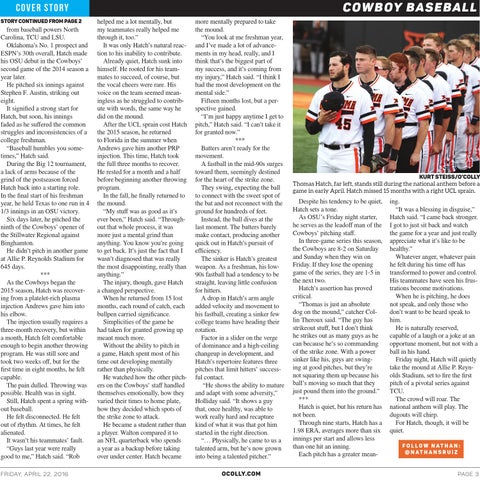
kurt steiss/O’COLLY Thomas Hatch, far left, stands still during the national anthem before a game in early April. Hatch missed 15 months with a right UCL sprain.
Despite his tendency to be quiet, Hatch sets a tone. As OSU’s Friday night starter, he serves as the leadoff man of the Cowboys’ pitching staff. In three-game series this season, the Cowboys are 8-2 on Saturday and Sunday when they win on Friday. If they lose the opening game of the series, they are 1-5 in the next two. Hatch’s assertion has proved critical. “Thomas is just an absolute dog on the mound,” catcher Collin Theroux said. “The guy has strikeout stuff, but I don’t think he strikes out as many guys as he can because he’s so commanding of the strike zone. With a power sinker like his, guys are swinging at good pitches, but they’re not squaring them up because his ball’s moving so much that they just pound them into the ground.” *** Hatch is quiet, but his return has not been. Through nine starts, Hatch has a 1.98 ERA, averages more than six innings per start and allows less than one hit an inning. Each pitch has a greater mean-
ing. “It was a blessing in disguise,” Hatch said. “I came back stronger. I got to just sit back and watch the game for a year and just really appreciate what it’s like to be healthy.” Whatever anger, whatever pain he felt during his time off has transformed to power and control. His teammates have seen his frustrations become motivations. When he is pitching, he does not speak, and only those who don’t want to be heard speak to him. He is naturally reserved, capable of a laugh or a joke at an opportune moment, but not with a ball in his hand. Friday night, Hatch will quietly take the mound at Allie P. Reynolds Stadium, set to fire the first pitch of a pivotal series against TCU. The crowd will roar. The national anthem will play. The dugouts will chirp. For Hatch, though, it will be quiet. f o l l o w n at h a n : @ n at h a n s r u i z
PAGE 3
# stillwaterstron g
n e ws
See Monday’s special issue
T
he O'Colly is publishing a special issue Monday for the six-month anniversary of the homecoming parade crash, and we would like to hear from you, our readers. We want to hear what homecoming means to you now, your experiences that day and what you think has changed at OSU in six months. Send your letters to news@ocolly.com by 2 p.m. Sunday for print publication, or send them any time to be in our online collection for this issue.
Tweet @ocolly to share your thoughts
Enjoy a Spiritual Journey This Sunday Feeling the healing presence of God KVRO - FM (101.1) 9:00 am - The Weekly Bible Lesson - Shines the light on the Scriptures so we can see and know how God cares for us today, as he cared for those in Bible times. 9:30 am - Sentinal Radio - Where others share how, through prayer alone, the love and laws of God healed whatever was keeping them from living life to the fullest. This week’s topic is shown above. Brought to you by Stillwater’s Christian Science Church Also Visit www.christianscience.com FRIDAY, APRIL 22, 2016
OCOLLY.COM
PAGE 4
fire protection
news
OSU fire protection program gets fund from national organization
The NFPA is a nonprofit organization that supports fire safety awareness through research, education and outreach. NFPA’s mission is to prevent death and loss of property in Daniel fires, according to the Norman NFPA website. S ta f f R e p o rte r Each school will distribute the money It’s it receives to the best getting students, and OSU hot in will award up to three here. undergraduate students The each year based on their National Fire Protection Association started required senior project. Each student will rea fire protection engiceive a monetary award neering support fund as well as a stipend for three universities to attend the NFPA including Oklahoma national conference and State. exposition and present The NFPA will his or her project. finance fire protection In the NFPA news engineering departments at OSU, the Uni- release, Chris Dubay, versity of Maryland and NFPA’s vice president of engineering, said Worcester Polytechnic helping students at uniInstitute to support AFFORDABLE versities is an opportueducation and research AMAZING nity to make an impact in the field, according TOWNHOUSE on the fire protection to a news release on the field. NFPA website.
2 bedroom/1.5 bath 895 sq. ft. water and sewer paid.
1001 N Perkins Rd.
“Recipients of NFPA funds represent the future of fire protection engineering,” Dubay said. “Supporting these students’ efforts presents a powerful opportunity to to reinforce their passion and validate that their research has a real, vital impact on the world of fire protection engineering.” Qingsheng Wang, the program coordinator for the fire protection engineering at OSU, said it presents a great opportunity for the students in the program, but will also help the program in the long run through its closer relationship to AFFORDABLE NFPA. AMAZING OSU was probably TOWNHOUSE selected to be a part of this fund because it has 2 bedroom/1.5 bath the oldest fire protec895 sq. ft.protion engineering gram, Wang said. water and sewer “We were established paid. in 1937,” Wang said. “We were also the first 1001 N Perkins Rd. ABET accredited pro-
the NFPA conference and exposition, according to the NFPA news release. F o l l o w o ’ c o l ly :
@ o c o l ly
Courtesy Qingsheng Wang Qingsheng Wang is the program coordinator for fire protection engineering at Oklahoma State University.
AN EVENING WITH
$520/month $300 deposit. AFFORDABLE AMAZING TOWNHOUSE
Come play spin the wheel for reduced deposit!
2 bedroom/1.5 bath AFFORDABLE $520/month 895 sq. ft. AMAZING water and sewer $300 deposit. TOWNHOUSE AFFORDABLE paid. Come play spin the AMAZING 1001 N Perkins Rd. 2wheel bedroom/1.5 bath TOWNHOUSE for reduced 895 sq. ft. $520/month deposit! $300 deposit. water and sewer 2 bedroom/1.5 bath paid. Henneberry Come play spin the
FRIDAY, APRIL 22, 2016
gram.” ABET is the Accreditation Board for Engineering and Technology, a nonprofit accreditation organization. Wang said the initial agreement between OSU and NFPA was for five years but could be renewed at that time for another five years. In June, the winners will go to Las Vegas for
Henneberry Properties 405-372-7395
SEPT. 22 CHESAPEAKE ENERGY ARENA ON SALE TODAY AT NOON
AT TICKETMASTER.COM, TICKETMASTER OUTLETS, 800-745-3000, THEAVETTBROTHERS.COM AND AT CHESAPEAKE ENERGY ARENA BOX OFFICE.
OCOLLY.COM
PAGE 5
April 22, 2016
2014
OSU System Saves $35 Million with Energy Program CNG PROGRESS
Your mileage may vary, but you might want to take a few tips from Oklahoma State University to cut your energy bill. After all, the OSU System has slashed $35 million from its utility bill in the last nine years. OSU’s Energy Management Program, which started in 2007, uses a variety of innovative practices to lead the way in reducing energy consumption. In 2013, OSU added sustainability to its energy portfolio when the 26-turbine Cowboy Wind Farm near Blackwell began producing electricity. Now, on average, the OSU-Stillwater campus uses 70 percent wind power per year. “Since 2013, we have successfully and consistently met or exceeded our goal of using 67 percent wind power to power the Stillwater campus,” said James Rosner, OSU energy services director. OSU has also implemented several other energy conservation practices, including providing energy guidelines for faculty, staff and students. FRIDAY, APRIL 22, 2016
With the focused efforts of the university, OSU has managed to save a total of more than $35 million across all campuses. The OSU-Stillwater campus averages a $3.5 million savings per year. “Ultimately, energy conservation equals saving money,” said Rosner. “The energy program helps every entity on campus because it helps reduce operating costs.” Energy management also tries to save money through it’s purchasing practices of electricity and natural gas. On average the Stillwater campus uses 652,155 DecaTherms of natural gas at a cost of about $3 million each year. Recently OSU energy services purchased 80% of the volume until the year 2020 in advance as natural gas prices fell to record lows. This locked in rate for natural gas is projected to save the university at least $520,000 each year. OSU’s energy savings also help the environment, a result noted by recognition for the third year in a row from the U.S. Environmental Protection Agency. For 2015,
OSU was ranked #7 in the Top 30 Colleges and Universities and #51 in the National Top 100 for renewable energy. OSU was one of four organizations — and the only educational institution — named a Green Power Partner of the Year in 2014. For more tips on saving energy, visit the OSU Energy Management Program website.
By 2014, virtually all of OSU’s bus fleet had transferred from diesel to cleaner burning compressed natural gas. The motor pool fleet had been positioned to do the same with plans to lease additional vehicles as they become more competitively available from manufacturers, and Regents approved the purchase of a CNG station on campus that same year, which also offers considerable cost-savings.
Oklahoma State University Facilities Reach $1 Million Cost Reduction
The green transport movement on campus started small in 2010, when OSU Transit initially purchased nine CNG buses, a number that quickly grew after the first natural gas fueling station was added in 2011, thanks to OSU’s partnership with Clean Energy.
Read more at timeline.okstate.edu
For a second year, Oklahoma State University is acknowledging facilities which have reduced their cumulative building energy costs by $1 million. To recognize this accomplishment, facilities are awarded a “million dollar plaque”. The savings are reached through a team effort. Students, faculty and staff take part by doing such things as turning off lights and computers in addition to working closely with the OSU energy management team. While buildings with larger energy consumption generally accumulate the $1 million energy cost reduction more quickly than smaller buildings, every building has the ability by making small changes to impact energy conservation. Facilities that were recognized this year include: Willard, Edmon Low Library, Noble Research Center, Physical Sciences and Bennett Hall. The OSU-IT campus in Okmulgee was also recognized for reaching the million dollar mark in energy savings for the entire campus. THIS PAGE PRODUCED AND PAID FOR BY OSU COMMUNICATIONS AND MARKETING
Good luck to @britosu22 as she heads to San Antonio today as the latest Cowgirl to embark on a @wnba career!
#okstate
PAGE 7
Alpha W eek
News
‘New Slaves’ lets African-American students discuss issues
Jordan Bishop Staf f Rep orter
Sometimes, all it takes to help adapt to an unfamiliar world is talking it out with someone who shares the struggle. That’s what members of Oklahoma State’s chapter of Alpha Phi Alpha were trying to emote in its presentation of “New Slaves” on Thursday Night in Agricul-
ture Hall. “New Slaves” is one of OSU’s Alpha Week’s final events, which are brought about each year to provide a social atmosphere to discuss intellectually stimulating ideas about race. In the discussion, African-American students were asked questions of what it truly means to be black, if the “N” word is acceptable, what it’s like being a black student on a predominately white campus and other pivotal questions. Dominic Hardaway, president of the chapter, said it’s up to Alpha Phi Alpha and other multicultural Greeks to prepare events like “New Slaves.” “We rarely get interested
people to come speak to us or professors who want to teach things that relate to us,” Hardaway said. “So when the institution fails to provide that for us, it’s our job to provide it for each other.” Hardaway said initially the event was going to be sort of a black awareness event, but once he saw there was so much struggle between black students themselves, he thought it was better to discuss them in a “no-judgement zone.” “We realized that some of the biggest things were division within ourselves related to skin tone,” Hardaway said. “There is division related to socio-economic status, certain personal
beliefs, male vs. female.” Before the discussion, fraternity members divided attendees into different seats based on skin tone to create an experience and show them that through discussion, things such as skin tone don’t have to be a dividing issue. Michaela Boyd, a member of the choir that sang before the event, said she was glad to find out there was not only an event like “New Slaves” at OSU but also all of Alpha Week as well. She shared Hardaway’s sentiment’s that there should be more events like it. “I feel like it would be better if we had other cultures actually join us and hear some of the stuff,”
Jordan Bishop/O’COLLY Members of Alpha Phi Alpha discuss racial issues with African-Americn students in Ag Hall on Thursday night.
Boyd said. “It would be kind of cool if we could get together and learn about each other’s differences and even some similarities.” Chauntel Brown, a psychology major, said she thinks that the first step toward getting past racial issues and bridging the divide in society is to discuss them with other African Americans. “We’re so different with such different backgrounds
coming from our roots in Africa to being here and born and raised in a western European culture,” Brown said. “It has shaped each of us in a very different way. What is normal to one person isn’t normal isn’t normal to everyone else. “It opens the eyes to those who may not know, and it’s about adjusting and adapting and living in harmony” follow jordan: @jordanbishop35
Stillwater’s Hole-In-The-Wall Cantina! $2.50 Tecate Bottles all week long! Friday April 22nd: NOW LEASING FOR
-Friday Live Music with “Jake Moffat” from 9-11 -Saturday Live Music with “Cale Lester and Tim Cowan” from 9-11
(405) 372-1169 311 E Hall of Fame Ave, Stillwater, OK 74075 FRIDAY, APRIL 22, 2016
JUNE 1ST & AUGUST 1ST 2016 Move-In Dates! As low as $333 per person!
405-372-9225 w w w. C A M P B E L L M G M T. C O M OCOLLY.COM
1776 W. Lakeview Stillwater, OK 74075
www.campbellmgmt.com PAGE 8
cl a ss ifieds
Help Wanted
Live‑in apartment position. Professional atmosphere. Requires night, weekend, and holiday work; driver’s license; professional dress. Apply in person at 610 S. Duncan. No phone calls please. Seeking full time summer workers to start for OSU Wheat Research when semester ends. Must be able to work outside in the heat, able to lift 50+ lbs., working occasional 40+ hour work week, weekend work may be expected and overnight harvesting trips. Farming experience is a plus. Only apply if you are able to work 40 hour weeks. MUST have valid U.S. driver’s license. If you are interested call Jason Ray (405)334‑ 6924 or Nathan Stepp (405)564‑4709. Summer job Yost Lake Country club in Stillwater Certified lifeguard $10 an hour For questions and application call Vincent Sorrentino 405‑762‑9692 Or email: Vincent.sorrentino@okstate. edu
Misc. For Sale
SCOOTERS WHY WALK?
Honda of Stillwater 105 S. Perkins Road stillwaterhonda.com
Furniture/Household FREE POOL TABLE 747‑5982
Mobile Home Rentals
Houses For Rent Apartment Rentals Apartment Rentals Apartment Rentals 109 N. Grandview . This 3 bedroom 2 bath house is freshly painted in a quiet neighborhood, huge back yard. Rents For $1100.00 per month. $750.00 deposit. Call 405/743/4266 1302 S. Western 3 bedroom 2 bath $1200.00 per month $750.00 Deposit. Call today 405/743/4266 2‑bedroom, 2‑bath, new homes. Preleasing for mid June & August. Call 405‑880‑ 2785. 3 & 4 bedroom houses AMSCO 405‑372‑6462. 3‑bedroom, 2‑bath. 801 North Star. Pet friendly. $1050/month. 405‑388‑0038. 4 bedroom house available March 15. AMSCO 405‑372‑ 6462.
Take over lease at Reserve on Perkins Aug.12, 2016‑July 31, 2017 2‑person unit, 1‑bedroom, 1‑bath each. $575 bills paid. BONUS: WE WILL PAY AUG., SEPT., & OCT. RENT +TRANSFER FEES Reserveonperkins.com Call 580‑755‑0211, 580‑591‑3962.
3 Bedrooms
Exceptional 2, 3, 4 & 5 bedroom houses close to campus. Discount for related roommates. Call Rob 377‑9000. Exceptional new 4‑bedroom, 3‑bath, all appliances. Call Rob 377‑9000. For Lease: 4‑bedroom, ski‑ lodge type houses across from Boomer Lake. Includes major apliances. 405‑880‑2984. June 1st Leasing. 3‑bedroom, 2‑bath, 1700 sq.ft. living space. $900.00. Call 405‑880‑2785. Nice 2‑3‑4 Bedroom houses available for June 1st Lease. Call Donna (Local Owner) @ 612‑0270 One‑bedroom, 307 W. 13th. Gas/water/sewer paid. Pet friendly 405‑377‑2136, 405‑ 338‑8816.
Duplexes For Rent
********************************* Beautiful, huge, 3 & 4 bedroom duplexes available. 405‑707‑7277. www.cowboyproperty.com
Spacious 1 BR, 1 BH , 2BR, 1BH first and second floor apartments , Available in June. Ample parking, Quiet Neighborhood, Close to shopping, and The Bus Line. Rent $450.00 to $ 520.00 per Month. Security Deposits $250.00 to $300.00. Pets OK Henneberry Properties 405‑743‑4266.
8. Lakeview Town Home 105.5 W. Lakeview, 2 Large Bedrooms, 2 & ½ Bath, 2 Car Garage 2 Story Duplex, Only $950/ month!
2‑bedroom 2012 E. McElroy. 405‑372‑7107
Houses For Rent
FRIDAY, APRIL 22, 2016
Quiet, comfortable, first and second floor apartments, Available In June. Quiet Neighborhood, close to shops, restaurants and bus line. Studios for $360.00 per month,$250.00. Sorry, No Pets. Some Bills Paid. Call 405‑743‑4266. Henneberry Properties
1 & 2 bedroom apartments close to campus. AMSCO 405‑ 372‑6462.
Available Now
2‑Bedroom, all electric. 3805 Andy Kay Lane. $550/month, 405‑377‑2136, 405‑338‑8816.
1009 E. Knapp 3 bedroom 1.5 bath $850.00 per month $750.00 Deposit. Henneberry Properties 405‑743‑4266.
Want your own space‑place, rent 2 bedroom Townhouse $520.00 It’s all for you! 405‑372‑7395
MAPLE 500 1 BED/1 BATH, 600 SQFT. COMPLETELY REMODELED 1/2 BLOCK FROM CAMPUS. OPEN FLOOR PLAN. MODERN KITCHEN AND BATH. OAK HARDWOOD FLOORING. WALK‑ IN CLOSETS. BRAND NEW APPLIANCES W/D, DISHWASHER, MICROWAVE. ASSIGNED PARKING. $700/MONTH, $150/DEPOSIT. PRE‑LEASING FOR JUNE 1ST. 405‑377‑2787
1 Bedrooms 1. The Vintage (519 S. Jardot) 1 Bed, 1 Bath Luxury Apartments, Pool, Spas, Sand Volleyball, Sport Court, Available June 1st! Starting at Only $630/month!
2 Bedrooms 1. 11902 S. Fairgrounds (Perkins, OK) 2 Bed, 1 Bath Duplex, yardwork included. Only $500/month! 2. 120 W. Miller 2 Bed, 1 Bath Apt, 2 blocks f/OSU, Ch/A, Only $500/month! 3. 214 W. Maple 2 Bed, 1 Bath Apt, 2 Blks E. of Campus, Ch/A. Only $540/month! 4. Lakview Duplex 2 Bed, 1 Bath, 201 W. Lakeview, Only $650/month! 5. Homestead Apts 1020 W. 4th St. 2 Bed, 1 Bath, Ch/A, Total Elec,1 Block from OSU! Available August 1st, Only $650/ month! 6. 18121 Chisolm, 2 Bed, 1 Bath Home Near McMurtry Lake, ALL UTILITIES PAID $800/Month! 7. TRAIL’S END 2610 W. 58th, 2 Bed, 2 Bath Duplex, Loafing Shed with Private Pasture set up for Horses, Staring at Only $800/month! www.equinerentalcommunity.com
OCOLLY.COM
1. James Creek (Phase 2) Open House at 138 S. Bryan Ct., 3 Bed, 3 Bath, 2 Car Oversized Garage, Private Pool, Spas, Sand Volleyball, Sport Court, OSU Transit stop, 1.5 Mi to OSU! Mowing/Yardwork Inclu, Total Elec, Energy Efficient! Only $450/person a month ($1,350/month)! 2.. Teal Ridge Duplex, 2422 W. Teal, 3 Large Beds, 2 Bath, 2 Car Garage, Ch/A, Only $945/month! 3. James Creek (Phase 1), 126 S. Payne St, 3 Bed, 2 Bath, 1 & 2 Car Oversized Garages, 1.5 Mi to OSU!, Pool, Spas, Sand Volleyball, Sport Court, Yardwork Incl, Starting at Only $999/month! 4. McMurtry Acres, 18101 Chisolm Rd, 3 Bed, 2 Bath Home w/ Large yard and back fenced yard near McMurtry Lake. Storm Shelter on-site, ALL UTILITIES PAID for Only $1,050/ month! 5. Black Copper Ranch, 7518 N. Black Copper Rd. 3 Bed, 2 Bath Solitaire MH on Acreage, option for horses, Only 6 miles to OSU Campus, see driving directions on our website, ALL UTILITIES PAID for Only $1,095/month! 6. Trail’s End, 3 Bed, 3 Bath Home, 2413 W. 58th, Private Pasture for horses w/Loafing shed/tack room, Starting at Only $1,125/month! www.equinerentalcommunity.com 7. 2318 N. Benjamin, 3 Bed, 2 Bath, 2 Car Garage Large Fenced back yard and covered back porch. Only $1,260/ month! 8. 614 S. McFarland, 3 Bed, 2 Bath, 2 Car Garage with Large Fenced back yard, 4 blks to OSU!, Only $1,350/month! 9. 107 W. Tyler, 3 Bed, 1 Bath, 1 Car Garage Home, Yardwork Included, Only $700/month! 10. St. Michael’s Village, 1722 W. James Place, 3 Large Bedrooms, 2.5 Baths, 2 Car Oversized Garage, Yardwork Included, access to Storm Shelter, Yard Sprinkler system Only $1,500/ month!
5 Bedrooms
1. Teal Ridge Duplex, 1625 W. 21st, 5 Bedroom, 2 Bath, 2 Car Garage, Ch/A, Fenced Back yard, Amazing price ($290/ person) $1,450/month
Mobile Home Lots 1. Valley Acres Mobile Home Park, 2800 W. Lakeview, Can accommodate up to 18’ x 90’ Homes, Only $190/month!
PAGE 9
FOR RELEASE APRIL 22, 2016 Subscription Rates:
Classified Line Rates: 1 Day .......................................................50¢ per word/per day 2-4 Days...................................................40¢ per word/per day 5-9 Days...................................................35¢ per word/per day 10-14 Days...............................................30¢ per word/per day 15 or more Days.......................................25¢ per word/per day Logos and graphics are available at an additional cost of $1 per day. Borders are also available for a flat rate of $2. Deadline for Classifieds – Noon the business day prior to publication Deadline for Display – Noon two business days prior to publication
Society Squares
$5.00
Business Squares
$8.00
(New Low Price!) For 7 lines. Each additional line 50¢. Each Line is approx. 14 characters wide. Graphics and logos available at an additional cost. Society squares are for campus organizations, departments and the greek community only.
For 7 lines. Each additional line $1.00. Each Line is approx. 14 characters wide. Graphics and logos available at an additional cost.
Student Notices
$3.00
Per day for 25 words. No borders or graphics available at this rate. Only for student groups and organizations. Activities must be free and open to everyone. FRIDAY, APRIL 22, 2016
Los Angeles Times Daily Crossword Puzzle First Class Mail Edited by Rich Norris and Joyce Lewis
One year $125.00 Fall orACROSS Spring semester $57.50 1 “For __ had eyes, Summer Semester $10.00 and chose me”: Prorated days figured at $1.25/day Othello
4 Utterly failed at 8 With great Off Campus Delivery urgency & Subscription 14 Gobbler 15Local Blue-skinned Delivery off campus: deity 1 Paper for one semester 16 Ferrous sulfate target $1/day 17 Fed. financial agency 18 “Metamorphoses” 1 Paper for summer sem. $8 poet 19 How pooches’ Bulk Delivery Rates smooches are delivered for Fall or Spring 20 Model T 11-35contemporary copies $83.50 21 “The Iliad” subject 36-50 copies $83.50 22 Goes with 70 copies $125.00 23 Ancient theater Summer Semester props 25 Added result 11-35 copies $8 27 Bellicose deity 36-50 $8 28 Pitcher of milk? By Jeffrey Wechsler It may include a 7029copies $12 model, briefly 57 Desired result 30 Pumped item 58 Swiss city, to 31Paper “Now!” Circulation most locals32 Storm 59 The Taj Mahal, consequence9,000 e.g. Monday-Thursday 34 French 60 African bovine possessive 10,00061 Turns out to be pronoun 62 Elements in vital O’Colly Weekend Edition 37 Priceline options statistics 38 Have a special 63 Dubious place for communication Papers are also available at our 39 __ work: menial method Newsrack at the Post Office labor 40 Batt. terminal DOWN 41 Plastered 1 Entered angrily 42 Amos eight Forwith Questions about 2 Huge holiday film Grammy 3 Lining with raised Display advertising nominations decorations? 43 “Castle” producer 4 Window-shop 744-7371 45 Yuma : Yours :: 5 Kilauea sight For Questions aboutleader’s Toulouse : à ___ 6 Mideast 46 Ruination personal CPA? Advertising 47Classified __-dieu 7 Singles group, 48 Take 744-7355e.g.? responsibility for 8 June honorees 49 Hair care brand 9 Visiting the vet, since 1930 maybe For Questions about 50 Pun, sometimes 10 Suckerfish 52 Motor Trend’s 11 Insurance for Circulation 1968 Car of the royalty? 744-8372 Year 12 Light melodies 54 Eggs on toast, 13 Appreciative perhaps shouts 55Fax Diverted Number 22 744-7936 Snoopy starting a 56 Dutch export trip?
OCOLLY.COM
4/22/16 Thursday’s Puzzle Solved
©2016 Tribune Content Agency, LLC
24 They encourage modeling 26 As yet 32 Word with meal or cake 33 Bygone small car 35 Change overseas, maybe 36 Robber’s demand ... or what to do to solve four long puzzle answers?
4/22/16
39 George Clooney, for one 41 When in Act I Duncan arrives at Macbeth’s castle 44 Slants 46 Cold War threats 47 Spin docs 50 “Eleni” author Nicholas 51 Perfect place 53 Not that exciting 56 H-like letter PAGE 10
h o ros cop e
Daily Horoscope
Reader Services
By Nancy Black Tribune Content Agency
106 Paul Miller Building, Oklahoma State University Stillwater, OK 74078
Newsroom . . . . . . . . . . . . . . . . . . . . . . . . . . . . . 744-6363 Display Advertising . . . . . . . . . . . . . . . . . . . . 744-7371 Classified Advertising . . . . . . . . . . . . . . . . . . . 744-7355 Business Office . . . . . . . . . . . . . . . . . . . . . . . . 744-7355 Circulation . . . . . . . . . . . . . . . . . . . . . . . . . . .. 744-8369 Fax . . . . . . . . . . . . . . . . . . . . . . . . . . . . . . . . . . . 744-7936 Professional staff
Level: 1 2 3 4
Barbara Allen, Director of Student Media. . . . . . . . . . . . . . . . . . . . . . . . . 744-8369 Lori Radford, Business Office Manager. . . . . . . . . . . . . . . . . . . . . . . . . . . . . 744-7355 Shelby Rogers, Display Advertising Sales Manager. . . .. . . . . . . . . . . . . .744-6681 Student Employees Jacob Harman, systems administrator, business office assistant
D i s P l ay a D v e r t i s i n g s t u D e n t s ta f f
Paige Albert, ad assistant Jacob Rexwinkle, regional sales rep. Joshua Watkins, account exec. Jordan Langan, account exec. Anne Raun, university account exec. Amanda Gerths, account exec. Anthony Garza, graphic designer
e D i t o r i a l s t u D e n t s ta f f Emily Farris, Editor In Chief Sierra Winrow, Creative Director Hayden Barber, Co Sports Editor Savannah Evanoff, Entertainment Editor Marcia Guevara, Video Editor
Nathan Ruiz, Content Director Stetson Payne, News Editor Marshall Scott, Co Sports Editor Kurt Steiss, Photo Editor Luke Spencer, Audio Editor
CirCulation stuDent staff Flint Funkhouser, distributor Marissa Commey, distributor
SOLUTION TO THURSDAY’S PUZZLE
4/22/16
Complete the grid so each row, column and 3-by-3 box (in bold borders) contains every digit, 1 to 9. For strategies on how to solve Sudoku, visit
www.sudoku.org.uk © 2016 The Mepham Group. Distributed by Tribune Content Agency. All rights reserved.
FRIDAY, APRIL 22, 2016
Lorne Parker, distributor Jimmy Ciolino, distributor
Oklahoma State University’s award-winning student newspaper has served Stillwater and the campus community since 1895. The O’Colly is a real newsroom that prepares students for a professional career in journalism. We publish newspapers on Mondays, Wednesdays and Friday, during the school year. We are online 24/7 with fresh content daily, breaking news, sports and more. The O’Colly is independent from the university and entirely student run, with more than 100 students on payroll. A staff of three professionals advise, guide, educate and provide support. The O’Colly is governed by the Student Media Board, which is made up of faculty, staff, students and Oklahoma media members. In 2015, the O’Colly was honored for the fourth year in a row as Oklahoma’s best college newspaper by the Oklahoma Press Association. Errors of fact reported to the editor-in-chief will be corrected promptly. Please direct all concerns to the editor-in-chief at 744-6365 or editorinchief@ocolly.com. Letters to the editor must include name, contact info and class/affiliation to OSU. Nonuniversity individuals must also include hometown. Letters are subject to editing for libel and clarity, or to eliminate statements of questionable taste. Letters may be delivered to room 108 Paul Miller Bldg., or emailed to letters@ocolly.com The views offered by The O’Colly employees are not necessarily those of the university administration or Oklahoma State University Board of Regents. Columns are the opinion of the author. Columns and letters to the editor do not necessarily reflect the views of the editorial board or The O’Colly. The newspaper derives its revenue from advertising sales, student subscriptions and from other sources. The O’Colly is a member of Associated Collegiate Press, College Media Association, College Business and Advertising Managers, Oklahoma Press Association, Society of Professional Journalists, Student Press Law Center and Stillwater Chamber of Commerce. Copyright 2015. The O’Colly. All rights reserved.
Local subscription
One copy ....... per year $175 One copy .... per semester $83 One copy ....... summer $9
Mail subscriptions
Fall or spring semester . . . . . .$57.50 Summer semester . . . . . . . . . . . .$10 Per year . . . . . . . . . . . . . . . . . . $125
Single copy newsrack price is 25 cents OCOLLY.COM
Today’s Birthday (04/22/16). It’s getting fun this year! Plan family play time for after 5/9. Apply financial discipline for higher returns, making moves after 8/13. Romance blossoms after 9/1. Your work enters a two-year boom after 9/9. A turning point in group efforts engages after 9/16. Speak your heart. To get the advantage, check the day’s rating: 10 is the easiest day, 0 the most challenging. Aries (March 21-April 19) -- Today is a 5 -- Be a strategist, rather than impulsive. This Scorpio Full Moon marks a turning point in shared finances. Stash away the surplus. Collaborative efforts bear fruit. Work together. Taurus (April 20-May 20) -- Today is a 7 -- Love grows in unexpected places. A Full Moon turning point arises in a partnership. Things could get hot. You’re making a fabulous impression. Take an interested party out on the town. Gemini (May 21-June 20) -- Today is a 7 -- New opportunities open up in your work. Creative efforts pay off big. Provide great service while still serving yourself. Unexpected benefits fall like rain in the drought. Cancer (June 21-July 22) -- Today is a 7 -- Everything seems possible. Complete and clean up the old game before making a new mess. A new direction beckons in a passion, romance or enthusiasm. The odds are in your favor now. Leo (July 23-Aug. 22) -- Today is an 8 -- Get into a new domestic phase with this Full Moon. Play with friends and family. Renovate, remodel and plant your garden. Romance flowers when least expected. Balance work with pleasure. Virgo (Aug. 23-Sept. 22) -- Today is a 7 -- An imaginative assignment pays well. Begin a new phase in communications and networking. Write, record or research. Craft a compelling promotion or case. Use your words. Libra (Sept. 23-Oct. 22) -- Today is an 8 -- New opportunities arise after this Full Moon. Begin a profitable phase, and watch expenses. Breakdowns lead to breakthroughs. The impossible seems accessible. Explore new avenues. Scorpio (Oct. 23-Nov. 21) -- Today is an 8 -- A new phase in your self-confidence blossoms under the Full Moon in your sign. You’re especially persuasive. Romance kindles from a hot spark. Love sets you free. Sagittarius (Nov. 22-Dec. 21) -- Today is a 5 -- Finish old projects. Your dreams could seem prophetic. Ritual and symbolism provide comfort. The Full Moon reveals a new phase of introspection, deep thought and spiritual discovery. Provide beauty and goodness. Capricorn (Dec. 22-Jan. 19) -- Today is a 6 -- Begin a new phase in a group project with this Scorpio Full Moon. Acknowledge participation. Set high standards. You’re gaining respect. Win more than expected. Fall in love at first sight. Aquarius (Jan. 20-Feb. 18) -- Today is a 7 -- Crazy dreams seem possible. Step into increased professional leadership. A new career phase arises with this Scorpio Full Moon. Listen to your heart. Beauty feeds your spirit. Accept a gift. Pisces (Feb. 19-March 20) -- Today is a 6 -- Discover unexpected beauty. The Scorpio Full Moon illuminates a new educational direction. Begin a new phase in an exploration. Love creeps in on little cat feet. Soak it in.
PAGE 11
The Oklahoma State University Chapter of Phi Kappa Phi is pleased to announce that as of April 14, 2016 the following students have accepted induction and initiation into The Honor Society of Phi Kappa Phi. The initiation banquet will be held on Thursday, April 21, 2016, at 6:30 p.m. in the Student Union Ballroom. The Honor Society of Phi Kappa Phi, founded in 1897, is the oldest and most selective honor society for top-ranking students from all academic disciplines. Invitation to membership is based on academic achievements and exemplary character and includes junior, senior, graduate and professional students. CHAPTER OFFICERS President Elect: Keith Garbutt x6799 Information Officer: Tim Ireland x8642
President: Lee Bird x5328 Treasurer: Tory Lightfoot x3336
College of Agricultural Sciences & Natural Resources sssssss Bssss spsssss Bssñss ússssss Bsñsáñ Jssss Gññssás
ússxssssss ússsñs Tssssñs Isssssss Zssssss sssáñss ssssss Js sssps
College of Arts & Sciences Jssss ss ússsñ sssássss Bsssñsssssp Jssssss Bsñsásss ssss Bñsssss ssssss ssssssá Jñssss ússsñss ssWsss
sssss sssssss sssss sssssss ssssssás sssssñs Gñss Jssssñss Jssss ússss Zsss ss úñssss sssss Js Jñsssñs
sñssssss sspss ússsss ssssssssñs Tsssñs Js sñássss Jsss sñssss
ssssssss sñssssss� ssñsñs Tsñspsñs
Nssñss ss sssssssñssss ússx Gsñsás sssñpsssssñ ssáss sñss sssás Ns ssssss úásásss sssss ssFsssss Bssñs ssssss
Wssssss Gssssss ssssss sssssss Tsñsss sssssssñs ssssss sssss ssñsssss Tsssñs ssssñ sssssss ús ssss ssssss ssss sssssssáss
sssss ssssss ssspsss ssssñs Tssñss Jssss Tssssss Jssñá ússs Wsss Bsñññs Wsssss ssss sssásásss Wññs
Jñss Xsssss ssssss Jss Jñssss ssssss ssssssss ss Oñsss sssssss ssssssss sssñss ússsss ss sñssñññ
úsáss sssssssss ssssss sssssñs ssssss ssssss sss Gsssssñ sssñ ssssss ss sssá
ússs ssspñ sssss sssssñs�� ssssss sssss Tssssss sssss Tsññsss Tssssñss
Spears School of Business ssss sssásásss Bssss ússssñs Bñsss ssss ssssss sssssss ssñssss ússsss Bs ssássss
sssss úss Fssss ssspsssss Gsssss Bssss ússpssss sssssssss ss Jsssss sñáss ss sss
Membership Chair: Denise Weaver x5627 Grants & Awards: Jessica Roark x7313
sñsá ssss Tsssá Jsssss Bs Wsssñs Bssssñs sssssss Wssss ssssss Wssss Nsssss ss Wññss
College of Education Jssss ússs úsñss sñssssss sñss ússñss
Jñssps Gsssss ssspsss ssssás Gsssssñs ússssñs ss Fssssss ssss Jñssssñs Gssssss
College of Engineering, Architecture, and Technology ússsss Vssássss úásssss ússsss Nssñss sñx
Js sñssñs sssñs Gssáñss sssssss ússssssñsñs
Jssssss ússss ssss ússñsss
Bssss úñsssss ssss Gssssss Nsss
sssss sñsñsássj Bsssssss ssss
Jssñssssss sssss sssssss sssss ss Wssss
Tsssñs ss Wsssñs ssspsss Zssñs
College of Human Sciences sssssss sssss ússsssñs ssásss ssssás
sssssssss Fñssssss sssssss Gsñssss
Graduate College
ússsss sñsñsss Bsáñsñss Jssssñss sss Bsssññsss ssssssss Bññss Tsñsss ss Bssssss ssáss Tssssss Bsssss Jssss ssssssñ Tssss ss sssss ssspsñ sssss sssssssss ssjsñsss sssssss ss Gssñsss ssssss ssss Gsssss Wsssñs ússsñss Gsssssss Jss
úsáss ssñssss Jssñá ssssss
ússsss Gññssás Jssssss ssssss Gsssss ússñs Gsssssss úásásss ússsssñs sssss úss ússsssássñs Jssúúúúúúúúúúááááááááááááá sssssss áááááááááááááá úsásss sssss ss ússáss sssñsss sssáñsss Usñssss sspññs ssssss sssss
sssssss sssssss Bssss sssss
Jñssss Tssss sssssss ssss Wssásss
sssñssáss ússs sssñss sssñs ssssssssss Ossss sssssássss sssñs ssssssss Vsñssss ssssñs Osss úss sñsssáss Jsssñs Nsssñsss Ns sñssss Nsñññ ññññññññññññññññññññ ññññññññññññ ññññññññññññññññññ ñññññññññññññññññ
Qsssá ssss ssss Jssñss ús ssssssñ Ysñsss ss sssññ ssss ssss Bssss ssss Bsss Vsssss Bssá sñssssss Wsáá ússsss ssss Wssppss sssájss (ssss) Xsssá
Center for Veterinary Health Sciences
sssssssssssssssss s s s s s s sssssssssssssssss sssssssssssssssssssss s s s s ssssssssssssss s s s s s s s s s s s s s s ss s s s s s s s s s s s s s s
FRIDAY, APRIL 22, 2016
OCOLLY.COM
PAGE 12