THE NUEVA CURRENT STUDENT NEWSPAPER OF THE NUEVA SCHOOL
NEWS • 2
FOOD & CULTURE • 4
10
VOL. ISSUE 1 SEPT. 30 2026
131 E. 28TH AVENUE, SAN MATEO, CALIFORNIA 94403
FEATURES • 8
OPINION • 15
WWW.THENUEVACURRENT.COM
ENTERTAINMENT • 17
SPORTS • 18
Inside this Issue:
FEATURES
The Schedule Shake-up An unexpected pattern in junior course assignments prompted a schedule rerun and raised broader questions about how Nueva builds its schedules. Alexis C. ’27 • Editor-in-Chief
A new AI scheduling tool was designed to make Nueva’s notoriously complex process more efficient and solve longstanding headaches, including the 60-plus schedule holes left unresolved last year. But when many juniors found themselves without courses they had prioritized, the school was forced to take a closer look at what had inadvertently gone wrong. PAGE 12
OPINION
Novig knows sex sells; gambling keeps you coming back Behind the outrage over Sydney Sweeney’s body is a calculated campaign designed to drive gambling engagement. PAGE 14
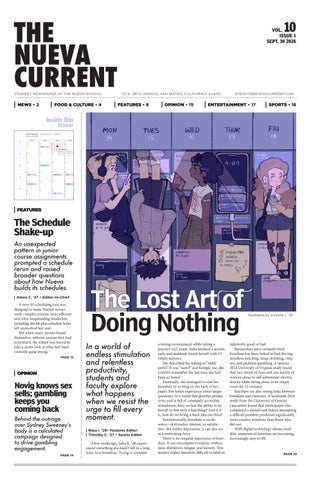
The Lost Art of Doing Nothing In a world of endless stimulation and relentless productivity, students and faculty explore what happens when we resist the urge to fill every moment. Raya I. ’28• Features Editor Timothy C. ’27 • Sports Editor
A few weeks ago, Sofia R. ’28 experienced something she hadn’t felt in a long time: true boredom. Trying to simulate
a testing environment while taking a practice SAT exam, Sofia finished a section early and suddenly found herself with 15 empty minutes. She described the feeling as “really awful.” It was “weird” and foreign, too; she couldn’t remember the last time she had been so bored. Eventually, she managed to ease her boredom by writing on the back of her paper. But Sofia’s experience raises larger questions. In a world that glorifies productivity and is full of constantly accessible stimulation, have we lost the ability to be bored? Is that such a bad thing? And if it is, how do we bring it back into our lives? Fundamentally, boredom is an absence—of stimulus, interest, or satisfaction. But unlike depression, it can also act as a motivating force. There is no singular experience of boredom. It can encompass irritation, restlessness, disinterest, fatigue, and anxiety. This nuance makes boredom difficult to label as
Illustration by Vivienne J. ’30
inherently good or bad. Researchers have certainly tried: boredom has been linked to bad driving, mindless snacking, binge drinking, risky sex, and problem gambling. A famous 2014 University of Virginia study found that two-thirds of men and one-fourth of women chose to self-administer electric shocks while sitting alone in an empty room for 15 minutes. But there are also strong links between boredom and creativity. A landmark 2014 study from the University of Central Lancashire found that participants who completed a menial task before attempting a difficult problem produced significantly more creative solutions than those who did not. With digital technology always available, moments of boredom are becoming increasingly easy to fill.
PAGE 10
2
THE NUEVA CURRENT
NEWS
Final Plots Under Development After 20 years of construction, Bay Meadows is nearing completion. Reed C. ’27 • Staff Writer
The final chain-link fences now surround the construction for the last two empty plots of Bay Meadows, located right across from the Nueva Upper School’s front entrance. The two plots are soon to become office buildings and houses, continuing the trend of Bay Meadows’ current roster of midrises. The projected completion timelines are still a few years off: the office buildings, located in the MU2 site—which borders E 28th Ave, W Kyne St, Derby Ave, and S Delaware St—are scheduled for late 2028, whereas the MU3 site next to Landing Ave containing the 67-unit housing building is set to open in early 2029. The official Bay Meadows website already includes conceptual renderings of the buildings along with the current office spaces and restaurants. Wilson Meany is the master developer of the Bay Meadows area in collaboration with Stockbridge Capital Group, and is working on the construction of the two sites. Stockbridge C. is also the original developer who sold Nueva the plot of land it sits on now in 2012. Chuck Noll, Construction Manager for Wilson Meany, spoke about his excitement for the upcoming project. “For me it’s been fun seeing this coming together—I started when [Bay Meadows] was still a racetrack,” Noll said. “[The plots are] the last two pieces of the puzzle to complete the Bay Meadows neighborhood after 20 years.”
He described the new developments as “mainly a continuation of the overall theme for this [neighborhood].” Noll emphasized that every measure is being taken to minimize the construction’s obstruction to the neighborhood. “There will be no more street closures than what you see now with the fence line, but there will be noise, and there will be more truck traffic […] We are doing everything possible to minimize our impact.” According to the Silicon Valley Business Journal, the MU3 office buildings will be occupied by Roblox, further extending the company’s expanse of offices in Bay Meadows. For students living in Bay Meadows, this upcoming construction is a minor inconvenience. Arisa A. ’29 expressed her sadness that the present breathing room of the area is disappearing: “I am a little bit bummed, because I feel like this will make the [atmosphere] of school feel more city-like.” Harry C. ’29, who has lived in Bay Meadows since April 2025, sees the construction as “kind of annoying,” as it prevents him from biking straight to Nueva on the road across from Roblox, and instead he has to take a path more full of cars and pedestrians. However, he thinks the benefits of living in Bay Meadows much outweigh the negatives.
By the Numbers Rethinking Assessment in the Age of AI Reporting by Oliver L.
400 donuts were bought for seniors to enjoy and hand out at Senior Sunrise, the long standning first, tradition of every school year.
104 freshmen traveled to Santa Cruz on the annual grade 9 retreat.
9 Fantasy Football leagues between all high school students. Photos by Lucas R. ’27, Patrick Berger, Wilson Sports
How humanities curricula is evolving to discourage AI use in the classroom Violet C. ’27 • Staff Writer
This year at Nueva, humanities classes are shifting how they approach assessment. As AI makes it harder to know whether a submitted essay truly reflects a student’s own thinking and writing, teachers are experimenting with new ways to design assignments, evaluate learning, and discourage AI use. The changes reflect a question facing schools far beyond Nueva: What does it mean to evaluate student writing when generative AI use is so prevalent? These shifts have already been felt throughout humanities classes. US History teacher Simon Brown said that he has increasingly relied on printed sources and readings, while English teacher Alexa Hart has recently had students sit with their backs to her during writing periods to make AI use less convenient and encourage accountability. Brown added that “pretty much across the board, we’re moving to more in-class writing.” Instead of solely evaluating a written final product, teachers want to assess how
In Development: The upcoming plot in foreground sits across from the Nueva Upper School Campus and Roblox’s current offices. • Photo by Reed C. ’27
He named the short commute to campus and easy access to Hillsdale Mall and Whole Foods as primary conveniences. “You kind of have everything all in one place,” he said. Associate Head of School Terry Lee, who worked with a board-led task force to help secure the land for the Upper School in Spring 2012, expressed “incredible gratitude” for the current land Nueva sits on. For Lee, the central location it offers Nueva community members, with its benefits such as Caltrain access and collaboration with nearby businesses, makes the campus feel “a little bit
more sophisticated, a little bit more urban, [and] a little bit more independent.” “All these little amenities, which, by the way, are nice for employees, they’re nice for parents, and they’re nice for kids. It’s a win for everybody,” Lee said. He also expressed optimism about the potential for the new project: “It’s going to be great. Just more commercial office, more potential internships or employers for families that come to school here, and then more residential houses, so more people who want to live close to school can have a place close to school.”
students show and discuss their work and how they incorporate feedback into their sustained writing. “Writing is [now] only one part of a larger assessment,” US History teacher Tom Dorrance said. Dorrance said conversations among Nueva faculty have centered on understanding the fundamental principles behind their pedagogy. The rise of AI use, he said, has fostered “really productive conversations about why we assess, how we assess, and what we hope the assessments produce.” Brown noted that these changes extend beyond preventing AI use. He described AI as a catalyst for curricular changes faculty already had reason to consider, characterizing some of the shifts as “a long time coming.” Brown said history teachers are considering assessments that pair at-home writing with one-on-one conversations, allowing students to demonstrate their understanding beyond a polished final product. Hart described how she first understood AI could imitate and replace student writing after prompting it with a sophomore writing assignment a couple of years ago. She recalled her immediate reaction: “We can’t do this assignment anymore.” Since then, English teachers have increasingly valued the process over the final product alone. Hart pointed to ideation, a standard added to English rubrics this semester by a team of faculty, as well as in-class drafting as ways to make students’ thinking more visible. English teacher Regina Yoong described a similar goal behind the department’s new emphasis on ideation. Teachers want to see students “wrestle with their ideas” during the brainstorming process. Still, those changes have not eliminated the problem. Yoong recalled recently finding the “exact same phrasing” in two different student essays despite the new ideation component. Importantly, teachers emphasized that the goal of these changes is not to eliminate AI
use altogether. Instead, they distinguished between instances where AI replaces a student’s thinking and uses that can support the learning process. Brown said he knows teachers who allow students to use AI “in ways that seem very productive to me,” adding, “I wouldn’t want to tell them they can’t use it.” Instead, he suggested tailoring expectations for AI use to the specific assignment. Though this semester’s changes are more apparent than in the past, “it’s [really] something that’s been percolating over time,” Dorrance said. But AI’s presence has evolved radically since its emergence in 2023. “It’s almost like a default on computers today. It’s hard to avoid,” Hart said. “It feels omnipresent.” Dorrance expressed that this prominence has fostered an unwelcome sense of unease in grading students’ work. “When I read a good piece of writing, the reaction I want to have is, ‘Oh, how awesome,’ he explained. “I think AI has introduced an element where instead of reflexively being excited, there’s an added reflex of, ‘Does this mean the student used AI?’” Part of this hesitance, Dorrance expressed, stems from the ambiguity of AI writing. “I don’t actually have confidence in my ability to identify it, which is, I think, part of what creates that sense of suspicion,” he said. Hart described a similar tension. Investigating suspected AI use, she said, feels uncomfortably confrontational: “It feels like we don’t trust our students and I want to trust our students.” However, Hart made sure to note that, “In general, I think our students really value the learning process. And that is a gift.” For now, no single solution exists, as teachers seemed to describe a sense of exploratory uncertainty universally. For Yoong, preserving the inherent uncertainty and difficulty of writing is itself part of the point. She encouraged students to embrace the “glorious mess of figuring out what you think.”
VOL. 10 ISSUE 1 SEPT. 30 2026
NEWS
3
A New Way to Share Music Nueva students at Magical Bridge rethink music education by fostering exploration and connection. Callan C. ’27 • Staff Writer
On the first Sunday of each month, music joins the sounds of children playing at Magical Bridge Playground in Palo Alto. As children run between the playground’s slides and climbing structures, Nueva students, among other volunteers, set up a variety of instruments including keyboards, ukuleles, guitars, bongos, and shakers, inviting children to learn and play. The student-led Magical Bridge Music program provides free, hands-on music lessons for children of all ages and abilities. The monthly meetings in Palo Alto reflect Magical Bridge’s broader mission to create inclusive spaces where children can play, connect, and immerse themselves in music—especially those who might not otherwise do so. Cameron L. ’27, Anjali M. ’27, and Natasha M. ’27 are among the Nueva students involved in the program. Rather than simply performing for the participants, the students work directly with them, introducing instruments and helping them explore music at their own pace. “Our general mission is to provide free music lessons for all, and we just want kids to be able to explore their curiosities,” Cameron said. That exploration can look different for every child. Some approach the instruments wanting to learn specific skills, while others
Speak Up! New speech team creates a platform for self-expression and joy Vivienne J. • Staff Writer
Enthusiastic voices are beginning to fill the third-floor hallways as the new Nueva speech team kicks off this school year. Founded by Julie Herman, the Middle and Upper School Debate Director, and a group of passionate students, the program grew out of students’ desire to compete and practice speech as a separate event outside of Nueva’s robust debate program. Meetings are on every Tuesday at lunch and on Thursday afternoon from 4:30 to 6:30 to accommodate students who also participate in debate. A majority of the students who joined the speech team heard about it from debate, but several have been competing for years. Freshman Gale F. ’30 has been doing speech since elementary school. She now competes in Original Oratory—a category
A Helping Hand: Cameron L. ’27 demonstrates a chord on a ukulele • Photo by Finn R. ’27
Twin Power: Anjali and Natasha M. ’27 teach two children how to play the piano • Photo by Cameron L. ’27
simply want to experiment. For Cameron, Anjali, and Natasha, recognizing those differences has become part of volunteering itself. “I’ve definitely grown to understand when some people might just want to play around versus when they actually really want to learn something, and how to cater to specific individuals based on their needs,” Anjali said. Because the students return regularly, they have also begun to recognize some of the families who come back each month. Among them are a pair of twin boys who repeatedly returned to the keyboard during several early visits: “They were really into the keyboard, and you could definitely see that they were improving every single time they came back,” Natasha said. The students have also found that music can create connections even when children and volunteers do not share a common language. During one visit, a young girl from Ukraine approached the piano; although she was not fluent in English, she eagerly sat down to play. “Even though there was a language barrier, I was able to connect with the girl through our shared understanding of mu-
experience outside of recitals, concerts, and competitions. They stated that even those who are not highly advanced musicians can contribute by helping children choose instruments, encouraging them to participate, or simply interacting with them in a friendly manner. “I feel like it provides a good outlet for students to really get involved with local communities and have an opportunity to utilize their skills,” Natasha said. At the playground, those connections can begin with something as simple as a few notes. A child might initially pass by the instruments, only to stop when a student begins playing. Even children who are not directly participating can be drawn toward the music, watching from the playground before eventually approaching themselves. For our Nueva volunteers and others contributing to Magical Bridge, those moments of connection and a shared love for music are a reminder that community service does not always have to mean providing a predetermined service. Sometimes, it can mean creating a space where someone else feels curious enough to try something new.
of competitive speech requiring students to write and memorize an original 10-minute speech. To Grace, the event enhances her speaking skills: “I used to have a lot of social anxiety—everyone does, and I still do to an extent,” she said. “[But] through speech, that kind of just went away.” The program’s long-term goal is to grow the cohort and expand opportunities available for the team. “We want to send people to Nationals and to State and to the Tournament of Champions,” Herman said. “I hope we’ll get to do that.” Students like Fabrikant aim to grow a community, where amidst all the academic chaos and argumentation of Nueva, they gain a space “to simply just be with other people.” The team’s energy is currently focused on writing and practicing as freshmen Ira S. ’30 and Grace work towards their first tournament, the Stephen Stewart Memorial Invitational, on Sept. 27. With 16 years of experience in coaching, Julie has witnessed the ways in which speech can benefit students and hopes to foster those same benefits among Nueva students. She specifically cites spontaneous events (speeches that are spoken with little prior preparation) as helping improve confidence and public speaking skills. “I think people have a huge fear of
sic,” Anjali said. The program also challenges expectations surrounding traditional education in music. Students who participate in more formal music programs can encounter an emphasis on starting young, practicing extensively, and progressing through increasingly advanced training. At Magical Bridge, the focus is instead on making music welcoming through student volunteers while being accessible and enjoyable in a way that sparks true interest. “To love music doesn’t mean to love the hours being put into it,” Cameron said. “[You can just] be engaging with the music itself and the curiosity surrounding it. That difference is part of what the students see as the program’s value. Children who may not have access to the same resources or formal lessons as others can try several instruments with complete freedom and companionship. Because the playground brings together children with a wide range of ages, abilities, and backgrounds, it creates an environment where students can participate without feeling pressured to perform. For the Nueva volunteers, the program provides another way to use their musical
Audible Success: Gale F. ’30 shows off her medal • Photo by Gale F. ’30
I used to have a lot of social anxiety—everyone does, and I still do to an extent. [But] through speech, that kind of just went away. —Gale F. ’30
speaking in public, and [spontaneous] is the one that’s going to get you used to the idea of just getting up and saying stuff confidently in a way that other people find compelling,” Herman said. Speech has also allowed students to explore topics that matter to them. Sophomore Lumi Y. ’29, who explored the complexities of race last year for her informative speech, found the experience rewarding and challenging. “I chose race because our 8th grade summer reading was a book about race, and I found it really fascinating. [Writing an informative speech] made me care more about the topic and just have a wider understanding,” Lumi said. There are currently 14 Upper School students participating in the speech program this year, a strong indication of the budding interest in building speech skills and forming a community that celebrates self-expression and growth. “We all, as students, have something that we care about—sometimes many things,” Grace said. “And we all want some way for people to pay attention to what we care about, so that it feels worth it to care about that thing. Speech helps me spread what I care about to other people, so I can have a community of people who care about the same things that I do.”
4
THE NUEVA CURRENT
NEWS
Mavericks in the Moment Ever year, the course catelog is updated with new classes that give students the chance to explore unique subjects that expand beyond traditional coursework. Here is a glimpse into the different ways students are engaging in these subjects.
Oliver L. ’27 • News Editor Nikhil S. ’27 • Photographer
Willa B. ’27 • Photographer Grey L. ’27 • Photographer
Below: Max Cowan is bringing radio-ready songwriting into the classroom with Hit Harmonics. Unlike his other class, Sound Experience, Cowan aims for this elective to specifically focus on producing music that grabs people’s attention in radio-like fashion. By the end of the semester, students will produce a class-collaborated project developed through a deeper understanding of how musical decisions shape the listener’s experience.
Right: Japanese teacher Chris Scott’s elective, Comparative Literature: Art and War, delves into the ethics of writing about atrocity. Through a variety of media, texts, and projects, students learn to grapple with questions such as: Who can speak for the dead? And how can words and images help us understand violence in ways that facts and figures cannot?
Right: This is the second rendition of Environmental Earth Science. First taught four years ago, Upper School science teacher Jeremy Jaquot’s elective returns to teach students about how energy and elements have shaped the emergence and evolution of Earth. Spending time outdoors in the garden is a core aspect of this course as students will gain hands-on experience to apply their textbook knowledge.
Above: The newest addition to Nueva’s growing psychology curriculum is Psychological Disorders: Body, Mind, and Culture. Amy Hunt uses guest speakers, readings, videos, and in-class seminars to lead students through the changing landscape of mental health research. After weeks of learning as a group, students become the teachers, sharing the results of their independent investigation of a chosen disorder.
Instagram Court Settlement Brings Screen Time Shift For Teens Meta settles in a pivotal case over social media’s effects on the mental health of minors.
them until they’re 18, they’ve never had the chance to develop that critical thinking of, ‘I’ve been on Instagram for this amount of time. Maybe I shouldn’t be on it,’” Veer said. Regardless, these rules will soon become reality for teens. Similar limits are
Kellan C. ’29 • Staff Writer
In August, Meta, the parent company of Instagram and Facebook, agreed to settle in a landmark case brought by 47 states, the District of Columbia, and several U.S. territories, including California, bringing sweeping limits to the social media lives of Nueva students. Meta will now enforce a two-hour default limit on its popular Instagram and Facebook platforms for under-18s. The limit requires parent permission to disable. Other restrictions include a night block from the hours of midnight to 6 a.m., during which Reels and Feeds are shut off, while messaging remains active, and notifications are automatically muted during school hours (8 a.m. to 3 p.m.). The settlement “institutes real change, real transparency, real protections for children and teens across the country,” California Attorney General Rob Bonta told the Associated Press. Teen users of Instagram can expect the
In front of Meta Headquarters: Meta agrees to pay of maximum fine of 16.7 billion. • Photo by Peter DaSilva / Reuters
new limits to take effect by early 2027. Anay M. ’29 thinks the settlement is justified. He spends two to three hours a day on his phone, mostly on Messages, TikTok, and YouTube, but Mehta rarely passes two hours on Instagram. “The ban isn’t going to impact me much personally, but I do think I will be more conscious of how much I use it,” Anay said. He views Instagram as a slippery slope to procrastinating on assignments, even if it may just seem like a break from a stressful day, and acknowledges he, too, has been distracted from schoolwork by social media. Others are concerned the fix is not right for everyone. Jane J. ’29 hadn’t heard of the settlement beforehand, and her initial reaction was skepticism towards the
one-size-fits-all rules. “If it’s hard to change or impossible, it will limit the amount of social media outreach youth can do for academic, professional, and extracurricular activities,” said Jane, who questioned the limits as opposed to a more case-by-case approach by parents. Anay’s parents limited him to one hour on all social media apps up until age 15. He said, “They trust me more now to the point where I don't need to,” but “I think it was definitely helpful in building a routine to not be on the screen that much.” Veer C. ’28 understands the restrictions on younger kids. However, he also believes that 16- and 17-year-olds should be allowed to figure it out on their own. “Some people are getting jobs or paying taxes. People can drive. If we're limiting
If we’re limiting them until they’re 18, they’ve never had the chance to develop that critical thinking of, ‘I’ve been on Instagram for this amount of time. Maybe I shouldn’t be on it.’
—Veer C. ’28
also likely to follow from various social media platforms, including TikTok and YouTube, with Meta calling on others to follow. “These protections will only be truly effective if we work with our peers — TikTok and YouTube — to put the same measures in place,” said the Meta Newsroom.
VOL. 10 ISSUE 1 SEPT. 30 2026
FOOD & CULTURE
Pop Culture Thermometer On a scale from freezing to blazing hot, here’s the latest in pop culture. Natalia R. • Staff Writer
BLAZING HOT: YOU CAN SEE EVERYTHING Theranos promised to revolutionize blood testing. Instead, its founder, Elizabeth Holmes, was convicted of fraud—and is now the subject of a documentary by comedian Nathan Fielder and Lance Oppenheim. Fielder has a talent for finding social commentary in strange behavior, so I’m curious how his style will work when the real situation already sounds like an episode of Nathan for You. Positive festival reactions have only made me more excited for its Oct. 16 release. Photo via A24
WARM: BIG BROTHER 28 Big Brother 28 has given us entertaining contestants, but the three reality TV “Icons”—two from Survivor, one from Big Brother 26—have dominated more than I’d like. Watching new players create and betray alliances is part of the fun; instead, they’ve spent most of the season sucking up to the reality TV veterans. Still, I’m invested in the Oct. 1 finale. I’m rooting for Drew Campbell after watching him turn against the Icons.
Photo via CBS
COLD: ED SHEERAN’S TOUR After Macklemore said “Free Palestine” while opening for Ed Sheeran, venue owners, including Robert Kraft, refused to host concerts with him on the lineup. The concert promoter dropped Macklemore, and the remaining openers withdrew in solidarity. Sheeran has since criticized the pressure from venues, but it’s disturbing that stadium owners had enough power to push an artist off someone else’s tour for speaking up about political issues.
The death of concert etiquette Concert culture is becoming unbearable, making live music hard to enjoy. Mila W ’27. • Guest Writer
Attending Steve Lacy’s Give You the World Tour, I was ecstatic to experience their music live with fans who shared my love for their recent album, Gemini Rights. But instead, I found myself distracted by drunk teens lacking spatial awareness, people pushing me around to get a better video, and mosh pits that felt absolutely unnecessary for the music. This concert’s unruly fans weren’t unique, however. The widespread decline in concert etiquette is ruining live music of all genres. The experience of going to a show has become much more public, performative, and individualized, largely due to social media. Concerts are incredibly easy to turn into content: the ticket, the outfit, the venue, the video of the artist walking onstage, the clip of your favorite song, and the obligatory blurry picture of the crowd. As a regular concert attendee, I’d be lying if I said I didn’t indulge in taking and posting a good video. There is something exciting about being able to look back and remember what a song sounded like live, and sharing your love for that moment online. The problem is when documenting the experience starts to become the whole experience. Watching an entire show through a phone screen feels like a strange use of a several-hundred-dollar ticket. That change is especially noticeable in
A Sea of Screens Fans watch a Steve Lacy Give You the World Tour concert through their phones // Photo via Kimchi Photography
crowd dynamics. People are losing their consideration of others at concerts. They have become so caught up with their own objectives—getting that close-up video, trying to post a barricade photo or an interaction with the artist—that they have begun to neglect the well-being and comfort of fellow fans. Concerts are crowded enough without someone being completely wasted, screaming over the music, or repeatedly pushing past people who have been standing in the same spot for an hour. While getting close to the stage can be exciting, everyone paid to be there. You are not entitled to the best possible view at someone else’s expense. There is no reason that people should be pulled out of the crowd for getting
trampled at a Steve Lacy concert. Mosh pits have always had a place at the right shows. When everyone understands the environment, they can be fun and even create a stronger sense of community. However, there is a difference between participating in a crowd and treating everyone around you like an obstacle. No one needs a rigid rulebook for concert etiquette—the weird, unpredictable energy of a crowd is what makes live music great. But when you’re sharing a room with thousands of fans, basic consideration isn’t optional. The next time you go to a show, just remember the music isn’t playing for an audience of one.
Community Cookbook: Popo’s Pork Dumplings Willa B. ‘27 shares her popo’s (grandma’s) longstanding dumpling recipe. Neel G ’27. • Managing Editor Willa B. ’27 folded her first dumpling at age 6—and has been honing her dumpling-folding skills ever since. These days, you can find her expertly folding dozens within an hour, only made possible by her popo’s instruction. “We used to spend hours at the dining table
making and folding dozens of dumplings, me, popo, and my brother,” Willa said. “Popo and I learned so much about each other with the meaningful stories we shared over these dumplings. My knowledge and connection to my Chinese culture were only made possible by them.” Popo passed down her dumpling recipe through word of mouth, which she learned from the women in her family as a child. The recipe only existed orally until Willa included it in the cookbook she developed as her eighthgrade recital project. “I set out to write a cookbook recording the recipes throughout my family lineage and to create a collection of timeless recipes that were meaningful to my family and myself,” she said. “The cookbook was only developed in the first place because of these dumplings, since they
inspired my interest in cooking and Chinese culture.” Though in fifth grade, this bonding extended to her classmates as well—specifically, Miriam H. ’27, Tiffany S. ’27, and Haviland S. ’27. Her popo’s visits to her Mandarin classes inspired their “dumpling parties”: monthly gatherings with friends from Mandarin class, which continued into high school. “These dumpling parties were a fun way to share my culture with my friends,” Willa said. “In the end, my friends bonded with my popo just as I had.” Popo’s pork dumplings aren’t just an amazing meal to Willa; they are an ode to her family traditions, cultural knowledge, and bonds with family and friends.
Photo by Steve Marcus / Reuters
FREEZING: THE EMMYS The Emmys are already the most boring of the big award shows to me, and seeing familiar names win again didn’t help. More disappointing, no actors of color won a major acting award during the televised ceremony—the first time that’s happened in five years. With performances from Chase Infiniti in The Testaments and Sepideh Moafi in The Pitt among the nominees, the shutout was especially frustrating. Photo by Mario Anzuoni / Reuters
5
THE RECIPE: Ingredients - 1 pound of your choice of protein - 1 stick of carrot, chopped or ground - 1 medium-sized head of onion, chopped or ground - 1/4 of a cabbage, chopped or ground - 1 teaspoon of salt - 1 tablespoon of oyster sauce - 2 tablespoons of cooking wine/or any wine - 2 tablespoons of sesame oil - A pinch of pepper - Dumpling wrappers
Instructions 1. Combine meat, carrot, onion, and cabbage in a large bowl. Thoroughly mix until combined. 2. Add the remaining ingredients and mix with hands or a wooden spoon. 3. Once the filling is complete, take a round dumpling wrapper and put a small spoonful of filling in the center. 4. Dip your finger and spread a very thin layer of water around the edge of the dumpling wrapper. 5. (See visual) Fold the wrapper in half and pinch the top together, leaving roughly half an inch unfolded near the creased side. Then, tuck the corners in and fold together any flaps.
THE FOLDING GUIDE [2]
[4]
[1]
[3]
[5]
Photos by Willa B. ’27
THE NUEVA CURRENT
FOOD & CULTURE
6
From page to screen Novels inspire some of Hollywood’s biggest hits—and misses. Here are recent and upcoming film adaptations, with our takes on whether they’re worth the watch. Sofiia P. ’30 • Staff Writer
The Hunger Games: Sunrise on Reaping Based on: Suzanne Collins Starring: Joseph Zada Release: Nov. 20, 2026 The premise: The sixth Photo via Lionsgate installment of The Hunger Games film franchise centers around 16-year-old Haymitch Abernathy in the 50th Hunger Games. Our take: WATCH Director Francis Lawrence has not once disappointed with his Hunger Games movies. Recently released teasers for the upcoming movie, featuring characters like Haymitch, President Snow, and Drusilla Sickle, offer a glimpse into the intriguing storyline and flawless casting.
Practical Magic 2 Based on: Alice Hoffman Starring: Sandra Bullock, Nicole Kidman, Joey King Release: Sep. 10, 2026 The premise: The fantasy-comedy follows a witch Photo via Warner Bros. family and their attempt at breaking a generational curse that makes it impossible to be loved, uncovering dark secrets and family history. Our take: SKIP The movie loses the best qualities of the classic, nostalgic Practice Magic 1: the cozy atmosphere, message of embracing aging, and intimate scenery. The disjointed script and recast of fan-favorite characters like Kylie and Antonia Owens make it a disappointment to the franchise.
Sense and Sensibility Based on: Jane Austen Starring: Daisy Edgar-Jones, Esmé CreedMiles Release: Oct. 16, 2026 The premise: Director Photo via Focus Features Georgia Oakley stays faithful to the core plot, in which the Dashwood sisters move to a country cottage after financial ruin and their father’s death. Though, Oakley takes a revised perspective, aiming to focus more on sisterhood rather than each of their romantic endeavors. Our take: WATCH Critics described the movie as a contemporary interpretation of the novel. Lead Daisy Edgar-Jones’ acting is deeply emotional and raw, perfect for protagonist Elinor Dashwood and the film’s introspection.
Klara and the Sun
Verity Based on: Colleen Hoover Starring: Anne Hathaway, Dakota Johnson, Josh Hartnett Release: Oct. 2, 2026 Photo via Amazon MGM Studios The premise: The psychological thriller revolves around a struggling writer, Lowen Ashleigh, who is hired to ghostwrite the remaining books of a successful thriller series for an incapacitated writer, Verity Crawford. Our take: MAYBE Only time will tell if director Michael Showalter effectively builds a sense of suspense and mystery. Though, the A-list cast, high anticipation, and captivating plot signal a movie worth tuning into.
Based on: Kazuo Ishiguro Starring: Jenna Ortega, Amy Adams, Mia Tharia Release: Oct. 23, 2026 The premise: The dystopian film centers around Photo via Sony Pictures Klara, an artificial intelligence manufactured to form a friendship with her human companion. She is purchased by a family to support an ill daughter and her fractured family. .Our take: WATCH The film is a thoughtful commentary on society, investigating what it means to be human and the temperance of life. The movie explores grief, forgiveness, love, and isolation, making for a thought-provoking and deeply emotional story.
The Love Hypothesis Based on: Ali Hazelwood Starring: Lili Reinhart, Tom Bateman, Rachel Marsh Photo via Amazon MGM Studios Release: Sept. 23, 2026 The premise: The romcom follows a Ph.D. student and a young professor at Stanford who pursue a fake romantic relationship and eventually develop genuine feelings for each other. Our take: MAYBE The film can be slightly cringy and predictable at times, but that can also be part of the appeal of comforting, sappy rom-coms.
4 summer albums you can’t miss Tune into new releases from Kelela, Love Spells, Willow, and Larry June.
Photo via Larry June
Photo via Willow
Photo via Kelela
Photo via Love Spells
Neel G. 27 • Managing Editor
Kelela: New Avatar
Love Spells: Love is the Law
Willow: The Thread
Larry June: Who Coppin
Kelela bends genre and refuses labels with her latest album, offering an escape to a world where anything is possible. Whether she’s an extraterrestrial being floating in the air in “New Life Forms” or seeking to reignite the connection between body and soul in “Crystalize,” Kelela excels in experimentation and creating something so uniquely her. She effortlessly blends musical inspirations ranging from grunge to alternative R&B, transcending the very concept of genre with her versatile body of work. In New Avatar, Kelela offers a journey of navigating her own mind, a true reflection of her singular artistic vision.
In his debut album, Love Spells stays true to his name. He entrances listeners with his distinct, seductive sound—oozing passionate romance and deep yearning. The album is a masterclass in professing love: he submits himself and his self-control in the name of emotional intimacy. His vulnerability shines through in his lyrics, which plead attention from his lover, his psychedelic production, and, most of all, his high-pitched voice, which loses itself in the rhythms of his songs. Love is the Law sounds like a rom-com soundtrack in the best way possible: it tugs at your heart, making you want to fall in love to the sound of Love Spells’ seemingly never-ending quest for romance.
Willow manages to push the boundaries of musical innovation with almost every release, and this album is no exception. In The Thread, she weaves together a spiritual atmosphere centered on healing, growth, and groundedness. Her admirable willingness to lean into the weird—with experimental vocal arrangement, creative production, and eccentric word choice—highlights her raw talent and authenticity. Willow has mastered dramatic stylistic changes and rapid genre-hopping in her other albums, but The Thread practices careful restraint in terms of sound and dynamics, showcasing her continuing sonic evolution.
Bay Area native Larry June digs deep in his pocket with Who Coppin, leaning into the best parts of Bay Area hip hop: the grooves, the flow, and the slang. The album may not be particularly lyrically or sonically complex, but its lack of seriousness is its primary appeal. June’s impressive list of features, including R&B titans Jhené Aiko and Musiq Soulchild, balances out his rapping with smooth vocals. Songs like “The Machinist” and “The Smooth Kind” exude confidence and drip with swag, offering music fit for getting ready with friends or a night out. In all, June’s style is evident in his music, and so is his Bay Area pride.
Genre: Indie Pop Standout Songs: “Stupid,” “Crutch,” “Don’t Touch”
Genre: Experimental Jazz, Art-Pop Standout Songs: “Talk on the Hill,” “Shrink to Fantasy,” “Crush on Eternity”
Genre: Bay Area Hip Hop, Rap Standout Songs: “The Machinist,” “Pretty Green Eyes,” “The Smooth Kind”
Genre: Alternative R&B, Grunge, Shoegaze, Electronic Standout Songs: “Linknb,” “New Life Forms,” “Idea 1”
VOL. 10 ISSUE 1 SEPT. 30 2026
FOOD & CULTURE
7
PRIMA plays it safe Adéla’s debut embraces what pop already is while two rising artists explore what it can be. Natalia R. • Staff Writer
Photo via Adéla
Adéla really wants you to know she’s a pop star. On her debut album, PRIMA, she calls herself a “pop princess,” declares herself the next Madonna, and spends much of the album reveling in the excess that comes with the titles. And for the most part, she sounds like a pop star, too. PRIMA is incredibly palatable, with catchy hooks and just enough electronic flourishes to fit comfortably
alongside the biggest names in pop music. But that might also be its biggest problem. The first time I listened to PRIMA, I kept thinking I had heard it before. The album overall is the love child of Slayyyter and Addison Rae. Tracks like “Boys” and “Marijuana” carry more than a little Tate McRae, while early Doja Cat even peeks through in the song “Nicole Kidman.” By the time I reached “Therapy,” whose melancholic electronic production reminded me of a worse-written “I Might Say Something Stupid” from Charli XCX’s Brat, I had accumulated an entire family tree of comparisons. That doesn’t make PRIMA a bad album. Two of its pre-release singles, “KGB” and “Ain’t in LA,” are also the most distinctly Adéla. “KGB” is provocative, electronic, and personal. The album’s final track, “Ain’t in LA,” adopts an optimistic 2016 pop production to declare that “the baddest bitches ain’t in L.A.,” paying homage to her Slovakian roots. Even “Hitachi,” a ballad built around a lack of intimacy in a relationship, is an interesting departure from the rest of the album. Its tortured metaphor—an off-label adult toy—is slightly more successful than the previous track “Red Bottoms.” PRIMA is easy to listen to and infectious; it’s just difficult to figure out what makes it distinctly Adéla. But PRIMA’s familiarity doesn’t mean electronic pop has run out of places to go. Beyond the increasingly polished sound of mainstream pop, these two rising artists are pushing the genre in more subversive, personal, and experimental directions.
Babe America
Eva Pagán
Photo via Babe America
Photo via Eva Pagán
Babe America’s latest album, ANGELFOODCAKE—one of my favorites from this year—moves between slower, intimate moments and explosive electronic production, often within the same song. Despite these shifts, the production never feels muddy, leaving room for Babe America’s powerful vocals. “STREETCAR DESIRE” begins stripped back and low before the music crescendos and Babe America starts belting about her vulnerability. This contrast carries throughout the album: deeply personal lyrics set against a euphoric production. While every track falls within the same genre, there is no point in the album’s 20-minute runtime where the sound feels repetitive. When Slayyyter’s single “brand new chanel$” came out a week later, it immediately reminded me of ANGELFOODCAKE.
On her single “24/7,” Eva Pagán trades the acoustic sound of her earlier music for a pulsing electronic beat. Throughout the track, she repeats and glitches and manipulates her vocals to different pitches, which creates the majority of the song’s variation. Similarly to ANGELFOODCAKE, the production stays clear even as these layers build, giving Pagán’s lyrics room to take center stage. Midway through, she switches into Spanish for a verse, reflecting what Pagán calls a growing “pride in her heritage.” She sings, “Esta canción es mi destino, como un río encuentro mi camino”—“this song is my destiny, like a river I find my path.” As one of her first releases in this new Spanglish electropop era, “24/7” makes me want to hear how much further Pagán can take the genre.
For Maia M. ’27, bus rides to and from the Lower School campus were filled with belting the lyrics to pop songs with her friends. “I always knew I loved singing,” Maia said. Maia became interested in songwriting during the COVID-19 lockdown, where she used her voice and instruments like the piano as a creative outlet. “I like that it gives me the ability to tell my own story,” Maia said. Today, Maia is constantly looking for inspiration for her music. “[I always] remind myself to pick my head up, look around, and take in my surroundings,” Maia said. After noticing something, she immediately writes it down in her Notes app. Even the simplest of moments can be an inspiration for Maia. For instance, walking down the first-floor hallways inspired her upcoming release, “Bad on the Weekend.” “I’m really looking forward to getting to share it with people,” Maia said. She reflects on her Nueva experiences as a positive contribution to her musical journey. She recommends both the Hit Harmonics and Groove Workshop classes. “[Groove Workshop is] my favorite creative space ever,” Maia said.
For Mila W. ‘27, writing and producing music is about creating a sound that is distinctly her own. Music has always had a major presence in Mila’s life. She began playing guitar at just 7 years old and drums at 13. But it wasn’t until the end of her sophomore year, when she attended a music production camp, that she began to consider it as a future career. “That’s when I realized this is what I’m most passionate about. And it’s what I want to do,” she said. Now, Mila is working to develop her own unique style. While she currently describes her music as most similar to intelligent dance music (IDM), she avoids confining herself to one genre. “I want to try to make something a little more experimental and a little bit more unique to me that’s pretty distinguishable,” Mila said. Her creative process mirrors this experimentality. Instead of starting with a concrete idea, she described her process as throwing “stuff at the wall” and seeing what sticks. “I just kind of mess around and make something I like.” Mila’s most recent piece, “Still Good,” reflects the music she hopes to keep making. “I feel really proud of it because it feels super distinct to me and I’ve not heard anything that sounds like it yet,” Mila said.
Nueva “Spotifyers” Students produce and release music on Spotify. Violet C. ’28 • Staff Writer Aviva S. ’29 • Staff Writer
Benji S. ’27 began experimenting with music production in Cody Alan’s Music Production class as a freshman. When Benji was gifted a keyboard about a year ago, his interest in releasing songs on Spotify and exploring DJing bloomed. “EDM has gained a lot of popularity, and it inspires a lot of my work,” Benji said. “I love to share my music when other people at the school are willing to hear it.” Benji’s motivation to continue exploring EDM music is largely fueled by support from his friends. “I was like, maybe I can make music that my friends would actually listen to, or that people find interesting,” Benji said. While Benji noted he doesn’t have much time for producing music at the moment, he hopes to continue to produce more music in the future. “I’m just doing it for fun,” Benji said.
TJ L. ’28 “fell in love with [music production]” in sixth grade and has pursued it since. In his freshman year, he began releasing electronic dance music (EDM) on Spotify under the name Saint. TJ believes his favorite release, “Falling in Love Together,” signifies his growth as a producer. “I can really hear the transformation in my music from two years ago to now,” he said. That growth came from persistence and dedication, according to TJ. “No matter how long it takes, no matter how many different iterations you have to make, you just have to sit down and crank it out,” he said. Looking forward, TJ plans to study music production in college, with the eventual goal of becoming an independent artist. “It’s all about just seeing what happens,” he said, “and doing my best to network and make connections with as many people as I can in the music industry.”
8
THE NUEVA CURRENT
FEATURES
Get to know the new faculty What is your favorite fictional character?
Six new teachers join the Upper School campus
Sarah Ruddy English Teacher Hometown:
Coastal Maine
Natalia R. ’28 • Staff Writer
What is your favorite thing you’ve learned recently?
How to make sourdough bread. When we moved here, I brought my sourdough starter with me on the airplane—I’m committed. It was under three ounces and in a plastic bag. Nobody asked any questions.
Dorothea Brooke from George Eliot’s Middlemarch. She’s fighting for her intellectual freedom as a woman while trying not to become jaded doing it, and I really relate to that. If you could have dinner with any book author, who would it be?
I’ve been reading The Disappearers by Marlon James. His writing voice is so great that I think he would be a really captivating person to have dinner with. I also just read Hamnet. I was like, “Wow, all these years, and I would still like to have dinner with Shakespeare—the Paul Mescal version.”
Favorite childhood book?
The Fall of Freddy the Leaf.
What’s your favorite movie?
I am a huge Lord of the Rings fan, so I would probably say The Fellowship of the Ring.
Favorite piece of advice from someone else?
To march to the beat of my own drum.
Favorite math theorem?
Favorite place you’ve ever visited?
There’s a really famous theorem that proves that there’s an infinite number of prime numbers. It’s one of the first proofs ever created. I love that proof because it’s not super intuitive, but it’s incredibly powerful.
Saintes-Maries-de-la-Mer in France and Vardø in Norway. Favorite pastry?
Nicole Camastra English Teacher Hometown:
Mount Vernon, New York.
I don’t really make pastries. I don’t have the patience for all that lamination—I’m not trying to impress anybody. I think feeding people is a really intimate form of caregiving, so I tend to make comfort bakes like shortbread, chocolate chip cookies, pound cake, and just plain devil’s cake with frosting. What is your favorite thing that students have taught you?
The power of a positive feedback loop. When there’s a lot of reciprocity in the conversation, it’s really rewarding.
What’s a topic you could talk about for hours?
Star Wars. I’m also a huge Star Wars nerd, so I have very strong feelings about it. I could talk people’s ears off about that.
Scott Cairns Math Teacher Hometown:
Los Altos, California.
was very young. I first moved to Seattle, then to Union City. I consider the latter my true hometown because I practically built my life there.
The Clark in Williamstown, Massachusetts. When I was a little kid, it was maybe an hour away from where I grew up. I was really obsessed with this Winslow Homer painting and so I would demand that my parents specifically take me to the museum to look at that painting.
A topic I have been thinking about recently is practical applications of philosophy. One that stands out to me is Rawls’ theory of justice as fairness. I also love thinking about Said’s Orientalism because this reading first inspired me to interrogate how knowledge is constructed and controlled in Western media. I also think about philosophy of race, intersectionality, and [Michel] Foucault’s biopolitics, among other ideas.
Sky Juinio
Debate Teacher Hometown:
I was born in Quezon City, Philippines, and moved to the United States when I
I don’t know if it’s my favorite, but I’ve been using “glizzy” a lot recently. It is probably because I have a Costco hot dog shirt that says, “I got that dog in me,” though I’m larping someone who enjoys hot dogs. I think they can be mid.
What is your favorite museum?
Ananya Ram ’17 I-Lab Shop Manager Hometown:
I spent the most years in San Mateo, so I’d say here.
Asian Art Museum. They recently introduced Mahjong Thursdays—I’m looking forward to dropping by one day. What is your favorite place you’ve ever visited?
Japan. I visited Tokyo, Kyoto, and the Nagoya Ghibli theme park. [My Neighbor] Totoro is my favorite Studio Ghibli movie; it always makes me cry.
Arrested Development. Clips of the show have infiltrated my YouTube [recommendations]. I think it’s a sign for me to watch it again.
What’s your favorite museum?
What’s a topic you’ve been thinking about recently?
What’s your favorite slang word?
What’s your comfort show?
What’s a topic you can talk about for hours?
Real Housewives of Salt Lake City. I love reality TV. I have so many thoughts on the representation of the [Latter Day Saints] Church in popular culture. I could write a whole dissertation. Favorite fact connected to your subject?
Lauren O’Donnell History Teacher Hometown:
Troy, New York.
During the Third Crusade, the two opposing leaders exchanged letters and gifts. Saladin, the leader of the Muslim contingent, sent Richard I frozen grapes as a sign of mutual respect, which I love because I feel like frozen grapes are objectively good.
If you could create a jewelry piece for any celebrity, who would it be?
Doechii. She has a very maximalist style, so I’d design a piece that’s bold and sculptural. Her latest album uses a lot of swamp imagery, so I would create a headpiece made from wires and layered materials modeled after an alligator.
Photos by Callan C. ’27
VOL. 10 ISSUE 1 SEPT. 30 2026
FEATURES
Painting Together: Art classes such as Intro to Painting commonly have students with a mix of grades • Photo by Sophia L. ’30
First Years, Final Years Freshmen and seniors navigate the social distance between grades. Sophia L. ’30 • Staff Writer Eliya W. ’28 • Staff Writer
Despite sharing lunch breaks, the same school community, and many classes, to freshmen, seniors can feel worlds away. Many ninth graders share classes with upperclassmen—everything from language and math to electives—while finding it difficult to hold a conversation with or even approach them. Freshman Elbert P. ’30 explained a common perception that might be contributing to this. “There’s sort of a cultural stigma against freshmen and upperclassmen that’s been there for eons,” Elbert said, describing the feeling of automatically behaving differently or in a more restrained way around upperclassmen versus around his friends. Freshmen Neel S. ‘30, Annabelle S. ‘30, and Elbert echoed this idea of a stigma when asked to describe the seniors in three words. They included “big,” “confident,” “smart,” “scary,” and “rowdy.” Annabelle commented that some members of the Class of 2027 were friendly, but most had an air of unapproachability or were “a little bit on the scary side.” She cited seniority as well as a perceived “distaste towards freshmen because we’re fresh out of middle school and apparently not that mature yet.” However, according to upperclassmen, this perceived distance will change. Senior Anjali M. ’27 said that this year, for the first time, she has been actively trying to reach out to the
freshmen. “I’ve been wanting to bridge that gap, because I remember when I was a freshman, the seniors were this big, powerful body that I [looked] up to.” Anjali recalled her own experience as a freshman taking the cinema studies elective. As the sole freshman among seniors, she struggled to articulate herself well and felt that it was all “quite scary.” However, she also conceded that her perspective on the divide between freshmen and seniors has changed over the years. “I’m actually surprised by how well-spoken a lot of the freshmen are,” she said. “You don’t realize that seniors can almost look up to freshmen.” Although Nueva does not have many formal mentorship programs connecting underclassmen and upperclassmen, cross-grade relationships often develop organically through electives. Nueva’s emphasis on offering students diverse courses based on their interests, rather than their grade level, frequently puts students of different ages in the same classroom. As a result, according to Dean of Academic Systems and Analytics Ryan Sawtell, 91% of freshmen currently share a class with at least one senior. Claire Yeo, the US Assistant Division Head, said these interactions are less the result of a deliberate philosophy than a natural outcome of Nueva’s approach to gifted education. The approach in question acknowledges that “gifted kids […] may be precociously talented in one area.” Outside of class, the Council on Intergrade Advocacy, founded two years ago, states that it aims to use advisory time to “facilitate mentorship and collaboration between under and upperclassmen.” The council “formaliz[es] something which we have informally run for many years,” Yeo explained.
Hubert C. ’27 thinks that mixedgrade classes have been a very positive experience both when he was a freshman and now. Hubert doesn’t interact much with freshmen outside of classes, but he enjoys meeting and getting to know them through randomly assigned groups in an academic setting. Anjali agreed. “I love bonding with the freshmen in my class and I hope that they feel like they can talk to us as well!” she said.
9
switch out of classes where a lack of same-grade peers makes it difficult to engage fully, the “potency of having got[ten] your desired elective makes people reluctant to shift.” Freshman Carolyn A. ’30 agreed that even when she is one of the few freshmen in a cross-grade class, those classes are “honestly some of [her] more fun classes” because of the different perspectives upperclassmen bring. While US Math Teacher and department chair Braelyn Riner noted that students in her cross-grade classes (many of her core math classes contain multiple grades) tend to mix with each other over time, she has also observed some of that social distance. “There might be a little bit of a pressure, behaviorally and socially, for ninth graders who are in a class with juniors and seniors,” she said. Outside academic settings, Annabelle said activities such as sports can ease that pressure by giving freshmen and upperclassmen opportunities to interact more casually. “You’re being more carefree. You’re not acting in front of a teacher,” Sun said. “I think that allows for much deeper bonds than I’ve seen in classes.” US Math Teacher Veena Krishnan
I love bonding with the freshmen in my class and I hope that they feel like they can talk to us as well! — Anjali M. ‘27
8.8%
91.2% 41.0%
59.0%
Left chart: Freshmen sharing classes with seniors (blue). Right chart: Electives open to all four grades (blue) • Charts by Eliya W. ’28
Despite clear age gaps between the students in mixed-grade classes, “it’s less about age and more about stage,” Hubert said. He added that the prerequisites required for certain classes mean that there is room for more rigorous intellectual work between students of the same knowledge level. Hubert’s positive experience echoes what Yeo has noticed about crossgrade classes and the importance of electives. She says that while students occasionally come with requests to
agreed. “Those personal connections [make] a huge difference in how [freshmen and seniors] interact in the classroom space.” Lauren J. ’28 reflected on her role as an upperclassman reaching out to connect with underclassmen. Older and wiser from her years at Nueva, she suggests reaching out in electives because “you might not know more [content] than they do, but you have more general knowledge about Nueva and stuff in general.”
10
THE NUEVA CURRENT
FEATURES
The Lost Art of Doing Nothin In a world of endless stimulation and relentless productivity, students and faculty explore what happens when we resist the urge to fill every moment. Raya I. ’28 • Features Editor Timothy C. ’27 • Sports Editor
Continued from Page 1: The effects of near-constant stimulation are not yet fully understood, but researchers speculate that the lost art of sitting alone with one’s thoughts may erode the capacity for mind-wandering, which is integral to problem-solving, creativity, and reflection. Community members say their relationship to boredom has changed over time with adult responsibilities, intensifying workloads, and, of course, their devices. Smartphones are particularly easy to reach for. “If you have access to something to cure your boredom, why would you feel bored?” Anvi M. ’28 said. But extreme accessibility can quickly breed automaticity. When Veer C. ’28 briefly deleted Instagram, he was shocked by his habit of tapping the place on his phone screen where the app had once lived. The reflex existed even though boredom is the primary feeling he associates with social media. Research on “digital switching”—rapidly switching or fast-forwarding through social media content—suggests the behavior can exacerbate the boredom it aims to relieve. “I have all of these choices and none of them feel good,” US History teacher Tom Dorrance said of being online. Devices themselves, however, are only part of the equation. How someone uses technology—and whether their choices are deliberate—matters, too. Alejandro B. ’28 emphasized the fact that consuming short-form content isn’t the only way to use a phone. “You can read on it, you can text your friends on it,” he said. “A lot of the different things you would do analog to entertain yourself, you can do on your phone a lot easier.” Similarly, US Science teacher Lindy Jensen explained that she has lately been gravitating more towards longer, in-depth content. “I’m no longer interested in engaging in media where I’m not getting anything out of it,” she said. “I want it to change the way I think about something.” Often, though, people turn to digital devices not to alleviate boredom directly but to decompress. Consuming content is one of the most low-effort ways to fill time, and exhaustion can make a digital respite seem more appealing. “Electronics have been a way for me to offload emotion,” Mars R. ’27 said. Their instinctual response to upsetting situations has become reaching for their phone, to “get the hit of dopamine.” They don’t rely on their phone to transform their mental state, simply to redirect it. But even so, Mars sees this tendency as part of a broader shift away from acknowledging discomfort. “Any harms that we feel as humans, we’re just trying to automate away,” they said. And discomfort is a crucial component of boredom. Without it, it may be impossible to access potential creativity. US SEL and Psychology teacher Amy Hunt noted that extremely task-oriented
people—like, she observed, many Nueva students—can be particularly averse to the discomfort of unfilled time. When phones are the automatic solution, she said, loose, associative thinking can be stifled. “Now the phone is controlling what you see, and you’re just responding,” Hunt said. “We build our brains as we live our lives,” she said, and every choice reinforces a neural pathway. But Hunt doesn’t think short-form content and social media are inherently harmful; they become detrimental when they are the only kinds of content people consume, or when the impulse to check one’s phone is triggered in every non-task-oriented moment. I. Learning to Sit with Nothing Many people remember boredom as a much more generative experience in childhood. “Almost all of my childhood was figuring out ways to fill the time,” Dorrance said. “Boredom is always a breeding ground for silliness, [for] those unintentional moments.” US SEL teacher Sean Schochet recalled
Were you bored enough as a kid? Because being bored as a kid meant that you just got to figure it out. —Lindy Jensen
long road trips with nothing to do but look out the window. “I look back at those memories as they were the best memories of my life, being with my brother and my two parents stuck in a car,” he said. He hopes to have the experience of “being bored together, all daydreaming differently” with his own family. Jensen remembers spending hours alone in the 40 acres of “woods and swamp” near her house, imagining elaborate scenarios. Childhood daydreams formed a core aspect of who she is. “One summer, my parents had gotten me a Razor scooter, and I spent the entire summer playing whole universes of race games where the entire storyline depended on racing results,” she said. Jensen believes that if she’d had access to modern social media as a child, she might not have been pushed towards such exploration and invention. “I think the only way to solve [that type of boredom] was by doing things rather than just being on social media,” she said. “That was critical for me to create the muscle memory of, ‘Oh, and now I can do creative things.’” For some, however, it is not only technology that has made boredom feel increasingly rare. The broader pressure to be productive can make unstructured time feel wasteful. “When I’m bored [now], I feel really bad, because I don’t have a ton of free time,” Alejandro said. “So if I’m not doing anything during my free time, it feels wasted. Boredom doesn’t feel like a thing I can indulge in as much because I have so much to do.” That pressure can follow students even when nothing demands their attention. “Even when [I’m] in conditions that could allow for boredom, I can’t even let myself [daydream] without thinking about the future so much and having so much stress and anxiety,” Mars said. “I absolutely miss the moments where boredom could turn into anything.” Sofia points to another pressure that comes with age: becoming more self-conscious about imagination itself. Younger children, she said, are more comfortable with “creating imaginary worlds,” while teenagers might dismiss that as a “little kid thing to do.” II. What Boredom Makes Possible For teachers, these shifts in creative instincts raise concerns about problem-solving capabilities. Jensen worries about what happens when students have fewer occasions where they must determine what comes next themselves. Boredom trains the muscle mem-
ory of “figuring things out,” she said, while technology can create a form of “learned helplessness” when students expect an uncomfortable or unengaging situation to be immediately solved for them. Of those students, she wonders, “Were you bored enough as a kid? Because being bored as a kid meant that you just got to figure it out.” Jacquot sees a similar tension arise when students encounter difficulties in their work. If a student feels blocked, he said, they may cite boredom as a “coping technique.” And working through that feeling re-
Boredom doesn’t feel like a thing I can indulge in as much because I have so much to do.” —Alejandro B. ’28
quires patience. “Most of the things that matter are going to be hard at first [and] might feel boring because you don’t see that progress coming quickly,” he said. “So if you’re able to really exercise that patience [and] sit with the discomfort, hopefully good things will come.” Other times, solving a problem may mean doing the opposite: allowing attention to loosen or taking a break. For Hunt, much of daily life—especially school—requires constant directed, analytical thinking. “If our whole lives are executive function[ing], we are going to be missing these loose associations and mind-wandering that often are the next great idea, happening largely on an unconscious level.” Jacquot agreed. “You don’t want to be constantly taxing your mental bandwidth. Especially if you’re grappling with a hard problem, it’s good to give your brain a break.” That idea is already built into parts of the Nueva experience. Hunt and Holtzman point to SEL as an intentionally protected space for students to step away from constant productivity, encounter less structure, and sit with discomfort rather than immediately trying to resolve it. “[SEL] allows me to make a container for all the different impulses that people have in those slower moments,” Hunt said. “It’s good practice because it might be one of the only times that week where [a student] is doing that, where they’re just sitting there.” Without those protected moments, becoming accustomed to constant input can alter someone’s baseline sensitivity to
VOL. 10 ISSUE 1 SEPT. 30 2026
FEATURES
11
ng
stimulation, making boredom easier to fall into and harder to alleviate. Ayda D. ’28 defines boredom as an absence of stimulation and observes that the internet has increased her tolerance to stimulation. As a result, spending time on her phone makes her more susceptible to boredom. “I can have music in and still need another thing to feel like I’m not bored anymore,” Sofia agreed. Acknowledging the risks that being constantly online poses to their creativity and peace of mind, some students, like Mars and Mila, have sought to disconnect: setting limits that can only be unlocked by someone else, downloading blocking apps, or leaving their phones in hard-to-reach places. Beyond just attempting to decrease their reliance on devices, though, community members are broadly reevaluating the ways in which they fill free time—and rediscovering hobbies or passions that had been eclipsed. Dorrance tries to intentionally carve out space to make music. “It’s not just learning a couple of chords to back a melody, it’s learning an actual melodic and rhythmic piece,” he said. “And that feels like I need to clear away some time and just get into that piece.” Holtzman noted that, although she rarely feels true boredom, she has developed the habit of reaching for creative projects—like writing, knitting, or drawing—instead of her phone in free moments. Sofia similarly cites “long stretches of boredom” as the reason behind her interest in fiber arts like knitting, weaving, and embroidery. For Mars, moving away from their phone has resulted in them reading for pleasure and playing guitar again. What arises from boredom doesn’t have to be an entire new hobby, though. Sometimes, the payoff of allowing one’s mind to wander is simply a new idea. Hunt explained that humans can do extraordinary problem solving using brain regions devoted to analytical, task-oriented thinking. Relying only on this hyper-directed mode, though, risks missing out on creative connections. “In order to cultivate that synthesis, we need to allow other mental processes to chime in, and some of these don’t have a voice when the brain is busy in another mode—it happens in the present moment, when we’re neither focused nor distracted,” she said. Hidden possibilities surface from these “incredibly beautiful moments of synthesis,” she said, ones that are often suppressed “because the other functions of the brain are so noisy and so busy.” “Boredom is really good for sparking creativity,” Mars agreed. “I like to write, and at the moments when I’m doing the least, I feel like I can think the most.” For Jane J. ’29, boredom offers a critical space for reflection, stillness, and presence. “I feel like I gain more out of my life if I’m
reflecting and critically about versus just going with
When you’re bored, try...
thinking what’s happened no plans,” she said. And Dorrance observed that on the phone-free trip to Alaska he leads for juniors, unstructured moments lead to fun and spontaneity that would be impossible if technology were readily available.
At the moments when I’m doing the least, I feel like I can think the most.” —Mars R. ’27
III. Boredom or Downtime? Intentionally trying to protect hobbies and moments of stillness is sometimes more about cultivating downtime than boredom. This distinction is crucial because boredom itself is not always beneficial. Long-term boredom—profound feelings of restlessness or disengagement with life—can have effects that are more harmful than generative. “If [our brains] have stimulating, interesting problems to solve, then we’ll go after them and build new circuitry,” Hunt said. A chronically deprived environment, by contrast, can be damaging. A life totally controlled by repetitive tasks imposed by someone else, she said, is “not good for mental health. It’s not good for the human spirit. It’s not how we thrive.” Holtzman similarly sees the effects of boredom as dependent on scale and context. “If you’re deciding to major in a topic you absolutely have no interest in, that is not good life growth,” she said. But being occasionally bored in class or while standing in a supermarket line should not necessarily feel like a problem to be solved. “And I do think our phones solve [that] for us in problematic ways,” she added. “Having a moment with nothing to do permits our default mode network to take over, releasing the grip on directed thinking,” Hunt explained. “Following where our thinking goes without having to feel like we’re fulfilling some task feels amazing— those moments can give us a cognitive rest and make room for playful discovery.” Making time for quieter mental space matters immensely for mental health and well-being. But for students accustomed to filling their time with accomplishing items, that can be difficult. “I’m sad that people feel
they need their [lives] to be so wired and engaged,” Schochet said. “I feel worried that young people are growing up in a world where doomscrolling is the norm and it’s the norm to fight against boredom.” Rather than escaping boredom, he said, it is sometimes the emotions underneath that people need to address. “Our emotional lives still need that downtime,” he added. Decompressing could mean intentionally resting or doing a “mindful, mindless” activity that allows the mind to relax and wander. Jane similarly sees downtime as a way to “refresh your mind” and process information, especially after something difficult. “Whereas boredom is just empty,” she added. Downtime, unlike boredom, can be intentional. It can provide an open opportunity for creative activity, but it can also simply allow one to rest. Crucially, it doesn’t have to be associated with the irritation or anxiety that can accompany boredom. IV. Protecting the Empty Space “We should protect boredom because I think that these are the moments where people can have their most unfiltered thoughts and their most unfiltered creativity,” Mars said. “I think it’s really important to preserve that.” Hunt emphasized the importance of responding to boredom in ways that don’t just reinforce existing, default neural pathways. Situations that initially feel uncomfortable can instead become opportunities to expand one’s capacity for creative thought. “In those moments, sometimes there is surprising growth that we didn’t know was there,” she said. “We wouldn’t have chosen it and we would have missed the whole thing.” And there is always room to change our default response to boredom. Habits are difficult to break, but brains are adaptive; recognizing an unhelpful habit is the first step towards altering it. Hunt believes that defining boredom, and the impulses it breeds, is essential. “A lot of it is just teaching ourselves not to be automatic in the moment, because the automaticity is always going to choose the distraction,” she said. And, she added, often expecting productivity or stimulation in every moment causes more harm than boredom itself. “[Boredom] doesn’t mean I’m going to sit here for the rest of my life,” she said. “I don’t have to tolerate eternal boredom.”
Illustrations by Vivienne J. ’30
12
THE NUEVA CURRENT
FEATURES
The Schedule Shake-Up he found that over half of juniors received An unexpected at least one elective ranked sixth through twelfth on their preference form. pattern in junior The problem arose from an issue with ScheduleX, AI tool newly implementcourse assignments ed this year the to improve the longstanding complexities of Nueva’s unique scheduling prompted a schedule rerun and system. In addition to solving for singleton courses, teacher constraints, and capacity raised broader limitations, ScheduleX was also introduced to reduce the number of schedule holes: gaps questions about in student schedules with no class or course how Nueva builds to fill them. Last year, over 60 students had schedule holes even a week before school its schedules. resumed. With ScheduleX, only six students Alexis C. ’27 • Editor-in-Chief
Two weeks into summer break, Camilla K. ’28 opened an email telling her that her course assignments for the 26–27 school year were now available. She was hopeful that her priority as a junior would land her a spot in one of the advanced physics or biology classes she had been excited to take for years. To her dismay, her schedule included two of her lowest-ranked choices and did not include a science class at all. “I was like, ‘This is kind of odd,’” Camilla said. “[My reaction] was definitely one of shock.” In her friends’ group chat, she heard similar stories: schedules full of low-ranked courses or classes that hadn’t even been requested. At the same time, junior Zoe K. ’28, who received her last elective choice, noticed that her brother, freshman Zachary K. ’30, was enrolled in a number of his highest-ranked choices. The pattern that they noticed pointed to a broader issue within the junior class’s schedules. Upperclassmen are promised priority in the scheduling process; however, when initial schedules were released to the Upper School on June 23, the anecdotes shared among the juniors seemed to contradict that promise. Junior Bence O. ’28 was excited about the possibility of taking one of his long-awaited top-choice electives, such as Philosophy of Consciousness or Intro to Psychology. “I figured I’d have a good shot of getting in,” Bence said. “[But] I got into three music electives for the semester, and then both intro and advanced photography. Three of my classes were ones that I didn’t even put on my [list].” The fallout was quick. Juniors and their families emailed the Upper School academic team and the Head of School, expressing their concerns and requesting a closer look at the process. For many of them, the unexpected assignments felt particularly significant because elective choice is such a meaningful part of the Nueva experience. The stakes felt especially high for juniors, because college admissions were a factor contributing to the heightened tension around elective assignments. Paul Gallagher, 11th Grade Dean and College Counselor, recognized that elective courses are both “essential to the culture of Nueva” and a useful reflection of students’ varied interests in college admissions. Furthermore, the 160 distinct classes offered often draw students like Camilla to Nueva, who are excited to design personalized schedules across all four years. However, such an expansive course catalog creates unique complexities. Specific advanced courses are only offered in one block, referred to as “singletons.” Similarly, certain classes are taught only by specific teachers. According to Ryan Sawtell, the Upper School Dean of Academic Systems and Analytics, some of these advanced classes can have three to four times the student demand as capacity. When he dug into the scheduling data,
had incomplete schedules. ScheduleX also “used students’ enrollment needs and elective preferences to build the optimal master schedule, determining when each course should run to guarantee the highest fulfillment rate possible,” according to an email sent to families on June 23. Multiple versions of the “master schedule” were made with ScheduleX and the most optimal iteration was selected to limit conflicts and prioritize student preference. In the past, a similar process with multiple iterations was created with different tools, such as USAScheduler. ScheduleX was “selected after a monthslong process in which we met with their engineers and confirmed their capabilities supported our Nueva-specific scheduling needs,” according to the same June 23 email. However, some parents had reservations about the extent of AI use. One junior parent, who expressed wariness with ScheduleX and uncertainty about human involvement in the process, described the scheduling issues as “a lesson learned about using a new AI tool.” Creating the schedule was an involved process even this year. In fact, the release of student schedules was pushed back from the end of last school year to mid-summer because audits were required after multiple rounds of trial schedules.
There’s too much of a black box of vagueness as to how courses are assigned. —Ryan Sawtell
Administrators and teachers previewed these trials, and some noticed discrepancies from previous years’ roster patterns. Upper School Biology Teacher Jehnna Ronan noticed an unusual grade distribution in her highly sought electives, which are typically stacked with seniors. “In the first round, I was surprised that there were a lot of juniors in Mechanisms of Cancer and Sensory Neuroscience,” Ronan said. “I didn’t think anything else had changed about the demographics of who was interested in what. [...] So, I thought there might be a scheduling difference this year.” Dav R. ’28 recognized this issue anecdotally and sent a survey to peers to learn how many students received elective choices of a given rank. The survey’s data demonstrated a U-shaped curve: of the 43 juniors polled, 46% received their first choice, 7% received their sixth choice, and 53% received a lastchoice elective. After hearing of the survey results through a parent WhatsApp channel, some junior families found the data upsetting. “Initially, several people thought that they had [...] given freshmen priority over
IN NUMBERS
The graphs below were included in an email to juniors on July 22, depicting junior elective preference distribution. The top graph reflects a U-shaped curve, demonstrating the large amount of juniors who received top three and bottom three preferences The bottom graphs reflect the junior preference distributions, compared between the 2025-2026 and 2026-2027 school years.
Initial 20262027 junior preference distribution.
Junior preference distribution from the 2025-2026 school year.
Junior preference distribution for the 2026-2027 fall semester, as of July 22. Images by Ryan Sawtell
seniors. We thought it was so extreme that they must have just flipped the order of the hierarchy,” one junior parent said. “I definitely feel that the statistics they presented in emails made it seem like less of an issue than it was,” Camilla said, referring to a statistic sent to families on June 29, which read: “For the fall semester, 10% of juniors had been given all three electives from the bottom half of their list. In the spring semester, the figure jumped to 20%.” According to one junior parent, “The initial feedback that we got was that there was no widespread problem. The concern was [that] if there was a lack of recognition, then the school [wouldn’t] resolve it.” Additionally, the absence of in-person communication over summer heightened stress for some students and parents. “When you’re in the void of the summer when no one is around, I think it’s just much harder [to communicate],” one junior parent said. A number of parents emailed Sawtell and Liza Raynal, Upper School Division Head, to request schedule audits. “Luckily, we have great parent partnership, and [...] through student advocacy and parents reaching out, we [were] able to see this wasn’t just a lot of juniors who were frustrated; this was a problem that needed to be solved,” Raynal said. Sawtell, Raynal, Gallagher, and others hosted a town hall on Zoom for junior families on July 13 to answer questions, offer insight into the multiple factors impacting the scheduling, and share next steps. “My hope was to frame [the town hall] with values,” Raynal said. [We wanted] to humanize the experience and say, ‘We know this is important; please give us your patience to be able to make the changes.’” Ultimately, the juniors’ schedules were rerun by ScheduleX. Students who had already received any of their top three choices in the first schedule run had those classes maintained. Sawtell made manual adjustments and corresponded with students individually. By the first day of school, distribution graphs for student schedules looked similar to last year’s. The scheduling team is currently deciding how to process schedules for future years.
To Upper School Assistant Division Head Claire Yeo, whose role involved creating schedules until 2021, ScheduleX appears to have significantly improved efficiency. In past years, Yeo, alongside former math and engineering teachers, built and ran an algorithm to create multiple schedule versions. Afterwards, Yeo would select the “best” one, based on the percentage of students who received first-choice electives, then manually adjust individual schedules. Sawtell agrees with Yeo. “95 % of what we were trying to do, [ScheduleX] did a really good job at,” including balancing teacher and student needs, learning plans, and graduation requirements. However, further partnership with ScheduleX is still being discussed. Over the next month, the scheduling team will meet to reflect on last year’s process and plan for next year. Nonetheless, Sawtell is prioritizing transparency about the scheduling process moving forward. “There’s too much of a black box of vagueness as to how courses are assigned,” Sawtell said. Whether it’s manual assignments or previous algorithms, Sawtell acknowledged that scheduling at any school can be confusing due to the many factors at play. Additionally, the team is discussing how to set expectations for certain courses; for example, classes that are typically filled by seniors yet technically open to both 11th and 12th graders. Sawtell also plans to continue releasing the master calendar, so students can see if preferred courses conflict or have capacity constraints. Moreover, both Raynal and Sawtell emphasized the valuable lessons and opportunities generated from this year’s issues. “If something hadn’t been broken, we wouldn’t have seen [these questions] as powerfully,” Raynal said. “I think [Sawtell] has some really good ideas about how to make changes for next year that will improve the scheduling process for people, including communication of what’s possible and why we’re doing what we’re doing.”
VOL. 10 ISSUE 1 SEPT. 30 2026
FEATURES
13
Alum is valedictorian of “Best in Class” Marcus Hirschman ‘25 is the winner of Xfinity’s vertical reality competition series. Alexis C. ’27 • Editor-in-Chief
Filming a Get Ready With Me Video in a fluffy white coat and blue lipstick, Marcus Hirschman ’25 briefly thought to himself, “What am I doing? This is so embarrassing,” before snapping back to the stakes: a prize of $100,000 and a brand deal with Xfinity. This summer, Hirschman competed in “Best in Class,” a short-form reality show that was released weekly on TikTok and Instagram. A Nueva alum and sophomore at the University of Pennsylvania, Hirschman got his first taste of viral fame when he posted a tour of his dorm room. The 30 second video showed how he transformed his 80-square feet dorm—the smallest on the UPenn campus—into a space that reflected his personal tastes. Hirschman’s diaristic style and dorm-decorating tips gained traction; one of his dorm videos has been viewed over 4.5 million times on Instagram. His foray into content creation began well before his dorm-tour video. “I’ve always loved to make videos, whether it was just for myself or for my family,” Hirschman said. In 2022, Hirschman began to see the potential for his passion to become a side hustle after a video he posted, advertising a digital picture box, garnered more than nine million views across various platforms. “I realized that there are brand opportunities that can come from this; [it] can be a
Room to Impress: Marcus Hirschman ’25 moved the smallest room on the UPenn campus. His dorm makeover video now has over 4 million views. • Photo from Marcus Hirschman ’25
lucrative career,” Hirschman said. “I think that’s motivated me to create more content in the future, recording videos day-to-day and editing them.” Currently studying design and architecture and consumer psychology, Hirschman entered “Best in Class” as a design content creator. Though he competed against five other contestants from other colleges with varied social media experience, Hirschman found an instant community and close friends united by the novelty of filming on set. “Since we were all put into random pairs with each other, it was hard to feel competitive because you never knew if your opponent [would] be your partner in the next challenge,” Hirschman said. The show was hosted by social media personality Katie Feeney, a Sports and Lifestyle Content Creator for ESPN. In the series
In front of the camera: Hirschman and fellow contestant Mackenzie Fullam • Photo from Marcus Hirschman ’25
finale, Feeney praised the way Hirschman’s confidence grew throughout the competition and embraced every challenge. “What really sticks out is your heart,” Feeney said. “I for one cannot wait to see what you do next.” Despite lacking as much social media experience as the other contestants, Hirschman felt his competitive edge was in the way he was a team player in every challenge. A Nueva lifer, he credits much of his collaborative spirit to Nueva. “[Nueva] was such a tight-knit community that put a strong emphasis on collaboration over competition. That environment definitely shaped the way I worked with others,” Hirschman said. From GRWM videos to cooking challenges and doing the worm, Hirschman’s flexibility was another of his strengths. “I don’t necessarily have one niche that I gravitate towards, [so] it was easier for me to adapt to every sort of challenge,” Hirschman said.
Hirschman doesn’t consider himself a “super competitive person,” he said. “I went into the show thinking that I was going to lose it, and I was okay with that. I thought everyone was so talented and I just wanted to have fun.” Despite his humble expectations, Hirschman ultimately won the $100,000 partnership, which will unfold over the next nine months. He plans to save and invest the money. And with a taste of what it’s like to be in front of the cameras, he’s now excited to explore opportunities behind the scenes in the entertainment or content creation industry. “It was so interesting to see how a production like this came to life. There were so many people involved, [and] in between takes, I was asking so many questions,” Hirschman said. “If I were to be on a set like this again, I would want to be behind the camera or in the writer’s room.”
with Wikipedia was often treated as poor practice. Now, he sees value in how it exposes the human work of gathering, citing, and synthesizing research. US History Teacher Tom Dorrance
to AI’s effects on how students read. He teaches students to identify a text’s broad argument along with the “significant facts” or details that illustrate it. Two students can read the same material and find different overarching claims supported by entirely different details, which Brown said makes discussion more engaging. Dorrance sees a related skill at risk—that of source discernment. He remembers an older form of “Google diligence” that entailed scrolling past the first few results to compare websites and decide which ones deserved trust. With AI supplying both an answer and a chosen set of links, users may get far fewer opportunities to practice finding quality sources. That does not necessarily make AI Overviews useless in research, though. Dorrance described them as something closer to a “table of contents”: a quick orientation that can point towards questions worth pursuing. “The barrier to using [these summaries] seems so low that it’s almost like something that happens before you actually do the work rather than the work itself,” he said. For Brown, effective AI summary use comes down, ultimately, to where the search ends. He believed that discovering specific sources may be an area where AI Overviews can be effectively used. “But I think the value of the reading of the source has to be central.”
Search, Summarized The evolution of AI Overviews shifts user habits of online research. Timothy C. ’27• Sports Editor
Type any question into your Google search bar. Before the familiar blue links pop up, before any headlines or article titles appear, an “AI Overview” occupies the very top of your screen, offering its own synthesized answer. The “AI Overviews” feature—an answer box summarizing answers to a search prompt—was introduced by Google in May 2024. In January 2026, the “AI Mode” feature was added, allowing users to converse directly with Google Gemini after their initial search. Despite the relatively recent emergence of the summaries, a habit has already developed for US History Teacher Simon Brown. He tries, in most cases, to “skim past the overview.” For historical topics, his first instinct is to find the Wikipedia page. Brown’s experience is evident of how the emergence of the AI Overview may have changed the habits of individuals searching for information. While search once meant choosing among sources for consultation,
the AI Overviews attempts to synthesize those sources before a user has opened any of them. “[The] old functions of Google search that I’ve been using for a long time [for] finding sources are still valuable,” Brown said. “[But] the text that Google is generating about them is less helpful.” He encountered this distinction recently while searching for an English translation of Freedom of the Will by Renaissance scholar Desidarius Erasmus to use in his Religion and Modernity class. Google eventually led him to a useful translation several results down the page; however, the AI Overview claimed the work had been written in 1926 when Erasmus died in the 16th century. Beyond occasional factual errors like these, Brown notes that AI Overviews can “conflate a couple different claims,” citing several sources that do not individually support the AI synthesis. The susceptibility of the tool to erroneous answers underscore the importance of opening links to determine what each source actually contains. And this process of tracing information back to its sources can reveal something else that a summary does not present. Brown pointed to Wikipedia and Reddit, for example, where information is visibly presented by large communities of humans. When he was a student, beginning research
The value of the reading of the source has to be central. —Simon Brown
echoed that observation, saying that AI has effectively “lower[ed] the bottom rung,” making human-edited tertiary sources seem more credible in comparison. Wikipedia preserves edit histories and discussions over page improvements for every existing entry; Reddit threads retain user responses or arguments, upvotes, and downvotes. “[These metrics] might be a reflection of [people’s] real interest in a topic, [even] their kind of hobbyist, strange obsession with a topic,” Brown said. The AI Overviews, he said, “abstracts all that out. It just presents all of this human community endeavor as three equally spaced bullet points.” Brown believes that this flattening is akin
14
THE NUEVA CURRENT
OPINION
Novig knows sex sells; gambling keeps you coming back Behind the outrage over Sydney Sweeney’s body is a calculated campaign designed to drive gambling engagement. Anjali M. • Guest Writer
My hot take? The internet is tearing itself apart over Sydney Sweeney’s body: did she show too much? Is the ad sexist? Are women in sports being sexualized? Meanwhile, Novig is betting we won’t notice the gambling. Don’t get played. Sweeney has mastered the ragebait, aka the “attention economy.” Amidst successfully offending half of the internet after her 2025 American Eagle ‘Good Jeans’ ad campaign, according to CNN, the company’s stock jumped by 25% shortly after its release. Clearly, Novig wants in. And if Sweeney’s job is to get people talking, Novig’s is to keep them talking: CEO Jacob Fortinsky says she “forces us into national discourse.” I mean, the whole “all publicity is good publicity” memo may be old, but who has heard of them before this controversy? Novig isn’t exactly having a quiet year; they’re suing five states to stop regulators from shutting down their sports-prediction markets, arguing that what it offers is “just sports”: no politics, no buzzword-filled pop culture… Most importantly, no illegal sports betting. Fortinsky says Sweeney, who has an equity stake in Novig, helped develop the campaign. His defense? It was never about women’s sports. It was “just sports.” Sweeney appears nearly nude, strategically covered by basketballs, footballs, and enough sports equipment to make the point. Female athletes, unsurprisingly, had thoughts. Australian surfer Felicity Palmateer called the campaign “very damaging,” and boxer Skye Nicolson said Novig was getting “exactly what they wanted,” captioning her response: “stop sexualising women in #sport.” But women can be sexy. Athletes can
Creating an AllergenAware Campus Rethinking Nueva’s policy around nuts: creating awareness, not a ban. Aviva S. • Web Editor
The peanut-butter-and-jelly sandwich has been a staple in U.S. households for decades, particularly as a quick meal that kids can take to school. The nutty peanut
Illustration by Callum S. ’27
be sexy! Look at the Golden State Valkyries, for example. Their partnership with Sephora is quite literally a black-and-white striped sign saying that femininity and athleticism can coexist. Sephora describes the Valkyries partnership as an intersec-
Despite screaming that you love it or hate it, Novig’s ragebait is acting exactly as intended. tion of “elite athletics and premium, confident beauty,” and says it wants to support women’s “empowerment, self-expression, and excellence.” Female athletes can care about how they look, embrace femininity, and even be sexy while still being valued first and foremost for what they can do. And yes, sports can also be sweaty, painful (and very unglamorous). Amy Hunt urges that sports are “not sexy all the time.” If you’ve been online in the past couple weeks and seen the HYROX competitor completely quite literally crapping herself, you know this. There is nothing inherently wrong with a woman choosing to show her body. And that’s essentially what Sweeney thought she was arguing when she posted Sports Illustrated’s old issues as her defense: if
butter crunch perfectly balances out the fruity sweetness of the jelly and provides a nostalgic comfort for many. However, for others, it may pose a health concern. Nueva’s Peanut and Tree Nut Policy, as stated in the Student Handbook, opens with: “Our goal is that the school will be a food allergen-aware school.” The question is whether a blanket ban— as the policy proposes—is the best way to achieve this goal in the Upper School. This goal of awareness is reasonable, but it doesn’t need to be all or nothing, as the policy currently states—simply: ‘aware’. Students should be allowed to bring nuts to campus, while still being mindful of the allergies of others around them. This creates a more aware environment than banning nuts on campus altogether. If a student were to accidentally bring nuts to the Upper School with the rule still in place, no one would be keeping an eye out for any potential mishap. However, with mindful guidelines in place, the community would
female athletes can pose nearly naked for a magazine, why is it suddenly a problem when she does it? But Sports Illustrated Swimsuit Issues and ESPN’s 2009 Body Issue displayed the diverse bodies of elite athletes, and the years of training that helped them reach the highest level of their sports—with interviews letting the athletes tell those stories themselves. Sweeney’s body is bait, however, designed to stop a predominantly male sports audience mid-scroll and funnel that attention into gambling engagement. The campaign effectively celebrates and fantasizes the masculine status of being the guy who “knows” the sport well enough to predict a game and capitalize on the win, with Sweeney positioned as the sexual reward for having that expertise. Sweeney’s product is gambling. And so, bodies this, bodies that… Gambling almost disappears from the conversation. Aside from the legal aspects, gambling disorder, according to the American Psychiatric Association, is connected to substantially higher rates of suicidal thoughts, attempts, and suicide mortality. Especially ironic considering it’s September, National Suicide Prevention Month. A 2025 systematic review published in Addiction examining 22 quantitative studies also found that sports-related gambling advertising was associated with increased gambling frequency, spending, likelihood of gambling, unintended gambling, and, in some studies, riskier or more complex bets. This matters in women’s sports, where
be better prepared for an event. In the Lower School, for example, it is reasonable to assume that students would have trouble managing complicated things like administering their own EpiPen. However, as students age, they gain more responsibility and independence, not just in academic workload, but also in the ability to drive themselves and manage their own schedules. The independence a student gains from all these responsibilities, however, isn’t just there for them to deal with on their own. Each student is supported by teachers, ad-
athletes’ bodies are already treated as data to be analyzed, then bet on. In 2025, WIRED reported that sports gamblers were actually betting on WNBA players based on assumptions about their menstrual cycles. One betting creator, “FadeMeBets,” gained thousands of followers by guessing when players were menstruating and telling people to “bet the under” if he thought their performance would suffer. He even predicted that Caitlin Clark would be weaker because he believed she was in her late luteal phase, despite never asking Clark or any other players about their cycles. A sports-medicine doctor told WIRED that the method was scientifically shaky because menstrual cycles vary from person to person and month to month. What a far cry from celebrating an athlete’s body. Haley Rosen, founder of Just Women’s Sports (yes, she coined this first), has a pretty simple explanation for why that keeps happening: “we don’t treat women in sports like sports, we treat them like a charity” (TEDx Talks 2022). I’ve personally fallen into this pit as an athlete myself, seeing Nike’s “everyone watches women’s sports” T-shirts. It’s performative: if viewership were truly universal, shouting it defensively or defiantly via a $45 novelty T-shirt wouldn’t be necessary. Rosen argues, we too often make the sport secondary: “We talk to everyone about watching women’s sports, but do everything we can to point them somewhere else.” Despite screaming that you love it or hate it, Novig’s ragebait is acting exactly as intended. The ad racked up 37 million views on Instagram in just four days, and CNN reported that Novig was ranked No. 50 among sports apps in August and has since climbed to No. 11 amid the controversy. The WNBA just returned from a threeweek break for the FIBA Women’s World Cup, where Team USA won its fifth consecutive title. The league is now heading into the final stretch of its regular season, with playoff seeding still up for grabs. Kelsey Mitchell just dropped 33 points on September 18th, bringing her season total to 1,034 points to surpass A’ja Wilson’s previous WNBA single-season record of 1,021 points. And across track, Keely Hodgkinson just won the Athlos London 800 meters in 1:56.40, with Sha’Carri Richardson, Gabby Thomas and Marileidy Paulino also taking titles. Don’t get played.
ministrators, friends, and the wider Nueva community. The same can be done with nuts. Junior and senior students are granted off-campus privileges, with many frequenting nearby restaurants and food locations, leaving the bubble that is the Upper School campus. These locations typically serve food with nuts, or produce their food in a kitchen that also uses nut products. Aside from this, many Nueva students take the train home, where passengers are permitted to eat whatever they want, including… nuts. The prominence of tree nuts and peanuts in spaces outside of school—especially ones that students frequent daily, such as grocery stores, parks, extracurriculars, and soon college—is undeniable. If a student is expected to deal with this responsibility among others, isn’t it Nueva’s job as a high school to prepare students—both with and without allergies—to be ready for this? Photo by Aviva S. ’29
VOL. 10 ISSUE 1 SEPT. 30 2026
OPINION
Student Standoff
Should colleges require applicants to submit standardized test scores?
The Hidden Costs of Dropping the Tests
Learning The Test, Not The Material
It’s time to bring back the standardized testing requirement for college admissions.
Colleges shouldn’t require test scores that measure privilege over ability.
Raya I. ’28 • Features Editor
The year is 2019. Amid a nationwide movement to reexamine standardized testing in college admissions, the University of California system appoints an 18-person committee to study exactly that. The committee concludes that SAT and ACT scores are better measures of college readiness than high school grades and are especially useful for identifying high-performing students from under-resourced backgrounds and underrepresented minorities. It recommends that test scores remain a factor in admissions. In May 2020, the UC system disregards the recommendation and votes to phase testing out of admissions entirely. By 2021, it is test-blind: it will no longer even look at test scores. This shift was gaining traction in 2020, informed by COVID-19 restrictions on testing administration and growing concerns about equity. But six years later, a vast swath of schools have reverted to test-required policies. Removing standardized tests from college applications was a risky and costly experiment. The results are becoming increasingly clear, and they make a strong case for requiring test scores again. Two open letters from UC faculty in STEM and non-STEM fields, with more than 3,000 combined signatures, urgently call for reinstating the testing requirement after describing students’ shocking underpreparedness. At UC San Diego, for example, one in 12 incoming freshmen places below middle-school math levels. The letters claim similar trends across UC campuses. As a result, calculus professors are forced to explain the conceptual meaning of “equals” or linear equations to students who lack “basic mathematical fluency” while also trying to teach advanced math crucial to rigorous STEM majors. Similarly, humanities faculty cite concerns about AI and deteriorating close-reading skills. But teaching university students rudimentary literary analysis or middle-school math is not the job of college professors. And the UCs, as California’s top tier of public education, ostensibly serve some of the state’s most capable students. Research shows that standardized tests are accurate measures of foundational mathematics and reading ability and strong predictors of college grades.
Critics claim that they are biased against Black, Latino, Indigenous, and other marginalized groups of students, citing evidence that these groups consistently score lower on standardized tests. But there is an enormous, critical difference between a test that creates disparities through an inherently biased form of evaluation and one that simply measures existing disparities. It is true that test prep exists on a spectrum of affordability, from pricey personal tutors to free online materials. However, the SAT remains one of the least purchasable components of a college application. Elite extracurriculars like club sports, high-level private music or dance instruction, and anything that requires frequent travel all take time and money. So do selective summer programs, internships, private college counselors, and tuition to well-resourced schools. When affluent students fill their applications with all of these, they contribute far more to the chasm of privilege than standardized test scores do. Just as crucially, other application components are becoming less useful for distinguishing between students. UC faculty themselves noted that essays are increasingly written with the help of AI and/ or heavy parent and counselor involvement. Skyrocketing grade inflation has devalued high school transcripts and GPAs: over 25% of students in UC San Diego’s 2024 remedial math class had a high school math GPA of 4.0. Teacher recommendations, too, tend to portray every applicant as excellent. Without test scores, distinguishing between two otherwise similar applicants becomes harder. And the UC committee’s original finding matters here: standardized tests can help identify high-performing students from under-resourced backgrounds. When other pieces of an application are shaped by access to money, time, and support, eliminating one of the few standardized metrics risks allowing those students to fall through the cracks. And the diversity test-blind policies were supposed to deliver? An internal report found that, as of 2025, there was little change in the diversity of the UC student body. The broader crisis in American education will not be solved by a test. But if colleges want to know whether students are prepared for rigorous higher education, they need a reliable way to find out. It’s time to make considering test scores the norm again, not the exception.
Collage and illustration by Callum S. ‘27
Willow H. ’27 • Guest Writer
When taking the SAT Math, it often felt as though I was being assessed more upon my own memorization of Desmos syntax and ability to maintain focus under time pressure than on actual analytical skill or mathematical knowledge. In my experience, a significant number of problems were most easily solved by plugging every given equation into Desmos and using trial and error from there. Indeed, many of the most challenging problems on the test derive their difficulty from complex and misleading syntax, leading to the SAT Math section feeling more reminiscent of a series of increasingly frustrating puzzles than a robust assessment of skill. Similarly, I found the Reading and Writing section focused as much upon strict, archaic grammar structures and obtuse vocabulary as on any actual analysis. These kinds of questions don’t assess someone’s actual ability to communicate effectively, but rather a combination of cultural upbringing and how much time one has spent studying for the SAT specifically. From Kindergarten to Junior year, I wasn’t exposed to half of the rules present in the SAT’s English, yet grammatical failings have never impacted my ability to write formally or casually in any noticeable way. Additionally, thanks to the SAT’s pursuit of objectivity, it opts to rely upon an incredibly strict grammatical code built from the rules of ‘formal English,’ a dialect historically associated with the white middle and upper class. What felt so strange about this experience was that in both sections, the SAT seemed to reward a student first and foremost for opportunities which were by and large unrelated to what it supposedly measures. I’ve heard these sentiments echoed not only by my
peers, but also by the Compass peer tutors that Nueva hired for our class! It seems as though the people who know the most about the SAT agree that competency or prior knowledge are at best only aspects of what is assessed; in the tutor’s own words, their focus was not in teaching us Math, Reading, or Writing, but in ‘teaching us the SAT’ itself. The very presence of school-hired tutors at Nueva reinforces this idea for me—after all, if the SAT did an effective job of measuring a student’s ability in an academic subject, one would imagine that one of the highest-ranked STEM schools in the country would be able to rely upon its already robust course load, yet Nueva still feels the need to hire tutors specialized in the test itself! If the SAT does not effectively assess a person’s aptitude for a given subject, the question arises as to what it does assess. Proponents of the test might argue that the binary, numerical nature of standardized tests’ scoring should make bias negligible, or at least significantly decrease its effects. The data, unfortunately, does not back this up. A 2025 study from Harvard University shows that a student in the wealthiest 1% is 13 times more likely to score a 1300 or higher on the SAT (or the ACT equivalent) than a student from a low-income family. More damningly, research from Brookings shows that there are 45 times more white students than Black students among those scoring a 700 or higher on SAT math. Data from the Institute of Educational Sciences shows a similar (though less extreme) correlation between race/ethnicity and scoring within the ACT. So, is the answer to simply abolish standardized testing? Not exactly. Unfortunately, the fact that the SAT often acts as an indirect measure of wealth and privilege among the student body is somewhat unsurprising—within the current educational system, more privileged students will constantly be granted opportunities to succeed where less privileged students cannot. Fundamentally, the SAT and ACT are specific aspects of a broader educational system that is already structurally biased, and their abolition alone will not single-handedly solve its flaws. Until we address these biases via large-scale reform of our educational system, we will be unable to make them disappear. Until then, though, colleges can and should take action via test and need-blind admissions, along with DEI initiatives. These systems increase the likelihood that underprivileged students’ applications will be seen and given proper consideration—two crucial steps towards a more equitable academia.
15
16
THE NUEVA CURRENT
OPINION
THE NUEVA CURRENT VOLUME 10 2026–2027 EDITORIAL TEAM Alexis C. ’27 Editor-in-Chief Neel G. ’27 Managing Editor & Culture Editor Oliver L. ’27 News Editor Raya I. ’28 Features Editor Callum S. ’27 Opinion Editor Timothy C. ’27 Sports Editor Aviva S. ’29 Web Editor LiAnn Yim Faculty Advisor STAFF Violet C. ’28 Kellan C. ’29 Audrey C. ’30 Callan C. ’27 Reed C. ’29 Nikhil G. ’30 Vivienne J. ’30 Sophia L. ’30 Sofiia P. ’30 Natalia R. ’28 Eliya W. ’28 THE NUEVA CURRENT strives to provide informative and impactful articles for our community. Our issues cover stories related to our school, the Bay Area, California, and other relevant spheres. We are dedicated to helping readers understand the ways in which we can all make a difference in the world around us. The opinions expressed in The Nueva Current belong solely to the writers and are not a reflection or representation of the opinions of the school or administrators.
The Nueva Current is distributed to current and alumni members of The Nueva School community. Press run is 500 copies, printed by FolgerGraphics. Fonts used in Volume 10: Gotham, Futura, Poytner Agnate. The Nueva Current is a member of the NSPA and CSPA. NSPA Pacemaker Finalist 2020, 2022, 2023. Pacemaker Winner 2022. Gold Crown Winner 2023, 2024, 2025, 2026. QUESTIONS, COMMENTS, SUBMISSIONS We welcome your voices. We accept photographs, letters to the editors, articles, illustrations, and other pieces of work. Please email us at thenuevacurrent@ nuevaschool.org.
Callum S. • Opinion Editor
Exactly one year ago, in my standoff article for The Current, I accused school admin of being “social engineers.” I warned that the incoming policy, which generally restricts phone use throughout the school day, could “evaporate years of carefully built connections in a single, misguided procedure,” and I condemned the school for infantilizing its students who were perfectly capable of managing themselves. For context, they had essentially asked me to stop playing Clash Royale at lunch. I was wrong. Not because the phone ban “cured” my screen addiction, but because my argument rested entirely on a prevalent falsehood in Nueva: that trusting students meant leaving us alone. We love to be treated like adults here. We want our teachers to trust us; we want administration to stay out of our business; and most of all, we want the rules to bend in our favor whenever we have a sufficiently compelling reason why they shouldn’t apply to us. The second a line is drawn, words like “infantilizing” and “overdoing” are thrown out. I know this because I used both of them in my standoff article. In retrospect, I don’t even think the phone policy was particularly infantilizing. I think some of us were just unusually offended by being told “no” to something so ingrained in our routines. Nueva gives its high schoolers a generous amount of leeway, which is part of what makes this school so amazing. But there’s a downside to the fact that “consequences” in this school boil down to a talk with the Dean of Students or
45 minutes of community service. Just this last week, our yearbook Senior Superlatives were paused indefinitely after someone—or multiple students—used the form to submit sickening comments about classmates they barely knew. After repeatedly seeing acts of targeting like this under the veil of anonymity, I’ve started to wonder who actually benefits from all this leeway. And yet, I spent the last year arguing that the real danger was that administrators and teachers had too little faith in us. Looking back, I think I conflated being trusted with being
I think we have conflated being trusted with being exempt from consequences or new policies. exempt from consequences or new policies. That doesn’t mean that every rule is necessarily smart. The occasional enforcement zealot can still turn checking your Google Calendar on your phone into something resembling a cocaine bust on National Geographic. But there is still a tremendous difference between absurd levels of enforcement and the existence of a boundary at all. The phone policy is still a pretty good boundary. People still sneak a moment on their phones—at least I do. But lunch is better, the couches are louder, and people are definitely talking more. For a few hours every day, it becomes slightly harder to sit next to 10 people while barely interacting with any of them. I still want Nueva to treat us like adults. But that should include holding us responsible for how we treat each other, even if we’d rather the school stay out of it.
AI can’t reflect Large language models’ attempts at being genuine fail to capture the beauty of personal writing. Alexis C. • Editor In Chief
Throughout the day, we encounter small stretches where nothing in particular is required of us. We might be walking somewhere, taking a break from work, or waiting in line. Often, we fill that time almost automatically, pulling out our phones or popping in our earbuds before we’ve considered whether there’s anything we actually want to read, hear, or watch. It’s true that much of what we find is worth our attention: we have our favorite songs and things we want to learn. But there’s a difference between consciously choosing to spend time with something and reaching for it simply because we have a moment of freedom. When we fill these occasions on impulse, we give ourselves fewer chances to notice our surroundings. If we are occupied with our devices, the thoughts we’ve been sitting with don’t have a chance to develop; unexpected connections with others have little room to spark. That doesn’t mean every quiet moment has to produce an interesting thought or conversation with someone else. We can spend a couple of minutes letting our minds wander without expecting to come away with anything particularly useful or profound. We already spend enough of our day worrying about assignments and expectations set on us; a couple of minutes when nothing is asked of us are worth keeping. We also don’t need to detox entirely from stimulation. Try one commute without headphones, five minutes without scrolling, or leaving your phone in your bag instead of facedown on the table. Take your headphones out and absorb what’s around you. Be in your own thoughts without that subtle stream of stimulation for a bit, or be available for a conversation you didn’t plan on having. Sincerely, The Nueva Current Editorial Board
Reader Survey The Nueva Current is student-run, and your voice matters in guiding our coverage. This survey is an opportunity to share what stories resonate with you, what feels missing, and how we can grow as a publication. Scan the QR code to participate in a short reader survey.
. ’27
is C
Alex
When prompted to “write a reflection about lessons learned while hiking, in a personal, diaristic voice,” Claude followed a four-pronged structure while ChatGPT wrote punchy, “unapologetically honest” statements: “The trail changes constantly. A steep incline makes me slow down. A patch of shade feels like a gift.” As humans, we rarely write in declarations as ChatGPT does, and this is the problem with using artificial intelligence to write “genuine” captions for Instagram reels that offer “genuine” parenting advice, or “genuine” reflection on celebratory LinkedIn posts. LLMs mistake blunt honesty for authenticity, and rarely does such saturated text actually cut through the overstimulating noise of our online world. It is exhausting to wade through excessive rhetorical questions and paragraphs whose second-to-last sentence always begins with a
conjunction. If you wish for quick words, don’t turn to AI: just write how you think instead. Thoughts in our heads meander, pause, and resume. Writing like our thought process, with ideas that are revised and reflected upon as they are put down, feels human. If you can take one step further, write by hand. When we type, we self-correct, put words on paper, and then take them back. There’s adaptability and resourcefulness lost when we have the ability to quickly erase, which is why writing by hand feels like cooking. You have to roll with the punches when you oversalt your steak, and do the same when a list becomes a party full of “and then…” It is possible to write with spontaneity. In fact, we could all use a dose of grammar failure. The next time you turn to write something online, it doesn’t need to be saturated nor edited to crisp perfection because real words from a real person are most meaningful. Either way, get off your phone and take a hike instead.
The Editorial Board
y to b
131 E. 28th Ave., San Mateo, CA 94403
Nueva gives us considerable freedom; we owe responsibility in return.
Editorial: Appreciating the unoccupied moments
Pho
STAY CONNECTED www.thenuevacurrent.com Instagram: @thenuevacurrent
A case against myself
VOL. 10 ISSUE 1 SEPT. 30 2026
ENTERTAINMENT
Crossword Allison G. ’29 • Contributor
1
2
3
4
5
6
7
12
13
14
15
16
17
19
20
25
10
11
31
32
21 23
26
27
28
29
33 36
9
18
22 24
8
30
34 37
35 38
39
40
41
42
Across
Down
1. “Speak of the _____!” 6. Be attentive 12. Speak one’s mind 13. Old Apple app for pictures 14. Make “it” again 15. Floor the gas pedal 16. Flows, as a stream with a shallow channel might 18. “___ get it!” 19. What turns “http” into “https” 20. Palindromic woman’s name... or, with 21-Across, a bit of wordplay seen in this puzzle 21. Old woman’s nickname 22. “Yes, captain!” 23. “Humble” home 24. Pillow covers 27. DNF variation, on Goodreads 28. Tool used to inflate Halloween decorates... or, with 29-Across, common Halloween decoration 29. Flesh and blood 30. Cul-de-___ 33. “tbh...” 34. Spanish pastry meaning “breaded” 36. Poet Pablo 38. “Yang” formerly on SNL 39. Pink or White Pearl 40. Most common Scrabble piece 41. How one should be in order to 6-Across 42. 5-Across reversed
1. Senior centers, perhaps? 2. Virtually pointless blades 3. Key 4. ____ instant 5. Oft-skipped gym sessions 6. First sign of fall 7. NASDAQ debuts 8. Prefix marking the littlest 9-Down 9. Miyazaki’s “My Neighbor ______” 10. “Now he’s at the ______ / HaHa-Ha-Haaland” 11. In-class writing woe 17. Opposite of WSW 21. The UK, in the Olympics 22. Band aid? 23. Poe’s “_______ Lee” 24. Longest chains of human bones 25. Longest human bones above the hips 26. Lacking values 27. Fun ___ (candy with powder and a stick) 29. Store known for its Blue Light Specials 30. 2007 horror sequel 31. “Hello” singer 32. Flogged 34. Locale of the original sin 35. “Don’t look at me!” 37. Employ
What’s that word?
Asking faculty whether they can define and use popular slang words in a sentence. Sofiia P. ’30 • Staff Writer Violet C. ’28 • Staff Writer Natalia R. ’28 • Staff Writer
LARPing [LAR-ping] verb • English Defined by: Ihmar Aldana
Definition: “Sucking at something.” Use in a Sentence: “You were caught larping when a teacher asked to solve a problem and you couldn’t.”
Techy [TEK-ee] adjective • English Defined by: Trenton Stewart
Definition: “Techy is, ‘this person is down with tech.’ They know how to plug in an HDMI cable.” Use in a Sentence: “Peter’s really techy because he has 67 HDMI cables at home.”
Aura [OR-uh] noun • English Defined by: Laura Mendez-Ortiz
Definition: “It’s the sense that somebody gives off, like their spirit sort of thing.” Use in a Sentence: “Bruh, what is wrong with Todd? He’s been so aura lost lately.”
Chud [chuhd] adjective • English Defined by: Lee Fertig
Definition: Chud is something that is a complete flop.” Use in a Sentence: “That event was slated to be really exciting, but it ended up being a real chud.”
Huzz [huhz] noun • English Defined by: Jessie Suzuki
Definition: “My guess is that a huzz is a pretend husband in a show you like.” Sentence: “I love watching that show, so-and-so is my Huzz.”
Chopped [chAHpt] adjective • English Defined by: Francisco BecerraHernandez
Definition: “Something cut in small pieces. Or, I think it applies to a very bad situation.” Use in a Sentence: “I went to watch this football game, and Georgia Tech was chopped by Stanford.”
Quiet on the creek [KWAI-uht on thuh kreek.”] noun • English Defined by: Jackee Bruno
Definition: “It means ‘don’t tell the opps.’” Sentence: “There’s an assembly coming up. Let’s sneak out through the garage, but keep it quiet on the creek.
Glaze [glayz] verb • English Defined by: Katie Kintz
Definition: “Makes me think of a donut. Maybe it means shiny and new.” Used in a Sentence by Claire Yeo: “My eyes glaze over when I’m tired.”
17
18
THE NUEVA CURRENT
SPORTS
Sports Report Card Nikhil G. ’30 • Staff Writer
Photo by Annegret Hilse / Reuters
Women’s Sports: A Women’s sports have been on a hot streak. Two major leagues, the Women’s National Basketball Association and the National Women’s Soccer League have been on a roll; the WNBA recently signed its 3.1 billion dollar media rights deal, and the NWSL shattered its single-game attendance record multiple times last year. In addition to basketball and soccer, other women’s sports are growing—there have been 10 new professional women’s sports leagues added since 2024, including softball, hockey, lacrosse, and volleyball. The WNBA playoffs started on September 27, and stars like Caitlin Clark, Paige Bueckers, and A’ja Wilson are driving viewership never seen before in the league. Watching women’s sports grow in real time is a one of a kind experience that brings communities together.
Photo by Piroschka Van De Wouw / Reuters
US Open: B Once again, Arthur Ashe Stadium was lit up by tennis this September. This year’s US Open started with a huge surprise: the return of Carlos Alcaraz, sponsored by Travis Scott and Nike. But besides Alcaraz, the men’s bracket felt to be missing star power, with Jannik Sinner sitting out. Alcaraz and Novak Djokovic were both absent from the semifinals, making later rounds feel lacking in action. After a thrilling men’s final, Alexander Zverev beat Ben Shelton in a four set match. On the other side of the tournament, the women’s bracket was amazing. After an exhilarating women’s side featuring Coco Gauff, Jessica Pegula, and Mirra Andreeva, Aryna Sabalenka lost to a flaming hot Elena Rybakina in the finals.
Photo by Jayne Kamin-Oncea / Imagn Images
LA Clippers: F
If you’re an LA Clippers fan, you have two choices: choose another NBA team, or choose another sport. On September 2, 2026, the NBA rolled out one of the harshest punishments in league history in response to finding the Clippers guilty of salary cap circumvention: the removal of five future first-round picks. Steve Ballmer, the team’s owner, was suspended for a year and fined $30 million, while two Clippers executives were suspended for upwards of six months. If you thought things couldn’t get worse, a new headline dropped—at least one subpoena has been issued by the Justice Department to Clippers executives.
Waves crash on Pacifica Beach • Photo by Nikhil G. ’30
Making Waves Ocean advocacy arrives at Nueva via new Surfrider Club. Nikhil G. ’30 • Staff Writer
Soon, high school students will fill the beaches of Pacifica. With bags of chips in hand, they embark on a job picking up trash. After the beach cleanup, students will hit the waves, surfing across the beach. This is the plan for Nueva’s new Surfrider Club run by sophomores Joshua B. ’29 and Matthew S. ’29. After an inaugural onboarding meeting, the club plans to meet once a month. Subsequently, they hope to host their first community event. A community event will consist of a Community Service Learning task—such as a beach cleanup—and the opportunity to go surfing afterwards. This summer, Joshua and Matthew set out to start a surfing club at Nueva. Early on, they were worried they would run into a problem: a club dedicated to strictly surfing might have imposed too much a concern for safety and athletic inclusion on the school and themselves. So they pivoted to a Surfrider Club—a specialized student or community chapter focused on environmental activism and ocean conservation as well as surfing. They secured a partnership with the Surfrider Foundation, an environmental organization dedicated to protecting and enabling enjoyment of the world’s ocean, waves, and beaches through a
grassroots network. “We thought that Surfrider Club was a great way to combine our interests [and] involve others who weren’t able to surf,” Matthew said. By expanding the scope of the club, they hope that the Surfrider Club can help protect coastal envi-
is open to anyone, not just surfers. “[J]ust because it’s called Surfrider Club doesn’t mean that you have to be like a surfer,” Matthew said, “[Maybe] you want to get more into being by the water and contribute to making the ocean a better place.” The sophomores share a passion for surfing and the ocean. During the pandemic, Matthew spent time with his family in Monterey and started taking surf lessons to pass the time. He has continued the lessons since. In seventh grade, he joined the Red Triangle Surf Team, located in Half Moon Bay. He has continued and now surfs on the Red Triangle High School Surf Team that competes in the Santa Cruz Scholastic Surf League. He remembers his first wave in Monterey as one of his favorite memories of surfing. “The waves are small, so it’s … a good atmosphere to get used to [surfing]. And it was very fun. And then honestly, catching my first wave —Matthew S. ’29 [and] paddling into it on my own was ronments while also creating a fun a good memory,” Matthew said. space for Nueva students. Joshua’s love for surfing started in “A big part of it will be … spread- a different way. He was introduced to ing our love to the ocean and advothe sport by a friend, and quickly becating for it, taking care of it,” Matcame attached after surfing together a thew said. “I think that also extends few times. to the community as well, like around He has snowboarded since prePacifica, for instance.” school, and he thinks that the previThey hope to do this through ous board sport helped him when he community events, such as local started surfing. To him, the technical beach cleanups in Pacifica. side is interesting, but his favorite “[W]e hope to make an impact part of surfing is the community. with different events that we want “I think that just sharing interto host. [F]or example, as part of the ests with one another and a shared Surfrider Foundation Student Netgoal to get better at surfing [builds work, we hope to host each cleanup community]. And I think that’s really associated with them, as well as just special.” in general, having a lot of fun,” Joshua said. Because of the Community Service Learning opportunities, this club
A big part of it will be spreading our love to the ocean and advocating for it, taking care of it.
VOL. 10 ISSUE 1 SEPT. 30 2026
SPORTS
19
Teeing Off The culture and community behind Nueva’s inaugural girls golf team. Audrey C. ’30 • Staff Writer
The chatter over sharing spam musubis, soft background music—these are the sounds that filled the van ride of Nueva’s new girls golf team to their first tournament. In previous years, female student athletes at the high school played competitive golf on the co-ed team, due to the small pool of female golfers interested in playing for Nueva. This year, with the large influx of freshmen recruits, they are now able to play with their own team, which brings together eight students—five freshmen, one sophomore, and two upperclassmen—who all share a similar passion for golf. “I think it’s [...] such a cool experience that we’re making history in Nueva athletics,” said co-captain Annabel Y. ’27. Annabel has been playing golf since she was 6, and she particularly enjoys how golf allows her to build community with diverse ranges of people. After years of playing at the Stanford Driving Range every evening, she’s gotten to know some of the regulars: the grandfather who loves showing her photos of his grandkid; the dad who has daughters playing D1 golf and gives Annabel recruiting advice; and
a boy her age that she’ll sometimes play with. Similarly, for Arisa A. ’29, golf is all about the community she is able to build. “What I really treasure about golf is the camaraderie: celebrating great shots, laughing together over the bad ones, and always having teammates around to uplift you,” she said. Arisa, a team co-captain, has also been playing golf for the majority of her life, including playing for the co-ed team in middle school and as a ninth grader last year. “We’ve always wanted to have a girls team since forever, we just didn’t have enough players,” she said. Arisa and Annabel, along with Ariel Z. ’28, were the only three girls who expressed interest in playing golf for the team last year. They had to enter a tournament as individuals, instead of as a team. Ariel mentioned how she’s now more exposed to female representation in golf. “When I was younger I would learn to copy the swings of pro golfers who were guys but now there’s more awareness around [female golfers] as well,” she said. “I think that there’s this assumption that golf is a men’s sport because historically there haven’t been many girls teams at all,” said Zainab A. ’30, a freshman on the team, expressing excitement for the opportunity to represent girls in the sport. Representing Nueva together has added a new dimension to their unity as a team. “It’s just been so inclusive. The second that I met the upperclassman, we just really clicked,” she described. “We’re really just united on golf like we’re playing togeth-
A Team Bonded: The team poses in uniform for a media day photo • Photo by VYPE Media
er, we’re representing the Nueva school together.” Arisa notices that these inter-grade relationships show up outside of practice as well. “Every time we see each other, there’s this short realization that’s like, “oh wait, you’re on the golf team!” And then you begin to build a stronger bond within the team,” she said. The team had their first tournament on Sept. 1 against Mercy High School and Crystal Springs Uplands School, and Zainab recalled how after the match, there was a strong sense of community and an uplifting atmosphere. “It’s really great to have a community that everyone has this mindset and we all encourage each other and it’s really something special,” she said.
At the tournament, Annabel noticed how the pressure and excitement of the first tournament affected the team. “I think because it [is] the first team I think there’s going to be a lot of nerves that come with it,” she said. As an experienced player, Annabel reflected on her process of becoming a more comfortable and controlled player. “It’s definitely a mental game and I think it took me years to realize how to keep myself regulated,” Annabel commented. Annabel also described her goals for the team this season, centered around good times and preventing scores from getting in the way of that. “I would want them leaving each match feeling proud of what they did out there, regardless of what they shot,” she said.
Off the clock, on the mat Faculty stretch both body and mind in Amy Hunt’s afterschool yoga class. Neel G. ’27 • Managing Editor
Keep your eyes forward. Ground your feet into the floor. Remember, keep breathing. Every Monday, after a full day of teaching, a group of Upper School teachers turn to yoga to decompress and reset. In 376B, they practice backbends, warrior poses, and inversions, all guided by Psychology teacher Amy Hunt.
“These are teachers who work really hard. Their nervous systems are stressed out, and they’re trying to take care of themselves,” Hunt said. “I
wanted to provide a space where they can do that without crashing on the couch, while feeling grounded after such tiring days.” Director of Teaching and Learning Lauren Pool found this particularly effective as Hunt considers the faculty’s needs when designing the agenda each week. “Her practice, unlike any classes we would take outside of Nueva, is uniquely tailored to the Nueva academic calendar. For example, we might have something more energizing during the start of the year and something more relaxing when we’re coming up on MAs,” Pool said. “In the end, it’s all about having that block of time where I’m not thinking about my to-do list and just staying present.” Hunt, a licensed yoga therapist who has led practices for 22 years now, also aims to differentiate her practice by focusing on mental exercise as opposed to strictly physical ones. Through practices like titrated stress loading, or Allostasis, Pranayama breathwork, and restorative yoga, she balances active physical activity with mental training. “It’s especially important as a yoga teacher for me not to feed into what a lot of the yoga looks like in the Bay Area, that solely focuses on being a workout and building flexibility. Of course yoga should, but it’s also about flexibility and strength as a metaphor for cognitive capacity,” Hunt
said. “It’s truly a mind-body practice. With yoga, you put your body in uncomfortable positions while maintaining your breath. It helps build your internal feedback, where you understand your limits and your body at a heightened level.” Restorative yoga, called Yoga Nidra, is Hunt’s most popular yoga session, where faculty members lie on pillows, practice breathwork, listen to sound baths, wear eye masks, and “can barely remember their names after just floating with their thoughts 20 minutes in,” according to Hunt. Yoga Nidra puts the individual in a hypnagogic state, between sleep and consciousness, and helps with dopamine production. “The practice in particular is extremely powerful, and I value it a lot,” science teacher Paul Hicks said. “It’s easy to become disconnected from our bodies during our busy days, but Yoga Nidra allows us to sit with ourselves without the pressure of people watching or judging. Hunt created the faculty yoga group the very year she came to Nueva.
Since then, the group has expanded from a few teachers coming together for a fun exercise to a formal class offered to faculty for free, for which Hunt is paid a stipend. “It’s the power of the collective group. There is actual physiological change when you practice yoga in a group dynamic,” Hunt said. “I think the group aspect is a big part of why people keep coming back.” Hicks shares this appreciation for the community, especially because it allows him to interact with teachers from other disciplines. “It’s a great way to connect with people,” Hicks said. “There are administrators, veteran teachers, brand new teachers, ATs, all in the room, all at different levels.” Hunt finds yoga to benefit teachers largely, which she sees in real time. “I definitely see people changing with the practice,” she said. “Teaching is a hard job, and you have to build resilience if you want to stay in it for a long time.”
Favorite poses: Roya Curtis in Viparita Karani Pose, Mikel Inchausti in Vrksasana (Tree Pose), Amy Hunt in Utthita Hasta Padangusthasana Pose • Photos by Alexis C. ’27
20
THE NUEVA CURRENT
SPORTS
Set in Motion Girls Volleyball enters the season with increased chemistry, growing connections, and a stronger sense of community. Callan C. ’27 • Staff Writer
“Cookie,” a student-designed play developing on Nueva’s girls volleyball court over several years, has made the varsity team’s official rotation. Designed by Langley V. ‘28 and Cate G. ‘28, the play, also known as a “three,” involves the outside hitter and middle switching places so that a set in the middle of the net can be hit by one of the outside hitters. For Langley and Cate, running the play this season shows how years of learning each other’s game have already had a direct impact on the team. After three years of playing varsity and club volleyball together, they ran Cookie in their first game of the season—an example of the team’s success in fostering chemistry alongside technical skill. That continuity is one of the defining parts of Nueva volleyball. Unlike club teams, whose rosters can change every year, Nueva players spend several seasons with the same teammates while also seeing them in classes and around campus. “One aspect that makes it feel very community-building is the [mix of] cross-grade
players,” Langley said. This unification has allowed her and Cate, along with many of their teammates, to form lasting relationships with people they might not otherwise interact with. For captain Lucy K. ’27, that connection extends beyond volleyball: “The intergrade nature of Nueva sports teams is really something special,” she said. “It’s definitely a place where I feel like I can talk about things that I’m stressed about or give advice to younger teammates.” She has gotten to know returning and new students alike, offering the perspective and support that comes with her experience as a leader. Those relationships have further proven to make a difference during games. Captain Zoe C. ’27 described how communication in facets of play such as serve reception depends not only on calling for the ball, but also on knowing your teammates. With unfamiliar players, hesitation can become detrimental to a point, sets, or even an entire game. But after years together, players can accustom themselves to each other’s movements. Still, the entire girls volleyball program does not always feel like one unified team. During the season, junior varsity and varsity practices are separated. Sophomore Catriona C. ’29 initially described the teams as having limited interactions, though she pointed to the shared training in the weight room as a step forward and “one place where they really come together.” While Zoe also noted that she would like to see more interaction between JV and varsity teams, at the same time, the separation has allowed for players to develop at appropriate levels, strengthening both
A Hot Start Cross-country prevails in opening meets and welcomes new members. Oliver L. ’27 • News Editor
In a dominant win for the Nueva cross-country team at the first PSAL meet of the season, senior captain Jonathan H. ’27 and freshman Olivia F.-S. ’30 led the way with two first-place finishes. This strong form was no surprise, as Nueva qualified for the California state championship last year. Beyond the cross country team’s continued success, this year emphasizes not focusing purely on results; team bonding and welcoming new runners matter just as much. One of the team’s bonding exercises is the team’s annual Mammoth Lakes challenge run. During the summer, the team travels to Mammoth, California, and runs together for five days to increase morale and prepare for the season. “I think this shared hardship always really helps bond the team going into our season of competing,” Jonathan said. Another introductory exercise that brought the team closer was mile reps. “With the mile reps, everyone was running kind of at the same time and then stopped at the same time...so you could kind of interact with a lot more people,” Olivia said. Jonathan is one of only two seniors
Team in Action: Langley V. ’28 jumps for the ball. • Photo by Diane Mazzoni Photography
teams. Younger players can also learn from more experienced varsity athletes, creating a pathway for players moving through the program while also providing an outlet for those older players to use their skills in a different way. The varsity team itself has seen significant growth in both skill and spirit over the past few years, which has been particularly observed by players who have been on the team for a longer amount of time. “I was kind of timid coming in as a freshman on the varsity team. And I also think that we were more divided. I think the freshmen mostly stuck together, and then there were smaller groups within the team,” Zoe said. Now, she sees a team with stronger connections, including several seniors who have played together since before high school. At the same time, Coach Harley, who has coached the players throughout their high school careers, has emphasized
Serving Up
A Team United: Group photo of the cross country team. • Photo by Robert Lopez
on the cross country team and has taken on additional responsibilities to welcome incoming cross country members while upholding the team’s core values. Since joining as a freshman, Jonathan has strived to continue the tradition of complaining and struggling through exercises with a positive mindset as an entire team. These values have made it especially easy for freshmen to feel welcome, including fellow PSAL 1 winner Olivia. “When you think, oh, this is a really hard workout, this isn’t going to go well, but everyone tries to have that positive mentality and bring other people up with them, it makes practice a lot more bearable,” she said. “It was almost like seeing the upperclassmen struggle along with us made practice and getting to know them more approachable.” Looking ahead, Jonathan has goals for the early meets this season. “It doesn’t necessarily matter what we as a team place in these meets […] it’s a really great opportunity to see what you can truly do.”
A young roster and growing team chemistry propel the girls tennis team through opening league matches. Timothy C. ’27 • Sports Editor
Seven to nil. The girls tennis team dominated on every single line in the first in-league game of the season, sweeping Pinewood by the highest point difference in their division thus far. For co-captain Julia C. ’27, the success, while similar to last year, reflected a team that feels much different. A larger freshman presence has completely reshaped the lineup after four seniors graduated. Underclassmen now play a greater role in each spot, with sophomores at singles one and two freshmen at singles two and four. More noticeably, though, these newcomers have brought phenomenal, passionate energy to the team. “The second we stepped on the court, Sylvie Z. ’30 was by far the loudest one,” said co-captain Ela K. ’27. “She was cheering for everybody.” That enthusiasm has spread across the entire team, with Julia and Ela encouraging players to show up for each other and call across courts during matches, bursting into shouts of “Let’s go Mavs.” Julia said hearing teammates several courts away can make a difference when players are struggling or
communication, confidence, and the mental side of the game. As a result, that development is showing on the court. Players describe Nueva as historically strong in the back row while lacking a similarly robust offensive presence; however, this year’s team has worked to overcome that one-dimensionality with added strength in the front row and a more aggressive offense. With the season still early, players expect to continue learning through games and developing that chemistry. For Zoe, the season’s first spirit game against Crystal Springs demonstrated what that chemistry can produce. Despite the result not being what the team hoped for, she said that they “built momentum, played with high energy, and gave full effort.” With a season of practice and games still ahead, the team is continuing to build—not only its skills, but the relationships that hold it together.
down on points. Ela herself has taken the old leading by example adage beyond the usual cliché. Despite a broken toe, she still showed up to the practices that were held before school even started. “[Ela] was showing a face for the team,” singles one player Amaira G. ’29 said. “I felt like that was just so amazing.” The team followed its “bagel”—when a team bests another in all matchups—over Pinewood with a five-two win against Notre Dame San Jose and a six-one win in their first home game against Mercy, keeping their undefeated run intact. Afterwards, head coach Gerald Sargeant followed through on a promise he had made to the team: if they ever “bagelled” a team, he would bring bagels to practice. The next practice, players began practice sitting on the courts having bagels and boba. The bonds of the team are continually cultivated even after games or practices. Players have made their way to post-game In-N-Out and Jamba Juice runs together, driven by the two co-captains. The team held a pre-season kickoff party and has started planning “theme days” for home games, where players dress up according to a chosen theme. On the day of their match against Mercy, the theme was “Wimbledon White” and each player on the team dressed in white-out. For Amaira, tennis also gives players a built-in community at the beginning of each school year. “Since tennis is the first couple months of school, we all really get to know each other,” she said. “These bonds really do form and continue growing for the rest of the year and even the rest of high school.”