Mr. Edison and His Light In 1879, Thomas Edison focused on inventing a practical light bulb, one that would last a long time before burning out. The challenge was finding a strong material to be used as the filament, the small wire inside the bulb that conducts the electricity. Finally, Edison used ordinary cotton thread that had been soaked in carbon. The filament did not burn—instead, it became incandescent; that is, it glowed. These new lights were battery-powered, though, and expensive. The next obstacle was developing an electrical system that could provide people with a practical, inexpensive source of energy. Edison went about looking for ways to make electricity both practical and inexpensive. He engineered the first electric power plant that was able to carry electricity to people’s homes. Edison’s Pearl Street Power Station started up its generator on September 4, 1882, in New York City. About 85 customers in lower Manhattan received enough power to light 5,000 lamps. His customers paid a lot for their electricity. In today’s dollars, the electricity cost $5 per kilowatt-hour! Today’s electricity costs about 12.7 cents per kilowatt-hour.
The Question: AC or DC?
Image courtesy of U.S. Library of Congress
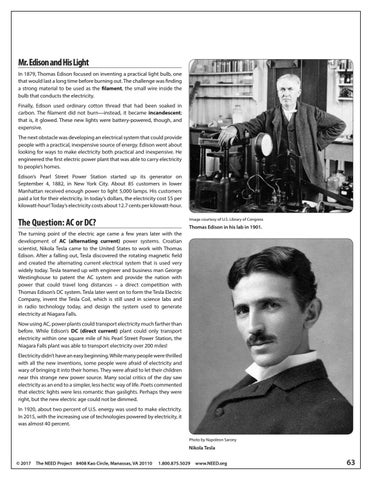
Thomas Edison in his lab in 1901.
The turning point of the electric age came a few years later with the development of AC (alternating current) power systems. Croatian scientist, Nikola Tesla came to the United States to work with Thomas Edison. After a falling out, Tesla discovered the rotating magnetic field and created the alternating current electrical system that is used very widely today. Tesla teamed up with engineer and business man George Westinghouse to patent the AC system and provide the nation with power that could travel long distances – a direct competition with Thomas Edison’s DC system. Tesla later went on to form the Tesla Electric Company, invent the Tesla Coil, which is still used in science labs and in radio technology today, and design the system used to generate electricity at Niagara Falls. Now using AC, power plants could transport electricity much farther than before. While Edison’s DC (direct current) plant could only transport electricity within one square mile of his Pearl Street Power Station, the Niagara Falls plant was able to transport electricity over 200 miles! Electricity didn’t have an easy beginning. While many people were thrilled with all the new inventions, some people were afraid of electricity and wary of bringing it into their homes. They were afraid to let their children near this strange new power source. Many social critics of the day saw electricity as an end to a simpler, less hectic way of life. Poets commented that electric lights were less romantic than gaslights. Perhaps they were right, but the new electric age could not be dimmed. In 1920, about two percent of U.S. energy was used to make electricity. In 2015, with the increasing use of technologies powered by electricity, it was almost 40 percent. Photo by Napoleon Sarony
Nikola Tesla © 2017 The NEED Project 8408 Kao Circle, Manassas, VA 20110
1.800.875.5029
www.NEED.org
63