Natural Gas What Is Natural Gas?
History of Natural Gas
Natural gas is generally considered a nonrenewable fossil fuel. (There are some renewable sources of methane, the main ingredient in natural gas, also discussed in this fact sheet.) Natural gas is considered a fossil fuel because natural gas was formed from the remains of tiny sea animals and plants that died 300 to 400 million years ago.
The ancient peoples of Greece, Persia, and India discovered natural gas many centuries ago. The people were mystified by the burning springs created when natural gas seeping from cracks in the ground was ignited by lightning. They sometimes built temples around these eternal flames so they could worship the mysterious fire.
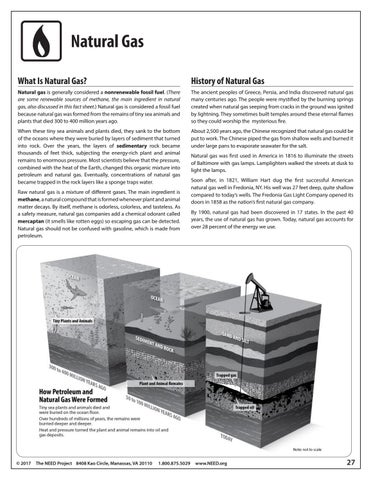
When these tiny sea animals and plants died, they sank to the bottom of the oceans where they were buried by layers of sediment that turned into rock. Over the years, the layers of sedimentary rock became thousands of feet thick, subjecting the energy-rich plant and animal remains to enormous pressure. Most scientists believe that the pressure, combined with the heat of the Earth, changed this organic mixture into petroleum and natural gas. Eventually, concentrations of natural gas became trapped in the rock layers like a sponge traps water.
About 2,500 years ago, the Chinese recognized that natural gas could be put to work. The Chinese piped the gas from shallow wells and burned it under large pans to evaporate seawater for the salt.
Raw natural gas is a mixture of different gases. The main ingredient is methane, a natural compound that is formed whenever plant and animal matter decays. By itself, methane is odorless, colorless, and tasteless. As a safety measure, natural gas companies add a chemical odorant called mercaptan (it smells like rotten eggs) so escaping gas can be detected. Natural gas should not be confused with gasoline, which is made from petroleum.
Š 2017 The NEED Project 8408 Kao Circle, Manassas, VA 20110
1.800.875.5029
Natural gas was first used in America in 1816 to illuminate the streets of Baltimore with gas lamps. Lamplighters walked the streets at dusk to light the lamps. Soon after, in 1821, William Hart dug the first successful American natural gas well in Fredonia, NY. His well was 27 feet deep, quite shallow compared to today’s wells. The Fredonia Gas Light Company opened its doors in 1858 as the nation’s first natural gas company. By 1900, natural gas had been discovered in 17 states. In the past 40 years, the use of natural gas has grown. Today, natural gas accounts for over 28 percent of the energy we use.
www.NEED.org
27