Exploring Sound 3 SOUND MODULE THREE
? Question How can you prove that sound causes vibrations of different frequencies?
Hypothesis Read the procedure and record your hypothesis in your science notebook using the format "If... then... because..." format.
Materials 2 Tuning forks–256 Hz and 1024 Hz 1 Mallet 2 Metal cans 1 Large rubber band
Plastic wrap (12” x 12”) Pepper
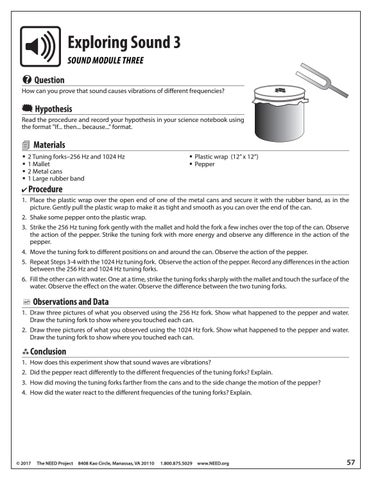
Procedure 1. Place the plastic wrap over the open end of one of the metal cans and secure it with the rubber band, as in the picture. Gently pull the plastic wrap to make it as tight and smooth as you can over the end of the can. 2. Shake some pepper onto the plastic wrap. 3. Strike the 256 Hz tuning fork gently with the mallet and hold the fork a few inches over the top of the can. Observe the action of the pepper. Strike the tuning fork with more energy and observe any difference in the action of the pepper. 4. Move the tuning fork to different positions on and around the can. Observe the action of the pepper. 5. Repeat Steps 3-4 with the 1024 Hz tuning fork. Observe the action of the pepper. Record any differences in the action between the 256 Hz and 1024 Hz tuning forks. 6. Fill the other can with water. One at a time, strike the tuning forks sharply with the mallet and touch the surface of the water. Observe the effect on the water. Observe the difference between the two tuning forks.
Observations and Data 1. Draw three pictures of what you observed using the 256 Hz fork. Show what happened to the pepper and water. Draw the tuning fork to show where you touched each can. 2. Draw three pictures of what you observed using the 1024 Hz fork. Show what happened to the pepper and water. Draw the tuning fork to show where you touched each can.
Conclusion 1. How does this experiment show that sound waves are vibrations? 2. Did the pepper react differently to the different frequencies of the tuning forks? Explain. 3. How did moving the tuning forks farther from the cans and to the side change the motion of the pepper? 4. How did the water react to the different frequencies of the tuning forks? Explain.
© 2017
The NEED Project
8408 Kao Circle, Manassas, VA 20110
1.800.875.5029
www.NEED.org
57