Conductors and Insulators HEAT MODULE TWO
? Question
NOTE
How does the material a cup is made of affect the transfer of heat?
When the procedure calls for: cold water, use water between 7-13°C or 45-55°F ice water, use water <7°C or <45°F warm water, use water between 43-49°C or 110-120°F hot water, use water just under boiling (the teacher should handle the container for hot water)
Hypothesis Read the procedure and record your hypothesis in your science notebook using an "If... then... because..." format.
Materials 1 Plastic cup 1 Foam cup 1 Metal cup 1 Paper cup 4 Digital thermometers 4 Rubber bands Plastic wrap Stopwatch or clock with second hand Ice water Hot water
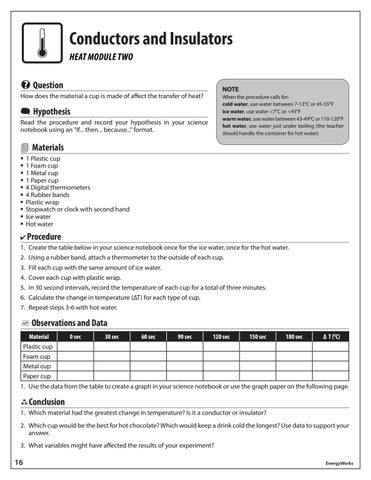
Procedure 1. Create the table below in your science notebook once for the ice water, once for the hot water. 2. Using a rubber band, attach a thermometer to the outside of each cup. 3. Fill each cup with the same amount of ice water. 4. Cover each cup with plastic wrap. 5. In 30 second intervals, record the temperature of each cup for a total of three minutes. 6. Calculate the change in temperature (ΔT) for each type of cup. 7. Repeat steps 3-6 with hot water.
Observations and Data Material Plastic cup Foam cup Metal cup Paper cup
0 sec
30 sec
60 sec
90 sec
120 sec
150 sec
180 sec
∆ T (OC)
1. Use the data from the table to create a graph in your science notebook or use the graph paper on the following page.
Conclusion 1. Which material had the greatest change in temperature? Is it a conductor or insulator? 2. Which cup would be the best for hot chocolate? Which would keep a drink cold the longest? Use data to support your answer. 3. What variables might have affected the results of your experiment?
16
EnergyWorks