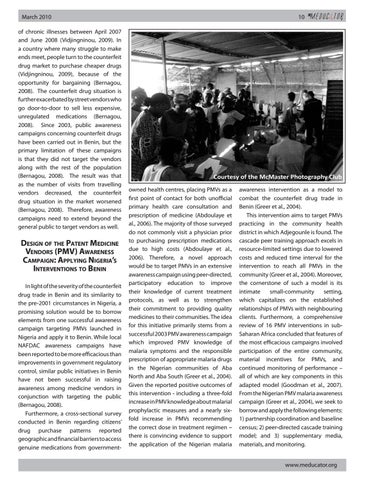
March 2010 of chronic illnesses between April 2007 and June 2008 (Vidjingninou, 2009). In a country where many struggle to make ends meet, people turn to the counterfeit drug market to purchase cheaper drugs (Vidjingninou, 2009), because of the opportunity for bargaining (Bernagou, 2008). The counterfeit drug situation is further exacerbated by street vendors who go door-to-door to sell less expensive, unregulated medications (Bernagou, 2008). Since 2003, public awareness campaigns concerning counterfeit drugs have been carried out in Benin, but the primary limitation of these campaigns is that they did not target the vendors along with the rest of the population (Bernagou, 2008). The result was that as the number of visits from travelling vendors decreased, the counterfeit drug situation in the market worsened (Bernagou, 2008). Therefore, awareness campaigns need to extend beyond the general public to target vendors as well.
Design of the Patent Medicine Vendors (PMV) Awareness Campaign: Applying Nigeria’s Interventions to Benin In light of the severity of the counterfeit drug trade in Benin and its similarity to the pre-2001 circumstances in Nigeria, a promising solution would be to borrow elements from one successful awareness campaign targeting PMVs launched in Nigeria and apply it to Benin. While local NAFDAC awareness campaigns have been reported to be more efficacious than improvements in government regulatory control, similar public initiatives in Benin have not been successful in raising awareness among medicine vendors in conjunction with targeting the public (Bernagou, 2008). Furthermore, a cross-sectional survey conducted in Benin regarding citizens’ drug purchase patterns reported geographic and financial barriers to access genuine medications from government-
10
owned health centres, placing PMVs as a first point of contact for both unofficial primary health care consultation and prescription of medicine (Abdoulaye et al., 2006). The majority of those surveyed do not commonly visit a physician prior to purchasing prescription medications due to high costs (Abdoulaye et al., 2006). Therefore, a novel approach would be to target PMVs in an extensive awareness campaign using peer-directed, participatory education to improve their knowledge of current treatment protocols, as well as to strengthen their commitment to providing quality medicines to their communities. The idea for this initiative primarily stems from a successful 2003 PMV awareness campaign which improved PMV knowledge of malaria symptoms and the responsible prescription of appropriate malaria drugs in the Nigerian communities of Aba North and Aba South (Greer et al., 2004). Given the reported positive outcomes of this intervention - including a three-fold increase in PMV knowledge about malarial prophylactic measures and a nearly sixfold increase in PMVs recommending the correct dose in treatment regimen – there is convincing evidence to support the application of the Nigerian malaria
awareness intervention as a model to combat the counterfeit drug trade in Benin (Greer et al., 2004). This intervention aims to target PMVs practicing in the community health district in which Adjegounle is found. The cascade peer training approach excels in resource-limited settings due to lowered costs and reduced time interval for the intervention to reach all PMVs in the community (Greer et al., 2004). Moreover, the cornerstone of such a model is its intimate small-community setting, which capitalizes on the established relationships of PMVs with neighbouring clients. Furthermore, a comprehensive review of 16 PMV interventions in subSaharan Africa concluded that features of the most efficacious campaigns involved participation of the entire community, material incentives for PMVs, and continued monitoring of performance – all of which are key components in this adapted model (Goodman et al., 2007). From the Nigerian PMV malaria awareness campaign (Greer et al., 2004), we seek to borrow and apply the following elements: 1) partnership coordination and baseline census; 2) peer-directed cascade training model; and 3) supplementary media, materials, and monitoring. www.meducator.org