NEWS
5
The MARIAN July-August 2012
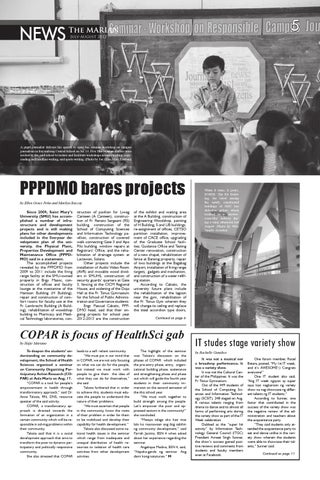
A pupil-journalist delivers his speech to open the seminar-workshop on campus journalism in Bayombong Central School on Jul. 14. Five The Marian staffers were invited by the said school to lecture and facilitate workshops in news writing, copyreading and headline writing, and sports writing. (Photo by Joe Allen Mark Esteban)
PPPDMO bares projects by Ellen Grace Peña and Marilyn Baccay
Since 2009, Saint Mary’s University (SMU) has accomplished a number of infrastructure and development projects and is still making plans for other developments included in the five-year development plan of the university, the Physical Plant, Properties Development and Maintenance Office (PPPDMO) said in a statement. The accomplished projects revealed by the PPPDMO from 2009 to 2011 include the firing range facility at the SMU-owned property in Brgy. Masoc, construction of offices and faculty lounge at the mezzanine of the Hantson Building (H Building), repair and construction of comfort rooms for faculty use at the Fr. Lambrecht Building (A Building), rehabilitation of woodshop building to Pharmacy and Medical Technology laboratories, con-
struction of pavilion for Liwag Canteen (A Canteen), construction of Fr. Renato Sergeant (RS) building, construction of the School of Computing Sciences and Information Technology pavillion, construction of covered walk connecting Gate 3 and Apo Pilo building, window repairs at Registrars’ Office, and the rehabilitation of drainage system at Lactawan, Solano. Other projects include the installation of Audio Video Room (AVR) and movable wood dividers in SMUHS, construction of security guards’ quarters at Gate 3, fencing at the CICM Regional House, and widening of the Dojo Hall at the Fr. Tonus Gymnasium for the School of Public Administration and Governance students. Engr. Pascual Cabatic, PPPDMO head, said that their ongoing projects for school year 2012-2013 are the construction
of the exhibit and waiting area at the A Building, construction of Engineering Woodshop, painting of H Building, S and UB buildings, re-assignment of offices, CETSO partition installation, improvement of CACE office, upgrading of the Graduate School facilities, Guidance Office and Testing Center renovation, construction of a new chapel, rehabilitation of fence at Bansing property, repair of two buildings at the Bagabag Airport, installation of firing range targets, gadgets and mechanism, and construction of a water refilling station. According to Cabatic, the university future plans include the rehabilitation of the lagoon near the gym, rehabilitation of the Fr. Tonus Gym wherein they will change its ceiling and replace the steel accordion type doors, Continued on page 6
COPAR is focus of HealthSci gab by Hajie Mariano
To deepen the students’ understanding on community development, the School of Health Sciences organized a seminar on Community Organizing Participatory Action Research (COPAR) at Aula Maria on Aug. 17. “COPAR is a tool for people’s empowerment in health through transformatory approach,” said Dr. Anne Talosia, RN, DNS, resource speaker of the said activity. COPAR, a transfomatory approach is directed towards the formation of an organization in a certain community which will be responsible in solving problems within their community. Talosia said that it is a social development approach that aims to transform the poor to dynamic participatory and politically responsive community. She also stressed that COPAR
leads to a self- reliant community. “We must put in our mind that in COPAR, we are not only focusing on what we can do for the people, but instead we must work with people to give them the idea of what they can do for themselves,” she said Talosia furthered that in order to achieve this, students must educate the people to understand the nature of their problems. “We must ascertain that people in the community, know the roots of their problem in order for them to be mobilized and develop their capability for health development.” Talosia also discussed some national health issues in the seminar which range from inadequate and unequal distribution of health resources to isolation of health care activities from other development actvities.
When it rains, it pours, INSIDE. The RS Building, the latest among the newly constructed buildings of SMU has defective gutters which resulted to a ‘showerroom-like’ hallway during a rainy afternoon last August. (Photo by Wrix Vinnlly Arzadon)
The highlight of the seminar was Talosia’s discussion on the phases of COPAR which included the pre-entry phase, entry, organizational building phase, sustenance and strengthening phase and phase out which will guide the fourth year students in their community immersion on the second semester of the this school year. “We must work together to build strength among the people. Let’s empower the poor and oppressed sectors in the community!” she concluded. “Masaya talaga ako kasi mas lalo ko naunawaan ang ibig sabihin ng community development,” said Farrah Jacinto, BSN 4 when asked about her experience regarding the seminar. Angelique Medina, BSN 4, said, “Napaka-ganda ng seminar. Ang dami kong natutunan.” M
IT studes stage variety show by Rochelle Gumih-o It was not a musical nor a broadway performance. It was a variety show. It was not the Cultural Center of the Philippines. It was the Fr. Tonus Gymnasium. Out of the 449 students of the School of Computing Sciences and Information Technology (SCSIT), 248 staged on Aug. 8 various talents ranging from drama to dance and to almost all forms of performing arts during the variety show as part of the IT Week celebration. Dubbed as the “super hit activity” by Information Technology General Council (ITGC) President Avneet Singh Sunner, the show’s success gained positive reviews and comments from students and faculty members even at Facebook.
One forum member, Rocel Batara, posted, “My 1st IT week, and it’s AWESOME!:) Congrats everyone!” One IT student also said, “Ang IT week ngayon ay super saya kasi nagkaroon ng variety show na nag-showcase ng different talents ng IT students.” According to Sunner, one factor that contributed in the success of the variety show was the negative review of the administration and teachers about the acquaintance party. “They said students only attended the acquiantance party to eat and dance unlike in the variety show wherein the students were able to showcase their talents,” Sunner said.
Continued on page 11