11
Science & Technology Editor: Bryce Hoye Contact: science@themanitoban.com / 474.6529
Science & technology
Enemy at the gates Taking a look at invasive aquatic species in Manitoba Tom Ingram, staff
R
ivers and lakes have long been nutrient normally locked up at the important for Manitoba. They bottom of the stream, contributing are a source of food, they generate to the eutrophication (nutrient loadour electricity, and at one time they ing) of lakes. were important transportation routes. Before 1940, the common carp They are also centres of leisure. All was only found in the Red River. By these things affect, and are in turn 1950, it had become established in the affected by, the delicate ecosystems of south basins of lakes Winnipeg and our waterways. And these ecosystems Manitoba. Over the next 20 years are threatened by invasive species. it expanded rapidly, and by 1976 it According to the Invasive Species was found in almost all major lakes Council of Manitoba, invasive spe- and rivers in Manitoba except the cies are “plants, animals, or other Churchill River system. In the last 16 organisms that are growing out of years, the common carp invaded the their country or region of origin and Churchill River system. Its expansion are outcompeting or even replacing in the north was made possible by native organisms.” When a species hydroelectric development – espetravels to a new environment, it could cially the construction of Kettle find that environment inhospitable Generating Station in 1974 and the and fail to take root there. But if it Churchill River Diversion in 1976. can handle the new environment, the This development flooded what had invasive species might find that it is been dry land, and provided shallow not susceptible to the local preda- marshy areas for the carp to spawn tors and diseases. This gives it a great in the summer. advantage over local species. There’s another carp that’s even Of course, the system has a way more concerning: the Asian carp. It of shifting to accommodate the has not yet reached Manitoba, but change, but in nature these changes there is a serious danger that it will take place gradually. Without human invade the Great Lakes. Canadian intervention, a species is not going to and American fisheries officials are be abruptly introduced to a new area working to keep it out, but it has on the other side of the planet. But been spotted just six miles from Lake when you throw humanity into the Michigan. This is particularly trouequation, with all our planes, trains, bling, as Lake Michigan “opens the automobiles, and global shipping, door” to Lake Huron and the rest of these changes can occur faster than the Great Lakes. ever and lead to ecosystems that are The Asian carp can have devasradically out of balance. Invasive spe- tating effects on biodiversity. The cies are what you get when evolution fish can grow to about a metre in meets our industrialized, globalized length and up to 45 kilograms. They human society. eat voraciously, outcompeting and By beating out native species, starving other fish and dominating invasive species reduce biodiversity the ecosystems they invade. One spiny waterflea to invade new lakes. and destroy unique ecosystems. They variety, the silver carp, is dangerous The spiny waterflea can reproduce can also impact agriculture (as with in an especially dramatic way: when sexually or by parthenogenesis (i.e., weeds that compete with crops and startled, they launch themselves from asexual reproduction). This allows can be costly to deal with) and the the water in great numbers and with them to reproduce very quickly. Also, flow and quality of water. These fac- considerable force. People have had because it preys on zooplankters, it tors are all of particular concern in bones broken by silver carp. competes directly with small fish for Manitoba. The Asian carp escaped into the food. Because of its rapid reproducInvasive species usually travel to Mississippi River from U.S. aqua- tion, the spiny waterflea can hog all new areas as a result of human activ- culture facilities in the 1990s. It has the food, leaving little for the small, ity. Sometimes this can be the result been advancing steadily northward young fish. of illegal activity such as the smug- since that time, and is now perilously According to an article published gling of fruits and vegetables, which close to the Great Lakes. “Nine out of by the Michigan Sea Grant, the can introduce invasive plants as well 10 fishes pulled out of the Mississippi spiny waterflea has become a peras insects and parasites, or obviously River basin are now Asian carps,” said manent part of the ecosystem in the irresponsible activities like the pur- Becky Cudmore, manager of the Great Lakes. And Brenda Hann, chase of certain exotic animals – the Centre of Expertise for Aquatic Risk a University of Manitoba scientist Everglades in Florida are being rap- Assessment (CEARA) of Fisheries who studies the spiny waterflea, says, idly overrun with Burmese pythons and Oceans Canada. Computer “Once a non-indigenous species has that were introduced by the exotic modelling by CEARA suggests invaded a new habitat, it is almost reptile trade. But even the everyday that the Asian carp would have no impossible to eradicate. Prevention is work of fishermen can, if they are not trouble adapting to most Canadian vital, but as non-indigenous aquatic careful, transfer invasive pests from environments. species move along waterways, it is a one area to another. It’s not just fish that are danger- matter of ‘when,’ not ‘if’ they invade if Sometimes they are introduced on ous invaders. The spiny waterflea, an the waterways are connected.” purpose for purely ornamental pur- aquatic invertebrate and zooplankter In many cases, the invasive species poses. The common carp was brought native of Europe, can be found in have already arrived and there’s not to North America for this reason, and Lake of the Woods and the Winnipeg much we can do other than track their it reached Manitoba around 1886. By River and is making inroads into advance. At some point you have to 1954 it had disrupted commercial fish- Lake Winnipeg. They are capable accept that the invaders have suceries. When the common carp feeds, of reaching 15mm in size, which is ceeded, and they’re now a local speit stirs up the substrate (bed of the large in zooplankton terms. Unlike cies. When you talk about invasive stream), making the water cloudy. other waterfleas, which mostly feed species, heavy questions about the This destroys habitats and kills plants, on algae, the spiny waterflea preys on way we relate to nature lurk just below and can make the water unsuitable other zooplankters. The long, barbed the surface. All the same, though, it for drinking or swimming. It can tail spine can get stuck in fishing gear, would be better if the Asian carp did also release phosphorus, which is a which is a potential method for the not reach Manitoba.
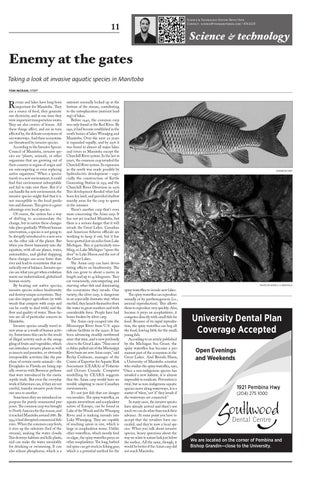
common carp
Photo by koen G. h. breeveld
University Dental Plan Coverage Accepted Open Evenings and Weekends
1921 Pembina Hwy (204) 275 1000
We are located on the corner of Pembina and Bishop Grandin—close to the University.