Sports Editor: Marc Lagace Contact: sports@themanitoban.com / 474.6529
Sports
18
Olympic soccer bronze as good as gold How the Canadian women’s soccer team stole the spotlight in London Marc Lagace, staff
T
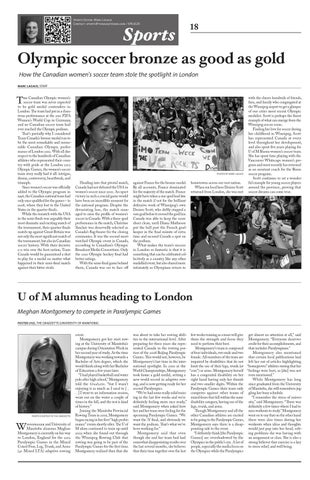
he Canadian Olympic women’s soccer team was never expected to be gold medal contenders in London. The team had put in a disastrous performance at the 2011 FIFA Women’s World Cup in Germany, and no Canadian soccer team had ever reached the Olympic podium. That’s partially why I considered Team Canada’s bronze medal run to be the most remarkable and memorable Canadian Olympic performance of London 2012. With all due respect to the hundreds of Canadian athletes who represented their country with pride at the London 2012 Olympic Games, the women’s soccer team story really had it all: intrigue, drama, controversy, heartbreak, and triumph. Since women’s soccer was officially added to the Olympic program in 1996, the Canadian national team had only once qualified for the games – in 2008, where they lost to the United States in the quarter-finals. While the rematch with the USA in the semi-finals was arguably their most dramatic and exciting match of the tournament, their quarter-finals match-up against Great Britain was not only the most significant match of the tournament, but also in Canadian soccer history. With their decisive 2-0 win over the host nation, Team Canada would be guaranteed a shot to play for a medal no matter what happened in their semi-final match against their bitter rivals.
photos by marc lagace
Heading into that pivotal match, Canada had not defeated the USA in women’s soccer since 2001. An upset victory in such a crucial game would have been an incredible moment for the national program. Despite the devastating loss, the match managed to raise the profile of women’s soccer in Canada. With a three-goal performance in the match, Christine Sinclair was deservedly selected as Canada’s flag-bearer for the closing ceremonies. It was the second mostwatched Olympic event in Canada, according to Canadian’s Olympic Broadcast Media Consortium. Only the 2010 Olympic hockey final had better ratings. With the semi-final game behind them, Canada was set to face off
against France for the bronze medal. By all accounts, France dominated for the majority of the match. France might have taken a one-goal lead late in the match if not for the brilliant defensive work of Winnipeg’s own Desiree Scott, who deftly stopped a sure goal before it crossed the goal line. Canada was able to keep the score sheet clean, until Diana Matheson put the ball past the French goalkeeper in the final minute of extra time and secured Canada a spot on the podium. What makes the team’s success in London so fantastic is that it is something that can be celebrated collectively as a country like any other medalled event, but also shared more intimately as Olympians return to
hometowns across our vast nation. When our local hero Desiree Scott returned from London, she was met
with the cheers hundreds of friends, fans, and family who congregated at the Winnipeg airport to get a glimpse of our cities most recent Olympic medalist. Scott is perhaps the finest example of what can emerge from the Winnipeg soccer scene. Finding her love for soccer during her childhood in Winnipeg, Scott has represented Canada at every level throughout her development, and also spent five years playing for U of M Bisons women’s soccer team. She has spent time playing with the Vancouver Whitecaps women’s program and most recently has returned as an assistant coach for the Bison soccer program. Scott continues to set a wonderful example for young soccer players around the province, proving that soccer dreams can come true.
U of M alumnus heading to London Meghan Montgomery to compete in Paralympic Games Foster Lyle, the Gradzette (University of Manitoba)
Photo courtesy of the Gradzette
W
innipegger and University of Manitoba alumnus Meghan Montgomery is currently on her way to London, England for the 2012 Paralympic Games in the Mixed Coxed Four, Leg, Trunk, and Arms (4+ Mixed LTA) adaptive rowing
event. was about to take her rowing abili- few weeks training as a team will give get almost no attention at all,” said Montgomery got her start row- ties to the international level. After them the strength and focus they Montgomery. “Everyone deserves ing at the University of Manitoba’s preparing for three years she repre- need to perform their best. credit for their accomplishments, and campus during Orientation Week in sented Canada in the rowing porMontgomery’s team is composed that includes Paralympians.” her second year of study. At the time tion of the 2008 Beijing Paralympic of four individuals, two male and two Montgomery also mentioned Montgomery was working towards a Games. This would not, however, be female. All members of the team are that certain local publications had Bachelor of Arts degree, which she Montgomery’s last time in the inter- impaired by disabilities that do not left her out of articles highlighting would finish along with her Bachelor national spotlight. In 2010 at the limit the use of their legs, trunk (or “homegrown” athletes stating that her of Education a few years later. World Championships, Montgomery “core”) or arms. Montgomery herself “feelings were hurt, as [she] was not “I had played basketball and water took home a gold medal, setting a has a congenital disability on her even mentioned.” polo after high school,” Montgomery new world record in adaptive row- right hand having only her thumb While Montgomery has long told the Gradzette, “but I wasn’t ing, and is now getting ready for her and two smaller digits. Within the since graduated from the University enjoying it as much as I used to [ . second Paralympics. Paralympic Games their team only of Manitoba, she still remembers jug. . ] I went to an information session, “We’ve had some really solid train- competes against other teams of gling her busy schedule. went out on the water a couple of ing in the last few weeks and we’re mixed fours that fall within the same “I remember the stress of univertimes in the fall, and the rest is kind definitely feeling more race ready,” disability category, having use of the sity,” said Montgomery. “There was of history.” said Montgomery when asked how legs, trunk, and arms. definitely a few times where I had to Joining the Manitoba Provincial her and her team were feeling for the Though Montgomery and all the miss workouts to study.” Montgomery Rowing Team in 2001, Montgomery upcoming Paralympic Games. “We other Canadian athletes are excited went on to say that on the other hand began racing in her first “high perfor- want the ‘A’ final, and obviously we to be going to the Paralympic Games, there were also times during her mance” events shortly after. The U of want the podium. That’s what we’ve Montgomery says there is a disap- workouts when ideas and thoughts M alum continued to train up until been working for.” pointing side to the event. would just pop into her head, solv2005 when she found out through Montgomery said that even “I definitely think [the Paralympic ing problems she was having with the Winnipeg Rowing Club that though she and her team had had Games] are overshadowed by the an assignment or class. She is also a rowing was going to be part of the somewhat disappointing results over Olympics in the public’s eye. A lot of strong believer that exercise is a key Paralympic Games for the first time. the last several months, she believes people, especially the media focus on to stress relief, and well being. Montgomery realized then that she that their time together over the last the Olympics while the Paralympics