2-3
STAFF EDITORIAL: UNDER PRESSURE
4-5
A LETTER TO A YOUNG BLACK BOY
14-15
TOXIC MASCULINITY
LH
SPECIAL EDITION
GUN CONTROL
This special issue from The Little Hawk is dedicated to the victims of Parkland, and everyone who has suffered because of gun violence across the United States. We hope this issue will educate readers about the pain caused by mass shootings and about options for gun reform in our nation, as well as ways to pull up the deep societal roots of gun culture.
SPECIAL EDITION NO.4 4.6.2018 COVER DESIGN BY OLIVIA LUSALA
STAFF EDITORIAL:
UNDER PRESSURE
2 April 6, 2018
Art by avery shrader
I
n our culture, we talk a lot about bias, particularly in the media. The recent years have brought a maelstrom of attention to “fake news” and the “liberal media.” As journalists, this is an issue we try to handle with sensitivity. While we always want to write about things we care about, it is our duty to not let feeling get in the way of fact. Especially when dealing with such a sensitive and politicized issue as gun control, we must uphold the standard of honesty with our readers. We want to reassure you—there is no bias hidden in this special edition magazine. That is because we do not intend to hide it. Approximately 71.43% of “WE WANT TO REASSURE our editors YOU—THERE IS NO BIAS are foundHIDDEN IN THIS SPECIAL ing members EDITION MAGAZINE. THAT IS of Students BECAUSE WE DO NOT INTEND Against TO HIDE IT.” S c h o o l Shootings (SASS), an organization promoting gun-control activism. Members of our editorial board have led marches, given speeches, written legislation proposals, and yelled at Senator Chuck Grassley about gun control in America. But more importantly, we are students. We are the ones who must face the terror and the pain of each new wave of shootings. And we are not going to pretend to hide that fear in the name of objectivity. This is too important an issue. The reason for all this activism is that we believe that enough is enough. School shootings and mass shootings in general exemplify some of the worst trends America has to offer: inaction, a reluctance to make change, and submitting to tiny, vocal minorities because of the cash they can shove in politicians’ pockets. The reason that we have taken extensive steps to protest for change in our state’s and our nation’s policy on guns is that we are fed up with the atrocities. We are fed up with the fear. Most importantly, we are fed up with the silence. Staying neutral in this debate is something that no one can truly do. Because of the persistent and emotional clash between violence, culture, and constitutional right, Americans are swamped by nationwide debate after each shooting. More than that, silence should not be possible. Inaction on this issue is as damning as the
most pro-gun position, because silence is complicity. We are seeking a change in this absurd, this violent, this completely unacceptable status quo. People in America are 10 times more likely to be killed by guns than people in other developed countries. This is unequivocally due to America’s lax standards when it comes to our guns. This is how our country has been, is, and will continue to be if we do not change. Belief that your participation is not necessary for growth and for success fosters a culture of apathy and normalizes being a bystander. We must make ourselves heard with the same demanding vociferousness as extreme gun-rights activists. Otherwise, we will lose this fight. Inaction means that this issue will remain. Silence means continued violence. We must voice the problems of our nation, loudly, and with no shame. Our collective future depends on our openness and our upholding of the tenets of democracy. If you’re looking for a call to action, for some cosmic sign telling you that you need to pay attention, to fight for change, to be your own hero, this is it. Your passivity, your inaction, and your willingness to accept terrible violence are facilitating the continuation of a system which prioritizes money and status over the lives of its people. As anyone who has taken a United States history class will well know, the only way to “WE—AS CITIZENS, AND see change ESPECIALLY AS STUDENTS— happen is ARE THE FUTURE OF THIS to force it. NATION. WE HAVE EFFECTED Those who CHANGE BEFORE...WE WILL benefit from DO IT AGAIN.” this current system do not want us to alter their power or their ability to sit pretty in the eaves of our nation. They are ignoring our safety in favor of seats in the Senate and money in their bank accounts. We-—as citizens, and especially as students—are the future of this nation. We have effected change before in this country through boycotts and walkouts and sit-ins. We will do it again. But this movement can only work if the quiet march alongside the outspoken. Do not allow yourself to remain stationary in the tide of change. Do not watch your feet moving backward into the sand. Wade in with us. Let’s stand together.
A Letter to a Young Black Boy Dear Hassan, You are only thirteen, much too young for your response to another report of “an unarmed Black man“ to be “stop killing Black people.” Much too young to have to think about these things. I wish that you didn’t have to live in a world where you can find videos of people who look just like you do being gunned down for being Black in the wrong place at the wrong time. I wish that I didn’t have to worry about your growing taller, taller than me (though I hate to admit). I know you don’t understand why I fear for the day when you finally grow out of your baby face but it is because I know that as you grow older, the world will become more dangerous for you. When we heard the sound of bullets being fired at Stephon Clark in his own backyard because another phone was mistaken for another gun, you said, “This makes me wish I would have gone to the walkout.” I was quiet. I couldn’t find the strength to tell you in that moment that bullets from a civilian with a gun pose the same amount of threat to you as any policeman. That the lack of gun control in this country is just as drastic as you walking out of a grocery store without a receipt. I reminded you again, as you sat watching a marathon of bullets catch up with a man who could have been you, to always make sure that you get one when you leave a store, or at the very least a bag with a logo. That a thin sheet of paper or plastic could lengthen your life. You were in the passenger seat as we sat still in the driveway. I told you that it could save you from being another “unarmed Black man” but in all honesty, I don’t know that it can. I know that I cer-
tainly can’t. I didn’t tell you in that moment that I didn’t walk out because my fear of being shot while sitting in a classroom is not tantamount to my fear of being Black in America. Hassan, I want you to know that you can go far in this world and I know that it still doesn’t make sense to you why I hate when you wear hoodies and why I tell you not to walk with your hands in your pockets and to always be polite to the strangers that you walk past on the street and why you cannot afford to break the rules whether spoken or otherwise. I wish that we lived in a world where it didn’t have to make sense. I hope that these lectures that I’ve given to you will always in some part stay with you because though I will not always be driving you around, you will always be in need of them. I cannot stop you from growing or keep you from knowing but I hope that it is never you.
Love from your sister,
Mariam.
4 APRIL 6, 2018
photo by zoe butler and olivia lusala
S
tudent activism has been at its highest recently, stemming from gun violence protests around the country. Following the shooting at Marjory Stoneman Douglas High School on February 14th, student activists from South East Junior High decided to protest and walk out the next day along with both City and West High Schools. One major thing that came out of this was a student activist group called Students Against School Shootings, or SASS. Shayna Jaskolka ‘18 is one of the students who helped plan the walkout, and is a core member of this group. “SASS is Students Against School Shootings, and our goal is to inform people about gun violence and how there are way that we can stop it and make sure that people are educated about guns so people know the damage that guns can do and our goal is to hopefully convince senators and representatives of Iowa and everywhere in the country to pass some sensible and common sense gun laws,” Jaskolka said. Although there was limited time to plan the protest, Jaskolka was proud of how the event turned out. “We found out that South East Junior High was planning a walkout the night before and so instead of doing something of our own, we decided to go and just do the walkout with them. We planned and put together the entire walkout in about twelve hours, which was really impressive,” Jaskolka said. “After that, I think all of us in the
group felt really good about what we had done, so we wanted to keep doing more. So this group basically formed from what we thought would be an ill-planned walkout.” One thing Jaskolka particularly enjoyed was being one of the group’s organizers. “I’ve always liked being the leader because you get to watch over everything, see everything happen and you get to participate in the planning process,” Jaskolka said. “I’m just really excited to be a part of this group and be an activist. I’m really glad I was able to help start this group too. Instead of just being a part of an organization, I get to say I helped start it.” Before this protest, Jaskolka’s activism had been fairly limited to social media rants. “I often post angry rants on social media about
things President Trump has said and things from
“THE MAIN GOAL RIGHT NOW IS JUST TO TRY AND KEEP THE MOMENTUM OF THE MOVEMENT GOING.” - BIHOTZA JAMES-LEJARCEGUI people who identify with the Republican party, but
By Mina Takahashi
I never really did anything about it so I was really excited when I was able to participate in the walkout because I was actually doing something,” Jaskolka said. “People are actually going to see this, and it’s going to hopefully make a difference. I don’t want to take guns away from people, but there definitely need to be better regulations on them.” Bihotza James-Lejarcegui ‘18 is known for being a student activist at City High. After hearing about the planned walkout at South East Junior High, she immediately contacted her friends from both City and
“I’VE ALWAYS LIKED BEING A LEADER BECAUSE YOU GET TO WATCH OVER EVERYTHING, SEE EVERYTHING HAPPEN AND YOU GET TO PARTICIPATE IN THE PLANNING PROCESS.” - SHAYNA JASKOLKA
West to help organize the protest. “The main goal right now is just to try and keep the momentum of the movement going and make sure that it continues because I know adults and politicians are really hoping for young people to just forget about the issue after a walkout and get over it. I think our job is to keep getting people informed and involved and doing our re-
search and contacting people and just making sure that the momentum continues,” James-Lejarcegui said. Student activism and leadership is not unfamiliar to James-Lejarcegui. “I feel like I’m kind of known for being a bit of an advocate at City High because I just love doing things like that. It’s always something to work on. I definitely have worked with initiating things and doing social justice and I have started programs in the past for other stuff although they were pretty established,” James-Lejarcegui said. “None of those things were as big as this though, and they didn’t involve West High as much so this is really cool. We get to work with students from West High and South East Junior High, and we even have a website so it’s becoming pretty established.” James-Lejarcegui hopes to see SASS continue to expand even after the local protests die down. “In the future I hope to see this group expand some more within the boundaries of Iowa and maybe even some more. I want to keep contacting more people, more politicians, have more discussions, and go places. Right now we’re planning on possibly even going to Washington, D.C. We just make as much of an impact as we can,” James-Lejarcegui said. Nick Pryor ‘18 is one of the core members of SASS from West High, and on the research and publicity committees. “As a core member, I’m one of the organizers of the events we plan and attend the weekly core member meetings. On the research committee we work on keeping up-to-date on the most recent facts and statistics and legislative actions that are being taken. On publicity we focus on getting the ‘SASS name’ out there on social media and around Iowa City,” Pryor said. Although Pryor has not had previous experience organizing groups and events, politics is something he has always been passionate about. “Bihotza got in contact with me and the other three organizers at West—Wala [Siddig ‘18], Safeya [Siddig ‘18], and Lujayn [Hamad ‘18]—the night before the walkout,” Pryor said. “I think especially following Stoneman Douglas, the issue of gun control is on everyone’s mind. I felt like it was the best opportunity to start getting involved and getting our voices out there.” Although things have calmed down since the first week of organizing the walk-
out, there is still a lot of energy in the group. “After the March for Our Lives event on March 24th, hopefully we’ll put together a more concrete expansion plan. But so far we have gotten some other schools around Iowa involved in walkouts and other protests,” Pryor said. All members agree that they hope not
“I THINK ESPECIALLY FOLLOWING STONEMAN DOUGLAS, THE ISSUE OF GUN CONTROL IS ON EVERYONE’S MIND. I FELT LIKE [SASS] WAS THE BEST OPPORTUNITY TO START GETTING INVOLVED AND GET OUR VOICES OUT THERE.” - NICK PRUOR only SASS but also student’s activism continues in the future. “We hope to see this group having more letter-writing and calling campaigns to senators and representatives, keep protesting and organizing rallies and walkouts, and to bring attention to the gun issues in the United States,” Jaskolka said. “We hope that, even though at the moment half of us in the group are seniors, we will be able to start SASS branches at whatever colleges we go to and keep this momentum going. We want this to be something that continues, because a lot of activist groups fizzle out over time but this is such a big issue that we want to make sure that something gets done about this and that it lasts.” Students also maintain an online social media presence through Instagram, Twitter, Facebook, and even a website. Follow the QR code below for updates.
April 6, 2018 7
In the balance: Iowa City Students rally at the local March for Our Lives, protesting a lack of gun regulation and honoring those who have lost their lives to gun violence and mass shootings
by Mina Takahashi
8 APRIL 6TH, 2018
photo by leah Soweid
“I felt invincible that day.” Nina Lavezzo-Stecopoulos ‘20 woke up on Saturday, March 24th feeling extremely nervous, despite the confidence she had felt leading up to the worldwide March for Our Lives protest against gun violence. Inclement weather notwithstanding, the march exceeded all expectations. “I was pretty worried. I thought we would have about a hundred people at most. When I got there, there was a small crowd, but when we started marching I kept looking back to see if our crowd had grown and I just couldn’t see the line of people marching on the sidewalk stop, which was really amazing,” Lavezzo-Stecopoulos said. The turnout was so large that by the time the front of the group had reached the Pentacrest, there were other marchers
posters that they had made to print out ourselves. It was really cool to see and to know that so many people all around the world were doing this with us. We all stand for the same thing. We all want the same thing. It’s such a unified effort.” The fact that this was a worldwide event was a standout moment for Lavezzo-Stecopoulos. “We were in a group chat with all the other organizers, with all the other marches across the world, and that was the exciting thing for me. Finally we were part of the people making the change rather than just someone in the crowd,” Lavezzo-Stecopoulos said. In Iowa, many students who put this march together are in the group Students Against School Shootings, also known as SASS. This includes Esti Brady ‘20. “Seeing so many people made me and the other SASS members so proud that what we had done had been executed well and that people were showing up just as excited as we were showing how much we care about this issue,” Brady said. “When we got up on the stage to sing ‘Lean on Me’, I was close to tears. That was just really moving and it felt really good to just come together and express a lot of joy happening in this time of exhaustion from all the work we’re doing and all the sadness about all of the events. But afterwards, I just felt really proud of it.” Brady said that the entire movement has great personal and emotional significance for many. “I decided to be a part of this movement because I think that this is an issue where there is a lot of consensus between both sides of the political spectrum that something needs to be done about it. But for a really long time, nothing has been done,” Brady continued. “After Parkland, when the students who were survivors of it made such a passionate display that just said, ‘We’re not gonna stand for this, we’re gonna do something about it.’ I think that really motivated the nation to say, ‘We can do something about this, we don’t just have to sit back and watch this happen over and over again.’ For me personally, I’m just very politically active in a lot of issues and this is something that I really care about.” Organizers mentioned one standout moment at the Iowa City march: when Longfellow Elementary sixth-grader Margalit Frank gave a speech. “I would probably say the big takeaway moment for the audience as well as the organizers was when the sixth grader got up to speak. That just really touches upon how personal it gets for students who maybe shouldn’t even be hearing about these terrible incidents,” Brady said. “I think the
overall feeling that was left with the protesters was hope. I think that when all of these tragedies happen over and over again it’s hard to stay strong and stay hopeful and positive about the future, but I think March for Our Lives, especially because it was happening all throughout the world, allowed us to feel hopeful that things aren’t going to stay this way forever.” Besides protesting gun violence, leading a march also helped overcome other obstacles. “I have a huge fear of public speaking,” Jaskolka said. “However, I was the one that went out and introduced the speakers, I led a bunch of chants, I helped out if a speaker needed to switch a microphone or something, and I gave my own speech, so I really stepped outside of my comfort zone. We always are taught about leadership skills but you never really get to use them. This was one of those moments where we got to use them.” For Jaskolka, one of the most inspiring things that came out of the march was being recognized at work later in the day. “I was still wearing my ‘Never Again’ sweatshirt at work and at the end of my shift, I had a dad come up to me and ask if I had been at the march that day and if I had given a speech because I looked familiar,” Jaskolka said. “He gave me a tip, which is unusual because at my job I don’t really get tips, but he gave me a $20 tip and said, ‘Keep on doing what you’re doing, you are the group of people who are going to change the world,’ and that was so reassuring to hear. He even said to his five children, ‘Look at that fantastic person and what she did today,’ so that was a really cool moment.” The impact students have made in this movement, organizers felt, demonstrated how active and capable this generation is.
WELCOME TO THE “I FELT INVINCIBLE THAT DAY.” -NINA LAVEZZOSTECOPOULOS
Technological innovations in our own backyard
who had run from College Green Park to say, “Don’t start the speakers, there are still hundreds of people coming.” “We marched through a blizzard but the march still happened and we had 8001000 people show up. There were people in wheelchairs, people brought infants, dogs, and there were people of all ages. It was really exhilarating and it was really cool to see everything we had planned actually happen,” Shayna Jaskolka ‘18, an organizer, said. 19 high school students came together to organize the Iowa City sibling march in only three weeks, even though they barely knew one another. Many of the other marches were planned in a similar manner. “The cool thing is that all of these marches were set up by high school students,” Jaskolka said. “There were 800 March for Our Lives movements across the United States and most of them were set up or started by high school students.” These sibling marches not only happened across the country, but around the world. “One of my favorite parts was that we did this together,” Jaskolka said. “Before the march even started we had someone from Switzerland send us a bunch of
“SEEING HOW SUCCESSFUL THIS MARCH WAS HAS ERASED ANY DOUBTS I HAD ABOUT MYSELF AND MY PEERS.” -NINA LAVEZZOSTECOPOULOS
“Seeing how successful this march was has erased any doubts I had about myself and my peers,” Lavezzo-Stecopoulos said. “I just don’t really have any doubts for us in the future at all. I think that amazing things are going to happen.”
By Mina Takahashi
In the Aftermath The past and future of gun legislation By Nick Pryor
T
Guest Writer
he aftermath of every shooting is the same. Initial shock leads to conflict over gun legislation, followed by the inevitable politician shutting down the conversation. Then the public silently accepts it and moves on as another story rolls around. But when the students at Marjory Stoneman Douglas (MSD) High School refused to back down following the mass shooting on Valentine’s Day, a massive partisan debate developed over the best possible way to address and prevent these shootings from taking place. The debate rapidly turned from discussion to insult: Maine Republican House candidate Leslie Gibson recently referred to MSD shooting survivor Emma González as a “skinhead lesbian.” It’s still important to look closer at what the options are in terms of legislation to slow down, or altogether stop, these mass shootings with everything on the table, from locking schools down like prisons to banning the weapons used in these mass shootings. Many are opposed to the ban of weapons, pointing to its unconstitutionality. However, from 1994 to 2004 the Public Safety and Recreational Firearms Use Protection Act, better known as the “Federal Assault Weapons Ban,” forbade the sale and production in the United States of weapons such as the AR-15. The law’s history dates back to 1989, when a gunman opened fire on the schoolyard of Cleve-
10 the little hawk
land Elementary setts at Boston School in Stockreviewed the data “WE URGE YOU TO LISTEN TO ton, California. from the gun THE AMERICAN PUBLIC...AND He fired 106 massacres during rounds in three the past 50 years SUPPORT A BAN ON THE FURTHER minutes. 34 were in the United MANUFACTURE OF THESE wounded and States. Klarevas’s five children were findings showed WEAPONS.” killed. This led that while comRonald Reagan to the passing of paring the 10-year Jimmy Carter the Roberti-Roos period, the ban Gerald Ford Assault Weapons was enforced to Control Act of the 10 years lead1989 in Califoring up to it, there nia, which made was a 37% deit illegal to own or transfer over 50 different types crease in gun massacres and a 43% decrease in the of semi-automatic rifles, shotguns. and pistols in number of people who died in these massacres. the state. After no action on a national level, an- However, when the ban ended in 2004, Klarevas’s other two shootings followed. findings show a 183% increase in the number of This time, however, Senator Dianne Feinstein gun massacres and a 239% increase in the number (D-CA) authored the Federal Assault Weapons of deaths in gun massacres. Ban in response to the then three major mass The law banned the manufacture of certain shootings in four years. After passing the Senate semi-automatic pistols, rifles and shotguns that in 1993, the bill faced considerable pushback in were deemed “assault weapons” along with magathe House. zines deemed “large capacity” for civilian use. But In 1994, former U.S. Presidents Gerald Ford, what exactly qualifies as an assault weapon? Jimmy Carter, and Ronald Reagan wrote a joint There’s actually a legal distinction between statement to the House in support of the Assault an assault weapon and an assault rifle. An assault Weapons Ban, citing a CNN/USA Today/Gallup rifle is, at a basic level, a military-use rifle capapoll from 1993 which showed that 77% of Amer- ble of toggling between semi-automatic and fulicans supported the ban of the manufacture, sale ly-automatic firing. Fully-automatic assault rifles and possession of assault weapons, saying that have been banned from production in the Unit“this is a matter of vital importance to the pub- ed States since 1986, making them now both exlic safety. While we recognize that assault weapon tremely expensive and rare, and in order to attain legislation will not stop all assault weapon crime, one, there are extensive background checks. An statistics prove that we can dry up the supply of assault weapon (although the definition fluctuthese guns, making them less accessible to crimi- ates) usually applies to semi-automatic rifles with nals. We urge you to listen to the American public detachable magazines and a pistol grip. and to the law enforcement community and supFor a semi-automatic weapon to be placed port a ban on the further manufacture of these under the ban, it had to possess a few key charweapons.” The co-signing from the three former acteristics. These banned assault weapons inpresidents greatly helped the push for the bill, clude semi-automatic pistols with detachable and in 1994 it became law as a part of the Violent magazines, along with two or more military-style Crime Control and Prevention Act of 1994. features such as a magazine that extended beSince the ban was abandoned in 2004, gun yond the barrel, a semi-automatic version of a violence experts have seen a large increase in the fully-automatic pistol, or a pistol grip. This innumber of mass shootings in the United States. cluded the AR-15, the weapon used in Parkland. Louis Klarevas from the University of Massachu-
Gun Legislation T hat Works
April 6th, 2018 11
The Australian Solution
T
BY Theo Prineas
wenty-five years ago, anyone could buy a gun in Australia. Regulations were loose, and there were no lengthy background checks of consequence. Rampant gun violence led to thousands of otherwise avoidable deaths. It all changed when Martin Bryant opened fire in Port Arthur on April 28th, 1996, killing 35 people and injuring 23 more during one of the deadliest mass shootings in history. The aftereffects of this shooting—once the initial shock, outrage, and grief of the public had faded—eventually resulted in widespread clamor for change. In response to this mass outcry, Australia put preventative measures in place. The government’s first action was to begin buying back guns from the public in an effort to reduce the possibility of another shooting of any magnitude. The result was that hundreds of thousands of guns were taken off the market. They then employed an extreme vetting process so that the process of obtaining on became increasingly difficult. Now, in order to buy a gun in Australia, one must regularly attend a shooting club, complete a course on firearm safety, pass a written test, arrange safe firearm storage, and pass a check for criminal and domestic violence records, restraining orders, and arrest, before one can apply for a permit to acquire a specific type of firearm. Finally, one must complete a waiting period of at least four weeks before one is permitted to at last buy the type of gun one is certified to carry. These new regulations m e a n “IN THE UNITED STATES, that, since DESPITE A TOTAL OF 346 MASS the Port SHOOTINGS...OVER THE COURSE Arthur shooting, OF 2017 ALONE, WE HAVE there has YET TO SEE ANY REGULATORY not been a single ACTION ON GUNS, AS WAS SEEN m a s s IMMEDIATELY IN AUSTRALIA.” shooting in Australia. In fact, following the passing of this newer, stricter gun legislation, there is a statistically higher chance of an Australian being killed by an animal than by a gun. In the United States, despite a total of 346 mass shootings and over 15,000 gun deaths over the course of 2017 alone, we have yet to see any regulatory action on guns, as was seen immediately in Australia. In order to obtain a gun in America, one merely has to pass an on-site background check over criminal status. However, a certain loophole, which does not require background checks at gun shows, allows permit holders to bypass even the meager qualification given
12 the little hawk
by a solitary background check. In other words, it is frighteningly easy to obtain a gun in this country. Despite this, our government officials still refuse to offer reasonable gun legislation alternatives to keep us safe, and the 1996 Dickey Amendment mandated that the CDC “THE MORE GUNS THAT ARE could not OUT ON THE MARKET FOR pursue any THE AVERAGE CITIZEN, THE research into the MORE MONE THE NRA WILL area of gun BE ABLE TO USE TOWARDS violence. As INFLUENCING POLITICIANS’ a result, our government AGENDAS UNDER THE POWER is unable to ENDOWED BY CITIZENS collect any UNITED.” conclusive information on possible causes. risk factors, and effects of gun violence, and as such is consequently unable to ascertain what must be done in order to fix the legislative and political issues rooted in our society’s gun culture. When the NRA says that we only need a “good guy with a gun” because there’s “no reasonable evidence that gun control works,” it is just trying to make a profit. The more guns which are out on the market for the average citizen to buy, the more money the NRA will be able to use towards influencing politicians’ agendas under the power endowed by Citizens United. The NRA’s agenda prevented the CDC from gathering evidence until recently, on March 21st, when the Dickey Amendment was clarified. Now, the CDC can research gun violence. This is undoubtedly a step in the right direction; officially sanctioned research and confirmed data from the government will increase communication and the possibility that sections and subsections of the Second Amendment will come up for a thought-out, bipartisan, logical debate might yield results, rather than the shouting match it is right now. The NRA insists that guns are necessary for citizens to protect themselves, while the organizers of March for Our Lives, Never Again, and other current moevements keep demanding nothing more than protection from those who would do harm with their guns. We have seen that increasing the number of guns on the market does not work. We have seen that in the increase of mass shootings over the last 20 years. Gun legislation in Australia, as well as in many other nations like Japan, Britain, and Canada, has saved hundreds of thousands of lives. These laws can work, and we need to utilize the Australian solution.
INFOGraphic BY OLIVIA LUSALA
‘T I S U N M A N L Y G R I EEFF By Reese Hill
W
hen I heard the news of the Parkland, Florida shooting last month, I immediately assumed the shooter was male. It didn’t even cross my mind that a female could just as easily have committed that crime. But looking back, I cannot remember a time when a mass shooting was perpetrated by a woman. Knowing women are just as capable of murder as men, it made me wonder what might explain that gender imbalance seen in shooters. In the past 36 years, there have only been three female mass shooters in the United States. Compare that to the 95 male mass shooters. Perhaps that serves as a significant example of the vast gender imbalance of violent tendencies among our population. Now, this is not to imply that men are inherently more violent or are at fault for these national tragedies. In fact, it is a result of the institutionalized patriarchy that has structured our society globally since before
14 the little hawk
recorded history. However, in Western culture, the concept of “masculinity” is something that harms both women and men socially, economically, and perhaps most importantly in this context, emotionally. The reader is likely familiar with the phrase “boys will be boys”, which is drilled into our heads from a young age. Aggressive men with physical skill sets and signature weapons are glorified in media—for example, Indiana Jones, Mission Impossible, James Bond, and superheroes like Batman, Captain America, and the franchises surrounding them. On the flip side, women are glorified for their beauty and sex appeal and portrayed as domestic objects, often not even the protagonists of popular media and instead fulfilling the role of the male hero’s love interest. This creates a toxic cycle of hyper-masculine men using their savvy violence to defeat evil and win the perfect woman, ultimately becoming the Western idea of a hero. Not only does the patriarchy encourage vio-
lence in males, it also discourages and sometimes even humiliates boys for expressing emotion or doing anything generally considered “feminine.” Another familiar maxim is “boys don’t cry”. Everybody glorifies James Bond’s gunmanship and Captain America’s soldier physique, but nobody’s made a movie about Indiana Jones’ mental health. Meanwhile, movies targeted towards young women are based on emotion and romance—for example, Disney Princesses, chick flicks, or romance movies. As a little girl, I was told that when boys were mean to me at school it meant they liked me. We live in a society where men are discouraged from expressing feelings, the foundation for our humanity, in any way except anger or violence. So when some boys don’t fit this macho, stoic facade of male perfection it can leave them feeling dejected and unhappy—similar to the female equivalent of not fitting into beauty stereotypes. However, the problem is instead of trying to change the way they look, boys face a higher danger of becoming isolated, angry, and prone to
violent or dangerous actions to make up for that deviation from our culture’s characterization of “masculinity.” Masculine culture is also deeply rooted in the idea of guns and gun ownership. From the founding of this country, owning a gun has become symbolic of protection and independence, two traits revered in those aforementioned male figureheads. So sometimes, these boys who feel isolated, discouraged by society, or thwarted in love, find solace in weapons. The Columbine shooters, Eric Harris and Dylan Klebold, faced bullying at school which contributed to them isolating and idolizing themselves (Klebold referred to his actions and plans as “god-like”) and creating an elaborate fantasy where they blew up the school. This is the plan they attempted to carry out on April 20th, 1999, when they killed 13 people and wounded 24 others, before both committing suicide themselves. Nikolas Cruz, the Parkland shooter, was described as “a loner” by other students attending MSD, and his obsession with guns had concerned his
adopted mother since she took him in and eventually got him kicked out of her house. Most recently, the shooter at Great Mills High School in Maryland wounded one and murdered two people: himself and his ex-girlfriend. One of the arguments against imposing greater gun control has been that the mass shooting epidemic is a mental-health problem, not a gun problem. While this is not entirely untrue, there are some obvious faults in this statement. Women are 40% more likely to have a mental illness than men, and yet 98% of mass-shooters in the United States are male. So while mental illness is what prompts one human being to slaughter other human beings, the matter and cause of that illness is much more specific and intimately ingrained in our world than we’ve acknowledged. There has to be a way our society can create a safer way for boys to understand they don’t have to turn to violence and murder to validate their own masculinity. The difference between the ways men and women experience and express emotion is learned, and it doesn’t have to stay the same for-
ever. Feminists and progressives have been gradually chipping away at the patriarchy for decades now, but it is important for everyone to realize that more than just liberated women’s rights are coming out of its destruction. The patriarchy is the root of most hot-button issues in our country today: abortion, equal pay, sexual assault and rape culture, domestic abuse, and also, undeniably, gun control. The damaging effects of male aggression and entitlement extend far beyond the harm to women. It’s harming boys as well. If we provide boys and girls with similar expectations of what perfection is—not a Barbie-shaped, complacent sidekick, and not a heroic and muscular gunslinger—so many knots in the threads of our society would begin to loosen. Gun violence and school shootings would be one of those knots slowly beginning to untangle. It will take regulations, amendments, and persistent outcry from citizens to turn over the vote on gun control, but we can’t forget that the patriarchy is the unmoving boulder in the avalanche of change on the mountain which is America.
art by zoe butler
April 6th, 2018 15
DOUBLE
BY MIRA BOHANNAN KUMAR
FRIDAY, APRIL 6TH, 2018
ART BY OLIVIA LUSALA
A one-two punch on the definition of terrorism and unequal media coverage in America
I
n the beginning, terror meant one thing and one thing only: because of guns.” fear. By now, everyone in this country has probably heard at least one The word “terror” came into English in what is, when one student say they are scared of going to school because of the threat of considers the tortuous and complicated paths etymology often violence hanging over their head. Observing this widespread paranoia takes, a very direct manner: the word came from the common and trepidation in our nation’s children, it is difficult to see why we Latin verb terrere meaning “to frighten.” do not term mass shootings terrorism; if One might not guess that a word with terror at its core, at its most distilled, is such a simple meaning would exert such only fear, then of course mass shootings “IF TERROR AT ITS CORE, force over today’s America, or that it would are terrorism. be possessed of such specific connotations. There is one main reason that mass AT ITS MOST DISTILLED, In this country’s mainstream perspective, shootings are not generally called acts IS ONLY FEAR, THEN OF terror means Islamic extremism. It is an of terror, and that reason is their deCOURSE MASS SHOOTINGS amorphous entity. Except in rare cases like mographics. According to Newsweek, a ARE TERRORISM.” 9/11, it does not strike at home. It is not majority—54%—of mass shootings are made from people, but rather from some committed by white men. Calling them evil that justifies war. When Americans (esterrorist acts would be redefining white pecially white ones) think of terrorism, what they see may be many America’s conventional image of terrorism as something racially or things, but it is probably not white men. It is probably not white men religiously charged, as something other. Calling them terrorist acts with guns. would be exposing that the real threat to America is coming not from Yet according to CNN, “For every one American killed by an act foreign threats, not from people of color who can be ostracized and of terror in the United States or abroad in 2014, more than 1,049 died dehumanized, but from the very demographic constantly given the
168 the little hawk
STANDARDS FREE SPEECH
ISSUE: EVERYBODY’S
EVERYWHERE
benefit of the doubt: white men. a “young man.” But 19-year-old Parkland shooter Nikolas Cruz? Unequal media coverage based on demographics is nothing new A “troubled kid.” We call a man who entered a school and killed for this country. Over the past few decades, white male shooters have seventeen of his classmates a kid, while we demonize children and been humanized, given backstories to justify their actions, misrepadolescents of color who are victims of police violence. Looking at resented in their views, or depicted as “tragic geniuses,” as sensitive, these cases, one begins to see the clear divides—the clear priorities—of shy individuals, victims of a cruel world order which just couldn’t the American media. seem to fit them in. All of these angles, all of these segregated justifications and dehuThese depictions may be slightly different, but they all have one manizations, add once again to the concept of “otherness” pervasive thing in common: humanization and justification of white shooters in coverage of terrorism. White America depicts shooters as loners, and their actions. Tucson shooter Jared Loughner’s possible mental as individuals who acted completely of their own accord, in the hope illness and “troubled life” were parsed and analyzed by Time Magof dissuading citizens from seeing that systemic violence is a probazine as the driving factors behind his murder of 13 people and lem, that the greatest threat comes from within. attempted murder of six others in January 2011. Discourse on James We are told that terrorism is committed by people of color, that Holmes, who killed and injured a total of their violence is a phenomenon linked to 82 people in a movie theater in Aurora, gangs or organizations like ISIS. When it CO, described him as socially awkward and comes to threats to our society, what we see intelligent, as well as “a typical American may be many things, but it is probably not “WHITE AMERICA kid,” despite the fact that Holmes was 24 at white men. It is probably not white men with DEPICTS SHOOTERS AS the time of the shooting. guns. Because not all white people are terrorLONERS IN THE HOPE OF Dylann Roof, who killed nine black ists, no white people are. DISSUADING CITIZENS people in a church in Charleston in 2015, The thing is, America, not all people of FROM SEEING THAT was a self-professed white supremacist. Roof color are terrorists either. THE GREATEST THREAT declared that he wanted a “race war” and We must work our magic and our justice pictures emerged of Roof wearing a patch in solidarity. We must be all or nothing, beCOMES FROM WITHIN.” on his jacket which displayed the flag of cause terror means fear, and we are all afraidApartheid-era South Africa. Still, Senator -but not of them, of the nameless, racially Lindsey Graham linked his violence to hasegregated “other” as this society has tried tred of Christians rather than of black people. “There are people out to make us. Instead, we are afraid of this fractured, angry, tragic, there looking for Christians to kill them,” Graham said, disregardgenius, sensitive, shy, lonely, troubled, violent, human, inhumane ing Roof’s own assertion that his shooting was racially motivated country we all call home. and testimonials from his peers that he was segregationist and racist. In America, we are not now taking our lives in our hands. We Meanwhile, people of color victimized by police are frequently have had them tight in our fists for years, smashed up against our demonized. Trayvon Martin, who was unarmed when George Zimpassivity, our inaction, and our weak justifications of hatred, of “termerman shot him, was wearing a hoodie which ultimately became rorism” as Islamic extremism, of “thuggery” as something possessed his most important trait in the coverage of his murder. Michael if and only if one is black. Like children (like our children, like the Brown, the Ferguson, MO, victim whose shooting sparked nationones we have lost to bullets), we have clutched these outdated moniwide outrage, was described as “no angel.” Megyn Kelly said that kers to our chests. Like children, we have not given them up. Dajerria Becton, a fifteen-year-old black girl violently arrested by a In the beginning, terror meant one thing and one thing only: fear. police officer at a pool party, was “no saint.” Tamir Rice, a twelveyear-old black boy, carried a BB gun and a police officer shot him twice in the chest—after which the police force described him as
It’s time to let go.
APRIL 6, 2018 17
118 the little hawk
ART BY MAYA DURHAM
SONS
OF GUNS
How Columbine inspired a generation of mass shooters By Eden Knoop
“I
’m ecstatic for April 19th,” Joshua O’Connor allegedly wrote in a private journal. The reason: On April 19th, 2018, O’Conner, an 18-year-old, planned on massacring his classmates at ACES High School in Everett, Washington. April 20th, the day after O’Connor planned to shoot up the school, will be the 19th anniversary of the shooting at Columbine. Nineteen years ago, Eric Harris and Dylan Klebold killed fifteen of their classmates in a brutal attack. Harris and Klebold’s act was one of revenge and anger over years of bullying and perceived social ostracization. Their vengefulness inspired O’Connor, who chose both the date and the weapon for the attack, a carbine rifle, to pay homage. O’Connor allegedly hoped to outdo Harris and Klebold, wanting the “largest fatality number.” However, on February 13th, before he could complete the attack, he was arrested. His grandmother found his journal and his semi-automatic and reported him to the police. His arrest came one day before the shooting at Parkland. Although he was unsuccessful, O’Connor joins a long list of both aspiring and actual school shooters inspired by the Columbine attack. Between 1999 and 2014, at least 17 attacks
and 36 alleged plots can be tied to the massacre. The inspired attackers include Sandy Hook shooter Adam Lanza, who owned a complete copy of the Columbine investigation, and Virginia Tech shooter Seung-Hui Cho, who wrote in a paper for English class that he wanted to repeat Columbine. These shooter and plotters often use admiring terms for Harris and Klebold, referring to them as “idols” or “heroes.” They relate to the pair, and often cite the same feeling of ostracization as their motive. The fascination with the pair extends even into the general public, where every school shooting brings Columbine back into the headlines. Books and movies are made for mass consumption, and in turn inspire more copycats. The film “Bowling for Columbine” inspired at least two aspiring shooters alone. The digital age has only fueled fascination with Harris and Klebold. In 2005, Danny Ledonne released a Columbine-inspired video game, Super Columbine Massacre RPG! In the free online game, players can play as either Harris or Klebold as they act out the shooting. Although Ledonne defends the game as a criticism of the media’s obsessive portrayal of Columbine, he admits that he was inspired to create it in part because of his own history of being bullied. The game has been played and studied by at least two inspired plotters, as well as Jose Reyes, who killed both a teacher and himself in an attack on
Sparks Middle School in 2013. On websites like tumblr, entire blogs are dedicating to Harris and Klebold, creating fanart and writing about their affection and admiration for the pair. These “Columbiners” often post about their own social struggles and bullying experiences. Harris and Klebold are not the only shooters with a fan base, however. Parkland shooter Nikolas Cruz has received hundreds of letters in jail, ranging from pen-pal requests to intimate photos of the girls sending the mail. Nineteen-year -old James Gamble was killed after the police foiled a shooting plot he helped plan. Gamble was deeply involved in the Columbine sub-culture on Tumblr. However, in an interview with Vice News, one anonymous blogger maintained that the vast majority of “Columbiners” aren’t dangerous. Rather, she argues that these blogs can actually provide support for those dealing with mental illness by connecting them with other people who are going through the same struggle and who found the same solace in Columbine. “When I first read some pages of Dylan Klebold’s journal, I realized he was going through a lot of things that I was going through,” she said. “It almost made me forget that this was written by a future mass murderer.”
APRIL 6, 2018 19
By Nina Lavezzo- Stecopoulos Reporter
N R A 20 the little hawk
The National Rifle Association is a nonprofit organization founded by ex-Union soldiers in 1817, because they were disgusted by their fellow soldiers’ poor use of guns during the Civil War. Since then, the NRA has made efforts to elect politicians who support their ideals by donating large sums of money to their campaigns. The NRA also grades politicians in United States elections, which usually correlates with the amount of money they have taken from the NRA. Politicians’ affiliation with the NRA usually affect their views or non-existent views on gun control. In late February, Donald Trump called out other politicians for staying silent while speaking about gun control, stating that they are “afraid of the NRA.” In order to promote and aid the NRA’s chosen politicians, it founded the Political Victory Fund (PVF). The first political candidate the PVF supported was Ronald Reagan in the election of 1980. The NRA has endorsed many politicians since, spending $54 million on supporting Donald Trump during the 2016 presidential election. But the NRA doesn’t only comment on politics in the United States: it has also commented on Australian gun laws and Brazilian gun rights. The NRA first began to take on a larger role in politics in 1975, when it formed the Institution for Legislative Action. The ILA “is committed to preserving the rights of all law-abiding individ-
uals to purchase, possess and use firearms for legitimate purposes as guaranteed by the Second Amendment to the U.S. Constitution.” The NRA advocates for gun rights in many ways. One topic they use in arguments and promote often is the safety issue. The NRA is known to advocate for guns as a way to defend oneself, especially women. On their website they describe how to “refuse to be a victim” under the section titled Women’s Interests. In addition to this reason for gun advocacy, they have an article describing the reasons why members need an AR-15, citing hunting, disaster preparation , hunting, and fun. Generally, this association takes current social topics and tries to connect them to advocating for guns. The NRA also responded to the March for Our Lives by claiming the activists from Marjory Stoneman Douglas wanted to repeal the Second Amendment and steal their guns. Though this extremely political association is mostly focused on gun rights, they still spread information about gun training, also known as gun safety. They offer free training programs for basics of pistol shooting, refusing to be a victim for women, range safety officer training, club leadership and range development courses online. On their website, they have arti-
cles focused on defining firearm legislation in each state. They also supply facts, usually responding to gun control activists, about why the NRA believes in the right to own an AR-15. But the NRA wasn’t always this involved in politics. In fact, for many years they were just showing boy scouts how to shoot a rifle. The first mission of the NRA was to create more rifle ranges and general shooting grounds. At these grounds the NRA’s first shooting matches were held. From then on the NRA began to promote gun-related sports. They also promoted rifle clubs in colleges around the nation, increasing the size of their youth programs, which are still around today, in places like YMCA Camp Wapsie where there is a rifle range that most likely arose from the NRA’s youth programs. One way the NRA spreads their information is through memberships. With a membership, one receives one of their magazines as well as Armscare Coverage, which insures NRA members’ rifles. With its magazines the NRA can spread its chosen articles, and, like most political organizations’ publicity, the magazines don’t include many points for the other side. This propaganda enlarges the NRA’s following and spreads the voices of NRA’s five million supporters.
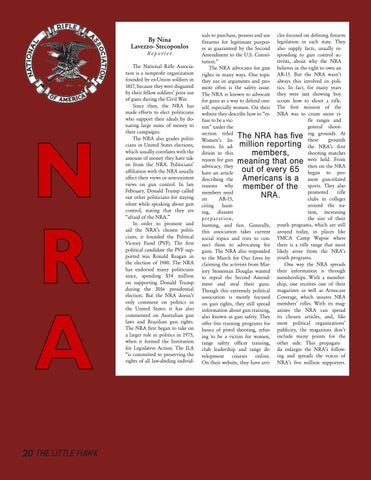
The NRA has five million reporting members, meaning that one out of every 65 Americans is a member of the NRA.
Graphic BY OLIVIA LUSALA and Victor Kalil
SCHOOL SHOOTINGS Since Columbine, over 200 school shootings, from
Infographic by Zoe Miller and Olivia Lusala
SINCE COLUMBINE preschools to colleges, have devastated the nation
A school shooting consists of a gun being fired on a school campus.
SIX LARGEST SCHOOL SHOOTINGS
-Columbine High School -Red Lake Senior High School -Virginia Tech -Sandy Hook Elementary School -Umpqua Community College -Marjory Stoneman Douglas High School Source: Wikipedia
April 6th, 2018 23
Hannah Ahlers Heather Alvarado Dorene Anderson Carrie Barnette Jack Beaton Steve Berger Candice Bowers Denise Burditus Sandy Casey Andrea in Castilla Denise Cohen Austin Davis Thomas Day, Jr. Christiana Duarte Stacee Etcheber Brian Fraser Keri Galvan Dana Gardner Angela Gomez Rocio Guillen Rocha Charleston Hartfield Chris Hazencomb Jennifer Topaz Irvine Teresa Nicol Kimura Jessica Klymchuk Carly Kreibaum Rhonda LeRocque Victor Link Jordan McIldoon Kelsey Meadows Calla-Marie Medig James “Sonny” Melton Patricia Mestas Austin Meyer Adrian Murfitt Rachael Parker Jenny Parks Carrie Parsons Lisa Patterson John Phippen Melissa Ramirez Jordyn Rivera Quinton Robbins Cameron Robinson Tara Roe Lisa Romero-Muniz Chris Roybal Brett Schwanbeck Bailey Schweitzer Laura Shipp Erick Silva Susan Smith Brennan Stewart Derrick “Bo” Taylor Neysa Tonks Michelle Vo memoriam Kurt von Tillow Bill Wolfe Stanley Almodóvar Amanda Alvear Oscar A. Aracena-Montero Rodolfo Ayala Ayala Antonio Davon Brown Darryl Burt Simón Carrillo Luis Daniel Conde Cory Connell Tevin Eugene Crosby Anthony Laureano Disla Deonka Drayton Leroy Valentín Fernández Mercedez Marisol Flores Jean Carlo Méndez Pérez Peter González-Cruz Juan Ramón Guerrero Paul Terrell Henry Frank Hernández Miguel Ángel Honorato Javier Jorge-Reyes Jason Josaphat Eddie Justice Christopher Andrew Leinonen Luis Daniel Wilson León Alejandro of Barrios Martínez Juan Chavez Martinez Brenda Lee Márquez McCool Gilberto Ramón Silva Menéndez Kimberly Morris Akyra Murray Luis Omar Ocasio-Capo Geraldo Ortiz Eric Ivan Ortiz-Rivera Ángel Luis Candelario Padró Joel Rayón Paniagua Enrique L. Rios Jean Carlos Nieves Rodríguez Xavier Emmanuel Serrano Rosado Christopher Sanfeliz Yilmary Rodríguez Solivan Edward Sotomayor Jr. Shane Tomlinson Martin Benítez Torres Jonathan Antonio Camuy Vega Franky Jimmy De Jesús Velázquez Juan Pablo Rivera Velázquez Luis Sergio Vielma Jerald Arthur Wright Ross Alameddine Christopher James Bishop Brian Bluhm Ryan Clark Austin Cloyd Jocelyne Couture-Nowak Kevin Granata Matthew Gwaltney Caitlin Hammaren Jeremy Herbstritt Rachael Elizabeth Hill Emily Hilscher Jarrett Lane Matthew La Porte Henry Lee Liviu Librescu G. V. Loganathan Partahi Lumbantoruan Lauren McCain Daniel O’Neil Juan Ortiz Minal Panchal Daniel Perez Cueva Erin Nichole Peterson Michael Pohle Jr. Julia Pryde Mary Karen Read Reema Samaha victims Waleed Mohamed Shaalan Leslie Sherman Maxine Turner Nicole White Charlotte Bacon Daniel Barden Rachel D’Avino Olivia Engel Josephine Gay Dylan Hockley Dawn Lafferty Hochsprung Madeleine Hsu Catherine Hubbard Chase Kowalski Jesse Lewis Ana Marquez-Greene James Mattioli Grace McDonnell Anne Marie Murphy Emilie Parker Jack Pinto Noah Pozner Caroline Previdi Jessica Rekos Avielle Richman Lauren Rousseau Mary Sherlach Victoria Soto Benjamin Wheeler Allison Wyatt Keith Allen Braden Robert Corrigan Shani Corrigan Emily Garcia Emily Hill of Gregory Hill Megan Hill Carlin Brite “Billy Bob” Holcombe (unborn) Crystal Holcombe John Bryan Holcombe Karla Holcombe Marc Daniel Holcombe Noah Holcombe Dennis Johnson, Sr. Sara Johnson Haley Krueger Karen Marshall Robert Scott Marshall Tara McNulty Annabelle Pomeroy Ricardo Rodriguez Therese Rodriguez Brooke Ward Joann Ward Peggy Lynn Warden Lula Woicinski White Patricia Carney Jimmie deadliest Caruthers Kriemhild Davis Steven Dody Al Gratia Ursula Gratia Debra Gray Michael Griffith Venice Henehan Clodine Humphrey Sylvia King Zona Lynn Connie Peterson Ruth Pujol Su-Zann Rashott John Romero, Jr. Thomas Simmons Glen Arval Spivey Nancy Stansbury Olgica Taylor James Welsh Lula Welsh Juanita Williams Elsa Herlinda Borboa-Fierro Claudia Perez Neva Denise Caine Jose Rubén Lozano Perez Michelle Deanne Carncross Carlos Reyes Jackie Lynn Wright Reyes María Elena Colmenero-Silva Gloria López González Victor Maxmillian Rivera Blythe Regan Herrera Arisdelsi Vuelvas Vargas Mateo Herrera Hugo Luis Velazquez Vasquez Laurence Herman Versluis Paulina Aquino López Margarita Padilla David Flores Delgado Omarr Alonso Hernandez Miguel Victoria Ulloa Aida Velazquez Victoria US Thomas Aquinas Ashton Robert Hamilton Boyer Thomas Frederick Eckman Baby Wilson (unborn) Martin “Mark” Gabour Marguerite Lamport Karen Griffith David Hubert Gunby Thomas Ray Karr Claudia Rutt Paul Bolton Sonntag Roy Dell Schmidt Billy Paul Speed Edna Elizabeth Townsley Harry Walchuk Kathy Whitman Margaret Whitman Alyssa Alhadeff Scott Beigel Martin Duque Anguiano Nicholas Dworet Aaron Feis Jaime Guttenberg Chris Hixon Luke Hoyer Cara Loughran Gina Montalto Joaquin Oliver Alaina Petty Meadow Pollack Helena Ramsay Alex Schachter Carmen Schentrup Peter Wang Robert Adams Isaac Amanios Bennetta Betbadal Harry Bowman Sierra Clayborn Juan Espinoza Aurora Godoy Shannon Johnson Larry Daniel Kaufman Damian Meins Tin Nguyen Nicholas Thalasinos Yvette Valasco Michael Raymond Wetzel mass Patricia Ann Chambers Judy Stephens Denney Richard C. Esser Jr. Patricia A. Gabbard Jonna Gragert Hamilton Patty Jean Husband Betty Ann Jarred William F. Miller Kenneth W. Morey Leroy Orrin Phillips Jerry Ralph Pyle Paul Michael Rockne Thomas Wade Shader Jr. Patti Lou Welch Cassie Bernall Steve Curnow Corey DePooter Kelly Fleming Matt Kechter Daniel Mauser Daniel Rohrbough Rachel Scott Isaiah Shoels John Tomlin Lauren Townsend Kyle Velasquez Dave Sanders Parveen Ali Almir Alimpio Alves Marc Henry Bernard Maria Sonia Bernard Li Guo Lan Ho Layla Khalil Roberta King Jiang Ling Hong Xiu “Amy” Mao Marsland Dolores Yigal Hai Hong Zhong Maria Zobniw John Joseph Pilarchik Orris Martin Smith Clark Hoover James Hutton Rose Cohen Minnie Cohen Maurice J. Cohen Alvin Day Thomas Hamilton Helga Kautzach Zegrino Helen Wilson Emma Matlack John Wilson Regina Clemens Montanzima Banks Susan Yuhas Boende Banks Mauritania Banks Dorothy Lyons Nany Lyons Foraroude Banks Raymond F. Hall Jr. Sharon Mazzillo shootings Kissmayu Banks Scott Mazzillo Alice Mazzillo Michael Cahill Libardo Caraveo Justin Michael DeCrow John P. Gaffaney Frederick Greeane Jason Hunt Amy Krueger Aaron Nemelka Michael Pearson Russell Seager Francheska Velez Juanita Warman Kham Xiong Michael Arnold Martin Bodrog Arthur Daniels Sylvia Frasier Kathy Gaarde John Johnson Mary Knight Frank Kohler Vishnu Pandit Kenneth Proctor Gerald Read Richard Michael Jonathan Blunk Alexander Boik Jesse Childress Gordon Cowden Jessica Ghawi John Larimer Matt McQuinn Micayla Medek Veronica Moser-Sullivan Alex Sullivan Alexander Teves Rebecca Wingo Lisa McLendon James White Tracy Wise Dean Wise Andrea Dawn Myers Corrine Myers Virginia White Sonya Smith Bruce Malloy James Irvin Starling Charity Ruppert Leonard Ruppert Jr. Alma Ruppert Leonard Ruppert III Michael Ruppert Thomas Ruppert Carol Ruppert Ann Ruppert David Ruppert Teresa Ruppert John Ruppert and too many more