page 12 | centerfold
the lion's roar
A Stranger Danger South strikes a balance between security and freedom in their open campus policy
By Irene González de las Casas & Ava Ransbotham
W
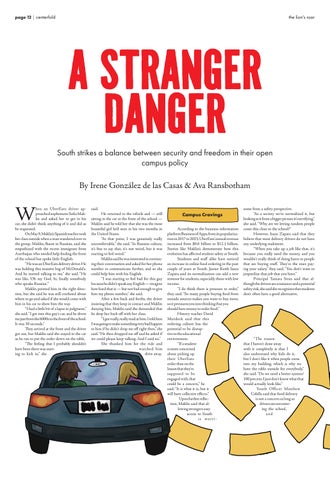
hen an UberEats driver approached sophomore Sofia Maklin and asked her to get in his car, she didn’t think anything of it and did as he requested. On May 9, Maklin’s Spanish teacher took her class outside when a man wandered over to the group. Maklin, fluent in Russian, said she empathized with the recent immigrant from Azerbaijan who needed help finding the front of the school but spoke little English. “He was an UberEats delivery driver. He was holding this massive bag of McDonald's. And he started talking to me,” she said. “He was like, ‘Oh my God, hi, finally somebody who speaks Russian.’” Maklin pointed him in the right direction, but she said he was still confused about where to go and asked if she would come with him in his car to show him the way. “I had a little bit of a lapse in judgment,” she said. “I got into this guy's car, and he drove me just from the 6000s to the front of the school. It was 30 seconds.” They arrived at the front and the driver got out, but Maklin said she stayed in the car as he ran to put the order down on the table. “The feeling that I probably shouldn’t have been there was starting to kick in,” she
said. He returned to the vehicle and — still sitting in the car at the front of the school — Maklin said he told her that she was the most beautiful girl he’d seen in his two months in the United States. “At that point, I was genuinely really uncomfortable,” she said. “In Russian culture, it’s fine to say that, it's not weird, but it was starting to feel weird.” Maklin said he was interested in continuing their conversation and asked for her phone number to communicate further, and so she could help him with his English. “I was starting to feel bad for this guy because he didn't speak any English — imagine how hard that is — but not bad enough to give him my phone number,” she said. After a few back and forths, the driver insisting that they keep in contact and Maklin denying him, Maklin said she demanded that he drop her back off with her class. “I got really, really mad at him. I told him I was going to make something very bad happen to him if he didn't drop me off right then,” she said. “He then dropped me off and he asked if we could please keep talking. And I said no.” She thanked him for the ride and watched him drive away.
Campus Cravings According to the business information platform Business of Apps, from its popularization in 2017 to 2023, UberEats’ annual revenue increased from $0.6 billion to $12.1 billion. Stories like Maklin’s demonstrate how this evolution has affected student safety at South. Students and staff alike have noticed an increase in online food ordering in the past couple of years at South. Junior Keith Isaza Zapata said its normalization can add a new stressor for students, especially those with low income. “I do think there is pressure to order,” they said. “So many people buying food from outside sources makes you want to buy more, so it pressures you into thinking that you should have money to order food.” History teacher David Murdock said that this ordering culture has the potential to be disruptive to the educational environment. “If a student is more concerned about picking up their UberEats order than on the lesson that they're supposed to be engaged with, that could be a concern,” he said. “It is what it is, but it will have collective effects.” Upon further reflection, Maklin said that allowing strangers easy access to South is worri-
some from a safety perspective. “As a society we've normalized it, but looking at it from a bigger picture it’s terrifying,” she said. “Why are we letting random people come this close to the school?” However, Isaza Zapata said that they believe that most delivery drivers do not have any underlying malintent. “When you take up a job like that, it's because you really need the money, and you wouldn't really think of doing harm to people that are buying stuff. They're the ones paying your salary,” they said. “You don't want to jeopardize that job that you have.” Principal Tamara Stras said that although the drivers are a nuisance and a potential safety risk, she said she recognizes that students don’t often have a good alternative.
“ The reason that I haven't done away with it completely is that I also understand why kids do it, but I don't like it when people come into my building, which is why we have the table outside for everybody,” she said. “Do we need a better system? 100 percent. I just don't know what that would actually look like.” Youth Officer Matthew Colella said that food delivery is not a concern as long as drivers are not entering the school, and