Local Corn and Soybean Price Index
18 THE LAND, AUGUST 9, 2013
Cash Grain Markets Sauk Rapids Madison Redwood Falls Fergus Falls Morris Tracy
corn/change* soybeans/change* $5.37 $5.62 $5.74 $5.32 $5.48 $5.67
Average: Year Ago Average:
-1.25 -1.04 -1.05 -.96 -.78 -1.00
$12.02 $12.59 $12.87 $11.87 $12.30 $12.92
-2.35 -1.84 -1.93 -2.35 -1.86 -1.98
$5.53
$12.43
$7.46
$15.55
SEP’12
OCT
NOV
DEC
JAN ‘13
FEB
MAR
APR
MAY
JUN
JUL
AUG
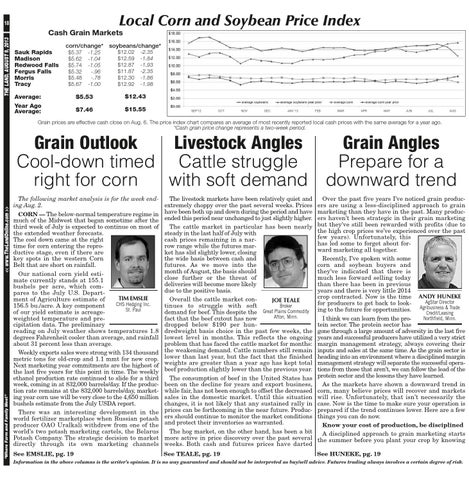
Grain prices are effective cash close on Aug. 6. The price index chart compares an average of most recently reported local cash prices with the same average for a year ago. *Cash grain price change represents a two-week period.
“Where Farm and Family Meet”
<< www.TheLandOnline.com >>
Grain Outlook Livestock Angles Grain Angles Cool-down timed Cattle struggle Prepare for a right for corn with soft demand downward trend The following market analysis is for the week ending Aug. 2. CORN — The below-normal temperature regime in much of the Midwest that began sometime after the third week of July is expected to continue on most of the extended weather forecasts. The cool down came at the right time for corn entering the reproductive stage, even if there are key spots in the western Corn Belt that are short on rainfall. Our national corn yield estimate currently stands at 155.1 bushels per acre, which compares to the July U.S. DepartTIM EMSLIE ment of Agriculture estimate of CHS Hedging Inc. 156.5 bu./acre. A key component St. Paul of our yield estimate is acreageweighted temperature and precipitation data. The preliminary reading on July weather shows temperatures 1.8 degrees Fahrenheit cooler than average, and rainfall about 31 percent less than average. Weekly exports sales were strong with 134 thousand metric tons for old-crop and 1.1 mmt for new crop. Next marketing year commitments are the highest of the last five years for this point in time. The weekly ethanol production rate continued to slide for a third week, coming in at 832,000 barrels/day. If the production rate remains at the 832,000 barrels/day, marketing year corn use will be very close to the 4,650 million bushels estimate from the July USDA report. There was an interesting development in the world fertilizer marketplace when Russian potash producer OAO Uralkali withdrew from one of the world’s two potash marketing cartels, the Belarus Potash Company. The strategic decision to market directly through its own marketing channels
The livestock markets have been relatively quiet and extremely choppy over the past several weeks. Prices have been both up and down during the period and have ended this period near unchanged to just slightly higher. The cattle market in particular has been nearly steady in the last half of July with cash prices remaining in a narrow range while the futures market has slid slightly lower, closing the wide basis between cash and futures. As we move into the month of August, the basis should close further or the threat of deliveries will become more likely due to the positive basis. Overall the cattle market conJOE TEALE tinues to struggle with soft Broker demand for beef. This despite the Great Plains Commodity Afton, Minn. fact that the beef cutout has now dropped below $190 per hundredweight basis choice in the past few weeks, the lowest level in months. This reflects the ongoing problem that has faced the cattle market for months: the weakening demand. Cattle numbers still remain lower than last year, but the fact that the finished weights are greater than a year ago has kept total beef production slightly lower than the previous year. The consumption of beef in the United States has been on the decline for years and export business, while fair, has not been enough to offset the decreased sales in the domestic market. Until this situation changes, it is not likely that any sustained rally in prices can be forthcoming in the near future. Producers should continue to monitor the market conditions and protect their inventories as warranted. The hog market, on the other hand, has been a bit more active in price discovery over the past several weeks. Both cash and futures prices have darted
Over the past five years I’ve noticed grain producers are using a less-disciplined approach to grain marketing than they have in the past. Many producers haven’t been strategic in their grain marketing but they’ve still been rewarded with profits (due to the high crop prices we’ve experienced over the past few years). Unfortunately, this has led some to forget about forward marketing all together. Recently, I’ve spoken with some corn and soybean buyers and they’ve indicated that there is much less forward selling today than there has been in previous years and there is very little 2014 crop contracted. Now is the time ANDY HUNEKE AgStar Director for producers to get back to looking to the future for opportunities. Agribusiness & Trade Credit/Leasing Northfield, Minn. I think we can learn from the protein sector. The protein sector has gone through a large amount of adversity in the last five years and successful producers have utilized a very strict margin management strategy, always covering their inputs and sales at the same time. As the grain sector is heading into an environment where a disciplined margin management strategy will separate the successful operations from those that aren’t, we can follow the lead of the protein sector and the lessons they have learned. As the markets have shown a downward trend in corn, many believe prices will recover and markets will rise. Unfortunately, that isn’t necessarily the case. Now is the time to make sure your operation is prepared if the trend continues lower. Here are a few things you can do now. Know your cost of production, be disciplined A disciplined approach to grain marketing starts the summer before you plant your crop by knowing
See EMSLIE, pg. 19
See TEALE, pg. 19
See HUNEKE, pg. 19
Information in the above columns is the writer’s opinion. It is no way guaranteed and should not be interpreted as buy/sell advice. Futures trading always involves a certain degree of risk.