THE LAND, JULY 1, 2011
8 A
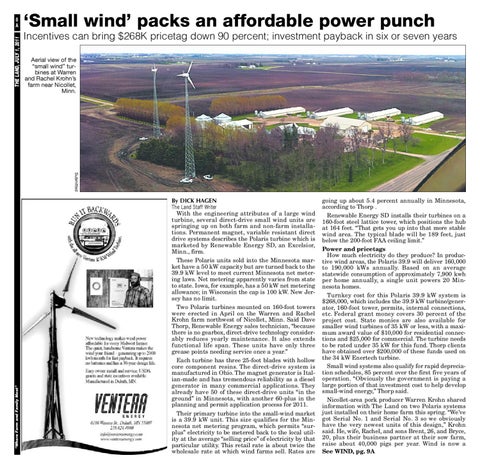
‘Small wind’ packs an affordable power punch Incentives can bring $268K pricetag down 90 percent; investment payback in six or seven years Aerial view of the “small wind” turbines at Warren and Rachel Krohn’s farm near Nicollet, Minn.
“Where Farm and Family Meet”
<< MILKER’S MESSAGE >>
Submitted
By DICK HAGEN The Land Staff Writer With the engineering attributes of a large wind turbine, several direct-drive small wind units are springing up on both farm and non-farm installations. Permanent magnet, variable resistant direct drive systems describes the Polaris turbine which is marketed by Renewable Energy SD, an Excelsior, Minn., firm. These Polaris units sold into the Minnesota market have a 50 kW capacity but are turned back to the 39.9 kW level to meet current Minnesota net metering laws. Net metering apparently varies from state to state. Iowa, for example, has a 50 kW net metering allowance; in Wisconsin the cap is 100 kW. New Jersey has no limit. Two Polaris turbines mounted on 160-foot towers were erected in April on the Warren and Rachel Krohn farm northwest of Nicollet, Minn. Said Dave Thorp, Renewable Energy sales technician, “because there is no gearbox, direct-drive technology considerably reduces yearly maintenance. It also extends functional life span. These units have only three grease points needing service once a year.” Each turbine has three 25-foot blades with hollow core component resins. The direct-drive system is manufactured in Ohio. The magnet generator is Italian-made and has tremendous reliability as a diesel generator in many commercial applications. They already have 50 of these direct-drive units “in the ground” in Minnesota, with another 60-plus in the planning and permit application process for 2011. Their primary turbine into the small-wind market is a 39.9 kW unit. This size qualifies for the Minnesota net metering program, which permits “surplus” electricity to be metered back to the local utility at the average “selling price” of electricity by that particular utility. This retail rate is about twice the wholesale rate at which wind farms sell. Rates are
going up about 5.4 percent annually in Minnesota, according to Thorp . Renewable Energy SD installs their turbines on a 160-foot steel lattice tower, which positions the hub at 164 feet. “That gets you up into that more stable wind area. The typical blade will be 189 feet, just below the 200-foot FAA ceiling limit.” Power and pricetags How much electricity do they produce? In productive wind areas, the Polaris 39.9 will deliver 160,000 to 190,000 kWs annually. Based on an average statewide consumption of approximately 7,900 kwh per home annually, a single unit powers 20 Minnesota homes. Turnkey cost for this Polaris 39.9 kW system is $268,000, which includes the 39.9 kW turbine/generator, 160-foot tower, permits, internal connections, etc. Federal grant money covers 30 percent of the project cost. State monies are also available for smaller wind turbines of 35 kW or less, with a maximum award value of $10,000 for residential connections and $25,000 for commercial. The turbine needs to be rated under 35 kW for this fund. Thorp clients have obtained over $200,000 of these funds used on the 34 kW Enertech turbine. Small wind systems also qualify for rapid depreciation schedules, 85 percent over the first five years of operation. “Obviously the government is paying a large portion of that investment cost to help develop small-wind energy,” Thorp said. Nicollet-area pork producer Warren Krohn shared information with The Land on two Polaris systems just installed on their home farm this spring. “We’ve got Serial No. 1 and Serial No. 3 so we obviously have the very newest units of this design,” Krohn said. He, wife, Rachel, and sons Brent, 26, and Bryce, 20, plus their business partner at their sow farm, raise about 40,000 pigs per year. Wind is now a See WIND, pg. 9A