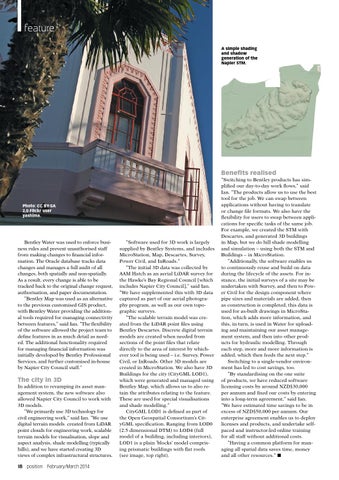
feature A simple shading and shadow generation of the Napier STM.
Benefits realised
Photo: CC BY-SA 2.0 Flickr user yashima.
Bentley Water was used to enforce business rules and prevent unauthorised staff from making changes to financial information. The Oracle database tracks data changes and manages a full audit of all changes, both spatially and non-spatially. As a result, every change is able to be tracked back to the original change request, authorisation, and paper documentation. “Bentley Map was used as an alternative to the previous customised GIS product, with Bentley Water providing the additional tools required for managing connectivity between features,” said Ian. “The flexibility of the software allowed the project team to define features in as much detail as needed. The additional functionality required for managing financial information was initially developed by Bentley Professional Services, and further customised in-house by Napier City Council staff.”
The city in 3D In addition to revamping its asset management system, the new software also allowed Napier City Council to work with 3D models. “We primarily use 3D technology for civil engineering work,” said Ian. “We use digital terrain models created from LiDAR point clouds for engineering work, scalable terrain models for visualisation, slope and aspect analysis, shade modelling (typically hills), and we have started creating 3D views of complex infrastructural structures.
18 position February/March 2014
“Software used for 3D work is largely supplied by Bentley Systems, and includes MicroStation, Map, Descartes, Survey, Power Civil, and InRoads.” “The initial 3D data was collected by AAM Hatch as an aerial LiDAR survey for the Hawke’s Bay Regional Council [which includes Napier City Council],” said Ian. “We have supplemented this with 3D data captured as part of our aerial photography program, as well as our own topographic surveys. “The scalable terrain model was created from the LiDAR point files using Bentley Descartes. Discrete digital terrain models are created when needed from sections of the point files that relate directly to the area of interest by whichever tool is being used – i.e. Survey, Power Civil, or InRoads. Other 3D models are created in MicroStation. We also have 3D Buildings for the city (CityGML LOD1), which were generated and managed using Bentley Map, which allows us to also retain the attributes relating to the feature. These are used for special visualisations and shade modelling.” CityGML LOD1 is defined as part of the Open Geospatial Consortium’s CityGML specification. Ranging from LOD0 (2.5 dimensional DTM) to LOD4 (full model of a building, including interiors), LOD1 is a plain ‘blocks’ model comprising prismatic buildings with flat roofs (see image, top right).
“Switching to Bentley products has simplified our day-to-day work flows,” said Ian. “The products allow us to use the best tool for the job. We can swap between applications without having to translate or change file formats. We also have the flexibility for users to swap between applications for specific tasks of the same job. For example, we created the STM with Descartes, and generated 3D buildings in Map, but we do hill shade modelling and simulation – using both the STM and Buildings – in MicroStation. “Additionally, the software enables us to continuously reuse and build on data during the lifecycle of the assets. For instance, the initial surveys of a site may be undertaken with Survey, and then to Power Civil for the design component where pipe sizes and materials are added, then as construction is completed, this data is used for as-built drawings in MicroStation, which adds more information, and this, in turn, is used in Water for uploading and maintaining our asset management system, and then into other products for hydraulic modelling. Through each step, more and more information is added, which then feeds the next step.” Switching to a single-vendor environment has led to cost savings, too. “By standardising on the one suite of products, we have reduced software licensing costs by around NZD$30,000 per annum and fixed our costs by entering into a long-term agreement,” said Ian. “We have estimated time savings to be in excess of NZD$50,000 per annum. Our enterprise agreement enables us to deploy licenses and products, and undertake selfpaced and instructor-led online training for all staff without additional costs. “Having a common platform for managing all spatial data saves time, money and all other resources.” ■