DELIVERING SUSTAINABLE HYGIENE INFORMATION
www.incleanmag.com.au
ARTWORK INSPIRED ORIGINS BY JY FARRAR. ADAPTED BY BRENDON VUNTARDE
May / June 2022
sales@cleaningcentral.com.au www.cleaningcentral.com.au
Detail area cleaning solutions Effective cleaning for narrow gaps and smaller areas like stairs.
Perfect for showers, vanities and tight spaces around toilets.
Handheld version for walls and elevated areas.
The i-scrub 21B Clean hard to reach, dirty areas Manually dose solution with the push of a button Extreme cleaning power – dual 400 RPM brush heads Cleans almost any surface type
Scan the QR code
Adjustable telescopic handle and 360° swivel head to adapt to any application
Phone 1800 861 030
Scan for more info
|
www.i-teamanz.com
or contact us to get in touch with an i-team partner near you.
EDITOR’S LETTER
INCLEAN is published by The Intermedia Group Pty Ltd on behalf of ISSA – The Worldwide Cleaning Industry Association. 41 Bridge Road, Glebe NSW 2037 Australia MANAGING DIRECTOR: Simon Grover PUBLISHER: Simon Cooper MANAGING EDITOR Claire Hibbit Email: chibbit@incleanmag.com.au Phone: 02 8586 6140 NATIONAL ADVERTISING MANAGER: Samantha Ewart Email: sewart@incleanmag.com.au Phone: 02 8586 6106 PRODUCTION MANAGER: Jacqui Cooper PRODUCTION ASSISTANT: Natasha Jara GRAPHIC DESIGNER: Sanja Spuzanic Print Post Approved Publication No. PP: 255003/09765 AUSTRALIAN SUBSCRIPTION RATE 12 months (6 issues) - $66 (inc. GST) To subscribe call 1800 651 422 subscriptions@intermedia.com.au
INCLEAN is owned by ISSA ABN: 44 617 407 020 P: +61 2 9890 4951 A: Suite 1, Level 1, 52 O’Connell Street, Parramatta, NSW, 2150 W: www.issa.com DISCLAIMER: This publication is published by The Intermedia Group Pty Ltd (the Publisher). Materials in this publication have been created by a variety of different entities and, to the extent permitted by law, the Publisher accepts no liability for materials created by others. All materials should be considered protected by Australian and international intellectual property laws. Unless you are authorised by law or the copyright owner to do so, you may not copy any of the materials. The mention of a product or service, person or company in this publication does not indicate the Publisherís endorsement. The views expressed in this publication do not necessarily represent the opinion of the Publisher, its agents, company officers or employees. Any use of the information contained in this publication is at the sole risk of the person using that information. The user should make independent enquiries as to the accuracy of the information before relying on that information. All express or implied terms, conditions, warranties, statements, assurances and representations in relation to the Publisher, its publications and its services are expressly excluded save for those conditions and warranties which must be implied under the laws of any State of Australia or the provisions of Division 2 of Part V of the Trade Practices Act 1974 and any statutory modification or re-enactment thereof. To the extent permitted by law, the Publisher will not be liable for any damages including special, exemplary, punitive or consequential damages (including but not limited to economic loss or loss of profit or revenue or loss of opportunity) or indirect loss or damage of any kind arising in contract, tort or otherwise, even if advised of the possibility of such loss of profits or damages. While we use our best endeavours to ensure accuracy of the materials we create, to the extent permitted by law, the Publisher excludes all liability for loss resulting from any inaccuracies or false or misleading statements that may appear in this publication. Copyright © 2022 - The Intermedia Group Pty Ltd.
Editor’s letter
I
nfection control has always been integral to the environmental cleaning process, however, over the last two years it has become a critical necessity. While the COVID-19 pandemic drew attention to the importance of infection prevention, it also triggered an uptick in unsafe cleaning and disinfection practices In this issue, Rich Prinz’s healthcare article provides an inside look at some of the hazards posed by legacy practices and offers a route towards safer approaches to infection prevention. Read how to establish a roadmap for safer infection prevention practices and environmental cleaning on page 30. Another timely issue is the right to repair movement that is gaining traction in Australia. As cleaning businesses seek faster and more cost-effective ways to repair machinery and equipment, advocates are calling for Australia to adopt progressive right to repair laws that they think could empower consumers and limit waste. Read Cameron Cooper’s report on the growing right to repair movement in Australia, and why some major players in the industry are throwing their support behind right to repair laws on page 38. We’ve also turned our focus to restoration this issue. Our restoration and carpet care coverage includes a comprehensive guide to recordkeeping, how to identify fire, smoke, and heat damage, as well as how to keep remediation workers and building occupants safe from mould, while also protecting your company from associated liability. In this edition you can also read strategies to help extend the lifespan of your carpet – and why it pays to invest in proper carpet cleaning techniques, training, and tools – on page 74. And finally, this issue is packed with business and leadership tips. From advice for business owners who are wanting to make the transition from working ‘in’ to working ‘on’ their business to the importance of corporate social responsibility and organisational purpose - there’s something for cleaning and restoration businesses of all shapes and sizes. Happy reading!
Claire Hibbit Managing Editor
FOR MORE INDUSTRY NEWS FOLLOW US ON
CHECK OUT WWW.INCLEANMAG.COM.AU
The Intermedia Group takes its corporate and social responsibilities seriously and is committed to reducing its impact on the environment. We continuously strive to improve our environmental performance and to initiate additional CSR based projects and activities. As part of our company policy we ensure that the products and services used in the manufacture of this magazine are sourced from environmentally responsible suppliers. This magazine has been printed on paper produced from sustainably sourced wood and pulp fibre and is accredited under PEFC chain of custody. PEFC certified wood and paper products come from environmentally appropriate, socially beneficial and economically viable management of forests. The wrapping used in the delivery process of this magazine is 100 per cent biodegradable.
www.incleanmag.com.au 5
What’s on 2022 Interclean Amsterdam 10-13 May 2022 Europe’s leading exhibition for the professional cleaning industry. www.intercleanshow.com
RIA Australasian Restoration Conference and Tradeshow 25-27 May 2022 The event will take place at Novotel Twin Waters on the Sunshine Coast. www.restorationindustry.org.au
ISSA Show Canada 8-9 June 2022 Canada’s leading trade show for facility managers and facility service providers. www.canadashow.issa.com
MOST CLICKED www.incleanmag.com.au
ISSA Cleaning & Hygiene Expo 14-15 September 2022 The cleaning industry’s premier event will be held at ICC Sydney. www.issacleaninghygieneexpo.com
ISSA Show North America October 10-13 2022 The ISSA Show North America will take place in Chicago. www.issashow.com
Wed 15 - Thu 16 September 2021
Clean NZ
Newmarket Room, Ellerslie Racecourse, Auckland, New Zealand
25-26 October 2022 Clean NZ is New Zealand’s only dedicated trade event for the cleaning industry. www.cleannzexpo.co.nz
Millennium board announces resignation of CEO
Dominant announces brand refresh
Millennium co-founder appointed interim CEO and managing director.
Dominant unveils brand refresh, secures new warehouse space for growth.
Sydney cleaning business operators penalised
Melbourne to host week of built environment events
Fair Work Ombudsman secures $12,787 in penalties against operators of Sydneybased cleaning business.
BE Summit, DesignBUILD, Total Facilities, and Digital Construction Week together under one roof.
RIA announces speaker line-up for Australasian Restoration Conference
More Canberra events to become plastic-free
Two-day conference will include educational sessions, optional training courses, and networking events.
ACT cuts single-use plastics from more major events in Canberra, including GIO Stadium and Manuka Oval.
2023 ISSA Pulire – The Smart Show 9-11 May 2023 The largest professional cleaning and sanitisation industry trade show in Italy. www.issapulire.com/en
CMS 19-22 September 2023 The international conference and trade show will be in Berlin. www.cms-berlin.de 6 INCLEAN May / June 2022
ON THE COVER Cleanstar/XPOWER’s 2022 marketing campaign has been designed in collaboration with artist and AFL Gold Coast Suns player, Jy Farrar. Cleanstar is a leading wholesaler of commercial and domestic vacuum cleaner bags, filters, spare parts and equipment. XPOWER is a major worldwide brand of restoration equipment including air-movers, dryers, air scrubbers and dehumidifiers.
MAY / JUNE 2022
ISSUE #3 VOLUME 35
IN THIS ISSUE Regulars 05 12 16 83 86
Editor’s letter Industry news Cover story Opinion Products
86
8 30 Guiding your facility’s approach to infection prevention How to establish a roadmap for safer environmental cleaning.
30 22
38 No quick fix Why industry is calling for Australia to adopt progressive Right to Repair laws. 46 Rethinking supply chain Tips to future proof your supply chain. 54 Job costing and documentation A comprehensive guide to professional record keeping. 62 Mould safety concerns How to keep remediation workers and occupants safe from mould. 70 Identifying fire, smoke, and heat damage Why there’s more to fire than flames. 74 Six strategies to extend the lifespan of carpet Invest in your floor’s future with proper techniques, training, and tools. 76 Time to step up How to transition from working “in” to working “on” the business.
42 www.incleanmag.com.au 7
SPONSORED
Autonomous cleaning robots up to the job In the wake of a labour shortage during COVID-19, facility owners and building services contractors are turning to the latest robotic cleaning machines to fill the void.
A
new breed of autonomous cleaning robots is set to be rolled out in Australia as site managers and cleaning contractors deal with a COVID-19-inspired shortage
of cleaners. From aged care centres and supermarkets to multiple other facilities, the robots represent an efficient way to clean commercial and industrial floors quickly and cost-effectively. 8 INCLEAN May / June 2022
Eclipse Floor Solutions director Alan Selcuk says the pandemic has highlighted the severe shortage of cleaning personnel in the industry, but he believes the latest robots are a game-changer. His business is now an Australian distributor for Gaussian Robotics, a leader in the autonomous robot cleaning space. Eclipse has established distributor support networks in NSW, Victoria, Queensland and Western Australia for machines such as floor scrubbers and vacuum cleaners.
SPONSORED
“During COVID-19, some companies have had to pay outrageous dollars just to get staff in to get the work done,” Selcuk says. “So it makes sense for us to move into the autonomous market and introduce a leading brand into Australia.”
While some robotic cleaning machines that were introduced into Australia in years past “over-promised and under-delivered”, Selcuk says the Gaussian Robotics products are in a different league. “I didn’t recommend those old robots to our customers. But the software technology today is very different to even 12 months ago.”
WORLD-CLASS RANGE
Gaussian Robotics prides itself on providing autonomous robots that automate cleaning tasks to achieve improved productivity and performance. It has cleaning robots working in more than 35 countries in sites such as airports, schools, offices, shopping malls, hospitals and hotels. The range includes fully autonomous ECOBOTS that can top up their own water and charge themselves automatically. Thomas Culver, the Australia-New Zealand manager for Gaussian Robotics, believes
“
Eclipse Floor Solutions is now an Australian distributor for Gaussian Robotics, a leader in the autonomous robot cleaning space.
”
Improving Indoor Air Quality Fighting The Spread Reduce Airborne Microorganisms >99% within 5 min. The 250AP significantly reduces airborne bacteria and viruses known to negatively affect indoor air quality.
The 250AP: A 3-Stage Portable Air Purifier EPA Est. No. 41567-NC-01
41–43 Steel Street, Capalaba 4157 Queensland • 07 3390 3027 • info@eclipsefloorsolutions.com.au
INC MJ22 PG 09 Eclipse Purifer HPHB.indd 1
5/4/22 10:39 am
www.incleanmag.com.au 9
SPONSORED
Air purifiers prove their worth Australia is ready for the latest industrial robots after lagging behind some other international markets. “These robots really are the best in the world. They’re well made and come at the right price,” Culver says. “So we see big things for the Australian market.” The robots that have initially been targeted for use in Australia include: • the Scrubber75 Pro, which has perfected corner cleaning and is ideal for larger shopping centres • the Scrubber50 Pro, which can navigate lifts to clean multiple levels of a building and is suited to smaller centres • the Vacuum40, which uses an advanced AI navigation system to maximise floorcleaning productivity and which also has the capacity to navigate lifts. “We’ve developed these machines from the ground up and we’re continually innovating with all the products,” Culver says. He notes that Gaussian Robotics spends about 45 per cent of its spending on R&D and is a company that is made up primarily of engineers. “So the build quality is great, the interfaces are good and the products are rock solid.”
SERVICE AND PERFORMANCE EDGE
As part of its Australian offering, Eclipse Floor Solutions will use the distribution support networks to handle any repairs or technical support. Training sessions will be available for customers who want to maximise the use of the robots.
10 INCLEAN May / June 2022
As a result of COVID-19, air purifiers have gone from being a somewhat misunderstood product to now being an essential component of the fight against the pandemic. The purifiers are a proven way to significantly improve indoor air quality and human health, reducing airborne bacteria and viruses. That realisation has led to Amano Pioneer Eclipse developing the 250AP portable air purifier. “Indoor air quality is now getting the attention it deserves,” says Jacqueline Van Delft, Vice-President International Operations & Sales at Amano Pioneer Eclipse. “And air purifiers are an effective way of making the environment safer and healthier for people.” Noting the businesses are seeking preventative technology as a result of COVID-19, she says the 250AP is ideal for environments such as schools, office buildings, retail centres, airports, restaurants and manufacturing and industrial spaces. The machine, which is available through Amano Pioneer Eclipse’s Australian partner, Eclipse Floor Solutions, uses HEPA filtration for auxiliary air cleaning, as well as a broad spectrum germicidal UVC light to deactivate microorganism particles. It produces far greater downdraft air movement than competing purifiers, adding to its efficacy. In addition to targeting the coronavirus, the 250AP air purifier can combat other common airborne threats such as influenza, rhinovirus (the common cold), airborne allergens, dust particles and mould. A portable unit that can be left in a room or moved around a building, the 250AP is a passive air purifier, which means it filters out and kills airborne microorganisms, whereas active-air counterparts ‘seek and destroy’ airborne microorganisms and can result in particles falling and sticking to surfaces. “That means you still have to disinfect the surface because particles are not removed from the environment entirely,” Van Delft says. She adds that quality air purifiers can deliver more than just health benefits, noting that in the United States alone employee absenteeism and reduced performance from poor indoor air quality costs the economy tens of billions of dollars a year. “Sick building syndrome is a serious issue,” she says. “And with the pandemic, it’s more critical than ever to address indoor air quality.”
SPONSORED
“We’ve handpicked our support team all the way from Perth up to Cairns,” Selcuk says. Selcuk says a recent trial run of the Scrubber50 Pro at a food court demonstrated the value of the machine, with it even being able to work its way around chairs and tables. “I don’t know of any other machine out there that can manoeuvre its way around a food court like that.” At the same time, Selcuk says it is crucial for the robots to be used in appropriate spaces. “If we recognise a site where the robot doesn’t belong, we’ll tell our customer. We will not over-promise,” he says. With COVID-19 lingering and cleaning staff shortages likely to continue for some time, Selcuk is confident that the market for the robotic cleaning machines will grow quickly. Eclipse Floor Solutions will be showcasing the machines through demonstrations to customers in coming months. “So watch this space.” ■
INC MJ22 PG 11 Eclipse GS Robot HPHB.indd 1
“
Gaussian Robotics prides itself on providing autonomous robots that automate cleaning tasks to achieve improved productivity and performance.
”
4/4/22 3:57 pm
www.incleanmag.com.au 11
INDUSTRY NEWS
Central Cleaning Supplies opens first Adelaide site, with more sites to come Central Cleaning Supplies have opened its first retail store and distribution centre in South Australia. The site, located at 113 – 115 Sir Donald Bradman Drive, Hilton, Adelaide, takes the total number of Central Cleaning Supplies stores to 12 nationally. “We are very excited to open our first site in South Australia,” said Joe Camilleri, managing director of Central Cleaning Supplies. “For the first time, our South Australian customers will be able to go in-store and speak to our staff, view our extensive product range, and be given equipment demonstrations. Furthermore, having a distribution centre on-site means we can stock a greater range of products and will be able to deliver products quicker.” Central Cleaning Supplies, one of the largest distributors of cleaning materials, chemicals, and equipment, is headquartered in West Footscray, Victoria. In 2021, Central Cleaning Supplies opened three new sites in Victoria including Footscray, Ballarat, and Campbellfield. “Our national footprint of outlets continues to provide greater coverage, convenience and service for our customers,” said Camilleri. Central Cleaning Supplies has been in operation for more than 30 years and provides an extensive range of products and services catering for the professional, commercial, industrial and domestic cleaning industry. “Central is a trusted industry brand for many cleaning companies. Our customers can buy our products from our retail sites, online, or direct via our sales and customer service division,” said Camilleri. “At Central, we also provide customers on-site training and technical seminars, such as safety training, chemical handling, as well as new product and equipment training. More sites and team members on the ground around Australia means we can continue to provide more value, service and innovative products to our customers.” 12 INCLEAN May / June 2022
Central donates cleaning supplies to flood affected areas Central Cleaning Supplies is helping the flood relief effort, donating 22 pallets of cleaning products to affected communities in Queensland and New South Wales. “With the help of HRX transport, which have generously donated transport, we have dispatched 22 pallets of cleaning products from our head office and distribution centre in West Footscray, Victoria, as a donation to Ventia Employee Flood Impact Support,” said Joe Camilleri, managing director of Central Cleaning Supplies. Ventia provides operation, maintenance, and management of public and private assets and infrastructure across a range of industries. After navigating through difficult flood affected terrain, the truck made it to Lismore, NSW where the supplies were distributed to communities in need. “We hope our donation will help make the clean-up safer and easier for those regions and the local communities that have been affected,” said Camilleri.
A new generation of scrubbing machines Antea 50
An innovative scrubbing machine that champions sturdiness and reliability. Antea 50’s durable frame, intuitive controls and compact size make it ideal for cleaning in a variety of sectors, including hospitality, healthcare, large scale retailers and public institutions.
Versa 65
A high-performance, walk-behind scrubbing machine with the power to handle even the most difficult cleaning jobs. Reliable, efficient and easy-to use, the Versa 65 is the ideal solution for increasing productivity and reducing the cost of cleaning operations.
Vega 85
A walk-behind floor scrubber that combines power and versatility in a single machine while remaining compact and easy to handle. It’s clever, functional design makes it the perfect cleaning tool for industrial or logistics sectors, healthcare facilities and large scale retailers.
1800 314 580 commercial@godfreys.com.au
INDUSTRY NEWS
Bunzl ANZ launches Cleaning and Hygiene Advisory Team Cleaning and hygiene is more important than ever, and with the help of Bunzl’s Cleaning and Hygiene Advisory Team, you can make sure that your business is prepared. Know how to manage and maintain good hygiene practices, how to respond before a situation gets critical, and how your staff and business complies with best practice guidelines and government regulations. Maintaining a clean, well-managed and safe workplace means your staff and customers are safe and confident in their surroundings. Implementing infection prevention and health measures ensures you protect them and mitigate future risk. Bunzl’s Cleaning and Hygiene Advisory Team offers a comprehensive three-step approach: review and advise, execute, secure. The team will conduct a site evaluation and reviews, provide detailed recommendations, and develop an agreed action plan. 14 INCLEAN May / June 2022
In addition, the Cleaning and Hygiene Advisory Team will coordinate all product and system implementation, activate an on-going service and support model, support all training and compliance requirements, and provide analytical reporting. Bunzl Australia & New Zealand has a national network of more than 50 warehouse and office facilities around Australia and two in New Zealand. As well as its own significant range of brands, Bunzl ANZ distributes a wide range of more than 100,000 products across cleaning and hygiene, food processing, healthcare, hospitality, commercial packaging and safety & personal protection equipment (PPE).
INDUSTRY NEWS
Melbourne to host week of built environment events The Melbourne Exhibition and Convention centre will host a week of events for professionals across the built environment from May 10-13. Covering industries ranging from planning and construction to technology and facilities management, DesignBUILD, Total Facilities, the Be Summit and Digital Construction Week will join forces to create a unique built environment event for Melbourne. Commercial manager, Lynn Ormiston, said the past two years has allowed time to create a new whole-of-industry style approach to these events.
“With the rise of Building Information Management (BIM) systems, the various built environment sectors have become increasingly interdependent, so cross sector knowledge is more important than ever,” Ormiston said. “We have collected feedback and fine-tuned these events so this year we are confident of delivering an exceptional experience for both exhibitors and attendees,” she said. The event also brings together all the major built environment industry groups with partner including the Australian Construction Industry Forum (ACIF), Australian Institute of Building (AIB), Australian Institute of Quantity Surveyors (AIQS), National Precast Concrete Association Australia, Women in BIM, Green Building Institute and the Facility Management Association of Australia (FMA).
LEADING CHEMICAL MANUFACTURER
Your new reliable manufacturing partner. Complete turn-key manufacturing solutions for your liquid & powder chemical requirements. GET IN TOUCH TODAY
Custom Chemicals International
103 - 107 Potassium Street, Narangba QLD 4504, Australia +61 7 3204 8300
glenn@customchem.com.au
SCAN ME www.incleanmag.com.au 15
At CLEANSTAR/XPOWER we pride ourselves on our creative flair. Each year we tap into a different theme to express and convey our message through a marketing campaign specific for that year. As we wave goodbye to last year’s 15 YEARS STRONG campaign which saw us celebrating 15 Years of CLEANSTAR/ XPOWER, we are excited to introduce our new look 2022 campaign which saw us collaborating with artist and current AFL Gold Coast Suns player, Jy Farrar. Jy created a series of dot paintings symbolizing his background, using unique colours and sequences to represent our homeland. Brendon Vuntarde, our in-house designer, then adapted the painting to digital artwork.
INSPIREDINSPIRED
ORIGINSORIGINS I was born and raised in Halls Creek and am a proud Kija Bunuba man from the Kimberley region in northern Western Australia. I was always around art and sport growing up in my small town surrounded by family and lots of cousins. I remember growing up we were always outside and did outings to the local water hole or out trying to score dinner with the rifle. I went to boarding school in Perth in Year 8 and graduated at Hale School. It was at school where I learnt most about art and a little about sport. It wasn’t until I finished school that I decided to chase the football even harder and see how far it could take me. I spent a year in country Victoria before relocating to Adelaide to try my luck with SANFL footy. I played two games as a top-up player for the Adelaide Crows before being picked up by the Gold Coast Suns at the end of 2019.
By
JY FARRAR
The artwork I did is very close to home. The colours I used were very earthy colours and very similar to the terrain and landscape near my home. The inner circles represents different meeting places and the flow on effect represents different people coming from those meeting places and meeting new people. The outside blue colour is generally seen around coastal regions but what better way to represent our beautiful beaches and water with a nice to look at colour sequence.
SCAN HERE TO VIEW OUR PRODUCT CATALOGUES ONLINE
PRODUCTS AVAILABLE THROUGH OUR NATIONWIDE DISTRIBUTOR NETWORK
(03) 9460 5655
sales@cleanstar.com.au
cleanstar.com.au
INDUSTRY NEWS
Coach8 to host inaugural Australasian Indoor Building Management Symposium Coach8 will host the inaugural Australasian Indoor Building Management Symposium, featuring ‘Spring Break’, on Thursday, 22 September and Friday, 23 September 2022 Coach8 is an Australian school offering IICRC certification and training for the cleaning and restoration industries. The event will be held at the Rydges Mackay Suites, North Queensland. Symposium speakers include instructors from the restoration and hygiene industries, with the event also to provide technical workshops and live demonstrations at the Coach8 ASD house and classroom. Keynote speakers of the event include Global Biorisk Advisory Council (GBAC) senior director, Dr Gavin MacgregorSkinner, and Whiteley Corporation executive chairman, Dr Greg Whiteley. Other speakers include Jeremy Stamkos, MD and Principal Consultant of
Restoration Industry Consultants; Tony Powell, an accredited ATFA inspector; and Mark Reggers, Occupational Hygienist (MAIOH) at 3M Australia (Personal Safety Division). A women’s networking event will also take place on Thursday, 22 September. Technical workshops will also be on offer for attendees of the two-day event. Scott McFadzen, principle IICRC instructor at Coach8 and director of Mackay Carpet Care and Restoration Services, said the Australasian Indoor Building Management Symposium featuring Spring Break is “an industry event that will be like no other in Australia.”
“The night festivities are where it all starts or ends for some, with a whiskey tasting competition, a degustation menu planned for both nights, bands will be playing into the night with dancing and beer van on hand,” said McFadzen. “Saturday [24th September] will be an opportunity to relax and experience the sights and sounds of the local region. Enjoy an island day tour, snorkelling, paddleboarding and swimming in crystal clear waters with Wildcat Mackay. Tour the award-winning Sarina Sugar Shed for a paddock-to-plate experience that showcases Queensland farming.” Tickets are available at https:// coach8springbreak.com.au/tickets
i-team ANZ launches cobotic 1700 smart vacuum i-team ANZ has announced the launch of the co-botic 1700, an energyefficient autonomous vacuum, to the Australian market. “With advances in technology, we believe it’s no longer necessary to make any sacrifices when looking for a compact, autonomous vacuum,” said i-team ANZ. “That’s why we have designed the co-botic 1700 as a commercial robotic vacuum with absolutely no compromises when it comes to cleaning power, runtimes and user-friendly operation.” The co-botic 1700 offers high-speed brush spinning of up to 1,300rpm and offers run times of up to four and a half hours per charge due to its high-capacity battery pack. According to i-team ANZ, the co-botic 1700 leads the segment for energy efficiency, consuming 50-watts of electricity. “Offering a complete floor clean for those that prefer a hands-off
18 INCLEAN May / June 2022
approach, the co-botic 1700 learns its surroundings, allowing it to avoid obstacles while mapping its progress as it cleans. “Connected to the i-team professional app, users can set specific zones to
clean, off-limit boundaries, and even kick the co-botic into action remotely. You can even put it to work in a pitchblack office overnight, providing perfectly cleaned floors as you return to work the next day.”
IMPROVE YOUR PRODUCTIVITY...
X-LARGE LOW PROFILE FLOOR TOOL BOOST your productivity by 30%
Works beautifully with Cleanstar Ghibli T1 Backpack Together it provides extra airflow & ultimate cleaning perfomance # FTXL132 32mm
Great edge cleaning functionality
Very low profile design to help get under low furnishings
Use with ease on carpets and hard floors
CONTACT US FOR YOUR NEAREST STOCKIST (03) 9460 5655
sales@cleanstar.com.au
cleanstar.com.au
INDUSTRY NEWS
Hand hygiene still a top priority, says Northfork Chemicals As COVID-19 cases continue, local and international governments are continuing to remove certain restrictions. However, as restrictions ease, this could be a cause for complacency. “It’s extremely important to continue hand hygiene during your daily routine, whether it be at home, work, or out and about,” says Ben Antecki, brand manager for Northfork Chemicals. Hand washing is one of the best ways to protect yourself and others from getting sick. It is recommended to wash your hands with soap and water when hands are visibly dirty, before, during and after food preparation, before and after first aid, after using the bathroom, before touching your face and after blowing your nose, coughing, or sneezing, to name a few. Alcohol based hand sanitiser is also an effective solution where soap and water are not available or where hands are not visibly
soiled but need cleaning. It is important to remember that hand sanitiser may not work well when hands are visibly dirty. Northfork Chemicals has a comprehensive hand hygiene solution to suit any environment. From low scent economical solutions for general, everyday use to premium hand and body washes suitable for public washrooms and showers. Antibacterial options include fragrance based and fragrance free, foaming hand wash and an effective formula certified by GECA. The Australian Scents range (pictured) is a new formula from Northfork Chemicals featuring three Australian fragrances: Lemon Myrtle, Native Bush, and Outback Plum. The range is presented in a 250ml amber bottle suitable for any décor. Northfork Chemicals is made in Australia and is part of the ACCO Brands Australia portfolio.
Dettol Pro Solutions and Accor partner to offer trusted protection for guests and team members Reckitt’s Dettol Pro Solutions has announced a partnership with Accor, the largest hotel operator in the Pacific. The partnership will see Dettol Pro Solutions provide Dettol products to Accor’s hotels, apartments and resorts in reception, meeting and event spaces. David Rankine, GM of Reckitt Health ANZ said: “We know from our latest research overseas that 80 per cent of people ‘definitely’ expect strict cleaning protocols in four and five star hotels. With Australia’s borders now open to international tourists, guests and team members can feel confident in the strict hygiene measures we are implementing together via the Dettol Pro Solutions program.” As part of the alliance, event and meeting spaces within Accor’s properties will provide hosts and guests with complimentary access to Dettol Instant Hand Sanitiser and other products, including Dettol’s 2in1 Hands and Surfaces Wipes and Disinfectant Cleaning Wipes, providing guests with trusted germ protection. Sarah Derry, CEO of Accor Pacific, said: “We prioritise all people’s health and wellbeing, and our investment in this 20 INCLEAN May / June 2022
partnership with a brand as trusted as Dettol will bring peace of mind to all when working or staying at one of our properties or attending for a meeting or event.” As a program member, Accor establishments will be provided with Dettol branded signage to display in meeting and events rooms, entrance points and online to encourage good hand hygiene and assure visitors that the space is protected by Dettol. Team members will be provided with science-backed targeted cleaning protocols for high-traffic, high-touch areas such as lift buttons, touchscreens, and door handles.
ACCOR LOGO Nº dossier : 18J3476 Date : 9/11/18 Validation DA/DC : Validation Client :
INDUSTRY NEWS
The new PEUGEOT Partner Van delivers more The new PEUGEOT Partner Van has been built for business, with everything you need to get the job done – no matter what the day ahead holds. Now more versatile than ever, Partner Van delivers tech, safety, comfort, flexibility, and uncompromising style. Choose from the innovative City, Pro or Premium models.
Building on its award-winning history, the new Partner Van is a reliable and super capable workhorse with car-like driving dynamics. Zipping between cleaning jobs is effortless due to the fuel efficient, yet responsive PEUGEOT 1.2L turbo petrol engine. Nimble handling and compact dimensions also make light work of
city driving and parking – even in tight underground car parks, thanks to the 1.8m roof height. A van with a big heart, the Partner Van has up to a maximum of 3.9 cubic metres of cargo space and it can take a full 1.2m x 1.2m Australian pallet. For maximum productivity, the dual rear swing doors and optional dual sliding side doors allow easy access to all your cleaning gear for fast loading and unloading between jobs. Available in both short and long body versions, with the Partner Pro seating three across the front for those big jobs when you need all hands-on deck. PEUGEOT understands that you’re on the road a day and night, so Partner Van’s ergonomic i-CockpitTM layout makes driving smooth and effortless. Plus, you can choose between the 6-speed manual or 8-speed automatic transmission, with the very latest advanced safety technology. Plus Partner Van is a business partner you can depend on, thanks to a 5 Year/200,000 km warranty and five years roadside assist.
YOU’RE IN GOOD COMPANY
Quality brands worth distributing.
BIOLOGICAL CLEANING PRODUCTS
We have a range of quality products and a suite of marketing materials to set your sales team up for success Australia Wide. GET IN TOUCH TODAY PROFESSIONAL CLEANING SOLUTIONS
Custom Chemicals International
Unit 3, 29-39 Business Drive, Narangba QLD 4504, Australia +61 7 3204 8300
sales@customchem.com.au
SCAN ME www.incleanmag.com.au 21
SPONSORED
In good
hands
Positive feedback for Verla’s hand and body solutions means the brand is well placed to grow market share.
T
he focus on hand hygiene during the COVID-19 pandemic has been a double-edged sword for respected hand-care products suppliers such as Verla. While the demand for hand washes, sanitisers and skin care products has been on the rise, a flood of local and imported brands into the market – some of them of questionable quality – has underlined the importance of educating distributors and consumers about getting a premium product at a costeffective price. 22 INCLEAN May / June 2022
It is a task that Luke Fittler, National Verla Sales Manager, welcomes as an opportunity to showcase the premium products in Verla’s range for use in areas such as healthcare, education, childcare, health and fitness, hospitality, commercial property and office space. “We have a genuine passion for professional hand care and hygiene,” he says. “Since COVID-19, every business has sanitisers when you walk on to their site, but they’re not all made the same. You need to do your homework and make sure you’re
SPONSORED
getting hand-hygiene products that are fit for purpose.” Verla, an independent brand offering luxurious hand and body solutions, is owned by True Blue, which is Australia’s leading service supplier of cleaning and hygiene products. Specially formulated by its Innovation and Product Development team, Verla’s range of liquids, foams, gels and lotions have been carefully formulated for optimal skin care. The range is 100 per cent Australian owned and made, and reflects Verla’s commitment to supplying luxury, premium skin care products at an affordable price.
GOING FOR GROWTH
COVID-19 or not, Verla is committed to expanding its footprint with like-minded, independent distributors who are looking for quality hand-care and skin care products that provide them with a level of exclusivity and loyalty.
As part of their education campaign, Fittler and his team are highlighting the fact that Verla purposely fills a gap in the handhygiene market, sitting between the large multinationals and the next tier down. “We know where we fit in the market,” Fittler says. “We’re not trying to be in the top tier, but we feel confident that we’re offering a premium range of Australian products with great fragrances at a price that offers real value.” Verla’s ingredients are naturally sourced and suitable for all skin types. The botanical fragrances of the soaps, gels and foams have been positively received by distributors and users alike. The product list includes Red Pear & Ginger Hand Wash, Cedarwood & Rose Anti-Bacterial Hand Wash, Apricot & Cotton Flower Hair & Body Wash, Fragrance Free Hand Wash, Verla Care Moisturiser, Green Tea and Sage Moisturising Cream, Verla Blue Hand Sanitiser (70 per cent ethanol), Cedarwood
Carefully formulated for optimal skin care.
“
We have a genuine passion for professional hand care and hygiene.
”
Follow Us verlaskincare verla_handcare
Red Pear & Ginger Hand Wash
Apricot & Cotton Flower Hair & Body Wash
Fragrance Free Hand Wash
Standard 1L Dispenser
Verla Blue+ Hand Sanitiser
Verla Blue+ Fragrance Free Hand Sanitiser
Verla Care Moisturiser
Mini 500ml Dispenser
verla.com.au
www.incleanmag.com.au 23
SPONSORED
Luke Fittler, Verla National Sales Manager
“
Verla’s ingredients are naturally sourced and suitable for all skin types.
”
& Rose Antibacterial Hand Wash and Verla Blue+ Fragrance Free Hand Sanitiser (70 per cent ethanol). As an example of Verla’s value for money, one of its 1-litre hand sanitiser foam dispensers can pump out 1667 shots, far more than most competitors. This means the pod does not have to be replaced as often, which creates logistical and cost efficiencies for businesses that use the product. “That’s a big selling point,” Fittler says. Another key asset is the presence of on-site chemists at True Blue and Verla. They formulate all products in Australia and can make any product modifications rapidly, if required, or roll out new products as the market evolves. “We’re constantly developing products where we see gaps,” Fittler says. “That’s a strength from our perspective – we can genuinely respond to market demands quickly courtesy of our innovation and manufacturing strengths.”
SUPPLY-CHAIN EDGE
The pandemic has put the spotlight on supplychain bottlenecks that have stalled or disrupted the distribution of a vast range of goods, from motor vehicles and homeware to cleaning machinery and hygiene items. As an Australian manufacturer, Fittler says Verla has not experienced such challenges 24 INCLEAN May / June 2022
during COVID-19, reliably dispatching its hand wash and skin care products around Australia from its state-of-the-art plant in Sydney. “Being Australian-made is a major advantage and having stock readily available here in Australia is a big plus,” Fittler says. He believes the benefits of Verla’s Australian manufacturing presence will outlast the pandemic, with distributors and product users becoming increasingly attracted to the notion of supporting domestic manufacturers and enterprises. With COVID-19 driving up the use of hand sanitisers in facilities such as healthcare
SPONSORED
centres, schools and industrial sites, the need for sophisticated but simple dispensing systems has also come to the fore. In this regard, Verla has won praise for its two proprietary dispensers that are available in two convenient sizes: Verla Mini (500ml) and Standard (1 litre). Developed in partnership with a leading Dutch engineering company that manufactures dispensers, they are reliable, easy to install, cost efficient, low in maintenance and come in the colours of black, white and blue. “We’ve deliberately kept things simple with two dispenser sizes,” Fittler says.
HAND HYGIENE TO STAY ON RADAR
In the United States, the Center for Disease Control and Prevention has estimated 80 per cent of all infections are transmitted by hands and it notes that frequent hand washing can help prevent the spread of flu and other conditions. It is a message that is now clearly understood among the operators of all
facilities across Australia, and especially in high-risk sites such as aged care centres, restaurants and schools. Fresh from a recent tour of distributors in Victoria, Fittler says it is clear that businesses appreciate that they need to have some kind of hand hygiene program to protect their employees, customers and the wider community. He is confident that Verla has a key role to play in this hand hygiene regime courtesy of its premium soaps, gels and foams that deliver on quality, fragrance and price. “I think we’ve got the balance right with what we believe are the most cost-effective products on the market. We want to keep sharing our vision with great hand hygiene products that are proudly created and made in Australia.” ■ Verla’s range of products is available across Australia and New Zealand from Verla’s independent distributor partners, which can be found via the Verla website: www.verla.com.au.
“
Being Australianmade is a major advantage and having stock readily available here in Australia is a big plus.
”
Innovative, costefficient and low in maintenance. + 100% Australian made + Products available in Liquid & Foam + Luxury feel at an affordable price + Two Dispenser size options: • Verla Mini 500mL • Standard 1L + 3 Colour options – White, Blue, Black
Follow Us
verlaskincare
verla_handcare
verla.com.au
www.incleanmag.com.au 25
SPONSORED
How hygiene habits have changed since we first Words Dr Lisa Ackerley, Director of Medical and Scientific Engagement, Hygiene, at Dettol Pro Solutions
26 INCLEAN May / June 2022
locked down I
t’s been over two years since Australia’s first border closures and nationwide lockdowns. Since then, as a nation, we’ve emerged with a greater understanding of the importance of good hygiene and the role we all play in helping protect the community from the spread of germs. As we return to daily commutes, hot desking, shared kitchens, sports games, concerts, hotel stays, travel across the country and beyond our borders, how much have our hygiene habits changed? Let’s look back.
SPONSORED
SOCIAL IMPACT, CHANGE, AND THE RESPONSIBILITY OF BUSINESSES WHEN IT COMES TO HYGIENE
Since March 2020, there’s no denying that going about our lives outside the home looks different. QR check-ins are now commonplace, COVID-19 specific hygiene and cleaning protocols are advised by the government, proof of COVID-19 vaccination is required as a condition of entry to many places, social distancing is socially acceptable, and the use of masks are still required in a number of settings. In line with these changes and the presence of COVID-19, research conducted overseas by Reckitt in March 2021, showed that 81 per cent of people surveyed agreed that since the pandemic, businesses need to put in additional protective measures to keep customers protected. Fast forward to 2022 and for example, the New South Wales government has scrapped the requirement to wear masks indoors, removed the recommendation to work from home, abolished density limits and reduced the need for QR codes in many circumstances. Despite these changes, latest research from Reckitt indicates 74 per cent of Australian consumers remain concerned about the spread of germs. When it comes to shared spaces, research indicates that 60 per cent of Australians believe public toilets, money, public transport and shopping trolleys are the most germ ridden locations. As lockdowns and outbreaks have eased, and people have begun to head back out, the onus has moved from individuals protecting themselves at home, to businesses helping protect people in the community. Despite the ebbs and flows of the pandemic’s first year and varied lockdown experiences across the nation, Australian consumer confidence in businesses grew 12.6 per cent between January 2020 and January 2021. On the flip side, Australian consumer confidence dropped six percent between January 2021 and January 2022. What can we take from this? Despite the yo-yoing of the last few years and unpredictability of what could come next, Australian businesses have played an important role in helping people feel
confident to get back to living their lives BC (before SARS-CoV-2). It’s imperative that these newly established societal norms and hygiene expectations are maintained.
TARGETED HYGIENE: RESEARCH AND RIGOUR
The silver lining is the spotlight on the need to take a targeted approach to hygiene. Rooted in research and rigour, targeted hygiene refers to the practice of putting into place hygiene surface and hand hygiene interventions when and where they are most needed. Based around risk management and efficacy, targeted hygiene focuses on what is needed to help stop the spread of germs, pointing businesses towards cleaning smarter, not just harder, and encouraging hand hygiene at key moments, rather than “frequently”. This approach is something we have been championing at Reckitt for years. In Australia, awareness around the need for targeted cleaning and disinfection is now commonplace thanks to government advice which differentiates between less and more frequently touched surfaces and the different protocols used to tackle each. Research has shown that high-touch points such as door handles, hangers, hand dryers and hooks can become contaminated by dirty hands, allowing germs to be transferred onto the hands of the next person to touch them. It makes sense then for these items to be cleaned more frequently at intervals that reflect likely use of an area (obviously you don’t worry so much about areas where they are not being used) so you target the frequency accordingly. Once you have developed targeted hygiene protocols, it is important to ensure that cleaning teams are trained so that they understand when, where and how to clean. Monitoring is always part of any cleaning system to ensure spaces are not only being cleaned and disinfected in line with government health advice, but also so businesses can adapt their protocols based on footfall in the various spaces. In addition, monitoring helps to understand where hand sanitiser is being used – does it need to be put somewhere
“
Businesses are beginning to acknowledge the need to follow science and riskbased protocols and are looking to brands not just for their expertise, but to share in their level of trust consumers place in them.
”
www.incleanmag.com.au 27
SPONSORED
more accessible, and whether messaging about hand washing is helping to get compliance, or does it need tweaking?
HAND HYGIENE AND CHANGING HABITS
“
It is imperative that businesses and individuals work together to ensure hygiene remains an essential factor in how we work and play.
According to Reckitt research from June 2021, 55 per cent of Australians said that they washed or sanitised their hands more frequently compared to a year ago. Yet one in three (36 per cent) said the frequency of hand washing or sanitising remained the same with eight per cent declaring they were doing it less. If there’s anything we can take away from this is that overall heightened awareness of hand hygiene among staff and customers should be something businesses should look to not just sustain, but actively encourage. This can be done with signage to remind people to sanitise or wash hands with soap for at least 20 seconds at crucial times such as after using the bathroom, upon arrival at their destinations or in a shared space, or before eating.
”
TRUST BUILDS CONFIDENCE
Businesses are beginning to acknowledge the need to follow science and risk-based protocols and are looking to brands not just for their expertise, but to share in their level of trust consumers place in them. 28 INCLEAN May / June 2022
Not to toot our own horns, but studies have indicated that 68 per cent of Australians are more likely to be confident in the level of hygiene of a business if they use Dettol, which increases to 81 per cent amongst those who are ‘hygiene driven’ when making decisions to visit a business. This is where a program like Dettol Pro Solutions can help businesses in need of hygiene expertise and who are looking to build confidence amongst their staff and patrons.
LOOKING TO 2022, AND BEYOND
Consumers and businesses need to be weary of letting their guard down and not letting our newly established hygiene habits fall by the wayside. Despite differences – from Victoria’s crown as the world’s most locked down city, to Western Australia’s iron curtain border which has only recently lifted, our newly found hygiene habits from the last two years are at risk if we don’t remain vigilant. It is imperative that businesses and individuals work together to ensure hygiene remains an essential factor in how we work and play. Keeping up good habits now, and in the future, is one of our strongest defences if we’re to avoid a repeat of the last two years. And finally, remember that hygiene is not just for COVID – it can help stop the spread of a whole host of other germs. ■
INFECTION CONTROL
Guiding your facility’s approach to
infection prevention
Words Rich Prinz
How to establish a roadmap for safer and more sustainable environmental cleaning.
30 INCLEAN May / June 2022
I
nfection control has always been integral to the environmental cleaning process, however, over the last two years it has become a critical necessity. While the COVID-19 pandemic drew attention to the importance of infection prevention, it also triggered a dramatic uptick in unsafe cleaning and disinfection practices with potential health risks. Disinfecting is now ubiquitous across all industries, yet few sectors have employed dedicated infection control specialists with expertise in best practices for safer processes. This article will provide an inside look at some of the hazards posed by legacy practices and offer a route toward safer approaches to infection prevention.
As hidden hazards come to light, cleaning professionals are discarding the assumption that traditional sanitisation methods are tried and true. For instance, the age-old belief that the most potent disinfectants are sodium hypochlorite (bleach) or quaternary ammonium compounds (quats) is now viewed with caution due to serious health concerns and the probability of lower efficacy. Using too many different chemicals for each cleaning task is another example of how conventional procedures have inadvertently caused safety concerns. Not only is this practice wasteful and inefficient, but it also creates a confusing labyrinth for cleaning staff that can significantly increase risks for error.
INFECTION CONTROL
The laser focus on maintaining more hygienic environments to prevent infectious outbreaks will remain long after the current pandemic subsides. The public will continue to expect higher levels of cleanliness from every type of facility. Therefore, facility managers must take proactive steps sooner rather than later to establish responsible strategies for safer and more sustainable environmental cleaning. Four key components contribute to safer infection prevention practices: chemistry, protocols, education, and sustainability. The first stop on the route is chemistry.
1. EVALUATE CLEANING CHEMICALS AND INITIATE BEST PRACTICES
“
Creating a roadmap to safer infection prevention practices isn’t easy, but it will lead to a healthier, more sustainable future.
”
Since chemicals are fundamental to virtually every environmental cleaning process, all products should be evaluated against an ideal chemical profile based on the following criteria: range of use, safety data, efficacy, contact time, application, and cost. Improving safety starts with assessing all the cleaning products a facility uses to identify those that don’t measure up to the ideal profile, then replacing them with safer alternatives that serve multiple purposes. The concept of chemical standardisation is still relatively new to the cleaning industry but is rapidly gaining popularity. Imagine having only one set of chemical instructions, rather than the usual seven to 10, to accomplish a wide array of cleaning,
YOU’RE IN GOOD COMPANY
Quality brands worth distributing.
BIOLOGICAL CLEANING PRODUCTS
We have a range of quality products and a suite of marketing materials to set your sales team up for success Australia Wide. GET IN TOUCH TODAY PROFESSIONAL CLEANING SOLUTIONS
Custom Chemicals International
Unit 3, 29-39 Business Drive, Narangba QLD 4504, Australia +61 7 3204 8300
sales@customchem.com.au
SCAN ME www.incleanmag.com.au 31
INFECTION CONTROL
3. EDUCATE CLEANING STAFF ON PROPER USAGE AND PROTOCOLS
sanitising, and disinfecting applications for surfaces, floors, windows, furniture, walls, restrooms, and more. Standardising chemical usage helps reduce complexity and eliminate failure points that can directly impact safety and efficacy. Low toxicity is at the top of the list of ideal properties for safer cleaning chemical alternatives. Nowadays, there are chemistries available that are both safer as well as highly effective. Product safety data sheets (SDS) are the key to finding products with optimal safety ratings across the board. Avoiding the use of products known to cause asthma and other health hazards should always be top priority. Of course, the other top safety consideration is efficacy – specifically, efficacy against a wide range of bacteria, viruses, and fungi. Superior biocidal performance is crucial but only if the chemical is registered as effective against the most prevalent pathogens, such as SARS-CoV-2 (List N), Norovirus (List G), and C. auris (List P), as well as multidrug-resistant organisms (MDROs) like C. difficile (List K), MRSA, and vancomycin-resistant enterococci or VRE (List H). Moreover, the contact time it takes to inactivate these pathogens should be four minutes or less. Several environmental factors also impact disinfectant efficacy. Environmental staff should confirm the chemistry has been tested in the presence of soil and proven to be resistant to organic matter, as well as sunlight. 32 INCLEAN May / June 2022
The good news is there are a handful of chemistries that check every box. A few are even capable of achieving maximum efficacy at lower concentrations, further mitigating exposure risks. At the end of the day, ease of application and affordability are the final deciding factors. If dilution is easy and accurate, staff are more efficient and effective. A product that is also economical to purchase, ship, and store is a bonus for everyone.
2. ADDRESS PROTOCOLS TO MITIGATE CROSSCONTAMINATION RISKS
Many facilities outside of health care don’t even realise cross-contamination is an important topic to address. Yet, even in the most hygienic environments, viral droplets, an ill person, or a contaminated cleaning cloth can infect surfaces. Stopping the contamination cycle requires dedicated process-improvement measures. Follow three steps to limit the risks of cross-contamination. First, consider utilising touchless electrostatic sprayer technologies that enable quick and complete surface disinfection with zero incidences of cross-contamination. Second, incorporate a disposable wipe system into existing protocols to prevent transferring contaminants from surface to surface. If using microfibre cloths, follow the manufacturer’s guide for applications and replace the cloths regularly. Finally, avoid disinfectants like quats that often bind to microfibre cleaning cloths and leave surfaces vulnerable to recontamination.
Even when safer cleaning and disinfection products are added to the mix, infection prevention improvement plans will fail if staff members are not trained on proper usage and protocols. Again, infection control begins with an assessment: Evaluate all current cleaning protocols to identify gaps, inefficiencies, and errors, then use the data to develop training programs tailored to improving processes. Targeted education should cover chemical differentiators, SDS, personal protective equipment (PPE), labels, dilutions, and application. It also should include pathogen training with appropriate dwell times, wipes program training, and best practices for achieving enhanced disinfection to mitigate cross-contamination. Supplement education with signage as a reminder of essential safety directions. When all is said and done, staff should have a clear understanding of how to use all cleaning equipment and chemicals effectively, efficiently, and safely.
4. FOLLOW THE ROADMAP TO SAFETY AND SUSTAINABILITY
Once facility managers adapt products and protocols to achieve safer infection prevention processes, facilities will realise additional advantages. Ideal cleaning chemical properties naturally point to eco-friendly options that are more stable and sustainable, thereby lowering carbon footprints while supporting health and safety. The reality is, even though infection prevention is now a critical necessity in all sectors, it should not necessitate putting staff and building occupant health at risk in the process when there are effective alternatives that will not sacrifice safety. Creating a roadmap to safer infection prevention practices isn’t easy, but it will lead to a healthier, more sustainable future. ■ Rich Prinz is global vice president of sales and marketing for EvaClean. This article was first published by CMM magazine and has been republished with permission.
W NE
CLEAN & DISINFECT
WITH VIRATTACK THIS WINTER LET’S TALK
WHAT IS VIRATTACK? VIRATTACK is a hospital-grade disinfectant that uses clever chemistry to provide a more sustainable cleaning solution without sacrificing cleaning power. The formula is specially designed fragrance-free to cater for sensitive individuals while the active ingredient breaks down into harmless by-products (oxygen + water) for a safer alternative for people, pets and the planet.
KILLS COVID-19 VIRUS IN 2 MINUTES AT 1:16
QUICK & EFFECTIVE CLEANING & DISINFECTING
Virattack 5L VIR5 Virattack 500ml Spray Bottle D5V
HARMLESS BY-PRODUCTS OXYGEN + WATER
NO FRAGRANCE & ODOURLESS FOR SENSTIVE INDIVIDUALS
The Chemistry of Cleaning
SCAN TO LEARN MORE
1800 301 302 | www.agar.com.au | sales@agar.com.au
SPONSORED
Dr Greg Whiteley with Nick Roberts in the research and development facility.
From the Great Depression to a global fight against pandemics and superbugs Whiteley has remained committed to delivering world class products to the cleaning sector throughout its almost 90-year history.
W
hen the business that evolved into Whiteley started back in 1933, the world was still recovering from the Great Depression. Global supply chains for cleaning products had been severely interrupted and there was a major need to develop local manufacturing. Core product components evolved towards local ingredients, and the products of the time were used to clean and disinfect public venues such as movie theatres and other hospitality venues. 34 INCLEAN May / June 2022
From the very beginning, Whiteley was established to serve the health and hygiene needs of Australia. Since then, health focused innovation has been at the heart of the ongoing growth and development of the business. The move out of the original facility in downtown Sydney and into a world class production facility in Tomago in the Hunter Region was marked with further innovation. Expansion into a broad range of personal care and hygiene technologies was supported by an array of collaborative research projects and local patenting.
SPONSORED
Whiteley pioneered many of the major product developments in our sector over the past 50 years and has won the accolade of “Most Innovative Product’’ numerous times for innovative cleaning technology. The business has remained truly committed to delivering world class products to the cleaning sector throughout our almost 90-year history. Fast forward to 2022 and Whiteley is the only family-run business in the cleaning and hygiene supply sector with a truly independent board of directors and governance-based on leading principles such as real sustainability. When COVID-19 first made headlines in the media, Whiteley was well prepared to meet the challenges thrown at all Australians.
INDUSTRY LEADING INNOVATION
Dr Greg Whiteley led the way for the entire sector, in securing a crucial claim for Viraclean, for its ability to kill the SARS-CoV-2 (COVID-19) virus.
This was approved by the Therapeutic Goods Administration (TGA) and Viraclean became the first product to carry a COVID-19 kill claim in Australia. Viraclean remains Australia’s leading hospital grade disinfectant for use in healthcare settings, but we have also seen a major increase in usage in the commercial and industrial cleaning industry based on the brands’ reputation and its well-known effectiveness against pathogens. Whiteley didn’t need to ‘pivot’ into antibacterial hand sanitisers, because they were already a well-established essential supplier prior to the pandemic. Whiteley brands such as Bactol had been supplied into healthcare, hospital and medical applications for more than a decade. Sanitol™ production was stepped up to help meet the needs of the professional cleaning and hospitality industries during this time. Dr Greg Whiteley was invited onto the PPE taskforce for Hand Sanitisers established by
“
The Whiteley team is pushing the boundaries of cleaning science and aims to solve some of the big issues that still exist in the realm of cleaning, hygiene and infection prevention.
”
www.incleanmag.com.au 35
SPONSORED
Part of the Whiteley Campus in Tomago, near Newcastle NSW
“
As the issues with COVID-19 diminish, superbugs continue to take lives and as such requires appropriate hygiene interventions. Whiteley is researching how superbugs bind onto surfaces, and then stick onto people’s hands and cleaning cloths, and then move to infect others.
”
36 INCLEAN May / June 2022
the Department of Industry, Science Energy and Resources (DISER) due to the expertise of Whiteley in this area. The first year of the pandemic was exceptionally disruptive to supply chains and impacted the availability of a broad range of hygiene products and components, especially those coming in from overseas manufacturers. Whiteley, with their local manufacturing footprint was able to reorganise and continue manufacturing at a significantly increased output right through the most challenging times of the supply crisis. With an increase in labour hire, an increase in shifts, and focused production the business produced more output in 2020 than was previously thought possible from the existing production facility. This allowed the supply of critical infection prevention products to keep flowing. During the worst of the pandemic, despite various global supply shortages, Whiteley continued to support many of Australia’s Pacific neighbours by providing nearly half a million dollars’ worth of crucial Infection Prevention products such as Surfex free of
charge to hospital and healthcare workers in PNG, The Solomons and Fiji.
PUSHING THE BOUNDARIES OF CLEANING SCIENCE
Having come through what we all hope is now the worst of this pandemic, Whiteley is again looking firmly to the future and the evolving needs of their customers throughout professional cleaning, and hospital and healthcare. Increasing innovation, and higher production output is putting pressure on the existing production facility and expansion is now firmly on the radar. The next phase of expansion will see the addition of a specialty Human Therapeutics Plant close to their head office in Tomago. This will provide a safer, more economical and more flexible platform for manufacturing of highly flammable alcohol-based product technologies and won’t compromise any of the existing throughput from the existing production facilities on the Whiteley campus. Driving product expansion requires ongoing investment in research. Collaborative ground-
SPONSORED
Bruce Robertson, Reg Whiteley, and Dr Greg Whiteley celebrating the 75th anniversary of Whiteley Corporation
breaking research continues to evolve with existing partners and Whiteley is eagerly looking to establish several multi-million-dollar clinical research projects. The Whiteley team is pushing the boundaries of cleaning science and aims to solve some of the big issues that still exist in the realm of cleaning, hygiene and infection prevention. “Our work on bacterial biofilms continues to be a key focus, and several of our publications are recognised as seminal papers in the field, particularly with dry surface biofilms,” Dr Whiteley said. “As the issues with COVID-19 diminish, superbugs continue to take lives and as such requires appropriate hygiene interventions. Whiteley is researching how superbugs bind onto surfaces, and then stick onto people’s hands and cleaning cloths,
and then move to infect others,” Dr Whiteley said. “We want to investigate how we can stop these biofilms forming and contributing to patient infections. Not to replace antibiotics, but as an additional process in the prevention or treatment of infections.” In recognition of his groundbreaking work, Dr Greg Whiteley was recently appointed as an Adjunct Associate Professor in the Faculty of Medicine and Health at the University of Sydney. The future looks bright for Whiteley. With new products, new claims, new research, new facilities and many new product opportunities being investigated they look forward to delivering even more leading cleaning and disinfection technology to the market in the future. ■
www.incleanmag.com.au 37
RIGHT TO REPAIR
No quick
fixes
As cleaning businesses seek faster and more cost-effective ways to repair machinery and equipment, advocates are calling for Australia to adopt progressive Right to Repair laws that could empower consumers and limit waste. Words Cameron Cooper
F
rance has emerged as an unusual source of hope as cleaning industry operators express frustration at a throwaway culture that can make it all but impossible to get machinery and equipment repaired. From January 1 last year, the Macron Government introduced a Repairability Index, as part of an Anti-Waste law, requiring manufacturers of devices such as smartphones and laptops to give their products a score on a ‘repairability index’ on a scale of one to 10. The mark indicates how easy it is to fix a product and access spare parts and technical documents. Supporters of the concept include Professor Leanne Wiseman, an intellectual property law expert at Griffith University in Brisbane. 38 INCLEAN May / June 2022
She believes the Repairability Index can serve as a litmus test for other nations seeking to increase the lifespan of products and minimise waste. Rather than simply dumping devices and machinery that need minor repairs, the goal is to transition countries and businesses to a more circular economy in which products are fixed and re-used. In tandem, there is the potential to foster more trained technicians for everything from smartphones, cars and tractors through to cleaning industry machines such as vacuum cleaners, robotic sweepers and scrubbers. “The Repair Index gives you a guide when you buy a fridge, for example, as to whether you’ll be able to get a mechanic to come and fix it or not. That’s really influencing consumer decisions at the point
of purchase,” says Professor Wiseman, Chair of Repair Australia, a peak body that is bringing together repair stakeholders and championing legislative and policy changes to respond to the international right-torepair movement which wants to stop corporations from forcing consumers to buy new items instead of repairing old ones.
CONSUMER RIGHTS TO THE FORE
In Australia, the Productivity Commission has released its findings following an inquiry into right-to-repair issues. The government body has found there are “significant and unnecessary barriers” to consumers’ rights to repair products and it has recommended changes to consumer and copyright laws that would make repairs of products cheaper, easier and less wasteful (see panel).
Any new laws would be designed to combat manufacturers who intentionally design technologies to shorten their lifespan, or who impose IP restrictions that prohibit individuals or independent repairers from fixing things. The Productivity Commission’s recommendations are a source of encouragement for Lisa Michalson, co-founder of Cleanstar XPOWER, a Melbourne-based business that distributes cleaning machinery, restoration equipment, parts and accessories. Michalson notes that Australia has lagged behind Europe and the United States on the issue and hopes reforms will lead to greater availability of trained technicians who can fix machinery and equipment. “We need to wake up to this issue,” she says. “It may be a good idea for the cleaning and restoration industry to get together to campaign for government to recognise the trade and to support businesses in our industries to employ and train repairers.” Cleanstar and its subsidiary XPOWER have made a point of carrying parts for lengthy periods for all the machinery they sell. They also maintain the same range of machines for as long as possible to ensure parts do not quickly become redundant as new models are introduced. “We would rather preserve the machines, instead of throwing them away and hurting the environment,” Michalson says. To date, she admits that a throwaway culture has meant that machinery is often either too difficult or too expensive to repair. As a result, it ends up on the waste scrapheap and exacerbates landfill and environmental problems. “For a number of years, I have had conversations with the Cleanstar and XPOWER distribution network regarding the lack of appliance repairers available in our industry and the fact that younger people are not wanting to do this type of job,” Michalson says. “There’s no training or apprenticeships for appliance repairing and the younger generations tend to go into the more conventional trades like plumbing and electrical.”
A BROKEN SYSTEM
Greg Hulbert is a director at B & G Supplies, which distributes products to the cleaning and hospitality industries in New South Wales. He remembers the days when technicians simply repaired equipment that was damaged or broken. “We used to fix stuff, but now the repairers just take the damaged part off and put on a new one,” he says. He agrees that a lot of younger technicians want to specialise in just one area of repairs, which may not be practical if they are trying to fix machinery such as petrolpowered floor sweepers, for instance, which may experience engine or hydraulic problems. “If one element breaks or both break, in lots of cases someone will fix one part of it and then have to get someone else to fix the other part,” Hulbert says. “In many cases, the technicians are pretty quick to say, ‘you can’t repair it’ – it’s beyond them because they need to have an electrical background and a mechanical background as well.” This scenario inevitably adds to the time and cost of any repairs if they can be done at all. Hulbert regrets that a lot of technical expertise has been lost to Australia given that most manufacturing now occurs offshore. “Because of this you may have to wait for days to get answers on technical advice if machinery is not working.” An additional complication with repairs, according to Professor Wiseman, is that many smart goods and machinery – from phones and vacuum cleaners to motor vehicles and tractors – now have IP protections for the software that is embedded in the product. “Whereas we used to be able to take our car down to a mechanic and get them to lift up the bonnet and have a look, now they need the diagnostics to plug into and identify the problems,” she says. Many manufacturers have also been restricting access to their repair schematics and manuals. “They see such value in the repair market that they sell the goods but then want to keep you tethered to them,” Professor Wiseman says. She is encouraged, however, that new Australian laws from July 1 this year will require motor vehicle manufacturers to share their diagnostic data for servicing and repairs. She hopes the change is extended to other sectors.
Progenics® Cuff First Glove Dispensing System
• Fast and easy to use • Reduce cross contamination by 96% • Reduce glove waste by up to 30% • Reduce packaging waste by 50% Available in: Nitrile Gloves - Blue and Black Vinyl Gloves - Clear and Blue Wall mounted single and triple brackets available
1300 522 645 sales@bastionpacific.com.au www. bastionpacific.com.au
www.incleanmag.com.au 39
RIGHT TO REPAIR
A way forward The Productivity Commission’s final right-to-repair report includes recommendations that would:
According to a United Nations report, e-waste is the world’s fastest-growing stream of waste.
ENVIRONMENTAL FALLOUT
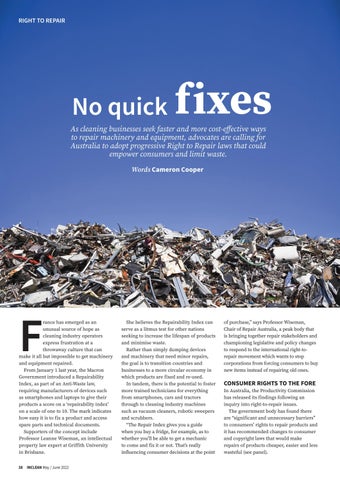
The world’s throwaway culture and ever-increasing amounts of waste raise concerns around business sustainability and the environment. According to a United Nations report, e-waste is the world’s fastest-growing stream of waste, with 53.6 million metric tonnes having been generated in 2019, up 21 per cent from the previous year. Giving consumers the right to repair their own technology and machinery should result in greater longevity for products and cut such waste. Michalson has no doubt that strong right-to-repair laws can contribute to more sustainable cleaning operations and change consumer behaviours. “If more people are aware of the option and ease of accessing repairers, then I am sure more people would repair their product rather than throw it away, even if it costs more,” she says. Cleanstar is committed to doing its bit. It carries parts for all of its machines, often in excess of the compulsory sevenyear period. “We always encourage repairing a machine rather than disposing of it into landfill. We also have a nationwide service network that can assist with this. Some equipment and appliance importers don’t even carry parts for their imported product. We need to change 40 INCLEAN May / June 2022
our behaviours and avoid being the throwaway society that we are.” Professor Wiseman says there is a clear need for businesses and society to address waste, especially e-waste, and “help mitigate all of these climate disasters that we’re experiencing”. She says products that could be fixed easily often have to be discarded because of a lack of availability of basic parts. “Some people are trying to do the right thing, but if the manufacturers don’t make the spare parts available that creates a vicious cycle. We have to dispose of these goods, which creates huge problems with the waste.”
TRAINING IMPERATIVE
Rising freight and oil costs because of COVID-19 and Russia’s invasion of Ukraine also puts more pressure on supply chains and creates a scenario whereby it could be better to repair existing goods, rather than experiencing delays while shipping new products across international and domestic borders. In this context, the Productivity Commission’s report highlights the need for further upskilling and training in the repair industry. Hulbert says B&G Supplies makes every effort to sell refurbished machinery as part of a second-hand machinery market,
• require suppliers to provide access to repair supplies • amend copyright laws to allow consumers to access repair manuals • amend warranty regulations so that consumers would not lose their rights to a repair, replacement or refund just because they used an unauthorised repairer or spare parts • promote product package labelling that sets out the durability and repairability of a product • ensure software updates are provided for a reasonable time for products with embedded software. • give the Australian Competition and Consumer Commission the ability to seek “pecuniary penalties” (a type of non-criminal fine) against suppliers and manufacturers • create a “super complaints” process that would allow consumer organisations to take action on behalf of consumers.
which assists customers by lowering costs and improving sustainability. He hopes younger technicians embrace more expansive training measures that will broaden their skills and allow them to fix all elements of various machines. “At the moment it seems to be below them,” Hulbert says. Michalson believes government should be the main driver in encouraging training for machinery and appliance repairs, adding that there is great scope for upskilling through TAFE and other vocational education institutions. She hopes appliance repairing can become a registered trade. Greater diversity of repairers could also make a difference, according to Michalson, with people of all ages being encouraged to join the repair industry, including more women and those with a disability. “The conventional ideal that only a male do this type of work should no longer apply.” ■
www.peugeot.com
.au
*Overseas models shown.
THE NEW PEUGEOT EXPERT VAN Flexible Payloads - Uncompromising modularity - 6.6m3 capacity
Contact your Peugeot Professional dealership today
*Some features and specifications may vary, check with your authorised Peugeot Professional dealer.
SPONSORED
Bunzl delivers Global distribution business Bunzl has continued its success during the pandemic on the back of smart sourcing strategies and strong relationships with manufacturers and customers.
N
ot many companies have been able to turn supply chains into an advantage during the COVID-19 pandemic. Then again, few organisations in the cleaning and hygiene space have the scale and leverage of Bunzl, a FTSE 100 company with operations across the Americas, Europe, the Asia-Pacific region and the United Kingdom. Lance Ward, Managing Director at Bunzl Australia and New Zealand, says distributors have been facing a “perfect storm”, with soaring freight costs and a shortage of shipping containers accompanying high demand for 42 INCLEAN May / June 2022
cleaning chemicals and equipment, janitorial and washroom supplies and PPE gear. “But because of our reach when it comes to sourcing, we’ve been able to secure inventories when maybe others haven’t been able to,” Ward says. Bunzl has also been quick to adapt. Facing some product shortages from its China-Australia route, it set up additional supply channels via alternate ports, giving it additional direct shipping lines to Australia. “It’s more expensive for us and it’s slower, but we’ve had more capacity and that’s helped us and our customers considerably,” Ward says.
SPONSORED
UNPARALLELED SUPPORT
Customer support has been another defining factor behind Bunzl’s success during COVID-19. The newly formed Cleaning & Hygiene Advisory Team (CHAT) has acted as a counselling source for customers at a time when specialised cleaning products and services are required. Greg Crisp, Sector Manager – Facility Management Australia & New Zealand for Bunzl, says team members have benefited from participating in cleaning standards courses from trade association ISSA and the Global Biorisk and Advisory Council’s (GBAC) course on biohazard responses. “That means our team members are qualified from a cleaning industry point of view, not just a sales point of view,” he says. Such customer assistance has covered the gamut from governance and compliance to site evaluations, product selection and availability, strategy execution, safety measures, supply-chain management, and training and support. The approach has proven to be especially valuable in high-pressure, high-demand areas such as healthcare, hospitality, facility management, food processing and industrial packaging.
STAYING COMPETITIVE
With COVID-19 causing massive rises in freight and supply-chain expenses, Bunzl and other cleaning and hygiene industry players have been under pressure to keep customer costs down. Ward notes that shipping container costs that may have totalled about $5000 before the pandemic now come in at roughly $14,000. While Bunzl has benefited from long-term fixed-price contracts with its product partners, the diversity of its customer base and resilience of its managers and employees have been crucial, too. “I’m really proud of the Bunzl organisation and our people in the field who have done an awesome job.” Investment in infrastructure and technology cannot be underestimated either. For example, during the past few years Bunzl has been opening new super warehouses that have enabled it to reduce the overall number of warehouses across the group and deliver cost and supply-chain efficiencies. The Australasian arm has also shared some backof-house costs with Bunzl’s global head office in London. Within Asia, Bunzl has directly employed personnel out of Shanghai to source the best
“
[The cleaning and hygiene industry] is a market that’s worth investing in – and we invest in our people, innovation and technology.
”
2022 is Coming! Around Australia and New Zealand, businesses are opening up. So Bunzl is bringing you the latest global products and trends, so you can stay informed and safe. These last few years have seen many cleaning and hygiene innovations fast-tracked – from surface disinfectants to personal hygiene products, and air quality controls. Join the Bunzl team at the Innov8 series of workshops and find out about the latest products, hygiene and safety protocols, and mandates and governance requirements. Bunzl – sourcing globally to help you locally. Innov8 coming to Auckland | Adelaide | Brisbane | Darwin | Melbourne | Perth | Sydney
Contact Your Bunzl representative for more details.
MKT-1187
www.incleanmag.com.au 43
SPONSORED
“
We’re absolutely committed to eliminating modern slavery and human trafficking from the supply chain.
”
44 INCLEAN May / June 2022
products and negotiate directly with manufacturers while ensuring they meet strict quality assurance and quality control standards. Ward says leverage, not just scale, has played a key role in Bunzl’s success. One initiative has been setting up a global procurement forum for managing directors and procurement specialists across the cleaning and hygiene sector. This has had a two-fold impact – Bunzl has been able to share market information on product capacity and buying opportunities, while it has also enabled the group to forge ever-stronger ties with manufacturers and other suppliers. “This has further enhanced our ability to secure inventory,” Ward says. “And, in turn, that has enabled us to give our customers supply-chain continuity and support.”
INNOVATION TO THE FORE
According to Crisp, innovation will be a strategic element that drives continuous improvement and success for cleaning and hygiene leaders. Bunzl has long been a champion of innovation through its Innov8 program in the UK which showcases product and service evolutions through industry workshops. From July to October,Bunzl will run a series of workshops across Australia and New Zealand, including from Auckland, Adelaide, Brisbane,
Darwin, Melbourne, Perth and Sydney. They will bring together the best new global and local innovation products and systems. “Essentially, it’s our way of showcasing some of this innovation in a very friendly and open environment with our invited customers,” Crisp says. “The workshops will really demonstrate our capability and willingness to bring these innovations to as many of our customers as possible. After the last couple of years, it will be great to get together and showcase what has been happening globally and locally.” In addition to product innovation, the workshops will advise attendees on other best-practice actions related to procurement, cleaning and disinfection best-practice, and sustainability around the use of chemicals and packaging. The development in sustainable manufacturing has been led from a global focus in many European countries which we are now experiencing in ANZ with government support; there are so many alternatives from “plastic bottles into microfibre cloths” that are readily available and more to come via our Innov8 platform this year – there are some very exciting initiatives ahead for our customers.
ETHICAL SOURCING
Although the pandemic has forced many cleaning and hygiene businesses to seek efficiencies, Ward
SPONSORED
says Bunzl will never relax its commitment to the ethical supply of products and services. Likewise, it endorses and embraces modern slavery laws as part of its strong “moral compass”. “At Bunzl, we’ve raised our standards during the pandemic,” Ward says. “We’re absolutely committed to eliminating modern slavery and human trafficking from the supply chain.” To that end, Bunzl has a global code of conduct and training regimes that apply to all employees and suppliers. “And we have a really extensive auditing program, so when you do business with Bunzl you get an assurance that the products we have supplied have come from an ethical environment,” Ward says
LESSONS FOR ALL
COVID-19 has presented the greatest challenge that the cleaning and hygiene industry has ever faced, delivering lessons along the way. For Crisp, the past two years have highlighted the importance of following Therapeutic Goods Administration guidelines, focusing on strategy and best-practice, adhering to ethical standards
and insisting on quality and compliance with products and processes. “Never cut corners,” he says. The other imperative has been to foster strong supply-chain partnerships. As Crisp explains: “At Bunzl, of course we need to have strong relationships with manufacturers, but also with our customers. These ties have allowed our customers to supply and trade through what’s been a really turbulent 24 months.” Ward notes that Bunzl is well placed to keep growing, COVID-19 or otherwise. He is confident the cleaning and hygiene market will continue to prosper. “It’s a market that’s worth investing in – and we invest in our people, innovation and technology.” With businesses seeking to improve efficiencies and cut labour costs, he expects innovations around robotics to make a difference, along with consolidation with distributors and an emphasis “on one order, one delivery, one payment and standardisation of product ranges”. “That’s where the game’s going to be won and lost,” Ward says. Along the way, Bunzl will be there to help. ■
“
At Bunzl, of course we need to have strong relationships with manufacturers, but also with our customers. These ties have allowed our customers to supply and trade through what’s been a really turbulent 24 months.
”
CHAT Cleaning & Hygiene Advisory Team Bunzl’s Cleaning & Hygiene Advisory Team will make sure you are prepared. This means knowing how to manage and maintain good hygiene practices, how to respond before a situation gets critical, and how your staff and business complies with best practice guidelines and government regulations. With you, we will manage a comprehensive three-step approach. Review and Advise
Execute
Secure
Conduct site evaluations and reviews
Implement agreed recommendations
Manage long term supply chain with regular updates
Provide detailed recommendations
Coordinate all product and system implementation
Activate an on-going service and support model
Develop an agreed action plan
Support all training and compliance requirements
Provide analytical reporting
Contact one of our Cleaning & Hygiene Advisory Team e: bunzlchat@bunzl.com.au | www.bunzl.com.au/CHAT
INC MJ22 PG 43 Bunzl HPH-NEW.indd 1
MKT-1186
Bunzl’s Cleaning & Hygiene Advisory Team will help you plan, execute and achieve your cleaning and hygiene goals.
5/4/22 2:53 pm
www.incleanmag.com.au 45
SUPPLY CHAIN
y l p p u y s g g e n t i a k tr n i s h n t i e R cha Th
ink
b we n i . ha gain c a ly pp hink u s T lex es? p s om ines c a us ing ig b v b ha
O
is
r t fo s ju
ver the last couple of years, we have experienced our global supply chains being held to ransom by major disruptions, including the pandemic, natural disasters, and geo/political conflicts, that seem to be only increasing their impact. These disruptions are not dissipating and are becoming the new normal. COVID-19 is not our first pandemic and nor will it be our last. Weather patterns across the globe have changed dramatically and are constantly moving. Not only that, but we are also facing major political issues, causing countries to have sanctions thrusted upon them and trade agreements threatened. These disruptions are not targeted at a singular region. Let’s face it, our supply chain/ procurement managers are probably in one of the toughest roles in a business today. One of the big challenges for supply chain now is on 46 INCLEAN May / June 2022
the water, with hundreds of cargo ships at a time waiting to enter some of the world’s largest ports. We are also seeing a lot of the smaller ports becoming impacted, although we do anticipate seeing this clearing soon. Once containers land, the impact keeps moving downstream where we are seeing logistics and the warehouse chain start to fail. A good example of this is in Australia. We are already feeling the squeeze as we saw containers sitting in detention on the docks in late 2021 and in early 2022 due to warehouses being at capacity. Additionally, they have also been heavily impacted by labour shortages, disrupting the cycle of movement in and out of the warehouse and severely delaying the last mile delivery. I have seen a lot of mistakes due to lack of planning and communication throughout the supply chain, with reactive decision making.
SUPPLY CHAIN
“
Internationally, many companies are taking new approaches, implementing strategies such as regionalisation and nearshoring.
”
THE SUPPLY CHAIN DOMINO EFFECT
So, how did we get into this mess when the pandemic and all the disruptions have been around for a few years? There are many reasons why, but let’s focus on two main procurement models so we can learn from this.
• JUST IN TIME (JIT) • BUFFER STOCK
Both open you up for risk and failure
Many businesses have been working with the JIT (Just in Time) Model mainly due to market competitiveness. Relying on vendors is based on the end inventory model, not how fast the inventory moves its way through. This model works if everything goes to plan. The risks occur when it doesn’t go to plan such as what we are seeing now, with all the disruptions across the entire supply chain, from components, manufacturing, on the water and now on land. These disruptions cost you across all touchpoints in turn increase COGS, potentially outweighing the profits you have made or could have made on those products. This model not only poses a risk to your customers if you cannot deliver on time, but also the loss of revenue and your reputation. The other model being used is you or your vendor/manufacture hold buffer stock in case of a disruption. This can potentially create the problem of stock stagnate between these disruptions. The risk here is firstly a financial – the cost of storage, the cost to avoiding SLOBS and/or repurposing your stock, potentially writing of stock, all these together you have possibly already priced yourself out of the market. This is where we have seen businesses shut due to stock issues. Think of supply chain like a game of dominoes: one piece that stumbles or falls will either impact the upstream or downstream of your supply chain – impacting the entire game. Shipping costs alone have increased more than tenfold, which is scary when you think that globally 90 per cent of goods are shipped by sea. These costs have been absorbed in the past, if it’s only short term, but not in today’s environment. We are seeing around 25 per cent+ (depending on the industry) being passed onto the consumer, and it won’t stop there. The demand chain is becoming impossible to plan. If you’re analysing data from the past five years, or even two years, you will see a bullwhip effect, significant peaks and troughs. So, how do you set your minimum and maximum levels of stock holdings when you don’t know what you don’t know? That is why these two models are not sustainable for the future and now a lot of businesses are starting to rethink their supply chain. Let’s look at how businesses are starting to rethink their supply chain.
COLLABORATION AND INNOVATION
Internationally, many companies are taking new approaches, implementing strategies such as regionalisation and nearshoring. Regionalisation is the spreading of factories – moving them closer to the consumer by spreading their manufacturing footprint over various www.incleanmag.com.au 47
SUPPLY CHAIN regions. The idea is to minimise risk, this means if a factory must shut down, it only impacts sales in close locations within the region. A more popular strategy, especially in the apparel industry, is nearshoring – moving the manufacturing closer to the country where the goods are sold and distributed. An example of this is Italian clothing company, Benetton. It was suffering major shortages, so the fashion brand decided to increase manufacturing in Turkey, Croatia, Serbia, Ukraine, Tunisia, and Egypt – closer to its core customers. The company is now planning to cut manufacturing in China down to half by the end of 2022 – 2023. In Australia, we need to think bigger and louder. There are some companies that have already started bringing manufacturing back, also known as ‘reshoring’. This is expensive and also not without risks. There are many impacts to your bottom line, which could derive from this movement. With this in mind, we need to think outside the square, dig deep and come up with other solutions. If you are a small to medium sized business the three strategies above will not be in your reach unless you collaborate with others. It’s important we understand the severity of the disruption impacts in Australia. The Australian Bureau of Statistics (ABS) recently conducted surveys to understand the supply chain impact to businesses. According to the results, during April 2021 – Jan 2022, 47 per cent of businesses said they suffered due to supply chain issues. In February, the number of businesses that suffered due to supply chain issues decreased to 37 per cent. However, 15-22 per cent of these businesses were/are severally impacted by labour and revenue loss, due to supply chain issues. According to the ABS, it has been medium sized business most impacted.
Businesses provided information on how these disruptions were impacting their supply chains.
Businesses experiencing supply chain disruptions(a)
Yes 37%
No 61%
Don’t know 2%
Of those businesses with supply chain disruptions(b)(c):
88% reported increased time to receive products from suppliers
80% reported that existing suppliers were unable to provide products
75% reported increased prices e.g. transport costs
50% were unable to source or substitute alternate suppliers for products
(a) Proportions are of all businesses. (b) Proportions are of businesses experiencing supply chain disruptions. (c) Businesses could select more than one response option. Source: https://www.abs.gov.au/statistics/economy/business-indicators/ business-conditions-and-sentiments/feb-2022
48 INCLEAN May / June 2022
“
Think of supply chain like a game of dominoes: one piece that stumbles or falls will either impact the upstream or downstream of your supply chain – impacting the entire game.
”
Business owners need to start thinking holistically and taking a more collaborative approach. Collaborating within your supply chain web may lead to solutions that can work with very little risk.
WHERE TO FROM HERE?
So, where to start? The first step is to map out your current supply chain web. Find out where your raw materials are sourced and go downstream from there. The key is to understand every touchpoint from the first mile to the last. By doing this you will identify where your risks lie within the current state supply chain. Once you have transparency of your supply chain, you can develop your future state supply chain map. When we talk about transparency, we are talking about identifying businesses/industries that utilise and work within your supply chain web, and whom you should start collaborating and build relationships with by leveraging of each other. These actions are quite complicated but will provide you with a lot of insight, allowing you to develop strategies that will allow all involved to take control and pivot quickly along the chain to avoid as much disruption as possible. This type of complex planning requires time and investment but will pay off. It is what is required to have a sustainable future, enabling you to plan and react quickly so your businesses supply chain is more fluid. It is up to you to understand and manage this. ■ This article was written by Susan Crane, Director, Crane Consulting on behalf of Tennant Australia & New Zealand. Crane is also an ISSA Oceania Trainer. For more information about the ISSA visit: http://issa.com/oceania. To discover more about Tennant Australia & New Zealand visit https://au.tennantco.com
JOIN NOW!
TOGETHER WE CHANGE THE WAY THE WORLD VIEWS CLEANING!
ISSA OCEANIA MEMBER EVENTS & TRADE SHOWS Benefit from networking events and global trade shows, including the Australian ISSA Cleaning & Hygiene Expo. COMPLIMENTARY RESOURCES FOR YOUR BUSINESS Enjoy complimentary tools like Product Cost & Usage Calculator, Workloading & Bidding Tool, The Value of Clean Toolkit to take your business to the next level. INDUSTRY NEWS Be on the front foot with INCLEAN and INCLEAN New Zealand magazines, international publications like ISSA Today and Cleanfax, online news and ISSA TV.
BENEFITS EDUCATION, CERTIFICATION & STANDARDS Take your operation to the next level with industry-leading training, education programs and accreditation, customised to the needs of Australian and New Zealand businesses. LOCAL MEMBER BENEFITS The ISSA Oceania team is working with a number of local service providers to provide members with exclusive discounts to relevant services.
FOUNDATION OF EXPERTISE Share in our vision, mission, values and goals. Together we can change the way the world views cleaning.
TRENDS & INSIGHTS Gain valuable market analysis both regionally and globally.
MEMBER DIRECTORY Get featured in the online listing of all members which attracts over 15,000 clicks per month and provides access to all company profiles.
GLOBAL NETWORK Expose your business to the ISSA Group, international office networks and alliances.
issa.com/oceania
oceania@issa.com
ww w.issa.com/oceania issa.com/oceania
1800 621 872 Search ISSA Oceania JOIN TODAY! oceania@issa.com
1800 621 872 Search ISSA Oceania
SPONSORED
Facing the post-COVID
challenge
SEKO’s innovative DispenserONE Flexi Battery sanitiser system offers customers a long-term, cost-effective improvement to their daily operations.
CASE STUDY: HAND SANITISER SYSTEMS FOR RUGBY BOROUGH COUNCIL’S CAR PARK
Rugby is a picturesque town in England’s West Midlands, offering employment in the engineering, manufacturing and service sectors as well as being popular with tourists for its history, sport, and culture. As was common in every town or city during the height of the Coronavirus pandemic, most 50 INCLEAN May / June 2022
of Rugby’s businesses were forced to close their doors due to local and national lockdowns – with the retail and hospitality industries both severely affected. That was why, when lockdown ended and businesses were finally able to re-open after many months of hardship, Rugby Borough Council’s Environmental Health department was keen to encourage visitors to return, with initiatives put in place to protect and reassure the public.
SPONSORED
“
The council was able to benefit from DispenserONE’s groundbreaking IoT technology, which enabled them to access live and historical data on system usage and remaining product level for all 20 units via smartphone.
”
These measures included hand hygiene provision across 12 of the town’s car parks – including a central multi-storey facility – to allow visitors to sanitise their hands before and after using pay and display machines. As well as helping to prevent the spread of infection, it was hoped that the presence of sanitizer systems would give the public confidence and help to increase visitor numbers at a time when many would be anxious about returning. Consequently, Chemex International Ltd was approached to supply hand sanitiser systems for 12 car parks, with some larger outdoor sites requiring two machines and a multi-storey facility to have one on each floor. In order to deliver the most hygienic experience possible for users, Chemex wanted to provide automatic touch-free sanitiser systems rather than manual dispensers which can harbour and transmit germs and viruses via the body of the unit. However, with automatic dispensers traditionally relying on disposable battery power, Chemex knew that such systems would require frequent maintenance to replace expired cells, with systems being out of commission in the meantime and potentially leaving users unprotected.
THE SEKO SOLUTION
That was why they turned to SEKO’s ground-breaking DispenserONE Flexi Battery sanitiser system, which offers longlife rechargeable battery connection for uninterrupted service, while removing the maintenance requirement and negative environmental impact of single-use battery disposal. Added to that, DispenserONE’s 10-litre sanitiser tank meant that each unit would www.incleanmag.com.au 51
SPONSORED
“
DispenserONE’s durable steel casing made it the ideal choice for the heavy use typical of the town’s busy car parks.
”
provide up to 10,000 doses between refills, vastly reducing replenishment frequency when compared to the 1000-dose capacity of standard-sized dispensers. And where the use of light-duty manual dispensers would have necessitated regular repair and replacement, DispenserONE’s durable steel casing made it the ideal choice for the heavy use typical of the town’s busy car parks. Confident that they had found the ideal solution for the council’s needs, Chemex ordered 20 DispenserONE systems from SEKO which were soon installed across the town’s car parks. With the systems in place and lockdowns beginning to ease, the council was able to benefit from DispenserONE’s groundbreaking IoT technology, which enabled them to access live and historical data on system usage and remaining product level for all 20 units via smartphone. This allowed the council to remotely monitor each of its DispenserONE systems from a single platform and ensure the dispensers never ran empty. Meanwhile, the systems could be refilled only when necessary, saving on wasted trips by maintenance staff. And with DispenserONE’s ultra-consistent ‘soft’ dispensing – achieved via advanced stepper motor technology – the council has also avoided the common problem of splashing and dripping associated with manual sanitizer dispensers while reducing product wastage. Finally, Rugby Borough Council benefitted from DispenserONE’s customisability, with 52 INCLEAN May / June 2022
each system supplied in the council’s choice of black with its logo featuring prominently on the front panel. Another example of a SEKO solution helping customers achieve long-term, cost-effective improvements in their daily operations. ■
DispenserONE® The IoT sanitizer system that offers unmatched performance with virtually zero maintenance requirement •
3,000 to 10,000 doses between refills
•
Motor-powered pump for ultra-reliable dosing
•
Mains power or rechargeable battery
•
24/7 data on demand via smartphone app
•
Unlock advertising revenue with 17” screen model
•
Customizable with your company colours and logo
Find out more
DispenserONE® Applications Airports
Conference centres
Hospitals
Shopping malls
Sports stadiums
Supermarkets
Transport hubs
Restaurants
Offices
Gyms
For more information please visit www.seko.com
RESTORATION
Job costing and
documentation A restoration company’s jobsite recordkeeping can make or break a project. Learn to make an air-tight record with this detailed guide. Words Kris Rzesnoski
I
t’s getting harder and harder for restorers to grow a profitable business, and it’s no secret that the last two years have not been an easy environment to operate in. Many restorers feel like their businesses are under increased scrutiny that is taking a toll on staff. It’s especially frustrating when you feel like insurance carriers aren’t working with you as you try to help people in their time of need. Restoration is an essential part of the insurance ecosystem, and you perform a service that is needed for the insurance industry to be successful. Theirs is a data-driven industry, and the data they require to make decisions comes from the documentation you capture in the field. The level 54 INCLEAN May / June 2022
of detail and accuracy you capture can make or break you. I have witnessed firsthand the best restorers in Australia, Canada, the UK, and the US all have one thing in common: The ability to deliver major wins to the bottom line depends on field documentation systems and consistently sticking to the same process. To build a foundation that will lead to consistent profitability, restoration companies must create a simple, repeatable process for the team to use while in the field. If you want premiere-level documentation, it’s essential to validate the work you did to justify and defend your actions; limit the exposure of pre-existing conditions/damages so you don’t pay
RESTORATION
for things you didn’t damage; and create repeatable processes, so your business runs more efficiently and routinely. If you don’t focus on these things right from the get-go, you’re selling yourself short and setting yourself up for constant back-and-forth battles with reviewers, adjusters, and TPAs. You’ll be fighting for every dollar, and it’ll likely take forever to get paid. At the very minimum, there are six types of field documentation categories you should check off for every job to protect your business – and your customer – from unnecessary scrutiny and delays: 1. Overview 2. Pre-existing conditions/damages 3. Source/cause of loss 4. Resulting damage to structure 5. Resulting damage to contents 6. Pre-existing conditions/damage to contents Taking the time to document the job properly instantly solidifies a process that will help your business succeed.
OVERVIEW
When to take them: During the first walkthrough (before beginning any work). Benefit: You document exactly how the property was upon arrival. This is the only opportunity for you to document the original condition of the building and contents before you start working unless you take these photos and videos immediately upon arrival at the site. Start at the door of the affected room and take your photos left to right, slightly overlapping them. You want the images you capture to tell a story so that anyone reviewing your documents will understand exactly what you were looking at when you arrived. These photos are critical. They will be used by your company’s internal resources, the homeowner, and the adjuster, and if taken poorly, they can be weaponised against you. Gaps in your documentation leave room for doubt, allowing people to further scrutinise your work and documentation capabilities.
PRE-EXISTING CONDITIONS/DAMAGE
When to take them: During the initial walkthrough (before beginning any work). Benefit: You clearly identify previous, current, or future issues. The problem is people walk by their home finishings every day without noticing dents, dings, scratches, and other imperfections – until you and your team arrive. I can’t express how many times we have had to pay for walls to get painted or to repair damaged finishes or contents that we didn’t even touch. Unfortunately, that’s the nature of this business. Every restorer has this type of liability exposure, so it’s important to understand how to limit it.
Again, start at the door of the room and work your way around from left to right. This time, you need to focus in greater detail right down to the dents and dings, moving from top to bottom, but still maintaining a left to right flow. If a question arises in the future you can demonstrate, isolate, and identify any marks. If the mark is on a flat wall surface, it’s a good idea to take a photo from further away from the location to provide some context. Look to frame a light switch, outlet, trim piece, or some other item in your photo capture as a point of reference to help identify the mark’s location. In this step you are looking for everything: • Dents • Scratches • Stains • Tears • Discolorations • Pre-existing mould/water damage (Don’t miss this one especially!) • Odours • Sounds We saved so much money on jobs when we slowed our response and actually took the time to protect our company. The bottom line increased, and the potential for any problems with the customer decreased. Overall, it cost us less time and money to close our jobs out by taking a little more time to do it right from the start.
“
To build a foundation that will lead to consistent profitability, restoration companies must create a simple, repeatable process for the team to use while in the field.
”
SOURCE OF LOSS/CAUSE OF LOSS
When to take them: As soon as possible. Benefit: This documentation helps your customer make their claim. There is a difference between the “source of loss,” a contractor term, and the “cause of loss,” an insurance term. Before we discuss how to document them, let’s clarify how these two terms differ: The source of loss (SOL) identifies the place of origin for the loss and should be identified by the restorer. An SOL could be a ruptured water line, a punctured waterbed, seepage from the foundation, an overflowing sump pit, etc. For restorers, we are less concerned with how a loss happened and more concerned with where the loss originated from. A broken pipe is a source of loss, and we need to know what type of pipe ruptured. A supply line (drinking water) provides us with an initial categorisation of water as a Category 1. A broken sewer line would provide us with an initial categorisation of water as a Category 3. The adjuster is more concerned with the cause of loss because the insurance policy revolves around what caused the loss in order to determine the level of coverage. The same supply line may or may not have coverage, depending on what caused the rupture. If the rupture was a sudden and accidental break in the line, the insurance policy might cover the break. If the rupture was a slow www.incleanmag.com.au 55
RESTORATION
“
Taking the time to document the job properly instantly solidifies a process that will help your business succeed.
”
56 INCLEAN May / June 2022
leak due to poor maintenance, the policy might not cover the loss. But the restorer drying the building has to determine the source of the water and the current condition of the water, regardless of whether there is coverage. Despite these differences, how you document the SOL and the cause of loss is very similar. When documenting the room, you should take a distant photo to provide fuller context, then move in toward the source or cause of loss until you can capture a closer photo. The property owner and adjuster need clear pictures and accurate context. It doesn’t matter whether you are working with the adjuster or only for the property owner, the information you collect is still required by both parties to determine coverage, insurance dollars, and how the submission of the claim goes.
RESULTING DAMAGE TO STRUCTURE
When to take them: You should take these on the first day. You may take more photos within 48 hours due to further water damage. You also should take these photographs when you open the wall structure or find damage that was concealed, as well, typically within the first few days. Benefit: This documentation supports your actions in the field, assists the property owner in making their claim, and reduces conflict in a file review. This category of documentation should be done with great diligence because it often expands the loss size and scope as time goes on and as materials are removed and additional impact is found. While it is common for more damages to appear after the initial assessment, it is uncommon for restorers to document the resulting damages after
the first day, but these findings can have a huge impact on the restoration process. For many novice restorers the resulting damage is taken upon the initial walkthrough and then never updated. This is where a good operator should pay particular attention to the resulting damages and document because an initial scope or rough order of magnitude of $10,000 could easily be increased to $25,000 upon removing some materials or waiting for the water to finish penetrating the building structure. Using a digital or written change order is critical to documenting the reason for increasing or decreasing your costs based on what you find during your work.
RESULTING DAMAGE TO CONTENTS
When to take them: Before you move the content, while you are listing content, and during the cleaning process when damage is identified. Benefit: This documentation supports your actions in the field, assists the property owner in making their claim, and reduces conflict in a file review. We often think of contents as the stuff in our way when we are trying to do “real” restoration. The reality is, if you ever want to connect with someone, you must take very good care of their belongings. Most restorers underestimate the importance of documenting the damage to contents. This is especially true if the contents are deemed nonrestorable or economically non-restorable. These items are going to be documented, identified, and then thrown out forever, so you’ve only got one chance to properly document them so that the property owner can make their insurance claim and get the full value of those items.
RESTORATION While removing contents might seem like a chore, when you do it incorrectly, it can cost the customer thousands of dollars. Every item should be documented by capturing the following: • An overview photo of the item • The brand name of the item • The model or serial number if applicable or the tag (for size and style) • The quantity of items. For items that are not retail brand name items you’ll need to get more information from the customer. What is the value of the item? Where did it come from? What’s the value to the customer? Is there anything else that should be noted? After you’re done identifying all the items, share the list of pictures with the customer for a final review before permanently discarding those items. That way you won’t accidentally discard a family heirloom and cringe thinking about it for years.
PRE-EXISTING CONDITIONS/ DAMAGE TO CONTENTS
When to take them: Before you move any item; on all items over $100 (set your value) Benefit: These limit your risk of paying for damage not done by your team, limit potential conflicts, and create a bond between you and your customer. People are emotionally attached to the things they acquire throughout their lives. Of course, almost everything has a monetary value, but you cannot discount a customer’s potential emotional attachment to any item. Focusing on this can change your relationship with your customer. When you document their possessions, you are doing two things: 1. Reducing your liability: People don’t notice the wear their items pick up over time until you touch or move equipment around those items.
2. Establishing a bond with the customer: They witness the care and attention to detail you take with their belongings, and you showcase your professionalism. The beautiful thing about documenting the job to this level is, if you do make a mistake, most of the time the customer is willing to forgive you because they have witnessed your sincere and careful approach with their things.
BETTER DOCUMENTATION LEADS TO HIGHER PROFITS
Your business thrives when you have repeatable processes that allow you to hire and retain new employees who can fit into your system and succeed in this complex industry. I repeatedly have found that, by spending a little more time at the beginning of a job to document the entire situation in greater detail, I am saved immense frustration and protect my employees from feeling doubted on every job. It’s okay to slow down and document the job properly to do right by yourself, your team, and your customer. Your inevitable success will pay dividends and major time savings down the road. ■
“
Your business thrives when you have repeatable processes that allow you to hire and retain new employees who can fit into your system and succeed in this complex industry.
”
Kris Rzesnoski is VP of business development for Encircle. He is an RIA technical instructor, an IICRC approved instructor, a third-party evaluator, and owner of Reztime Training and Consulting. Rzesnoski sits on RIA’s Restoration Council and Canadian Education Committee and is the chairman of the Estimating Committee. This article was first published in Cleanfax and has been republished with permission.
www.incleanmag.com.au 57
SPONSORED
The SafePlus cleaning solution from Vileda Professional Vileda Professional brings a new level of hygiene to hospitals
A
round 180,000 Australians contract infections in hospitals around the country every year. Large parts of these infections are considered preventable through better infection prevention and thorough cleaning. To achieve a high level of hygiene, the cleaning and disinfection of surfaces in hospitals is becoming increasingly important. That’s why Vileda Professional offers you the most hygienic and safe cleaning solutions for surface cleaning and disinfection. The new SafePlus cleaning solution dispenses single use microfibre wipes in their safest way. SafePlus Maxi dispenser is the first with an antibacterial self-closing lid. Together with the leading cleaning performance of single use microfibre wipes this solution achieves the highest grades in hygiene. 58 INCLEAN May / June 2022
SPONSORED
“
The new SafePlus cleaning solution dispenses single use microfibre wipes in their safest way.
”
SAFEPLUS BRINGS THE PLUS IN HYGIENE
Each SafePlus MicronRoll wipe cleans while disinfecting at the same time and achieves the highest grades in cleanliness. 99.99 per cent of bovine corona virus are removed from surfaces, without disinfectants. The wipes are designed for rapid and most hygienic cleaning of all surfaces, even in high-risk areas, and to avoid the risk of crosscontamination. Externally certified to store preprepared wipes till 31 days.
SAFEPLUS BRINGS THE PLUS IN FUNCTIONALITY
The SafePlus Dispenser is the safest and most innovative dispenser system from Vileda Professional. The rolls of wipes are sealed in polybags and fit perfectly into the dispensers, providing additional security during preparation, use and storage. The cleaning personal easily adds any detergent or disinfectant of choice.
SAFEPLUS BRINGS THE PLUS IN SAFETY
The innovative closing system provides extra safety and functionality. Its antibacterial selfclosing flexible lid guarantees that the dispensers will be never left open again. Certified antibacterial properties on the flexible lid ensure that the flexible lid remains antibacterial even after 80x autoclave cycle. ■ To find out more about the SafePlus cleaning solution from Vileda Professional, visit: https:// www.vileda-professional.com.au www.incleanmag.com.au 59
SPONSORED
The Power of TWO:
UltraFlex Duo UltraFlex Duo by Vileda Professional provides easy and efficient double-sided mopping.
A
s a global leader in cleaning solutions, we firmly believe that every product we develop needs to make your daily business easier and more efficient. So, we asked ourselves, can we create a system that combines all the elements you need to push your business to next level? Yes, we can! Welcome to UltraFlex Duo. The easy, efficient double-sided mopping system. Designed to increase your cleaning speed, hygiene, and flexibility at an excellent price-/performance ratio. The complexity and cost pressure of running cleaning facilities to meet high hygiene standards are very high. What if there was a solution that significantly reduced costs and complexity?
THE SPEED OF TWO
Double the floor coverage Cover up to 40m2 per mop before changing. double the distance of single sided systems Two faster cleaning Double sided mopping means more time 60 INCLEAN May / June 2022
cleaning and less time changing mops or wringing All areas and methods Use as a pre-prepared system in hygiene sensitive areas (such as patient rooms ...) or with a press in high traffic areas (such as canteens …)
Touchless mop removal Innovative frame design ensures used preprepared mops are removed without touching Microfibre cleaning performance Pioneered by Vileda Professional and updated to meet the latest Nordic Swan ecological standards
THE FLEXIBILITY OF TWO
THE IMPACT OF TWO
Flexible mop range Washable, attractively priced mops covering all hygiene levels and floor types Compatible with all trolley systems UltraFlex Duo mops can be pre-prepared in every mop box, reducing initial investments in new trolleys Minimal process changes Staff only require training in mop on, mop off and dosing. All laundry and associated processes remain the same.
THE HYGIENE OF TWO
Proven bacteria and virus removal All mops are certified to remove up to 99.99% of virus and bacteria from floor surfaces
Excellent price/ performance ratio Your investments are tailored to your needs with a choice of mops covering threeyear contracts Low start up investments If budgets are tight UltraFlex Duo can be easily implemented onto your existing trolleys, so you only need to purchase mops and frames Reduce complexity Save time training staff as UltraFlex Duo is one system that can be used with all cleaning methods. ■ For more information about UltraFlex Duo from Vileda Professional, visit: https://www. vileda-professional.com.au
UltraFlex Duo. Easy, efficient double sided mopping. For more information please contact us at: csvic@fhp-ww.com or 1300 669 686 www.vileda-professional.com.au
RESTORATION
Mould safety concerns
How to keep remediation workers and occupants safe from mould exposure risks and protect your company from liability.
Words Mark Drozdov and Carey Vermeulen with Amanda Hosey
62 INCLEAN May / June 2022
W
orking in the remediation field, we often hear client concerns about mould and its associated health risks, hypersensitivities, and finance-crippling lawsuits, but, despite this, some in the industry continue to underestimate the hazardous effects of mould on workers and occupants. But mould, just like the other contaminants of concern, is dangerous to our health, and failure to prioritise mould safety puts our people, clients, and company in harm’s way. The bodily effects of mould exposure are many but are primarily respiratory related—from sinuses down into the lungs. There is also the potential for mould to affect one’s immune system long term, making a person not only more susceptible to mould, but also to other respiratory-related illnesses. These reactions occur both in immunocompromised
people as well as healthy individuals with no prior allergic reactions. This is why it is so important not to overexpose workers in occupational settings. This article aims to provide restoration companies an overview of the risks related to mould remediation work and how to keep workers safe while protecting the company from associated liability.
HYPERSENSITIVITY AND WORKERS
For years, clients who reported hypersensitive reactions to mould were met with suspicion and derision from many restoration and insurance companies alike. However, scientific studies like those from the Institute of Medicine have found sufficient evidence to link indoor mould exposure with upper respiratory tract symptoms—coughing, wheezing, shortness of breath, stuffy nose, itchy
RESTORATION
“
The responsibility to prevent exposure is both a moral and legal one that depends on proper controls.
”
eyes and skin, fever, etc.—in otherwise healthy people, in addition to the immunocompromised. These findings have compelled most of the industry to accept the existence of hypersensitivities. It is important to remember that those same sensitivities in clients can occur in front-line workers—and hypersensitivity can develop over time from overexposure to mould. Many remediators working in the field prior to the rise of safety equipment use were exposed to high concentrations of mould over the years and have since developed their own hypersensitivity to the substance. Those in the industry who still do not take the proper precautions (PPE, pressure differentials, containment, etc.) are opening themselves up to the same problems, and the adverse effects of exposure might not be evident until much later. Many have questioned whether hypersensitivity or the potential for hypersensitivity should preclude someone from working in the industry altogether, but avoiding the work is unnecessary—and unrealistic on a larger scale. If we avoided all hazardous materials, restoration and many other industries would cease to exist. There are many hazardous materials that workers can interact with safely. The other contaminants of concern on the P.A.L.M.S. list all pose dangers to workers, and potentially more so than mould, but technicians are able to work with them without harm. The key is exposure prevention. If workers understand the materials they work with, whether mould, asbestos, PCBs, silica, or other contaminants; know how to prevent exposure through containments, negative air, engineering controls, administrative controls, and personal protective equipment (PPE); follow best practices; and get licensed, they will be protected. Despite the interaction with dangerous materials, hazard pay is illegal in settings with mould or other contaminants because it offsets the exposure prevention responsibility by shifting focus from prevention to reaction. The responsibility to prevent exposure is both a moral and legal one that depends on proper controls.
PERSONAL PROTECTIVE EQUIPMENT
Remediators should always wear proper PPE for every potential exposure. This means skin coverage, respiratory protection (with a HEPAfiltered P100 and organic vapor cartridge), and eye protection. Per the United States Occupational Safety and Health Administration (OSHA), the level and type of PPE for each project should be determined by performing a risk/hazard assessment.
While we recommend workers wear full-face respirators whenever possible because it gives a slightly higher protection factor and covers the eyes, many workers prefer half-face respirators because they wear glasses, have respiratory issues, etc. Added eye protection in these cases is essential, and skin should be protected using disposable coveralls, booties, and sometimes a double layer of nitrile gloves. A hood is highly recommended, and in some cases, work gloves are, too. Any openings—at the wrist and ankles and around the hood and respirator—should be sealed with tape.
REGULATIONS AND TRAINING
Mould remediation work is not regulated at the federal level in the United States, but more and more states (15 currently) are implementing their own regulations on the industry. Likewise, in Canada, mould remediation, except for in health care facilities and government buildings, is not regulated at the federal level, and a push for providence-level regulations is underway. With the continued growth of weather-related water-infiltration events, like major hurricanes and flooding, regulations will, no doubt, grow in response to needed large-scale remediation recovery work. Due diligence requires a site risk/hazard assessment and the development of an exposure control plan that lays out the appropriate equipment and PPE needed, among other requirements, but it is unfortunately not uncommon for workers to go forward with a project without performing an acceptable risk assessment. Proper remediation training is key to ensuring due diligence is followed. It is more important than simply making sure workers know how to do their jobs; training also teaches them how to protect their own health and safety, as well as that of their families and others they could expose secondhand. The ANSI/IICRC S520 Standard for Professional Mold Remediation provides guidelines for workers to properly decontaminate themselves when leaving a containment area to prevent just that. If workers are not aware of the practices laid out in the standard and the required due diligence, they will open themselves up to exposure, and the company opens itself up to legal, moral, and potentially criminal liabilities due to healthrelated issues.
PRE-SAMPLING AND PRV
Sampling costs money, but it is an expenditure that protects workers, occupants, and companies, both before and after a remediation project. www.incleanmag.com.au 63
RESTORATION
One of the most important aspects of remediation is to initially locate the mould. Condition 3 contamination (“Conditions” are defined in the ANSI/IICRC S520.) identification is easy to find, as it consists of visible mould and/or active growth, but in situations with Condition 2 mould, where an area is contaminated with settled spores spread there by airflow, people, etc., it can typically only be identified by sampling. Clients might be apt to say, “The mould is there on that wall. I just want it removed,” but discovering any other contaminated parts of the building is critical to the work. As a contractor, it is important to identify Condition 2 areas via pre-sampling to avoid taking blame for their contamination, and the only way to do that is to find them ahead of time. Entering a project without establishing background levels leaves you open to liabilities if Condition 2 contamination is later found. We sometimes hear people in the industry say sampling is unnecessary because there is no established threshold limit to which we can compare samples, as exist for PCBs, asbestos, lead, or silica. While it is true there are no recognised limits for mould contamination, comparing post-remediation samples against pre-work samples taken in unaffected areas provides proof of success (or failure) on a project; 64 INCLEAN May / June 2022
alternatively, juxtaposing post-remediation sampling with samples taken from outside also offers a means for judging success. The air inside the building should have the same types of mould as outside, only at much lower concentrations. Sampling is key to post-remediation verification (PRV), which serves as a risk assessment for reoccupancy. There are other verification processes beyond
A note on containment Outside of small amounts of mould or where it is limited to the surface and can, therefore, be remediated with source removal, containment should be built. Once we have moderate or significant levels of mould present and must remove building materials, containment with pressure differentials is necessary to contain dust and spores in a localized area. This prevents cross contamination of unaffected areas. If you spread the hazards to otherwise clean areas, you are creating additional work for yourself to rectify the situation—or worse, if left unaddressed, creating liabilities for your company.
sampling that are important, like visual and olfactory inspection, but surface and air sampling are highly important for gauging remediation success. It is important to note that PRV by a third-party, independent of the contractor, is required in areas where mould remediation is regulated.
An indoor environmental professional (as defined by the ANSI/IICRC S520), which may be refered to as a certified mould accessor or industrial hygienist depending on jurisdiction, certifies a project’s completion by ensuring: all visible mould is removed, areas are dust free, no dirty water is left behind, and everything is clean overall with nothing of concern left behind for occupants.
RESTORATION
FOCUSING ON SAFETY
Recognition of mould hazards and early remediation date back thousands of years. The Bible chapter Leviticus refers to “defiling mold” and provides methods of remediation, including inspection and removal of contaminated areas and ultimate demolition of the entire structure if the mold could not be removed or contained. If people living more than two millennia ago recognised the inherent dangers mold exposure poses, then perhaps it is well beyond time all remediation professionals do as well. We must ensure anyone interacting with mold contamination is properly trained and equipped to protect themselves and those around them, that we use all the tools in our box—including proper work practices, containment, and sampling—to guarantee success, and that we lean on post-remediation verification to prove that success to insurance adjusters, clients, regulators, and ourselves.
Ultimately, adhering to safety guidelines for mould remediation can only serve our companies. They benefit us by protecting our most important resources, our workers and clients, while also protecting our businesses from lawsuits and a destroyed reputation. ■ Mark Drozdov is known for his work in environmental, health, and safety (EHS) projects worldwide. He contributes to the AIHA/RIA/ IICRC Crisis-Response Joint Task Force, IICRC Board of Directors, ISO infection control and EHS standards, and AIHA government relations. Carey Vermeulen is the owner of Indoor Air Management Canada. Vermeulen helped develop the ANSI/IICRC S500, S520, S100, and S300 (for which he was chair) standards. He is an industry speaker, technical author, and consultant to the restoration, cleaning, and insurance industries. Amanda Hosey is the managing editor of Cleanfax.
“
Failure to prioritise mould safety puts our people, clients, and company in harm’s way.
”
www.coach8springbreak.com.au www.incleanmag.com.au 65
SPONSORED
A new way to protect, shine and maintain commercial floors 3M’s new Advance Floor Care & Concrete Floor Polishing and Maintenance Systems simplify floor maintenance while saving costs and helping to meet sustainability goals.
T
he building maintenance industry faces significant challenges due to labour shortages, increasing material costs and safety demands. The industry is responding by moving away from traditional cleaning methods. 3M aims to help simplify the floor maintenance cycle more sustainably with its range of innovative new products to suit all current and emerging floor types. 3M has introduced two new floor care systems:
66 INCLEAN May / June 2022
1. 3M’s new Advanced Floor Care System is a complete solution that reduces the floor maintenance Cycle on Stone and Vinyl floors. Each product in this revolutionary floor care technology perfectly complements the other to provide better results with less work and costs than the traditional methods. 2. The 3M™ Concrete Floor Polishing and Maintenance System has been developed specifically for uncoated concrete floors. The system includes an easy-to-use diamond floor brush and cleaner & densifier that help
SPONSORED to maximize the customer’s floor appearance while reducing overall labour and material costs. Traditionally, the floor maintenance cycle for an acrylic floor finish consists of coating (applying a floor finish to protect the underlying floor underneath from scratching, staining, and wear); routine maintenance; burnishing; followed by scrub and recoating; and finally, floor stripping.
Innovative cleaning solutions from 3M seek to simplify the floor maintenance cycle by reducing or eliminating burnishing, reducing the frequency of scrub and recoats, and reducing or even removing the stripping step altogether. The simplified system results in a floor care system that is sustainable, laboursaving, and easier to maintain.
SIMPLIFYING THE FLOOR MAINTENANCE CYCLE WITH 3M
3M™ Advanced Floor Care System
High gloss. Less effort.
The 3M™ Advanced Floor Care System helps you achieve a beautiful, high-gloss floor while reducing maintenance costs. For best results, incorporate all three products into your routine maintenance.
Foundation
Scotchgard™ UHS 25 Floor Finish
First, lay a high-gloss foundation.
Daily Use
Scotch-Brite™ 3M™ Clean & Shine Clean & Shine Pad Daily Floor Enhancer
Then, maintain that shine with daily use.
Request a Trial
www.incleanmag.com.au 67
SPONSORED HOW TO RESTORE, PROTECT, AND MAINTAIN FLOORS WITH 3M IN THREE EASY STEPS
Restoring, protecting, and maintaining floors can be done easily and efficiently with 3 M’s three-step process.
Step 1: Scotchgard Floor Protector or Floor Finish
First, lay a high gloss foundation. The 3M protector or floor finishes contains proprietary formulation which offers many advantages over a traditional acrylic floor finish: • Eliminates the stripping step • Less burnishing required • Good resistance to scuffs, black marks, stains, scratches, and soil • Quick-drying • No base coat required
Step 2: 3M Clean & Shine Pad
After applying the 3M floor protector or coating, maintain shine with the 3M Clean & Shine Pad and Daily Floor Enhancer. • The 3M Clean & Shine Pad provides both cleaning and gloss recovery in one step
• Improves gloss and clarity with daily use • Reduces (and in some cases, eliminates) burnishing • Suitable for nearly all coated and uncoated floors (such as terrazzo, concrete, marble, VCT, vinyl, etc.) 3M Clean & Shine Daily Floor Enhancer The 3M Clean & Shine Daily Floor Enhancer is a daily cleaning concentrate with restorative properties and when used with the 3M Clean & Shine Pad, can help to reduce further the need for burnishing. 3M estimates that for a 3,000 square metre store (2,200 square metres of open floor) with a general acrylic floor finish that is burnished every day, by switching to the Advanced Floor Care System/Clean & Shine Pad and Clean & Shine Daily Floor Enhancer and reducing burnishing to once a week, annual savings of more than $15,000 can be achieved.
Step 3: Scrub & Recoating
Scrub and recoat procedures are not needed using 3M protectors and finishes; only periodic top-up coats in high and medium foot traffic areas.
CASE STUDY: FLOORCARE TRIAL USING 3M CLEAN & SHINE PAD AND DAILY FLOOR ENHANCER ON A TRADITIONAL ACRYLIC FLOOR FINISH Goal: Reduce burnishing and maintain floor appearance.
Frequency: Trials were performed at three sites for one month, including weekly gloss readings, slip tests, and technical reports. Results: Burnishing reduced from six days a week to one day (85 per cent reduction), with gloss levels also maintained and/or slightly increased. Below: Burnishing frequency was reduced ~83 per cent, and gloss levels on average were maintained or increased using the 3M Advanced Floor Care System.
68 INCLEAN May / June 2022
Scrubbing every day with a red pad and burnishing six nights a week.
Scrubbing with the 3M Clean & Shine Pad and Daily Floor Enhancer and burnishing reduced to once a week
SPONSORED NEW 3M CONCRETE FLOOR POLISHING AND MAINTENANCE SYSTEM
The latest addition to the 3M floor care family provides a series of easy-to-use diamond floor brushes and cleaner and densifier that help maximize the customer’s floor appearance while reducing overall labour and material costs. The system effectively cleans, polishes and maintains uncoated concrete floors. Daily Maintenance: Utilizing 3M patented Roloc™ Bristle Brush technology, the Scotch-Brite™ Diamond Floor Brush have options for providing a. Clean and safe surfaces for factories, warehouses, and transportation facilities b. High levels of gloss and cleanliness for Retail, schools and stadiums The brush conforms with uneven floors, cleaning better in low spots while being safer and easier to install with its bladeless installation. The floor brushes work with existing low-speed auto scrubbers or swing machines and are designed for daily use with water or cleaning chemicals depending on the desired outcome. The long-lasting durability reduces consumption and landfill compared to lower durability solutions such as floor pads. The 3M™ Concrete Floor Cleaner & Densifier is formulated with lower environmental impact chemicals. It provides excellent cleaning ability and contains a densifier to improve shine and durability, extending the concrete useful life and reducing dust formation.
Working in tandem with the Scotch-Brite™ Diamond Floor brush, the cleaner and densifier maximise the floor appearance, reducing the burnishing process and improving air quality and maintenance cycles. ■
Left: dull, unpolished concrete floor with low to medium gloss/DOI floor. Right: Polished concrete floor using the Concrete Floor Polishing and Maintenance System
To request a trial or for more information about 3M’s Advanced Floor Care System and its range of innovative floor care products, visit www.3m.com.au/advance-floor-care
Your floor’s time to shine A better solution for uncoated concrete floors
Long-lasting polishing power Scotch-Brite™ Diamond Floor Brush • Simplified maintenance - Cleaning and gloss recovery in one step • Safer - No sharp blades • Lasts longer - Compared to traditional and diamond floor pads Maximum appearance 3M™ Concrete Floor Cleaner & Densifier • Improved shine and durability - Excellent cleaning ability and densifier • Perfect partner – Optimised to work with the Scotch-Brite™ Diamond Floor brush to maximise floor appearance © 3M 2022. 3M™ and ScotchBrite™ are trademarks of 3M.
Request a Trial
www.incleanmag.com.au 69
RESTORATION
Identifying fire, smoke, and heat damage There’s more to fire than flames. Restoration pros must understand how smoke, heat, and pressure contribute to structural fire damage. Words David Oakes
W
hen talking about fire restoration, the damage that first comes to mind is typically that caused by the flames, physically burning materials on the property. But this is only one facet of the damage a fire does. The heat, smoke, and other corrosive substances emitted by the fire can be equally destructive to property and costly to restore. 70 INCLEAN May / June 2022
SMOKE DAMAGE
The residues, gases, and vapors produced by fire are products of incomplete combustion (PIC) that can include particle matter (PM), polycyclic aromatic hydrocarbons (PAHs), carbon dioxide, carbon monoxide, heavy metals, dioxins, and other complex chemical compounds, according to the U.S. Environmental Protection Agency and Centers for Disease Control.
RESTORATION
Chemical composition varies with the material burned, the amount of oxygen available, combustion temperature, and humidity. These variables change during the fire, as do the resulting PICs.
LIGHT SMOKE RESIDUE ON DRYWALL WITH NO HEAT DAMAGE
As particles settle or are deposited by pressure, or as vapours condense on surfaces, the PICs form a film that in itself is complex; not a single film but the sum of multiple different chemical compounds. Some of these PICs are known or suspected carcinogens. Residues tend to be acidic in nature and can produce offensive odours. High acid residue fires cause damage to surfaces and finishes. Timely mitigation by cleaning can neutralise these acid residues and can sometimes prevent additional damage and staining. The good news is high levels of the toxic, nasty PICs generated during the fire dissipate significantly when the fire goes out. Depending on the severity of the damage, there may be a need for engineering controls (ventilation and/ or HEPA air scrubbers) and personal protective equipment (PPE).
The conventional wisdom is that respiratory protection (P100 level with HEPA organic vapor cartridges) and dermal protection (gloves and suits) is adequate PPE—but we’re not certain. The IICRC committee working on the Field Guide for Safety and Health for Disaster Restoration Professionals is running a series of scientific tests to analyse PICs to determine the minimum levels of engineering controls and PPE necessary. Look for more information when the committee publishes the results of these tests.
HEAT DAMAGE
Damage from high heat is easily identified as physical damage, char, or blistering. Temperatures in a structure fire can exceed 1,800 degrees Fahrenheit. Heat can cause damage to surfaces and materials at much lower temperatures. For example, gypsum goes through a process of calcination at 176 degrees Fahrenheit where it changes both physically and chemically (release of water). At this point, the gypsum becomes brittle and can begin to crumble. The “heat line” is a visible demarcation between heavy and light smoke residue.
“
When addressing fire damage, restoration professionals must understand and consider the dynamics of fire, smoke, heat, and pressures to accurately assess the damage and prepare a successful scope of work.
”
www.incleanmag.com.au 71
RESTORATION
An easy way to determine if the gypsum is damaged is to tap the drywall below the heat line and above the heat line; there will be an audible difference in the tone where this calcination has occurred. The heat line can be used as a reference to determine the potential restorability of structural components and contents. In addition to physical damage, heat drives PICs into surfaces as heat expands or opens the surface. Cooling then locks in the PICs. This type of damage requires cleaning and then sealing (or refinishing) or replacement. Often heat damage does not manifest itself until the item is move or cleaned.
PRESSURE DAMAGE
All fire damage has a pressure component that can help us understand why PICs end up in seemingly odd areas. A protein fire produces little pressure, but thermal dynamics will cause the PICs to be attracted to cool surfaces either by pressure or condensation. 72 INCLEAN May / June 2022
Areas in the kitchen behind cabinets and appliance mounting cavities, cool closets several closed doors beyond the source, and the inside of cabinets and case goods are suspect locations of residue and odours. Cleaning to remove the PICs will resolve the associated protein odour. For PICs to be deposited in the interstitial areas behind drywall there needs to be significant pressure and a pathway. Smoke damage from a candle doesn’t produce enough pressure for PICs to make their way behind drywall. Even a fire with significant physical flames, heat, and smoke damage won’t force smoke behind drywall unless there is a pathway such as an opening or physical damage. If the ceiling is breached in a fire and the smoke is allowed access the attic, not only will the attic have smoke damage, but it is also quite possible that the pressures created in the attic will force smoke down into the wall cavities through chases, plumbing, or electrical access openings. Smoke tracks leave tell-tale signs that the drywall will need to be removed and smoke residue will need to be addressed.
RESTORATION ADDRESSING DAMAGES
Depending on the nature of the smoke and the surface involved, PICs often can be successfully removed by cleaning provided there is no heat damage. Heat damage often requires refinishing or replacing the surface. When addressing fire damage, restoration professionals must understand and consider the dynamics of fire, smoke, heat, and pressures to accurately assess the damage and prepare a successful scope of work. ■ David Oakes consults for both restoration contractors and insurance companies and has served as an expert witness in state and federal court. Oakes is an RIA Certified Restorer, holds multiple IICRC certifications, and is an IICRC approved instructor, teaching restorative drying classes, among others. He is currently chairman of the ANSI/S540 2021 Consensus Body and serves on the IICRC Field Guide for Safety and Health for Disaster Restoration Professionals and the Harmonized Industry Glossary Committee.
“
But this is only one facet of the damage a fire does. The heat, smoke, and other corrosive substances emitted by the fire can be equally destructive to property and costly to restore.
”
AVAILABLE NOW 4 Stage Suction Control
POWER WITHOUT LIMITS
™
Delivers Market Leading Suction
CL002GZ01
40V Max Brushless Stick Vacuum Max. sealed suction Max. air volume (L/s) Tank capacity Suction power Continuous Runtime (Max) 6.0Ah Overall length Weight (with battery) Voltage
YEAR LIMITED WARRANTY*
21kPa 20 500mL 125W, 70W, 45W, 20W 25 minutes (BL4040) 1,046mm 1.7kg (BL4025) 40V Max
Low Noise Operation at 65dB
500mL Reuseable Filter Bag
Highly Manoeuvrable Floor Tool
MAKITA 5 YEAR LIMITED WARRANTY ON NEW CORDLESS SKINS* *
Makita.com.au/MyMakita for details, terms & conditions E&OE / H469-22
INC MJ22 PG 00 Makita HPHB.indd 1
4/4/22 2:23 pm
www.incleanmag.com.au 73
CARPET CARE
Six strategies to extend the
lifespan of carpet Invest in your floor’s future with proper techniques, training, and tools. Words Joe Bshero
F
rom HVAC systems to plumbing to flooring, everything within a building must be properly maintained over time to function efficiently and cost effectively. Regardless of the type of building, location, or square footage, building owners and managers not only invest in products that will create an inviting and comfortable space, but also consider the intended lifespan and return on investment (ROI). When it comes to carpet, life expectancy ranges extensively based on use and care over the first several years. 74 INCLEAN May / June 2022
Proper carpet care can result in extending the life of carpet by decades. However, putting off carpet care for too long—allowing soils and stains to become permanent and wearing down or tearing fibres—can cut carpet lifespan down significantly. Facility managers who adhere to best practices can better protect their investment while upholding the aesthetic of their buildings.
MAKE THE RIGHT INVESTMENT
Carpet offers a variety of benefits within commercial facilities, including contributing to the overall atmosphere of the environment and
CARPET CARE
the ability to limit noise. When selecting carpet, consider the following details and features:
Placement Will carpet be placed wall-to-wall or only in certain areas of the building? If carpet is placed near entrances and exits, it is best to opt for a durable carpet and supplement it with matting that can capture soils and moisture. Likewise, if carpet is placed in areas where food and drinks are served or made, installing stain-resistant carpet, or using a stain-block product will be helpful.
Durability Carpet tiles have become increasingly popular, as they are incredibly durable and easy to install and even replace as needed. That said, not all carpet tiles or traditional carpet is made to withstand decades of use, so it is essential to discuss the durability of a product with the manufacturer.
Construction
Install matting In addition to dry soils, wet soils like rain, and mud often find their way into facilities. Installing matting at entrances and exits, as well as in hightraffic and common areas, can help to reduce soils from reaching carpet. Quality matting traps soils and reduces the risk of stains that require additional effort and product to remove.
Provide regular training Commercial cleaning roles often experience high turnover. Not only that, but carpet and floor care require a consistent approach. If a spill is not attended to right away, it will stain the carpet. If soils build up over the course of a week, it is much less likely they will be effectively removed with one pass of a vacuum. Maintaining carpet to the highest standards requires thorough and frequent training over the course of each employee’s tenure.
Practice low-moisture carpet care
Most commercial facilities select tufted carpet due to its simple installation process and low price point. However, carpet made with 100 per cent wool or wool blends can offer an upscale look and feel while also remaining easy to maintain. The construction of carpet matters not only for design purposes, but it will also impact the products you need to effectively clean and maintain it over time.
Otherwise known as interim cleaning, low-moisture carpet care helps protect carpet appearance at a low cost, while also extending the life of the carpet. Excessive moisture is a quick way to impact carpet lifespan, leading to mold and mildew growth. By using low-moisture carpet cleaning systems consisting of machines and chemistry, carpet will stay clean. It is also a very sustainable cleaning method, as it requires little water and energy.
Sustainability
Maintain machinery
Today, there are numerous ways to reduce a building’s environmental footprint. For carpet, it is important to consider the manufacturer’s dedication to sustainable materials and processes, as some carpeting is treated with harmful substances. You can also select carpet made with recycled materials.
Carpet cleaning machines require regular maintenance to function as intended and effectively remove soils from carpet. After each use, make sure to rinse off the brushes and inspect them for any issues, such as damaged bristles, which could mean it is time for a replacement. Take a close look at spray nozzles that distribute cleaning chemicals as well, as they can become clogged over time. Conduct annual or biannual deep cleans. It is a good idea to determine a time each year to perform a deep clean to ensure any remaining soils are effectively removed. It is recommended to use a certified company for hot water extractions to ensure it is done properly and does not damage the carpet.
Strategies for success After selecting the right carpet for your facility, it is time to develop a maintenance plan. Most quality commercial carpet has a life expectancy of 10 to 30 years. To reach the maximum life expectancy, it requires proper care on a regular basis. The four cornerstones of a smart carpet care program include preventative maintenance, daily maintenance, interim maintenance, and restorative maintenance.
Vacuum every day Nearly 85 per cent of soil is tracked into facilities from guests’ shoes. Depending on the location and season, this can include everything from sand, salt, dirt, and more. When soil remains on carpet, it sinks down into the fibres and accumulates, making it more difficult to remove. To effectively remove soils from carpet, it is essential to not only vacuum every day, but invest in a certified, high quality vacuum.
“
To ensure your carpet lasts for decades to come, it is a must to invest in proven carpet cleaning technology, cleaning strategies, and training.
”
INVEST IN YOUR FLOOR’S FUTURE
To ensure your carpet lasts for decades to come, it is a must to invest in proven carpet cleaning technology, cleaning strategies, and training. The state of your facility’s carpet impacts the satisfaction of your guests and occupants. Carpet care also contributes to your triple bottom line and future success. ■ Joe Bshero is the director of technical services with R.E. Whittaker Co. This article was first published by CMM Magazine and has been republished with permission www.incleanmag.com.au 75
MANAGEMENT
step up Time to
How to transition from working “in” the business to working “on” the business. Words David Grossman
R
unning a business is very challenging, in part because there are so many tasks needed to make it function. These activities range from buying supplies and repairing equipment to managing workers and doing collections—not to mention performing the work and winning new customers. As the owner of the company, it can seem overwhelming just to tread water, let alone grow the business. Successful leaders learn to delegate day-to-day operations so they can focus 76 INCLEAN May / June 2022
on the highest-value activities, namely, sales and customer service. When a business is small with only a handful of customers, the leader will often roll up her sleeves and perform the work alongside her few employees. By doing so, she will save the business money by not hiring more staff, and she may feel like she has more control over the execution of the jobs. However, a problem arises when inevitably a customer is lost or an employee leaves.
MANAGEMENT
The leader then becomes trapped on the rapidly ever-increasing treadmill of daily operations. The business does not grow but instead shrinks. The ultimate solution is to develop a highly functional team that delivers strong results for the customer and is capable of operating without on-premises oversight by a micromanaging leader. This outcome has two important benefits. For one, customers are happy, and you incur little if any extra labor costs to resolve satisfaction issues. Customer satisfaction leads to referred or additional projects. The other benefit is less appreciated but more impactful: freed-up time for the leader to grow revenue. Given there are only so many hours in a day, less time devoted on operations allows for more time dedicated to selling to existing customers and prospects.
HOW TO MAKE THE TRANSITION
So how does someone make the transition from working “in” the business to working “on” it? The first step is to realise that this transformation is not a one-time event, but rather an ongoing effort that requires continued awareness and attention. With this realisation, a leader must put a persistent and comprehensive focus on team building. Recruiting, developing, and retaining employees is paramount. Beginning even before an employee is hired, carefully and repeatedly specify your expectations, and give feedback. Provide employees with a wide range of tools such as internal and external training, highquality equipment and cleaning chemicals, and a comfortable working environment. Successful team building requires you to take an interest in each team member’s personal
and professional development. Practice open communication through regularly scheduled team meetings as well as informal conversations with each person on your staff. Financial incentives are important as well. Putting these systems in place sounds like it will take significant effort, and it will. In fact, when a new team member is added, expect an initial drop in efficiency since time and resources will be diverted to training. However, keep in mind that the use of these best practices will lead to an attractive long-term return on investment for the business.
Change is never easy, so the key is to undertake a series of small, incremental steps.
IDEAS TO LEVERAGE YOUR TIME
Hiring an assistant, maybe part-time initially, will off-load repetitive and time-consuming administrative functions – such as payroll, invoicing, collections, scheduling, and ordering supplies – from the business leader’s task list. An assistant can even help with lower-value sales-oriented tasks such as prospecting and coordinating customer meetings. Remember, the goal is time management, allowing the head of the business to focus on the highestvalue activities while ridding as much as possible of the necessary but lowest-value operational functions. One helpful guideline is the 80/20 rule. If someone else can perform an activity on their own roughly 80 per cent as well as you can, then unload it. Delegation is key, and the key to delegation is developing a competent team. This requires ongoing effort in creating an environment that empowers employees to grow and learn from their mistakes.
TruSens A i r Puri fi ers el i m i nat es 9 9.99% of a i rb orne coronavi rus (SA RS-Cov-2) in your i nd oor sp a ce. * *Res ults f rom ind ep end ent third -p ar ty tes ting us ing aeros olize d air b or ne concentration of human coronavirus 229E over a tw o-hour p er iod in a s e ale d 30m3 test chamb er. HCoV-229e is a w ell-es tab lis he d s ur rogate for SARS -Cov -2 ( the v ir us that c aus es COVID-19) . For more in formation visit www.accob rand s .com.au or contact 1300 278 546
www.incleanmag.com.au 77
MANAGEMENT
“
One helpful guideline is the 80/20 rule. If someone else can perform an activity on their own roughly 80 per cent as well as you can, then unload it.
”
OVERCOME THE APPREHENSION
To some managers, the possibility of an unhappy customer is deeply unsettling and often cited as the reason they must be present on every job. However, who is to say that the presence of the manager on every job will prevent any customer issues? Success will come through open communication with team members to identify any challenges, allowing time to remedy these problems in a timely and satisfactory manner. We all know the expression of “turning lemons into lemonade.” As long as the shortfall is addressed quickly, the customer typically ends up feeling positive—and in fact often more positive than if there was no issue at all! In practice, focusing on high-value sales activities is not natural for everyone, and that may be the primary reason some gravitate to operations. Fortunately, we are living in a time when there are many affordable resources 78 INCLEAN May / June 2022
to assist and improve marketing capabilities. Available tools include customer relationship management (CRM) software, online courses, and business coaches specialising in sales and a variety of other functional areas. Change is never easy, so the key is to undertake a series of small, incremental steps. Laying the groundwork to pull back from operations - say, one extra hour each week – moves the ball forward to reorient your approach to working “on” and not “in” the business. Celebrate even the littlest victories, and over time the result will be much more dramatic than simply replacing one vowel with another. ■ David Grossman is the president and CEO of Renue Systems (www.renuesystems.com) He can be reached at david.grossman@ renuesystems.com. This article was first published by CMM Magazine and has been republished with permission.
® AUSTRALIA’S NO.1 SUPPLIER TO THE CLEANING & RESTORATION INDUSTRY
Axial Fans
Low Profile Air Movers
Air Movers
Air Scrubbers
LGR Dehumidifiers
ULV Foggers
Carpet Extractors
Wet & Dry Vacuums
Scrubber/Dryers
VISIT US AT STAND 31-32 for a demo
www.xpoweraustralia.com.au
MANAGEMENT
Why overcoming technophobia is the key to rebuilding
small business What role can technology play in rebuilding the small business sector post-pandemic?
L
t’s get the buzz words out of e the way up front, shall we? For small business owners the last two years have been “unprecedented”. We’ve seen more “pivots” and pirouettes than the Bolshoi Ballet and quite frankly we just want to move on from the COVID conversation and figure out the “new normal”. Wouldn’t it be lovely if we could pick up where we left off, dust off the ‘open for business’ signs and wait for the hungry throngs to beat down our door? But business has fundamentally changed and so has consumer behaviour. Everything from exercise to medical appointments became available online. QR codes are a universally accepted language and according to Australia Post research, November 2021 was the largest 80 INCLEAN May / June 2022
ever online shopping month in Australia, with a staggering 76 per cent increase from November 2019. In just months, technology forever changed business – for business owners, suppliers and consumers. But what role can technology play in rebuilding our small business sector post COVID?
WHO IS “SMALL BUSINESS”?
If we look at the age spread across small business owners, you’ll quickly realise there are a whole lot of Gen Xers (over 40). In fact, more than 63 per cent of all small business ABNs are registered to people over 40. These folks (who include me) did not grow up as digital natives. The fast-moving nature of technology leaves many of us feeling overwhelmed and frustrated. There are too many options, not enough clarity, and we’ve
been burned by digital providers too many times. I call this group my ‘technophobes’. They’re the ones who realise digitising their business could have huge upsides, but they don’t know where to start or who to trust. So, they do nothing… drag their heels and delay making decisions in the hopes an easy solution will present itself. The flip side of the coin are the early adopters. These are the folks who see opportunities in technology. And, while it’s not a club exclusive to the under 40s, it certainly has far more of those who don’t recognise a VHS or cassette tape. They are quick to try the latest software or hardware. They invest in upskilling their knowledge and they aren’t shy about testlaunching a new product or service to see how the market responds.
MANAGEMENT
They are nimble and they realise that some of what they trial won’t suit their long-term requirements, but they also know some will pay off hugely. I’ve also observed these adopters tend to grow faster and bigger. They typically employ more people and they often have more than one business venture at a time, so they’re always looking for ways to simplify and speed up their operations. These two sides of the same technology coin (the adopters and delayers) represent a digital divide across the country. This is the divide we need to address so we can see significant growth within our small business sector.
CLOSING THE DIGITAL DIVIDE
So, how do we close this gap, overcome the technophobia and get small business humming again? To begin, the government needs to get serious about the situation. Research conducted last year by CPA Australia pointed to the major investment (AU$325 million) Singapore is making to assist small business owners with their digital transformation. We’ve seen some investment at a federal level, and our state governments have offered some grants over the last few years. But we don’t have the grass roots ‘hand up’ kind of support that is really required to make a difference. Next comes the corporate end of town. There’s a sizeable group that relies on small businesses as their clients. Let’s assume that 10 per cent of small businesses don’t make it through the next two years (and that’s a conservative figure). What would that mean for the bottom line of these corporates? Imagine the shareholders wondering what happened to their dividends… Think about the job cuts as the loss of small business clients shrinks their business. Corporates can avoid all this by assisting their small business communities to upskill on the various ways technology can streamline activities and increase profitability (as well as improve sustainability). The win for big business? Clients now have a reason to remain loyal. They would likely become even more profitable to the larger companies, and they’d certainly be stickier to their products or services. The short-term cost to government and corporates would be far outweighed by the increased profitability a digital transformation would deliver
HOW DO WE OVERCOME TECHNOPHOBIA? We need to totally revamp our thinking on how we best assist our technophobic business owners. The general consensus has been to offer ‘virtual’ training (and I’m talking well before the pandemic). The thinking was: Give people webinars and they’ll learn.
Offer them YouTube sessions and they’ll pick it up. Give them a downloadable training series, they’ll be fine. But they aren’t fine. They are overwhelmed with the amount of information on offer. They are frustrated with how to choose someone they can trust. And a good portion of them literally haven’t had the bandwidth to stream content without causing the town to brown out. Okay, maybe it’s not quite that bad but I have travelled to a lot of regional towns that are only now getting internet speeds faster than a stroll. We cannot continue to cajole these folks with purely digital solutions. This is the generation that needs to connect, to build trust, to feel safe enough to ask the ‘dumb’ questions. I’ve trained small business owners who would not click on a Zoom link until I walked them through it. Now, they join webinars and participate in group learning, but it took time and in-person effort to get them there. It’s our responsibility to meet these folks where they are. In marketing we promote the value of building relationships with clients and putting the customer at the center of a business. It’s time we start thinking of our technophobes as the client and put them at the center of better solutions.
“
Technology is the road to rebuilding small business post0COVID but only if we overcome the technophobia that’s at the heart of Australian business.
”
WHAT WE NEED TO BE DOING
We need hybrid training solutions. We need boots on the ground showing our technophobes how to cut through the digital noise. We need supportive learning environments, where they can see other people ‘just like them’ getting digital wins and showcasing how it’s improved their business. We need to encourage tiny steps, not try to convince people to change their entire business model overnight. We need to show them how to track and measure the adaptations they are making in their business, then celebrate their wins as they come. We’re not looking for huge leaps forward for most of our business owners. We’re not asking for double digit growth year on year. We just need to guide them towards implementing technology to improve their business in small ways to start with. Then we’ll see overall increases in productivity and profit, that in turn lead to job growth and better economic sustainability. Technology is the road to rebuilding small business post COVID but only if we overcome the technophobia that’s at the heart of Australian business. ■ Tracy Sheen is a small business digital trainer, certified practicing marketer and author of The End of Technophobia. www.incleanmag.com.au 81
MANAGEMENT
Why organisational purpose must lead
from the top
T
he topic of purpose has been trending for long enough now, that the conversation has shifted from whether purpose is important, to ‘how’ an organisation discovers and embeds its purpose within the business. This begs the question, who should lead this work? Some might argue that this is the role of HR, because purpose must be owned first and foremost by your own people. The brand team might champion the importance of the role of brand in a purposeful organisation, not just to its external customers, but also internal ones. Your people. Your CSR team may also fight for a look-in, highlighting their work in building strategic partnerships with impact organisations that are making a meaningful difference. The reality is all these perspectives are true. Each one of these stakeholders needs a seat at the table when it comes to uncovering your organisation’s higher purpose and building your purpose strategy. In fact, the entire executive leadership team should be involved. Most importantly however, the CEO must be at the head of the table. Without the CEO leading on purpose, it loses relevance, because it signals to everyone else that the CEO and Board do not consider it to be the key driver of the organisational strategy. Purpose can no longer just be framed as a passive context for what you do in your business. It is equally about identity and human endeavour: who you are and how you show up for the common good. So, if your purpose does not drive your business strategy, you cannot claim to be a purpose-led organisation. You may have a purpose statement, but your organisation is not led by its stated intention. The true purpose your organisation serves is inconsistent with what your 82 INCLEAN May / June 2022
purpose statement articulates. Therefore, you either have the wrong purpose statement, or if your leaders are not aligned with that purpose, they are the wrong people to bring that purpose to life. Either way there is a misalignment that is likely to impact negatively on the organisation. Unmet expectations usually do end in tears.
HAVING A PURPOSE STATEMENT VS BEING PURPOSE-LED
The Global Leadership Forecast 2018 found getting purpose right builds organisational resilience and, crucially, improves longterm financial performance. It found the real benefits come when leaders walk the walk by behaving in a manner that exemplifies their organisation’s purpose. Of 1500 global c-suite executives surveyed, 84 per cent said their business operates in an increasingly disrupted environment. In a disrupted world, purpose is a north star; a fixed point to help navigate through change and uncertainty. Global Leadership Forecast identified three types of organisations: 1. Those without a purpose 2. Those with a purpose statement 3. Purposeful organisations where leaders bring the stated purpose to life through behaviours. The report found clear evidence that companies in the third category were earning a significant performance premium. The results tracked the financial performance of the companies surveyed, showing that companies with a purpose statement performed at the average (mean) of the organisations surveyed. Companies without a purpose statement underperformed by 42 per cent. Purposeful companies outperformed the average by 42 per cent.
How does being purposeful deliver stronger performance? The key advantages outlined in the report included: • Significantly stronger culture with higher levels of psychological safety • Higher levels of trust and loyalty, leading to more resilience when the going gets tough. This impacts on retention of customers, employees and shareholders during times of crisis and transition. • Having a broader vision which serves all stakeholders and aspires to improve society, gives purposeful organisations an advantage in their ability to identify risks and unexpected opportunities • Purposeful organisations create a culture of coaching, development and cultivate better leadership.
SOCIETAL LEADERSHIP NOW CONSIDERED A CORE BUSINESS FUNCTION
The context to this is that society is experiencing a crisis of leadership. Trust has collapsed in democracies around the world. Society’s traditional leaders are no longer trusted. Yet there are hints of optimism. According to the 2022 Edelman Trust Barometer, business and NGOs are the only institutions considered both ethical and competent, with the ability to act as stabilising forces. “My CEO” is trusted, alongside “My co-workers”. Societal leadership is now considered a core business function. By embracing their role as stewards of their organisation’s purpose, leaders will deliver on society’s changing expectations of them. Consequently, they will be better able to navigate their organisation through difficult times, positioning their businesses well for the future. ■ Carolyn Butler-Madden is chief purpose activist of her consultancy, The Cause Effect, and has written two books on social purpose. www.thecauseeffect.com.au
OPINION
Restoration industry to reunite at 2022 RIA Australasian Conference and Tradeshow
A
fter two years where we have all not been able to travel and network with our industry peers and suppliers, we are excited to be hosting the 2022 RIA Australasian Conference and Tradeshow at the recently renovated Novotel Twin Waters on the Sunshine Coast. Following a tumultuous start to 2022, with natural disasters presenting challenges to all restoration providers up and down the east coast, our 2022 conference will present everyone with a chance to learn, network, and share stories of our recent challenges and experiences with peers from across the country. The conference will begin with our inaugural Indoor Air Quality Day on Wednesday, 25 May. Held in conjunction with the Indoor Air Quality Association of Australia (IAQAA), the event features a fantastic line-up of speakers that will discuss microbial and indoor air quality issues. The 2022 RIA Australasian Restoration Conference and Tradeshow will be held on Thursday, 26 May and Friday, 27 May. The event will offer attendees a wide-
ranging educational program featuring experts on all things restoration – from fire to some interesting jobs during the recent flooding events around the country. The trade show exhibition will be opening each afternoon following the day’s education sessions, with our industry suppliers to showcase the latest in learning, technology, and equipment. The 2022 RIA Australasian Restoration Conference and Tradeshow will conclude with the our gala dinner. Prior to the conference, RIA is also hosting the RIA Project Management Course on Monday, 23 May and Tuesday, 24 May Novotel Twin Waters, enabling attendees to not only participate in the training, but also the education and networking the conference allows. The RIA Project Management course is designed to teach the restoration, indoor air or cleaning professional skills to enable them to better manage their restoration projects, while also increasing their professionalism and bottom line. This course also forms part of the perquisite make up for entry into the RIA’s advanced designations such as the Water Loss Specialist (WLS), Fire loss Specialist (FLS), Contents Loss Specialist
(CLS) ,and the soon to be released Environmental Risk Specialist (ERS). These four pillars of the restoration body of knowledge then allow participants to work towards the highest industry designation of the Certified Restorer (CR). Working through the advanced RIA and IICRC courses gives registrants not only a fantastic amount of learning and knowledge but also a career pathway to becoming recognised as true professionals in the industry. The RIA Australasian Restoration Conference and Tradeshow gives attendees the chance to meet and network with many senior figures of the Australian Restoration Industry. It is also an opportunity to grow both your industry contacts and support network that can assist you growing your business. Combined with a restoration focused trade show, the RIA Australasian Restoration Conference and Tradeshow is not to be missed. ■ Owen Boak CR is chairperson of RIA Australasian For more information about the event visit: www.restorationindustry.org.au/events www.incleanmag.com.au 83
14-15
September 2022
FREE TO ATTEND REGISTER NOW! wissacleaninghygieneexpo.com ww.issacleaninghygieneex po.com 1300 789 845 info@interpoint.com.au
NETWORK
Don’t miss this unique opportunity for people in the cleaning sector to COME TOGETHER AND RECONNECT in the aftermath of COVID-19
LEARN
GROW
FORMER SYDNEY SWANS AFL STAR MICHAEL O’LOUGHLIN will headline a stellar list of speakers as part of the Education Program
An exclusive opportunity for companies to bring their teams – FROM SALES, PROCUREMENT AND OPERATIONS TO TOP MANAGEMENT - to update industry knowledge and support personal development
Visit MORE THAN 70 EXHIBITORS showcasing their new products, services and innovations
The comprehensive Expo Education Program will run over two full days and will feature EXPERT DISCUSSION PANELS AND IN-DEPTH WORKSHOPS
Network with industry MANUFACTURERS, DISTRIBUTORS AND WHOLESALERS at the exhibition hall or during informal networking events
Hear from MORE THAN 40 SPEAKERS discussing the postpandemic road to recovery, technology & innovation, supply chain & procurement, business resilience and much more
Owned by
Silver Sponsor:
Media Partner:
Platinum Sponsor:
Silver Sponsor:
Gold Sponsor:
Silver Sponsor:
Education Seminar Sponsor:
Gold Sponsor:
Learn the best industry practices at the INCLEAN EXCELLENCE AWARDS
Improve the look and feel of your online presence with the exclusive PROFESSIONAL HEADSHOT PHOTOGRAPHER
Silver Premium Sponsor:
Silver Sponsor:
Coffee Cart Sponsor:
Silver Sponsor:
Silver Sponsor:
PRODUCTS
TruSens N-300 Humidifier As we start to prepare for the winter months, TruSens introduces the N-300 Humidifier with remote SensorPod. Did you know that adding humidity to the air during the winter months can improve the air quality in your home or working space? Dry air in your personal space can cause sinus issues, bloody noses, and cracked lips. With the TruSens N-300 Humidifier you will benefit from the extralarge 8-litre tank which is able to provide 26-80 hours of operating time. The water softening filter in the unit helps reduce white dust while the UVC Light helps kill germs in the mist.
ACCO Brands 1300 278 546 www.trusens.com
Builders Kleen Builders Kleen provides an ideal cleaning solution to clean brick walls. It is an organic salt solution and is non-fuming. However, in the presence of reactive deposits such as calcium carbonate and calcium sulphate Builders Kleen behaves just like hydrochloric acid, rapidly dissolving scale and calcium deposits. It is fast acting and cleans heavily soiled tile and grout surfaces. Builders Kleen can be used to remove excess grout and mortar. It can also be used as a lime, rust and calcium remover and to restore grout lines.
Freudenberg Home & Cleaning Solutions 1300 669 686 www.oates.com.au
XPOWER Air movers We have seen severe flooding in Australia this year from the effects of the La Nina weather pattern. XPOWER Air movers are used to dry flooded areas like floors, carpets, walls and cavities. There is a range of styles that include centrifugal, axial fans and low-profile radial air movers. Visit XPOWER at the RIA Conference and Tradeshow at Stand 31 and 32.
XPOWER sales@xpoweraustralia.com.au www.xpoweraustralia.com.au
JUMA STEP 150 Escalator Cleaning Machine The JUMA STEP 150 is the newest generation of escalator cleaning machines. Juma cleaning devices are 100 per cent quality made in Germany, in the original factory that produced other escalator cleaners. With major changes incorporated into the STEP 150, you are able to clean escalators faster than you have ever experienced. • 18 brushes for more efficient and faster cleaning • Choose cleaning cycles between 12 and 60 seconds • New brush geometry giving you more force on the steps to remove heavy dirt faster • In one single step, steps and rise are cleaned, in horizontal and vertical movements • Touch display with manuals • Free demonstration available
Central Cleaning Supplies 1300 347 347 sales@centralcleaning.com.au www.centralcleaning.com.au 86 INCLEAN May / June 2022
PRODUCTS
Adiatek Quartz Range The new generation, battery-powered Adiatek Quartz Auto Scrubbers offer unbeatable cleaning performances and deliver the comfort of a ride on machine with unmatched manoeuvrability and visibility.The Quartz range come in three models, Quartz 50, 66, and 80. They provide a flexible and compact solution with cleaning widths from 508mm to 785mm, battery autonomy of up to four to five hours, and a working capacity up to 4710 m²/h. Like all Adiatek machines, the Quartz range is simple and cost effective to use and come with a two-year warranty. Free demonstration available.
Central Cleaning Supplies 1300 347 347 sales@centralcleaning.com.au
i-scrub 26H
www.centralcleaning.com.au
Bring invisible bacteria into plain sight and remove them entirely with i-team’s agile i-scrub 26H microfibre cleaning tool. With an inbuilt UV light, the i-scrub 26H allows you to clearly see bacteria on surfaces as you’re cleaning, so you don’t miss any germs in sensitive areas like bathrooms or kitchens. The i-scrub 26H offers class-leading cleaning results with our trio-split microfibre design that captures dirt and bacteria within three debris channels, backed by a 750-wash guarantee. The soft-edge design accommodates curves and rounded edges of a sink or wall surface, providing a superior with optimised ergonomics.
www.i-teamanz.com hello@i-teamanz.com
SEBO = CLEAN FLOOR + CLEAN AIR
FLOORCARE FOR BETTER IAQ
PREDATOR 6V AGM BATTERIES • Double Separator Construction
• Heavy Duty,
• High Energy Density & Cycle Life
• Low Self Discharge
Non-Spillable Available at R&J Batteries
sebo.com.au / rjbatt.com.au
/ 1300 769 282
POWERHEADS | CRB MACHINE | UPRIGHTS | BARRELS | POLISHER
www.incleanmag.com.au 87
PRODUCTS
Admiral 4000 The 4,000-psi steam cleaner can produce steam to 130°C with flows up to 15 litres per minute. Aussie’s new Admiral 4000 steam cleaner 415 volt cleans and sterilises at the same time.
Convenient commercial cleaning with Pullman backpack vacuums The Pullman backpack vacuum range is designed to maximise convenience and comfort without compromising on performance. Models like the cordless Advance PL950 and high-powered Commander PV900 are equipped with a world-first comfort system harness with three height settings to facilitate a more comfortable cleaning experience for any user. As well as offering efficient, reliable dirt pickup, both backpack cleaners also feature HEPA filtration to improve air quality and the ability to transform into a powerful blower for easy versatility.
Godfreys Commercial 1800 314 580 commercial@godfreys.com.au
Motorscrubber SHOCK Motorscrubber’s latest innovation is almost ready to SHOCK the cleaning world. SHOCK will be available in the last half of the calendar year 2022, with a preview to be shown at the Manchester Cleaning Show, 6-7 April. Designed and developed over a two-year period design engineers at Motorscrubber HQ, SHOCK the has lowest profile head in the world. Optimised for access-all-areas cleaning, it utilises targeted shock-wave technology and delivers ground-breaking performance that is second to none.
Motorscrubber Australia www.motorscrubberclean.com 88 INCLEAN May / June 2022
• Stainless steel cover, four wheels with heavy duty steel chassis with bumper • Slow speed four pole motor for long life • Heavy duty slow speed triplex pump with brass head and ceramic pistons 18 litre diesel fuel tank • Packed with safety features including low water cut-out, low timed total stop auto shutdown, safety thermostat, micro-leak detection When using the machine at pressure, rather than full steam, halve the time taken by a 3,000-psi machine by using the 4,000-psi unit. For extra bite, using one of Aussie’s hot turbo lances, will deliver the job even faster.
Aussie Pumps 02 8865 3500 www.aussiepumps.com.au
PRODUCTS
Dish-Kleena Dish-Kleena harnesses the power of plant-based ingredients to provide an exceptional clean that leaves your dishes sparkling without drying out your skin. This high-foaming, neutral and concentrated detergent has been specially formulated to be environmentally preferable and economical, minimising the cost to the environment and your pocket. • GECA-certified environmentally preferable • Sparkling finish on glass, china, and metal surfaces • Gentle on hands – can’t be beaten for dishwashing • Subtle lemon fragrance
Agar Cleaning Systems 03 9480 3000 www.agar.com.au
Central Cleaning Supplies Nitrile Gloves New from Central Cleaning Supplies is a range of disposable Nitrile Gloves that are ideal for use in many types of applications. They are latex free, chemical resistant, ambidextrous, and finger textured. Available powder free in packs of 100, blue or black and in sizes ranging from small, medium, large, to extra-large.
Central Cleaning Supplies 1300 347 347 sales@centralcleaning.com.au www.centralcleaning.com.au
New AGM Range CLEANER FASTER SMARTER
Maintenance Free & Fast Charging Technology Rolls Battery Engineering are experts in designing and manufacturing reliable and durable solutions specifically for commercial and industrial cleaning applications. Higher productivity rates and longer operational times keep your cleaning services more profitable. > Longer lasting for larger cleaning areas > Maintenance free, spill & leak-proof > Higher capacity for hard wearing usage > Superior uptime with faster recharging to reduce downtime > 18 Months Warranty
18 DC
Call us on 1300 133 980
www.aussiepumps.com.au
Melbourne | Sydney | Brisbane | Perth | Adelaide | Newcastle | Townsville | Darwin
www.incleanmag.com.au 89
PRODUCTS
Billions of grime fighting heroes in every capful Meet Bacillus velezensis, or Benny for short, the ingredient that brings CCI’s probiotic technology to life. Literally. Traditional cleaning has long supported ‘nuking’ surfaces to destroy all of the micro-organisms on a surface. Wiping out the good with the bad. Unfortunately, once the chemicals stop working, the grime and the bad bacteria return. Creating a perfect environment for nasty bugs, such a E. coli, Salmonella and Staph to continue to spread. Formulated to support in a variety of scenarios including general purpose, bathroom, laundry and personal care. ProBlue’s beneficial bacteria live on surfaces and continue to multiply. This healthy layer of good bacteria works to keep your surfaces cleaner for longer. Join Benny in the healthy fight against grime.
Custom Chemicals International 61 07 3204 8300 sales@customchem.com.au www.customchem.com.au
Makita 40V Max Brushless Wet/Dry Vacuum – VC003GLZ01 Cut the cord with new levels or cordless power - Makita’s 40V Max XGT battery platform delivers AC equivalent suction, no cords attached! • 23kPa & 46L/s Max air flow to power through tough applications • Continuous operation of 28 – 220 minutes on 2 x 5.0Ah batteries • 15-litre dust capacity with washable cloth filter • Variable suction control dial for optimum suction and runtime • Market leading charge time of 50 minutes with Makita rapid charger
1300 361 690 www.makita.com.au enquries@makita.com.au
Coach8 classroom reopens Coach8 is an Australian school offering IICRC certification and training for the cleaning and restoration industry. Coach8’s interactive classroom is now open again following lockdowns. Coach8 also provides popular IICRC-certified WRT, FSRT and TCST courses online, but the classroom setting offers interactivity, demonstrations, and activities. The IICRC ASD, AMRT, WRT, FSRT, and TCST courses are all live and in class.
Coach8 1300 253 464 educate@coach8.com.au www.coach8.com.au
Sanitol Jade Sanitol Jade is a is a uniquely formulated antibacterial hand sanitiser designed to prevent the spread of harmful germs. Sanitol Jade has a rapidly acting formula that kills 99.99 per cent of germs – protecting you against a range of potentially unsafe microorganisms. Sanitol Jade is an effective component of a personal hygiene program, and its scientifically advanced formula is gentle on all skin types. Benefits: • Contains natural emollients to replenish the skin’s lipids – leaves hands feeling soft, smooth and revitalised • Natural skin conditioners and light pleasant fragrance – ideal for all ages to use • A refreshing gel that kills germs without the need for water
Whiteley Corporation 1800 833 566 marketing@whiteley.com.au 90 INCLEAN May / June 2022
PRODUCTS
JUMA TRAVEL 600 Escalator/Travelator Cleaning Machine The JUMA TRAVEL 600 is the turbo wet-cleaning machine for travelators and escalators. Juma cleaning devices are 100 per cent quality made in Germany, in the original factory that produced other escalator cleaners. Unlike conventional cleaning machines, the TRAVEL 600 relies on the highly effective power of a secure vacuum-type mechanism. Dirt can be thoroughly dissolved and removed with a sufficiently high-water input – and without any water getting into the steps. • Simply place on the step and you’ll only need to lock it in place once. The machine works while the escalator/travelator is in operation • Operation is simple – there are three pre-set programmes with different levels of water consumption • Safety – the weight of the cleaning head keeps the TRAVEL 600 firmly and securely in place on the step • The hallmark of the TRAVEL 600 is its exceptionally large number of brush tufts – your guarantee of quality and hygiene • Free demonstration available
Central Cleaning Supplies 1300 347 347 sales@centralcleaning.com.au www.centralcleaning.com.au ai161602878262_2262 CCS Bonastre Inclean QP Ad Final FA.pdf
NEW Peugeot van range delivers Introducing the new, multi-award-winning range of Peugeot vans. Designed to deliver outstanding productivity and efficiency, this new generation teams advanced technology, safety and driving pleasure with uncompromising style. Peugeot also melds practicality with carlike cabin comfort, athletic handling and renowned drivability. Choose your workhorse from short and long body models, flexible payloads, modular cargo configurations and a range of door opening options, including double sliding door versatility. Plus, with the recent launch of Peugeot Financial Services, enjoy the convenience of a range of flexible finance offerings to suit your business. Contact your Peugeot Professional dealer today.
Peugeot
sales@centralcleaning.com.au
www.centralcleaning.com.au
www.peugeot.com.au www.incleanmag.com.au 91
1
18/3
PRODUCTS
XPOWER Dehumidifiers Once water has subsided from flooding, moisture becomes a significant issue. The XPOWER Dehumidifiers remove moisture from the air and when they work together with XPOWER Air Movers, that circulate the air and therefore drying the area quickly and effectively. Visit XPOWER at the RIA Conference and Tradeshow at Stand 31 and 32.
XPOWER sales@xpoweraustralia.com.au www.xpoweraustralia.com.au
Bazooka Bazooka, oven and hot plate cleaner features a heavy-duty formulation and is available in five-litre size. Bazooka will break up and remove the most stubborn build ups of grease and carbon, and is formulated to perform on grill plates, fry pans, rotisseries, cook tops, deep fryers, BBQ’s.
True Blue Chemicals 1800 635 746 www.truebluechemicals.com.au
Central Cleaning Supplies 1750psi Electric Pressure Washer Central Cleaning Supplies has released a range of pressure washers to help get your pressure cleaning jobs completed with ease. Suitable for domestic, commercial, and industrial use, these pressure washers come with many included accessories so that you are always prepared for the task at hand. The Electric model has a maximum pressure of 1750psi, 7.8 L/min flow and 1450 R.P.M. A lance and 8m hose are included, as well a set of four nozzles. What’s more, a free turbo mozzle comes as a part of the package. Demonstration available.
Central Cleaning Supplies 1300 347 347 sales@centralcleaning.com.au www.centralcleaning.com.au 92 INCLEAN May / June 2022
Predator ED63400 and ED63900 batteries R&J Batteries have custom sourced a range of 6-volt batteries to meet the unique needs of Australia’s industrial market. These new sizes have been added to the Predator range; a brand owned by R&J Batteries. The Predator ED63400 and ED63900 are true deep cycle absorbent glass mat (AGM) batteries. The grids and active material are manufactured using 99.99 per cent virgin lead to ensure maximum performance and durability. Their unique double separator configuration delivers high energy density and excellent vibration resistance. The valve regulated, non-spillable design delivers outstanding cycle life and a low self-discharge rate for longer shelf life. This battery is designed for any industrial and heavy-duty applications where a 6-volt battery is required. Predator AGM batteries are available at all R&J Batteries branches or selected distributors across Australia and New Zealand.
R&J Batteries 1300 769 282 industrialsales@rjbatt.com.au rjbatt.com.au
PRODUCTS
Mould-X Mould-X is Agar’s latest product for mould extermination that destroys mould and mildew at the source. Boosted with chlorine for superior strength, Mould-X penetrates deep to remove stubborn mould stains and dirt from hard surfaces both indoors and outdoors. • Destroys mould and mildew • Chlorine boosted for superior strength • Suitable for a variety of surfaces indoors & outdoors
Agar Cleaning Systems 03 9480 3000
Innov8 2022 is coming!
www.agar.com.au
Join the Bunzl team at workshops around Australia and New Zealand. Find out about the latest products, and hygiene and safety protocols. From surface disinfectants to personal hygiene products and air quality control - see the latest from overseas and locally. Innov8 is coming to Auckland, Adelaide, Brisbane, Darwin, Melbourne, Perth, Sydney. Contact your Bunzl representative for more details.
Dermalux Essentials The Dermalux Essentials range of hand soaps are developed and made in Australia. The range includes liquid and foam hand soaps with delicate fragrances of primrose, vanilla, and French vanilla. The Dermalux Essentials French Vanilla and Primrose liquid hand soaps are pH balanced, Ultra-mild Hand Soaps with a generous lather. The Dermalux Essentials Primrose hand soap provides good coverage, generous lather with a delicate vanilla fragrance and is recommended for use with bulk foam soap dispensers.
Whiteley Corporation
Bunzl
1800 833 566
www.bunzl.com.au
marketing@whiteley.com.au
X-LARGE LOW PROFILE FLOOR TOOL BOOST your productivity by 30% Available in 32mm & 35mm
CONTACT US FOR YOUR NEAREST STOCKIST (03) 9460 5655
sales@cleanstar.com.au
cleanstar.com.au
www.incleanmag.com.au 93
PRODUCTS
Central Cleaning Supplies 2700psi Petrol Pressure Washer Central Cleaning Supplies has released a range of pressure washers to help get your pressure cleaning jobs completed with ease. Suitable for domestic, commercial, and industrial use, these pressure washers come with many included accessories so that you are always prepared for the task at hand. The Petrol model has a maximum pressure of 2700psi, 9.3 L/min flow, 7HP and 3400 R.P.M. A lance and 8m hose are included, as well a set of four nozzles. What’s more, a free turbo mozzle comes as a part of the package. Demonstration available.
Central Cleaning Supplies 1300 347 347 sales@centralcleaning.com.au www.centralcleaning.com.au
Mr Bean Mr Bean is an easy-to-use concentrated water-based air-freshener, general purpose cleaner and commercial grade disinfectant. Mr Bean has a pleasant fragrance, is safe for use on most surfaces and can be used in any area where soil build up is a problem, including floors, walls, benchtops, doors. The long-lasting residual action of Mr Bean makes it excellent for use as an all-in-one cleaner.
Whiteley Corporation 1800 833 566 marketing@whiteley.com.au
Dettol Instant Hand Sanitiser Refresh 5L
Mould is very dangerous and a health issue, and can set in after the floods. Therefore, using an XPOWER Air Scrubber is very important to remove the mould particles in that environment. This unit scrubs the air clean. By using the Air Scrubber in conjunction with XPOWER air movers, will circulate the air, allowing the air scrubber to work most efficiently and therefore collecting the particles and general contaminants.
The Dettol Refresh Instant Hand Sanitiser 5L is formulated to kill 99.99 per cent of germs whilst also leaving hands feeling refreshed. Rinse-free, hand sanitiser is ideal for those on the go. Available via Winc or to Dettol Pro Solutions program members, the 5-litre size is designed for refilling hand sanitiser dispensers stationed throughout offices, public spaces, and hospitality venues.
Visit XPOWER at the RIA Conference and Tradeshow at Stand 31 and 32.
Dettol Pro Solutions
XPOWER
13 26 44
sales@xpoweraustralia.com.au
customerexperience@winc.com.au
XPOWER Air Scrubbers and Purifiers
www.xpoweraustralia.com.au 94 INCLEAN May / June 2022
DELIVERING SUSTAINABLE HYGIENE INFORMATION
www.incleanmag.com.au
March / April 2022
National Supply Solutions
Subscribe NOW
Stay up to date with the latest news and events in the cleaning industry
www.incleanmag.com.au
FREE TO ATTEND
New Zealand’s largest dedicated cleaning & hygiene trade show
NEW DATE Tue 25 - Wed 26 October 2022
Newmarket Room, Ellerslie Racecourse, Auckland, New Zealand Visit www.cleannzexpo.co.nz or phone 0800 451 590 (NZ) / 1300 789 845 (AUS)