THE
GROUNDSMAN WWW.IOG.ORG
SEPTEMBER 2018 £4.00
ACHIEVING EXCELLENCE IN GROUNDS MANAGEMENT IOG INDUSTRY AWARDS Finalists announced!
A GOOD INNINGS Cricket’s legendary groundsman Mick Hunt retires after 49 years at Lord’s
INS IDE
TRIAL RESULTS FOR DISEASE PREVENTION TURF ON TOP DOWN UNDER PRODUCT SHOWCASE: TOP DRESSERS, SPREADERS & BRUSHCUTTERS SALTEX 2018 UPDATE
BEST PRACTICE Castleford Tigers’ Stuart Vause on his rigorous routine
Contents REGULARS
September 2018 IOG AWARDS SHORTLIST
05 Welcome
We must employ best practice when it comes to chemicals
Find out who the 2018 finalists are! page 11
06 Update
Industry news round-up and the latest products
11 2018 IOG Industry Awards The finalists are announced
14 SALTEX news
Register for Learning LIVE
22 GaNTIP update
Discover how PIP aided Wingerworth JSA FC
16
39 Product showcase
Topdressers, spreaders and brushcutters
45 Tools & guidance
Maintenance and weather
FEATURES 16 Best practice
Castleford Tigers’ Stuart Vause talks about his demanding role
20 In action
Rain Bird and Pellenc updates
24 National Sports Convention
The global industry gathered in Melbourne to share knowledge
28 COVER: Farewell, Mick Hunt
ON THE COVER
24
We say farewell to Mick Hunt – an expert in his field Photo: by Tom
We look back at the Lord’s groundsman’s glorious career
33 Tech update
Shaw/Getty Images
Disease management trials
35 Amenity Forum
Annual Conference preview
37 In action
Limagrain and Infinicut news
50 Grow with the IOG Site audit service
28
37
THE GROUNDSMAN
Editorial address: 28 Stratford Office Village, Walker Avenue, Wolverton Mill East, Milton Keynes, MK12 5TW t: 07785 293077 Managing editor Karen Maxwell e: kmaxwell@iog.org t: 01908 552987 Features editor Colin Hoskins e: editor@iog.org t: 01634 832 221 Product editor Charlie Lyon e: charlie.lyon@jamespembrokemedia.co.uk t: 01225 337777 IOG membership and general enquiries t: 01908 312511 e: membership@iog.org Magazine subscriptions Sue Fernandes t: 01908 312511 e: accounts@iog.org Subscriptions £72 UK, £82 Europe, £112 rest of world Publisher James Houston Head of design Simon Goddard Advertising Jasper Keeling e: jasper.keeling@jamespembrokemedia.co.uk t: 0203 859 7097 Published by James Pembroke Media The Groundsman is published monthly by the Institute of Groundsmanship. All material is copyright of the Institute of Groundsmanship and may not be reproduced without permission. The publishers do not accept responsibility for any advertisement appearing in the journal and cannot be held liable for editorial omissions or errors. The views expressed in the journal are not necessarily those of the Institute of Groundsmanship.
KEEP IN TOUCH
www.iog.org
www.facebook.com/theIOG
Institute of Groundsmanship
twitter.com/the_iog
www.iog.org THE GROUNDSMAN 3
Welcome
Contributors
Karen Maxwell Managing editor
A call for clarity In this issue we pay tribute to former IOG Award-winner Mick Hunt, who is retiring after 49 years at Lord’s. Along with everyone in the profession, especially those in cricket, the IOG wishes Mick a long, healthy retirement. Talking of previous award winners, this year’s contenders for the IOG Industry Awards have a high bar to reach, and while the number of nominations received has equalled last year’s record-breaking amount, the quality has been exceptional. They include new nominees coming to the fore, and judges have commented that some applications have been the best they’ve seen in the 10-year history of the awards. See who is shortlisted on p11. Last month, we saw the landmark ruling in the USA of a groundsman being awarded £226m in damages after a court ruled that a weed killer had caused his cancer. Dewayne Johnson, 48, was awarded the extraordinary sum after a jury ruled that Monsanto’s Roundup product led to him developing non-Hodgkin's lymphoma. Monsanto has strenuously denied that Roundup caused the cancer and has said it will appeal. “Roundup has been safe for four decades and will continue to be safe,” said the company. “There is no credible scientific evidence that demonstrates otherwise,” commented a spokesman. This issue draws parallels with the much-discussed concern over rubber crumb infill in 3G artificial pitches. The IOG always has, and always will, listen to all views on the issue, and now also the case for and against glyphosate. While the current balance of evidence and research suggests a pragmatic approach, the need for ongoing independent research to help provide answers should not be discounted, and if new evidence comes to light it should be published. It is in everyone’s interest to ensure players are safe and that anyone coming into contact with materials follows the manufacturers’ advice, and also keeps up-to-date records. This year’s Amenity Forum conference on 9 October will, I'm sure, pick up on this recent case, as will our own Learning LIVE sessions at SALTEX where the popular Amenity Forum’s ‘question time’ panel debate will take place, and a SAPCA-driven session will look at a new voluntary code for rubber crumb infill. Finally, the IOG is in the process of launching a wide-ranging industry survey to compare with our ‘The Hidden Profession’ research presented in 2007. Our latest comprehensive survey will be carried out over the coming months into 2019 and the results will be presented at next year’s SALTEX. I do hope you will take part if you are approached by one of our researchers so that we can build the most comprehensive picture of our industry and profession to date.
Colin Hoskins Features editor
Chris Bennett SALTEX press officer
Chris Biddle TurfPro Consultant editor
Tom Rowley GaNTIP key account manager (football)
Dan Prest IOG head of membership services (learning)
Dr Colin Mumford Bayer technical manager
Geoff Webb Chief Executive The Institute of Groundsmanship
KEEP IN TOUCH
www.iog.org
www.facebook.com/theIOG
Institute of Groundsmanship
twitter.com/the_iog
Prof John Moverley Amenity Forum independent chairman
Update
THE LATEST HEADLINES FROM THE IOG AND THE INDUSTRY
READ MORE
IOG NEWS
Read all the latest news and updates, and discover what members are entitled to www.iog.org
WOMEN’S FOOTBALL
NEW £5M STADIUM
The IOG reminds grounds sta to always ollow pesticide safety guidelines
COURT RULING
Amenity Forum ‘surprised’ by glyphosate verdict in US THE AMENITY FORUM has said it is surprised that a court in the US found in favour of a former school groundsman who claimed using herbicides containing glyphosate caused his cancer. Dewayne Johnson, 46, was awarded $289m (£226m) damages from Monsanto, the makers of Roundup weedkiller. Monsanto has said it will appeal the decision. In a statement, the Amenity Forum pointed out that glyphosate had only recently undergone a thorough review in Europe and been re-approved for use in amenity situations as a safe chemical.
ewayne ohnson after hearing the verdict to his case
6 THE GROUNDSMAN September 2018
“Managing weeds in amenity situations is a vital task – it impacts on every UK citizen every day,” the statement said. “As we move forward in this continually changing world, the need for decisions to be based upon proper evidence and science has never been so important. Chemicals used for amenity management are more rigorously tested than many household products.” The IOG is reminding all grounds personnel and contractors to follow the manufacturers’ safety and usage guidelines when using pesticide. It is also urging all grounds staff to ensure they carry out full risk assessments before any maintenance activity and to ensure appropriate control measures are in place. The IOG will continue to monitor the case and any subsequent developments arising from it. You can read the Amenity Forum’s full statement online at: amenityforum. co.uk/amenity-forum-responds-toglyphosate-verdict-in-the-usa
PLANS HAVE BEEN unveiled to build the UK’s first dedicated women’s football stadium at Sheffield Olympic Legacy Park. Scarborough Group International has submitted a planning application for a 3,900-capacity stadium, which would become the home of Sheffield United Women FC. The £5m stadium would feature a grandstand, hospitality and conferencing facilities.
TRAINING CENTRE
PLEA FOR FUNDING CRICKET IRELAND has opened its new £700k training facility and now wants to talk to Sport Ireland and the government about the construction of a new national stadium at Abbotstown. Plans to develop an international ground on the National Sports Campus were announced last February and now the first phase is complete, Cricket Ireland is keen to secure funding. The world-class training facility includes 17 practice wickets, a fielding area and stateof-the-art bowling machines.
PITCH PARTNERS
GREENFIELDS DEAL AFTER A YEAR year as pitch partner of the EVO-STIK Northern Premier League, sports turf specialist GreenFields has announced a pitch partnership with the clubs at the other end of the country, in the EVO-STIK League South. GreenFields, which manufactures FIFA-accredited artificial pitches, will provide support on sports surfaces to the 84 league clubs.
U P D AT E
NEWS
NEWS WOMEN IN TURF
IOG COMMISSIONS NEW RESEARCH
The Yorkshire Branch team on one of their many good days out
BRANCH FOCUS
DAYS OUT FOR THE YORKSHIRE BRANCH THE YORKSHIRE BRANCH of the IOG has been busy getting out and about in 2018. In spring members visited Leeds United’s training ground. Then, a day at York races in July was facilitated by head groundsman and IOG director Adrian Kay, where a great time was enjoyed by all. (They’re also happy to report that none of the team retired on their winnings!) The team would like to thank Adrian, Kev and course clerk William Derby. Looking ahead towards winter, the Yorkshire Branch has put together a
‘tantalising’ programme of meetings, kicking off on 12 October with guest speaker (fixtures permitting) Lee Jackson, Etihad Stadium’s head groundsman. He’ll be talking about factors that have influenced his career and how he sees the future for young people entering the industry. Other signings for the winter meetings include: Bill Marshall, local sports journalist and raconteur; Adam Matthews, from Moor Allerton Golf Club; David Roberts of Anfield Stadium; and Ewen Wilson from Dennis/SISIS.
COMMUNIT Y FOCUS
Pitch to Play winner announced HAMBLEDON FC IN Surrey, a community team that was formed in 1906, has won the national Pitch to Play competition, launched by Allett in conjunction with the IOG, aimed at helping develop amateur sports teams. It will now receive a brand new £3,000 Allett lawnmower, as used on pitches at high-level stadia. It will also receive pitch-side sponsorship, a brand new kit and a tailor-made pitch maintenance programme from the IOG. Teams from across the country and across a variety of sports – including cricket, football, hockey, rugby, bowls, KEEP IN TOUCH
www.iog.org
croquet, tennis, lacrosse, rounders, golf and even the lesser known stoolball! – entered the competition designed to find the sports pitch most in need of a makeover. Allett was overwhelmed by the amount of entries it received and staff were astonished to discover the number of amateur groundsmen who are working hard with limited resources. Commenting on the initiative, Jason Booth, director of the IOG’s Grounds & Natural Turf Improvement Programme, said: “The IOG is proud to support any initiative that helps grassroots sports.” www.pitchtoplay.co.uk
www.facebook.com/theIOG
Institute of Groundsmanship
THE IOG HAS commissioned Olympic hammer thrower hopeful Jess Mayho to undertake a new research project into how the IOG can progress its engagement with women and extend diversity within the grounds management community in general. Jess will illustrate how other organisations linked to women and diversity in sport are actively trying to make a change, and her findings, and subsequent plan of action, will be discussed at the second annual Women in Turf network get together, which will take place on the afternoon of 31 October at the NEC, Birmingham during this year’s SALTEX. The findings will also shape a set of questions that will be incorporated into the IOG Industry Research Survey. This will be a wide-ranging survey that will be compared to the previous research conducted by the IOG in 2007 entitled ‘Groundsmanship – The Hidden Profession’. The findings will be presented at SALTEX 2019. Jess, a hammer thrower since 2009, balances her marketing and sports events role at the University of Leeds’ Sports Park Weetwood around training six days a week. If you would like to attend the Women in Turf networking meeting, email kmaxwell@iog.org
twitter.com/the_iog
www.iog.org THE GROUNDSMAN 7
U P D AT E
NEWS
MOVERS & SHAKERS Meet the people taking on new challenges in the industry
1 TIM HOLLINGSWORTH
COMPANY BUYOUT
SPORT ENGLAND
TIM HOLLINGSWORTH HAS been appointed as Sport England’s new chief executive. Tim is currently chief executive of the British Paralympic Association, a role he has held since 2011. He replaces Jennie Price, who announced in May that she would be leaving Sport England after 11 years as CEO. Tim brings a wealth of senior experience to Sport England. As chief executive of the British Paralympic Association, he led the organisation through both the historic London 2012 and Rio 2016 Paralympic Games, with ParalympicsGB achieving an incredible 147 medals at the latter to finish second in the medal table.
A A R ROCHFORD ROCHFORD GARDEN MACHINERY has announced its acquisition by German manufacturer AL-KO Gardentech. Rochford says all divisions, staff and product lines remain unchanged. Rochford, based in Wincanton, Somerset is a family business – one of the UK’s current leading garden machinery suppliers.
Tim Hollingsworth
2 ROWAN RUMBALL STRI GROUP
Rowan is ready to provide solutions for STRI and its clients
3
SEEDS OF CHANGE
STRI GROUP HAS strengthened its ecology services by appointing a new consultant to join its UK team, Rowan Rumball. Rowan joins STRI as ecological consultant with six years’ experience in the industry. He has a Master’s degree in conservation and has previously worked at AECOM as a bat and great crested newt specialist. He has experience working on both small and large-scale projects such as HS2, North Wales Connect and the M6 Smart Motorways. Rowan said: “The most important lesson I have learnt is that it is very rare for there to be no solution that is not beneficial for both the client and nature.”
PITCHWORKS
LEE WILLIAMS
PITCHWORKS HAS ANNOUNCED the appointment of Lee Williams as its new area manager covering North Wales, Shropshire, Merseyside, Cheshire and surrounding areas. Lee’s previous roles have included head groundsman at Rydal Penrhos School – a position that he held for 30 years. He also has experience in the polo industry and is a keen golfer who has represented the County of Flintshire. Pitchworks says that Lee’s appointment will help ensure the team is perfectly placed to understand the daily demands faced by modern-day groundsmen.
8 THE GROUNDSMAN September 2018
Lee Williams (right) with Garry Worrall
DLF ACQUIRES PGG DLF SEEDS HAS acquired PGG Wrightson Seeds, a leading seed player in the southern hemisphere. The firm, which operates in New Zealand, Australia, Uruguay, Argentina and Brazil, is responsible for many of Europe’s top-rated bent grasses including Manor and Arrowtown. DLF chief executive Truels Damsgaard said: “To stay ahead, it is of utmost importance to gain scale in your business.”
DEALER AWARDS
REESINK WINNERS REESINK TURFCARE HAS announced the winners of its Aftermarket Dealer Awards. Outstanding Performance in Service went to Redtech, while Lloyd Ltd excelled in Skills, and Revill Mowers in Parts. There were joint winners of the coveted Dealer of the Year award: Cheshire Turf Machinery and Revill Mowers.
U P D AT E
NEWS
FITNESS FIRST
SPORTS CENTRE’S ON TRACK
Andy Maxfield with his Guinness World Records certificate
L AWNMOWER MAN
ANDY MAXFIELD SETS NEW WORLD RECORD PRISON OFFICER ANDY Maxfield’s amazing journey from John O’Groats to Land’s End on an unmodified lawn tractor has been officially recognised as a Guinness World Record. The story of Andy’s monumental journey is featured in a new display at the Land’s End Visitor Centre in Cornwall, and at the British Lawnmower Museum in Southport. The 874-mile record attempt in July 2017 took Andy five days, eight hours and 36 minutes, making it the fastest time every for the journey on a ride-on lawnmower.
Andy embarked on the challenge to raise funds and awareness for the Alzheimer’s Society after his father was diagnosed with the disease. His initial goal was to raise a modest £1,000 for the charity, but he has now collected more than £9,000 and has set a new £10,000 target, which he hopes to reach before the end of the year. Sadly, Andy’s father lost his battle with dementia in January 2018, unaware of his son’s achievement. To help Andy reach his target, visit www.justgiving.com/andrewmaxfield or text MAXF80 £3 to 70070.
TECH UPDATE
Schools seminar is a hit for six ICL HELD ITS sixth Independent Schools Seminar at Edgbaston Stadium in Birmingham last month. Turf professionals from across the UK heard seminars on a variety of topics, including a presentation by Dr Andy Owen, ICL’s international technical manager, on how to grow deeper rooted plants. Simon Taylor, ICL product and business development manager, revealed the opportunities for potential genetic improvements in finding new traits in varieties that could benefit the turf manager.
Former English first-class cricketer, Ashley Giles MBE, concluded the presentations by explaining his current role as director of cricket at Edgbaston, as well as sharing entertaining stories about how the successful Ashes team celebrated their victory over Australia. Aaron Skyrme, assistant groundsman at King Henry VIII School in Coventry, said: “I’m currently studying an NVQ Level 2 in Sports Turf Management and learning about the different technologies in seeds and various grasses. Today has really helped me.” www.icl-sf.co.uk / www.icl-sf.ie
WORK TO CREATE a new football, cricket and outdoor sports centre in Plymouth is progressing well. An FA-standard all-weather pitch opened at the site in May and the second phase started in July. The Manadon Sports and Community Hub, which is being delivered by Argyle Community Trust and Plymouth City Council, is expected to increase the number of people taking part in physical activity at the site from 17,500 a year to 30,000.
PERFECT MATCH
SEEDS OF SUCCESS AFTER IMPRESSIVE RESULTS using Oxy Rush: The Next Generation and Eon Bio on numerous pitch renovations and Desso installations, including at The Molineux, home of Wolves, and Hull City’s KCOM Stadium, Agronomic Services has announced that its products will now be available from Hurrells Specialist Seeds. Eon Bio promotes seed germination, establishment, plant growth and root mass, while Oxy Rush combines humic acid, seaweed biostimulants and complex carbohydrates for efficiency and performance.
TIME TO CELEBRATE
40 YEARS OF BASIS Standard setting, training and auditing organisation BASIS Registration is celebrating its 40th anniversary serving agricultural and related industries. BASIS was founded in 1978 to regulate agrochemical suppliers and advisers. Former chief executive Barrie Orme instigated the examination and training side of the organisation and the BASIS Professional Register was set up in the early 1990s. BASIS is now looking to the future with its 2020 digital transformation project.
www.iog.org THE GROUNDSMAN 9
U P D AT E
NEWS
SHORTLIST REVEALED
IOG industry awards finalists announced The finalists have been announced for this year’s prestigious Institute of Groundsmanship Industry Awards
THIS YEAR, CELEBRATING their 10th anniversary, the IOG Industry Awards acknowledge the passion, dedication and challenges faced by grounds staff, volunteers and professionals across all levels of sport. “Once again we have enjoyed a bumper number of nominations for the awards, matching last year’s record-breaking entry,” says IOG chief executive, Geoff Webb. “The quality has really been exceptional – with the judges commenting that some of the applications have been the best they’ve seen in the awards’ history – and a host of new nominees have come to the fore, too.” He continues: “The awards would not be possible without the generosity of our sponsors, and these companies and organisations have enabled the event to become a landmark occasion for the whole groundscare industry – especially this year as we celebrate a special anniversary.” The winners will be announced at the IOG Industry Awards dinner at the Hilton Birmingham Metropole on 31 October.
THE FINALISTS ARE:
Toro Most Promising Sports Turf Student of the Year - Tom Bacon, Devonshire Park, Eastbourne; Matthew Skingle, Coventry City FC Rigby Taylor/Top Green Young Grounds Person of the Year - Dan Sparks, Bristol Bears (Ashton Gate Stadium); John Wright, Southampton FC
NATIONAL GOVERNING BODIES OF SPORT AWARDS The National Governing Bodies of sport (NGBs) awards are co-sponsored by the AELTC (All England Lawn Tennis Club), ECB (the England and Wales Cricket Board), The FA (Football Association), the LTA (Lawn Tennis Association), the Premier League, the RFU (Rugby Football Union) and Sport England
The 2017 IOG Industry Award winners – who will follow in their footsteps this year?
AMS Volunteer Sports Grounds Team/ Person of the Year - Crowborough RFC, East Sussex; David Lane, Oldswinford and Stourbridge Social Cricket Club (Norwood Road), West Midlands National Governing Bodies’ Community Sports Club Grounds Team/Person of the Year – Hanwell Town FC, Middlesex; Stanningley Sports & Amateur Rugby League Club, Leeds Public Sector Sports Ground Team of the Year - Gavin Jones Ltd (Aspire Defence, Project Allenby/Connaught), Surrey; Devonshire Park, Eastbourne Bowling Grounds Team/Person of the Year - Burleys (Crouch Bowling Club, East Sussex); Rolls-Royce Leisure Association, Derby SCH Supplies Best Managed Artificial Surface of the Year - Beversbrook Sports Facility, Swindon; Scotstoun Stadium, Glasgow Ransomes Environmental and Ecology Strategy Award - Cardiff University; Forest Green Rovers FC, Gloucestershire National Governing Bodies’ Professional Multi-Sports Ground/Facility Team of the Year - Bath Recreation Ground; London Stadium 185; Manchester City FC Headland Amenity Professional Cricket Grounds Team of the Year - Fenner’s, Cambridge University; Warwickshire CCC, Edgbaston CubCadet INFINICUT Professional Tennis Courts Grounds Team/Person of the Year - Devonshire Park, Eastbourne; Magdalen College School, Oxford John Deere Professional Horse Racing Grounds Team of the Year - Lingfield Park Racecourse, Surrey; Warwick Racecourse
Professional Rugby Football League Grounds Team of the Year - Castleford Tigers, West Yorkshire; Leeds Rhinos (Leeds Rugby); Salford Red Devils Kubota Professional Rugby Football Union Grounds Team of the Year - Bristol Bears (Ashton Gate Stadium, Bristol); Scottish RFU (BT Murrayfield Stadium, Edinburgh); Leicester Tigers; Yorkshire Carnegie (Leeds Rugby) SISGrass Professional Football Grounds Team of the Year (English Leagues 1 & 2, National League, National League North/ South, Scottish Championship & Leagues 1 & 2, Ireland & Wales Professional Leagues) - Rotherham United FC; Swindon Town FC SGL Professional Football Grounds Team or the Year (Premier League, Championship and Scottish Premier League) - Leicester City FC; Manchester City FC Redexim Charterhouse/Kubota University/College Grounds Team of the Year - Loughborough University; University of Leicester; University of St Andrews, Fife Growth Products Independent School Grounds Team of the Year - Abingdon School, Oxford; St Joseph’s College, Ipswich International Ambassador of the Year Jonathan Calderwood, Paris Saint-Germain FC; Phil Fifield, iTurf Management. The Ransomes/DLF Johnsons Alex R Millar Award – chosen from the outstanding winner across all award categories – and the Special Recognition and the GrassMaster Solutions Lifetime/Outstanding Achievement Awards will be announced on the night.
www.iog.org THE GROUNDSMAN 11
U P D AT E
NEWS
PRODUCT UPDATE
S H OWC A S E Discover more essential products in our round-up page 39
SCH SUPPLIES
Cutting-edge developments in mowers, plus a portable watering unit
For sharp stripes, choose the Allett cylinder mower
1 C27 CYLINDER MOWER ALLETT MOWERS
ALLETT HAS INTRODUCED a new 27in cylinder mower to its professional range. The C27 offers ‘Quick Cartridge’ options that effectively makes it eight machines in one. Powered by the Honda GX200 engine, the 27in cylinder cutting system, with substantial front and rear rollers, promises a superior cut, a level finish and longer lasting, more crisply defined stripes.
The six-bladed cylinder produces 111 cuts-per-metre, while the eightblade will give you 148, irrespective of forward speed. The mower has handle-mounted levers for drive and adjustable handlebars with antivibration mountings. Accessories include a scarifier cartridge with tungsten-tipped blades, a Sorrel Roller, turf rake, verticut and brush. www.allett.co.uk
2 BIGMOW
3 WATERING UNITS
THIS YEAR’S HEATWAVE has reminded us all how important it is to keep your greenery hydrated – after all, plants and trees are expensive to replace. SCH Supplies makes a range of watering units with capacities from 50 to 900 litres. These units are typically towed behind a ride-on lawnmower or a small tractor, but some can be pulled along by hand, making sure that even plants far from your fixed water source thrive. Most watering units are fitted with either an electric or petrolpowered pump, giving a significant flow rate to save time, and allowing you to spray water over a vast area. All machines have robust steel frames and, because SCH designs and manufactures all its equipment, any product in the the range can be customised to suit your needs. www.schsupplies.co.uk
Make sure all plants thrive, wherever their location
AMS
Grants are now available for the Connected Line mower
12 THE GROUNDSMAN September 2018
THE BIGMOW Connected Line robotic mower can cover 24,000sq m, up from the 20,000sq m offered by its predecessor, the BigMow Classic. It has five sonars to navigate and a Belrobotics smartphone app allows you to programme mowing schedules and monitor performance. With 45+ robot locations across the UK, a single BigMow robotic mower can mow a pitch five to seven times a week.
It has 15 razor-sharp blades that trim the top of the grass into tiny clippings, which then decompose. Manicurestyle mulching also means there is no green waste to collect. AMS’s automated maintenance service is run on a monthly contract. Grants are available for sports facilities with limited resources. See the Connected Mower at SALTEX. www.automatedmanagedservices.com
U P D AT E
S A LT E X
By Chris Bennett
Mark Clemmit (above) and Mark Saggers (below) will again be hosting Learning LIVE education theatres
SALTEX press officer
SIGN UP FOR LEARNING LIVE 2018 Registration is now open for these free educational sessions
S
ALTEX EVENT organisers have revealed exciting details about this year’s all-encompassing education programme, Learning LIVE. The CPD-accredited seminars are free to attend and registration is now open for all sessions that will take place in four purpose-built seminar theatres on the SALTEX show floor – in Halls 6, 7 and 8. The event is being hosted at the NEC, Birmingham on 31 October to 1 November. Last year’s Learning LIVE programme was the biggest one yet and featured more than 100 industry experts who took to the stage to address a variety of topical issues and best-practice case studies in the turf care industry. Feedback gathered from seminar delegates has helped organisers to create an even better line-up of speakers and learning opportunities to suit the needs of all SALTEX visitors at this year’s event.
“Last year’s programme was the biggest yet and featured over 100 industry experts” 14 THE GROUNDSMAN September 2018
DAY ONE HIGHLIGHTS
Theatre One sessions across the two-day event include a panel debate featuring Professor Colin Fleming (Agri-Food and Biosciences Institute), Neil Stubley (AELTC), Tony Bell (Middlesbrough FC) and Andy Gray (Southampton FC), who will explore the use of steam for soil treatment. Graham Kimpton (The Queen’s Club), Ryan Middleton (Notts Tennis Centre), Ian Wall (Bank of England) and Danny Negus (Devonshire Park), will then highlight best practice in the maintenance of clay and grass tennis courts. The IOG’s Geoff Webb and Jason Booth will give an update on the latest findings from the Pitch Grading Framework pilot scheme, and the latest grassroots initiatives will be showcased by the FA, the ECB and the Football Foundation. John Dempsey PhD, course manager at the Royal Curragh Golf Club, will kickstart proceedings in Theatre Two with a focus on turf grass diseases and pests and alternative means of suppression. Adam Witchell (Forest Green Rovers FC) and Roy Rigby (Manchester City FC) will be among those highlighting the use of technology in groundsmanship and a panel of professional groundsmen including Anthony Facey (Colchester Utd FC), Dave Mitchell (Carlisle
Utd FC) and Stuart Vause (Castleford Tigers) will be discussing groundsmanship on a budget and sharing money-saving tips.
DAY TWO HIGHLIGHTS
Sessions on day two include Phil Garrod (Advance Grass Solutions) giving tips on new ideas that have had successful outcomes in preparing pristine turf for different sports on a single site. Andy McKay (Sussex CCC), Gary Barwell (Warwickshire CCC) and the ECB’s Chris Wood will also explain how to prepare a cricket wicket to world-class standards. Phosphite for cool-season turf grass management, sports pitch renovations, the benefits of topdressing and education in the sports turf industry will be addressed by expert speakers John Dempsey (Royal Curragh Golf Club), Geoff Fenn (Advance Grass Solutions), Andy Spetch (British Sugar Topsoil) and Dr Stewart Brown (University Centre Myerscough). This is just a snapshot of sessions available at this year’s SALTEX. Visit www.iogsaltex.com to register, see the full programme and book on to Learning LIVE session. Follow SALTEX on Twitter @IOG_SALTEX and Facebook www.facebook.com/iogsaltex
i
ELITE RUGBY
16 THE GROUNDSMAN September 2018
BEST PRACTICE
ELITE RUGBY
BEST PRACTICE
SUPER LEAGUE’S SUPERMAN! The way Stuart Vause multitasks at Castleford Tigers RLFC would put Superman to shame! As well as being the club’s handyman, on match days he prepares the stadium, team kit, dressing rooms and officials’ area – and still finds time to manage the pitch!
S
tuart Vause is living his dream by “being part of the rugby club I fell in love with as a schoolboy”, he says. Not only that, he is head groundsman at Castleford Tigers RLFC and feels fully part of the Super League team whose everyday actions – let alone their results on the field – are the talk of the west Yorkshire town. “I’ve followed the Tigers for as long as I can remember,” says Stuart. “After spending 30 years with the local council’s grounds department – maintaining football and cricket pitches as well as bowling greens – while also volunteering in various roles at the club for 14 years, I jumped at the opportunity to join the club as head groundsman four years ago.” He continues: “Where I am today is a million miles away from where I used to be. I was in a job where it seemed as though we were always dealing with complaints from the
ABOUT STUART
public – which was not a surprise as budgets were continually being cut, maintenance schedules were being ‘stretched’ and fewer employees were having to do more work. Now, however, it’s a joy to go to work.” Stuart’s consistent progress at The MendA-Hose Jungle ground in Wheldon Road does not go unnoticed, by the club or the supporters, who praise him often. “It’s really nice when I get a text from the head coach, or a player mentions me on the radio, thanking me for my efforts,” he says. But recognition of Stuart’s groundscare expertise has spread much further than the local area – he has regularly reached the finals of the annual IOG Industry Awards, being either shortlisted or coming runner-up in 2014, 2015 and 2016, and last year his team was named the IOG Professional Rugby Football League Grounds Team of the Year. “Being in contention and then winning an IOG award has undoubtedly made a big
It was during his 30-year tenure working for the local council – maintaining cricket pitches and bowling greens as well as football pitches – that Stuart Vause spent 14 years as a volunteer at Castleford Tigers. He joined the club four years ago as head groundsman.
By Colin Hoskins Features editor
”Recognition of Stuart’s groundscare expertise has spread much further than the local area – he has regularly reached the finals of the annual IOG Industry Awards” difference to the way the club views my role, and it has generated a great sense of achievement at the club,” he affirms. “While I’ve always been supported by the club and they understand and appreciate what I do, last year’s award created a sea change in attitudes towards things like capital expenditure, for example. “We’re right up there now with the big boys in terms of pitch standards and to stay there, and to ensure the pitch is usable for all the events scheduled, I need the right machinery”, says Stuart. “And the club has released funds for me to purchase some much-needed equipment (see ‘Machinery Matters’ on p18). Not only have the pitches now improved tremendously, but having this www.iog.org THE GROUNDSMAN 17
ELITE RUGBY In spring, it took two months to pump all water from the outlet drain
“One of the star players was being rested, but when he saw the pitch, he wanted to play! That sort of comment is pretty special” machinery has also allowed me to be more self-sufficient, rather than borrowing kit or relying on contractors who weren’t always available to do tasks when I wanted them done. Pitch maintenance is so weatherdependant, and now I can actually do what I want to, when I want to do it.” The new equipment will undoubtedly help Stuart make further improvements to the two surfaces under his control – the stadium pitch and the adjacent training pitch – but that doesn’t mean he will be able to take his foot off the gas in terms of the hours spent caring for the surfaces, or undertaking his additional tasks at the club. Stuart’s diligent role also includes stadium preparation for matches, match-day management, plus preparation of the team kit, dressing rooms and match officials’ area. He has part-time help from two people, including one young man with autism who attends every Monday – “he helps out around the ground and his care assistant and family have been overwhelmed by his progression since he’s been here”. Stuart is also the kit manager – ordering
and printing the kit for the first team, the under-19s and the under-16s – and undertakes stadium clean-up after every game (including main stand, toilets and terracing). In addition, he is responsible for maintenance including plumbing, concreting, painting, brickwork and pointing! It helps that Stuart holds numerous qualifications, including: an NVQ Level 2 in brickwork; a Level 2 accreditation in sports turf and greenkeeping; City & Guilds Levels 1, 2 and 3 in horticulture; and other certifications for the application of pesticides, health and safety, and working at height. He also takes care of minor refurbishments to offices, bars and players’ areas, and has even replaced the roof on the ticket office, built an ice bath spa area for the
MACHINERY MATTERS Stuart Vause’s machine and equipment portfolio includes: Dennis G860 mower with eight-blade cylinder and brush attachment – “which has certainly improved the surface compared to a ride-on mower” A John Deere rotary ride-on, which also doubles up as a multi-function vehicle, “which is a massive help” A spray linemarker “which, in addition to putting down lines that are better and last longer than the old wheel-to-wheel machine, also saves around £1,000 a year on paint” A suspension seat “that helps with surface levelling” A verti-cutter cassette A Billy Goat vacuum “for stadium clean-ups” Professional divot forks, drag brush and a levelling loot, as well as a pedestrian sprayer, small roller and trailer.
18 THE GROUNDSMAN September 2018
players and fitted out a medical room. The stadium pitch is however, Stuart says, his main concern. It’s a very old surface – 92 years – “that has certainly never been fully renovated in the time I’ve been here; usually it just receives a two-tonne divot mix of mainly sand every year”. But, he says: “This season, for the first time, I was able to fully renovate and seed the training pitch, and the stadium pitch received 40 tonnes of sand after the surface was cut up badly in early winter. It has made a big difference to the drainage and for restoring levels. “By the way, I find my Dennis mower heavy enough to achieve levels,” he adds.
PITCH MATTERS
Stuart prides himself on the presentation of the pitch, with televised games meaning that “nothing less than the highest standards are acceptable”. He prepares the pitch in the same way every time, whether for a Super League game or for a friendly. “We had a pre-season friendly on Boxing Day and one of the star players was being rested, but the coach said that when the player saw the pitch he wanted to play! That sort of comment is pretty special. “I also post pitch photos onto social media, and the fans have really bought into that – they even send me patterns asking if they can be created for the next game.” Drainage was the biggest problem Stuart faced upon arrival at the club. With the site sitting on a floodplain (close to the River Aire) and having no drainage as such, water was holding on the surface, affecting
BEST PRACTICE
Stuart is heavily involved with the planning of the pitch for the Tigers’ new stadium
“I post pitch photos on social media and the fans send me patterns asking if they can be created for the next game” playing quality and recovery, and causing lots of damage. However, such problems have largely disappeared after instigating a regular programme of vertidraining, which apparently was never undertaken before. He explains that a very successful partnership with Russell Group, a leading equipment supplier, now gives him access to a vertidrainer whenever needed, and this along with a programme of adding to the surface structure (mainly sand) and fertilisation and other treatments – all supplied by Sherriff Amenity, which also provides much-valued soil analyses – has proved invaluable. “Being an old pitch, the surface tends to hold on well to the nutrients,” he adds. Stuart’s maintenance regime is determined by the playing schedule – a weekly Monday morning meeting with the coaching staff sets the agenda for pitch preparation. This includes cutting – usually 30mm, but cut at 35mm through winter to give extra protection – and fertilisation and spraying.
ELITE RUGBY
2018 – THE TOUGHEST YEAR ON RECORD
It’s a demanding season, with the main pitch seeing three to four early season friendlies, 17 first team home games and usually some Challenge Cup games. The first team trains on the pitch from the end of March through to the start of October, including captain’s runs. The under-19s play 12 home games on the pitch, the scholarship team plays eight games, and eight amateur cup finals are held in August and September. There is also a family evening that runs twice a week over two months, plus children’s training camps from April to August. The training pitch is used four times a week by the first team from November to March; the under-19s and under-16s train there three times a week with double sessions at least once a week from February to September. Tag tournaments take place all year round (30 teams every Wednesday and Thursday under floodlights), a summer touch league runs for five months, and there are summer kids camps, weekly pathway coaching courses from April to October and walking rugby every Tuesday evening all year round.
A VENUE FOR ALL
Cheerleading practice also takes place on the training pitch, alongside a wide range of community events including the annual bonfire party. Last year, too, both pitches were in full use for the Rugby AM Rocks gala day for 40 junior and adult games, a rugby league legends game as well as a cheerleading competition. Its success, with
Stuart Vause reckons that this year’s weather patterns have been the most challenging he has ever encountered in his 35 years of involvement with turf care. “First, we had the Beast from the East, with all the snow, ice and freezing conditions. Then there was a very wet spring: on occasions we were having to brush off puddles from the centre of the pitch at half time, and we spent two months pumping all the water from the outlet drain. This was followed by a very, very dry and hot spell. “One extreme after the other has been very testing, to say the least, for everyone involved in pitch maintenance. I’ve never known a year like it.”
5,000 attendees, means it will now become an annual event. “We’ve been able to accommodate such a number of events simply because the pitches are continually improving,” adds Stuart, who reveals that another proud occasion last year was when the ground hosted the England v France under-16s international. “I do what needs to be done,” he concludes, but that often means interruptions to his family and social life. “You need a very understanding wife and family,” he admits. “During the recent hot, dry spell I’ve popped to the ground up to seven times a day, including Sundays, just to move the sprinklers.” It is this steely determination to always do what is right for the pitch that has earned Stuart the respect of his club and its supporters, as well as his peers throughout the UK turf care industry. And with Castleford Tigers scheduled to move into a new stadium for the 2021 season, Stuart is already heavily involved in the planning of the new pitch. While the details of the new surface have yet to be finalised, “one thing will be for certain,” he says. “And that’s the installation of a proper irrigation system!” Turn to p11 to find out who has made the shortlist for the 2018 IOG Industry Awards.
i
www.iog.org THE GROUNDSMAN 19
IN ACTION
NEW IRRIGATION SYSTEM FOR MADEJSKI STADIUM Rain Bird technology ensures major reconstruction results in top-grade pitch When the Madejski Stadium, home to Reading Football Club and London Irish Rugby Club, underwent its first major pitch reconstruction for 10 years, contractors MJ Abbott and Premier Pitches worked closely together over a six-week period. The venue became the first to have a dual-use pitch, given added durability by SISGrass hybrid system turf technology. During the later stages of construction, employing effective irrigation to the grass root zone was critical to enable the final pitch levels to be accurately graded, and to allow successful cultivation and seeding of the new surface. Nathan George,
he dual use itch enefits from smart-weather sensors
contracts manager at MJ Abbott, was confident that selecting Rain Bird products for the new pitch, to meet its irrigation requirements, was the way forward. After removing around 15 miles of existing pipework, MJ Abbott completely reconstructed the pitch, taking the old one out and, starting from the bottom up, reshaped all the sub-base levels, reinstalled the drainage, undersoil heating and rootzone layers. Premier Pitches took responsibility for pitch cultivation and seeding. The company now maintains its involvement through the annual pitch renovation.
Adam Grantham, Reading Football Club’s grounds manager, commented: “The Rain Bird system is great and very user friendly – it can be as complex as you would like it to be. I have found it very easy to monitor moisture levels with the sprinkler system coverage being very consistent. The pitch is holding together well and receiving good feedback from the coaching staff and players.” MJ Abbott has gone on to secure further contracts from Reading FC for its new training ground pitches.
i
For more information, visit www.rainbird.eu
PELLENC BATTERY POWER BOOST New Pellenc machines give boost to Places for People team Places for People, one of the UK’s largest property management companies, has reported a number of significant benefits since investing in a large fleet of Pellenc batterypowered equipment. Places for People embrace Pellenc battery power
20 THE GROUNDSMAN September 2018
Places for People Landscapes, responsible for the maintenance of properties and grounds from Newcastle to Portsmouth and Lowestoft to Taunton, employs around 240 members of maintenance and cleaning staff. For the grounds maintenance side of the business, the landscapes team recently purchased a fleet of Pellenc battery-powered equipment, which included a range of Excelion 2000 brushcutters, Helion 2 Compact hedge trimmers, Helion Telescopic hedge trimmers, Airion 2 hand blowers and Selion polesaws powered by 1100 ultralithium batteries. The exclusive Pellenc technology allows for a drastic reduction in the production of greenhouse gases and noise pollution. It also meets new sustainable development demands and offers excellent economic profitability.
With a record capacity of up to one day’s use on a single charge, these quality products, according to regional operations manager Gary Slater, are a perfect fit for Places for People. “I think for what we do the Pellenc equipment is a great replacement for the petrol equipment. There are so many benefits to using battery-powered products from an environmental and wellbeing point of view, and it makes sense to move in that direction rather than to stand still. In using the Pellenc equipment we are eliminating so many issues – there are no fumes, which is great for our staff, and we no longer have to carry fuel in our vans or be concerned with fuel leaks or spill kits, for example.”
i
For more information visit Etesia UK at www.etesia.co.uk
The Wingerworth team was thrilled with its new compact tractor, roller mower and turf-grooming tool
RAISING PITCH QUALITY FOR WINGERWORTH Help through the PIP resulted in reduced compaction and excellent turf health at Wingerworth JSA FC
W By Tom Rowley Key account manager (football)
ingerworth JSA FC contacted Derbyshire County FA in March 2016 with the aim of improving its playing surfaces – two full-size 11 v 11 pitches and a mini pitch. As a result, a FA Pitch Improvement Programme (PIP) visit was arranged, and I met with the club’s groundsman Phil Toy and other club officials. Phil explained that he had just taken on the role and, with limited experience and knowledge of sports turf maintenance, was in need of some advice and guidance. The pitch was suffering from a number of issues – compaction, a significant thatch layer, poor root depth and a grass sward dominated by annual meadow grass. These are all typical issues found at grassroots club level, where limited maintenance is undertaken and resources are scarce. My subsequent report provided Phil and club with a number of recommendations to improve the quality of the playing surfaces: Improved mowing regime Scarification Decompaction Drill seeding with dwarf perennial ryegrass Fertilising. All recommendations were taken on board and implemented over the course of the following few months and the club, and Phil in particular, deserve full credit for fully committing to improving the
22 THE GROUNDSMAN September 2018
“The club and Phil deserve full credit for fully committing to improving the pitches” pitches and providing better surfaces for the 10 junior and youth teams that play and train on the site.
ONE YEAR ON
I revisited the site in spring 2017 and was delighted to see huge improvements in pitch quality. Compaction had been significantly reduced, sward quality and coverage had improved and overall turf health and presentation was excellent. One area that still needed addressing was the use of suitable machinery for pitch maintenance. In the summer of 2017, the club secured Football Foundation funding for the purchase of a compact tractor, rotary roller mower and turf-grooming tool. These have enabled Phil to speed up cutting operations and the grounds team to carry out their own maintenance, rather than use contractors. Visit www.iog.org for more details about the Grounds and Natural Turf Improvement Programme.
i
GLOBAL TURF CARE
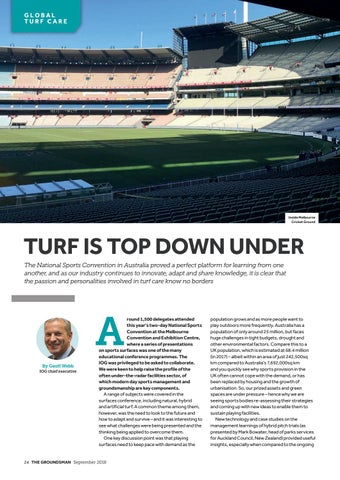
Inside Melbourne Cricket Ground
TURF IS TOP DOWN UNDER The National Sports Convention in Australia proved a perfect platform for learning from one another, and as our industry continues to innovate, adapt and share knowledge, it is clear that the passion and personalities involved in turf care know no borders
A By Geoff Webb IOG chief executive
round 1,500 delegates attended this year’s two-day National Sports Convention at the Melbourne Convention and Exhibition Centre, where a series of presentations on sports surfaces was one of the many educational conference programmes. The IOG was privileged to be asked to collaborate. We were keen to help raise the profile of the often under-the-radar facilities sector, of which modern day sports management and groundsmanship are key components. A range of subjects were covered in the surfaces conference, including natural, hybrid and artificial turf. A common theme among them, however, was the need to look to the future and how to adapt and survive – and it was interesting to see what challenges were being presented and the thinking being applied to overcome them. One key discussion point was that playing surfaces need to keep pace with demand as the
24 THE GROUNDSMAN September 2018
population grows and as more people want to play outdoors more frequently. Australia has a population of only around 25 million, but faces huge challenges in tight budgets, drought and other environmental factors. Compare this to a UK population, which is estimated at 68.4 million (in 2017) – albeit within an area of just 242,500sq km compared to Australia’s 7,692,000sq km and you quickly see why sports provision in the UK often cannot cope with the demand, or has been replaced by housing and the growth of urbanisation. So, our prized assets and green spaces are under pressure – hence why we are seeing sports bodies re-assessing their strategies and coming up with new ideas to enable them to sustain playing facilities. New technology and case studies on the management learnings of hybrid pitch trials (as presented by Mark Bowater, head of parks services for Auckland Council, New Zealand) provided useful insights, especially when compared to the ongoing
GLOBAL TURF CARE
SPORTS CONVENTION
AUSTRALIA’S INDUSTRY ASSOCIATIONS
Sydney’s ANZ Stadium
Eclipse stabilised turf system at the MCG
trials in the UK at Regent’s Park and Bisham Abbey, led by Sport England.
INDUSTRY VOICES
Among the many global keynote speakers were: Sport England’s CEO Jennie Price; Alistair Cox, who represented the Federation of International Hockey (FIH) and has an extensive background advising on sports facilities and surfaces; sports bodies including FIFA and UEFA; and Australia’s leading thinkers and practitioners. Several presentations were based on case studies to showcase technology, management practices and innovative solutions that can improve playing capacity. Indeed, themes of learning from the professional environment and applying new technology at community level were evident throughout the sessions – and an overview transpired, one of natural, hybrid, synthetic and hard
Olympic Park, Melbourne, from the Yarra River
surfaces all working together to satisfy growing demand. One delegate there was Keith McPhee. Keith is the vice president of Sports Turf Association New South Wales and sports facilities team leader for Maitland City Council in New South Wales. He is also a member of the IOG, and regularly keeps abreast of what we are doing in the UK via his monthly edition of The Groundsman. It was encouraging to know that the IOG itself had
“An overview transpired – natural, hybrid, synthetic and hard surfaces all working together”
The Sports Turf Association (STA) Australia is dedicated to the development and professionalism of sports turf management. The STA Australia Committee comprises representatives from the seven STA states – from Queensland to Tasmania – each of which works independently, managing sponsorship and events. The STA established a national body in June 2014 to create a stronger, more united organisation. The Sports Turf Association (Victoria) is the STA’s trading name and is a member of the Turf Grass Association of Australia (TGAA). The TGAA was formed in Melbourne after a meeting at the MCG on 22 November 1989. A steering committee was elected and the aims and objectives ratified at the first annual general meeting in 1990. The TGAA was formed to give all turf managers and allied trades a single representative body. Up until then, sports field curators, racecourse managers, council workers, groundsmen and those connected with the industry such as chemical, fertiliser and irrigation personnel had only a small amount of input into how the sports turf industry was organised. The formation of the TGAA, however, meant that everyone associated with the industry had a say. The TGAA describes itself as a non-profit industry body, funded by its members and sponsorship, representing Australian turf practitioners and industry bodies. www.sportsturf.asn.au
www.iog.org THE GROUNDSMAN 25
GLOBAL TURF CARE
Keith McPhee and Geo We
“The MCG pioneered the world’s first successful portable cricket pitch technology” members based in Australia, and we look forward to Keith paying us a visit in 2019.
SPECTACULAR VENUES
During my trip, I was privileged to visit some spectacular Australian sports venues including the Melbourne Cricket Ground (MCG), where I was kindly given a tour of the site by Erik Kinlon, general manager of HG Sports Turf, which specialises in the design and construction of sports fields across Australasia. HG’s products include what we know in the UK as the Eclipse stabilised turf system, now in use at the MCG. Another visit of note was to the 110,000seat ANZ Stadium, a legacy stadium of the
Warm-up area outside the ANZ Stadium in the Olympic Park, Sydney
Sydney Olympics, which uses a ‘lay and play’ system. Flexibility is a key driver here, as Australia’s stadia have to accommodate a heavy sports and events programme. The MCG pioneered the world’s first successful portable cricket pitch technology, involving a lightweight steel frame, pitch construction method and installation machinery that makes the installation, removal and performance of the portable pitch system workable. The system involves growing and nurturing cricket pitches off-site and ‘dropping’ them into the centre of the arena at the start of the cricket season, and it has also enabled MCG to produce a FIFA-standard soccer pitch for Olympic football just 10 days after the 2000 AFL Grand Final. The absence of cricket pitches from the centre in the winter months provides a safer playing surface for AFL players and allows events such as international soccer and Bledisloe Cup rugby to be played on a world-class surface. In the UK, the Eclipse and Hero turf systems are supplied by County Turf, which has installations at Leicester Tigers
and Brentford FC home grounds and The Grove in Watford, while the Hero system has been laid at Gloucester Rugby Club and at Real Madrid’s training facility. While in the UK and Europe the recent trend has been the stitched-in model with both Desso and SIS being dominant in many stadia, in Australia the lay-and-play systems seem like the preferred choice. This is due to the large amount and varied level of sports being played, as well as other events that are held in both the MCG and the ANZ stadia. Clubs in the UK and across Europe have the choice of a number of hybrid products and what will be interesting to see over the next 10 years is the impact these products will have beyond the stadia, in community level sport. Sustainability against a backdrop of lack of investment will require new thinking and new technology if we are to meet the participation demands of our various sports. To find out more about the National Sports Convention, visit: www.nationalsportsconvention.com.au
i
ABOUT THE EVENT The National Sports Convention is recognised as Australasia’s largest community sport and recreation knowledge-sharing event, especially with the integration of the Australian Sports Commissions’ ‘Our Sporting Futures Conference’. The convention was developed by Martin Sheppard of the Smart Connection Consultancy. He
26 THE GROUNDSMAN September 2018
co-founded the two-day event, which is led by educational sessions but also provides suppliers with the opportunity to exhibit. Martin has also co-written a number of Smart Guides including Football Fields, Maintaining Synthetic Turf (featuring practical tips) and Synthetic Sports Fields. Visit www.smartconnection.net.au for more details.
Lighting rig at Melbourne Cricket Ground
ELITE CRICKET
BEST PRACTICE
FAREWELL TO LORD’S GUV’NOR OF GRASS After 49 years at Lord’s Cricket Ground, Mick Hunt retires. He’s been praised by his peers for being constantly involved, committed and deeply caring for the ‘home of cricket’
L By Chris Biddle MCC member and consultant editor of Turf Pro
ook towards the sightscreen at Lord’s Nursery End during a Test match, and you’ll often spot Mick Hunt in the groundsman’s ‘paddock’ beneath the media centre. Furrowed brow, arms folded, his eyes search the weather coming from the back of the pavilion, waiting for a sign of rain or bad light that will prompt the grounds staff to rush onto the field. Like all groundsmen, Mick spends a lot of time looking at the sky. He’ll have all the latest weather gizmos at his disposal, but rather like a farmer, there is no substitute for having that in-built radar, that feel
28 THE GROUNDSMAN September 2018
and experience for weather conditions that he’s gained over the years. Despite the changing face of architecture at Lord’s cricket ground, mixing old with the new, the focal point remains the playing surface, and Mick is fiercely protective of his patch, no more so than when the pitches are prepared for Tests – normally two a year. “We treat them with kid gloves,” he says, “and even get angry when someone looks at them!” But that’s not all, he is equally obsessive over the outfield. In mid-August, Mick prepared the stage for his last Test, having announced his retirement after a
ELITE CRICKET
Photos: Courtesy of the MCC
BEST PRACTICE
remarkable 49 years. It has been a consistent and resilient career, rarely receiving the plaudits he deserved, and always in the firing line when things didn’t go to plan (as is the grounds person’s lot). Perhaps inevitably, his last Test (against India) proved to be one of his most challenging, although there have been a few of them over the years. Consistent rain prevented any play on the first day, Thursday, which was the first Lord’s Test day to be completely washed out for 17 years. Friday dawned bright, then a series of storms restricted play to two short periods before lunch. A violent storm hit just before 4pm flooding the outfield. The grounds staff could not mop up immediately and had to stay off the playing surface because of lightning in the area. Astonishingly, thanks to the new outfield and drainage system installed in 2003, and the efforts of Mick and his crew, play resumed just before 5.30pm providing a patient crowd with a wonderful two hours of play: Jimmy Anderson, in typical English conditions, took five wickets as India were dismissed for 107.
RECORD NUMBERS
A keen club cricketer in his youth, Mick lived ‘a good six hit’ from Lord’s, and after seeing a vacancy, joined the grounds staff in 1969, working under head groundsman Jim Fairbrother who had taken over the role the
Clockwise from left: Mick with his grounds team; des ite su erin with cancer for the last 10 years, Mick always ‘got on with the job’; Mick with Phil Tufnell (left) and Michael Vaughan; Lord’s cricket ground
”Mick spends a lot of time looking at the sky. He’ll have all the latest gizmos, but there is no substitute for having that in-built radar” previous year. After Jim’s death in 1984, Mick was promoted to replace him, becoming the ninth head groundsman at Lord’s. His first Test in charge was during the Ashes series of 1985, which Australia won by four wickets with Allan Border scoring 196. There were obviously no gripes about pitch preparation from the Aussies then!
OUTFIELDS AND OLYMPICS
For all its fabled ‘hallowed turf’ status, the Lord’s playing surface has posed several challenges to Mick throughout his career. Notably, the slope. The outfield falls 8ft 6in from the square, which itself is not totally level. “If I could change one thing, I’d like a nice, level square,” says Mick. “But to backfill and level the surface down to the mound stand you would need to dig up half of Lancashire!” And presumably lose several rows of seats. But in 2003, that is exactly what they did at Lord’s, which had always been prone to flooding. “There has only to be a cloud in the sky for the ground to puddle,” he says. It was particularly bad in the early ‘80s when eight
hours were lost during the Test against India, over nine hours in the West Indies Test and then, embarrassingly, 10 hours during the showpiece Centenary Test in 1980. Lord’s was built over dense London clay so surface water simply stayed where it lay and days of cricket were lost, along with valuable revenues. The decision was taken to rip out the outfield, leaving Mick’s treasured square as a pristine island in the midst of acres of bare soil. During the period of September 2002 to April 2003, 16,000 tonnes of turf and topsoil were removed – a process involving 800 lorries. New drains, state-of-the-art irrigation systems and rootzone were put in before final turfing. For months the playing area looked like a building site, but come the spring, spectators attending the first game of the season were unaware of the dramatic reconstruction of the ‘earth beneath’. The £1.25m expense was totally justified in 2007 on the second day of the Test against India when a thunderstorm hit the ground shortly after breakfast and over an inch of rain fell on the ground, which soon resembled a lake. Before the outfield renovation, play www.iog.org THE GROUNDSMAN 29
Photo: Chris Biddle
ELITE CRICKET
Olympic archery was held at Lord’s in 2012, giving Mick a new challenge
MICK HUNT’S CAREER IN NUMBERS In the 49 years he has been at cricket’s headquarters, he will have been involved in preparing the surface for: 24 Tests working on the ground with Jim Fairbrother 63 Tests as head groundsman (including an Australia v Pakistan Test played at Lord’s in 2010 and the 1970 England v Rest of World ‘Test’) 12 One-Day Internationals (ODIs) working with Jim Fairbrother (including three World Cup Finals) 50 ODIs as head groundsman (including one World Cup Final). That’s a total of 149 Tests and ODIs – 113 of them as head groundsman With Lord’s hosting around 30 other matches this year, from the Royal London One-Day Cup Final to Vitality Blast games and the National Village Cup Final, Mick will have prepared more than 4,000 pitches and outfields during his time at the club. That’s a quarter of the time that Lord’s has hosted major cricket.
30 THE GROUNDSMAN September 2018
would have been lost for the day, possibly a couple of days. Yet, spectators were amazed to see water simply seep through the surface and play commenced before lunchtime. An outfield relay was also required when Lord’s was chosen as a venue for the 2012 Olympic archery competition. A full programme of cricket was played until 1 July, after which control of the venue passed from the MCC to the International Olympic Committee. You can imagine that Mick was not too chuffed – within weeks his outfield was filled with stands holding 5,000 people. The square, however, was out-of-bounds so that he could continue regular maintenance. The archery final took place on 3 August and the race was then on for Mick and his team to return Lord’s to its cricket-ready state for a Test against South Africa starting on 16 August. A third of the outfield was re-laid and on the opening day the ground presented itself to players and spectators with little sign of the enormous upheaval. It had been an ‘Olympian’ feat by Mick, his grounds crew and the turf contractors. “Afterwards, the pitch was marked as very good by the match referee,” recalls Mick with a mixture of pride and relief.
KEEPER’S VIEW
It is clear that Mick is highly regarded by players, umpires and officials. He has a good relationship with them – they trust him and they value his knowledge and integrity. Like every Test venue, the ‘strip’ is analysed, prodded and poked, filmed in macro-detail and analysed to the nthdegree. “My overriding aim has always been to produce a pitch that provides a
good contest,” says Mick, adding ruefully: “Batsmen and bowlers have off-days, but groundsmen are not supposed to have them.” The pitches prepared by Mick have, particularly in recent years, been regarded as fair and balanced, progressing from batsmen-friendly on the opening days to assisting bowlers during the latter stages.
GETTING ON WITH THE JOB
Mick has always presented a self-effacing, philosophical, critical approach to his role. Fame and adulation do not sit easily with him. Describe him as a legend of his profession and he’ll shrug off the compliment. It is well known that he has lived with cancer for the past 10 years but has ‘just got on with the job’. The Marylebone Cricket Club (MCC) has enormous respect for the person who has looked after their most valuable asset for almost half a century. Before the start of play during his last Test, Mick was awarded Honorary Life Membership of the MCC by the current president, Lord MacLaurin, in front of a standing ovation. Acknowledging that Mick will be a ‘tough act to follow’, John Stephenson, MCC assistant secretary says: “Mick Hunt’s place in the history of Lord’s is assured.” All those in the turf grass profession and all those in cricket will wish Mick a long and healthy retirement. Chris Biddle is consultant editor of Turf Pro and an MCC member. This article is an updated version of a feature from Turf Pro.
i
TECHNICAL U P D AT E
DISEASE CONTROL
PREVENTION LEADS IN FUNGICIDE TRIALS Following the recent loss of the curative active ingredient, iprodione, STRI tests whether preventative disease control programmes can outperform curative options
B By Colin Mumford Bayer technical manager
ayer, Headland Amenity and Rigby Taylor joined forces with STRI to compare preventative and curative programmes, and to highlight how Microdochium Patch can be minimised by taking a different approach. As anticipated, preventative treatments performed significantly better on the trial plots. The trial compared spray programmes across nine preventative and three curative programmes, as well as one untreated plot. STRI analysed plots for turf quality, colour and presence of Microdochium Patch over a nine-month period at the site in Bingley, Yorkshire. The first three preventative programmes, P2 to P4, used purely preventative fungicides from Bayer including Dedicate and Exteris Stressgard. The rest of the preventative plots used a combination of these fungicides with additional plant health products from Rigby Taylor and Headland Amenity – and these saw the most consistent results. There were peaks and troughs of disease activity as expected over the course of the trial, with October and December seeing spikes. However, it’s also important
to note that the disease pressure at the trial site wasn’t as strong as general trends across the UK. Plots P5 to P7 had the greatest level of control for Microdochium Patch. But plots P6 and P7 particularly excelled due to the combination of fungicides and plant health products. The differences between turf quality on the plots were less obvious but followed a similar trend. Overall the preventative programmes had better turf quality than the curative programmes. Again, plots P6 and P7 showed the most consistent results throughout the whole trial. Turf colour followed a similar pattern, with treatments on P6 and P7 once again showing the most consistent colour throughout. None of the trial plots were treated with any cultural or biological controls during the nine months, other than mowing and switching when necessary. This is because we wanted to understand the differences that preventative or curative applications alone would achieve.
PLANNING AHEAD
During the trials, even the ‘strongest’ curative programme was significantly outperformed by the preventative options. With the extreme stress turf has endured this summer, it’s important that both cultural and biological practices are used to reduce the risk of Microdochium Patch this autumn. In particular, groundsmen should study historic weather conditions as well as the local forecast to help identify favourable disease conditions. This will help with planning preventative fungicide applications ahead of potential disease-inducing conditions. This autumn we will continue our research to see how we can improve on current disease management programmes. Visit the companies’ websites for more information about their plant protection products: Rigby Taylor www.rigbytaylor.com; Bayer www.environmentalscience.bayer.co.uk; Headland Amenity www.headlandamenity.com
i
The trial analysed plots for the presence of Microdochium Patch
34 THE GROUNDSMAN August 2018
www.iog.org THE GROUNDSMAN 33
AMENITY FORUM CONFERENCE
CONFERENCE
CHANGE, CHALLENGE AND OPPORTUNITY
This year’s Amenity Forum Conference promises to be as topical as ever for everyone involved in weed, pest and disease control
T By Prof John Moverley Amenity Forum chair
his year, the programme will be divided into three sections. The first addresses the change agenda, with presentations from the Chemicals Regulation Division, the Environment Agency and from Professor Michael Eddleston, a member of the Expert Committee on Pesticides and a specialist on human health issues. The second section will include a number of presentations from across the amenity spectrum, addressing the challenges of change and how organisations are responding. These presentations will include Steve Isaac from the R&A on the challenges golf is facing. The final section will look at the opportunities, and include speakers on biological control and mechanical weeding. The talks will be interspersed with opportunities to visit the trade exhibition area, to network and to hear about new developments and innovations. The conference presentations are just 20 minutes long, which means they will be focused, and guarantee a packed and lively programme. The conference will conclude with a presentation from the landscaping team at Manchester City FC on the pressures of creating and maintaining high-quality sports surfaces.
WHAT IS THE FUTURE? Image: 2017 Sprayer of the Year award winners
There has undoubtedly been of late real pressures on all involved in maintaining sports surfaces. We have seen the loss of important
“The Amenity Forum is the collective voice for the sector” chemical products after they failed to meet European renewal approval. This has created a period of review and indeed a re-think on the right approaches. The Amenity Forum is the collective voice for the sector on such matters. It is important that we all fully support it and ensure we follow all the guidelines for best practice. The IOG is proud to do so. We all need to demonstrate to the government that we have that commitment, allowing us to maintain our ability to undertake essential work. Speaking at an event recently, I used the thoughts of Charles Darwin: “It is not the most intellectual of the species that survives; it is not the strongest that survives; but the species that survives is the one that is able to adapt to and to adjust best to the changing environment in which it finds itself.”
i
The Amenity Forum Conference will be held on 9 October at the Pirelli Stadium, Burton on Trent. Delegate rate is £85 and a special initiative is in place this year for delegates from local authorities. To register, email admin@amenityforum.net or see full details at www.amenityforum.co.uk www.iog.org THE GROUNDSMAN 35
IN ACTION
LIMAGRAIN IS A PROVEN PACKAGE FOR ‘THE POSH’ Ryegrass formula is perfect for renovation and offers fast germination Rob Bradshaw, head groundsman at Peterborough United FC’s Mick George Training Academy, has admitted that he is currently ‘living the dream’. As a lifelong Peterborough United fan, he is now working for the club that he loves doing a job that he loves. In between his current full-time role at the academy, Rob is a pitch advisor for the Huntingdonshire FA and also runs a Sport England-funded grounds association in Cambridgeshire and Huntingdonshire. So passionate about providing the best surfaces he can, he even admits to sleeping in his car after tending to the pitches through the night.
Rob Bradshaw
Rob has been at Peterborough United FC for two years and after a season of settling in he soon decided it was time to make his mark. “It got to February time when I really wanted to start planning, make some improvements and finalise where we were going to go with our end-ofseason renovations. Firstly, I needed to choose a good grass seed because I only want to use the best products here. I did my homework on various products and gave a number of companies the opportunity to come in. “The Limagrain MM60 seed seemed to be the number one choice. I know that a lot of other professional clubs
use it and I have used various Limagrain products in the past – it has always been a proven package.” Limagrain’s MM60 grass seed is renowned for producing an excellent playing surface on a number of winter sports pitches. It is a 100 per cent Ryegrass formula, which is perfect for renovation and divot repair, has a high disease resistance, looks good and offers extremely fast germination. The result? “We had good germination within 10-12 days and we had excellent coverage,” said Rob.
i
For more information, visit www.lgseeds.co.uk/mm
INFINICUT MOWERS FOR HEADINGLEY Emerald Headingley Stadium takes delivery of a brace of Cub Cadet Infinicut mowers Home to both rugby union and rugby league, Leeds Rugby is currently in the midst of a £41m redevelopment and the Infinicut purchase is a ‘first’ for a rugby club in the UK. However, these aren’t the only new additions for head groundsman Ryan Golding to contend
he new nfinicut in action
with – the redevelopment also includes two new stands. “Myself and my team of three have our work cut out, with a busy schedule of play as we’re home to both Leeds Rhinos rugby league and Yorkshire Carnegie rugby union clubs. On top of multi-use rugby, we also host academy games, external events, training and more,” explains Ryan, who has been at Headingley for 15 years. While the facility is happy to invest where it’s considered to be required, when it comes to new machinery, Ryan must justify a solid business case. “Our previous mowers were starting to cause us a lot of problems, so we looked at some alternatives. I’ve demonstrated the Infinicut previously and been impressed with it, and after a few conversations with Vinny Tarbox of MTD, we realised the mowers could
make a big difference to the quality of our playing surface. The fact that the Infinicuts can be powered electrically went a long way in making a viable case. The reduced noise and emissions means that despite our inner-city location, we can mow earlier in the mornings, and have coped better with the hot weather.” Following their delivery in June 2018, the mowers are in use three to four times a week, including in the build-up to games, thanks to the cleanliness of cut and quality of finish they give. However, Ryan’s favourite feature is something else. “The Cub Cadets have quick-release, demountable wheels which are a godsend when it comes to transporting the mowers 300 yards from our stores to the pitch!”
i
For more information visit www.cubcadetturf.com
www.iog.org THE GROUNDSMAN 37
Product showcase
READ MORE
IOG NEWS UPDATES Go to the IOG website www.iog.org
THIS MONTH, TOPDRESSERS, SPREADERS AND BRUSHCUTTERS GBK machines are easily mounted on standard turf vehicles
RED DEVIL
ONE-PASS PERFECTION
FILL THE BILL
Sublime sand spreading and filling THE NEW GKB Sandfiller and SP100 Sandspreader are both from the GKB range specifically designed for the maintenance and renovation of sports pitches and golf courses. The SP100 has been developed following the success of GKB’s trailed versions to meet customer needs, with easy mounting onto turf trucks, like the John Deere Gator and Toro Workman. Mounting is straightforward with a simple bolt-on system, and stand legs allow the SP100 to be quickly set up or removed. With its 1m3 hopper capacity, the machine suits a variety of purposes, evenly distributing materials such as sand and mulch onto sports pitches with variable spread widths and depths. It is easily
KEEP IN TOUCH
www.iog.org
“The GKB Sandfiller is built to tackle the problems of surface drainage and aeration” fitted with electro-hydraulic controls and runs directly off the hydraulics of the chosen turf truck. The GKB Sandfiller is built to tackle the problems of surface drainage and aeration. It simultaneously aerates and fills the topsoil with sand, creating the right conditions for excellent root growth. To allow the machine to properly follow the contours of the ground, three adjustable depth rollers are used, while a slitting rotor, situated between conveyor rollers, operates the aerating and slitting actions. Two conveyor rollers are pivoted to distribute weight efficiently, and material removed from the top layer by verticutting is immediately collected in a sideways tipping container. The sand flow is controlled hydraulically by means of an adjustable valve situated on the side of the machine. www.gkbmachines.com
www.facebook.com/theIOG
Institute of Groundsmanship
‘VERSATILE’ AND ‘PRECISE’ are the words used to describe the Toro ProPass 200 , a broad-style topdresser praised for its ability to deliver accurate spread patterns – from ultra-light dustings to heavy-duty aeration hole filling – from the first pass. Whether you opt for the towed or utility vehicle-mounted version, there’s no guesswork involved thanks to a colour-coded operating system that delivers a consistent spread with defined edges every time. And, as with most Toro machines, this one is easy to use, clean and maintain. The twin spinner accessory can even be swapped out with a 180-degree swivel cross-conveyor, without using tools. Real-time adjustments are possible with the wireless controller, allowing the operator to make quick setting changes as well as adjust storing settings for future use. www.reesinkturfcare.co.uk
Toro’s ProPass 200 gives precise application from the first ass
twitter.com/the_iog
www.iog.org THE GROUNDSMAN 39
PRODUCT SHOWCASE
TOPDRESSERS AND SPREADERS
DRESS FOR SUCCESS
A METICULOUS FINISH EVERY TIME NEED TO SWITCH from light dressings to heavier dressings at the touch of a button? The Rink DS800 topdresser offers this flexibility with just one small adjustment, giving you accurate coverage on any type of surface. It can be trailed behind a 30hp compact tractor – offering the benefit of four wheels on an articulating axle – or fitted to a John Deere ProGator or Toro Workman truck for a lighter footprint, and has a working speed up to 19mph. It has a variable spread pattern up to 12m (36ft) and, thanks to the dual spinners, can apply precise amounts of material, even if the material is wet. The DS800 is a compact unit at 2.4m long with a 0.8m3 hopper and the benefit of a hydraulic rear door as standard – the shallow configuration of the hopper preventing material ‘bridging’ or sticking. It can offer a spreading thickness of up to 15mm and can be used for small-grained, loose material, such as sand, small granular material or similar. www.charterhouse-tm.co.uk
The Rink DS800 topdresser
40 THE GROUNDSMAN September 2018
With a 400kg capacity, the TBS300 is a heavy-duty mobile spreader
HOP TO IT
Tackling the big jobs with ease
THE TBS300 MOBILE Broadcaster is or small tractor. Alternatively, SCH a large, 300 litre-capacity spreader Supplies has a 250l capacity version, with a robust plastic hopper. which can be mounted to a threeThe machine is mounted on two point linkage. pneumatic wheels, and is especially By designing and manufacturing its useful for spreading fertiliser or own equipment, SCH has great road salt over large areas. flexibility when it comes to A heavy-duty sieve is customers requesting SEE MORE fixed into the hopper, variations to its standard and a powerful agitator P R O D U C T S products. This means keeps the fertiliser or spreaders, trailers, Find out what’s new this month salt flowing freely onto grass-care systems page 12 the spreading rotor. A and other products can guard is fitted around the be customised to suit the spreading rotor to restrict the requirements of the user, radius of spread. The spread allowing them to keep their grounds width ranges from an impressive in perfect condition as efficiently 6m to 18m as possible. The drive mechanism can be www.schsupplies.co.uk disengaged to allow the unit to be towed to the spreading area. A ball or towing clevis can be fitted, allowing the spreader to be towed by a car
“Spreaders, trailers, grass-care systems and other products can be customised to suit the requirements of the user”
PRODUCT SHOWCASE
TOPDRESSERS AND SPREADERS
POWER UP
The Powaspred goes easy on fine tur
DURABLE AND VERSATILE THE POWASPRED IS a tractormounted (minimum 15hp requirement) topdresser that spreads a wide range of materials at the desired rate, with an even, consistent spread. Use it with most free-flowing materials – sand, loam, rock salt, rubber crumb and hard porous dressings – for sports surfaces including football, hockey, rugby, cricket and golf. Special features include: infinitely variable spreading
rates; oscillating base plate to reduce bridging; rotating brush at point of discharge to ensure even spread; and four tyres on a twin axle to avoid marking and spread load on fine turf. www.sisis.com
#SoMuchChoice
95
0
15 20
10 10
D
S8
00
D
S5
50 SP
Brush or Disc spreading - it’s your choice!
SP
Pedestrian, Trailed or PTO
“Use it with most freeflowing materials – sand, loam, rock salt, rubber crumb, hard porous dressings – for sports surfaces including football, hockey and rugby”
0.95M spreading width to 15M See us at Saltex 2018 on Stand K070
www.charterhouse-tm.co.uk | 01428 661222
PRODUCT SHOWCASE
BRUSHCUTTERS
GOING PRO
TOP OF THE FIELD
The FSA 130 R is powerful yet lightweight
GOOD CHOICE
NEW, UNBEATABLE BRUSHCUTTERS FROM STIHL
THE ADVENT OF the new cordless FSA 130 and 130 R brushcutters mark yet another addition to STIHL’s ever-expanding PRO range. These powerful but lightweight machines are specifically designed for professionals working on large areas of thick grass. The FSA 130 is well suited to clearing large patches of grass and scrub quickly and efficiently thanks to the bike handle, while the FSA 130 R features a loop handle that makes it perfect for use in tighter spaces. The tools boast three adjustable power settings that can be changed via the handle, depending on the task in hand, and to help conserve battery power when full speed is not required. Powered by a 36 V lithium-ion battery with an electric motor, the FSA 130 and FSA 130 R are extremely energy efficient, lightweight and well balanced, weighing just 4.4kg excluding the battery. They run quietly, making them perfect for use in noise-sensitive areas, and the low vibrations during operation provide high operator comfort. Both tools can be powered by STIHL’s range of 36V battery systems, AP batteries or AR backpack batteries. www.stihl.co.uk
42 THE GROUNDSMAN September 2018
RECOGNISED FROM AFAR by its distinctive ‘cow-horn’ handle, Pellenc’s Excelion 2000 is designed for routine maintenance or intensive strimming and will meet the expectations of even the most demanding users. Strimming long grass, weeds and undergrowth on steep or difficult terrain demands particularly well thought-out tools. They need to be rugged, powerful, easy to handle and ergonomic in use – just the characteristics of this handheld brushcutter, and an ideal tool
“The Excelion 2000 uses the ultra-high capacity technology of the Pellenc lithium battery and guarantees non-polluting, odourless operation”
for professional landscapers and contractors. With a new heavy-duty harness and weighing just 5.1kg, the Excelion 2000 can be bought with a choice of five interchangeable cutting heads. As with all other Pellenc products, the Excelion 2000 uses the ultra-high capacity technology of the Pellenc lithium battery and guarantees nonpolluting, odourless operation with quick start-up and up to 4.5 hrs of continuous operation. The Pellenc ULB battery range is designed for professional tool use. ULB batteries allow the user to work for up to a full day on a single charge. Pellenc says it is the only professional tool manufacturer to offer a whole range of tools that operate with ultrahigh capacity multi-purpose batteries. Sold exclusively in the UK by Etesia. www.etesia.co.uk Use this product for routine maintenance or intensive strimming
PRODUCT SHOWCASE
BRUSHCUTTERS
The new multitool in action
SHARP OBJECT
New splitshaft multitool from Makita
MAKITA HAS LAUNCHED a 36v cordless multi-tool system for landscape maintenance operations, together with a range of quickfit attachments including the newly introduced brush cutter and linetrimmer. These are in addition to the cultivator, pole saw, hedge trimmer and lawn edging tool. The pole extension allows greater reach for the pole saw and hedge trimmer. With the move to battery-powered grounds maintenance machines, particularly at the demand of municipal authorities and public bodies, the new DUX60Z is powered
by two Makita 18v lithium-ion batteries to supply energy to the 36v DC motor drive system. The Makita DUX60Z LXT splitshaft motor unit has an effective output of 600 watts, a three-speed drive system that will run up to 9,700 rpm, and a reverse gear. The on-off button with auto-off turns the power
off if the trigger is not activated for 60 seconds. The versatile attachments are easily fitted with a tool-less slide joint coupling with a simple clip-lock that fixes the attachment in place. Maximum weight with the largest batteries and tool head is just 8.7kg. www.makitauk.com
Tools & guidance MAINTENANCE CALENDAR AND WEATHER UPDATE
WEATHER UPDATE
Find out what's in store this September page 47
OCTOBER OPERATIONS BOWLING GREENS
End of season renovation will be completed this month. Greens that are renovated late may benefit from the turfing of thin areas. Watch out for Fusarium, especially if topdressing has been applied. Ditches should be cleared of their fill material then cleaned and washed down. De-commission the irrigation where applicable before the winter frosts set in. Carry out repairs to banks when work on the green is complete.
TENNIS COURTS
Remove fallen leaves from adjacent trees to avoid them smothering the sward. Lightly top the grass to keep it well trimmed. Switch or lightly drag brush the court surface to remove dew and reduce the potential for disease attack. Keep an eye open for disease attack, especially if mild and humid conditions occur. Keep off the court wherever possible to allow good, initial grass establishment. De-commission any irrigation system in place.
CRICKET SQUARE
Ensure renovation is finished as soon as possible. Germination sheets on the ends can aid any late germination and initial establishment of seed - but watch out for disease. Drag brush on a regular basis, especially if dew is present. Earthworm activity can be high now, so drag brush when dry.
Chemical control may be required. Keep the square topped at a suitable height of cut – no more than 25 mm – as this will maintain a suitable sward density and prevent the sward from thinning out. Fence off the square to maintain its integrity.
CRICKET OUTFIELD
Repair areas of wear as required. Be vigilant for pest and disease attacks; the use of a drag brush or similar will help reduce the chance of attacks. Fungicide or pesticide application may be required. Mow as required, but this should be much less frequent. If the outfield is to be used for winter sports, be vigilant for damage and wear areas; repair as soon as possible. Aerate throughout this month to maintain surface drainage and root development.
FOOTBALL
The pitch shouldn’t be showing many signs of wear if it has been managed with the long-term season in mind. If not, some soilbased pitches may be exhibiting significant wear in goalmouths and centre circles. An application of sand, combined with hand forking, can help maintain a dry surface. Raising the height of cut slightly, say up to an extra 10 mm, on high wear areas can help to maintain an improved level of ground cover for a longer period of time.
Divot the pitch as required. This operation will be essential on pitches maintained to a high standard. Higher standard pitches will also need to be brushed to maintain an upright grass and to maintain good presentation.
with the coaches is essential for rotation of drills, as any damage inflicted now to the surface will not be able to be repaired to get through the winter.
HORSE RACECOURSE
RUGBY UNION
The frequency of cut for the pitch will be reducing considerably as grass growth slows. Consider drag brushing to produce a striping effect in between cuts. De-commission any irrigation system to prevent frost damage. Continue to aerate where ground and soil conditions permit.
RUGBY LEAGUE
The traditional end of the season will have arrived or shall be coming quickly; as such, make sure any end of season renovation plans are underway. This should involve scarification, overseeding, topdressing, vertidraining and an autumn/winter feed. With the season finishing so late, be sure not to renovate too harshly as this will have an adverse effect on grass cover and sward for the next season. Cordon off the area to protect from unwanted visitors. Constant drag brushing and switching of the surface will help to alleviate any dew that appears. De-commission any irrigation system to prevent frost damage. On the amateur side, constant pitch repair is essential, as any divots not replaced will lead to pitch deterioration. Cutting should be kept to a minimum as grass cover will be required to get through the winter months so drag brushing the stripe in would be useful. Constant communication
The course should be prepared ahead of the start of the National Hunt season. Courses used just for flat racing will be rested over autumn and winter. The whole course should be mown and tidied, with extra effort being put into the presentation for the first meeting. De-commission the irrigation system. Some parts of the course might be prone to leaf coverage from nearby trees. Regular clearing will avoid the turf being smothered. Consider using the leaves in a soil compost heap, which can later be used for topdressing. Prepare fences and jumps prior to the start of the season. With the growing season coming to a close, now is a good time to consider attending training courses or to enrol on courses that lead to recognised qualifications or to maintain continuous development.
GOLF COURSE
The renovation of the greens, and ideally the tees, should be completed by now. Fairway renovation, particularly divoting, will most likely still be ongoing. This is usually a good month for the deep spiking of fairways, as the ground is typically neither too dry nor wet for adequate tine penetration and soil shattering. Slit tining of greens should not be neglected just because the greens will have been renovated fairly recently.
www.iog.org THE GROUNDSMAN 45
TOOLS & GUIDANCE
W E AT H E R
TOP TIPS • Watch out for early disease risks • Don’t wait for visible infection in high risk periods • Overseed while conditions remain good • Use GreenCast to predict disease risk (www.greencast.co.uk)
September light levels will fall and night times will be cooler
CHANCE TO RECOVER GROWTH
T
his year’s extreme heat and prolonged drought has put unprecedented pressure on turf health. More recent welcome rain has started the process of recovery, but also revealed underlying issues with plant rooting and strength. Last year, the weather followed recent trends and produced good growing conditions that continued into September and the autumn. It gives opportunities to restore turf health and root mass.
SEPTEMBER 2017 HIGHS ’N’ LOWS • For the UK as a whole, growing conditions were good with slightly higher rainfall,
although sunshine levels were down. • Temperatures were higher again – most significantly with warmer night time temperatures that kept turf growing. • Wales and Northern Ireland were particularly wet, with 50 per cent more rain than normal, but the west of Scotland received only an average amount. • Unusually, most of England, including the eastern counties, had significant rain on more than half the number of days. The summer’s weather has created huge challenges for turf managers. After the intense heat and long, dry conditions, some areas received torrential downpours and
SEPTEMBER WEATHER, COMPARED TO RECENT SEASONS. Av Temp (°C)
Sun (hours)
Days with more than 1mm of rain
Rain (mm)
2014
2015
2016
2014
2015
2016
2014
2015
2016
2014
2015
2016
11.9
14.6
12.6
157
120
109
52
97
117
9
14
18
N England
11.8
15.0
12.7
128
136
110
43
69
115
8
11
18
S England
13.0
16.4
13.8
181
136
123
55
59
79
8
10
16
Scotland
10.8
12.7
11.2
130
97
94
50
144
142
9
18
19
UK
Rainfall and sunshine were remarkably close to average in 2016, although somewhat duller and wetter than in 2015. However, the most noticeable feature was the significantly warmer temperature throughout.
isolated flooding in August, while a few miles away, there was little or no rain; localised weather forecasting and recording has never been more important. Making the most of available conditions with healthy green leaf area is crucial as September light levels start to fall quickly, and evenings start to get cooler. Typically, night time temperatures are an average 2°C cooler, compared to August, with 40 hours less sunshine – a reduction of 25 per cent. Creating stronger turf with Primo Maxx II and Qualibra wetting agent, along with a proactive fungicide strategy where required, is paramount. It will help turf recover from the shock of the summer, improve success of renovation overseeding and prepare it to withstand the winter stresses.
HUMID DISEASE RISK
As humidity rises through the month to the end of September, and as growth slows, the opportunity to outgrow disease is limited, and the risk of an early Microdochium Patch (Fusarium) attack increases. This season the dry thatch is likely to have beneficially reduced the potentially infective pathogen loading, but populations can build quickly in conducive conditions, particularly on stressed turf. GreenCast weather and disease records last year highlighted weather conditions that created protracted risk periods for Microdochium in September, which rose significantly to high risk in October. This has helped to pinpoint the ideal timing for planning proactive preventative systemic treatments during periods conducive to disease but before symptoms are visible on the leaf surface.
www.iog.org THE GROUNDSMAN 47
RECRUITMENT
IOG
TO ADVERTISE IN THE GROUNDSMAN CONTACT JASPER KEELING: 48 THE GROUNDSMAN September 2018
E jasper.keeling@jamespembrokemedia.co.uk
0203 859 7097
IOG
TO ADVERTISE IN THE GROUNDSMAN CONTACT JASPER KEELING:
CLASSIFIEDS
E jasper.keeling@jamespembrokemedia.co.uk
0203 859 7097
www.iog.org THE GROUNDSMAN 49
GROW WITH THE IOG
NEW SOLUTION
IOG SITE AUDIT SERVICE
By Dan Prest Head of membership services (learning)
Site stakeholders have a vested interest in the grounds of a facility, how they are maintained and ultimately whether the output reflects the cost of the input, which is why a site audit is recommended
T
he IOG has recently launched a service that is designed to support all sports facility stakeholders – the bursar or finance manager, head of sport and grounds manager – by identifying key sports ground facility issues that affect the quality of a ground, the team’s well-being and general cost effectiveness. These issues can include carrying capacity, site constraints, manpower and resources. This full ‘site audit’ features three steps: a fact-finding exercise with the main stakeholders; an on-site visit; and an easyto-follow report that includes findings and valuable recommendations.
STAKEHOLDER SUPPORT
Richard Churchman, one of the IOG’s most respected trainers, has recently undertaken a series of audits at various sites across the south of England and explains how this service supports the facility management, the grounds personal and the end user. “The IOG‘s audit process relates to the site’s systems of management, resources (labour, equipment and materials) and the results obtained identify issues that KEEP IN TOUCH
www.iog.org
constrain the quality of grounds facilities. “The grounds staff are often very much aware of these issues and the investigations help to find ways in which the organisation can support the tasks of grounds management through better communication and co-ordinated use of materials and equipment.” Richard says that his audit visits often reveal issues that have not been fully understood by senior managers and the subsequent report has helped to find different approaches to turf problems. “Sometimes an impartial pair of eyes can see past immediate difficulties and can encourage a better understanding of grounds management for all,” he says.
SHARED INPUT
Richard adds that he can understand that a ‘site audit’ may sound daunting for grounds personnel, but throughout the process, everyone’s views are given equal attention. “We normally hold joint and individual meetings with all stakeholders. The major part of any visit is spent with the grounds staff and we ensure that this provides a great opportunity for a relaxed discussion.”
www.facebook.com/theIOG
50 THE GROUNDSMAN September 2018
Institute of Groundsmanship
HOW DOES THE IOG SITE AUDIT WORK? Step one: A phone or emailbased fact-finding exercise with an IOG industry expert. The discussion may include a bursar or finance manager, head of sport and grounds manager. Step two: An on-site visit with all relevant parties, to check and confirm any points raised. Step three: Information from the fact-finding exercises, discussions with relevant parties, observations made and advice given is documented in an easy-to-follow report. This will clearly identify the course(s) of recommended action.
For more information regarding the IOG’s site audit service, contact Dan Prest on dprest@iog.org or call 01908 312511.
i
twitter.com/the_iog