THE
GROUNDSMAN WWW.IOG.ORG
NOVEMBER 2017 £4.00
ACHIEVING EXCELLENCE IN GROUNDS MANAGEMENT
New growth Grounds and Natural Turf Improvement Programme expands
THE LUCK OF THE IRISH
Croke Park benefits from Stuart Wilson’s experience and expertise
INS IDE
THE FINAL COUNTDOWN TO THE 2017 IOG INDUSTRY AWARDS THE HIDDEN PROFESSION: UNDERSTANDING YOUR INDUSTRY ESSENTIAL WORK FOR WINTER PRODUCT SHOWCASE: DRAINAGE AND ESTATE MANAGEMENT SERVICES
Contents
November 2017 IN IT TO WIN IT
REGULARS 05 Welcome
Find out about this year’s IOG Industry Awards finalists page 28
Profiling our industry
06 Update
The latest news
14 Young IOG Board
Changes on the Young Board
39 Product showcase
Drainage and estate management
14
45 Tools & guidance
Maintenance and weather
FEATURES 16 GaNTIP update
The Grounds and Natural Turf Improvement Programme expands
20 COVER: Best practice Pitch management at Croke Park
26 Strategy update
28
The work of the IOG
28 IOG Industry Awards
ON THE COVER
The 2017 finalists explained
36 The hidden profession
Meeting the demands of heavy wear at Dublin’s Croke Park stadium
New research into our industry
43 In action
Products put to the test
50 Grow with the IOG
The learning pathway
36
43
THE GROUNDSMAN
Editorial address: 28 Stratford Office Village Walker Avenue Wolverton Mill East Milton Keynes, MK12 5TW t: 01908 312511 Managing editor Karen Maxwell e: kmaxwell@iog.org t: 01908 552987 Features editor Colin Hoskins e: editor@iog.org t: 01634 832 221 Product editor Elizabeth Hufton e: lizzie.hufton@jamespembrokemedia.co.uk t: 01225 337777 IOG membership and general enquiries t: 01908 312511 e: membership@iog.org Magazine subscriptions Sue Fernandes t: 01908 312511 e: accounts@iog.org Subscriptions £72 UK, £82 Europe, £112 rest of world Publisher James Houston Head of Design Simon Goddard Advertising Parminder Sangha e: parminder.sangha@jamespembrokemedia.co.uk t: 0203 859 7097 Published by James Pembroke Media The Groundsman is published monthly by the Institute of Groundsmanship. All material is copyright of the Institute of Groundsmanship and may not be reproduced without permission. The publishers do not accept responsibility for any advertisement appearing in the journal and cannot be held liable for editorial omissions or errors. The views expressed in the journal are not necessarily those of the Institute of Groundsmanship.
KEEP IN TOUCH
www.iog.org
www.facebook.com/theIOG
Institute of Groundsmanship
twitter.com/the_iog
www.iog.org THE GROUNDSMAN 3
Welcome
Contributors
Thank you for your support!
Karen Maxwell Managing editor
SALTEX and the IOG Industry Awards present a fantastic shop window for all the latest products, innovation and knowledge, and give the industry a chance to recognise and reward some outstanding groundsmen and women – from volunteer to professional. Every year the people behind the scenes do everything they can to create an exhibition and awards event that hits the mark. No easy task in a post-recession and now pre-Brexit climate. To all those exhibitors and visitors who have come to SALTEX since we moved to the NEC, thank you for your support. We couldn’t do it without you.
Colin Hoskins Features editor
INDUSTRY PROFILING A decade ago, the IOG presented the results of in-depth research into our sector – ‘Groundsmanship: The Hidden Profession’. Since then, the institute has taken positive action to: provide a voice for the industry; resolve individual issues; promote improved pay and conditions; attract more young people through the Young IOG initiative; and introduce a significantly revised training programme that provides an improved career progression structure.
Geoff Webb Chief executive
The IOG has also built partnerships with grounds managers working within professional sport as well as across the education and the voluntary sectors, and now has ambitious plans to introduce a nationally-recognised Pitch Grading System linking the technical requirements to levels of education and learning required at each level. At grassroots level, the NGB-funded, England-wide Grounds and Natural Turf Improvement Programme has been designed to significantly improve natural turf pitches at community sport level, and is now in its second funding cycle. During its first phase, more than 1,000 natural turf sites were visited and recommendations for improvement are already having a significant impact on the improvement of natural turf pitches, as well as raising the profile and the need to plan and invest in natural turf.
Dan Prest IOG head of member services
The IOG will commission a new piece of research in early 2018 (see page 36) and deliver the results at SALTEX 2018. If you’re interested in taking part, please do contact the IOG and register your details. This is your industry and this is a great opportunity to have your say and to help shape its future.
Will Graves Chair, Young IOG Board
Geoff Webb Chief Executive The Institute of Groundsmanship
KEEP IN TOUCH
www.iog.org
www.facebook.com/theIOG
Institute of Groundsmanship
twitter.com/the_iog
www.iog.org THE GROUNDSMAN 5
Update
READ MORE
IOG NEWS
Read all the latest news and updates, and discover what members are entitled to www.iog.org
THE LATEST HEADLINES FROM THE IOG AND THE INDUSTRY
LOTTERY BOOST
MONEY TO MOVE
Everton plans to move away from Goodison Park
STADIUM BENEFITS
£1 billion Blues boost for Liverpool’s economy
The new ground planned for the north docks area will bring in thousands of new jobs
EVERTON FC’S PROPOSED new stadium at Bramley Moore Dock in Liverpool would provide a £1bn boost to the local economy, according to planners. Projections by partners CBRE of the economic impact of a major new stadium in the north docks area of the city highlight the benefits the
“The figures estimate that a new stadium will bring more than £900m gross added value before the stadium is completed”
stadium will bring, including the creation of 12,000 new jobs during its construction and more than £255m spent locally through the supply chain. The figures estimate that a new stadium development will bring a contribution of more than £900m gross value added (GVA) to the region’s economy before the stadium is even completed. CBRE says once completed, the stadium will provide an annual GVA to Liverpool of £94m through hotel occupancy, retail and tourist spend across the city.
GET MORE FROM THE IOG
Are you making the most of your IOG membership? We have membership packages to suit all sectors of the industry, and there are fantastic benefits, from bespoke training to discounted rates for events. Find out more at: www.iog.org/membership/packages
6 THE GROUNDSMAN November 2017
SPORT ENGLAND IS investing £10m of National Lottery money into 20 projects across the country to reduce inactivity among over 55s. The funded organisations will use activity to help tackle problems including poor mental health, dementia, addiction and loneliness caused by bereavement. Mike Diaper, executive director at Sport England, said: “People are living longer but not necessarily in the best of health.”
DIARY DATE
PARTY FOR PERENNIAL MAKE A DATE in your diary for the annual Party for Perennial on 18 January 2018. The party will kick off Perennial’s HortAid 2018 fundraising campaign. Tickets for the event, at the Flamingo Room in London’s West End, cost £25 and include a glass of bubbly. Perennial is the UK’s only charity that supports people working in the horticulture industry. http://perennial.org.uk/events/ party-for-perennial-2018
MAKING THEIR MARK
PATENT GRANTED FLEET LINE MARKERS has been granted a patent for its laserguided line marking machines. The patent protects the actuator arm used in Fleet’s BeamRider and MAQA line marking systems. The MAQA Marker combines GNSS technology to reduce initial marking time by 75 per cent. The patent was first applied for in 2006. www.flmuk.com
U P D AT E
WORLD CUP ROW
NEWS
IOG NEWS
ADVICE FOR SCHOOLS
RISK REPORT DISMISSED QATAR HAS DISMISSED a report that claims there is an “increasing political risk” that it may not host the 2022 World Cup. The study, compiled by the management consultants Cornerstone Global, claims the ongoing diplomatic crisis between Qatar and its neighbours has impacted on the emirate’s ability to deliver the tournament and warns construction companies working on the country's £153bn infrastructure programme that it is “high-risk”. In June, Saudi Arabia, Bahrain, Egypt and the United Arab Emirates cut ties with their Gulf neighbour, accusing it of supporting terrorism. Saudi Arabia closed its border with
THE IMPORTANCE OF health and safety and good communication between departments were just two of the topics discussed by the IOG’s Chris Gray at the Independent Schools Bursars Association Conference in London. Chris, the IOG’s learning programme architect, was invited to talk to bursars and estate managers on a range of practical issues that schools need to consider to meet their duty of care to pupils. Chris explained that health and safety should be intrinsic to good groundsmanship. He also talked about the importance of effective communication between teams and the benefits of having defined performance standards so sports surfaces meet users’ expectations. Contact learning@iog.org if you would like more information on this from Chris.
Qatar says its plans are on track
Qatar and all four countries have cut air and sea links with the country. The report has been dismissed by Qatar’s World Cup supreme committee, which said: “There is no risk to the future of the first World Cup in the Middle East.” It also said its efforts at building stadia and infrastructure remain on track.
PRODUCTS WITHDRAWN
Bayer withdraws iprodione PRODUCTS CONTAINING iprodione will be withdrawn from the market across Europe, following an EU meeting of the Standing Committee on Plants, Animals, Food and Feed (SCoPAFF), which voted for its non-inclusion of the fungicide. As a result, Bayer has announced the withdrawal of Chipco Green and Interface. Steve Bishop, Bayer’s professional product manager, says the industry can expect an update soon on timescales for the sell-out and usage periods of iprodione product-based registrations. Find out more by phoning 00200 121 9451 or email turfsolutions@bayer.com.
Bayer has alternative products to Interface
Chris Gray, learning programme architect
PL AY ON
CANOPIES FOR CRICKET? THE ENGLAND AND WALES Cricket Board (ECB) is considering using mesh canopies over pitches to prevent rain stopping play. The idea has come from the US, where a company wants to use the ultra-fine material for baseball matches. The ECB has asked
KEEP IN TOUCH
www.iog.org
Marylebone Cricket Club to trial the technology when it’s available. MCC chief executive Guy Lavender told The Times: “These plans are embryonic, but it is a statement of intent to focus in these areas and we will now get into the detail.”
www.facebook.com/theIOG
New mesh could prevent rain stopping play
Institute of Groundsmanship
twitter.com/the_iog
www.iog.org THE GROUNDSMAN 7
U P D AT E
NEWS
SHOWCASE TACKLING DISEASE
NEW GUIDE FOR FIGHTING FUSARIUM BAYER HAS LAUNCHED a new guide to help greenkeepers tackle Microdochium Patch, or Fusarium. The guide, which can be downloaded from the Bayer website, covers all aspects of managing the disease. Bayer’s technical manager, Dr Colin Mumford, who has helped to compile the guide, said that it will explain how an integrated approach is best for tackling the disease. “Cultural and biological practices should be considered ahead of any pesticide application,” he said. “It’s also important that groundsmen select the appropriate fungicide for their individual disease outbreak.
Find more products in our Showcase section page 39
Fusarium is common on golf courses
“Whether you need a systemic or contact acting product, or want to know how to rotate fungicide groups, the guide will assist in your decision.” www.environmentalscience. bayer.co.uk
GROWING BUSINESS
Origin buys Linemark UK ORIGIN’S AMENITY BUSINESS, which already owns Rigby Taylor and Headland, has acquired Linemark UK, a leading supplier of pitch-marking paints, machines and accessories. Linemark UK has worked with Rigby Taylor for 10 years to bring to the industry Impact, an award-winning paint, now sold to over 43 countries. Commenting on the acquisition, Chris Clark, Rigby Taylor’s executive
Linemark helped bring Impact paint to the market
8 THE GROUNDSMAN November 2017
chairman, said: “Pitch line-marking paint and its application is an important market sector for the company. With Linemark UK joining the Origin family, we consider that Rigby Taylor will consolidate its leading market position and continue the high level of innovation and development for the benefit of our customers both now and in the future.” www.rigbytaylor.com
DEADLINE EXTENDED
COMMONWEALTH BID
THE DEADLINE FOR bids to host the 2022 Commonwealth Games has been extended to 30 November after Birmingham’s application was judged to be “not fully compliant”. Birmingham was the only bidder before the original 30 September deadline. Entries had been expected from cities in Australia, Canada and Kuala Lumpur, but none came forward.
GROUND WORK
STADIUM REVAMP Bath City plans to partially redevelop its ground, Twerton Park. The National League South club and a private investment company have entered into a “memorandum of understanding” over a joint redevelopment. Proposed works include a new grandstand, changing rooms, and rooms for officials and physios.
IOG NEWS
COVENTRY BRANCH UPDATE FORTHCOMING COVENTRY BRANCH meetings will be held on: November 13 Second round IOG Quiz December 11 Third round IOG Quiz January 15 AGM and fourth round IOG Quiz February 12 Sherriff Amenity’s John Mullins will talk about preseason fertilisers. These will be at the Jaguar Sports & Social Club, Browns Lane, Allesley, Coventry, CV5 9DY, at 7.30pm. March 12 Head groundsman Idris Elms and a special guest will talk about the construction and maintenance of a semi-professional football pitch. Held at Leamington FC, Harbury Lane, Leamington Spa CV33 9QB at 7.30pm. For further information, contact branch secretary Malcolm Reeves on 07712 690207.
U P D AT E
MOVERS & SHAKERS Meet the people taking on new challenges in the industry
1COLIN PARISH
SHOWCASE
Find details of products for drainage programmes page 39
LAWN MASTER
A MASTER GREENKEEPER with more than 36 years’ experience has become the latest Lawn Master franchisee. Colin Parish, who became a master greenkeeper in 2005, will run a
2LEWIS BLOIS
franchise in the Lake District. Lawn Master started treating lawns in the 1990s and franchised the business in 2002 with the aim of having a qualified groundsman in every UK area. www.lawnmaster.co.uk
BAYER
BAYER HAS APPOINTED a new national account manager for its turf and amenity products. Lewis Blois started his career with Sherriff Amenity and spent seven years at ICL. He said: “I’ll
mostly be working on the amenity side of the business, dealing with our distributors as well as vegetation management contractors, local authorities and customers.” www.bayer.com
3DAN GONZALEZ
NEWS
NEWS YORKSHIRE BRANCH
GRASS SEED INSIGHT THE YORKSHIRE BRANCH’S first meeting of its winter programme saw 30 members and guests treated to an interesting talk on grass seed from Phil Dick, research and technical manager of Barenbrug UK. Phil took the audience through the whole process from increasing genetic diversity, growers, STRI tests and trials, official Government trials and R&D.
OBITUARY
ROBERT ARMSTRONG ROBERT ARMSTRONG has passed away, aged 87. Known as Bob, he was an IOG life member and a long-standing Yorkshire Branch committee member. Bob’s connection with the industry goes back over 70 years, when he went to Holland to find work in the horticulture industry. He worked all over Europe and America as well as in the UK for En Tout Cas, becoming an area manager for tennis court construction. He set up his own business, Bob Armstrong Tennis Courts, before taking on the role of head groundsman at Chapel Allerton Tennis Club, Leeds. Bob will be remembered for his kindness and for his love of the great outdoors.
ATLETICO MADRID
ATLETICO MADRID IS poaching a member of Bournemouth’s groundstaff. Dan Gonzalez is to become the head groundsman at the new Estadio Wanda Metropolitano. Dan has been working under
KEEP IN TOUCH
www.iog.org
head groundsman Robin Wilcox at the Vitality Stadium, where the Cherries regularly receive compliments from visitors on the playing surface. http://en.atleticode madrid.com
www.facebook.com/theIOG
Institute of Groundsmanship
twitter.com/the_iog
www.iog.org THE GROUNDSMAN 11
U P D AT E
PRODUCTS
PRODUCT UPDATE
SHOWCASE Find more products in our Showcase section page 39
The new Hybrid makes crisper lines
The latest developments in sharpening, scarifying and sweeping
1
GROUNDPRO
L
IC
I
G O O two tractor-mounted Maredo machines to the British and Irish market. The MT200 Flex-Verticutter
2I
SPORTSEQUIP
IL
I
3
I LI
PITCHMARK HAS RELEASED a new line marker that promises to put an end to pitch ‘trenching’ and speed up drying times. The Hybrid has a three-wheeled spray design and comes with a range of nozzles. It uses a 12V 14ah SLA battery, which gives up to four hours from one charge. The front discs act as the front wheel, leaving crisper lines, and the wide rear wheels never go flat and leave less of a mark on the pitch. Designed for use with Pitchmark’s Direct and Ecoline+ ready-to-use paints, the Hybrid also features adjustable line widths to suit different competitions and goal-post widths. www.pitchmark.com
O
is a scarifier which removes thatch cleanly and quickly. Three independent floating heads mean undulating surfaces are no challenge thanks to an easy-turn ‘A’ frame and pivot point. The MT210 VibeSpike-Aerator relieves compaction and allows air to permeate. Unlike traditional spiking, the vibration action is built into the three separate floating heads. www.wiedenmann.co.uk
I
PITCHMARK
4 CARLISLE VERSA TRAIL ATR TYRE-LINE
O I I O C new types of timber fitness trail equipment that can be supplied and installed at a fraction of the cost of steel outdoor gym equipment. Stretch Stations are cost effective and provide gentle, easy to use exercises. Gym Trails are all low-level, low-impact and low-cost exercise round log timber units which remove the risk of falling from heights. There is also a new range of illustrated instructional signs (over 100) that can be used next to the equipment to help people get the
most from any fitness trail. www.sportsequip.co.uk/fitnesstrails
Stretch Stations o er gentle e ercise
THE R&D TEAM used computer aided design to formulate the optimal 3/4-inch, non-directional tread depth along with a toughtread rubber to improve cut and chip resistance. The Versa Trail ATR offers a perfect blend of grip and performance without compromising on tyre life or vehicle comfort. tyreline.com
5 GATOR XUV 865M JOHN DEERE
John Deere’s new Gator is more comfortable
KEEP IN TOUCH
12
G O
O full-size Gator has the firm’s quietest ever cab, more room for both driver and passengers and an extremely efficient heating system, including a windscreen defrost feature. Featuring an 854cc, 23hp diesel www.iog.org
www.facebook.com/theIOG
November 2017
engine, CVT transmission and power steering plus a top speed of 50kph, the XUV 865M offers a tight turning circle and optimal weight distribution for off-road performance. It can be fitted with over 90 attachments from Institute of Groundsmanship
snow blades to winches, and has a 42-litre fuel tank to keep the vehicle running longer. The cargo box has a load capacity of 454kg, while towing capacity has been increased by a third to 907kg. www.JohnDeere.co.uk
twitter.com/the_iog
YO U N G I O G BOARD
JOIN THE YB SUPPORT GROUP email: youngboard@iog.org
YOUNG BOARD UPDATE
Fresh starts September and October have been filled with opportunity for the Young IOG Board of Directors The Young Board visited the Young Leaders in Cricket Programme
W By Will Graves Chair, Young IOG Board
e are very pleased to welcome Matt Jenkins and Charlie Seager onto the Young IOG Board. Matt, who has experience working as an apprentice greenkeeper and now as a full-time groundsman at Southampton FC’s training ground, brings knowledge and enthusiasm to the group along with a burning desire to make a positive difference to the groundscare industry. The same can be said for Charlie, who started in the industry by volunteering at his local cricket club, which gave him a good understanding of the job and what is involved. Charlie’s interest in the profession snowballed, and he now works at Rugby School. With two additions to the team, the Young Board has also seen two members step down as directors: Ryan Powell, groundsman at Everton FC, and James Franklin, a groundsman at Arsenal FC’s training ground. Thanks to them for all of their hard work. Opportunities have also come the way of directors Anthony Facey and Harry Boxell, who have
“The group has carried out several site visits to encourage the next generation of young people into the industry” recently started new jobs at Colchester United FC and Hampshire Collegiate School, respectively. Director Luke Russell from Leicester City FC will also be experiencing a change of scenery for a few months as he will be helping out at Oud-Heverlee Leuven FC in Belgium. With the planning for the next Schools into Stadia roadshow event well underway, along with preparations for SALTEX, it’s been a busy time for the group over the last few weeks. The Young Board directors will be at this year’s Young Groundsmen’s Conference sessions at SALTEX, hosted by the BBC’s Mark Clemmit, and they will also spend time on the IOG Hub. The group has also carried out several site visits over the past few weeks to encourage the next generation of young people into the industry. This has included visits to the Bankside Open Spaces Trust, the Young Leaders in Cricket programme and a careers collaboration workshop run by the National Land Based College. The Young Board will be attending lots of events in the next few weeks, including a careers event being held at RHS Wisley on Saturday 4 November, plus the Prospect Young Professionals Network (YPN) forum at The People's History Museum in Manchester on Saturday 11 and Sunday 12 November. There are many opportunities for you to get involved with the Young Board and our activities, by joining the support group or following us on social media via Twitter: @iogyoungboard; Facebook: The IOG Young Board; or by email: youngboard@iog.org
i
The Young Board's Schools into Stadia event at Stoke City earlier this year
KEEP IN TOUCH
www.iog.org
www.facebook.com/theIOG
14 THE GROUNDSMAN November 2017
Institute of Groundsmanship
twitter.com/the_iog
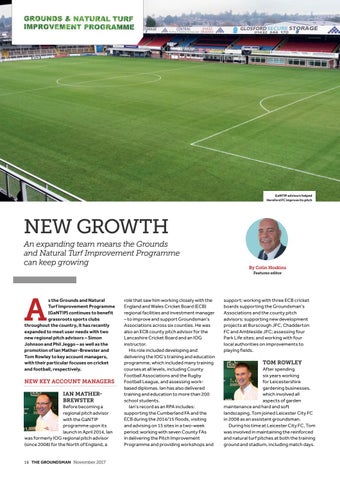
GaNTIP advisors helped Hereford FC improve its pitch
NEW GROWTH An expanding team means the Grounds and Natural Turf Improvement Programme can keep growing
By Colin Hoskins Features editor
A
s the Grounds and Natural Turf Improvement Programme (GaNTIP) continues to benefit grassroots sports clubs throughout the country, it has recently expanded to meet user needs with two new regional pitch advisors – Simon Johnson and Phil Jeggo – as well as the promotion of Ian Mather-Brewster and Tom Rowley to key account managers, with their particular focuses on cricket and football, respectively.
NEW KEY ACCOUNT MANAGERS IAN MATHERBREWSTER
Before becoming a regional pitch advisor with the GaNTIP programme upon its launch in April 2014, Ian was formerly IOG regional pitch advisor (since 2008) for the North of England, a 16 THE GROUNDSMAN November 2017
role that saw him working closely with the England and Wales Cricket Board (ECB) regional facilities and investment manager – to improve and support Groundsman’s Associations across six counties. He was also an ECB county pitch advisor for the Lancashire Cricket Board and an IOG instructor. His role included developing and delivering the IOG’s training and education programme, which included many training courses at all levels, including County Football Associations and the Rugby Football League, and assessing workbased diplomas. Ian has also delivered training and education to more than 200 school students. Ian’s record as an RPA includes: supporting the Cumberland FA and the ECB during the 2014/15 floods, visiting and advising on 15 sites in a two-week period; working with seven County FAs in delivering the Pitch Improvement Programme and providing workshops and
support; working with three ECB cricket boards supporting the Groundsman’s Associations and the county pitch advisors; supporting new development projects at Burscough JFC, Chadderton FC and Ambleside JFC; assessing four Park Life sites; and working with four local authorities on improvements to playing fields.
TOM ROWLEY
After spending six years working for Leicestershire gardening businesses, which involved all aspects of garden maintenance and hard and soft landscaping, Tom joined Leicester City FC in 2008 as an assistant groundsman. During his time at Leicester City FC, Tom was involved in maintaining the reinforced and natural turf pitches at both the training ground and stadium, including match days.
U P D AT E
GANTIP
GaNTIP helped this Welsh cricket ground recover ro devastating oods
Regional pitch advisor Ian Powell undertakes Performance Quality Standards tests at a sports ground
“Ian and Tom are charged with managing the achievement of the aims and objectives of the ECB and FA/ Football Foundation” He joined GaNTIP five years later as regional pitch advisor (RPA) for the East Midlands region. Tom is accredited to NVQ Level 3 in Sports Turf Management and NVQ Level 2 in Amenity Horticulture. He also holds a Diploma in Amenity Horticulture as well as NPTC PA1 and PA6a certificates. Tom’s record as an RPA includes: with Nottinghamshire County FC, site visits covering 247 pitches, with 34 pitches so far improved; a three-pitch improvement scheme with Lincolnshire FC; assessments/funding for 20 pitches at Ashfield District Council; 26 workshops staged in conjunction with the FA; funding
gained for pitch improvements as a result of site assessment at Hilton Harriers FC, and other clubs in the region, which has dramatically reduced cancelled games; and, after assessment and recommendations, working with Nottinghamshire County FA, Larch Groundwork and Nottinghamshire Cricket Board to secure grant funding from the Football Foundation to help improve grassroots sports pitches across Nottinghamshire in the form of an equipment bank.
WHAT THE ROLE INVOLVES
Now, being appointed as key account managers for the next phase of GaNTIP, Ian and Tom are charged with managing the achievement of the aims and objectives of the ECB (Ian) and the Football Association/ Football Foundation (Tom), working with the other regional pitch advisors, while also working closely with the GaNTIP director. Their remit will also include: • Helping to raise the profile and the development of groundsmanship through the GaNTIP across the country, working closely with, in Ian’s case, the ECB national participation manager facilities development, in delivering the ECB’s Cricket Unleashed strategy
and, for Tom, working closely with the Football Association (for strategy) and Football Foundation (for delivery); • Monitoring the implementation of GaNTIP within the designated sports; • Managing the achievement of the desired outcomes, aims and objectives of the governing bodies through the delivery of the RPAs within the designated sports; • Reporting on progress to funding partners; • Leading and managing the achievement of the aims and objectives of GaNTIP through the RPAs, and supporting the relevant key account in the delivery of the programme including engaging with key local authorities; • Providing support to Sport England and governing bodies in the development, delivery and accreditation of generic and sport-specific grounds and natural turf-related courses; • In conjunction with RPAs, ensuring a Performance Quality Standards programme is developed and delivered as set out by national governing bodies and the IOG; • Establishing a pitch performance programme in line with the aims and objectives as defined by partners. www.iog.org THE GROUNDSMAN 17
U P D AT E
GANTIP
The work of regional pitch advisors such as Darren Symonds (third from left) and Andrew Clarke (far left) includes talking to young people about groundsmanship
TWO NEW REGIONAL PITCH ADVISORS Increasing the number of GaNTIP regional pitch advisors in the UK, the IOG has just appointed two new RPAs: Simon Johnson for the South West Region and Phil Jeggo for the East Region.
SIMON JOHNSON
Simon brings more than 30 years’ experience to this role. Throughout his career he’s been involved with greenkeeping and cricket pitch preparation, he’s achieved NVQ 2 and NVQ 3 in Greenkeeping and Sports Turf Management and has been responsible for running the greenkeeping side of a successful local golf club – where the team constructed two new golf holes and two greens on existing holes. Most recently he was the Cornwall Cricket Pitch Advisor and put together a strategy to improve pitches throughout the Cornwall Cricket Premier League. Throughout his role he’s prepared cricket pitches up to Minor Counties standard at Camborne and Mount Ambrose. He was also involved in the development of a new playing facility at Mount Ambrose and, with funding from Sport England, constructed a new turf pitch for the local rugby team that plays in the Cornwall and Devon league. He’s a member of the League Management Committee of the Cornwall Cricket League and sits on the 18 THE GROUNDSMAN November 2017
Development, Disciplinary and Grounds sub committees.
PHIL JEGGO
Phil, too, brings 30 years’ experience to the role of RPA for the East Region. He entered the industry from school, joining Essex County Cricket Club on a youth training scheme and gaining a City and Guilds qualification at Writtle College. He started with Essex CCC as a junior groundsmen then, three years later, was made assistant head groundsman from 1991 to 2002. Phil then moved to Essex CCC’s Billericay satellite ground as head groundsman, where he spent the next 16 years. During recent times he has also helped out with the London Borough of Redbridge’s cricket squares, being involved with sites in Barking and Dagenham. Phil, who has been chair of the Essex Cricket Groundsman’s Association for five years, has also been the ECB County Pitch Advisor for Essex for the past 10 years, and for the past two years has worked part-time for Essex County FA on the Pitch Improvement Programme, during which time he has also been delivering IOG training courses – Levels 1 and 2 Winter Surfaces and Bowling. Find out more about GaNTIP at www.iog.org/who-we-are/ research-and-funding/grounds-naturalturf-improvement-programme
i
N LAND WID GaN I V RA With Simon Johnson as RPA for the South West region, and Phil Jeggo for the East region, GaNTIP’s other RPAs covering England are: • Darren Symonds, South Central region • Ian Powell, North and Yorkshire region • Ian Mather-Brewster, North West region (and key account manager) • Andrew Clarke, East Midlands region • Kevin Duffill, West Midlands region • Rob Donnelly, London region • Tom Rowley, key account manager The GaNTIP team is managed by Jason Booth, previously head groundsman at Leeds Rugby.
IOG BEST PRACTICE
By Colin Hoskins Features editor
THE LUCK OF THE IRISH …Or rather, Croke Park in Dublin – the home of the Gaelic Athletic Association – is clearly fortunate to have IOG Industry Award winner Stuart Wilson as its pitch manager
20 THE GROUNDSMAN November 2017
F E AT U R E
L
uck, however, plays no part in the way Stuart Wilson maintains and manages the Gaelic Athletic Association’s (GAA) Croke Park pitch and the National Games Development Centre, since he was appointed pitch manager. Aside from being the home of Gaelic games (primarily Gaelic football and hurling), the year-on-year challenge of accommodating a host of GAA sporting fixtures, plus music concerts and other events, is undoubtedly being met by Stuart and his team – he manages the stadium pitch with three full-time groundsmen – “though in one instance having to accommodate 10 matches in nine days soon after a concert by U2 did test the nerves somewhat,” he confesses. In addition to a phenomenal number of Gaelic matches played on the pitch, a significant stressor are the concerts staged at Croke Park during the summer. The season spans from the end of January to October so these outdoor events are presented at the most intensive part of the calendar, often at crucial All-Ireland quarter- and semi-final stages. In July, Stuart oversaw the turf being stripped out late on a Sunday evening after a match, for a concert the following Saturday. New turf was laid the following Wednesday and two matches were played 72 hours later. The whole process had to be repeated for a concert the following weekend before another gruelling re-turf and turnaround for more matches on the Saturday. The increasing testing of hybrid turf in the stadium has, however, eased the situation, says Stuart, who argues that hybrid’s wear capabilities and its ability to recover from heavy use are more important to him than aesthetics. Any turf that is
BEST PRACTICE
commissioned for use in Croke Park is rigorously tested and Stuart always visits the turf farm to see first-hand the quality of the turf as turnaround times are so short. After trialling different hybrid turf since 2015 in high wear areas, then progressively re-laying larger areas in 2016 and more this year using County Turf’s Hero hybrid system, Stuart is adamant that the playability of hybrid turf is critical to Gaelic sports. “The player’s turning ability and speed of turn is critical to the game,” he says. “With the added hybrid surface, I would prioritise playability every time. In fact, we are constantly recording, monitoring and performance testing the pitch, where the sward is maintained at 30mm high, gauging and monitoring (in conjunction with Ian McClements, STRI, as well as via three in-built Toro Turf Guard pitch sensors) moisture content, traction status and using Clegg hammer readings to ensure the surface is fit for purpose. We regularly have double/triple headers in terms of fixtures and when I joined in 2012, when there was a totally natural surface, the pitch was suffering a lot of damage, especially through high-wear areas.” Stuart emphasises that this almost constant monitoring is imperative in ensuring pitch performance is optimised; not only the detailed recording of nutrient input, soil temperatures, lighting hours per position and usage levels but also specific match-day Clegg, moisture and traction readings, coupled with feedback on how the surface played, so that regimes can be tweaked to produce the best possible underfoot conditions. Today, with the majority of the pitch remaining natural grass (it was last fully relaid in 2011), it may only be a matter of time before the whole surface is given a Hero’s welcome, so to speak.
WHO IS STUART WILSON? Stuart started his career as a greenkeeper at Woburn Golf Club. In 2006 he became head groundsman at St Paul’s School in Milton Keynes, before moving to Arsenal FC’s Emirates Stadium and then the Aviva Stadium, Dublin, in both cases as deputy head groundsman. He joined Croke Park as pitch manager in January 2012. Stuart, 40, has a degree in Sports Turf Management.
Stuart came to work at Croke Park in 2012
www.iog.org THE GROUNDSMAN 21
IOG BEST PRACTICE
The pitch needs to be set up to meet the demands of Gaelic sport
To ensure Croke Park meets all the demands placed on it, Stuart draws on the experience he gained as deputy head groundsman at Arsenal FC’s Emirates Stadium and more recently the Aviva Stadium, Dublin. “I can honestly say that the standards set and achieved by Arsenal’s grounds team have really shaped me and my career,” he says. “It was an incredibly important part of my professional development, working with guys like Paul Ashcroft, Reece Watson and Mark Pettit, and the experiences have certainly stood me in good stead.” But having met the Irish girl of his dreams, and after three years commuting between England and Dublin, 40-year-old Stuart says that he will always be eternally grateful to Majella Smyth, Aviva Stadium’s head groundsman, for giving him the opportunity to move to Dublin. It wasn’t long, however, before the Croke Park pitch manager role became vacant and Stuart joined the GAA team in January 2012. Croke Park is proud of its long established environmental credentials. It was the first stadium in the world to receive the Environmental Standard ISO 14001:2015 as well as the first stadium in the UK and 22 THE GROUNDSMAN November 2017
“The prime concern, like in most stadia pitches, is to minimise the build-up of organic matter, which is crucial to stability” Ireland to secure both ISO 14001:2004 and ISO 20121:2012. This has a major impact on Stuart’s ability to utilise pitch technology and he actively engages with key personnel to ensure he meets key objectives. Stuart says this is one of the biggest challenges he has had to face. “Coming from environments where there were no restrictions placed on budgets for gas and electricity, I found it very difficult to adapt to the very strict use of these modalities, which operate the air system, grow lights and undersoil heating. I really have to analyse the weather and always keep a reserve in case of extremely wet or cold conditions – and, of course, Ireland experiences plenty of those!”
COMBINATION TURF
The combination of natural and hybrid turf on the same pitch means that the team has to deal with the different sections in different ways, mainly in terms of managing
the moisture control. “The base profile of the surface below the 40mm turf layer is 120mm of fibresand rootzone over a 100mm layer of lower rootzone sand, which sits on a 125mm deep gravel layer that houses the undersoil heating (9°C is maintained throughout the winter months), drainage and air (Forced Air Vacuum Ventilation) systems,” says Stuart. “The 150 25mm undersoil heating pipes run lengthways along the pitch, and 150mm drainage pipes are laid at 4m centres across the pitch, intersecting with two 600mm main drains that run lengthways. There are also 16 perimeter sprinklers and eight in-field sprinklers for irrigation. “The prime concern, like in most stadia pitches, is to minimise the build-up of organic matter, which is crucial to the stability required by Gaelic sports players – it was a massive eye-opener to see how fast the games are played. We employ a rigorous
THE GAA AND CROKE PARK
Re-covering the pitch after a music concert
Introducing hybrid turf has helped playability
programme of spiking to develop the root system. Root development is key and we like at least 100mm to ensure a stable surface. “During my first season here, the pitch had only just been re-laid so the organic matter build-up in the turf required for harvesting purposes made the playability difficult to manage. An intensive scarification and raking programme was implemented, with regular topdressing to produce a better playing surface. Tweaks to the maintenance regime and a small increase in the use of nutrients plus improved communication with users – which has seen new protocols for designated areas for warm-up sessions and the like – has hugely improved things and the surface soon became firmer and started to perform how it should. “Nowadays, instead of fire-fighting to recover the pitch after each event, we have a planned routine. As well as regular spiking and mowing – eight to 10 times a week in the growing season; two to eight times a week in the winter – it includes granular feeds every four to six weeks, topped up with liquid feeds, plus the use of biostimulants, seaweed and iron. A fungicide is also applied every six to eight weeks. We also overseed with perennial rye grass mixture, using a mix
of Barenbrug RPR and Johnsons Pro Nitro, because I want to maintain grass cover to cope with such a busy fixture list.” In 2017, Croke Park hosted 73 matches, 15 Go Games Days (when up to 2,500 children use the pitch, which is divided into six mini pitches – the resultant wear and tear is equivalent to 85 matches), two music concerts, three sponsor events, five training sessions and a disability games event. “Living in Ireland I soon came to realise that Gaelic sports mean everything to so many people in the country, and with Croke Park at capacity it often means I have 82,300 spectators at a game, with each one having an opinion on the quality of the pitch,” Stuart says. “My staff, Padhraic Greene, head groundsman at the National Games Development Centre (see panel), Colm Daly and Enda Colfer – both groundsmen at Croke Park – taught me so much about Gaelic sports and why there’s so much pressure on pitch performance.”
The GAA was founded in 1884 to promote indigenous Gaelic games and pastimes, most prominently Gaelic football and hurling, as well as camogie, handball and rounders. It also promotes Irish music and dance, and the Irish language. Croke Park, formerly the Jones’ Road sports ground, was acquired by a GAA member for £3,250 in 1908. In 1913, the GAA gained exclusive ownership of the plot and the ground was renamed Croke Park in honour of Archbishop Thomas Croke, one of the GAA's first patrons. The highest attendance ever recorded at an All-Ireland Senior Football Championship Final was 90,556 in 1961. Since the introduction of seating in 1966, the largest crowd recorded has been 84,516. Stuart’s role as GAA pitch manager extends to the nearby National Games Development Centre, in Abbotstown, which opened 18 months ago and where two full-time groundsman look after natural and artificial surfaces that are used for the development of Gaelic games by squads from all GAA codes, as well as county and school sides. It is these pitches that Stuart uses as ‘test beds’ for new products, including new seed mixes. Also under trial is what Stuart describes as ‘pot seeding’ – the use of pre-germinated seed, sown using shorter than usual tines into 5/6mm deep ‘drills’ then covered in germination sheets. “We’re seeing some great results with this, particularly in high-wear areas,” he says.
TEAMWORK
Stuart heaps praise on his team, who have proven to be committed and motivated, despite long hours for renovation and concert turnaround times, as well as
The National Games Development Centre
www.iog.org THE GROUNDSMAN 23
IOG BEST PRACTICE
Croke Park – all set for this year’s GAA football AllIreland Championship Final
weekend work throughout the season. “The pitch is almost twice the size of conventional stadia at 15,000m2, therefore works take twice as long and double the amount of product has to be applied, which has a huge bearing on budgets,” he says.
WEATHER CHALLENGES
Like everyone else, Stuart also faces challenges presented by the local weather. “It can often be a nightmare,” he says, “with high rainfall levels and low temperatures, especially between the end of January through to mid-April, when there is an intense fixture list for league series games.” A penetrant wetting agent, rather than a ‘holding’ agent that is used in early autumn, plays a key role here, as do lighting rigs. “We normally have a three- to four-week renovation period between the end of April and the end of May when the championship season begins, and the fixture list really ramps up with events every weekend from June until the end of September.”
THE FUTURE
Stuart is qualified to degree level, is halfway through a consultancy course and is now also considering a Masters with Dublin City University but he still finds the time to work closely with the university on many scientific projects relating to the pitch. Another aim is to push and promote groundsmanship in Ireland. 24 THE GROUNDSMAN November 2017
“As part of the GAA National Pitch Committee, we’ve instigated education/ training/renovation days at Croke Park and at the National Games Development Centre, on one occasion attracting 100 groundsmen from all over Ireland,” he says. “Working with STRI, we’ve also introduced the County Pitch of the Year awards where, like in England, referees score the pitches every week. The idea is to improve the overall standards of pitches throughout Ireland and it was a fantastic experience being a judge of the top six GAA county pitches in conjunction with Dr Stephen Baker.” Stuart also works closely with greenkeepers in Ireland to engage matchday volunteers. The GAA prides itself on being a largely volunteer organisation with amateur sports, and players are not paid. Stuart engages qualified greenkeepers as volunteer divoters on match days, an initiative that has proven very successful with people very keen to watch the matches from the best seats in the house – those belonging to Stuart’s team pitch-side. These activities, combined with Stuart’s skill at maintaining high-class GAA pitches, are why his 2016 IOG Trimax International Ambassador of the Year Award was just reward for his achievements in Ireland. Progress your career with IOG Learning opportunities. Visit: www. iog.org/learning or email learning@iog.org
i
IOG TRIMAX INTERNATIONAL AMBASSADOR OF THE YEAR AWARD Stuart won the 2016 IOG International Ambassador of the Year Award, sponsored by Trimax Mowing Systems. Trimax has transformed itself from a small New Zealandbased company into a worldrenowned manufacturer and it works closely with its customers to develop innovative solutions. “Our view is that if we don’t stay at the forefront of what we are doing, and push the boundaries of what a product is capable of achieving, then we are standing still,” says owner Bob Sievwright. Trimax aims to come up with solutions that offer low total cost of ownership and a long life. In addition, they must be safe, efficient and intuitive. www.trimaxmowers.com
IOG U P D AT E
By Colin Hoskins Features editor
SUPPORTING YOU THROUGH THE SEASONS It’s been a busy 12 months for the IOG, with a number of initiatives underway designed to further the industry and to support its members through the seasons
A
ccording to IOG CEO Geoff Webb, while preparations for the SALTEX trade show and the accompanying Industry Awards gathered pace, the IOG has been carrying on this year with its work behind the scenes, with the aim of developing initiatives which will support IOG members, while enhancing and promoting the image and importance of the groundscare profession to a wider audience. “The Young IOG Board of Directors is making huge gains in communicating with and attracting new blood to the industry by reaching out to youngsters at a local level (find out more on page 14),” says Geoff.
“The Pitch Grading System will benchmark playing surfaces, from grassroots sites to iconic stadia” 26 THE GROUNDSMAN November 2017
IOG C O Geo e at Wembley Stadium, where he accompanied the winners of the 2016 SALTEX College Cup
“The Grounds and Natural Turf Improvement Programme (GaNTIP) is now entering another phase, having completed visits covering 2,000 pitches and producing 1,000 assessments, which are resulting in significant gains for grassroots sports sites. Indeed, as a result of GaNTIP findings, the IOG is currently restructuring all its training and education offerings, in line with the development of the new Pitch Grading System, which is destined to set new benchmarks for playing surfaces and the training and education of the people who manage them. “In addition, this year the Board structure has continued to develop with the aim of ensuring the IOG offers services to all our representative membership categories.”
weather was like. The IOG was faced with a scenario of less exhibitors, less visitors and less opportunities for everybody, so we knew we had to make a radical change. The move to the Birmingham NEC coincided with making SALTEX a two-day instead of a three-day event, and the IOG moved it to a different time of the year. In its first year, SALTEX attracted around 8,700 visitors – a rise of over 2,500 compared to the previous (last) outdoor show, and with this year’s event featuring around 300 exhibitors it is expected to attract similar visitor numbers.” SALTEX is now combined with the annual Industry Awards gala night, which continues to grow year-on-year and another bumper attendance is expected this year.
SALTEX AND AWARDS
The IOG is run on a professional basis, working to governance protocols. The Board comprises members who represent the areas where groundsmanship in the UK takes place, as it is both wide and diverse. There are now three people on the Board who represent schools, colleges and universities; two representing the volunteer/amateur
He continues: “As the doors open on this year’s SALTEX, the expectations are very high. After 33 years at Windsor Racecourse, the show had reached a point where exhibitors especially required certainty and opportunity, and they needed a venue where they could trade without fear of what the
BOARD DEVELOPMENT
I O G U P D AT E
GET MATCH READY
YEAR IN FOCUS
MEET THE CEO
Where are you on the IOG Learning pathway?
Outside his day-to-day role as IOG chief executive, Geoff Webb enjoys spending his downtime coaching junior football. He is also a lifelong Chelsea fan and has a keen interest in all sports, including tennis and golf (although he says that’s not his strong point). He also likes to travel – indeed, he recently narrowly avoided Hurricane Irma when it hit Miami. Rumour has it that as a young adult he was also a DJ.
Geo at the C �nal etween Chelsea and rsenal
“The IOG is processing over 1,000 GaNTIP pitch reports” sports club sector; two representing professionals working in sports stadia; two representing the public sector; and one representing corporate membership. In addition, there is a group of five independent Board members. Recommended to the Board, these people (who could be from outside the turf industry) are characterised by business acumen or certain skills, such as marketing or accountancy – anything the IOG thinks will embellish the way in which the IOG is run.
GANTIP AND PITCH GRADING
According to Geoff, GaNTIP continues to gather pace. “The programme started through a partnership with the England and Wales Cricket Board (ECB) to improve cricket facilities in England. This saw an initial investment of £500,000 over three years. That programme was a success and created opportunity for the scheme to be widened. The second phase included a partnership with the Football Association, Sport England and the Rugby Football League. This saw an input of £1.3m from 2014 to 2017, creating a regional network of advisory roles across
England. The regional team gives free advice to community sport facilities based on best practice approaches to preparing natural turf surfaces and to, effectively, gain more (playing time) from the pitches. “We have now concluded discussions to extend GaNTIP until 2021 working with both football and cricket. The team of advisors has recently been increased (see page 16) and we are processing the information received from over 1,000 GaNTIP pitch reports to further inform our understanding of the key issues of the quality of playing surfaces we have.“ Geoff says the IOG is also in the process of linking its education and training programmes to the GaNTIP findings, in tandem with the new simplified Pitch Grading System that will benchmark playing surfaces of every type, from grassroots sites to iconic stadia. “The aim is to match specific training and education services with the varying demands of grounds teams, from volunteers and up to Foundation Degree level for grounds managers,” he explains. The initial Pitch Grading System pilots are expected to be rolled out early next year and the system will, for the first time, offer the grounds industry a tangible and easy-tounderstand career development pathway to match an individual’s requirements.
MORE TO COME
The IOG continues to search for and investigate all opportunities that could
i ing so e t nes
ith Gian ranco ola
benefit members and the industry, and one of the latest examples of this is a commitment to The Mental Health Charter for Sport and Recreation. “The Charter sets out how sport and recreation organisations should adopt good mental health practice to make activities inclusive, positive and open to everyone,” Geoff says. Over the coming weeks, watch out for a number of IOG-led events and communications offering support to IOG members on this growing concern. You can find a full list of the governance protocols that the IOG works to on the website: www.iog.com
i
www.iog.org THE GROUNDSMAN 27
INDUSTRY AWARDS
The awards ceremony evening is a chance to network and celebrate great groundscare
The evening will include after-dinner entertainment and a great atmosphere
The winners will be announced in an Oscars-style ceremony
THE FINAL COUNTDOWN As this issue went to press, the IOG Industry Award winners were about to be announced at the ceremony on 1 November. Here’s a round-up of this year’s deserving finalists
28 THE GROUNDSMAN November 2017
By Colin Hoskins Features editor
INDUSTRY AWARDS
IOG AWARDS 2017 FINALISTS • Bowling Greenkeeper/ Team of the Year Burnham Hillside Bowls Club, Burnham-on-Crouch, Essex Burnham’s greenkeeper and his willing assistants take care of the year-round maintenance schedule for the green, including all fertilisation and chemical spraying as well as the end-of-season full renovations of the playing surface. Potters Bar Bowls Club, Hertfordshire Husband and wife duo Rod Smale, 72, and 69-year-old Sandra took over maintenance of the six-rink green in 2014 after the committee said: “The green is getting worse each year – can you improve it?” • Best Maintained Artificial Pitch of the Year Highfields Sports Complex, The University of Nottingham Nottingham University has five artificial playing surfaces and five members of the grounds team are fully trained to maintain these sand-based, 3G rubber crumb and water-based surfaces. Manchester City FC In addition to the stadium pitch, the MCFC team (18 full-time staff plus 12 causal staff who cover holidays etc) is also charged with the maintenance and upkeep of 17.5 full-size playing surfaces at the adjacent City Football Academy, which includes artificial surfaces. • Ransomes Environmental/ Innovative Project of the Year Arsenal FC The installation of a new pitch at the Emirates Stadium has enabled the club to reduce its use of grow lights by 31.1 per cent and, due to reduced leachate, cut nitrogen levels. Water used for cleaning machinery is now recycled, and all grass clippings are composted. These measures have helped reduce the club’s non-recyclable waste to just 1 per cent. Forest Green Rovers FC Forest Green Rovers FC adopts a ‘green’ policy of pitch care by, for example, not using herbicides, pesticides or fungicides, as well as utilising a robotic mower powered by 100 per cent green electricity and using GPS technology to automatically mow
The sports facilities at the University of Nottingham
the pitch. The club implemented the Eco-Management and Audit qualification (achieved in 2012 – a first in the football world), the gold standard in environmental performance. • Toro Most Promising Sports Turf Student of the Year Ollie Deeming, Bury St Edmunds RUFC, Suffolk With the Bury St Edmunds RUFC ground hosting 107 fixtures for the current season, Ollie Deeming has his work cut out maintaining the three main pitches for these games as well as the training sessions. He is responsible for the six-acre site and has so far undertaken two IOG training courses – City & Guilds Level 2 Extended Certificate in Sports and Amenity Turf Maintenance, gained with Distinction, and City & Guilds Level 2 Diploma in Sports and Amenity Turf Maintenance. Tara Massey, Manchester City FC Tara, an apprentice at Manchester City’s Football Academy (CFA), is a Level 2 student and, according to her tutor, “her level of understanding is nothing short of astonishing. The level of knowledge within her portfolio of evidence is more comparable to Level 3 and 4 work, and something that should be highly commended”. She completed the Level 2 programme in record time and now is looking to start the Level 3 programme.
• Redexim Charterhouse/ Kubota Volunteer Sports `Groundsman/Team of the Year Phillip Swann, Bridge Trust Society, Birmingham Phillip took over as groundsman of the 7.5-acre sports ground seven years ago with, he adds, “another equally inexperienced volunteer”. Since then, whenever a member of the club retires, they are recruited to join Phillip’s team. The team is charged with the upkeep of the site including maintaining the clubhouse, two pavilions, the score box and a garage, as well as two football pitches, a cricket square and nets plus two five-a-side training pitches. Phil Toy, Wingerworth JSA FC, Chesterfield, Derbyshire Phil carries out all the pitch maintenance on his own at Wingerworth Junior Sports Association. Ongoing improvements to the playing surface, with limited machinery and equipment, have been achieved by his application of an improved mowing regime, scarification, decompaction, and drill seeding with dwarf perennial ryegrass and fertilising.
“Her level of understanding is nothing short of astonishing” www.iog.org THE GROUNDSMAN 29
INDUSTRY AWARDS
IOG AWARDS 2017 FINALISTS • National Governing Bodies Grassroots Sports Grounds Team of the Year Darlington CC Peter Bentley maintains the club’s threeacre site, looking after the cricket field and the astro nets, as well as all floral borders and lawn areas plus the general upkeep of the grounds. As part of his desire for continual improvement to the playing surfaces, Peter has instigated a maintenance programme that is scheduled to generate further improvements. NPL Sports Club, Teddington, Middlesex The standard of playing surfaces at the sixhectare NPL site has steadily been improved over the years. The site accommodates a host of sports – two cricket squares (one of 18 strips, the other with eight strips), five grass tennis courts, a bowling rink and two cricket outfields, while in winter the field is used mainly for football. Other facilities include a sand-filled artificial surface for tennis and two synthetic cricket nets. This category is co-sponsored by the AELTC (All England Lawn Tennis Club), ECB (the England and Wales Cricket Board), The FA (Football Association), The LTA (Lawn Tennis Association), the Premier League, the RFL (Rugby Football League) and the RFU (Rugby Football Union).
• CubCadet INFINICUT® Professional Tennis Grounds Team All England Lawn Tennis & Croquet Club, Wimbledon The AELTC has 16 full-time grounds staff, including two mechanics and two water engineers, and their job is not only the upkeep of the iconic Wimbledon tennis courts at the 42-acre site, but also the amenity lawn areas including grass verges and car park areas. Another team of four looks after the AELTC’s Raynes Park 16-acre, multi-sport ground. Nottingham Tennis Centre The tennis centre’s grounds team is responsible for the day-to-day management of 13 international grass courts, eight indoor and 19 outdoor courts, as well as changing areas, outside toilets and various soft landscaped areas. The team also facilitates site dressing including bannering and floral/arboreal/ horticultural displays during tournaments, and works with the local and national media to promote the facility.
• Headland Amenity Professional Cricket Grounds Team of the Year Durham CCC The Durham CCC grounds team ensures the Emirates Riverside Stadium pitch is maintained and presented as an international cricket ground. With this in mind, records are kept of the moisture content and hardness of every match pitch; also, a daily record is kept of all work undertaken on the pitch, and of daily temperatures and rainfall. The grounds team is also charged with overseeing the development and build of a new second XI pitch adjacent to the stadium. Hampshire CCC, Southampton The seven-strong full-time grounds team is charged with maintaining the main cricket and nursery grounds, plus three blocks of grass nets at Southampton’s Ageas Bowl stadium. The facilities are used extensively and the focus, of course, is to provide the best playing surfaces possible for everyone who uses the facilities.
30 THE GROUNDSMAN November 2017
The AELTC grounds team tting the �nishing to ches to the co rts at i ledon
• SGL Professional Football Grounds Team of the Year (Premier League, Championship and Scottish Premier League) Arsenal FC The club’s grounds department is responsible for the management and maintenance of all playing surfaces and associated landscaping areas at the Emirates Stadium, the London Colney training facility (56.5 hectares; 15.6 hectares being fine turf), the Hale End Youth Academy (5.9 hectares); and the playing surface at Boreham Wood FC (with the Emirates Stadium, 1.5 hectares). The club has 26 full-time staff across these sites. The team also completes 98 per cent of the pitch renovations. Leicester City FC The 10-strong LCFC grounds team is responsible for the management of all sports turf surfaces and surrounding landscapes of The King Power Stadium,
INDUSTRY AWARDS
IOG AWARDS 2017 FINALISTS the Belvoir Drive training facility, the Holmes Park LRCFA HQ (under 23s venue) and the OHL FC (Belgium) site. Every member of the team contributes to the effectiveness of the department, from the grounds manager who plans and sets the strategies to the team members who log the hours of use, weather, machinery and operations diaries. Tottenham Hotspur FC While the 36-strong grounds team (which includes 10 gardeners) is charged with the upkeep of the varying styles of natural and hybrid grass pitches at the club’s 77-acre training ground in Enfield, the team is now also working closely with its counterparts at Wembley as the national stadium has become the club’s temporary home ground. That said, for the first part of this year, the original stadium pitch was managed and maintained to a high standard – as, indeed, are all the pitches. • SISGrass Professional Football Grounds Team of the Year (English Leagues 1 & 2, National, National North/South, Scottish Championship & Leagues 1 & 2, Ireland & Wales Professional Leagues) Bury FC, Greater Manchester Bury FC’s four-strong grounds team is charged with managing a total of 45 acres, including The Energy Check Stadium pitch, six pitches and accompanying shrub and flower bed areas at the Carrington training ground, plus 20 acres of 12 soil-based pitches at the nearby Goshen Community Sports Facility. Dagenham and Redbridge FC, London Jamie Honeyman has continually improved the pitch and until the recent arrival of an apprentice, was carrying out all the necessary duties on his own to keep the playing surface in top-class condition. This includes the introduction of an enhanced renovation, scarification and seeding programme, as well as the usual mowing, line marking, plus managing and assessing pitch performance and playability, for example.
andown ar hosts oth at and National Hunt racing
• John Deere Professional Horse Racing Grounds Team of the Year Nottingham Racecourse In addition to producing the best and safest racing surface possible for the racecourse’s 23 racing fixtures each year, the grounds team is also charged with a multitude of events involving the site’s lawns. In addition, its main responsibilities also embrace the paddock and grandstand area, as well as stables and saddling/treatment boxes. Ripon Racecourse The four-strong grounds team at Ripon Racecourse works consistently to produce a racing surface that is fast, good/good to firm for every race. As
part of this expert care, independent agronomy reports have shown that the turf management process has improved. In addition to the track, the team also maintains 210 acres of open space, car parks, woodland, lakes and buildings, which accommodate varied use. Sandown Park Racecourse The quest of the 11-strong Sandown Park grounds team is to maintain, manage and continually improve the site’s 14 hectares of dual-purpose racecourse and surrounding gardens, parkland, car parks and woodland. The course hosts both flat and National Hunt racing, and the grounds team continually tries to improve the presentation and performance of all aspects of the site.
www.iog.org THE GROUNDSMAN 31
INDUSTRY AWARDS
IOG AWARDS 2017 FINALISTS
The Leeds Rugby team looks after the pitch at Headingly Stadium – home to Leeds Rhinos and Yorkshire Carnegie
• Mansfield Sand Professional Rugby Football League Grounds Team of the Year Castleford Tigers, West Yorkshire The grounds team is dedicated to producing top-class playing surfaces at the stadium and on the training field, doing everything possible to ensure high standards. Recent upgrades to the machinery and equipment used has played a big role in improving the presentation of the stadium pitch, but regular verti-draining and a consistent fertilisation programme have also helped. Leeds Rugby The four-strong Leeds Rugby grounds team maintains the stadium and training pitches for both Leeds Rhinos (rugby league) and Yorkshire Carnegie (rugby union), including the Kirkstall Academy ground (two natural turf pitches and a synthetic surface), the Abbey Fields training area (four turf pitches) and the pitch at Stanningley ARLFC. The ongoing quest is to produce the best playing surfaces possible within budget. • GrassMaster Professional Rugby Football Union Grounds Team of the Year Sale Sharks, Salford The three-man grounds team at the AJ Bell Stadium in Eccles looks after grass community/training and artificial (3G) pitches as well as the stadium’s grass playing surface. An expert regime of pitch preparation and maintenance standards is in place, and the team employs a ‘rolling’ programme of renovation to achieve highstandard playing surfaces. Yorkshire Carnegie (Leeds Rugby) See above. 32 THE GROUNDSMAN November 2017
• National Governing Bodies Professional Sports Grounds Team of the Year All England Lawn Tennis & Croquet Club, Wimbledon See p30 for details. Chelsea FC In addition to the Stamford Bridge stadium, Chelsea FC has 32 grass pitches, a full-size outdoor artificial pitch and an indoor artificial pitch as well as 60 x 40 outdoor pitches at its Cobham Training Ground. The team of 15 groundsmen at the 150-acre Cobham site and two at Stamford Bridge are charged with a range of day-to-day tasks and the overriding consideration is that the pitches are of the highest quality and presentation for every occasion. Manchester City FC See p29 for details.
• Rigby Taylor/Top Green Young Groundsman of the Year Alex Brierley, All England Lawn Tennis & Croquet Club (AELTC), Wimbledon Alex joined the AELTC in 2008, when he was 17, and embarked on his National Diploma in Sports Turf Management. As well as being well-versed in operating all appropriate machinery and equipment, Alex has completed Level 2 Key Skills in Information and Communication Technology, as well as a number of other ‘safety’ courses, and is a first aider. Jake Messenger, Tottenham Hotspur FC Jake started with the club as an apprentice, studying his Level 2 Apprenticeship in Sports Turf Management. He has also undertaken the PA1 Foundation Spraying course and has begun his Level 3. Before joining Spurs, Jake underwent short courses in cricket (via Essex CCC) which included pre-season preparations, mid-season maintenance and end-ofseason renovations. James Wood, Manchester City FC An assistant groundsman at MCFC, James joined the club in 2013 after a period at Lancashire County Cricket Club. He gained the National Diploma in Sports Turf, with Distinction, simultaneously also collecting the Ransomes Jacobson Turf Machinery Practical Award for his hard work and dedication. In addition, he has also undertaken a number of safety courses and is an advanced first aider. He is currently enrolled on an IOG Level 4 course – Professional Certificate in Turf Surface Management. James Wood joined Manchester City FC in 2013
This category is co-sponsored by the AELTC (All England Lawn Tennis Club), ECB (the England and Wales Cricket Board), The FA (Football Association), The LTA (Lawn Tennis Association), the Premier League, the RFL (Rugby Football League) and the RFU (Rugby Football Union).
INDUSTRY AWARDS
IOG AWARDS 2017 FINALISTS The Queen’s Club in West Kensington, London
work such as aeration, fertilisation, seeding and spraying. The aim, it says, is to create the very best playing surface and to enhance the standards that can be expected from natural grass pitches. TurfDry, Derbyshire This sports turf construction and drainage contractor operates nationwide and started life as a designer and installer of sports turf drainage but is now also involved in sports pitch design and construction throughout the country – with the same philosophy of providing a complete service covering feasibility, design and construction.
Charterhouse in Surrey hosts around 400 sporting � t res each ear
• Growth Products Independent School/University/College Grounds Team of the Year Charterhouse, Surrey The school hosts around 400 sporting fixtures each year and, when training sessions and other unscheduled fixtures are taken into account, the grounds team actually prepares 1,200 pitches a year across the wide-ranging sporting facilities. The team of 17 also looks after a six-lane athletics track and various garden areas, formal lawns, planted boarders and 60 acres of woodland. University of Surrey Five of the 16-strong grounds team at the university are focused on maintaining the sports surfaces at the site, which runs to more than 400 acres. The team’s remit covers 10 grass football/rugby pitches, eight tennis courts, three artificial surfaces, including a 3G football pitch, two netball courts and a two-lane 40-metre sprint track.
34 THE GROUNDSMAN November 2017
• Private Members Sports Club Grounds Team of the Year Darlington CC Peter Bentley maintains the club’s three-acre site, looking after the cricket field and the astro nets, as well as all floral borders and lawn areas. He also undertakes general upkeep of the grounds. Peter’s quest is to achieve continual improvements to the playing surface. The Queen’s Club, London The Queen’s Club team’s main responsibilities revolve around maintaining the 45 multi-surface tennis courts on the West Kensington site, though they also look after the general maintenance on other outdoor facilities, including hedges, gardens and the club’s infrastructure. • Contractor of the Year Premier Pitches, Sheffield The company works at all levels of the game, specialising in end-of-season renovations and pitch reconstructions while also undertaking maintenance
INDIVIDUAL AWARDS – THE SHORTLIST • Simon Gumbrill, Stadium Grow Lighting, and Dean Gilasbey of Propitch are finalists for the International Ambassador of the Year Award.
• Paul Burgess of Real Madrid CF and Stoke City FC’s Andy Jackson are shortlisted for the Special Recognition Award (Professional Category). • Peter Green from Honley Cricket Club, Huddersfield, and Mick Oldfield, Sherriff Hutton Bridge Cricket Club, York, are finalists for the Special Recognition Award (Volunteer Category). At the time of going to press, two awards were due to be announced on the night: the Alex R Millar Ransomes/ DLF Johnsons Groundsman of the Year Award and the Lifetime/Outstanding Achievement Award.
H AV E YO U R S AY
INDUSTRY SURVEY
GaNTIP U P D AT E
By Geoff Webb IOG chief executive
THE HIDDEN O IO REVISITED
Find out the latest on the GaNTIP programme page 16
The IOG is set to repeat its industry-wide research into all aspects of groundscare, and this time it is looking to extend its investigations to embrace Wales, Scotland, Northern Ireland and Eire
I
n 2008/09, the IOG commissioned consultancy TrioPlus and Sheffield Hallam University’s Sports Industry Research Centre (SIRC) to provide an overview of England’s grounds management market in terms of its annual value, numbers employed and volunteers – as well as industry attitudes and trends. This resulted in the first definitive report – Grounds Management: The Hidden Profession – that highlighted trends, professional employment, volunteering, economic value and attitudes. For the first time it also presented an economic assessment of the sports turf sector. Further research in 2009 by SIRC looked at industry perceptions and trends, and while highlighting how little hard data existed, this also confirmed that there are/has been:
“The industry attracts dedicated, hard-working professionals” 36 THE GROUNDSMAN November 2017
Limited conditions in many parts of the sector Low intake of young people in an ageing sector An increase in the contracting out of basic grounds management routines A reduction in fine turf provision, particularly at local government level The action of ‘grass cutting’ rather than quality grass pitch provision More reliance on synthetic surfaces More pressure on grounds managers in respect of needing/using additional skills such as management, training, budgeting and cost reduction, and technology, as well as communications and ‘meetings’ expertise. SIRC confirmed that the groundscare industry attracts dedicated, hard-working professionals and volunteers, people who are prepared to – and do – work, long unsociable hours. It also confirmed that there is a group of professionals within the industry who have a reputation worldwide for quality and innovation.
THE IMPACT
The IOG responded positively to this
The IOG's work continues year-round
research. It has, for example, provided a ‘voice’ for the industry with some success. It has also taken positive action to resolve individual issues, as well as action to: promote improved pay and conditions; attract more young people through its Young IOG Board initiatives; and introduce a significantly revised training and education structure that provides improved career progression pathways. The IOG has also established partnerships with grounds managers working across professional sports, as well as partnerships with the education and volunteer sectors, so much so that the IOG also now has ambitious plans to introduce a nationallyrecognised Pitch Grading System that will link the technical requirements of sports surface maintenance to the required levels of education and learning. In addition, the IOG-led Grounds and Natural Turf Improvement Programme (GaNTIP), an England-wide scheme designed to significantly improve natural turf pitches,
H AV E YO U R S AY
“The IOG has taken action to promote improved pay and conditions” has in its first three years seen more than 2,000 natural turf pitches assessed and the resultant recommendations for improvement are already having a significant impact on the improvement and increased playability of natural turf pitches. The programme has also highlighted the profile of natural turf, and the need for planning and investment in it.
TIME TO UPDATE
Ten years on and there is now a need to update the research. This will be done in two stages. The primary research project will aim to: Identify overall trends within the grounds KEEP IN TOUCH
www.iog.org
management industry in England at 2017/18 Provide an estimate of the overall economic impact annually of the industry in England in 2017, including estimates of annual operational and capital expenditure Estimate the number of people working in the industry both professionally and as volunteers in England in 2017, and in which sectors of the industry Provide empirical evidence of attitudes towards grounds management including the attitudes of employers towards grounds managers and grounds staff; attitudes of grounds managers and grounds staff towards employers; and the attitudes of volunteers Identify trends, attitudes and pressures within individual sectors of the industry in England at 2017/18. The IOG is committed to undertaking this work but will aim to gain support and
www.facebook.com/theIOG
Institute of Groundsmanship
INDUSTRY SURVEY
partnership funding from a variety of sources. The IOG is also keen to undertake similar research in Scotland, Wales, Northern Ireland and Eire, to complete a nationwide picture.
TIMESCALES
The IOG wishes to commission the research in England to start in early 2018 and to deliver the results at SALTEX 2018. The research in Scotland, Wales, Northern Ireland and Eire would ideally be commissioned by the end of April 2018 and the target would be to deliver the individual country research outcomes progressively by the end of October 2018. Interested in taking part? If you would like our research team to contact you, contact the IOG by email iog@ iog.org or phone 01908 312 511. This is a great opportunity to have your say about your industry and to help shape its future.
i
twitter.com/the_iog
www.iog.org THE GROUNDSMAN 37
Product showcase
READ MORE
IOG NEWS UPDATES Go to the IOG website www.iog.org
FOCUS ON: DRAINAGE, IRRIGATION AND ESTATE MANAGEMENT
The system in action at Leicester
CLOUD NINE
BEST FOR LEICESTER
The Drainmaster from GKB Machines
DAY JOB
Drain without the strain
KEEPING A COMPLETE range of maintenance machinery is essential for contractors dealing with a wide range of grounds for clients, so investing in a GKB Machines Drainmaster was a straightforward decision for Phil Day Sports of Worcestershire. The company works with clients including West Bromwich Albion FC, Wasps Rugby and the STRI. Toby Grace, Phil Day’s business development manager, had been looking for a secondary drainage system and was
impressed with the Drainmaster. “We have found the Drainmaster does what it says, with unique sandslits to the correct width and depth,” says Toby. “With the way the sand bunker has been developed, you can operate the full length of the pitch in one operation or two across the width. Grass grows on the trenches in a matter of weeks.” The overall effect is strengthening of the grass while the drainage network ensures a higher playing capacity. www.gkbmachines.com
LITTLE WONDER
SMALLER, LIGHTER, FASTER
THE NEW KORO TopDrain 1000 from Campey Turf Care Systems is designed just for sports pitches. It joins the 1500 machine that creates trenches, removes spoil, injects sand and re-compacts the surface all in one operation. After customer feedback, the TopDrain 1000 is a smaller 1m machine. It is 1,000kg lighter (unladen)
KEEP IN TOUCH
www.iog.org
The TopDrain 1000
causing less surface compaction, and requires less tractor power to operate. The sand grid made by the TopDrain complements existing drainage systems. www.campeyturfcare.com
www.facebook.com/theIOG
Institute of Groundsmanship
WHEN LEICESTER CITY FC was looking for an intelligent water management solution, the club started using a new pitch irrigation system from Waterfield Solutions. Based on Rain Bird’s IQ-Cloud irrigation management technology, it fulfils the club’s needs for accurate irrigation levels, water conservation and remote management. Leicester City monitors moisture levels across all its playing surfaces to make sure irrigation levels are just right and access to the right information is essential for this. When the club was looking to achieve an even higher level of accuracy to record water consumption for irrigation, as well as wanting to implement remote control, Rain Bird’s ESPLXME controller with IQ-Cloud provided the solution. It allows for remote real-time management of the irrigation system. This enables use of IQ-Cloud’s full suite of remote water management tools over the internet. The functionality of IQ-Cloud, which includes collation of data from weather stations, is extremely useful and suggests what irrigation levels will be appropriate for prevailing and predicted conditions. www.rainbird.eu twitter.com/the_iog
www.iog.org THE GROUNDSMAN 39
PRODUCT SHOWCASE
E S TAT E M A N A G E M E N T
ROLL WITH IT
The lie of the land
KEEPING ON TOP of mowing over large areas is hard enough, but even more so when the surface isn’t flat. This is where the Pro-Flex 120 contour mower comes in. The Pro-Flex 120 operates like five walk-behind mowers in one. The main factors that make it stand out from the competition and perform as well as a contour mower are the independent floating decks – five decks in total that sit on the main frame. As a result, the Pro-Flex gives an excellent cut over contoured terrain. Each deck has shock absorbers and an anti-scalping design to reduce deck bounce as the mower travels over uneven ground. Because the Pro-Flex is a towed mower, it also means that you can use your tractor for other jobs when you’re not mowing, offering greater versatility and a saving over standalone machines.
40 THE GROUNDSMAN November 2017
The Pro-Flex is only available through Progressive. If you’d like to see the machine in action, contact the sales team to arrange a demo. Call 01638 720123 or email sales@thegrassgroup.com. www.thegrassgroup.com
The Pro-Flex 120 mower
TA S K CALENDAR Find out what’s on your to-do list page 45
PRODUCT SHOWCASE
E S TAT E M A N A G E M E N T
MULTI-TASKING
One for all
WHEN YOU’RE WORKING on a range of different surfaces with different uses, it can be tempting to fill your machine shed with numerous units to cope with all your needs. But it’s possible to save time, money and space with a versatile, flexible and adaptable machine, such as the fds series high-speed Turf Dethatcher. The fds Turf Dethatcher is invaluable for performing a wide range of natural and synthetic grass maintenance operations, quickly and effectively. Available in three widths (1.2m, 1.5m, 2.3m), the individual floating heads can adapt to a variety of surfaces, from the contours and undulations of a golf course, to the flat surfaces of sports fields, race tracks and synthetic grass surfaces. No longer limited to just tractor three-point link mounting, the latest fds Sport attachment means
The fds series highspeed Turf Dethatcher
the fds Turf Dethatcher can be towed behind quads or anything fitted with a tow bar. The fds turf Dethatcher has adjustable spring-loaded tines to help remove varying amounts of thatch to create improved turf growing conditions. The hardened and sprung tines can prepare grass for over-seeding or evenly spread and work in topdressings. They quickly
relieve minor surface compaction allowing water and fertiliser to penetrate quicker. And if you have an equestrian arena or artificial grass pitch, they also level and decompact the sand and rubber infill, quickly and evenly. For prices and more information please contact Sportsmark on 01635 867537. www.sportsmark.net
www.iog.org THE GROUNDSMAN 41
IN ACTION
TRIED AND TESTED Derby County FC’s head groundsman chose ICL products after conducting his own trials MANY BRANDS TEST their pitch treatment products, but for Derby County FC head groundsman Nathan Scarff, there was only one set of data he needed: his own. “When I first started here we used four different fertiliser suppliers and monitored them based on the reaction of the plant, the longevity of the product, the value for money – in terms of the amount we needed to get the reaction. We experimented for most of the year – which included trial boards in which we treated one area while leaving another un-treated, and we did half pitch treatments. All of the results just led us down one road – ICL.”
“My data showed me that ICL is the way forward for us”
WEAR BETTER Reading FC’s grounds manager installed SIS Pitches’ advanced hybrid system to cope with almost 250 hours of play
The Madejski Stadium hosts football and rugby
For Nathan – who was named Sky Bet Championships Groundsman of the Season for 2015/16 and was highly commended last year – the primary aim is to host more games at Pride Park Stadium without compromising the quality of the pitch. To achieve this, he uses a range of ICL products, including Qualibra (a wetting agent), Sportsmaster WSF SeaMax (a seaweed-based product that improves colour and quality), Primo Maxx, Vitalnova Blade and Sportsmaster WSF soluble fertiliser. “Towards the end of last season I applied ProTurf 20.0.7, which I had never used before, and I remember calling Emma Kilby (ICL technical area sales manager) asking why she hadn’t pushed me harder to use it! It was fantastic and the benefits of the Polyhalite with the calcium and the magnesium were amazing – especially on a pitch that is
ADAM GRANTHAM, grounds manager at Reading FC’s Madejski Stadium, has to work hard with his team to keep the pitch in top condition. The ground hosted over 55 matches last season, including all home first-team fixtures for Reading and for London Irish, the Aviva Premiership rugby side that is a ground-share tenant, plus a selection of the football club’s Under-23s and Under-18s games. Adam realised he needed a new hybrid surface that would work as hard as his groundscare team, so the club has become the first venue with a dual-use pitch to use the SISGrass hybrid system, which was installed at the ground this summer. Adam says: “The pitch was last reconstructed to this extent way back in 2007 and it reached the end of its shelf life last season, becoming ineffective in areas. Balancing all the football and rugby commitments on an ageing pitch was extremely tough at times and there was some criticism over the winter period, so it was good to start afresh in the summer.”
ICL’s Emma Kilby has advised er Co nt s athan car on the best products to use
naturally going to leach those nutrients more quickly. The longevity we got out of it was excellent, the reaction was brilliant and the value for money was exceptional too. “For me, I’m not going to jump head first into a full-on programme on a basis that data from somewhere else is really good. It’s got to be my research, my trials and my data, which showed me that ICL is the way forward for us.”
i
For more information visit www.icl-sf.co.uk
A total replacement was the only way forward. “We completely reconstructed the pitch, taking the old hybrid system out and starting from the bottom up, reshaped all the sub-base levels, re-installed the drainage, the undersoil heating and added a new irrigation system.” The durable pitch uses SISGrass, a reinforced natural turf system featuring patented fibre injection technology. “We have been really pleased with both the high quality of SIS Pitches’ service and the pitch it has installed,” says Adam. “With the increased durability of SISGrass, we’re extremely hopeful the end result is a much stronger and healthier pitch all year round that suits our manager Jaap Stam’s style of play. “By 9 September, we’d played five matches on it already but the pitch is holding together really well and I’ve been getting good feedback from the coaching staff and players.”
i
For more information visit www.sispitches.com
www.iog.org THE GROUNDSMAN 43
Tools & guidance MAINTENANCE CALENDAR AND WEATHER UPDATE
LEARN AND GROW
Find out more about the IOG learning pathway page 50
DECEMBER OPERATIONS CRICKET SQUARE
Check for disease activity and, if identified, spray with a propriety fungicide. Continue to brush as regularly as possible to allow sward to remain upright and to remove excess moisture/dew and, if any earthworm activity is noticed, try not to smear the casts. If possible, aerate using solid tines to a depth of 125mm. If climatic and ground conditions allow, mow sward by ‘topping off’.
CRICKET OUTFIELD
Check for damage, especially if used for winter sports. If climatic and ground conditions allow, mow sward by ‘topping off’. If possible, aerate outfield to 125mm.
BOWLING GREENS
Earthworms may be a problem, so regular drag brushing – ideally daily when conditions are such that large amounts of earthworm casts are produced – and aeration to keep the surface open to improve surface drainage and drying, may help towards reducing the effects of the earthworm activity. Regular applications of sulphate of iron, say every 3-4 weeks, can help to minimise the effects of surface casting earthworms. If all else fails, then you may have to apply synthetic pesticides. Watch out for Fusarium patch during mild damp spells. Sulphate of iron applications can help to harden the grass against this
disease, or alternatively, have a suitable stock of contact fungicide available to spray, usually at the first signs of infection. Keep the grass topped at about 10-12mm high: this will also help to reduce the chance of disease attack which may be more prevalent with longer grass as it will retain a more humid and damp ‘atmosphere’ among its leaves. Finish off bank repairs if possible. Prepare your maintenance schedule for next year, along with a budget requirement.
GOLF COURSE
Frost holes may be required in the early morning to protect against inappropriate wear. Slit tine aerate on a regular basis. Maintain green height in accordance with course standards – typically no higher than 8mm. Tees should still be topped, although the actual height will depend on whether they are rested for the winter or maintained in play. If artificial mats or carpets are used, ensure they are safe and secure, while sand-filled ones are properly topped up. Fairways – if topping hasn’t already ceased, then this might be the last occasion for a few months. Remove leaves to prevent the turf being smothered. Start, or continue, planning for next year’s requirements. A budget report/proposal may need to be submitted.
FOOTBALL
Divoting is a key task at this time of year. Repairs need to be made to maintain a reasonable surface for as long as possible. Brush and/or harrow. Overmarking should not be neglected. Consider the weather conditions and how many games have been played in determining a suitable overmarking programme. Slit tine aerate the pitch if smearing of the soil is not going to take place – be prepared to stop if conditions are found to be unsuitable, as more harm than good will be done by continuing. Sand worn areas as required.
RUGBY UNION
Soil conditions may become unsuitable for routine aeration, so selective handforking might be the order of the day. Sanding of wet or bare areas may also be needed. A final topping of the grass may be required, but a little extra length at this time of year will help counter some of the wear. Machinery should be prepared for its winter servicing schedule.
RUGBY LEAGUE
The end of season should be here and all renovations completed. A light topping off might still be required if conditions allow. Constant switching or dragbrushing of the surface will be required. An autumn/winter feed should be applied – something like a 4-12-12 – before it gets really cold. Make sure the pitch is protected to the best of your ability to alleviate any damage from unwanted visitors.
All machinery should be looked at for end-of-season repair or servicing. If possible, aeration maybe beneficial to the surface by way of handforking, vertidraining or slitting. With the growing season coming to a close, some training/ education courses may be looked at to aid personal and professional development. On the amateur side, constant pitch repair is essential. Any divots not replaced will lead to pitch deterioration. Chain harrowing could be used to aid the repair or presentation of the surface. Bare areas may be becoming apparent, so a light topdressing with sand will aid with playability and wear tolerance. Constant communication with coaches is essential for rotation of drills, as any damage inflicted now will not be able to be repaired before the winter.
HORSE RACECOURSE
Avoid the use of relatively heavy machinery over the winter months when ground conditions are generally unsuitable. Aeration can be carried out during dry periods, assuming the soil moisture content is not high. Continue to divot and repair after each meeting.
TENNIS
Continue to aerate, although ground conditions may now be unsuitable for most of the time. Dragbrush as required. Occasional topping of the grass might be required in the south. Machinery should be given an annual service over the next few months.
www.iog.org THE GROUNDSMAN 45
TOOLS & GUIDANCE
W E AT H E R
NOVEMBER TOP TIPS • Watch out for risk of Fusarium patch infection • Use ITM practices and fungicide treatments to reduce disease risk • Cold nights after warm and bright days can put extra stress on turf plants • Be prepared to change strategies if conditions dictate Surface moisture creates conditions for disease to thrive. Cooling wet weather in November makes it a challenge to dry surfaces quickly
O
O G O
N
ovember ought to see the onset of winter but, with the exception of last year, we’ve become accustomed to weather that is more like early autumn. This season conditions stayed relatively mild through October, with continued growth. The prolonged extension of autumn has frequently remained through to Christmas, helping to retain good surfaces.
O
NOVEMBER HIGHS ‘N’ LOWS
Weather patterns have become more extreme, with November temperatures fluctuating wildly from the average. In 2016, temperatures fell rapidly, particularly under clear night skies – with 14 nights of frost in east Scotland. In 2015, the average minimum temperature was 3.0°C above the long-term norm for England and Wales.
CO Av temp (°C)
O
Sun (hours)
Diff to 30-yr av
C
Rain (mm)
Diff to 30-yr av
2016
4.9
-1.4
75
+31
2015
8.2
+1.9
36
2014
7.6
+1.3
52
O Nights with air frost
Diff to 30-yr av
Diff to 30-yr av
105
-14%
8
+2
-47%
173
+42%
3
-3
-8%
124
+3%
2
-4
2013
5.5
-0.7
71
+24%
91
-25%
7
+1
2012
5.8
-0.5
62
+9%
136
+12%
6
0
2011
8.7
+2.4
59
+1%
101
-15%
1
-5
2010
4.3
-2.0
65
+11%
123
+2%
11
+5
Longterm av
6.3
57
121
6
November 2016 saw temperatures plummet well below the 30-year average, after two years of incredibly mild conditions. Although cold, there were very clear skies and bright days
Also in 2015, the average daily high for the whole of November was a balmy 12.7°C in the south of England. However, as recently as 2010 there was an unprecedented average 11 days of frost for the UK, and overall temperatures 2°C below average; the east coast of Scotland had frost on 50% of nights
WET WEATHER RISK
Temperature variability, shorter days and wet weather all put extra stress on turf, as well as creating conditions conducive to disease. Where warmer days initiate growth, any soft leaf tissue can be especially susceptible to infection. In milder periods of intermittent turf growth, mixing actives to include both contact and systemic activity, such as Instrata Elite, will give greater flexibility to target different stages of disease. GreenCast historic disease and weather charts have also shown that where rain falls, with leaf surfaces slow to dry, disease pressure is significantly higher. Integrated Turf Management options to dry surfaces – including drainage and aeration, improving air flow, switchingoff dew and thatch removal – can help minimise the level of disease inoculum in the turf and limit the conditions it needs to develop. Furthermore, applications of Contact+ Medallion TL will target disease pathogens on the leaf and in the thatch to further reduce infection pressure. Improved weather and disease forecasting can help target applications ahead of key risk periods.
IOG
RECRUITMENT
TO ADVERTISE IN THE GROUNDSMAN CONTACT PARMINDER SANGHA:
48 THE GROUNDSMAN November 2017
E parminder.sangha@jamespembrokemedia.co.uk
0203 859 7097
IOG
CLASSIFIEDS
o advertise in the classi�ed section of The Groundsman please contact:
Parminder Sangha
0203 859 7097
E parminder.sangha@jamespembrokemedia.co.uk
TO ADVERTISE IN THE GROUNDSMAN CONTACT PARMINDER SANGHA:
E parminder.sangha@jamespembrokemedia.co.uk
0203 859 7097
www.iog.org THE GROUNDSMAN 49
GROW WITH THE IOG
SKILLS AND TRAINING
Learning success It has been a great year for our students. In total 20 groundsmen of varying experience have achieved impressive results across the IOG’s suite of qualifications Shane Webb (The Curragh Racecourse) who has gained IOG Level 3 Certi�cate in Turf Surface Management
T By Dan Prest IOG head of member services
he IOG qualifications are new and updated versions of the historical National Technical Certificate, National Intermediate Diploma and National Diploma, and are supported by expert industry tutors and examiners. To encourage a flexible method of continuous learning, many qualifications also have modules, which can be taken as a professional development course without mandatory end-of-course assessments or tests. These qualifications all map to the Pitch Grading System (see page 26) to benchmark the quality of every playing surface in the UK, with each level being complemented by a training and education framework that will comprise specific and ‘accurately blended’ modules to suit the needs of each site at each level of ‘standard’, as well as being perfectly matched to the needs of the people charged with maintaining those pitches. The IOG would like to congratulate the following who have completed a qualification in the past year:
WHAT THE GROUNDSMEN SAY “Online IOG qualifications are a great way to keep learning where more traditional routes may not be suitable.” Daniel Ratling, Whitgift School “Organisations should take responsibility for training, investing in and educating their grounds staff. If staff understand why they’re doing x, y and z, they will undoubtedly be more interested in their work.” Shane Webb, The Curragh Racecourse “Being qualified and continual training are essential to progression in the industry.” Colin Ball, Ampleforth Abbey & College
KEEP IN TOUCH
www.iog.org
www.facebook.com/theIOG
50 THE GROUNDSMAN November 2017
IOG QUALIFICATIONS
NEXT MONTH
More advice on continued training and development
IOG Level 2 Award Will Hearsey IOG Level 2 Certificate in Turf Surface Maintenance Paul White IOG Level 3 Technical Diploma in Turf Surface Management Colin Ball Dan Bingle Shane Webb Stuart Lambert IOG Level 3 Certificate in Supervisory Management Stephen Ascott David Bastable Aiden Shepherd IOG Level 4 Professional Certificate in Turf Surface Management Samuel Gibbs Alex Latto Christian Brain IOG Level 6 Professional Certificate in Turf Surface Consulting Daniel Ratling
CITY AND GUILDS QUALIFICATIONS
City and Guilds Level 2 Extended Certificate / Diploma in Sports and Amenity Turf Maintenance Glen Comben Ollie Deeming James Spencer Leigh Denton Neil Smith City and Guilds Level 3 Certificate / Subsidiary Diploma (Turf Pathway) Kris Puzio James Duffield Congratulations to all involved and all the best for the future.
Institute of Groundsmanship
twitter.com/the_iog