10
29 OCTOBER 2020
Negative effects of COVID-19 and Online Learning on Students with Disabilities Catherine Dumé PRE-EXISTING SOCIAL CONDITIONS
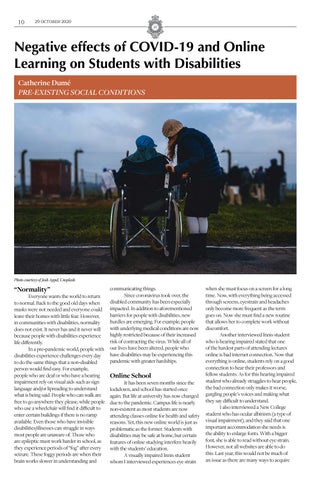
Photo courtesy of Josh Appel, Unsplash.
“Normality”
Everyone wants the world to return to normal. Back to the good old days when masks were not needed and everyone could leave their homes with little fear. However, in communities with disabilities, normality does not exist. It never has and it never will because people with disabilities experience life differently. In a pre-pandemic world, people with disabilities experience challenges every day to do the same things that a non-disabled person would find easy. For example, people who are deaf or who have a hearing impairment rely on visual aids such as sign language and/or lipreading to understand what is being said. People who can walk are free to go anywhere they please, while people who use a wheelchair will find it difficult to enter certain buildings if there is no ramp available. Even those who have invisible disabilities/illnesses can struggle in ways most people are unaware of. Those who are epileptic must work harder in school, as they experience periods of “fog” after every seizure. These foggy periods are when their brain works slower in understanding and
communicating things. Since coronavirus took over, the disabled community has been especially impacted. In addition to aforementioned barriers for people with disabilities, new hurdles are emerging. For example, people with underlying medical conditions are now highly restricted because of their increased risk of contracting the virus. While all of our lives have been altered, people who have disabilities may be experiencing this pandemic with greater hardships.
Online School
It has been seven months since the lockdown, and school has started once again. But life at university has now changed due to the pandemic. Campus life is nearly non-existent as most students are now attending classes online for health and safety reasons. Yet, this new online world is just as problematic as the former. Students with disabilities may be safe at home, but certain features of online studying interfere heavily with the students’ education. A visually impaired Innis student whom I interviewed experiences eye strain
when she must focus on a screen for a long time. Now, with everything being accessed through screens, eyestrain and headaches only become more frequent as the term goes on. Now she must find a new routine that allows her to complete work without discomfort. Another interviewed Innis student who is hearing impaired stated that one of the hardest parts of attending lectures online is bad internet connection. Now that everything is online, students rely on a good connection to hear their professors and fellow students. As for this hearing impaired student who already struggles to hear people, the bad connection only makes it worse, gurgling people’s voices and making what they say difficult to understand. I also interviewed a New College student who has ocular albinism (a type of visual impairment), and they said that one important accommodation she needs is the ability to enlarge fonts. With a bigger font, she is able to read without eye strain. However, not all websites are able to do this. Last year, this would not be much of an issue as there are many ways to acquire