c o v e r
s t o r y
|
l o c a l
f i l m
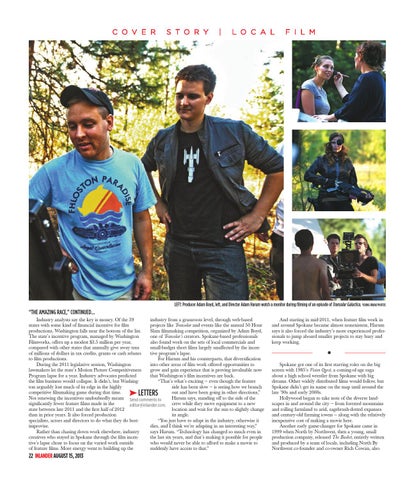
LEFT: Producer Adam Boyd, left, and Director Adam Harum watch a monitor during filming of an episode of Transolar Galactica. young kwak photos
“the amazing race,” continued... Industry analysts say the key is money. Of the 39 industry from a grassroots level, through web-based states with some kind of financial incentive for film projects like Transolar and events like the annual 50 Hour productions, Washington falls near the bottom of the list. Slam filmmaking competition, organized by Adam Boyd, The state’s incentive program, managed by Washington one of Transolar’s creators. Spokane-based professionals Filmworks, offers up a modest $3.5 million per year, also found work on the sets of local commercials and compared with other states that annually give away tens small-budget short films largely unaffected by the incenof millions of dollars in tax credits, grants or cash rebates tive program’s lapse. to film productions. For Harum and his counterparts, that diversification During the 2011 legislative session, Washington into other areas of film work offered opportunities to lawmakers let the state’s Motion Picture Competitiveness grow and gain experience that is proving invaluable now Program lapse for a year. Industry advocates predicted that Washington’s film incentives are back. the film business would collapse. It didn’t, but Washing“That’s what’s exciting — even though the feature ton arguably lost much of its edge in the highly side has been slow — is seeing how we branch competitive filmmaking game during that time. out and have been going in other directions,” Not renewing the incentives undoubtedly meant Send comments to Harum says, standing off to the side of the significantly fewer feature films made in the editor@inlander.com. crew while they move equipment to a new state between late 2011 and the first half of 2012 location and wait for the sun to slightly change than in prior years. It also forced production its angle. specialists, actors and directors to do what they do best: “You just have to adapt in the industry, otherwise it improvise. dies, and I think we’re adapting in an interesting way,” Rather than chasing down work elsewhere, industry says Harum. “Technology has changed so much even in creatives who stayed in Spokane through the film incenthe last six years, and that’s making it possible for people tive’s lapse chose to focus on the varied work outside who would never be able to afford to make a movie to of feature films. More energy went to building up the suddenly have access to that.”
letters
22 INLANDER August 15, 2013
And starting in mid-2011, when feature film work in and around Spokane became almost nonexistent, Harum says it also forced the industry’s more experienced professionals to jump aboard smaller projects to stay busy and keep working. Spokane got one of its first starring roles on the big screen with 1985’s Vision Quest, a coming-of-age saga about a high school wrestler from Spokane with big dreams. Other widely distributed films would follow, but Spokane didn’t get its name on the map until around the late ’90s and early 2000s. Hollywood began to take note of the diverse landscapes in and around the city — from forested mountains and rolling farmland to arid, sagebrush-dotted expanses and century-old farming towns — along with the relatively inexpensive cost of making a movie here. Another early game-changer for Spokane came in 1999 when North by Northwest, then a young, small production company, released The Basket, entirely written and produced by a team of locals, including North By Northwest co-founder and co-owner Rich Cowan, also