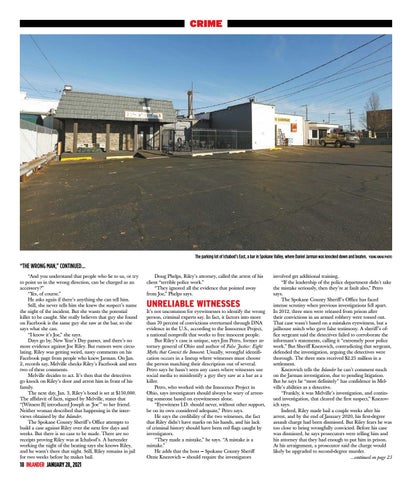
The parking lot of Ichabod’s East, a bar in Spokane Valley, where Daniel Jarman was knocked down and beaten.
YOUNG KWAK PHOTO
“THE WRONG MAN,” CONTINUED... “And you understand that people who lie to us, or try to point us in the wrong direction, can be charged as an accessory?” “Yes, of course.” He asks again if there’s anything she can tell him. Still, she never tells him she knew the suspect’s name the night of the incident. But she wants the potential killer to be caught. She really believes that guy she found on Facebook is the same guy she saw at the bar, so she says what she can. “I know it’s Joe,” she says. Days go by, New Year’s Day passes, and there’s no more evidence against Joe Riley. But rumors were circulating. Riley was getting weird, nasty comments on his Facebook page from people who knew Jarman. On Jan. 2, records say, Melville checks Riley’s Facebook and sees two of these comments. Melville decides to act. It’s then that the detectives go knock on Riley’s door and arrest him in front of his family. The next day, Jan. 3, Riley’s bond is set at $150,000. The affidavit of facts, signed by Melville, states that “[Witness B] introduced Joseph as ‘Joe’” to her friend. Neither woman described that happening in the interviews obtained by the Inlander. The Spokane County Sheriff’s Office attempts to build a case against Riley over the next few days and weeks. But there is no case to be made. There are no receipts proving Riley was at Ichabod’s. A bartender working the night of the beating says she knows Riley, and he wasn’t there that night. Still, Riley remains in jail for two weeks before he makes bail.
18 INLANDER JANUARY 28, 2021
Doug Phelps, Riley’s attorney, called the arrest of his client “terrible police work.” “They ignored all the evidence that pointed away from Joe,” Phelps says.
UNRELIABLE WITNESSES
It’s not uncommon for eyewitnesses to identify the wrong person, criminal experts say. In fact, it factors into more than 70 percent of convictions overturned through DNA evidence in the U.S., according to the Innocence Project, a national nonprofit that works to free innocent people. But Riley’s case is unique, says Jim Petro, former attorney general of Ohio and author of False Justice: Eight Myths that Convict the Innocent. Usually, wrongful identification occurs in a lineup where witnesses must choose the person matching their description out of several. Petro says he hasn’t seen any cases where witnesses use social media to misidentify a guy they saw at a bar as a killer. Petro, who worked with the Innocence Project in Ohio, says investigators should always be wary of arresting someone based on eyewitnesses alone. “Eyewitness I.D. should never, without other support, be on its own considered adequate,” Petro says. He says the credibility of the two witnesses, the fact that Riley didn’t have marks on his hands, and his lack of criminal history should have been red flags caught by investigators. “They made a mistake,” he says. “A mistake is a mistake.” He adds that the boss — Spokane County Sheriff Ozzie Knezovich — should require the investigators
involved get additional training. “If the leadership of the police department didn’t take the mistake seriously, then they’re at fault also,” Petro says. The Spokane County Sheriff’s Office has faced intense scrutiny when previous investigations fell apart. In 2012, three men were released from prison after their convictions in an armed robbery were tossed out. That case wasn’t based on a mistaken eyewitness, but a jailhouse snitch who gave false testimony. A sheriff’s office sergeant said the detectives failed to corroborate the informant’s statements, calling it “extremely poor police work.” But Sheriff Knezovich, contradicting that sergeant, defended the investigation, arguing the detectives were thorough. The three men received $2.25 million in a settlement. Knezovich tells the Inlander he can’t comment much on the Jarman investigation, due to pending litigation. But he says he “most definitely” has confidence in Melville’s abilities as a detective. “Frankly, it was Melville’s investigation, and continued investigation, that cleared the first suspect,” Knezovich says. Indeed, Riley made bail a couple weeks after his arrest, and by the end of January 2020, his first-degree assault charge had been dismissed. But Riley fears he was too close to being wrongfully convicted. Before his case was dismissed, he says prosecutors were telling him and his attorney that they had enough to put him in prison. At his arraignment, a prosecutor said the charge would likely be upgraded to second-degree murder. ...continued on page 23