NEWS | GOVERNMENT “WHEN WILL IT OPEN?,” CONTINUED... Washington Policy Center’s Eastern Washington director, Chris Cargill, says he finds that language threatening and inappropriate. Similarly, Spokane City Councilman Michael Cathcart, who helped put open bargaining to a city vote, says he found the language to be concerning. “Bullying language is definitely not the way to win this rhetorical argument,” Cathcart says. “The public is saying they want more transparency in this process.”
THE DISAGREEMENT
At both the city and county level, the open bargaining rules would allow reporters and members of the public to witness negotiations that have previously been kept secret until a final deal is presented to government officials to approve or reject. When unions and agencies reach an impasse in closed-door negotiations, it can be hard for the public to know what led to standoffs that can leave workers without contracts for years. “I think it’s good policy no matter what side of the political spectrum you’re from and it shouldn’t really be an ideological issue,” Cargill says. “We want people who are part of the union to hear what’s being negotiated on their behalf, and those who are taxpayers in the public to hear what’s being negotiated on their behalf. Sunshine is the best disinfectant to any issue.” At the city level, negotiations with the police union have been ongoing since 2017, says city spokesman Brian Coddington. A deal was presented to Spokane City Council in early summer 2020, but the council rejected it due to disagreement over police oversight requirements, sending the deal back to the bargaining table, which remains closed to the public. Negotiations with the firefighters union, Local 29, have been underway since fall 2019, before the open bargaining requirement was passed by voters. But in recent weeks, after delays due to COVID-19, the city has finally started laying the ground rules for negotiations with three unions representing management professionals, firefighter officers and that largest group of city employees covered by Local 270. Those three negotiations would be the first subject to the city charter change that voters enacted in 2019. “The city’s stance is there’s an expectation of open bargaining and we’ll pursue that,” Coddington says. The city will also look for any legal guidance that may come out of a court case between Lincoln County and the Teamsters union Local 690. The dispute over public bargaining there has been going on since late 2016. Most recently, the state court of appeals directed the Public Employment Relations Commission to provide clearer guidance about how a public process would work if labor unions and agencies agree to go that route.
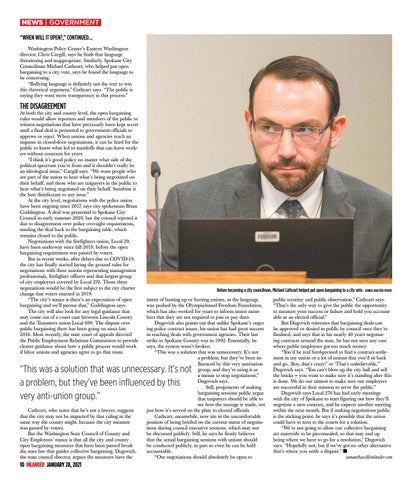
Before becoming a city councilman, Michael Cathcart helped put open bargaining to a city vote. intent of busting up or hurting unions, as the language was pushed by the Olympia-based Freedom Foundation, which has also worked for years to inform union members that they are not required to join or pay dues. Dugovich also points out that unlike Spokane’s ongoing police contract issues, his union has had great success in reaching deals with government agencies. Their last strike in Spokane County was in 1992. Essentially, he says, the system wasn’t broken. “This was a solution that was unnecessary. It’s not a problem, but they’ve been influenced by this very anti-union group, and they’re using it as a means to stop negotiations,” Dugovich says. Still, proponents of making bargaining sessions public argue that taxpayers should be able to see how the sausage is made, not just how it’s served on the plate to elected officials. Cathcart, meanwhile, now sits in the uncomfortable position of being briefed on the current status of negotiations during council executive sessions, which may not be discussed publicly. Still, he says he firmly believes that the actual bargaining sessions with unions should be conducted publicly, in part so even he can be held accountable. “Our negotiations should absolutely be open to
“This was a solution that was unnecessary. It’s not a problem, but they’ve been influenced by this very anti-union group.” Cathcart, who notes that he’s not a lawyer, suggests that the city may not be impacted by that ruling in the same way the county might, because the city measure was passed by voters. But the Washington State Council of County and City Employees’ stance is that all the city and county open bargaining measures that have been passed break the state law that guides collective bargaining. Dugovich, the state council director, argues the measures have the
10 INLANDER JANUARY 28, 2021
DANIEL WALTERS PHOTO
public scrutiny and public observation,” Cathcart says. “That’s the only way to give the public the opportunity to measure your success or failure and hold you accountable as an elected official.” But Dugovich reiterates that bargaining deals can be approved or denied in public by council once they’re finalized, and says that in his nearly 40 years negotiating contracts around the state, he has not seen any case where public employees got too much money. “You’d be real hard-pressed to find a contract settlement in my union or a lot of unions that you’d sit back and go, ‘Boy, that’s crazy!’ or ‘That’s unbelievable,’” Dugovich says. “You can’t blow up the city hall and sell the bricks — you want to make sure it’s standing after this is done. We do our utmost to make sure our employers are successful in their mission to serve the public.” Dugovich says Local 270 has had early meetings with the city of Spokane to start figuring out how they’ll negotiate a new contract, and he expects another meeting within the next month. But if making negotiations public is the sticking point, he says it’s possible that the union could have to turn to the courts for a solution. “We’re not going to allow our collective bargaining act statewide to be piecemealed, so that may end up being where we have to go for a resolution,” Dugovich says. “Hopefully not, but if we’ve got no other alternative that’s where you settle a dispute.” n samanthaw@inlander.com