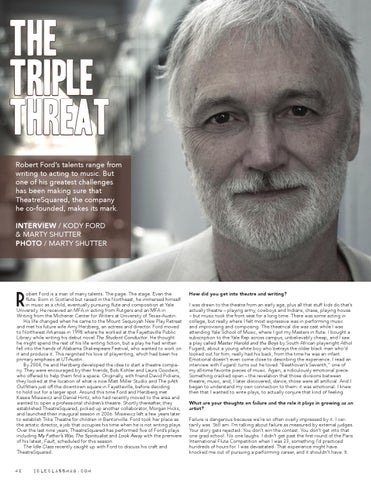
THE TRIPLE THREAT Robert Ford’s talents range from writing to acting to music. But one of his greatest challenges has been making sure that TheatreSquared, the company he co-founded, makes its mark. INTERVIEW / KODY FORD & MARTY SHUTTER PHOTO / MARTY SHUTTER
R
obert Ford is a man of many talents. The page. The stage. Even the flute. Born in Scotland but raised in the Northeast, he immersed himself in music as a child, eventually pursuing flute and composition at Yale University. He received an MFA in acting from Rutgers and an MFA in Writing from the Michener Center for Writers at University of Texas-Austin. His life changed when he came to the Mount Sequoyah New Play Retreat and met his future wife Amy Herzberg, an actress and director. Ford moved to Northwest Arkansas in 1998 where he worked at the Fayetteville Public Library while writing his debut novel The Student Conductor. He thought he might spend the rest of his life writing fiction, but a play he had written fell into the hands of Alabama Shakespeare Festival, who wanted to work on it and produce it. This reignited his love of playwriting, which had been his primary emphasis at UT-Austin. By 2004, he and Herzberg developed the idea to start a theatre company. They were encouraged by their friends, Bob Kohler and Laura Goodwin, who offered to help them find a space. Originally, with friend David Pickens, they looked at the location of what is now Matt Miller Studio and The pAth Outfitters just off the downtown square in Fayetteville, before deciding to hold out for a larger spot. Around this time Ford and Herzberg met Kassie Misiewicz and Daniel Hintz, who had recently moved to the area and wanted to open a professional children’s theatre. Shortly thereafter, they established TheatreSquared, picked up another collaborator, Morgan Hicks, and launched their inaugural season in 2006. Misiewicz left a few years later to establish Trike Theatre for children in Bentonville. Ford took her place as the artistic director, a job that occupies his time when he is not writing plays. Over the last nine years, TheatreSquared has performed five of Ford’s plays including My Father’s War, The Spiritualist and Look Away with the premiere of his latest, Fault, scheduled for this season. The Idle Class recently caught up with Ford to discuss his craft and TheatreSquared.
42
idleclassmag.com
How did you get into theatre and writing? I was drawn to the theatre from an early age, plus all that stuff kids do that’s actually theatre – playing army, cowboys and Indians, chase, playing house – but music took the front seat for a long time. There was some acting in college, but really where I felt most expressive was in performing music and improvising and composing. The theatrical die was cast while I was attending Yale School of Music, where I got my Masters in flute. I bought a subscription to the Yale Rep across campus, unbelievably cheap, and I saw a play called Master Harold and the Boys by South African playwright Athol Fugard, about a young white boy who betrays the older black man who’d looked out for him, really had his back, from the time he was an infant. Emotional doesn’t even come close to describing the experience. I read an interview with Fugard: turns out he loved “Beethoven’s Seventh,” one of my all-time favorite pieces of music. Again, a ridiculously emotional piece. Something cracked open – the revelation that those divisions between theatre, music, and, I later discovered, dance, those were all artificial. And I began to understand my own connection to them: it was emotional. I knew then that I wanted to write plays, to actually conjure that kind of feeling. What are your thoughts on failure and the role it plays in growing as an artist? Failure is dangerous because we’re so often overly impressed by it. I certainly was. Still am. I’m talking about failure as measured by external judges. Your story gets rejected. You don’t win the contest. You don’t get into that one grad school. No one laughs. I didn’t get past the first round of the Paris International Flute Competition when I was 23, something I’d practiced hundreds of hours for. I was devastated. That experience might have knocked me out of pursuing a performing career, and it shouldn’t have. It