Opinion UNITING TOGETHER IN A TIME OF CRISIS
Wednesday, May 29, 2019
3
STAFF EDITORIAL Anti-Muslim hate crimes have spread through the U.S. one after another, overwhelming the public with the mass amount of shootings and bombings throughout the country. As the media alerts us to the next hate-filled atrocity, we look on unaffected until tragedy strikes the city we live in. Recently, the location of such a hate crime was only 2 miles away from HHS. Sunnyvale resident Isaiah Joel Peoples is facing eight counts of attempted murder after plowing through a crowd of pedestrians at the intersection of El Camino Real and Sunnyvale-Saratoga Road on April 23. According to ABC News, Peoples, an army veteran suffering from PTSD, targeted the crowd based on his assumption that they were Muslim. Among the victims is a 13-yearold Sunnyvale Middle School student who is currently on life support. According to Mercury News, seven other victims suffered broken or fractured bones, abrasions, lacerations and other injuries. The FBI, as well as the Sunnyvale PD, are investigating the incident and prosecutors have yet to determine if they will file additional hate crime charges against Peoples. Yet, this alleged hate crime is no different from the Christ-
church mosque shooting in New Zealand or the Poway synagogue shooting in San Diego. The formation of anti-Muslim hate groups has rapidly increased in the U.S. According to the Southern Poverty Law Center, 14 anti-Muslim hate groups have been reported in California in 2018, double the number recorded in 2011. The rise of antiMuslim hate groups in recent years exemplifies the division and animosity sweeping through the country. However, as we see our beloved Habit Burger Grill and Panera Bread among the backdrop of the photos portrayed in the media, we realize that such acts are not restricted to the screen. California has been portrayed as a safe space, exempt from the hate crimes faced by the rest of the country, and this was true to a certain extent. However, even when we are partly shielded from the crimes in the rest of the country, we should not believe that we are totally exempt from prejudice. Such a period of safety does not mean we should be compliant. When such events shift to our diverse community, it is crucial
that we take a clear stand against discrimination. In such a time of distress, it is important that we gather together as a community and rally towards further unification, instead of promoting division. But, more than ever, we need to recognize that in order to stop the instances of hate-fueled events, the root of the issue — ignorance — needs to be recognized. According to the American Psychological Association, people are more willing to lump individuals of a group they are unfamiliar with into a “single-disliked category.” A deeper education about the Muslim community may be effective in deterring misconceptions and hate crimes, according to Ervin Staub,
professor of psychology at University of Massachusetts. So, as we send our thoughts and prayers to the Muslim community, let us also gain a deeper understanding of the cultures that are misrepresented by the actions of a few. While we as individuals may not be able to stop large-scale incidents of discrimination, we can speak out against the everyday instances of prejudice and intolerance.
By Melody Chen
Illustration by Saanvi Thakur
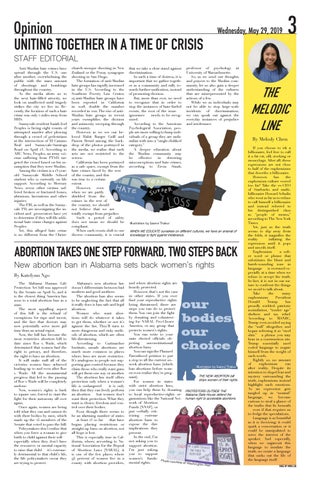
WHEN WE EDUCATE ourselves on different cultures, we have an arsenal of knowledge to fight against intolerance.
ABORTION TAKES ONE STEP FORWARD, TWO STEPS BACK
New abortion ban in Alabama sets back women’s rights By Katelynn Ngo The Alabama Human Life Protection Act bill was approved by the Senate on April 30, and it is the closest thing America has seen to a total abortion ban in a state. The most appalling aspect of this bill is the refusal of exemptions for rape and incest, and the fact that doctors may now potentially serve more jail time than an actual rapist. Now, the bill has become the most restrictive abortion bill to date since Roe v. Wade, which determined that women had the right to privacy, and therefore, the right to have an abortion. It will make null all of the victories women have achieved leading up to and even after Roe v. Wade. All the monumental progress that led to the passing of Roe v. Wade will be completely undone. Now, women’s rights is back to square one, forced to start the fight for their autonomy all over again. Once again, women are being told what they can and cannot do with their bodies by men, which made up the 25 members of the Senate that voted to pass the bill. Policymakers don’t realize that when you force a woman to give birth to child against their will — especially when they don’t have the resources or mental capacity to raise that child — it’s extremely detrimental to that child’s life, the life policymakers swear they are trying to protect.
Alabama’s new abortion law doesn’t differentiate between bad mothers and good mothers. The abortion ban also seems to be neglecting the fact that all it really does is ban safe and legal abortion. Women who want abortions will do whatever it takes to get them, whether or not it’s against the law. They’ll turn to more dangerous and risky methods of abortion, which are often life-threatening. According to Guttmacher Institute, unsafe abortions are much more common in places where laws are more restrictive. It’s analogous to people not supporting gun control because they claim those who really want guns will get them one way or another. The abortion law itself offers protection only when a woman’s life is endangered — it is only then that they can freely perform an abortion — but women don’t want their protection. What they want is choice, freedom and control over their bodies. Even though there seems to be an alarming number of states — at least 13 so far — that have begun placing restrictions or straight-up bans on abortion, not all hope is lost. This is especially true in California, where, according to National Association for the Repeal of Abortion Laws (NARAL), it is one of the few places where 95 percent of women live in a county with abortion providers,
THE MELODIC LINE
and where abortion rights are heavily protected. However, that’s not the case in other states. If you ever find your reproductive rights being threatened, there are steps you can do to protect them. You can join the fight by donating and volunteering for NARAL Pro-Choice America, or any group that protects women’s rights. You can write to your state elected officials objecting unconstitutional abortion bans. You can sign the Planned Parenthood petition to put a stop to all the current sixweek abortion bans (which Illustration by Saanvi Thakur ban abortions before women even realize they’re pregTHE NEW ABORTION bill nant). strips women of their rights. For women in states with strict abortion laws, you can help them by donating PROTESTORS OUTSIDE THE to local reproductive-rights or- Alabama State House defend the ganizations like the National Net- human right to accessible abortions. work of Abortion Funds (NNAF), or just verbally criticizing extreme abortion bans to expose the dire implications they present. In the end, I’m not asking you to support abortion. I’m just asking you to support women’s fundaPhoto courte sy of Washing mental rights. to n Post
If you choose to irk a billionaire, feel free to call it a fat cat, silk stocking or moneybags. After all, these expressions are not close to half of the euphemisms that describe a billionaire. However, has the euphemism culture veered too far? Take the ex-CEO of Starbucks and multibillionaire Howard Schultz who went as far as to refuse to call himself a billionaire and instead referred to his distinguished class as “people of means,” according to The New York Times. Yet, just as the truth seems to slip away from the folds, it magnifies the reality — inflating the expression until it pops and unveils itself. Euphemism — a softer word or phrase that substitutes the blunt and harsh-sounding tone in language — is overused especially at a time when we refuse to accept the truth. In fact, it is not in our nature to confront the things we avoid to talk about. Take the many euphemisms President Donald Trump has proudly wielded: patriotic assimilation, “tender age” shelters and tax relief. According to MSNBC, Trump even avoided saying the “wall” altogether, and began referring it as “steel slats”— a phrase you may hear in a construction site. Trump essentially used coded language to negate himself from the weight of such words. Rightly so, no amount of euphemism can alter reality. Despite its intention to dispel fear and mystery surrounding the truth, euphemisms instead highlight such emotions. As an expression gets tangled up in “neutral” language, we become curious to steal a glance of the truths that lie beneath — even if that requires us to dodge the speculations. Language is as beautiful as it is deceiving: it could spark a conversation or it could be manipulated to serve the interest of the speaker. And especially, when we sugarcoat this language to insulate the truth, we create a language that sucks out the life of the language itself. PAGE BY MIYA LIU