Wednesday May 10, 2017
@HCC_Egalitarian
FBI corrects Comey testimony Eric Tucker
Associated Press WASHINGTON —The FBI on Tuesday corrected the sworn testimony of Director James Comey, who last week told Congress that a top aide to Hillary Clinton had sent “hundreds and thousands” of emails to her husband’s laptop, including some with classified information. In fact, the FBI said in a two-page letter to the Senate Judiciary Committee, only “a small number” of the thousands of emails found on the laptop had been forwarded there while most had simply been backed up from electronic devices. Most of the email chains on the laptop containing classified information were not the result of forwarding, the FBI said. The apparent misstatements came during an hours-long hearing in which Comey was criticized for public comments during the election season, including his assertion during a July news conference at FBI headquarters that Clinton and her aides had been “extremely careless” in their handling of classified information. He spoke at length at that hearing about Huma Abedin, a top Clinton aide, as he defended his decision to alert Congress 11 days before the election about the discovery of thousands of emails on a laptop belonging to former
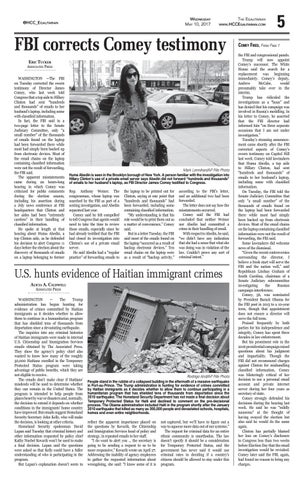
Mark Lennihan/AP File Photo Huma Abedin is seen in the Brooklyn borough of New York. A person familiar with the investigation into Hillary Clinton’s use of a private email server says Abedin did not forward “hundreds and thousands” of emails to her husband’s laptop, as FBI Director James Comey testified to Congress. Rep. Anthony Weiner. The congressman, whose laptop was searched by the FBI as part of a sexting investigation, and Abedin separated last year. Comey said he felt compelled to tell Congress that agents would need to take the time to review those emails, especially since he had already testified that the FBI had closed its investigation into Clinton’s use of a private email server. He said Abedin had a “regular practice” of forwarding emails to
the laptop to be printed out for Clinton, saying at one point that “hundreds and thousands” had been forwarded, including some containing classified information. “My understanding is that his role would be to print them out as a matter of convenience,” Comey said. But in a letter Tuesday, the FBI said most of the emails found on the laptop “occurred as a result of backup electronic devices.” Ten email chains on the laptop were as a result of “backup activity,”
according to the FBI’s letter, and an additional two had been forwarded. The letter does not say how the misstatements occurred. Comey said the FBI had concluded that neither Weiner nor Abedin had committed a crime in their handling of email. With respect to Abedin, he said, “we didn’t have any indication that she had a sense that what she was doing was in violation of the law. Couldn’t prove any sort of criminal intent.”
U.S. hunts evidence of Haitian immigrant crimes Alicia A. Caldwell Associated Press
WASHINGTON — The Trump administration has begun hunting for evidence of crimes committed by Haitian immigrants as it decides whether to allow them to continue in a humanitarian program that has shielded tens of thousands from deportation since a devastating earthquake. The inquiries into any criminal histories of Haitian immigrants were made in internal U.S. Citizenship and Immigration Services emails obtained by The Associated Press. They show the agency’s policy chief also wanted to know how many of the roughly 50,000 Haitians enrolled in the Temporary Protected Status program were taking advantage of public benefits, which they are not eligible to receive. The emails don’t make clear if Haitians’ misdeeds will be used to determine whether they can remain in the United States. The program is intended to help people from places beset by war or disasters and, normally, the decision to extend it depends on whether conditions in the immigrants’ home country have improved. But emails suggest Homeland Security Secretary John Kelly, who will make the decision, is looking at other criteria. Homeland Security spokesman David Lapan said Tuesday that criminal history and other information requested by policy chief Kathy Nuebel Kovarik won’t be used to make a final decision. Lapan said the questions were asked so that Kelly could have a fuller understanding of who is participating in the program. But Lapan’s explanation doesn’t seem to
Rodrigo And/AP File Photo People stand in the rubble of a collapsed building in the aftermath of a massive earthquake in Port-au-Prince. The Trump administration is hunting for evidence of crimes committed by Haitian immigrants as it decides whether to allow them to continue participating in a humanitarian program that has shielded tens of thousands from deportation since the 2010 earthquake. The Homeland Security Department has not made a final decision about Temporary Protected Status for Haiti and declined to comment on the pre-decisional process. The Obama administration included Haiti in the program shortly after the January 2010 earthquake that killed as many as 300,000 people and devastated schools, hospitals, homes and even entire neighborhoods. reflect the apparent importance placed on the questions by Kovarik, the Citizenship and Immigration Services head of policy and strategy, in repeated emails to her staff. “I do want to alert you ... the secretary is going to be sending a request to us to be more responsive,” Kovarik wrote on April 27. Addressing the inability of agency employees to gather the requested information about wrongdoing, she said: “I know some of it is
The Egalitarian
www.HCCEgalitarian.com
not captured, but we’ll have to figure out a way to squeeze more data out of our systems.” The request for criminal data for an entire ethnic community is unorthodox. The law doesn’t specify it should be a consideration for Temporary Protected Status, and the government has never said it would use criminal rates in deciding if a country’s citizens should be allowed to stay under this program.
5
Comey Fired, From Page 1 the FBI and congressional panels. Trump will now appoint Comey’s successor. The White House said the search for a replacement was beginning immediately. Comey’s deputy, Andrew McCabe, would presumably take over in the interim. Trump has ridiculed the investigations as a “hoax” and has denied that his campaign was involved in Russia’s meddling. In his letter to Comey, he asserted that the FBI director had informed him “on three separate occasions that I am not under investigation.” Tuesday’s stunning announcement came shortly after the FBI corrected aspects of Comey’s sworn testimony on Capitol Hill last week. Comey told lawmakers that Huma Abedin, a top aide to Hillary Clinton, had sent “hundreds and thousands” of emails to her husband’s laptop, including some with classified information. On Tuesday, the FBI told the Senate Judiciary Committee that only “a small number” of the thousands of emails found on the laptop had been forwarded there while most had simply been backed up from electronic devices. Most of the email chains on the laptop containing classified information were not the result of forwarding, the FBI said. Some lawmakers did welcome news of the dismissal. “Given the recent controversies surrounding the director, I believe a fresh start will serve the FBI and the nation well,” said Republican Lindsay Graham of South Carolina, chairman of a Senate Judiciary subcommittee investigating the Russian campaign interference. Comey, 56, was nominated by President Barack Obama for the FBI post in 2013 to a 10-year term, though that appointment does not ensure a director will serve the full term. Praised frequently by both parties for his independence and integrity, Comey has spent three decades in law enforcement. But his prominent role in the 2016 presidential campaign raised questions about his judgment and impartiality. Though the FBI did not recommend charges against Clinton for mishandling classified information, Comey was blisteringly critical of her decision to use a personal email account and private internet server during her four years as secretary of state. Comey strongly defended his decisions during the hearing last week. He said he was “mildly nauseous” at the thought of having swayed the election but also said he would do the same again. Clinton has partially blamed her loss on Comey’s disclosure to Congress less than two weeks before Election Day that the email investigation would be revisited. Comey later said the FBI, again, had found no reason to bring any charges.