News
The Guardsman & TheGuardsman.com | February 8- February 21, 2012 | 3
Faculty upset about how cuts were made
Editor-in-Chief Joe Fitzgerald News Editor Sara Bloomberg Culture Editor Lulu Orozco Opinion Editor Kevin Brown Sports Editor Taylor Clayton Online Editor Jon Bechtol Multimedia Editor Clarivel Fong Photo Editor Beth LaBerge Copy Chief Susan Boeckmann Calendar Editor Catherine Lee Social Media Editor Peter Hernandez Advertising Editor Peter Ho Network Manager Phillip Ng Staff Writers Peter Hernandez Catherine Lee Jon Bechtol Lance Kramer Thomas Figg-Hoblyn Lucas Pontes de Almeida Oz Litvac Alex Schmaus David Pan Anthony Fusaro Al Gutierrez Staff Photographers Vincent Palmier Augustine Wittkower Clairvel Fong Illustrator Jessica Kwan Multimedia Sergio Berreno Augustine Wittkower Copy Editors Jen Verzosa Aaron Turner Jon Bechtol Sonny Roberts Kevin Brown Faculty Adviser Juan Gonzales
Mail: 50 Phelan Ave Box V-67 San Francisco, CA 94112 Phone: (415) 239-3446 Email: email@theguardsman.com
Advertising:
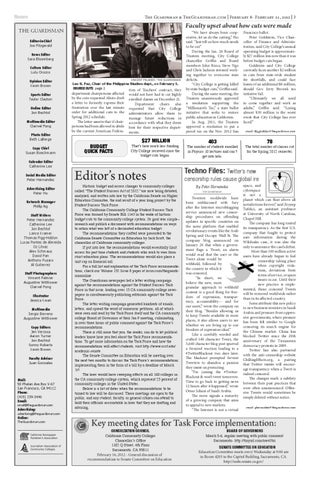
“We have always been cooperative, let us do the cutting,” Paz said. “Just tell us how much needs to be cut.” During the Jan. 26 Board of Trustees meeting, City College chancellor Griffin and Board members John Rizzo, Steve Ngo and Chris Jackson stressed working together to overcome state deficits. VINCENT PALMIER / THE GUARDSMAN Leo S. Paz, Chair of the Philippine Studies dept., on February 5. “City College is getting killed COURSE CUTS page 1 by state budget cuts,” Griffin said. tion of Teachers’ contract, they department chairpersons affected would not have had to cut highly During the same meeting, the by the cuts requested Alioto draft enrolled classes on December 21. Trustees unanimously approved a letter to formerly express their Department chairs also a resolution supporting the frustration over the last minute requested that City College “Millionaire’s Tax,” a state ballot order for additional cuts to the administrators allow them to initiative that seeks to restore Spring 2012 schedule. manage future reductions in public education in California. The letter asserts that if chair- accordance with what they deem In Aug. 2011, the Trustees persons had been allowed to abide best for their respective depart- approved a resolution to put a by the current American Federa- ments. parcel tax on the Nov. 2012 San
BUDGET QUICK FACTS
$27 MILLION
That’s how much less funding City College recieved since the budget cuts began.
Editor’s notes
Historic budget and access changes to community colleges called “The Student Success Act of 2012” are now being debated, analyzed, and written into law by the California Senate on Higher Education Commitee, the end result of a year long project by the Student Success Task Force. The California Community College Student Success Task Force was formed by Senate Bill 1143 in the wake of historic budget cuts to the community college system. Its goal was simple– research and publish a document with recommendations on ways to ration what was left of a decimated education budget. The recommendations they crafted were presented to the California Senate Committee on Education by Jack Scott, the chancellor of California community colleges. If put into law, the recommendations would essentially limit access for part time students and students who wish to veer from strict education plans. The recommendations would also place a unit cap on financial aid. For a full list and explanation of the Task Force recommendations, check our Volume 152 Issue 8 paper at issuu.com/theguardsmanonline . The Guardsman newspaper led a letter writing campaign against the recommendations against the Student Success Task Force in that issue, leading over 15 CA community college newspapers in simultaneously publishing editorials against the Task Force. The letter writing campaign generated hundreds of emails, letters, and spread the word of numerous petitions, all of which were seen and read by the Task Force itself and the CA community college Board of Governors at their Jan 9 meeting, culminating in over three hours of public comment against the Task Force’s recommendations. There is still more that you, the reader, can do to let political leaders know how you feel about the Task Force recommendations. To get more information on the Task Force and how the recommendations will affect students, visit http://www.ccsf.edu/ academic-senate . The Senate Committee on Education will be meeting over the next two months to discuss the Task Force’s recommendations, implementing them in the form of a bill by a deadline of March 1st. The laws would have sweeping effects on all 160 colleges in the CA community college system, which represent 25 percent of community colleges in the United States. Below is a list of dates when the recommendations to be turned to law will be discussed. These meetings are open to the public, and any student, faculty, or general citizen can attend to hold their officials accountable in laws that they are drafting and advising.
advertising@theguardsman.com
Online:
TheGuardsman.com
California Newspaper Publisher’s Association Journalism Association of Community Colleges
403
The number of students enrolled in Physics 10 lectures and can’t get into labs.
Francisco ballot. Peter Goldstein, Vice Chancellor of Finance and Administration, said City College’s annual operating budget is approximately $27 million less now than it was before budget cuts began. Goldstein said City College currently faces another $2 million in cuts from state-wide student fee shortfalls, and could face losses of an additional $8 million, should Gov. Jerry Brown’s tax initiative fail. “Ultimately we all need to come together and work as adults,” Griffin said. “Losing almost $30 million is the worst event that City College has ever faced.” email: tfigghoblyn@theguardsman.com
78
The total number of classes cut for the Spring 2012 semester.
Techno Files: Twitter’s new censorship rules cause global ire By Peter Hernandez THE GUARDSMAN
Tweeters worldwide have been emblazoned with fury after the Internet microblogging service announced new censorship procedures on offending updates in specific countries on the same platform that enabled revolutionary events like the Arab Spring and Occupy Wall St. The company blog announced on January 26 that when a government flags a Tweet, an alarm would read that the user or the Tweet alone would be withheld, followed by the country in which it was censored. “In short, we believe the new, more granular approach to withheld content is a good thing for freedom of expression, transparency, accountability— and for our users,” wrote the company on their blog. “Besides allowing us to keep Tweets available in more places, it also allows users to see whether we are living up to our freedom of expression ideal.” Like a carefully worded and crafted 140 character Tweet, the 3,640 character blog post spurred a frenzied reaction leading to a #TwitterBlackout two days later. The blackout prompted fervent Tweeters to abandon a passion they insist on protecting. “I’m joining the #TwitterBlackout & won’t tweet tomorrow. Time to go back to getting news 12 hours after it happened,” wrote Omar Johani of Saudi Arabia. The move signals a maturity of a growing company that aims to appeal to new markets. “The Internet is not a virtual
space, and cyberspace is not a planet which can float above all jurisdictions forever,” said Zeynep Tufekci, an assistant professor at University of North Carolina, Chapel Hill. The company has long touted its transparency. As the first U.S. company that fought to protect user information during the Wikileaks case, it was also the only to announce the case’s defeat. More than 100 million active users have already begun to feel censorship taking place when copyright violations, deviations from terms of service, or spam issues occur. Until their new practice is implemented, those censored Tweets will be removed worldwide rather than in its affected country. Some attribute this new policy to new business investors in Saudi Arabia and pressure from oppressive governments, where pressure has been felt similar to Google censoring its search engine for the Chinese market. China has blocked Twitter since the 20th anniversary of the Tienanmen democracy protests in 2009. Twitter has also partnered with the anti-censorship website ChillingEffects.org, a pairing that Twitter insists will encourage transparency when a Tweet is indeed censored. The changes mark a subtlety between their past practices that were often unannounced. Offensive Tweets would sometimes be simply deleted without notice. email: phernandez@theguardsman.com
Key meeting dates for Task Force implementation:
CONSULTATION COUNCIL California Community Colleges Chancellor’s Office 1102 Q Street, 4th Floor Sacramento, CA 95811 February 16, 2012 - General discussion of recommendations to Senate Committee on Education
BOARD OF GOVERNORS March 5-6, regular meeting with public comment Sacramento- http://tinyurl.com/nw43bz
SENATE COMMITTEE ON EDUCATION Education Committee meets every Wednesday at 9:00 am in Room 4203 in the Capitol Building, Sacramento, CA. http://sedn.senate.ca.gov/